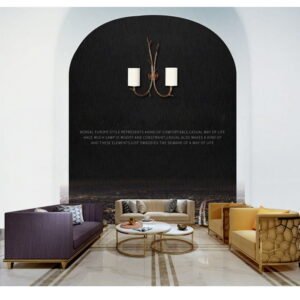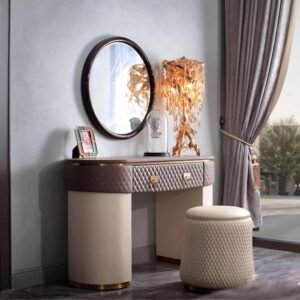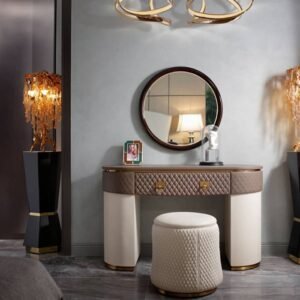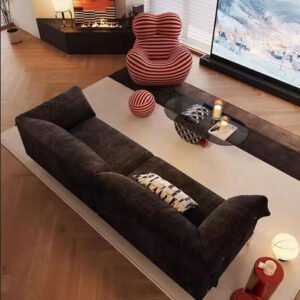
Discover how premium furniture selections can differentiate your portfolio, command higher project margins, and build lasting client relationships through superior quality and timeless design.
If you’re a furniture distributor, showroom owner, agent, or interior designer reading this, you’ve probably already felt the squeeze: more competitors, thinner margins, and clients who’ve seen everything on Pinterest before they walk through your door. The standard playbook — stock more SKUs, compete on lead time, sharpen your pencil on price — isn’t a strategy. It’s a slow erosion.
Luxury furniture changes the equation. Not because the word “luxury” is magic, but because premium inventory structurally changes how you compete, who you attract, and what your business is worth. The global luxury furniture market was valued at $33.7 billion in 2026 and is projected to reach $39.8 billion by 2030 (Grand View Research) — and the segment growing fastest within that is B2B project specification: hotels, high-end residential, commercial fit-out, and boutique hospitality. That’s your market.
This guide is a working framework — not inspiration content — for furniture professionals who want to build a luxury positioning strategy that actually increases revenue and reduces the client friction that comes with competing on price.
Understanding the True Cost of Luxury Furniture in Your Business Model
Why Your Clients Are Asking for Premium Options (And Why You Need to Be Ready)
The Shift Toward Quality-Focused Clientele in Hospitality and Residential Design
The clients driving the most project revenue in 2025 are not looking for the most affordable option. They’re looking for the most defensible one — a piece they can show their own client and explain why it cost what it cost. Interior designers working with HNWI (High-Net-Worth Individual — clients with $1M+ in investable assets) are being briefed on specific material standards. Hotel procurement teams at four- and five-star properties are writing FF&E (Furniture, Fixtures & Equipment) specifications that exclude certain materials and construction methods entirely.
According to First Chair’s interior design industry analysis, the premium and luxury furniture segment is growing at a 13.84% CAGR — significantly outpacing the overall furniture market. Meanwhile, furniture accounts for approximately 35% of interior design project spend. For a designer managing a $500,000 residential project, that’s $175,000 in furniture procurement — and the difference between a 30% and a 50% margin on that spend is $35,000 in their pocket.
The question for your business is not whether your clients want premium options. It’s whether you’re positioned to supply them when they do.
How Luxury Positioning Protects Your Profit Margins and Reduces Price-Based Competition
The furniture and fixtures industry’s average gross margin sits at 35.16% and net profit at 5.76% (CSIMarket, Q1 2026). Those numbers reflect a business competing primarily on price and availability. Distributors who have shifted meaningful inventory weight to premium lines consistently report gross margins in the 45–65% range on luxury pieces — because the client conversation is fundamentally different.
When a designer is choosing between two standard dining chairs at $280 and $310, price is the entire conversation. When they’re choosing a hand-stitched Italian leather dining chair for a client’s penthouse, the conversation is about material heritage, construction detail, and how it photographs. You are not competing on price — you are competing on specification quality. That is a margin-protective position.

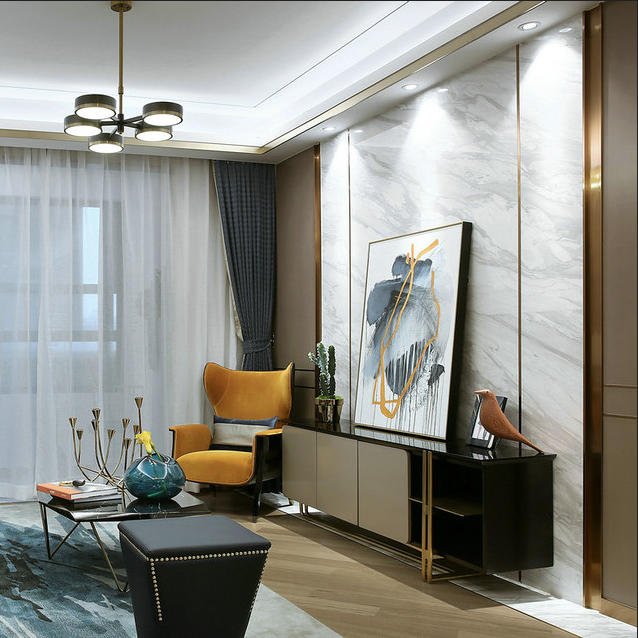
The premium residential brief: a client who has commissioned this level of interior design is not asking their designer to find the cheapest furniture. They’re asking for the best fit.
The Distributor’s Dilemma: Balancing Volume With Premium Inventory
Managing Cash Flow While Stocking High-End Pieces Your Showroom Actually Sells
The honest tension in luxury inventory is working capital. A $2,400 custom sofa that takes 10 weeks to sell ties up significantly more capital than a $600 standard alternative that moves in two weeks. This is the primary reason most distributors avoid the luxury tier — and it’s the reason those who manage it correctly have a market to themselves.
The practical answer is a curated, not comprehensive approach. You do not need a full luxury catalogue. You need 15–25 signature pieces — across seating, tables, case goods, and lighting — that demonstrate your premium positioning, generate inquiries from the right clients, and each carry enough margin to justify the holding cost.
The inventory economics work when you model them correctly:
| Inventory Type | Unit Price | Gross Margin | Gross Profit/Unit | Avg. Days to Sell | Monthly Turns | Monthly GP Contribution |
|---|---|---|---|---|---|---|
| Standard (volume) | $450 | 33% | $149 | 28 days | 1.1× | $164 |
| Mid-range | $900 | 42% | $378 | 45 days | 0.67× | $253 |
| Premium luxury | $2,200 | 55% | $1,210 | 75 days | 0.40× | $484 |
A single luxury unit contributes nearly 3× the monthly gross profit of a standard piece, even with a much longer sales cycle. Source: representative data from furniture distribution operations.
Building Supplier Relationships That Give You Exclusive Access to Sought-After Collections
Exclusivity is the currency of luxury distribution. A designer who knows that only your showroom carries a particular manufacturer’s collection has a reason to call you first — and a reason to maintain that relationship even when a competitor offers a better price on something else.
Exclusive distribution agreements are earned, not requested. Manufacturers grant territory exclusivity to partners who demonstrate consistent sales volume, invest in floor samples and marketing, and train their teams on the brand story. The path to exclusivity starts with commitment: stock their pieces, feature them in your client presentations, and generate documented sales data that justifies the exclusivity conversation.
Jade Ant Furniture structures its B2B manufacturing partnerships on exactly this principle — working with distributors, showrooms, and design firms who are committed to the premium segment, not just testing the water.
Superior Quality as Your Competitive Advantage
What “Quality” Actually Means When You’re Pitching to Designers and Hospitality Buyers
Materials, Construction Methods, and Craftsmanship That Justify Premium Pricing to Your Clients
“Quality” is not a sales argument unless you can make it specific. When a designer asks why a piece costs $2,800 instead of $800, “it’s higher quality” is not an answer. These are:
- Eight-way hand-tied spring construction (each spring connected in eight directions by hand, creating a seating surface that maintains its shape and support after years of use — versus sinuous wire springs that fatigue within 3–5 years in high-use settings)
- Full-grain leather (the outermost hide layer, with natural grain intact — develops patina with age rather than peeling or cracking like bonded or corrected-grain alternatives)
- Solid brass hardware (not brass-plated; plating wears through within 2–3 years in commercial settings; solid brass develops a natural patina that is considered a premium characteristic)
- Mortise-and-tenon joinery in solid wood frames (interlocking joint construction with no metal fasteners; the industry-standard structural measure for premium wood furniture longevity)
- Kiln-dried hardwood frames (moisture reduced to 6–8% before construction, preventing warping and joint failure that causes structural damage in mid-market furniture within 5–7 years)
Your sales team needs to be able to explain each of these in one sentence. When they can, the price conversation shifts from “why is this so expensive” to “I understand what I’m paying for.”
How to Articulate Durability Benefits in Contract Negotiations and Project Proposals
For hospitality and commercial specifications, the durability conversation is a financial one. Frame it as total cost of ownership (TCO) — the complete cost of a piece over its useful life, including purchase price, maintenance, and replacement cost.
A $600 contract chair in a hotel lobby may need full replacement every 3–4 years. A $1,800 premium piece with commercial-grade construction may perform for 10–12 years with minimal maintenance. Over a 12-year period: three $600 chairs = $1,800 + replacement labour; one $1,800 premium piece = $1,800, no replacement. Same total cost — except the premium piece maintains its appearance throughout, rather than looking worn at year two.
This is the argument that moves hotel procurement teams. Put it in a one-page comparison format for your sales team to use in project proposal meetings.
Durability That Reduces Client Callbacks and Warranty Issues
Real-World Performance Data: Why Luxury Furniture Outlasts Budget Alternatives in High-Traffic Commercial Settings
The hospitality furniture market was valued at $4.4 billion in 2024 and is projected to reach $6.4 billion by 2033 (Sara Hospitality). That growth is driven by hotel brands investing more in FF&E quality, specifically because the data on guest experience and revenue impact is now well-documented.
A single-point increase in a hotel’s guest satisfaction score can increase annual revenue by as much as $10 million (LinkedIn/CSAT industry data). Guest satisfaction is directly influenced by room and public area furniture quality — comfort, appearance, and the sense of care that premium pieces communicate. A hotel that cuts its furniture budget and stocks mid-market alternatives in guest rooms will see that decision reflected in its TripAdvisor scores within two review cycles.
For your hospitality clients, this is not an aesthetic argument. It is a revenue argument. Document it as such in your proposals.
Protecting Your Reputation by Stocking Pieces That Withstand Hotel Guest Use and Design-Forward Homes
Every warranty claim, every callback, every piece that fails in a client’s project is a cost your business absorbs — in staff time, logistics, reputation, and often replacement goods. Mid-market furniture in commercial settings generates a disproportionate share of these claims because it was not engineered for the use pattern it’s being asked to endure.
Premium commercial-grade furniture typically ships with structural warranties of 5–10 years on frames and 2–3 years on upholstery — versus 1-year warranties that are standard in the mid-market tier. When you build your product selection around manufacturers with documented warranty commitments, you are not just protecting your clients. You are protecting your own operations from the hidden cost of warranty administration.

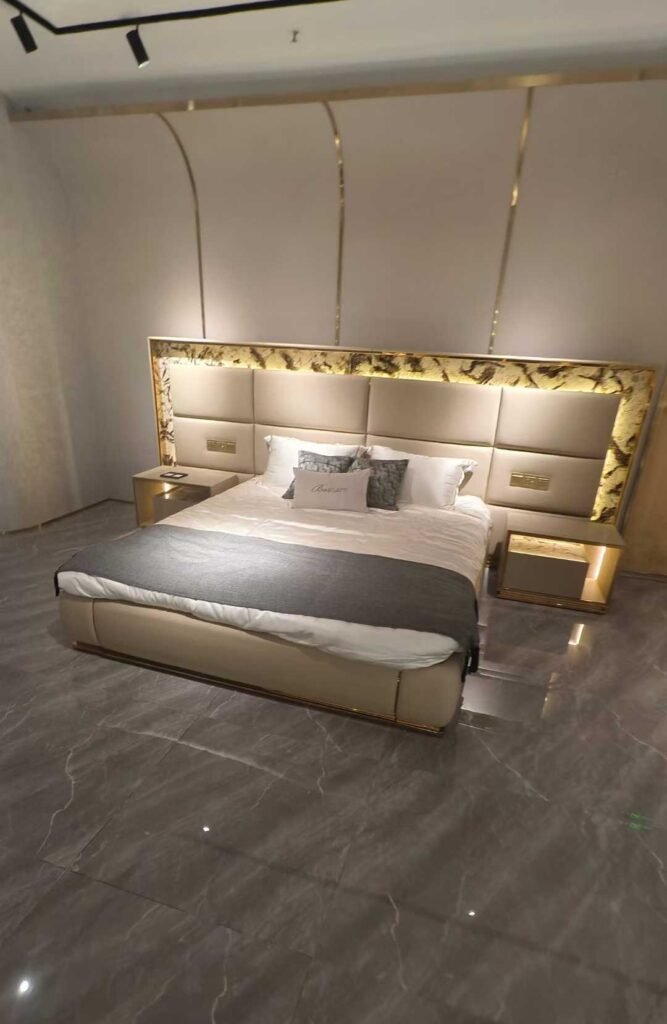
A hotel suite specified with premium custom furniture: the investment that drives the guest satisfaction scores and ADR (Average Daily Rate) that justify the fit-out budget.
Timeless Design as a Revenue Multiplier
Why Trend-Proof Pieces Sell Better to Your Design Professional Clients
How Classic Aesthetics Reduce Client Hesitation and Speed Up Selection Decisions
Interior designers face a specific professional risk when they specify trend-driven furniture: the piece looks dated by the time the project completes or, worse, by the time the client moves in. A designer who has made this mistake once becomes extremely cautious about specifying anything that looks like a trend rather than a position.
Timeless furniture — pieces grounded in proven proportions, classic material combinations, and design heritage — reduces that professional risk. When a designer can say to their client “this piece is based on mid-century construction principles that have been in continuous production for 60 years,” they are not selling a trend. They are selling a safe, prestigious decision.
For your showroom, this translates to faster selection decisions. The designer who hesitates for three weeks over a trendy piece because they’re not sure their client will still love it in five years makes a decision in one meeting about a classically proportioned Chesterfield sofa or a Saarinen-inspired marble table — because the design pedigree resolves the uncertainty.
Building a Curated Inventory That Appeals Across Multiple Project Types and Design Styles
The most commercially efficient luxury inventory is one where each piece works in multiple project contexts. A solid brass and marble side table works in a contemporary penthouse, a transitional hotel suite, and a traditional residential library. A well-proportioned linen upholstered wing chair works in a luxury villa, a boutique hotel lobby, and a high-end residential study.
This cross-project versatility means your floor samples generate more qualified interest per square foot of showroom space. A single piece that appeals to three different designer briefs is worth three times as much as a niche piece that only fits one very specific aesthetic.
When selecting luxury inventory, ask yourself: How many of my current client briefs could this piece answer? If the answer is fewer than two, it is a specialist piece and should be ordered only against specific confirmed demand.
Creating Repeat Orders Through Signature Collections
Developing Exclusive Partnerships That Make Your Showroom the Go-To Source for Specific Designers
The Houzz & Home survey found that 76% of architects and 78% of interior designers report that repeat clients contribute substantially to their business. The same dynamic applies to your relationship with those designers — a designer who has successfully sourced through you once, without friction, returns for the next project. And the one after that.
Signature collections create the mechanism for this loyalty. When your showroom is the only source in your territory for a specific manufacturer’s collection, designers who love that brand have no choice but to return to you. Build this exclusivity deliberately: identify two or three manufacturers whose aesthetic aligns with your best designer clients’ work, propose exclusive territory agreements, commit to stocking depth, and execute the marketing that makes your exclusivity known to the design community.
Leveraging Timeless Design to Justify Higher Wholesale Prices to Agent and Distributor Partners
Your agents and distributor partners face the same pricing pressure you do from their own retail clients. When you can provide them with inventory whose design heritage justifies the price — when they can walk into a showroom and say “this piece is manufactured using the same construction technique as Italian furniture brands that have been in production since 1958” — you give them a sales tool that protects the price.
Timeless design is a story that holds at every level of the distribution chain. Without it, every price conversation is a negotiation. With it, price is a reflection of provenance.
Property Value Enhancement — A Selling Point Your Interior Designer Clients Need
Positioning Luxury Furniture as an Asset, Not an Expense
How Premium Pieces Contribute to Property Appraisals and Resale Value in Residential Projects
Willetts Design research documents that professional interior design increases property value by 10–15% on average — on a $2M home, that’s $200,000–$300,000 in added value, often exceeding design fees and furniture budgets combined. Luxury markets consistently see returns at the higher end of that range or above.
For your interior designer clients, this data is a selling tool for their end clients. When a homeowner hesitates at the price of a hand-crafted dining table, the designer who can say “premium furniture specification is a documented contributor to resale value — buyers at this price point expect to see this level of finish” is having a fundamentally different conversation than the designer who says “it’s beautiful and well-made.”
Arm your designer clients with this language. Create a one-page reference document on furniture’s contribution to residential property value that they can use in their own client presentations.
Educating Your Design Clients on ROI So They Confidently Recommend Luxury Options
The interior design business benchmark data from Scarlett Thread Consulting shows that 64.9% of interior design companies are profitable, with average net margins of 12.8% of revenue. Furniture markups account for a significant portion of that — margins of 30–35% on furniture procurement are standard practice.
A designer who recommends a $4,000 custom sofa earns $1,200–$1,400 in procurement margin. The same designer recommending a $1,200 standard sofa earns $360–$420. Your job is to make the premium recommendation easy for them: provide the product knowledge, the material documentation, and the ROI framing they need to have a confident conversation with their end client.
The Hospitality Angle: Creating Memorable Spaces That Justify Premium Room Rates
How Upscale Furnishings Directly Impact Guest Satisfaction Scores and Booking Rates
Research from Ada Cosmetics’ hospitality analysis confirms that happy guests leave better reviews, which drives higher ADR (Average Daily Rate — the average revenue earned per occupied room). Specifically, improvements in guest satisfaction scores correlate with room rate increases of over 11% in competitive markets.
The mechanism is direct: a guest who sits in a well-crafted upholstered chair in their suite, who notices that the drawer pulls are solid brass and the bed frame doesn’t flex when they sit on the edge, who experiences a lobby with substantial, beautifully designed seating — that guest feels they are being looked after. That feeling becomes a 5-star review. That 5-star review becomes a booking at a rate $30–$80 higher per night. Over 12 months and hundreds of bookings, the furniture investment pays for itself multiple times.
Presenting Case Studies and Performance Metrics That Prove Luxury Investments Increase Hotel Revenue
When you are presenting to hotel procurement teams or FF&E (Furniture, Fixtures and Equipment) consultants, generic quality claims will not move the conversation. What moves it is documented evidence: a case study from a comparable property that invested in premium FF&E, saw guest satisfaction scores increase by a measurable amount, and tracked the revenue impact.
Build two or three of these case studies — even if they come from industry publications rather than your own client base initially. The hospitality furniture industry analysis provides documented evidence linking furniture quality to guest satisfaction metrics. Use it.
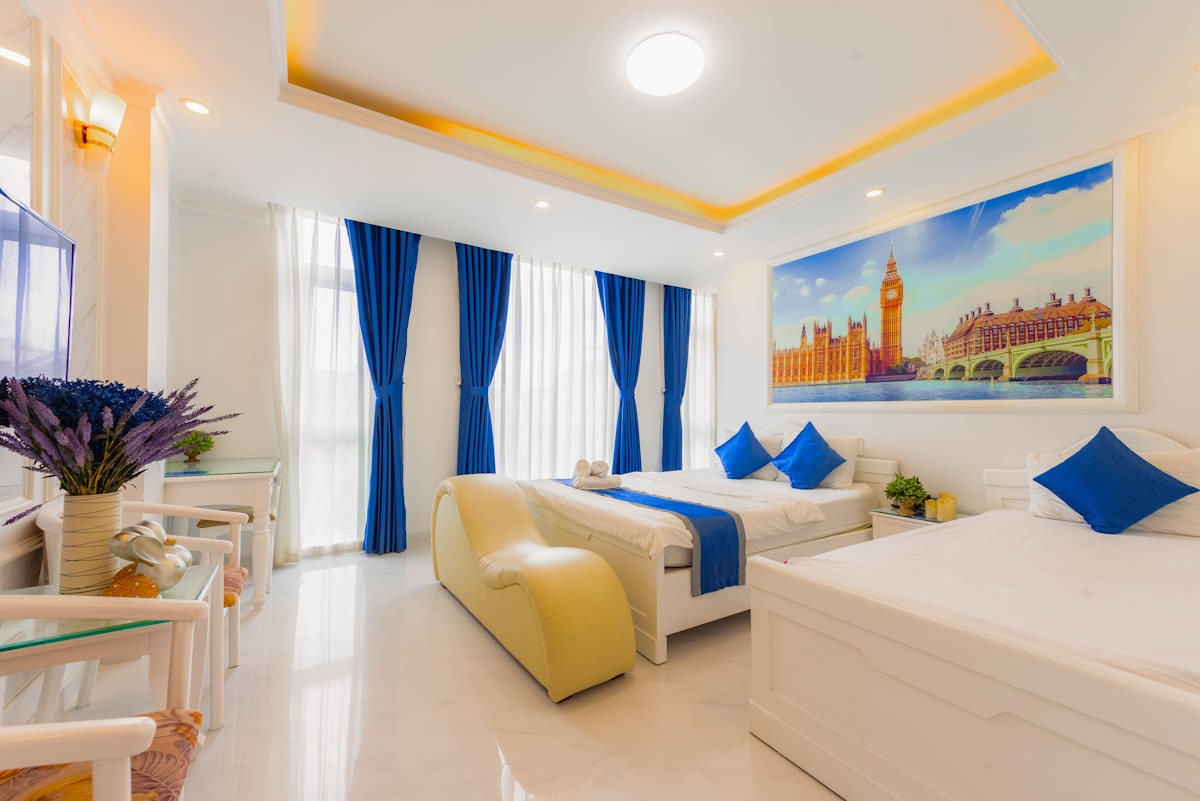 The boutique hotel lobby brief: every material decision here is communicating “we invested in your experience.” Procurement teams at properties like this specify by quality standard, not by price point.
Building Your Luxury Furniture Strategy as a Distributor or Showroom
Identifying Which Luxury Categories Align With Your Client Base
Conducting Market Analysis to Determine Which Premium Segments Your Designers and Agents Actually Specify
Before you invest in luxury inventory, spend 30 minutes with your last 24 months of project data. Filter for your top 20% of clients by revenue generated. What projects did they work on? What did they specify — and what did they ask for that you couldn’t supply? That gap is your luxury inventory brief.
If your best designers are consistently working on contemporary luxury residential projects, mid-century revival with contemporary twists is your entry point. If your strongest hospitality relationships are with boutique hotels, durability-grade premium upholstery and commercial stone-top tables are your investment thesis. The luxury segment you enter should be the one your existing clients are already adjacent to — not the one that looks most impressive in a catalogue.
The market segments available to you:
| Segment | Price Range (per key piece) | Primary Buyers | Margin Profile | Lead Time |
|---|---|---|---|---|
| Contemporary luxury residential | $1,500–$6,000 | Interior designers, HNWI | 50–65% | 8–14 weeks |
| Mid-century revival | $800–$3,500 | Residential & commercial designers | 48–60% | 6–12 weeks |
| Bespoke/custom | $2,000–$15,000+ | Design firms, hotel procurement | 55–70% | 10–18 weeks |
| Hospitality contract grade | $600–$2,800 | Hotel FF&E teams, fit-out specialists | 45–58% | 8–16 weeks |
| Artisan/handcrafted | $1,200–$8,000 | Boutique hotel, luxury residential | 55–70% | 12–20 weeks |
Avoiding Overstock by Understanding the Difference Between Aspirational and Actually-Requested Luxury Pieces
The most expensive inventory mistake in the luxury segment is buying pieces you love rather than pieces your clients specify. Before placing any luxury inventory order above your established volume threshold, validate against at least one of these signals: a designer or buyer has asked for this specific type of piece in the last 90 days; it fills an identified gap in your current portfolio that is costing you projects; or it is the same category as a piece that has generated repeat orders.
“I think this will sell” is not validation. “Three of our top designers have asked for a stone-top dining table in this price range in the past quarter” is.
Negotiating Better Terms With Luxury Manufacturers
Leverage Strategies for Securing Exclusive Distribution Rights and Volume-Based Pricing
Exclusivity negotiations with premium manufacturers follow a consistent logic: they want to know their brand is properly represented in your territory, and they want volume that makes the relationship commercially meaningful.
Your leverage points:
- Committed floor sample investment — agree to display a minimum number of pieces in your showroom, photographed and documented
- Annual volume commitment — a written purchase commitment, even at a conservative figure, demonstrates seriousness
- Marketing co-investment — offer to feature the manufacturer in your client communications, social content, and trade events
- Market development fund — propose a shared marketing fund where both parties contribute to territory-level brand building
Exclusivity is rarely granted at the start of a relationship. It is typically offered after 12–18 months of demonstrated sales performance. Structure your initial conversations around exclusivity as a pathway, not a starting requirement.
Building Long-Term Partnerships That Give You Competitive Advantages
Jade Ant Furniture’s B2B partnership model is built around long-term manufacturing relationships with distributors and design firms who are committed to the premium segment — providing protected trade pricing, custom specification capability, and consistent quality documentation that makes the relationship commercially defensible for both parties.
The manufacturers worth partnering with long-term are the ones who invest in the relationship: who provide training materials for your team, who share design trend analysis, who offer first access to new collections, and who treat your exclusivity as something worth protecting. If a manufacturer is willing to grant the same territory to your competitor six months after giving it to you, their “exclusivity” is not worth the paper it’s written on.
Margin Optimization Through Premium Positioning
How Luxury Furniture Protects You From Race-to-the-Bottom Pricing
Establishing Price Integrity Across Your Agent Network and Preventing Discount Wars
Price integrity — the consistent maintenance of agreed price levels across your distribution network — is significantly easier to enforce in the luxury segment because the product itself resists commoditisation. When a client can find the same product on three competitor websites at slightly different prices, your price is always under pressure. When your product is a custom piece, an exclusive line, or a premium manufacture that exists in limited supply, the price comparison is structurally harder to make.
Establish clear pricing policies with your agent and distributor partners from the start of the relationship:
- Minimum Advertised Price (MAP) policies that protect brand integrity and prevent discount wars
- Volume-based discount structures with transparent thresholds (no ad hoc discounting)
- Clear policies on showroom samples and their pricing (sample pieces should never be listed at public discount)
- Agreed terms for custom orders, including deposit structures and cancellation fees
These policies are easier to maintain in the luxury segment because your partners understand that discounting a premium piece cheapens the brand for everyone in the network — including themselves.
Training Your Sales Team to Sell Value, Not Price — Critical for Showroom Staff and Distributor Reps
The most common failure point in luxury furniture distribution is a sales team that reverts to price comparisons when challenged. A client asks “why is this $2,400 when I can get something similar for $900?” and the rep either panics or immediately offers a discount. Neither is the right response.
The right response requires product knowledge and conversational training. Your team needs to be able to say, with confidence: “The difference is in the construction. This frame uses eight-way hand-tied springs — a technique that maintains its performance for 15+ years in regular use. The $900 alternative uses sinuous wire springs that typically compress and lose support within 3–5 years. Over a 10-year period, you replace the lower-cost piece twice and spend more than the premium piece costs once.”
That is not a sales script. It is knowledge, delivered confidently. It requires investment in team training.
Calculating True Profitability Beyond the Markup
Understanding the Hidden Costs of Budget Furniture Versus Premium Pieces
The headline margin on a $500 standard piece at 33% markup looks straightforward: $165 gross profit. But that calculation ignores what actually happens in distribution operations:
| Cost Category | Standard Piece | Premium Piece |
|---|---|---|
| Gross margin (%) | 33% | 55% |
| Returns/damage rate | 4–8% of orders | 1–2% of orders |
| Warranty administration (staff time) | High (frequent claims) | Low (rare claims) |
| Replacement cost (when applicable) | Full replacement cost | Often manufacturer-covered |
| Average days in inventory | 25–40 days | 55–90 days |
| Client callbacks | More frequent | Rare |
| Net effective margin (after hidden costs) | Often 22–28% | Often 48–54% |
Illustrative ranges based on industry operational data. Actual figures vary by operation size and product category.
The premium piece carries more working capital per unit and a longer sales cycle — but its net effective margin, after accounting for the operational costs that standard furniture generates, is roughly double. Model this for your stakeholders. The case for luxury inventory investment is clearest when made with actual cost data.
Using Financial Modeling to Show Partners Why Luxury Inventory Improves Overall Business Health
Present this analysis in quarterly business reviews with your key retail and agent partners. Show them the gross margin per project on standard versus premium specifications, the client retention rate differential, and the reduction in operational overhead from fewer warranty and return events. This is the financial case for premium inventory positioning — and it is more persuasive than any brand story.

▶ Watch on YouTube: How to Sell Luxury Interior Design Services to HNW Clients — a practical guide on positioning premium products and services to the clients who are most worth working with.
Client Relationship Building Through Curated Selection
How Exclusive Collections Deepen Designer and Hotel Buyer Loyalty
Creating VIP Access Programs That Make Premium Clients Feel Valued and Partnered With
The designers and procurement managers who generate your highest-value projects respond to treatment that reflects their status in your business. A client who brings you $180,000 in annual project revenue should experience your showroom differently from a client who brings $15,000.
Practical VIP program elements that cost relatively little but create strong loyalty signals:
- Priority access to new collections — email your top 10 clients before a new line is announced publicly; let them be the first to see it
- Exclusive preview events — a small, curated gathering for your 15–20 best clients before a major trade show or new collection launch
- Dedicated account management — a named contact who knows their projects and their aesthetic, not a shared inbox
- Custom specification support — prioritise your VIP clients’ custom order requests for faster turnaround and more design flexibility
- Early access to limited availability pieces — when a manufacturer releases a limited-run collection, your best clients hear about it first
None of this is expensive. All of it communicates: “We value this relationship specifically, not just your orders in aggregate.”
Using Limited Availability and Curation as Relationship-Building Tools
Scarcity is a legitimate luxury tool when it’s genuine. When a manufacturer produces a limited-run material — a specific marble batch, a hand-dyed leather run, a numbered edition from an artisan maker — and you have allocation of that production, the client who gets first access has received something of real value. They remember that.
Build your client relationships around curation: “I thought of you specifically for this piece” is a sentence that builds loyalty faster than any discount. It demonstrates that you understand what they value — which is the highest form of service in the B2B design supply chain.
Positioning Your Showroom as a Design Authority, Not Just a Supplier
Hosting Designer Education Events and Trend Presentations That Establish Your Expertise
The showrooms that generate the most referrals from their designer clients are not the ones with the largest catalogue. They are the ones whose staff can speak intelligently about design history, material sourcing, construction methods, and market trends — and who create environments where designers want to spend time because they leave knowing more than when they arrived.
Host quarterly trend presentations for your designer client base. Bring in a manufacturer’s brand director to speak about their design philosophy and construction process. Partner with a material specialist — a stone supplier, a textile house — to run a materiality workshop. These events cost a few hundred dollars to produce and position your showroom as a knowledge resource, not just a product warehouse.
Interior designers source from suppliers who make them better at their jobs. Be that supplier.
Becoming a Trusted Advisor That Designers and Agents Recommend to Their Own Clients
The referral is the highest-value business development outcome in the design supply chain. A designer who tells a colleague “I work exclusively with [your showroom] for premium furniture — they’ve never let me down on a project” generates a qualified lead with zero marketing cost and maximum trust transfer.
This reputation is built over multiple successful projects, consistent quality delivery, and the kind of after-sales support that makes problems disappear rather than escalate. Jade Ant Furniture’s trade partnership model is structured around exactly this: consistent quality documentation, responsive customisation capability, and protected trade pricing that allows distribution partners to maintain their client relationships without margin anxiety.
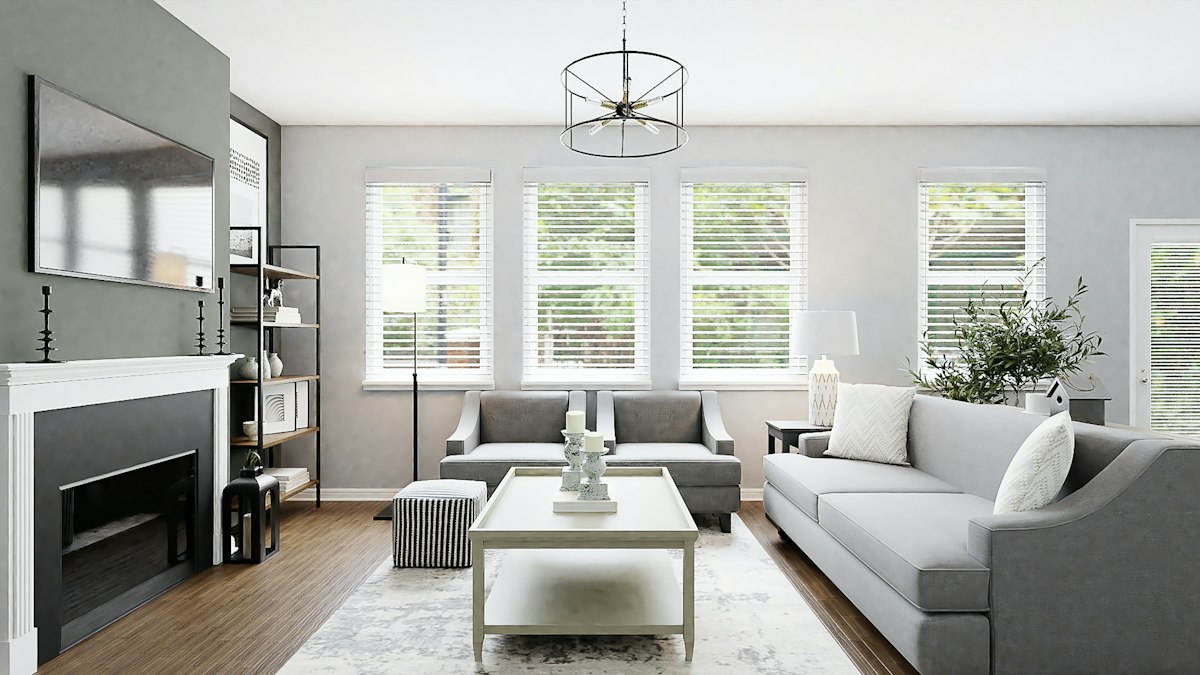 The design authority showroom: clients don’t just come here to buy — they come here to be inspired, educated, and confirmed in their decisions.
Navigating Supply Chain Challenges With Luxury Inventory
Managing Lead Times Without Losing Sales Momentum
Strategies for Pre-Ordering Strategically and Maintaining Floor Samples That Close Deals Faster
Luxury furniture lead times — typically 8–16 weeks from order to delivery — are the most common objection in the premium distribution conversation. The designer who needs a piece for a project completion in six weeks cannot wait 14 weeks. This is a real constraint, and pretending it isn’t loses deals.
The practical solution is a two-tier floor sample strategy: maintain showroom samples of your highest-velocity luxury pieces that can be sold off the floor (with replacement ordered simultaneously), and maintain a clear lead time matrix that you share with designer clients at the start of project planning conversations, not when they’re trying to place an order.
Strategic pre-ordering — placing orders for your top-selling luxury pieces before they are specifically requested, based on pattern recognition from your project pipeline — reduces the average effective lead time in your operation by 3–6 weeks. If three of your top designers consistently work on projects that specify a similar category of premium seating, ordering ahead of confirmed demand (in small quantities) means you have floor stock when the brief lands.
Communicating Lead Times in Ways That Enhance Perceived Value Rather Than Creating Frustration
The framing of a lead time determines whether it is perceived as a delay or a quality signal. Compare:
- Price-competing framing: “Unfortunately, lead time is 12 weeks on this piece.”
- Luxury framing: “This piece is made to order, which is why we can fully customise the finish and upholstery to your brief. Production takes 10–12 weeks from the point of design confirmation.”
The second sentence does not hide the lead time. It contextualises it as evidence of the bespoke process — which it genuinely is. The client who is asking about a custom leather sectional for a $3M apartment is not surprised by a 12-week lead time. They are reassured by it.
Train your team on this framing. It changes the conversation.
Handling Special Orders and Customisation Requests
Setting Up Processes That Allow Designers to Specify Custom Upholstery, Finishes, and Configurations
Customisation capability is the defining premium service in the luxury furniture distribution segment. A designer who can call you with a specific fabric reference, a custom dimension requirement, or a finish modification and receive a confident “yes, we can do that — here’s the process and lead time” is a designer who will never need to look elsewhere.
Build your customisation process as a documented workflow, not an ad hoc negotiation:
- Specification intake — a standardised brief form capturing dimensions, material references, finish requirements, and project timeline
- Feasibility confirmation — a 48-hour response window from your manufacturing partner confirming what is achievable within the client’s timeline
- Pricing proposal — a written quote with clear customisation line items and a deposit requirement
- Design sign-off — written client approval before manufacturing begins, including material samples where applicable
- Production updates — milestone photos at frame completion, pre-finishing, and pre-shipping stages
Jade Ant Furniture’s custom manufacturing workflow follows this structure precisely — built to support B2B partners who are managing designer clients with specific brief requirements and project deadlines.
Protecting Your Margins While Offering the Flexibility That Luxury-Focused Clients Expect
Customisation is only commercially viable when it is priced correctly. The most common margin error in custom furniture distribution is treating customisation as a service included in the base price — which means the manufacturing cost goes up and your margin goes down.
Price customisation as a tiered service:
- Standard configuration — base price; available dimensions and finishes in standard options
- Semi-custom — +15–25% premium; dimension modification within established ranges, fabric/finish selection from extended palette
- Fully custom — +35–55% premium; client-specified dimensions, custom material sourcing, fully bespoke design
Require a 50% deposit at order placement for all custom work, without exception. This is industry standard and protects your working capital against cancellations after material sourcing has begun.
Training Your Team to Sell Luxury Effectively
Equipping Your Sales Staff With Product Knowledge That Wins Projects
Teaching Showroom Staff and Agent Reps How to Articulate Construction, Materials, and Design Heritage
Product knowledge training for luxury sales is not a one-time onboarding exercise. It is an ongoing investment in your team’s commercial capability. The showroom rep who knows the name of the artisan workshop that produces your featured Italian sofa line, who can explain the difference between eight-way hand-tied and Marshall unit spring construction by touch, who can speak to the design period that influenced a specific collection — that rep closes premium deals that a less informed colleague loses to a competitor.
Structure your product knowledge training around three levels:
- Material identification — what each material looks, feels, and performs like; how to identify quality versus imitation
- Construction methods — the structural decisions that separate premium from mid-market pieces (joinery, spring types, upholstery techniques)
- Design heritage — the design movements, time periods, and influential designers that shaped the collections you stock
The HFA Sales Academy provides structured furniture sales training that can be adapted for luxury positioning. Use it as a foundation and build manufacturer-specific knowledge on top.
Role-Playing Common Objections So Your Team Closes Confidently
The three objections your team will face most frequently in luxury sales, and the responses that work:
“It’s too expensive.” “I understand the price is higher than you expected. Let me show you what you’re actually getting for the difference — specifically the construction details that make this piece a 15-year investment rather than a 5-year one.”
“The lead time is too long.” “The lead time reflects that this piece is manufactured to your exact specification — the finish you chose, the dimensions you need. We can look at floor sample options if your timeline is firm, or we can place the order now to align with your project’s furniture installation date.”
“I can find something similar for less.” “You probably can find something that looks similar in a photo. The difference shows up in three years, when one piece still looks as it did on delivery and the other is showing frame flex and fabric compression. Shall I show you the construction difference?”
Run these role-plays monthly. Confidence in objection handling is built through repetition, not information.
Creating Sales Tools and Resources for Your Distributor Network
Developing Spec Sheets, Comparison Guides, and ROI Calculators That Make Selling Easier
Your agent and distributor partners are selling on your behalf in territories and contexts you cannot always control. The quality of their client conversations depends on the quality of the tools you give them.
Essential sales tools for your luxury distribution network:
- Specification sheets — one-page product summaries with dimensions, materials, construction details, available customisation options, lead time, and warranty terms
- Material comparison guides — side-by-side comparisons of premium materials versus mid-market alternatives, with durability data and maintenance requirements
- TCO (Total Cost of Ownership) calculators — simple spreadsheets where a partner can input a client’s project context (number of units, expected use pattern, budget) and generate a 10-year cost comparison between standard and premium options
- Project case studies — documented examples of projects where premium specification delivered measurable outcomes for the client
Using Visual Content and Project Photography to Help Partners Present Options
A luxury piece that is photographed on a plain white background sells less confidently than the same piece styled in a beautifully composed vignette. Invest in professional project photography — not product photography — and make this content available to your entire agent and distributor network in a shared library.
When your partners are presenting options to a hotel procurement team or a residential designer, a photograph of the piece in a context similar to the client’s project is worth more than a page of specification text. Visual selling is especially critical in the luxury segment, where the client is buying an aesthetic experience, not just a functional object.

Professional project photography like this, shared with your agent and distributor network, is the sales tool that closes luxury specifications faster than any catalogue page.
Measuring Success: KPIs That Matter for Luxury Furniture Distribution
Tracking Metrics Beyond Unit Sales Volume
Monitoring Average Order Value, Margin per Project, and Client Retention Rates
Volume metrics — units shipped, orders processed, SKUs active — tell you how busy your operation is. They do not tell you whether it is profitable. The metrics that matter for a luxury furniture distribution strategy are different:
| KPI | What It Measures | Target (Luxury Positioning) | How to Improve |
|---|---|---|---|
| Average Order Value (AOV) | Revenue per transaction | 30–50% above pre-luxury baseline | Introduce premium SKUs; train team to upsell |
| Gross Margin per Project | Profitability on each job | 50%+ on premium projects | Shift mix toward custom and luxury lines |
| Client Retention Rate | % of clients who return | 70%+ for top-tier clients | VIP programs; dedicated account management |
| Client Lifetime Value (CLV) | Total revenue per client relationship | 3–5× annual revenue per client | Deepen relationships; expand project scope |
| Inventory Turnover Rate | How often inventory sells and is replaced | 4–6× annually for luxury tier | Improve curation; use pre-order strategy |
| Warranty/Return Rate | Frequency of claims and returns | Below 2% for premium lines | Strict quality control; premium manufacturer selection |
| Average Lead Time (delivered vs. quoted) | On-time delivery performance | Within 5 days of quoted date | Buffer times; manufacturer milestone tracking |
Target ranges are indicative of well-performing luxury distribution operations. Adjust based on your specific market and product mix.
Using Data to Identify Which Luxury Categories and Manufacturers Drive Your Profitability
Pull your sales data quarterly and filter by manufacturer and product category. Which lines are generating the highest gross margin per project? Which manufacturers generate the fewest warranty claims? Which product categories are your best designers specifying most frequently?
These three data points tell you where to concentrate your inventory investment, your marketing effort, and your exclusive partnership conversations. Data removes the subjectivity from inventory decisions — which is especially important in luxury, where personal taste can lead you to stock what you love rather than what your clients specify.
Building the Business Case for Your Luxury Furniture Strategy
Documenting Case Studies That Show How Premium Inventory Improved Your Bottom Line
The most persuasive argument for continued investment in luxury inventory positioning is a well-documented case study from your own business: the project where switching from standard to premium specification increased gross margin by a specific percentage, or the client relationship that generated $X in annual revenue after you introduced them to a premium collection.
Document these as you go. After each significant luxury project, capture: the brief, the products specified, the margin achieved, any client feedback, and whether the relationship generated a repeat order. After six to twelve months, you have a body of evidence that makes the investment case for your stakeholders — and compelling content for your client marketing.
Presenting Quarterly Performance Reviews to Stakeholders
Structure your quarterly performance review around the KPIs in the table above, with trend lines showing movement since luxury positioning was introduced. Show the average order value trajectory, the gross margin improvement by product category, and the client retention rate for your premium-tier clients versus your standard-tier clients.
If your luxury positioning is working, these numbers will be moving in the right direction within two to three quarters of implementation. If they’re not, the data tells you exactly where the strategy needs adjustment — which product categories aren’t converting, which client segments aren’t responding, which of your team needs more training support.
Making Luxury Furniture Your Competitive Moat
The furniture distribution industry is crowded with good operators who work hard and run efficient businesses. What most of them cannot offer — because they haven’t built it — is a position that a competitor cannot easily replicate.
Luxury furniture gives you that position. Not because premium products magically sell themselves, but because the combination of exclusive partnerships, product knowledge depth, client relationship quality, and margin structure that comes with serious luxury positioning takes years to build. By the time a competitor decides to move upmarket, you already have the relationships, the exclusivity agreements, and the reputation that make you the obvious choice for your market’s best clients.
The distributors, showrooms, and design firms that own the premium market segment in their territories five years from now are making the foundational investments today: curating the right inventory, building the right manufacturer relationships, training their teams, and serving their best clients with the specificity those clients require.
The question isn’t whether you can afford to invest in premium inventory. It’s whether you can afford to let a competitor own the margin that belongs in your business.
Ready to Transform Your Furniture Business With a Luxury Strategy?
Your best clients are looking for a premium supplier they can trust across multiple projects, multiple seasons, and multiple years. Whether you’re a distributor building your first luxury inventory tier, a showroom owner establishing exclusive manufacturer partnerships, or an interior design firm looking to elevate your procurement and increase project margins — the next step is a conversation about what that looks like specifically for your business.
Explore Jade Ant Furniture’s luxury and custom collections →
Read our B2B sourcing and trade pricing guide →
Review our furniture sourcing workflow →
Contact the B2B team to discuss your luxury strategy →
Glossary of Key Terms
FF&E (Furniture, Fixtures and Equipment): The specification category used in hospitality and commercial interior design projects covering all moveable furnishings, lighting, and non-structural elements. Hotel procurement teams manage FF&E budgets separately from construction costs. Example: A 200-room hotel might carry a $3–5M FF&E budget for a full refurbishment.
HNWI (High-Net-Worth Individual): A client with $1M+ in investable assets, excluding primary residence. In interior design, this term describes the end-client profile at the top of the residential design market. Example: A HNWI commissioning a $4M apartment renovation expects furniture specification to match the level of the architectural investment.
TCO (Total Cost of Ownership): The complete cost of a piece over its useful life, including purchase price, maintenance, and replacement. Used in commercial and hospitality specification to justify premium prices. Example: A $1,800 commercial-grade chair with a 12-year life has a lower TCO than three $600 chairs replaced every 4 years — even before accounting for replacement logistics costs.
ADR (Average Daily Rate): The average revenue earned per occupied hotel room. A key hotel performance metric directly influenced by guest satisfaction, which is in turn influenced by room and public area quality. Example: A boutique hotel that improves its ADR from $280 to $310 through premium furnishing investment generates $2.2M additional annual revenue on 200 rooms at 80% occupancy.
MAP (Minimum Advertised Price): A manufacturer-set minimum price below which products may not be advertised publicly. Used by premium furniture brands to protect price integrity across their distribution network. Example: A manufacturer sets a MAP of $1,400 on a sofa; no distributor may advertise it below that price, preventing discount wars.
CLV (Client Lifetime Value): The total projected revenue from a client relationship over its full duration. Premium clients with longer, deeper relationships generate disproportionately higher CLV than transaction-based clients. Example: A hotel chain that refurbishes one property annually and consistently specifies through your showroom generates a CLV many times greater than a single-project residential client.
Eight-Way Hand-Tied Springs: A premium upholstery construction technique where each coil spring is connected in eight directions to a base frame using hand-knotted twine. Creates a seating surface that maintains support and shape for 15+ years — a standard specification in luxury seating. Contrasts with sinuous wire springs, which are faster to install but degrade significantly faster.
Mortise-and-Tenon Joinery: A wood furniture joint where a projecting piece (tenon) fits into a corresponding cavity (mortise), creating a structural bond without metal fasteners. The benchmark for premium solid wood furniture construction; standard in pieces warranted for 10+ years.
FAQs for Furniture Distributors, Showroom Owners, Agents, and Interior Designers
1. How do I know which luxury furniture brands will actually sell in my specific market?
Start with your own transaction history. Pull your last 24 months of client requests and project specifications — specifically the briefs you lost because you couldn’t supply what was asked for, and the premium products that sold without price resistance. That data tells you more than any market research report. If three of your best designers have asked for stone-top dining tables in the $2,000–$3,500 range in the past year and you couldn’t fully supply them, that’s your first luxury investment thesis. Expand from there into adjacent categories that the same client profile specifies, rather than trying to cover the entire luxury spectrum from the start.
2. What’s the minimum inventory investment needed to credibly position as a luxury supplier?
You do not need depth across every category. 15–20 signature pieces — spanning upholstered seating, occasional tables, case goods, and at least one lighting option — can establish genuine luxury credibility if they are correctly curated and well-presented. The investment threshold matters less than the curation quality: 15 exceptional pieces that represent a coherent point of view position you as a luxury supplier; 50 mixed pieces at various price points position you as a general-line distributor with some expensive options. Focus on curation, invest in proper showroom presentation for each piece, and build from there based on what generates designer inquiries.
3. How do I prevent luxury inventory from becoming dead stock?
The discipline is pre-order validation, not post-purchase optimisation. Before placing any luxury inventory order, verify demand against at least one of these signals: a designer or buyer has explicitly asked for this category of piece in the last 90 days; this piece fills a gap in your portfolio that cost you a project; or it is the same category as a piece you’ve sold multiple times. For pieces outside these criteria, place orders against confirmed client interest rather than speculative demand. Maintain floor samples of your core luxury lines and order for sale only when a client engages with the sample seriously.
4. Can I sell luxury furniture profitably with a small showroom or a distributed agent model?
Yes — and in some respects, the smaller operation has structural advantages. Premium designers do not want to see their exclusive sourcing choice stocked at scale across a large distribution network. They value the exclusivity that a curated showroom or selective agent model provides. A 500 square foot showroom with 20 exceptional luxury pieces presented beautifully conveys more premium authority than a 5,000 square foot warehouse showroom with hundreds of options at every price point. The distributed agent model works well for luxury because agents who are deeply embedded in designer relationships can make personalised recommendations — which is exactly how luxury furniture specification decisions are made.
5. How do I justify higher prices to price-sensitive clients without losing them?
The first question to ask yourself is whether a price-sensitive client is actually your target market for luxury inventory. If they are genuinely price-shopping on a premium piece, they are not currently in the right position to buy it — and discounting to win them trains them to expect discounts, which destroys your margin on every future order. The more useful conversation is a consultative one: “Let me show you what the difference in construction means over a five-year period. If the economics make sense for your project, we can discuss. If they don’t, I can show you an alternative at a lower price point that still represents good value.” This frames you as an advisor, not a salesperson defending a price tag.
6. What’s the typical lead time for luxury furniture, and how do I manage client expectations?
Standard luxury furniture lead times run 8–16 weeks from order placement, with custom or fully bespoke pieces at the longer end. The key to managing expectations is raising the lead time conversation at the project timeline stage — not when the client is ready to place an order. Ask about installation dates at your first project meeting; work backward from there; and identify which pieces need to be ordered when to hit the timeline. Frame longer lead times as evidence of made-to-order quality: “This piece is manufactured to your exact specification, which takes 10–12 weeks. We’ll have production photos for you at key milestones so you can track progress.” Clients who understand why the lead time is what it is are rarely frustrated by it.
7. How do I build exclusive distribution relationships with luxury manufacturers?
Exclusivity is a commercial arrangement, not a favour. It is granted when a distributor has demonstrated that they are commercially valuable to the manufacturer in their territory: consistent purchase volume, professional brand presentation, trained sales staff, and effective marketing that builds the manufacturer’s reputation in your market. Start by being an excellent non-exclusive partner: stock their pieces, display them well, send your team for brand training, and generate documented sales. After 12–18 months of demonstrated performance, open the exclusivity conversation with a proposal that includes your existing sales data, a volume commitment, and a marketing co-investment offer. Exclusivity is earned, not requested at the start.
8. Should I introduce luxury options if most of my current clients are budget-conscious?
Introduce premium options gradually rather than pivoting your entire positioning overnight. Start with two or three signature luxury pieces that complement your existing inventory — positioned in your showroom in a way that communicates their different tier clearly. You may be surprised: clients who have been buying mid-market furniture from you are often capable of premium purchases when the option is presented confidently. The clients who move up with you are the ones worth nurturing into long-term premium relationships. The ones who don’t move up are still valuable standard clients. You are not replacing your client base; you are expanding the ceiling on what your best clients buy from you.
9. How do I train my sales team to sell luxury when they’re accustomed to volume-based selling?
The most important shift is from output metrics to relationship metrics. A volume-based salesperson measures success in units sold and orders processed. A luxury salesperson measures success in project wins, client retention, and average order value. Retrain your team’s performance conversations around these metrics. Practically: begin with product knowledge immersion (materials, construction, design heritage), move to consultative selling techniques (discovery questions that uncover client values rather than budget), and build in regular objection-handling role-plays. The HFA Sales Academy provides structured training that can be adapted for luxury positioning. Budget for this as an ongoing investment, not a one-time event.
10. What’s the difference between “luxury” and “high-end,” and does it matter for my business positioning?
The distinction is commercially meaningful. High-end typically describes a price tier — furniture that costs significantly more than mass-market alternatives, usually because of material quality or construction standards. Luxury describes a combination of craftsmanship heritage, design pedigree, exclusivity, and brand story that justifies a price premium beyond what material and labour cost alone would warrant. For your business positioning, the relevant question is what your specific clients value: hotel procurement teams often care about documented durability, commercial warranty terms, and design aesthetic — which maps more to “high-end commercial grade.” Residential interior designers and their HNWI clients often care about design heritage, exclusivity, and the cultural capital of the brand — which maps to “luxury.” Know your segment, and position your language accordingly.
11. How do I handle custom orders and special requests without eroding margins?
The margin protection in custom work comes from pricing the customisation separately and explicitly, not bundling it into the base price. Develop a tiered customisation structure: standard configurations at base price; dimension modifications and extended palette at a documented premium (typically 15–25%); fully bespoke design at a fully custom quote. Require written client approval of the specification and pricing before manufacturing begins, and collect a 50% deposit at order placement — this is industry standard for custom furniture and protects your working capital against cancellations after material sourcing has commenced. Never begin production without a signed approval and deposit in hand.
12. Can luxury furniture positioning help me compete against online retailers and big-box distributors?
Directly and structurally. Online retailers and volume distributors compete on price, selection, and delivery speed — all of which are areas where they have genuine scale advantages over a focused B2B showroom. What they cannot replicate is the curation, the product knowledge depth, the designer relationship quality, and the customisation capability that a committed luxury distributor provides. A designer specifying furniture for a $4M residential project is not placing the order on a retail website. They are calling the supplier who knows their aesthetic, can accommodate their brief modifications, and has never let them down on a project. That relationship belongs to you — and online platforms cannot take it.
13. How do I measure ROI on luxury furniture investment?
Track four primary metrics before and after introducing luxury inventory: average order value (revenue per transaction), gross margin per project (profitability on each job), client retention rate (percentage of clients who return within 18 months), and client lifetime value (total revenue per client relationship). Compare these metrics on a quarterly basis. Distributors who have introduced luxury positioning correctly typically see meaningful improvement in average order value within the first two quarters, margin improvement within three to four quarters, and retention rate improvement within 12–18 months. The lag in retention metrics is normal — it takes time for the relationship-building effects of luxury positioning to manifest in measurable repeat business.
14. What’s the best way to present luxury options to hospitality clients who have constrained budgets?
Reframe the conversation from purchase price to total cost of ownership. A hotel procurement manager who sees a $1,800 chair as expensive relative to a $600 alternative sees it differently when the conversation is: “The $600 chair in a hotel room environment needs replacement every 3–4 years. The $1,800 piece carries a commercial-grade warranty for 10 years and is designed for the wear pattern of hotel guest use. Over 10 years, the $600 option costs $1,800+ in replacements plus logistics — the same total cost, with worse appearance in years 3 and 4 when the first replacement is due.” This is not a sales technique; it is financial analysis. Present it with a simple TCO spreadsheet that the procurement manager can share internally with their finance team.
15. How do I stay current with luxury design trends without over-investing in pieces that will date quickly?
Follow three sources: industry publications (Dezeen, Architectural Digest), trade show coverage (Salone del Mobile, Maison & Objet, High Point Market), and most importantly, direct feedback from your best designer clients on what they are currently being briefed on. The critical discipline is distinguishing between design directions that have commercial traction (appearing in multiple designer clients’ actual project briefs) and editorial trends (appearing in publications but not yet translating to purchase decisions). Invest heavily in the former, lightly and selectively in the latter. Allocate 10–15% of your luxury inventory budget to early-stage trend testing, and scale only on confirmed demand signals. Timeless foundations — classic proportions, quality materials, versatile aesthetics — should always anchor your portfolio, with trend pieces as selective accents.
For more B2B resources on luxury furniture distribution strategy, trade pricing structures, and custom manufacturing partnerships, visit the Jade Ant Furniture blog — written specifically for furniture distributors, showroom managers, interior designers, and hospitality fit-out professionals.