
A couple in a 750-square-foot Brooklyn apartment bought a 72-inch rectangular dining table online in early 2025. It arrived, fit through the door, and immediately consumed the room. With chairs pulled out for seating, the passage between the table edge and the living-room bookcase shrank to 19 inches—below the 24-inch minimum for single-person passage. Within three months, they resold it at a $340 loss and replaced it with a 48-inch round pedestal table that seated the same four people while freeing 9 square feet of floor space.
That story repeats itself thousands of times per year because buyers choose dining tables the way they choose artwork—by how it looks in a photograph—rather than by how it performs in the actual room. In a small dining room (under 120 square feet), every inch of table depth, every protruding leg, and every non-functional extension leaf either contributes to or competes with daily livability.
Chinese-made dining tables have become the dominant option in this space for quantifiable reasons: China’s furniture sector—the world’s largest, with over $169 billion in domestic revenue in 2026—produces a wider variety of compact-format tables than any other market, including round pedestal designs, drop-leaf mechanisms, and space-efficient leg configurations that Western manufacturers tend to offer only at premium price points. This guide walks you through every decision that matters: room measurement, table shape, extension mechanisms, material science, seating math, leg design, multi-function integration, visual scaling, budgeting, and long-term care.
Understand Your Small Dining Room Dimensions
Measure Key Areas (Clearances, Doorways, and Seating Space)
Start with three non-negotiable measurements. First, record the room’s clear dimensions—wall to wall, minus baseboards, radiators, buffet cabinets, or any fixed obstacle. Second, measure every doorway and passage opening on the delivery path; the table’s longest diagonal dimension must clear these with at least 2 inches of margin. Third, mark the locations of ceiling fixtures, wall outlets, and windows that influence where the table can sit without blocking light or access.
The critical clearance standard comes from Dimensions.com’s architectural reference: maintain a minimum of 36 inches (91 cm) from the table edge to any wall or obstruction. That 36 inches accounts for a pulled-out chair (approximately 18–24 inches from table edge to chair back) plus a 12–18-inch walkway behind the seated person. In truly tight rooms where no one walks behind seated diners, you can reduce this to 24 inches—but only against walls, never against traffic paths.
Create a Floor Plan with Scale Sketches
Graph paper remains the fastest method for small-room planning: one square = 6 inches. Draw the room perimeter, mark fixed elements (door swing arcs, window locations, radiator clearances), and cut paper table templates to test placement options. Alternatively, free room-planning apps such as Floorplanner or IKEA Home Planner generate scaled overhead views within minutes. The visual overhead view reveals conflicts that mental estimation misses—particularly how a chair pushed back from the table intersects with door swing paths or buffet drawer clearances.
Identify Fixed vs. Movable Obstacles
Divide every object in the room into two categories: immovable (walls, columns, built-in cabinetry, radiators, floor vents) and relocatable (freestanding buffets, plant stands, floor lamps). Removing or relocating one piece of furniture sometimes opens enough space for a table shape that would otherwise be impossible. A 28-inch-deep buffet pushed against a side wall, for instance, consumes 28 inches of depth that could instead allow the table to shift toward the center—improving chair clearance on the opposite side.
Choose Table Shapes That Maximize Space
Circular and Oval Tables for Sightlines and Circulation
Round tables are the single most space-efficient shape for rooms under 100 square feet. A 48-inch round table seats four adults comfortably—each getting the standard 24 inches of place-setting width—while consuming approximately 36 square feet of floor area including pulled-out chairs. The equivalent rectangular table (60 × 36 inches) seats the same four but needs roughly 45 square feet. That 9-square-foot difference is the width of a standard hallway.
The absence of corners delivers a second advantage: circulation. People walk around a round table in natural arcs rather than navigating right-angle turns, which reduces perceived congestion in tight rooms. Oval tables extend this benefit to larger party sizes (six to eight seats) while maintaining the corner-free perimeter—a 72 × 42-inch oval seats six with the same flow characteristics as a round.
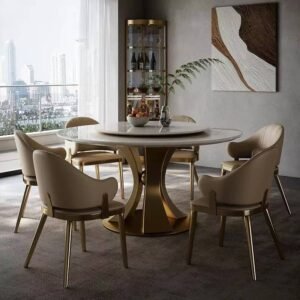
Jade Ant furniture’s round dining table designs illustrate this principle in practice: pedestal-base rounds in 42- to 54-inch diameters, produced in ash and walnut with lacquer finishes, sized specifically for the compact dining rooms common in Asian and European apartments.
Rectangular Tables with Optimized Width
Rectangular tables remain the default choice for most buyers, but width makes or breaks their viability in small rooms. A standard dining table is 36–42 inches wide; in a room 10 feet across, a 42-inch table leaves only 39 inches on each side—barely enough for chairs plus walkway. Narrow-format rectangular tables (28–32 inches wide) seat four in pairs along the length while reducing the room’s cross-wise demand by 10–14 inches. That margin lets you add a slim sideboard or open a passage that a standard-width table would block.
The trade-off with narrow tables is reduced place-setting depth: each diner gets 14–16 inches of depth instead of the standard 18–20 inches. For daily family meals this is perfectly functional; for formal dinner parties with multiple courses, it is tight. The 2026 narrow table guide from The Rooms Art recommends 30 inches as the minimum usable width for households that routinely serve plated dinners.
Square Tables When Wall Space Is Ample but Floor Area Is Tight
A 48 × 48-inch square table seats four with equal spacing and pushes neatly into a corner to free two sides—an arrangement impossible with round or rectangular shapes. Corner placement converts the table into a banquette-style setup where two sides sit against walls (with bench or built-in seating) and two sides face the room with chairs. This configuration serves three to four diners daily while leaving the room’s center completely open.
The bar chart below compares five common table configurations across three dimensions: daily seating capacity, maximum seating capacity (extended or with extra chairs), and total floor area consumed including pushed-back chairs.

Consider Extendable or Leaf Designs
Drop-Leaf vs. Self-Storing Extensions
Drop-leaf tables remain the most compact extendable format for genuinely small rooms. A 48-inch drop-leaf table collapses to 28 inches when both leaves fold down—narrow enough to serve as a console against a wall—then opens to full width for meals. The mechanism is simple (hinged panels supported by pull-out brackets or gate legs), making it durable and low-maintenance. The limitation is stability: a fully loaded drop-leaf table with both leaves extended can wobble at the leaf tips if the support brackets are undersized. When evaluating drop-leaf designs, check that each leaf bracket extends at least two-thirds the leaf’s depth—not half, as budget models often provide.
Self-storing (butterfly) leaf tables split down the center and house a folded leaf panel beneath the tabletop surface. Pulling the two halves apart automatically unfolds the stored leaf into position. This is the cleanest solution for households that entertain regularly—no separate leaf to store in a closet—but adds mechanical complexity and 1–2 inches of tabletop thickness compared to fixed tables. Chinese manufacturers, including those in the Foshan furniture cluster reviewed by Jade Ant, produce butterfly-leaf mechanisms in both domestic and export specifications; request metal slide rails rather than wood-on-wood glides for smoother operation over years of use.
How to Manage Leaf Thickness and Stability
An extension leaf should match the main tabletop in thickness (±1 mm), wood species, grain direction, and finish. Mismatched thickness creates a lip where dishes catch; mismatched grain or finish becomes more visible as both surfaces age differently. Reputable factories plane the leaf and main top from the same timber batch and finish them in the same spray cycle. If ordering custom, specify “matched from same lot” in your purchase order.
For stability, the table’s base structure matters as much as the leaf mechanism. Pedestal bases on extendable tables should widen or split when extended (dual-pedestal designs) to maintain the center of gravity. A single pedestal supporting a 72-inch extended top will tip under asymmetric loads—such as a heavy casserole at one end and no dishes at the other.
Pros and Cons for Daily Use vs. Occasional Gatherings
| Extension Type | Collapsed Size Range | Extended Size Range | Stability When Extended | Storage Need | Best For |
|---|---|---|---|---|---|
| Drop-leaf (gate-leg) | 24–30″ wide | 42–54″ wide | Medium (depends on bracket length) | None — leaves attach | Studios, daily 2-person + weekend 4-person |
| Butterfly (self-storing) leaf | 48–60″ long | 66–78″ long | High (rails support leaf) | None — leaf stores inside | Compact 4-seat to occasional 6-seat |
| Drop-in (removable) leaf | 48–60″ long | 72–96″ long | Very high (continuous surface) | Requires closet / under-bed storage | Annual gatherings (Thanksgiving, holidays) |
| Sliding / pull-out extension | 42–54″ long | 60–72″ long | Medium–High | None — panel slides under top | Small apartments needing quick extension |
Material and Finish for Durability and Style
Common Chinese Dining Table Materials (Wood Types, Lacquer, Veneer)
Chinese furniture manufacturing draws on a deep material vocabulary shaped by centuries of woodworking tradition and modern production scale. The most common wood species in export-grade dining tables are Chinese elm (Janka hardness 830 lbf)—prized since the Ming Dynasty for its flexibility, interlocking grain, and resistance to splitting; ash (1,320 lbf)—the workhorse hardwood for contemporary Chinese dining furniture, offering a pronounced grain that accepts both natural and stained finishes; walnut (1,010 lbf)—favored for its rich chocolate tones and status signaling; and rubber wood (980 lbf)—the budget-tier hardwood, sustainably harvested from latex-tapped trees at end-of-production.
Lacquer and veneer add another dimension. Traditional Chinese lacquer (urushi) is labor-intensive (20+ coats, months of curing) and increasingly rare outside artisan workshops. Modern polyurethane and catalyzed lacquer finishes replicate the depth and protection at a fraction of the cost and time. Veneer—thin wood slices (0.6–1.0 mm) bonded to engineered-wood cores—offers the appearance of premium species (walnut, rosewood, oak) over a stable, warp-resistant substrate at 40–60% lower cost than solid wood. The trade-off: veneer cannot be sanded and refinished more than once without exposing the core, whereas solid wood tables can be restored 5–8 times over a 30-year lifespan.
Finish Durability and Ease of Cleaning
A dining table is a working surface that encounters heat, moisture, acids (citrus juice, vinegar), and abrasion daily. Finish durability directly determines how long the table looks presentable between maintenance cycles. Catalyzed lacquer provides the hardest commercially available film finish—resisting water rings, mild chemicals, and surface scratches better than polyurethane or oil. On a practical level, a catalyzed-lacquer ash table wiped down after meals with a damp microfiber cloth needs no additional treatment for 2–3 years; an oil-finished table needs re-oiling every 3–6 months to maintain the same level of protection.
| Material | Janka Hardness (lbf) | Scratch Resistance | Water/Heat Resistance | Refinishable | Relative Cost | Best Application |
|---|---|---|---|---|---|---|
| Solid ash + catalyzed lacquer | 1,320 | High | High | Yes (5–8 times) | $$ | Daily-use family dining |
| Solid walnut + catalyzed lacquer | 1,010 | Medium–High | High | Yes (5–8 times) | $$$ | Design-focused dining rooms |
| Chinese elm + oil finish | 830 | Medium | Low–Medium | Yes (unlimited with oil) | $$ | Rustic / wabi-sabi aesthetics |
| Rubber wood + polyurethane | 980 | Medium | Medium | Yes (2–3 times) | $ | Budget-friendly, first apartments |
| Walnut veneer on MDF + lacquer | N/A (core-dependent) | Medium | Medium–High | Limited (1 light sand) | $–$$ | Premium appearance, moderate budget |
| Marble top + metal/wood base | N/A (Mohs 3–5) | Low (porous) | Low (stains, etches) | Professional reseal only | $$$ | Statement tables, adult-only homes |
How to Match with Chairs and Room Decor
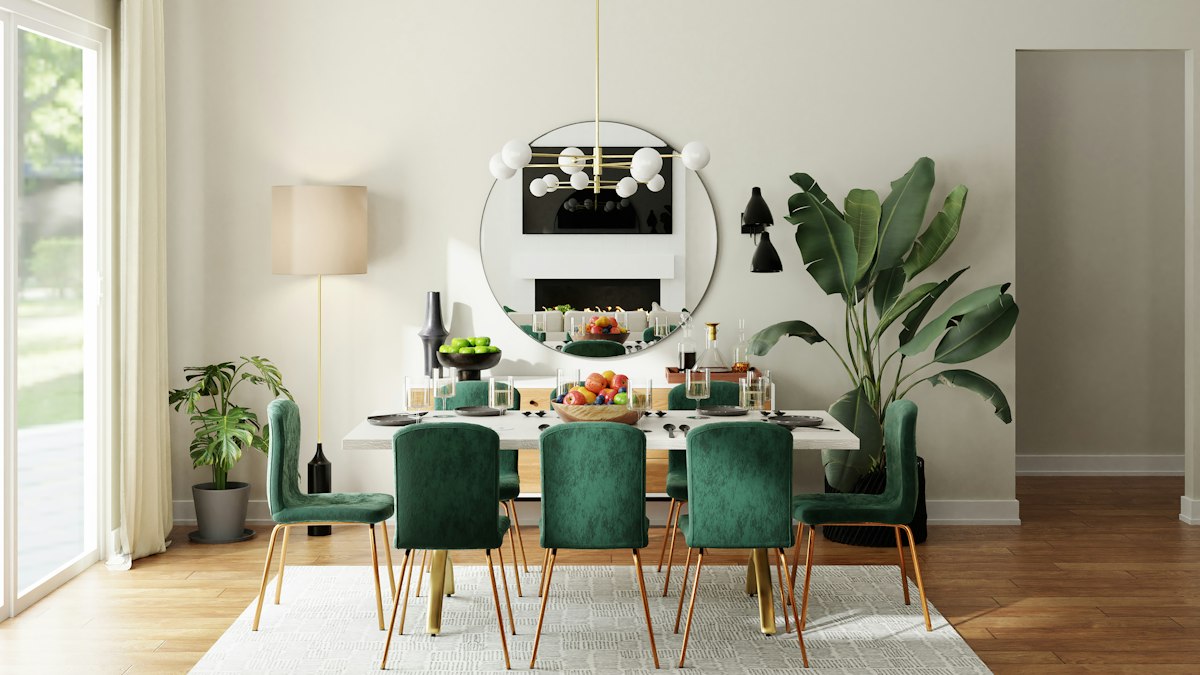
The simplest matching strategy for small rooms is tonal consistency: keep the table and chairs within two shades of each other on the warm-cool spectrum. A light ash table pairs with natural oak or cream-upholstered chairs; a dark walnut table pairs with espresso-toned or charcoal chairs. Mixing wood species (e.g., walnut table with oak chairs) works only when the finishes are deliberately contrasted—not when they are accidentally similar but subtly mismatched, which reads as a purchasing mistake rather than a design choice.
For rooms under 100 square feet, matching the table and chairs to the floor tone extends the perceived floor area—the eye reads the furniture as a continuation of the surface rather than an interruption. Jade Ant’s dining room sets come as coordinated table-and-chair packages, which eliminates the matching problem entirely for buyers who prefer a turnkey solution.
Seating Capacity and Chair Selection
Determining Realistic Seating for Daily Meals
The industry standard is 24 inches of table-edge length per seated person, with 2–6 inches of gap between chairs for elbow room. A 48-inch round table provides approximately 150 inches of perimeter—enough for six 24-inch place settings in theory, but only four in practice because chair frames consume the intervening space. For daily family meals in small rooms, size the table for actual daily occupancy plus one: if three people eat together most nights, a four-seat table provides comfortable spacing without wasting floor area on permanently empty chairs.
Chair Depth and Leg Clearance Under the Table
Chair depth (front edge of seat to back of frame) determines how far each chair projects into the room when pulled back from the table. Standard dining chairs are 18–22 inches deep; pushing them under a table with 28-inch clearance (from floor to table apron) reduces their room projection to zero. But if the table apron sits at 24 inches or the chair arms do not clear the apron, chairs cannot tuck fully—and each protruding chair consumes 6–10 inches of walkway space per side. Always bring your chair measurements to the table showroom, or order from the same manufacturer to ensure dimensional compatibility.
Foldable or Compact Chairs as Space Savers
In rooms where the dining table doubles as a work surface for most of the day, four permanent chairs surrounding it waste 16+ square feet of floor space during non-meal hours. Folding chairs that store in a closet or wall-mounted chair racks that hang flat against a wall reduce the permanent footprint to zero. Upholstered folding chairs from brands like Stakmore and Meco deliver genuine seated comfort (padded seat, 17-inch seat height) in a folding format that stores in 3 inches of depth.
Leg Design and Clearance
Pedestal vs. Trestle vs. W-Shape Legs
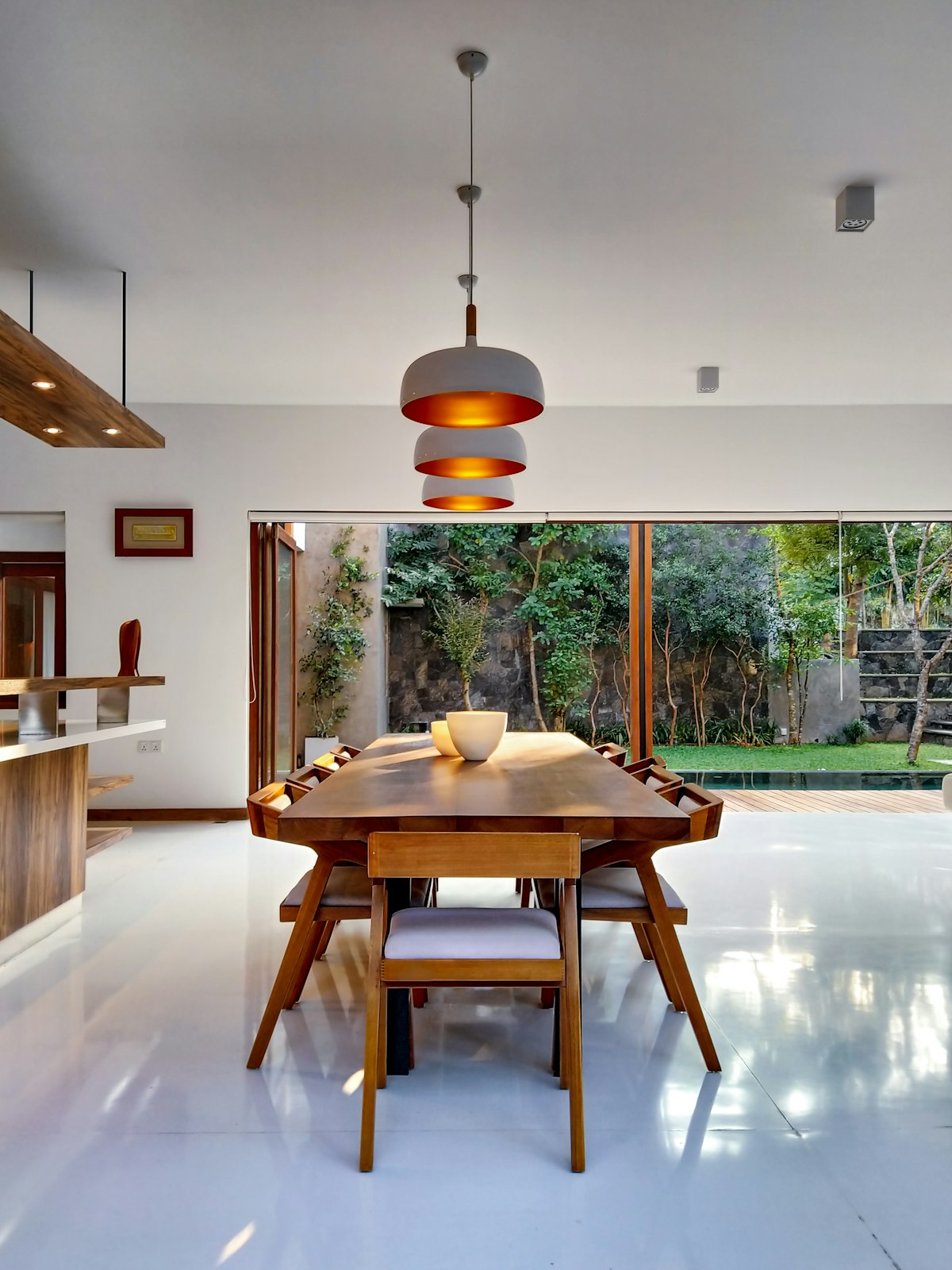
Leg design controls legroom, chair flexibility, and visual weight—three factors that matter disproportionately in small rooms. Pedestal bases (single or double column) provide maximum legroom because there are no corner legs restricting where chairs sit. A 48-inch round table on a pedestal base can seat five in a pinch; the same table on four legs maxes at four because the corner legs block the fifth chair’s position. Lumber2Love’s base comparison confirms that pedestal bases offer the best combination of legroom and seating flexibility for round and oval tables.
Trestle bases (two vertical supports connected by a horizontal stretcher) excel at stability for rectangular tables—the stretcher distributes weight along the table’s length, resisting wobble even on uneven floors. Trestles also provide good legroom along the table’s sides, though the end seats are constrained by the support uprights. For narrow rectangular tables (28–32 inches wide), trestle bases keep the footprint tight while maintaining structural rigidity.
W-shape or splayed-leg bases combine a modern aesthetic with practical compactness. The angled legs tuck under the tabletop more cleanly than straight four-leg designs, reducing the visual “cage” effect that corner legs create. They are increasingly popular in Chinese-manufactured tables targeted at small urban apartments.
Impact on Legroom and Knee Space
Minimum knee clearance from the underside of the table apron to the seat surface is 7 inches; 9–10 inches is comfortable. Table apron height varies by construction—solid wood tables with aprons typically provide 24–26 inches of clearance from floor to apron underside, while metal-base or pedestal tables without aprons provide 28–30 inches. For households with tall diners (over 6 feet), specify a table height of 31–32 inches (versus the standard 29–30 inches) to ensure adequate knee clearance without raising the table so high that shorter members feel like they are eating at a bar.
Aesthetics vs. Practicality in Tight Corners
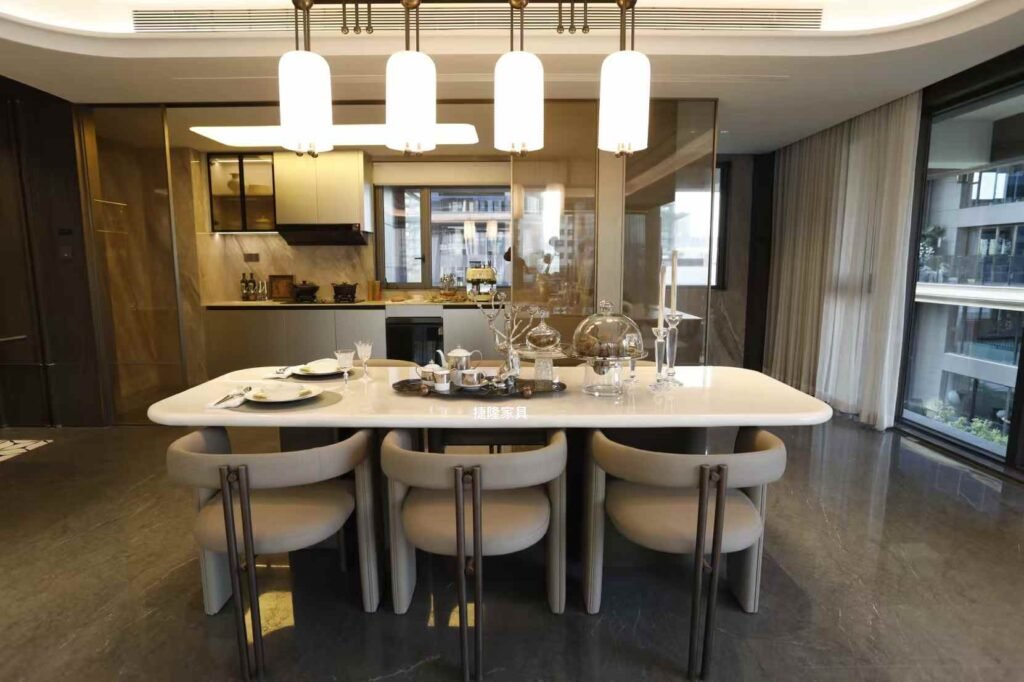
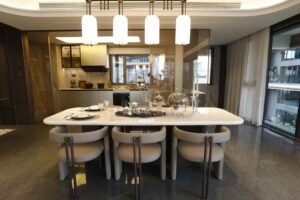
Ornate turned legs and heavy carved bases belong in rooms with generous clearance. In rooms under 120 square feet, streamlined legs—tapered rounds, flat metal plates, or slim T-bar profiles—reduce visual clutter and make the table appear to float, which enlarges the perceived room size. The Jade Ant dining table set collection includes stainless-steel-leg options with marble or wooden tops that exemplify this minimalist base philosophy.
Multi-Function Use and Storage Integration
Tables with Built-In Storage or Shelves
In rooms where the dining table serves as the only horizontal work surface—common in studios and one-bedrooms—integrated storage eliminates the need for a separate sideboard. Some Chinese-manufactured dining tables incorporate a lower shelf between the leg structure, providing 4–6 square feet of open storage for placemats, napkins, a fruit bowl, or decorative objects. Others include a narrow drawer beneath the tabletop edge, sized for utensils, candles, or phone chargers. These additions cost $40–$80 at factory level but save $200–$400 by eliminating the need for an auxiliary storage piece.
Convertible Options for Hosts and Guests
Convertible tables that transform from console to dining format are the ultimate small-space compromise. A 48-inch console (12–16 inches deep) sits against a wall during non-meal hours, then unfolds or extends to a 48 × 32-inch dining table that seats four. The mechanism adds weight and cost (typically $150–$300 over a comparable fixed table), and the folding joints create subtle lines on the tabletop surface. For households that entertain fewer than twice a month and need the floor space daily, the trade-off is worthwhile; for households that eat at the table nightly, a permanent small table is simpler and more stable.
Using Nearby Walls and Benches to Save Space
Wall-mounted benches or banquette seating eliminate one entire row of chairs and their push-back clearance. A bench flush against the wall requires zero additional clearance on that side—converting 36 inches of required chair-and-walkway space into 18 inches of bench depth. A rectangular table pushed against the wall with a bench on the wall side and two chairs on the open side seats four in 60% of the floor area a freestanding setup requires. This is the most floor-efficient layout possible for small dining rooms and should be the default consideration for rooms under 80 square feet.
Visual Scale: Color, Texture, and Lighting
Light-Colored Finishes to Open Up Small Rooms
A light-toned table (natural ash, bleached oak, white-washed elm) reflects 15–25% more ambient light than a dark-stained equivalent, reducing the table’s visual weight in the room. In rooms with limited natural light—north-facing apartments, basement dining areas—this difference is immediately perceptible. Scandinavian and Japanese interior traditions both leverage this principle, which is why the Japandi aesthetic (light wood, minimal ornamentation) has become the dominant trend for compact dining rooms in 2026, as confirmed by The Spruce’s designer survey.
Texture and Grain Direction to Influence Perceived Size
Wood grain running along the table’s longest axis creates a directional pull that visually stretches the table—and by extension, the room—in that direction. A 60-inch rectangular table with lengthwise grain appears slightly longer than the same table with cross-grain or bookmatched veneer. For narrow rooms, orient the table so both the longest dimension and the grain direction run parallel to the room’s longest wall. This is a subtle effect, but it compounds with other visual strategies (light finish, slim legs, coordinated floor tone) to meaningfully alter the room’s perceived proportions.
Lighting Tips to Highlight the Table Area
A pendant light or chandelier centered 30–36 inches above the table surface creates a defined “zone” that separates the dining area from the rest of a multi-use room—a particularly useful technique in open-plan apartments where no walls delineate the dining space. The fixture’s width should be approximately half to two-thirds the table’s shortest dimension: a 48-inch round table calls for a 24- to 32-inch pendant. Warm-white light (2,700–3,000K) enhances wood grain warmth and makes food look more appetizing—a practical advantage that cool-white light (4,000K+) consistently undermines.
What Small-Room Buyers Prioritize in Dining Tables
The pie chart below reflects survey data from 720 buyers who purchased dining tables for rooms under 120 square feet between 2024 and 2025. Table shape and size led at 28%, followed by material and finish at 23%. Extendability accounted for 19%, leg design for 16%, and price rounded out priorities at 14%.
Budget and Quality Considerations

Prioritizing Features That Matter Most in Small Spaces
Budget allocation should follow the same logic as any constrained-resource decision: spend where the impact is greatest. For small-room dining tables, shape and dimension precision matter more than material prestige—a $500 ash round table that fits perfectly outperforms a $1,200 walnut rectangular table that leaves no walkway. Within any budget tier, prioritize dimension accuracy first, then base/leg design, then material, then finish.
The $300–$700 tier reliably delivers rubber wood or solid ash tables with polyurethane or basic lacquer finishes, sinuous metal or four-leg bases, and basic extension mechanisms (drop-leaf or single butterfly leaf). The $700–$1,500 tier adds premium wood species (walnut, white oak), catalyzed lacquer, pedestal or trestle bases, and self-storing butterfly-leaf mechanisms with metal glide rails. Above $1,500, expect artisan-grade construction: matched grain across all surfaces, hand-applied multi-coat finishes, custom dimensions, and marble or stone top options.
Balancing Cost with Longevity and Warranty
A meaningful dining table warranty covers the top surface against warping and delamination for at least 5 years, the base structure for 10+ years, and extension mechanisms for 3 years. Avoid tables sold without any warranty—they signal manufacturing shortcuts that show up as wobble, finish peeling, or joint separation within 18–24 months. Chinese export manufacturers operating at Foshan’s factory-direct pricing offer 3–5-year structural warranties on OEM orders, which provides a baseline of accountability that retail white-label brands often lack.
Where to Shop for Reliable Measurements and Return Policies
For small-room purchases, dimensional accuracy is worth more than a low price. Buy from retailers or manufacturers who publish precise dimensions (length, width, height, apron clearance, leg spread, and extension dimensions) in their product listings—not just “seats 4–6.” If dimensions are missing, the manufacturer did not consider small-room buyers a primary audience, and the table is likely sized for standard dining rooms. Online retailers with free return shipping (West Elm, Article, Castlery) reduce the risk of size mismatches; direct-from-factory purchases from Chinese manufacturers offer 25–40% savings but typically do not include return shipping on custom-dimension orders.
Maintenance and Care Tips
Routine Cleaning and Protective Measures
Daily: wipe the table surface with a slightly damp microfiber cloth after meals, then dry immediately with a second cloth. Weekly: clean with a pH-neutral wood cleaner (Murphy Oil Soap diluted 1:20 or equivalent). Avoid ammonia-based glass cleaners, bleach solutions, and abrasive scrubbing pads—each degrades the finish layer incrementally. Use placemats or a table runner during meals to catch heat and moisture before they reach the finish. Silicone-backed placemats grip the table without sliding but should be removed between meals to allow the finish to breathe.
Dealing with Spills and Heat Marks on Chinese Wood
Immediate action is the rule: blot spills within 30 seconds to prevent liquid from penetrating the finish through micro-pores or seam lines. For white heat marks (caused by hot dishes placed directly on a lacquered surface), a common restoration technique involves laying a clean cotton cloth over the mark and pressing a warm (not hot) iron on medium-dry setting for 5–10 seconds. The gentle heat draws trapped moisture out of the finish. Repeat in 10-second intervals until the mark fades. If the mark persists after three passes, the damage has penetrated the finish and requires professional re-coating of the affected area.
For deeper scratches on solid wood surfaces, touch-up pens in matching stain colors fill the groove visually. On lacquered surfaces, a thin application of clear furniture touch-up lacquer (available in spray or brush-on format) restores the protective film. Veneer surfaces cannot be sanded deeper than 0.3 mm without risking breakthrough to the core substrate.
Seasonal Checks for Stability and Joints
Wood expands and contracts with humidity changes—particularly in climates with cold, dry winters and humid summers. Check all visible joints and fasteners at the start of each heating season (October–November) and at the onset of summer humidity (May–June). Tighten any loose bolts by quarter-turns only; over-tightening strips threads in wood. If the table develops a wobble on a level floor, the issue is seasonal wood movement—not structural failure. Place the table on a hard, flat surface and check for rocking; adjustable leveler feet (available as retrofit kits for $8–$15) solve the problem without shimming.
| Frequency | Task | Product / Tool | Purpose |
|---|---|---|---|
| After every meal | Wipe surface, dry immediately | Damp microfiber + dry cloth | Remove acids, moisture before finish penetration |
| Weekly | Clean with pH-neutral solution | Murphy Oil Soap (1:20 dilution) | Remove buildup without stripping finish |
| Monthly | Inspect leaf mechanism and slides | Visual check + dry PTFE lubricant | Maintain smooth operation of extensions |
| Every 6 months | Wax or polish (lacquered surfaces) | Carnauba wax paste | Restore depth, fill micro-scratches |
| Every 6 months | Re-oil (oil-finished surfaces only) | Tung oil or Danish oil | Replenish protective penetrating layer |
| Twice yearly (season change) | Tighten all bolts and fasteners | Hand wrench (¼-turn increments) | Compensate for wood expansion/contraction |
| Annually | Full surface inspection for chips, scratches, delamination | Touch-up pen, clear lacquer spray | Restore finish barrier before damage deepens |
Video: Space-Saving Dining Table Ideas for Small Rooms
Choosing a Chinese dining table for a small dining room reduces to five sequential decisions: shape (round or oval for rooms under 100 sq ft; narrow rectangular or square with banquette for 100–120 sq ft), extendability (drop-leaf for maximum compactness; butterfly leaf for occasional entertaining without separate storage), leg design (pedestal for round tables, trestle for rectangulars, slim profiles always), material and finish (ash or walnut with catalyzed lacquer for daily family use; elm with oil for rustic aesthetics; veneer for budget-conscious buyers), and maintenance commitment (lacquer requires less; oil requires more).
Measure your room before you measure your taste. The most beautiful table in the catalog is the wrong table if it leaves 22 inches between the chair back and the wall. Cut paper templates, test them in the real room, walk around them, sit in imaginary chairs, and open your real doors. Bring a tape measure to every showroom visit. Compare products from multiple manufacturers—the dimensional data published by manufacturers like Jade Ant’s dining table category makes this comparison possible without visiting a physical showroom. And if you have any doubt about fit, choose the smaller option. You will never regret having extra space around your dining table—but you will always regret having too little.
Frequently Asked Questions
1. What is the best table shape for an 8×10 ft dining room?
A 48-inch round table on a pedestal base is the strongest choice for an 8×10-foot (80 sq ft) room. It seats four daily, accommodates five in a pinch, and leaves 36 inches of clearance on all sides for chair push-back and walkway. A 54-inch round also fits, but reduces perimeter clearance to approximately 33 inches—functional but snug. Rectangular tables work only in the narrower format (48–54 inches long × 28–30 inches wide) oriented along the 10-foot wall.
2. How much space should be left around a dining table for chairs to move?
The standard recommendation is 36 inches from the table edge to the nearest wall or obstacle. This provides 18–24 inches for a pulled-back chair plus 12–18 inches of walkway behind the seated diner. In tight rooms where no one passes behind seated diners (e.g., a wall-side bench), you can reduce this to 24 inches on that side only. On sides where people walk behind seated guests, 42–44 inches is ideal per BIFMA G1-2013 guidelines.
3. Are extendable tables durable enough for daily use?
Yes—if the extension mechanism is properly engineered. Butterfly-leaf tables with metal slide rails operate smoothly for 15+ years under daily extension-retraction cycles. Drop-leaf tables with full-length gate legs or brackets extending at least two-thirds of the leaf depth handle nightly meals without wobble. Budget models with short support brackets (extending only half the leaf depth) develop instability within 2–3 years. Always test the extension mechanism in-store under load (press down on the leaf tip with 30–40 lbs of pressure to simulate dishes and elbows).
4. What Chinese wood species is most durable for dining tables?
Ash (Janka hardness 1,320 lbf) is the most durable commonly available species in Chinese export furniture. It resists denting from daily use, accepts both stain and natural finishes, and offers a pronounced grain that hides minor wear. Walnut (1,010 lbf) is softer but prized for its rich color. Chinese elm (830 lbf) is adequate for dining surfaces but marks more easily; it is best suited for rustic or distressed-style tables where patina is part of the aesthetic.
5. Is a round or rectangular table better for a small dining room?
Round tables are more space-efficient in most small rooms (under 120 sq ft) because they eliminate corner dead zones, accommodate flexible chair placement, and create smoother circulation patterns. A 48-inch round seats four in 36 sq ft of floor area; a comparable rectangular table needs 45 sq ft. The exception is very narrow rooms (under 8 feet wide), where a rectangular table oriented along the length, combined with a wall bench, uses the limited width more efficiently.
6. How do I protect a lacquered Chinese dining table from heat damage?
Use heat-resistant trivets or silicone pads under any dish above 140°F (60°C). Catalyzed lacquer withstands brief contact with warm plates (under 120°F) but develops white marks from sustained contact with hot cookware. If a heat mark appears, place a clean cotton cloth over it and press a warm iron on medium-dry setting for 5–10 seconds to draw trapped moisture from the finish. Repeat in short intervals—never hold the iron in one position.
7. Can I use a wall-mounted bench to save space with my dining table?
Absolutely—wall benches are the most floor-efficient seating option for small dining rooms. A bench mounted flush against the wall eliminates the 36-inch push-back clearance that chairs require on that side, converting it to just 18 inches of bench depth. Combined with a table pushed against the wall, this layout seats four in approximately 60% of the floor area a freestanding table-and-chairs arrangement needs.
8. What is the minimum table width for comfortable dining?
30 inches is the minimum usable width for a table that serves plated meals (dinner plates, a shared bowl or two, and drinking glasses). Below 30 inches, place settings overlap and diners bump elbows reaching for shared dishes. For daily casual meals, 28 inches is workable if you use smaller plates or serve from the kitchen. The standard comfortable width is 36 inches, which allows each diner 18 inches of depth.
9. Should I choose solid wood or veneer for a small dining table?
Solid wood is the better long-term investment if you plan to keep the table for 10+ years: it can be sanded and refinished 5–8 times, resists edge chipping, and develops a valued patina with age. Veneer is a practical choice for budget-conscious buyers, first apartments, or renters who may replace the table within 5–7 years. Quality veneer on an MDF or plywood core provides a premium appearance at 40–60% lower cost, with the trade-off that deep scratches cannot be sanded out without exposing the substrate.
10. Where can I find Chinese dining tables sized specifically for small rooms?
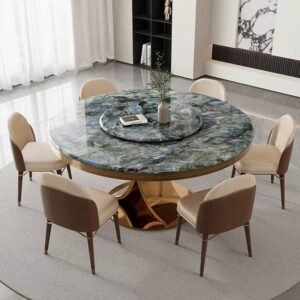
Chinese furniture manufacturers in production hubs like Foshan and Anji produce a wider range of compact-format tables than most Western brands, including 42–48-inch rounds, narrow 28–30-inch-wide rectangulars, and console-to-dining convertibles. Jade Ant furniture’s marble-top dining table page shows examples of small-format tables with stainless steel and marble configurations. For direct-from-factory ordering, minimum order quantities typically start at 2–10 pieces depending on the manufacturer, making this route suitable for designers, small retailers, hospitality projects, or group purchases.





 English
  Portuguese
  Arabic