
Introduction
A villa is more than a residence; it is a long-term investment in lifestyle, and every material chosen for its interior should reflect that commitment. Custom furniture sits at the intersection of design intent and practical performance, where the wrong material selection can mean premature wear, costly replacements, or — in the most serious scenario — a fire-safety failure that endangers occupants and exposes the owner to legal liability. Durability and regulatory compliance are not competing priorities. They are two facets of the same goal: furniture that looks extraordinary on the day it arrives and continues to perform years later.
In the context of residential upholstery, “fire-rated” refers to materials and assemblies that have been tested and certified to resist ignition, limit the spread of flame, or both. The United States enforces specific smolder-resistance requirements for upholstered furniture sold or imported into the country, meaning that every sofa, lounge chair, and upholstered bench in a villa must meet defined flammability benchmarks before it can legally reach the homeowner. These standards do not mandate the use of chemical flame retardants; instead, they focus on how materials behave when exposed to an ignition source such as a smoldering cigarette, giving designers and manufacturers the freedom to achieve compliance through smart material engineering rather than chemical treatment alone.
This article examines fire-rated custom villa furniture materials in depth — from the structural frame and cushioning core to the outermost cover fabric — so that designers, specifiers, and villa owners can make informed choices that deliver both lasting luxury and full regulatory compliance.
U.S. Standards at a Glance
TB 117-2013 / 16 CFR 1640
The foundation of U.S. upholstered-furniture flammability law is California Technical Bulletin 117-2013, which was elevated to a nationwide federal standard under 16 CFR Part 1640 following passage of the COVID-19 Regulatory Relief and Work From Home Safety Act in December 2020. The federal rule, administered by the U.S. Consumer Product Safety Commission (CPSC), went into effect on June 25, 2021, with a mandatory labeling requirement following on June 25, 2022. Every article of upholstered furniture manufactured, imported, or reupholstered for sale in the United States must comply.
TB 117-2013 is a smolder-resistance standard, not an open-flame standard. It evaluates four categories of component materials — cover fabric, barrier material, resilient filling material, and decking material — against criteria for char length, smoldering persistence, and transition to open flaming. A piece of upholstered furniture can satisfy the standard through one of two primary compliance paths. The first path requires both the cover fabric and the resilient filling to pass their respective smolder tests independently. The second path allows a non-passing cover fabric or filling to be used so long as a passing barrier material (sometimes called an interliner) completely encases the resilient filling. Any decking material present must also pass its own dedicated test. This flexibility is critical for luxury villa projects because it means designers are not forced to sacrifice aesthetic fabric choices; a high-performance barrier can bridge the compliance gap while preserving the look and hand-feel of a decorative cover textile.
NFPA 260 / 261 Context
While TB 117-2013 and 16 CFR 1640 form the mandatory baseline for residential furniture sold in the United States, two voluntary standards from the National Fire Protection Association remain highly relevant for villa projects where the owner, designer, or insurer wants additional assurance. NFPA 260, formally titled “Standard Methods of Tests and Classification System for Cigarette Ignition Resistance of Components of Upholstered Furniture,” tests individual component materials — cover fabrics, interior fabrics, welt cords, decking materials, barrier materials, and filling or padding — and classifies them according to their cigarette-ignition resistance. NFPA 261 takes a complementary approach by testing a mock-up furniture assembly rather than individual components, evaluating the finished combination of fabric, filling, and structure as a system. Together, these two standards are frequently cited in municipal fire codes, hospitality procurement specifications, and insurance underwriting requirements. For a villa whose spaces double as event venues, short-term rental accommodations, or home offices subject to local commercial fire codes, requesting NFPA 260 Class I cover fabrics and NFPA 261 mock-up certification from the manufacturer can provide a meaningful extra layer of protection and documentation.
Labeling and Documentation
Under 16 CFR § 1640.4(b), every piece of upholstered furniture within scope must carry a permanent label stating: “Complies with U.S. CPSC requirements for upholstered furniture flammability.” The label must be securely affixed — hang tags and zip ties do not qualify — with black text on a white background bordered in black, at a minimum height of one-eighth of an inch. California’s SB-1019 disclosure, which requires identification of any flame-retardant chemicals used, remains a separate obligation that is not preempted by the federal standard, so furniture shipped into or within California may need a combined label addressing both requirements. While a General Certificate of Conformity (GCC) is not required under 16 CFR 1640, maintaining test reports from an accredited laboratory for each component material is a best practice. These records document the compliance pathway chosen — passing cover fabric and filling, or passing barrier encasing the filling — and provide defensible evidence in the event of a liability claim, an insurance audit, or a customs inspection.
Durable Material Options
Frames and Casegoods
The frame is the skeleton of any upholstered piece and the single greatest determinant of its structural lifespan. For villa-grade furniture, kiln-dried hardwood remains the benchmark material. Species such as hard maple, white ash, birch, and beech offer favorable strength-to-weight ratios and excellent screw-holding capacity, while kiln drying to a moisture content of approximately six to eight percent minimizes the risk of warping, splitting, or joint failure as indoor humidity fluctuates with seasonal climate control. Corner blocks — whether glued and screwed hardwood triangles or engineered reinforcements — should be present at every high-stress junction. Doweled, mortise-and-tenon, or double-doweled joinery significantly outperforms staple-only construction, which may suffice for budget seating but cannot withstand the decades of daily use a villa owner expects.
For casegoods — dressers, nightstands, media consoles, buffets, and similar non-upholstered or partially upholstered pieces — the choice between solid wood, hardwood plywood, and high-pressure decorative laminate (HPDL) over engineered substrates depends on the project’s aesthetic direction and performance requirements. Solid hardwood delivers unmatched warmth and the ability to be refinished multiple times, but it is susceptible to seasonal movement. Hardwood plywood offers dimensional stability with a genuine wood veneer face and performs well in humidity-controlled villa interiors. Where surface durability and resistance to impact, staining, and moisture are paramount — such as bar tops, vanity surfaces, and children’s room furniture — HPDL panels tested to the NEMA LD 3 standard provide a quantifiable benchmark: the standard defines test methods and minimum performance values for wear resistance, impact resistance, dimensional stability, light-fastness, and stain resistance, ensuring the laminate will hold up under real-world use.
Cushioning and Fire Barriers
The cushioning system determines both the comfort signature and the fire performance of upholstered seating. High-resilience (HR) polyurethane foam is the most widely specified cushioning material for luxury residential furniture. Density — expressed in pounds per cubic foot (pcf) — is the primary indicator of longevity: foams below 1.8 pcf tend to break down within a few years, while densities of 2.0 pcf and above provide the structural integrity expected in villa-caliber seating. Indentation Load Deflection (ILD), measured by the force in pounds required to compress a four-inch foam sample by twenty-five percent, governs the feel. Seat cushions typically fall in the 28-to-40 ILD range, with lower values producing a softer sit and higher values offering firmer support; back cushions often use softer foam in the 18-to-24 ILD range to encourage relaxation. For the ultimate in long-term resilience, specifiers can look for foams with a high “support factor” (the ratio of 65% ILD to 25% ILD), where a value of 2.4 or higher generally signals excellent body conformance without bottoming out.
From a fire-safety perspective, TB 117-2013 Section 3 tests resilient filling materials individually by placing a lit cigarette on the foam surface and measuring smoldering behavior. Many standard polyurethane foams will pass this test without added flame retardants, but not all. When a chosen foam does not pass on its own, or when the designer prefers a cover fabric that fails the Section 1 cover-fabric test, a fire barrier becomes the compliance solution. A barrier — typically a non-woven or knitted fabric made from inherently fire-resistant fibers such as oxidized polyacrylonitrile, modacrylic blends, or fiberglass-core yarns — is placed between the cover fabric and the foam, fully encasing the cushion fill on all sides and the top. The barrier must pass TB 117-2013 Section 2, demonstrating that it prevents the smoldering ignition from reaching the foam core. This layered approach is what allows designers to use virtually any decorative textile without compromising compliance.
For villa projects destined for the U.S. market, coordinating all of these elements — frame engineering, foam specification, barrier selection, and test documentation — across multiple furniture categories can be a complex logistics challenge, particularly when production occurs overseas. Manufacturers like Jade Ant, a China-based custom and luxury furniture producer with over fifteen years of experience in villa and hospitality projects, address this challenge by offering one-stop custom engineering that covers material sourcing, construction detailing, and compliance documentation under a single production umbrella. Their workflow — from initial design confirmation through to customs declaration and logistics — is structured to give U.S.-bound buyers a coordinated path to TB 117-2013 compliance rather than leaving specifiers to chase separate test certificates from fragmented suppliers.
Fabrics and Decking
The cover fabric is the most visible material decision and the one most subject to the tension between aesthetics and performance. For fire compliance, fabrics are tested under TB 117-2013 Section 1: a lit cigarette is placed on the fabric, and the resulting char length, smoldering duration, and transition to open flaming are measured. Many tightly woven natural-fiber fabrics — particularly heavier-weight wool, cotton canvas, and linen-cotton blends — pass this test inherently because their dense structure limits oxygen flow to the smoldering zone. Synthetic performance fabrics, especially solution-dyed acrylics and certain polyester-olefin blends, are also engineered to meet the standard while delivering exceptional stain resistance, UV stability, and cleanability — all valuable traits in a villa where entertaining, children, and pets are part of daily life. Leather and vinyl, tested as cover materials under the same section, generally perform well due to their non-fibrous surface structure.
Beyond fire performance, the abrasion resistance of a cover fabric is the single best predictor of its visual longevity. The Wyzenbeek test, the predominant abrasion standard in North America, measures how many “double rubs” a fabric can endure before showing noticeable wear or yarn breakage. For residential furniture in moderate-use rooms, a minimum of 15,000 double rubs is commonly recommended; for high-traffic villa spaces such as family rooms, media lounges, and breakfast nooks, specifying fabrics rated at 30,000 double rubs or higher provides a substantial durability margin. Fabrics that reach 50,000 or more double rubs are typically classified as heavy-duty and may be suitable for semi-commercial applications within the villa, such as a home theater or a staff lounge.
Decking material — the fabric platform beneath the seat cushion on which the cushion rests — is an often-overlooked component with its own TB 117-2013 test requirement (Section 4). Decking must resist smoldering ignition independently, since a cushion removed for cleaning or flipping exposes the decking surface directly. Polypropylene and polyester decking fabrics are widely available in versions that pass the standard, but the specifier should always confirm test documentation for the specific decking material, as performance varies by weight and weave.
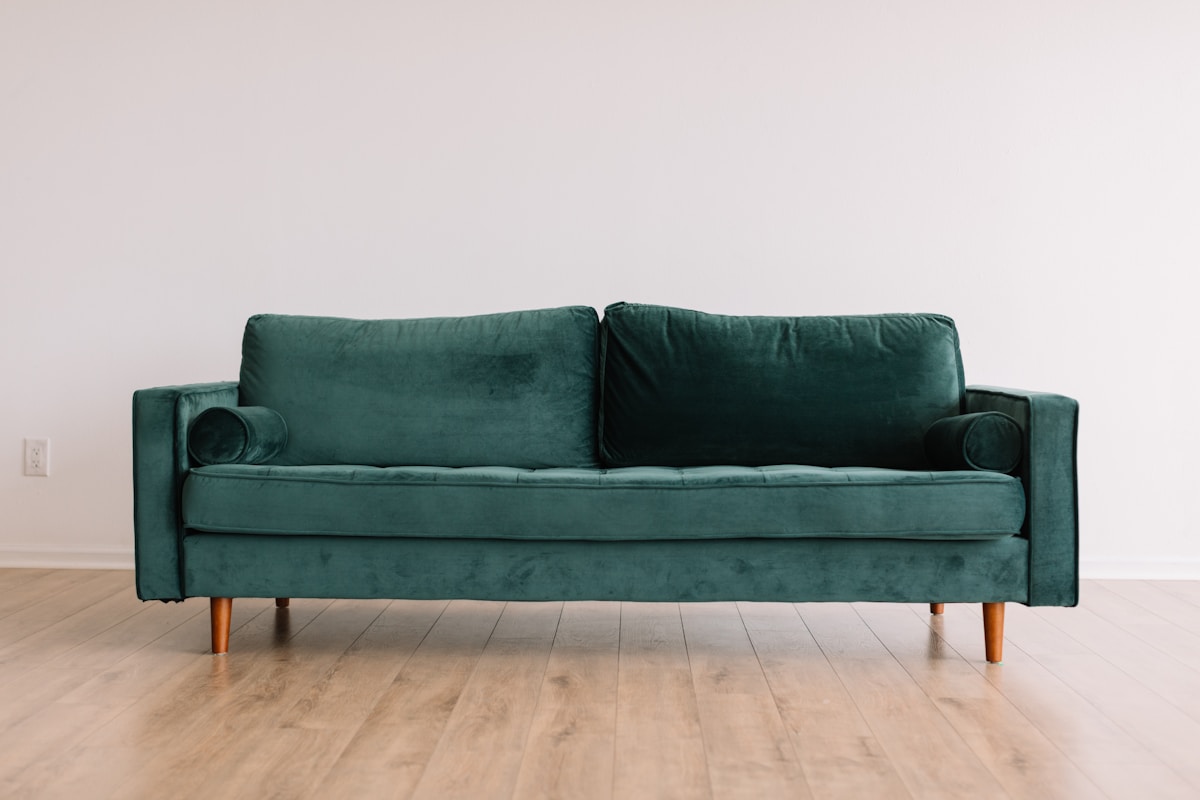
Conceptual reference: In a compliant assembly, the cover fabric sits outermost, followed by the fire barrier (if required), which fully wraps the resilient foam core. Below the foam, decking fabric spans the frame. Each layer has a distinct TB 117-2013 test section, and all must pass for the finished piece to carry the CPSC compliance label.
Specifying for Lasting Luxury
Performance Metrics That Matter
When evaluating materials for a villa furniture package, a handful of quantifiable metrics separate genuinely durable selections from those that merely look promising on a sample board. For foam, specifiers should request both density (target of 2.0 pcf or higher for seat cushions) and ILD (typically 28–38 for seats, 18–24 for backs), plus the support factor if available. For cover fabrics, the Wyzenbeek double-rub count is essential, and requesting the specific test method (cotton duck or wire mesh abductor) ensures an apples-to-apples comparison between fabric options. Pilling resistance (ASTM D3511), colorfastness to light (AATCC 16, minimum rating of 4 for residential use), and colorfastness to crocking (AATCC 8) round out the textile performance picture. For casegoods with laminate or veneer surfaces, NEMA LD 3 test results confirm that the surface will resist scratching, staining, and impact at levels appropriate for furniture-grade use.
Low-Emission Certifications
Indoor air quality is an increasingly important consideration for villa owners, and two certifications provide meaningful assurance that furniture materials will not off-gas harmful volatile organic compounds (VOCs) into the living environment. CertiPUR-US is a third-party certification program for flexible polyurethane foam that tests for content, emissions, and durability: certified foams are made without ozone-depleting substances, prohibited phthalates, or heavy metals, and must meet low-emission thresholds for VOCs. UL GREENGUARD Gold certification applies to the finished product rather than just the foam, screening for more than 15,000 individual chemicals and setting emission limits strict enough for use in schools, healthcare facilities, and homes with vulnerable populations. For a villa owner who prioritizes wellness — particularly in bedrooms, nurseries, and home offices where occupants spend extended hours — asking whether the manufacturer’s materials carry CertiPUR-US (foam) and whether the finished furniture can be supplied with GREENGUARD Gold certification (whole product) is a high-value specification question. Additionally, GREENGUARD Gold-certified products can contribute credit points in LEED-certified residential projects, adding tangible value for owners pursuing green-building recognition.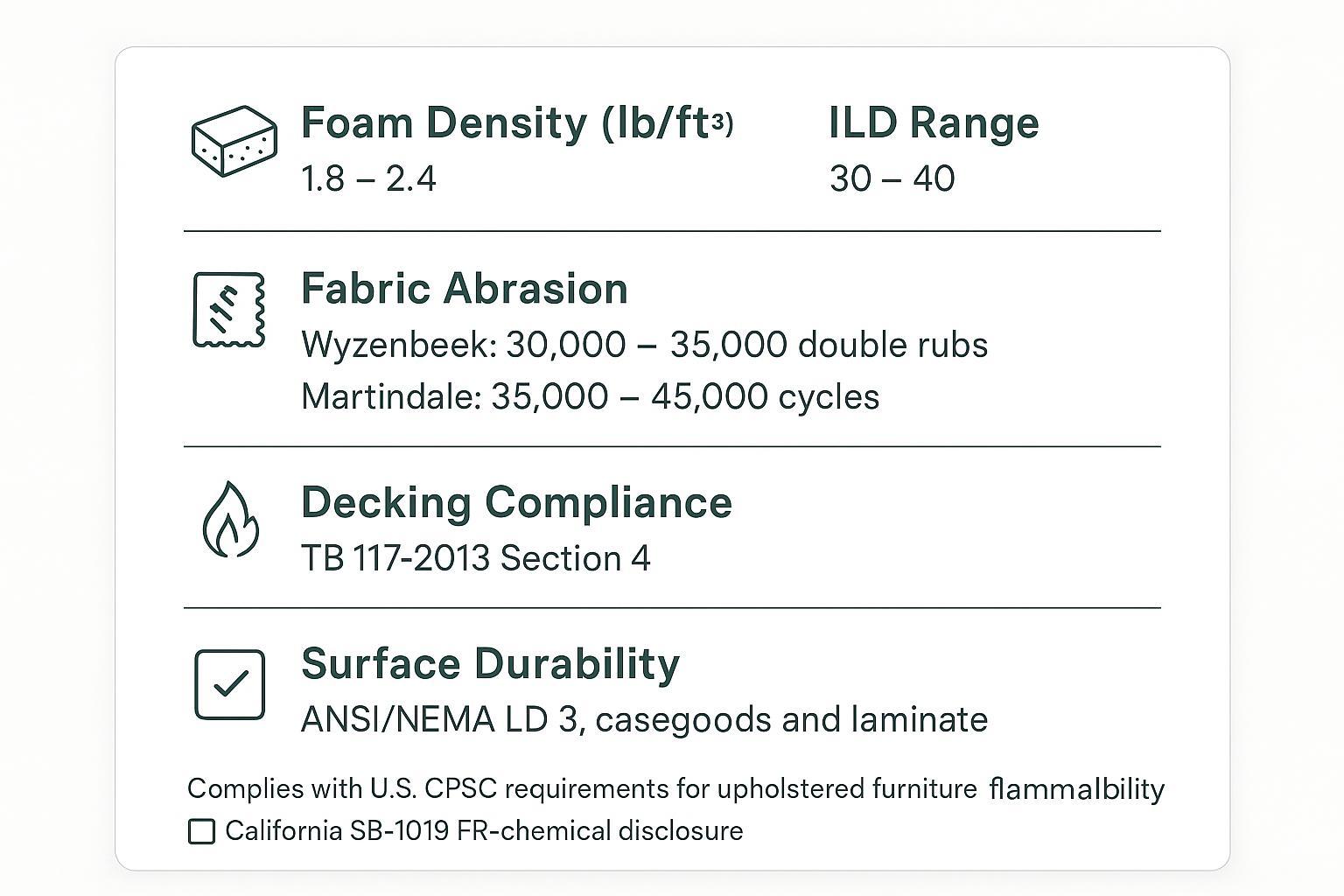
Sourcing and QA Tips
Specifying the right materials on paper is only half the equation; ensuring those materials actually arrive in the finished piece requires a disciplined quality-assurance process. Before committing to a manufacturer, request material test certificates for each critical component — foam density and ILD reports, fabric Wyzenbeek results, TB 117-2013 section-specific pass reports for cover fabric, barrier, filling, and decking — and verify that the testing laboratory is accredited (ISO 17025 accreditation is the international benchmark). During production, a pre-shipment inspection that verifies label placement, checks component materials against the approved bill of materials, and photographs the barrier-encased cushion construction (before the cover fabric is closed) provides documentary proof of compliance at the point of manufacture. For overseas production, working with a manufacturer that handles customs documentation and logistics coordination significantly reduces the risk of shipments being delayed or rejected at the U.S. port of entry due to missing or incorrect labeling.
It is also wise to require a retained sample program: the manufacturer keeps a tagged sample of each material lot used in the production run, stored for a minimum of three years, so that any future dispute or warranty claim can be traced back to verified materials. Finally, for multi-category villa furniture packages — where bedroom, living room, dining room, and study pieces may involve different frame materials, foams, fabrics, and finishes — consolidating production with a single manufacturer or a tightly managed supply chain reduces variability and ensures that the compliance and quality standards applied to the sofa are equally applied to the nightstand, the dining chair, and the home-office desk.

Quick-reference specification targets for villa furniture procurement: foam density ≥ 2.0 pcf, seat ILD 28–38, fabric abrasion ≥ 30,000 Wyzenbeek double rubs, NEMA LD 3 for casegood surfaces, TB 117-2013 pass certificates per component, CertiPUR-US foam, and GREENGUARD Gold for finished goods where available.
Selecting materials for custom villa furniture is ultimately an exercise in aligning three objectives: the design vision that makes a space feel uniquely personal, the physical durability that protects the owner’s investment over decades, and the fire-safety compliance that U.S. law requires and common sense demands. The standards framework — TB 117-2013 codified at 16 CFR 1640, supplemented by NFPA 260/261 where additional rigor is desired — is not a constraint on creativity but a design parameter, no different from load-bearing requirements for a cantilevered staircase or waterproofing specifications for a terrace. By understanding the compliance pathways (particularly the barrier-based route that preserves fabric freedom), insisting on quantifiable performance metrics for foam, fabric, and casegood surfaces, and verifying those specifications through accredited testing and disciplined QA, specifiers can deliver furniture that is as safe and durable as it is beautiful.
The next step is to put these principles into practice. Assemble a material specification sheet for your project that lists target values for foam density, ILD, fabric abrasion, and applicable certifications. Share that sheet with prospective manufacturers early in the design process and ask for component-level test documentation before approving production. Confirm that the manufacturer’s labeling process meets 16 CFR 1640 requirements and that barrier construction will be documented photographically during production. With these measures in place, the furniture that arrives at your villa will not simply meet the minimum standard — it will embody the lasting luxury that the space deserves.
FAQ
FAQ 1: What does “fire-rated” mean for custom villa furniture?
“Fire-rated” in the context of custom villa furniture means that every component material — cover fabric, resilient foam filling, barrier interliner, and decking — has been tested and certified to resist smoldering ignition under U.S. federal standard 16 CFR 1640 (based on California TB 117-2013). Importantly, the standard does not mandate the use of chemical flame retardants. Instead, it measures how materials behave when exposed to a smoldering ignition source such as a cigarette, evaluating char length, smoldering persistence, and transition to open flaming. This means manufacturers can achieve compliance through smart material engineering — for example, pairing a decorative cover fabric with a high-performance fire barrier — rather than chemical treatment, preserving both safety and the luxurious hand-feel villa owners expect.
FAQ 2: What U.S. flammability standards apply to upholstered furniture imported for villa projects?
All upholstered furniture manufactured, imported, or reupholstered for sale in the United States must comply with 16 CFR Part 1640, a federal standard that incorporates California Technical Bulletin 117-2013 (TB 117-2013). This rule, enforced by the U.S. Consumer Product Safety Commission (CPSC), has been in effect since June 25, 2021, with mandatory labeling requirements following on June 25, 2022. Beyond this mandatory baseline, two voluntary NFPA standards are also relevant: NFPA 260 tests individual component materials for cigarette-ignition resistance, while NFPA 261 evaluates a complete mock-up furniture assembly. These voluntary standards are frequently cited in municipal fire codes and insurance underwriting requirements, making them especially valuable for villas that double as short-term rental properties or event venues.
FAQ 3: What are the two compliance paths under TB 117-2013 for upholstered villa furniture?
TB 117-2013 offers two primary compliance paths. The first requires both the cover fabric (Section 1 test) and the resilient filling material (Section 3 test) to independently pass their respective smolder-resistance tests. The second path allows a cover fabric or filling material that does not pass on its own to be used, provided a fire-barrier interliner that passes the Section 2 test completely encases the resilient filling on all sides and the top. In either path, any decking material present must also pass the Section 4 decking test. The barrier-based second path is particularly important for luxury villa projects because it preserves full design freedom — designers can select virtually any decorative textile and achieve compliance by engineering the layers beneath it.
FAQ 4: What is the best frame material for durable, long-lasting villa furniture?
Kiln-dried hardwood is the benchmark frame material for villa-grade custom furniture. Species such as hard maple, white ash, birch, and beech provide excellent strength-to-weight ratios and screw-holding capacity. The wood should be kiln-dried to a moisture content of approximately 6–8% to prevent warping, splitting, or joint failure as indoor humidity fluctuates with seasonal climate control. Joinery is equally important: doweled, mortise-and-tenon, or double-doweled construction significantly outlasts staple-only assembly. Corner blocks — glued and screwed hardwood triangles or engineered reinforcements — should be present at every high-stress junction. For casegoods such as nightstands, dressers, and media consoles, hardwood plywood or high-pressure decorative laminate (HPDL) tested to the NEMA LD 3 standard offers proven surface durability against scratching, staining, and impact.
FAQ 5: What foam density and ILD should I specify for luxury villa seat cushions?
For villa-caliber seating that maintains its comfort and shape over many years, specify high-resilience (HR) polyurethane foam with a density of at least 2.0 pounds per cubic foot (pcf). Foams below 1.8 pcf tend to break down within a few years. Indentation Load Deflection (ILD), which measures the force required to compress a foam sample by 25%, determines the feel: seat cushions typically require an ILD of 28–40 (firmer), while back cushions use a softer 18–24 ILD range. For the best long-term resilience, look for a “support factor” (the ratio of 65% ILD to 25% ILD) of 2.4 or higher — this indicates excellent body conformance without bottoming out. Additionally, requesting CertiPUR-US-certified foam ensures the material meets third-party standards for low VOC emissions, with no prohibited phthalates or heavy metals.
FAQ 6: Can I use any decorative fabric on fire-rated villa furniture and still meet U.S. compliance?
Yes, in practice, designers can use virtually any decorative cover fabric — including high-end silks, velvets, and artisan weaves — and still meet TB 117-2013 requirements by utilizing the barrier-based compliance path. Under this approach, a fire-barrier interliner made from inherently fire-resistant fibers (such as oxidized polyacrylonitrile, modacrylic blends, or fiberglass-core yarns) is placed between the cover fabric and the foam, fully encasing the cushion fill. The barrier passes the TB 117-2013 Section 2 test and prevents smoldering ignition from reaching the foam core. That said, many tightly woven natural-fiber fabrics — particularly heavier-weight wool and cotton canvas — pass the Section 1 cover-fabric test inherently, as do leather, vinyl, and many synthetic performance fabrics. Beyond fire performance, specifiers should also evaluate abrasion resistance using the Wyzenbeek double-rub test: a minimum of 30,000 double rubs is recommended for high-traffic villa spaces.
FAQ 7: What low-emission certifications should I look for when specifying villa furniture materials?
Two certifications are most relevant for ensuring healthy indoor air quality in villa interiors. CertiPUR-US certifies flexible polyurethane foam for low VOC emissions, absence of ozone-depleting substances, prohibited phthalates, and heavy metals — it applies specifically to the foam component. UL GREENGUARD Gold certification is a broader, whole-product standard that screens for more than 15,000 individual chemicals, with emission limits strict enough for use in schools, healthcare facilities, and homes with vulnerable populations such as children and the elderly. GREENGUARD Gold-certified furniture can also contribute up to three credit points in LEED version 4 residential projects. For a villa owner prioritizing wellness — especially in bedrooms, nurseries, and home offices — asking the manufacturer whether their foam carries CertiPUR-US and whether the finished product qualifies for GREENGUARD Gold is a high-value specification question.
FAQ 8: How can I verify that my overseas furniture manufacturer actually meets U.S. fire-safety requirements?
Verification starts before production and continues through delivery. First, request material test certificates for every critical component — TB 117-2013 Section 1 (cover fabric), Section 2 (barrier), Section 3 (filling), and Section 4 (decking) — and confirm that the testing laboratory holds ISO 17025 accreditation. During production, a pre-shipment inspection should verify CPSC-compliant label placement, cross-check component materials against the approved bill of materials, and photograph the fire-barrier-encased cushion construction before the cover fabric is closed. Require a retained sample program where the manufacturer stores tagged material-lot samples for a minimum of three years to support future warranty or liability traceability. For multi-category villa furniture packages, consolidating production with a single manufacturer — such as a one-stop custom engineering partner experienced in U.S.-bound luxury projects — reduces variability and ensures that compliance standards applied to the sofa are equally enforced on every nightstand, dining chair, and desk in the package.





 English
  Portuguese
  Arabic