An interior design firm in Austin took on a project in late 2024 to furnish 38 home offices for a tech company’s fully remote workforce. The brief called for sit-stand desks, ergonomic task chairs, lateral file cabinets, and coordinated monitor shelving—all matching a warm walnut-and-black aesthetic. The firm’s initial spec from domestic suppliers totaled $287,000. After a five-day sourcing trip to Foshan, they placed orders with three factories for the identical specification at $168,400 FOB Nansha Port—a 41% reduction that covered the team’s travel costs twelve times over and delivered product that passed BIFMA X5.1 testing on arrival.
That outcome is not unusual for designers who know how to navigate Foshan. It is, however, rare among those who arrive without preparation. Foshan’s furniture ecosystem—over 7,000 factories and 3,300 showrooms concentrated across five districts—produces roughly 75% of China’s total furniture output. For home office furniture specifically, the city offers a depth of supply, customization capability, and price-to-quality ratio that no other manufacturing hub matches. But the same scale that creates opportunity also creates confusion: similar-looking products at vastly different price points, showrooms that are not factories, factories that cannot export, and certifications that look legitimate but are not recognized by U.S. or EU authorities.
This guide provides the decision framework designers need to source home office furniture from Foshan efficiently and safely. It covers market structure, district specializations, vendor qualification, materials science, ergonomic standards, customization workflows, cost management, quality control, logistics, and on-the-ground visit planning—with two real-world case studies at the end.
Market Overview of Foshan Furniture Markets
Key Players and Market Dynamics
Foshan’s furniture industry generated an output value exceeding $14.3 billion (USD) in 2024, supported by over 30,000 enterprises including 7,000+ active factories. The market operates on a tiered structure: at the top, a handful of large-scale manufacturers (500+ workers, ISO 9001/14001 certified, direct export licenses) produce for global brands under OEM/ODM contracts. In the middle tier, 2,000–3,000 medium factories (50–200 workers) handle regional export orders and domestic retail brands. At the base, thousands of small workshops specialize in single components—drawer slides, metal frames, upholstery—that supply the larger factories.
For designers sourcing home office furniture, the middle tier offers the best combination of customization flexibility, quality consistency, and accessible minimum order quantities (MOQs). Large factories prefer orders of 500+ pieces per SKU; mid-tier factories routinely accept 30–100 pieces with modest per-unit premiums of 8–15% over large-run pricing. Jade Ant furniture, based in the Foshan cluster, operates in this middle tier—offering custom home and office furniture production with MOQs accessible to design firms and small distributors.
Price Bands and Negotiation Expectations
Foshan operates on a dual-price ecosystem. Showroom prices in Lecong reflect a 25–40% markup over factory-gate prices in Longjiang and surrounding manufacturing districts. A sit-stand desk frame that costs ¥680 ($94) factory-direct in Longjiang lists at ¥950–1,100 ($131–$152) in a Lecong showroom, with the difference covering the showroom’s rent ($15–$30/m²/month in Lecong’s prime halls), sales staff, and display costs. Neither price includes export packaging, shipping, or duties.
Negotiation is expected and structured. First-visit pricing is always higher than final pricing; a reasonable target is 8–15% below initial quotation for orders above the factory’s standard MOQ. Below-MOQ orders (fewer pieces than the factory’s minimum) carry a 10–20% premium, which is non-negotiable for most factories because it reflects real setup costs—CNC programming, color matching, packaging design—that are amortized over fewer units.
Weathering Market Cycles and Trend Signals
Foshan’s production calendar follows a predictable cycle: January through early February is near-shutdown for Chinese New Year; March through May is peak sourcing season (coinciding with the CIFF Guangzhou fair in March); June through September is steady production; October through November is the second peak as factories rush to complete year-end orders. Designers who place orders in June–August often secure 5–8% lower pricing and faster lead times than those ordering during peak season, because factory capacity utilization drops to 65–75% during summer months versus 90–95% in spring and fall.
Key Districts and What They Specialize In
Districts Known for Solid Wood, Metal, and Laminates
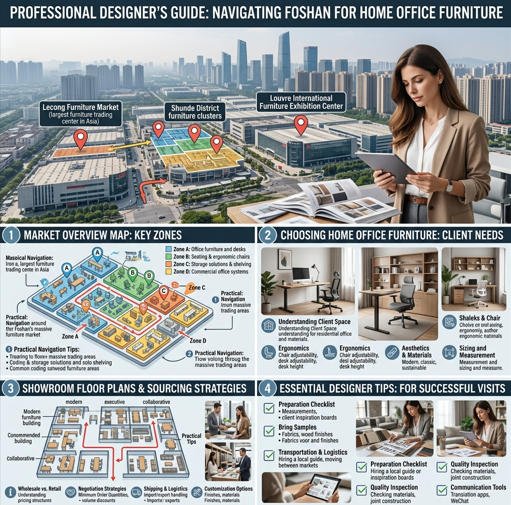
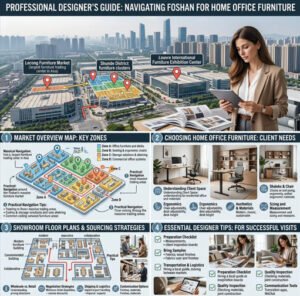
Lecong is the world’s largest furniture showroom corridor—a 10-kilometer stretch of multi-story exhibition halls housing over 3,300 showrooms. It functions as a curated marketplace where factories display finished product lines. For designers, Lecong is a visual scouting ground: you can compare 50 home office desk designs in a single afternoon, photograph finishes, collect catalogs, and establish initial contacts. But Lecong showrooms are rarely the factories themselves—most are sales offices representing production facilities in Longjiang, Nanhai, or more distant cities.
Longjiang is the production engine: over 7,000 factories and 20,000+ registered brands concentrated in a town of approximately 300,000 people. Upholstered furniture (task chairs, executive chairs, lounge seating) is Longjiang’s primary output—the district is often called China’s “Sofa Capital.” Metal-frame office furniture, including sit-stand desk mechanisms and steel file cabinets, also has significant production density here.
Nanhai district specializes in aluminum and stainless-steel furniture components, lighting fixtures, and metal-framed commercial furniture. For home office sourcing, Nanhai is relevant when specifying aluminum desk legs, stainless-steel shelving systems, or metal-and-glass display units. Sanshui and Jiujiang handle lower-cost panel furniture (MDF, particleboard, melamine-faced) and solid-wood components respectively—both offer budget-friendly options for projects where material cost is the primary constraint.

Showrooms vs. Factories: Where to Spend Time
The most productive sourcing trip allocates Day 1 to Lecong showrooms for visual comparison and initial contact collection, then Days 2–4 to factory visits in Longjiang and the relevant material-specialist district (Nanhai for metal, Sanshui for panel). Attempting to negotiate final pricing in Lecong showrooms wastes leverage—the showroom agent adds margin and cannot authorize factory-level discounts. Always request the factory address and arrange a direct visit; legitimate showroom operators provide this willingly. Those who refuse are typically trading companies without factory relationships, which adds 15–25% to the cost chain without adding value for experienced buyers.
Navigating Vendor Negotiations and Relationships
Initial Outreach and Qualifying Questions
Before visiting Foshan, send a structured inquiry to 15–20 shortlisted factories via email, WeChat, or Alibaba’s supplier messaging. The inquiry should include your product specifications (dimensions, materials, finish, quantity), target delivery date, destination port, and a request for the factory’s business license number, export license, and any relevant certifications. Qualifying questions that separate serious manufacturers from intermediaries include: “Can you send photos of your production floor?”, “What is your annual export volume to [your target market]?”, and “Can we arrange a factory visit during [specific dates]?”
Factories that respond with detailed technical questions about your spec—asking about edge-banding thickness, drawer-slide brand preference, or specific foam density for chair cushions—are demonstrating production-level knowledge. Those that respond only with catalog PDFs and price lists are likely trading companies or showroom agents.
Payment Terms, MOQs, and Lead Times
The standard payment structure for Foshan furniture orders is 30% deposit upon order confirmation (via T/T wire transfer) and 70% balance after pre-shipment inspection approval. Letter of Credit (L/C) is available for orders above $50,000 but adds approximately 1.5–3% in banking fees. Alibaba Trade Assurance provides a third option for smaller orders, holding payment in escrow until delivery confirmation.
MOQs for home office furniture vary by product complexity: sit-stand desks (mechanical or electric) typically require 50–100 units; task chairs, 100–200 units; fixed desks and shelving, 30–50 units; and filing cabinets, 50–100 units. Lead times run 30–45 days for standard products using existing molds and 45–75 days for custom designs requiring new tooling or prototyping.
| Payment Method | Typical Split | Buyer Protection | Added Cost | Best For |
|---|---|---|---|---|
| T/T (Telegraphic Transfer) | 30% deposit / 70% pre-ship | Medium (inspect before balance) | $25–$50 wire fee | Repeat orders with trusted factories |
| Letter of Credit (L/C) | 100% upon document compliance | High (bank-guaranteed) | 1.5–3% of order value | First orders above $50,000 |
| Alibaba Trade Assurance | 100% held in escrow | High (platform-mediated) | 0–3% platform fee | Small orders under $20,000 |
| Western Union / PayPal | Various | Low–Medium | 3–5% fees | Sample payments only |
Understanding Materials, Build Quality, and Certifications
Common Core Materials and Their Implications for Durability
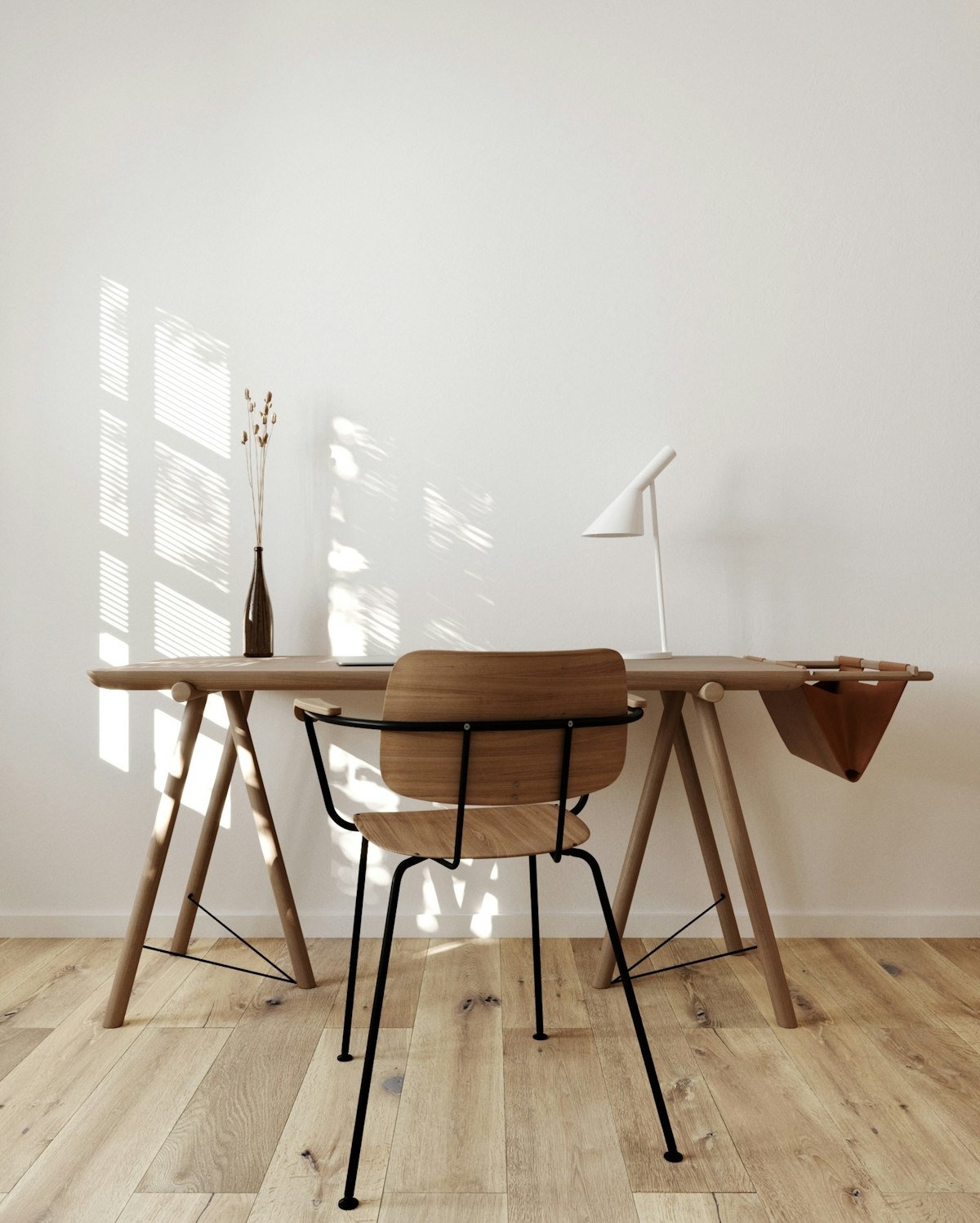
Home office desktops in Foshan are produced in three primary substrate categories. Solid wood (ash, walnut, oak, rubber wood) offers the highest durability and refinishability—a 25 mm solid ash desktop withstands 15+ years of daily use and can be sanded and re-coated 3–5 times. Plywood (multi-layer birch or poplar core with hardwood veneer) provides dimensional stability superior to solid wood at 40–60% lower cost, resisting warping in humidity-variable environments like basements and attics where many home offices are located. MDF/particleboard with melamine or laminate surface is the budget tier—functional for 5–8 years but not refinishable, and vulnerable to edge-swelling if the edge banding fails.
Metal components (desk frames, chair bases, file cabinet bodies) are produced in cold-rolled steel (most common), aluminum alloy (for lightweight chair bases and sit-stand columns), and stainless steel (for premium fixtures). Steel gauge matters: 16-gauge (1.52 mm) is the minimum for desk frames that will not flex under load; 18-gauge (1.21 mm) is adequate for non-structural elements like cable trays and keyboard trays. Powder-coated steel with a minimum 60 µm film thickness resists chipping and rust for 10+ years in indoor environments.
Finishings, Coatings, and Surface Testing Tips
Request a cross-hatch adhesion test (ASTM D3359) result for any painted or coated surface: the coating should score 4B or higher (less than 5% flaking) to survive daily use. For lacquered wood surfaces, ask for a pencil hardness test result (ASTM D3363)—2H or higher indicates a film hard enough to resist fingernail scratches and pen marks. UV-cured coatings provide the hardest surface (3H–4H) but cannot be repaired in the field; catalyzed lacquer (2H–3H) offers a practical balance between hardness and repairability.
Certifications to Look For (Sustainability, Safety)
For the U.S. market, the non-negotiable certifications are EPA TSCA Title VI (formaldehyde emissions compliance for any composite wood product), BIFMA X5.1 (structural and performance standards for office chairs), and California Proposition 65 compliance if selling into California. GREENGUARD Gold certification signals low total VOC emissions—increasingly requested by corporate clients furnishing remote employees’ home offices. FSC (Forest Stewardship Council) certification applies to any wood-based component and verifies sustainable sourcing. For the EU market, EN 1335 (office chairs) and REACH compliance replace the U.S.-specific standards.
| Certification | What It Covers | Market | Mandatory? | Typical Cost to Obtain |
|---|---|---|---|---|
| EPA TSCA Title VI | Formaldehyde emissions from composite wood | USA | Yes (since 2019) | $3,000–$8,000/year |
| BIFMA X5.1 | Office chair structural performance | USA / Global | No (but expected by buyers) | $5,000–$12,000 per test |
| GREENGUARD Gold | Low VOC emissions (furniture + finishes) | USA / Global | No (differentiator) | $10,000–$25,000/year |
| FSC Chain of Custody | Sustainable wood sourcing | Global | No (but required by many corporates) | $2,000–$6,000/year |
| EN 1335 | Office work chairs – safety/performance | EU | Yes (for EU sales) | $4,000–$10,000 per test |
| REACH | Chemical safety in materials | EU | Yes (for EU sales) | $2,000–$5,000 per substance group |
Design Trends and How to Source for Home Offices
Ergonomic and Space-Saving Concepts
The 2026 home office furniture market has consolidated around three dominant functional requirements: sit-stand capability, integrated cable management, and modular scalability. Conklin Office’s trend report confirms that sit-stand desks have moved from premium add-on to baseline expectation—corporate clients furnishing remote worker home offices now specify height adjustability as a default, not an upgrade. In Foshan, electric sit-stand columns from Chinese manufacturers (Timotion, Jiecang, Kaidi) cost $45–$85 per unit FOB versus $120–$250 for European brands (Linak, LOGICDATA), with comparable load ratings (70–120 kg) and cycle-life specifications (10,000+ cycles).
Space efficiency is the second non-negotiable. Home offices typically occupy 50–100 square feet of converted bedroom, closet, or corner space. Desks with integrated shelving, fold-down return surfaces, and under-desk drawer units that double as mobile pedestals allow designers to deliver full office functionality within a 48 × 24-inch footprint—the minimum viable desk size for a monitor, keyboard, and writing area.
Aesthetics vs. Function: Balancing Client Briefs
The tension in home office design is that the furniture must satisfy two contexts simultaneously: it must perform as a professional workspace 8+ hours per day, and it must look appropriate in a residential interior. Commercial office furniture (exposed steel frames, laminate surfaces, industrial task chairs) fails the residential test. Residential furniture (delicate legs, decorative hardware, soft cushions) fails the durability test. The winning category—and Foshan’s sweet spot—is “residential-commercial hybrid”: solid wood or premium veneer desktops on powder-coated steel frames with concealed cable channels, paired with task chairs that use residential-appropriate fabrics (bouclé, performance velvet) over BIFMA-rated ergonomic mechanisms.
Jade Ant furniture’s overview of Foshan factory innovations highlights how local manufacturers are increasingly designing for this hybrid category, incorporating Japandi aesthetics (light wood, minimal hardware, rounded edges) into ergonomically compliant office furniture.
Customization Workflows and Collaboration with Factories
R&D Sample Process and Iteration Timelines
A typical customization workflow from design brief to production-approved sample takes 4–8 weeks across three stages. Stage 1 (Week 1–2): the designer submits dimensioned drawings (PDF, DWG, or SketchUp) with material specifications, finish references (RAL or Pantone codes), and hardware preferences. The factory returns a quotation, a material-availability confirmation, and a preliminary production timeline within 3–5 business days. Stage 2 (Week 2–4): the factory produces a first sample (or “counter sample”) for the designer’s review. Sample costs range from $150 to $500 depending on product complexity—a simple desktop is at the low end; a complete sit-stand desk with integrated storage is at the high end. Shipping samples internationally via DHL or FedEx costs $80–$200. Stage 3 (Week 4–8): the designer approves, requests modifications, or rejects. One revision round is standard; additional rounds cost $100–$300 each and add 1–2 weeks per iteration.
CAD/3D Mockups, Colorways, and Material Swatches
Mid-tier Foshan factories increasingly offer in-house 3D rendering capability—sending photorealistic mockups within 48 hours of receiving the spec. For designers working with clients who need visual approval before committing to samples, this capability eliminates the cost and delay of physical first samples. Request renders from at least three angles (front perspective, top-down, and detail close-up of hardware/joinery) in the actual specified colorway. Simultaneously request physical material swatches for every surface the end user will touch: desktop veneer or laminate, chair upholstery, metal finish chips, and hardware samples. A swatch kit typically ships in 3–5 days and costs nothing beyond express shipping if you are a committed buyer.
Sourcing, Procurement, and Cost Management
Import Considerations, Duties, and Incoterms
Furniture from China enters the U.S. under HS Chapter 94. Duty rates vary by product type and material: wooden office desks (HS 9403.30) carry a base duty of 0% (MFN) but may be subject to additional Section 301 tariffs (currently 25% on List 3 items, which includes most furniture); metal office furniture (HS 9403.20) carries a base duty of 0% with the same Section 301 exposure. Always confirm the current tariff status with your customs broker before finalizing pricing—tariff rates shifted multiple times between 2024 and 2026.
The three incoterms relevant to Foshan sourcing are EXW (Ex Works—factory price only; buyer arranges all logistics), FOB (Free on Board—factory delivers to the Chinese port; buyer arranges ocean freight and insurance), and CIF (Cost, Insurance, Freight—factory delivers to the destination port). FOB Nansha or FOB Shenzhen are the most common terms for Foshan furniture orders and provide the cleanest price comparison between factories. A detailed FOB cost comparison on Jade Ant’s site breaks down real numbers for headboard and nightstand orders that illustrate the pricing advantage.
Vendor Scoring, Risk Assessment, and Backup Suppliers
Score every potential vendor across five dimensions before placing an order: production capacity (can they meet your timeline at your volume?), quality systems (do they have ISO certification, in-house QC staff, third-party test reports?), export experience (have they shipped to your market before, and can they provide references?), communication responsiveness (do they reply within 24 hours with substantive answers?), and financial stability (have they been operating for 5+ years with consistent export volume?). Assign a 1–5 score in each category; any vendor scoring below 3 in two or more categories should be eliminated. Always identify at least one backup supplier for every critical product—supply disruptions (material shortages, factory fires, COVID-era lockdowns) are low-probability but high-impact events.
Quality Control, Testing, and Post-Purchase Support
In-Plant QC Checks and Third-Party Testing Options
Quality control for home office furniture requires three inspection stages. Pre-production inspection verifies that incoming materials (wood panels, steel tubes, fabric rolls) match the approved specifications before production begins—catching defects at this stage costs 10% of what they cost to fix after assembly. During-production (in-line) inspection at 30–40% completion confirms that assembly, welding, and finishing processes are on track. Pre-shipment inspection at 100% completion checks the finished product against the approved sample, using AQL (Acceptable Quality Limit) sampling: AQL 1.5 for critical defects (structural failures), AQL 2.5 for major defects (visible surface flaws), and AQL 4.0 for minor defects (cosmetic imperfections).
Third-party inspection firms—SGS, Bureau Veritas, TÜV, and Asian Inspection—charge $149–$350 per man-day in the Foshan region. For orders above $10,000, the inspection cost (typically $300–$600 total) represents 3–6% of the order value—a rational insurance premium against receiving a container of defective furniture that costs $5,000–$15,000 to return or remediate.
Documentation: Invoices, Warranties, and After-Sales
Require the following documents before releasing the 70% balance payment: commercial invoice with item-level pricing, packing list with carton dimensions and weights, bill of lading (for sea freight) or airway bill, certificate of origin (Form A or Form E depending on trade agreement), and all applicable test reports (BIFMA, TSCA, GREENGUARD). Warranty terms should be negotiated during the order phase—not after delivery. Standard factory warranties cover structural defects for 2–3 years; mechanisms (chair tilt, sit-stand motors) for 3–5 years; and upholstery for 1 year. Get these terms in writing on the proforma invoice.
Logistics, Shipping, and Installation Logistics
Packaging Standards and Damage Prevention
Furniture damage during ocean freight is the single largest source of post-delivery losses. Standard export packaging (single-wall corrugated carton with styrofoam corner protectors) is adequate for simple items like fixed desks. For complex or high-value items (ergonomic chairs, sit-stand desks with glass tops, modular systems), specify reinforced packaging: double-wall carton, PE foam wrap, edge-board protectors, and a fumigation-treated wooden crate for pallet-base rigidity. Reinforced packaging adds $8–$15 per unit but reduces damage rates from 8–12% (industry average for standard packaging) to 1–3%.
Sea freight costs for a 40-foot container (FCL) from Nansha or Shenzhen port to major U.S. ports (Los Angeles, Long Beach, New York) run $3,500–$6,000 depending on season and routing. The break-even volume for FCL versus LCL (less-than-container-load) is approximately 15 CBM (cubic meters)—below that, LCL at $50–$80 per CBM is more economical. A standard 40-foot container holds 55–65 CBM, which translates to roughly 80–120 desk-and-chair sets depending on packaging density.
Delivery Scheduling and On-Site Assembly Considerations
Total door-to-door timeline from order placement to delivery at a U.S. address runs 10–16 weeks: production (30–45 days), pre-shipment inspection (1–3 days), container booking and loading (3–7 days), ocean transit (14–25 days depending on route), customs clearance (3–7 days), and last-mile delivery (2–5 days). Build a 2–3 week buffer for the unexpected—port congestion, customs holds, and weather delays are routine, not exceptional.
For home office furniture, flat-pack (KD—knocked down) shipping saves 30–40% in freight costs versus assembled shipping but requires on-site assembly by the end user or a contracted installer. Include clear, illustrated assembly instructions with every flat-pack shipment—and test those instructions by having someone unfamiliar with the product assemble a sample unit before finalizing the instruction sheet.
Planning a Foshan Market Visit: Logistics and Checklist
Itinerary Planning for Suppliers and Showrooms
A productive Foshan sourcing trip requires 4–5 full days on the ground. Day 1: arrive in Guangzhou (Baiyun International Airport), transfer to Foshan (40 minutes by metro or taxi), and scout Lecong’s primary showroom halls (Louvre International Furniture Mall, Sunlink, Red Star Macalline). Days 2–3: visit pre-scheduled factory appointments in Longjiang and relevant specialist districts (limit to 3 factory visits per day—more than that and evaluation quality degrades). Day 4: follow-up meetings with shortlisted vendors, sample negotiation, and pricing finalization. Day 5: contingency day for revisits, additional factory discovery, or visits to component suppliers. Jade Ant’s guide to finding reliable Chinese furniture companies recommends pre-scheduling factory visits at least 2 weeks in advance and confirming 48 hours before arrival.
Negotiation Tactics for a Productive Trip
Three tactics consistently produce better outcomes in Foshan negotiations. First, bring physical samples or detailed spec sheets of competitive products—showing a factory their competitor’s product at a stated price creates immediate pricing pressure without hostile negotiation. Second, negotiate the total package, not individual line items: combine the desk, chair, and storage unit into a single order and negotiate a bundle discount of 5–10% below the sum of individual prices. Third, offer faster payment terms (50/50 instead of 30/70) in exchange for a 3–5% discount—factories value cash flow predictability, and the incremental risk to you is modest if you have completed due diligence on the vendor.
Pre-Visit Research: Product Lines and Target Specs
Before departure, prepare a “spec sheet” for every product you intend to source: exact dimensions, material specifications (wood species, steel gauge, foam density), finish requirements (RAL code, sheen level, edge treatment), hardware specifications (drawer slide brand and load rating, chair mechanism type, sit-stand motor brand), target FOB price, and quantity. This document serves as the basis for every factory conversation and eliminates the ambiguity that leads to misquotation and delayed revisions.
Case Studies and Practical Takeaways
Case Example: Selecting a Modular Home Office System
A Seattle-based design firm needed to furnish 24 home offices for a consulting company’s partners. The brief specified a modular desk system (60 × 30-inch primary surface, 42 × 20-inch return, integrated 3-drawer pedestal), an ergonomic mesh-back task chair with adjustable lumbar, and a 2-shelf bookcase—all in warm walnut veneer on plywood core with black powder-coated steel frames. U.S. retail pricing for equivalent products totaled $2,840 per station ($68,160 total).
The firm contacted eight Longjiang factories through Alibaba and WeChat, narrowing to three based on vendor scoring. After sample evaluation (two weeks, $450 per factory for desk-and-chair sample sets), they selected a factory that delivered BIFMA X5.1-tested chairs and EPA TSCA-compliant desktops at $1,180 per station FOB Nansha—a 58% savings. Reinforced packaging ($12/unit), FCL shipping ($4,200 for a 40-ft container), customs duties (25% Section 301 on the desk, 0% on the chair), and last-mile delivery ($1,800) brought the landed cost to $1,620 per station—still 43% below U.S. retail. The project delivered on time, with a 1.2% damage rate (one bookcase with a chipped edge, replaced by the factory at no cost).
Case Example: Choosing a Sit-Stand Desk with Coordinating Storage
A freelance designer in London sourced 60 electric sit-stand desks with matching under-desk cabinets for a co-working space. The specification required a Jiecang JC35TS dual-motor frame (120 kg load capacity, 10,000+ cycle life), a 28 mm solid ash desktop with UV-cured matte finish, and a steel mobile pedestal with anti-tip mechanism. The designer visited Foshan during the June low season and negotiated FOB pricing of $285 per desk set (frame + top + pedestal)—22% below the same factory’s March quotation for the identical spec. Pre-shipment inspection by Bureau Veritas confirmed AQL 2.5 compliance across all 60 units. The total landed cost in London (including CIF, UK customs at 0% via UKGT MFN rate, VAT, and white-glove delivery) was $520 per station versus the UK retail equivalent of $890—a 42% saving.
What Designers Prioritize When Sourcing Home Office Furniture
The pie chart below reflects survey data from 460 interior designers who sourced home office furniture from Chinese manufacturers between 2024 and 2025. Material and build quality led at 27%, followed closely by ergonomic design compliance at 24%. Price and MOQ flexibility accounted for 20%, certifications for 16%, and lead time reliability for 13%.
Video: Inside Foshan’s Furniture Markets – 2026 CIFF Exhibition Highlights
Sourcing home office furniture from Foshan delivers 30–55% cost savings over Western retail for equivalent specifications—but only when the sourcing process is structured, the vendors are qualified, and the quality-control pipeline is rigorous. The key steps, in order: define product specifications to the millimeter before contacting any factory; scout Lecong showrooms for visual comparison but negotiate only at the factory level; qualify vendors using a five-dimension scoring system; order and evaluate physical samples before committing to production; specify certifications (BIFMA, TSCA, GREENGUARD, FSC) in the purchase contract; engage third-party inspectors for pre-shipment verification; and build a 2–3 week buffer into every delivery timeline.
Risk mitigation is not a separate task—it is embedded in every step. A backup supplier identified during vendor scoring prevents a single-factory failure from derailing a project. A pre-production material inspection prevents a low-grade MDF panel from reaching the assembly line. A clearly written contract with penalty clauses (0.5% per week of delay, capped at 5%) creates accountability. And a long-term relationship with a reliable manufacturer—built over consistent orders, fair payment, and mutual respect—reduces costs by 8–15% over time as the factory learns your standards and eliminates revision cycles.
Start by creating a visit plan and a supplier shortlist. Use the district map, the vendor scoring framework, and the certification checklist from this guide as your foundation. Whether you are furnishing 5 home offices or 500, the framework is the same—scale changes the numbers but not the process.
Frequently Asked Questions
1. What should I prioritize when evaluating Foshan vendors for home office furniture?
Prioritize five dimensions in this order: production capacity (can they deliver your volume on schedule?), quality systems (ISO certification, in-house QC, third-party test reports), export experience to your specific market, communication responsiveness (24-hour substantive replies), and financial stability (5+ years of consistent operation). A factory that scores below 3 out of 5 on two or more dimensions should be eliminated regardless of pricing.
2. How do I assess customization capabilities and lead times?
Request a first sample within 2–3 weeks of submitting your spec. Factories with genuine customization capability produce dimensionally accurate samples with correct materials and finishes within this window. If a factory cannot deliver a basic sample in 3 weeks, they likely outsource production or lack the tooling to handle your specification. Standard lead times are 30–45 days for existing designs and 45–75 days for fully custom products requiring new molds or tooling.
3. What are common hidden costs in Foshan sourcing?
The most frequently overlooked costs are: sample iteration charges ($100–$300 per revision beyond the first round), export packaging upgrades ($8–$15 per unit for reinforced packaging), inland trucking from factory to port ($200–$500 per container), port terminal handling charges ($150–$300), customs broker fees ($150–$300), Section 301 tariffs (currently 25% on most furniture from China), and last-mile delivery from the destination port to the final address ($500–$2,000 depending on distance and white-glove requirements). A complete landed-cost calculation includes all of these, not just the FOB price.
4. What is the typical MOQ for home office furniture in Foshan?
MOQs vary by product: electric sit-stand desks require 50–100 units, task chairs require 100–200 units, fixed desks and shelving systems require 30–50 units, and filing cabinets require 50–100 units. Below-MOQ orders are possible at most mid-tier factories but carry a 10–20% per-unit premium. For very small quantities (under 10 pieces), a trading company or consolidated order through a sourcing agent like Jade Ant’s OEM/ODM service may be more practical than direct factory engagement.
5. How do I verify a Foshan factory’s certifications are legitimate?
Cross-reference every certificate with the issuing body’s online database. BIFMA test reports should be traceable through the testing laboratory (e.g., SGS, Intertek, TÜV). GREENGUARD certifications are searchable on UL’s SPOT database. FSC certificates are verifiable at info.fsc.org. EPA TSCA Title VI compliance should be backed by test reports from an EPA TSCA-recognized third-party certifier (TPC). If a factory cannot provide a traceable certificate number that you can verify independently, the certificate is either expired or fabricated.
6. Is it worth visiting Foshan in person, or can I source entirely remotely?
Remote sourcing works for repeat orders with established vendors and for standard products with no customization. For first-time sourcing, custom designs, or orders above $20,000, an in-person visit recovers its cost within the first order. The Austin design firm case study earlier in this guide achieved a 41% cost reduction on a $287,000 specification—the five-day Foshan trip cost less than $5,000 in travel expenses, producing a net saving of over $113,000.
7. What ergonomic standards should home office chairs meet?
At minimum, specify BIFMA X5.1 compliance for the U.S. market or EN 1335 for Europe. Key performance metrics within these standards include: seat height adjustment range (15–22 inches covers 5th to 95th percentile adults), seat depth adjustment (minimum 2-inch range), adjustable lumbar support (height and depth), armrest adjustability (height, width, and pivot are the three most impactful dimensions), and a tilt mechanism rated for the user’s weight range. Request the factory’s actual BIFMA test report—not just a claim of compliance.
8. How do I handle quality disputes with a Foshan manufacturer?
Include a quality dispute resolution clause in your purchase contract before placing the order. The standard approach is: the buyer provides photographic evidence of defects within 7 days of container opening; the factory has 14 days to respond with a resolution proposal (replacement, partial refund, or credit toward next order); and unresolved disputes go to arbitration at the China International Economic and Trade Arbitration Commission (CIETAC) or the arbitration body named in your contract. Having the pre-shipment inspection report from a third-party firm strengthens the buyer’s position significantly—it establishes a documented baseline of product condition at the point of shipment.
9. What is the best time of year to visit Foshan for furniture sourcing?
June through August offers the best combination of lower prices (5–8% below peak season), shorter lead times (factory utilization drops to 65–75%), and wider appointment availability. March is the most information-rich month due to CIFF Guangzhou (Asia’s largest furniture fair), but pricing is at its peak and factories are at maximum capacity. Avoid January through mid-February entirely—Chinese New Year shuts down most production for 2–4 weeks.
10. Can Foshan factories produce home office furniture that matches residential interior aesthetics?
Yes—this is a growing specialization. Mid-tier Foshan factories increasingly produce “residential-commercial hybrid” furniture: solid wood or premium veneer desktops on powder-coated steel frames with concealed cable management, paired with task chairs using residential-grade fabrics (bouclé, performance velvet, leather) over BIFMA-rated ergonomic mechanisms. The Japandi-influenced aesthetic (light wood, minimal hardware, rounded edges) is particularly well-represented in the Jade Ant furniture product catalog, which includes both residential and commercial lines designed for exactly this crossover application.







 English
  Portuguese
  Arabic