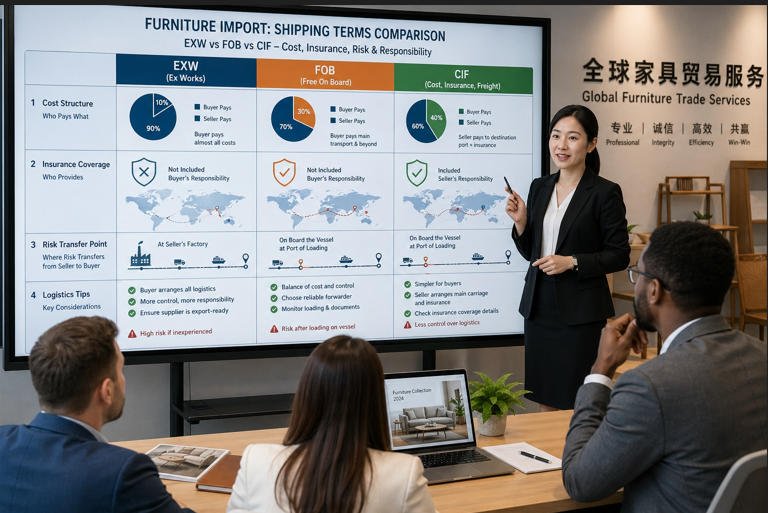
Importing furniture from China is not only about choosing a factory and approving a quotation. The freight term written into the proforma invoice can decide who pays for inland trucking, export clearance, port charges, ocean freight, insurance, customs handling, and sometimes the first serious dispute after production is finished.
Incoterms matter because furniture is bulky, damage-sensitive, and often shipped in mixed SKUs: sofas, beds, dining tables, chairs, marble tops, mirrors, cabinets, and fragile decorative parts may all share one 40HQ container. A small misunderstanding about EXW, FOB, or CIF can turn into unexpected port fees, delayed containers, uninsured claims, or unclear responsibility when cargo is damaged.
This article compares EXW, FOB, and CIF for furniture shipments from China, with practical guidance for importers, distributors, interior designers, hotel project buyers, and e-commerce furniture brands.

Overview of Incoterms in furniture sourcing
What Incoterms cover and why they matter for importers
Incoterms are internationally recognized trade terms published by the International Chamber of Commerce. The ICC Incoterms 2020 rules define how sellers and buyers divide delivery obligations, costs, and risk during international trade.
For furniture importers, Incoterms answer three practical questions:
- Cost: Which party pays for each logistics step?
- Risk: When does loss or damage risk transfer from seller to buyer?
- Control: Who chooses the forwarder, carrier, sailing schedule, and insurance arrangement?
In furniture sourcing, these questions are more serious than they look. A dining table with a stone top may require reinforced wooden crates. Upholstered beds may need moisture protection. High-gloss cabinets may need corner protection, foam spacing, and scratch-resistant wrapping. If the contract does not define who is responsible for transport and insurance at each stage, the buyer may discover the problem only after the goods arrive damaged.
How to read an Incoterms-based contract for furniture
A correct Incoterms clause should include the selected rule, named place or port, and version year. For example:
- EXW Foshan Factory, China, Incoterms 2020
- FOB Shenzhen Port, China, Incoterms 2020
- CIF Los Angeles Port, USA, Incoterms 2020
The named location is not a small detail. “FOB China” is incomplete. The correct port matters because inland trucking from a furniture factory in Foshan, Dongguan, Shanghai, Ningbo, or Qingdao can create different costs and transit risks.
The role of Incoterms in negotiation with suppliers
Incoterms are negotiation tools, not just logistics vocabulary. A supplier may quote a lower EXW price, but the buyer then carries more logistics work. Another supplier may quote CIF, but the ocean freight cost may include a margin, limited insurance, or less transparent destination charges.
When working with a custom supplier such as Jade Ant furniture, buyers should ask for quotations that clearly separate product cost, packing cost, inland transport, port handling, export clearance, ocean freight, and insurance. This makes comparison easier and helps avoid a misleading “cheap” quote.
EXW (Ex Works) explained
Seller and buyer duties under EXW
Under EXW, the seller makes the goods available at the named location, usually the factory or warehouse. The buyer takes responsibility for almost everything after that point: loading, inland pickup, export clearance, port handling, main freight, insurance, import clearance, duties, and final delivery.
For furniture imports, EXW can look attractive because the product price appears lower. However, this is usually because many costs have been removed from the supplier’s responsibility.
| EXW Responsibility Area | Seller Usually Handles | Buyer Usually Handles | Furniture Import Risk |
|---|---|---|---|
| Goods preparation | Manufacturing and basic packing | Inspection arrangement if required | Packaging may not be export-ready unless specified. |
| Factory pickup | Makes goods available | Truck booking, pickup coordination, loading responsibility depending on local practice | Bulky furniture can be damaged during loading if responsibility is unclear. |
| Export clearance | Limited support only | Export declaration and documents | Foreign buyers may struggle with China export procedures without a local forwarder. |
| Main freight | No | Ocean or air freight booking | Buyer has control but must manage all carrier and port coordination. |
| Insurance | No | Buyer arranges | Coverage gaps are common if insurance starts after factory pickup instead of before. |
When EXW makes sense for furniture imports
EXW can work when the buyer has a strong China-based freight forwarder, a local sourcing office, or a consolidation warehouse that can collect goods from multiple suppliers. It may also be useful when buyers purchase furniture, lighting, sanitary ware, decorative items, and building materials from several factories and need one party to consolidate the container.
EXW is less suitable for first-time importers or buyers who do not have a reliable logistics partner in China. In that case, export clearance, factory pickup, cargo handover, and loading documentation may become more complicated than expected.
FOB (Free On Board) explained
Transfer of risk and responsibility at the port of shipment
FOB means the seller delivers the goods on board the vessel nominated by the buyer at the named port of shipment. According to trade guidance from the International Trade Administration, Incoterms should be clearly referenced in sales contracts, and FOB is one of the rules used for sea and inland waterway transport.
Under FOB, the seller normally handles inland transport to the port, export customs clearance, and loading onto the vessel. Risk transfers to the buyer once the goods are on board the ship. The buyer then controls ocean freight, insurance, destination port handling, import clearance, duties, and final delivery.
Main carriage and export clearance under FOB
FOB is often practical for furniture because the Chinese supplier usually understands local trucking, export documents, port procedures, and customs declaration. The buyer still keeps control over the main international freight by choosing the forwarder and carrier.
This balance is useful when the importer wants transparent freight pricing but does not want to manage local China export procedures directly.
Why FOB is popular for sea freight of furniture
FOB is popular for furniture shipments because it divides responsibility at a logical point: the Chinese supplier manages local origin tasks, and the importer manages international freight and destination handling.
For bulky furniture, this is often the cleanest structure. The supplier can coordinate factory loading, inland trucking, export clearance, and port handover. The buyer can negotiate ocean freight through its own forwarder, buy cargo insurance, track the vessel, and manage arrival with its customs broker.
For a broader view of the furniture sourcing process, buyers can review this step-by-step guide to importing furniture from Chinese suppliers.
CIF (Cost, Insurance and Freight) explained
What CIF adds: insurance and freight terms
CIF means the seller arranges and pays for the cost of goods, ocean freight, and insurance to the named destination port. However, risk still transfers when the goods are loaded on board the vessel at the port of shipment. This detail surprises many new importers.
Major logistics providers such as DHL Global Forwarding explain that CIF is designed for sea and inland waterway transport. It can simplify the buying process, but the buyer should still check insurance limits, policy wording, claim process, and destination charges.
How CIF affects cost predictability and risk for buyers
CIF can make the initial quote look more predictable because the seller includes ocean freight and insurance to the destination port. This is helpful for buyers who want a simple landed estimate before placing an order.
However, CIF does not mean “delivered to warehouse.” The buyer still pays destination port charges, customs clearance, duties, taxes, terminal handling charges, demurrage if delays occur, and inland delivery from the destination port. These destination charges can be significant for furniture because containers often need careful unloading and may include oversized cartons or wooden crates.
Illustrative Cost Visibility by Freight Term
EXW
High buyer-managed cost
FOB
Medium buyer-managed cost
CIF
Lower visible freight before arrival
Illustrative only: CIF may still create destination charges; FOB often gives better freight transparency.
Cost and risk breakdown under each term
Typical cost components visible to the buyer
Importers should compare terms using a full landed-cost worksheet, not only the supplier’s invoice price. The main cost components include:
- Product cost
- Export packing and wooden crate cost
- Factory loading and inland trucking
- China export customs declaration
- Origin port charges
- Ocean freight or air freight
- Cargo insurance
- Destination port charges
- Import customs clearance
- Duties and taxes
- Final-mile delivery
- Warehouse unloading and claim handling
Where costs and risks shift from seller to buyer
The biggest difference among EXW, FOB, and CIF is not only cost allocation. It is the point where the buyer must take control. Under EXW, the buyer controls almost the full logistics chain. Under FOB, control begins after cargo is loaded on the vessel. Under CIF, the seller arranges freight and insurance, but the buyer still takes risk after loading and handles destination formalities.
Illustrative Risk and Control Split for Furniture Imports
● Origin handling risk: 25%
● Main freight exposure: 30%
● Destination charges uncertainty: 20%
● Insurance and claim complexity: 15%
● Documentation mismatch: 10%
Furniture import risk is concentrated around handling, freight exposure, insurance wording, and destination cost surprises.
Practical implications for furniture: packaging size, risk of damage, insurance needs
Furniture is usually shipped by volume, not only weight. A 40HQ container may look full long before it reaches the weight limit. Sofas, upholstered beds, lounge chairs, and assembled cabinets consume CBM quickly. This makes packing design directly connected to freight cost.
For example, a supplier may reduce carton thickness to save space, but that can increase damage risk on mirrored panels, high-gloss finishes, metal legs, or marble tops. For premium residential and hospitality projects, the better choice is often controlled packing with proper insurance, not the smallest possible carton.

How to choose the right term for furniture imports from China
Factors to consider: control, cost predictability, risk tolerance, logistics setup
The best term depends on the buyer’s logistics maturity.
- Choose EXW if you have a China-based forwarder, consolidation plan, and strong local control.
- Choose FOB if you want the supplier to manage China-side export tasks while you control ocean freight and insurance.
- Choose CIF if you want a simpler quote to destination port and can accept less control over freight selection.
For many small to mid-sized furniture importers, FOB is often the balanced choice. It avoids the complexity of China export handling while preserving buyer control over international freight and insurance.
Supplier reliability and transport mode considerations: air vs sea
Most furniture moves by sea because of volume. Air freight is usually reserved for samples, replacement parts, urgent hardware, fabric swatches, or small high-value accessories. A full sofa set by air can be financially unrealistic unless the project delay cost is higher than the freight premium.
Supplier reliability matters because late production can destroy the best freight plan. If a hotel opening date is fixed, the buyer should ask for production milestones, inspection dates, packing photos, and container loading records. Jade Ant furniture often works with project buyers who need custom dimensions, coordinated room sets, and realistic production scheduling rather than generic catalog supply.
Scale, lead time, and inventory strategy implications
For one container per quarter, buyers may prefer FOB to compare freight forwarder rates. For multi-supplier consolidation, EXW can make sense if a trusted forwarder manages all pickups. For a first small order, CIF can reduce coordination pressure, but the buyer must still understand destination costs.
Inventory strategy also matters. If the buyer sells furniture online, predictable replenishment may be more important than saving a few dollars per CBM. If the buyer purchases for a single villa or hotel project, the cost of delay may be higher than freight savings.
Example scenario: comparing EXW, FOB, and CIF for a furniture order
Sample numbers to illustrate cost differences
The following sample table is Excel-ready. It uses illustrative numbers for a 40HQ mixed furniture container from China to a destination port. Buyers should replace the numbers with their own supplier quotes, forwarder rates, port charges, duties, and insurance premiums.
| Cost Item | EXW Buyer Cost | FOB Buyer Cost | CIF Buyer Cost | Notes for Furniture Importers |
|---|---|---|---|---|
| Furniture production value | $28,000 | $28,000 | $28,000 | Same product specification assumed. |
| Export packing upgrade | $1,200 | $1,200 | $1,200 | Should be specified regardless of Incoterm. |
| China inland trucking | $650 | Included by seller | Included by seller | Varies by factory distance to port. |
| China export clearance and origin port charges | $480 | Included by seller | Included by seller | EXW buyers need local forwarder support. |
| Ocean freight | $3,200 | $3,200 | Included by seller | FOB lets buyer compare freight rates directly. |
| Cargo insurance | $180 | $180 | Included by seller | Check insured value and exclusions under CIF. |
| Destination port and customs handling | $1,100 | $1,100 | $1,100 | Usually paid by buyer under all three terms. |
| Estimated buyer-visible landed logistics total | $6,810 | $4,480 | $1,100 plus hidden freight margin risk | CIF appears simpler, but destination charges remain. |
Step-by-step along the shipment lifecycle
- Product confirmation: Buyer approves drawings, dimensions, materials, finishes, and packing standard.
- Production: Factory manufactures and prepares inspection photos or third-party inspection access.
- Packing: Furniture is packed by SKU, room, project phase, or container loading sequence.
- Origin logistics: Depending on EXW, FOB, or CIF, buyer or seller arranges trucking and export clearance.
- Port loading: Under FOB and CIF, seller responsibility usually extends to loading on board.
- Main freight: Under EXW and FOB, buyer normally controls freight. Under CIF, seller arranges it.
- Destination arrival: Buyer handles customs, duties, local charges, delivery, and unloading.
- Claim management: If damage occurs, photos, packing records, inspection reports, and insurance wording decide the claim result.
Practical tips and common pitfalls
Negotiating terms with Chinese suppliers
Ask suppliers to quote at least two terms, usually FOB and CIF, and request a breakdown. If the supplier only gives one total price, buyers cannot see whether the freight estimate is competitive.
For customized orders, also confirm whether the price includes reinforced packaging, moisture-proof wrapping, wooden crates for fragile parts, carton markings, loading photos, and export documents. The guide to working with Chinese furniture suppliers gives broader context on supplier negotiation, quality checks, and shipping coordination.
Ensuring clear Incoterms in contracts and invoices
Contracts, proforma invoices, commercial invoices, and packing lists should use the same Incoterm. Avoid vague phrases such as “shipping included” or “delivery to port” without naming the exact port and rule.
A better contract line is:
Trade term: FOB Shenzhen Port, China, Incoterms 2020. Seller responsible for China inland transport, export customs declaration, and loading on board vessel. Buyer responsible for ocean freight, insurance, destination customs clearance, duties, taxes, and final delivery.
Insurance coverage considerations for furniture
Furniture insurance should reflect real cargo risk. A basic marine policy may not cover insufficient packing, concealed damage, delay loss, mold, humidity, or certain handling-related claims. Ask for policy details before shipment, especially under CIF where the seller arranges insurance.
For high-value project furniture, buyers should consider insurance based on commercial invoice value plus freight and a margin, commonly 110% of invoice value in many trade practices. Also photograph the cargo before loading, during loading, after container sealing, and during unloading at destination.

Video reference: A beginner-friendly explanation of Incoterms including EXW, FOB, CIF, and other common shipping terms.
Quick decision framework and checklist
Key questions to answer before selecting a term
- Do we have a reliable freight forwarder in China?
- Do we need to consolidate goods from multiple furniture factories?
- Do we want control over the ocean carrier and sailing schedule?
- Can we manage China export clearance ourselves?
- Do we understand destination port charges under CIF?
- Is the cargo fragile, oversized, moisture-sensitive, or high value?
- Do we need special insurance coverage for stone, glass, mirrors, or high-gloss finishes?
- Is the shipment tied to a hotel opening, showroom launch, or customer delivery date?
A concise, term-by-term checklist for furniture imports
| Term | Best For | Buyer Must Control | Main Warning |
|---|---|---|---|
| EXW | Experienced importers with China forwarders and consolidation needs | Pickup, export clearance, freight, insurance, destination handling | Low product price can hide high operational workload. |
| FOB | Most sea freight furniture importers seeking control and balanced responsibility | Ocean freight, insurance, destination customs, final delivery | Buyer must buy insurance before risk transfers on board. |
| CIF | Buyers wanting simpler port-arrival freight arrangement | Destination charges, customs, duties, final delivery, claim review | Seller-arranged insurance may be limited; destination charges still apply. |
Conclusion and takeaway
When to favor EXW, FOB, or CIF for furniture imports
Favor EXW when you already have a strong China logistics setup and need to consolidate furniture from several factories. Favor FOB when you want the supplier to manage China-side export work but still want freight transparency and control. Favor CIF when you want the seller to arrange freight and insurance to the destination port, but only if you understand the insurance terms and destination charges.
For many furniture importers, FOB is the most balanced option because it keeps origin handling with the supplier and gives the buyer control over the international freight leg. For new buyers, CIF may feel simpler, but it should not be mistaken for door delivery. For advanced buyers, EXW can be efficient when supported by a capable forwarder.
Final guidance for minimizing risk while controlling costs
The safest approach is to compare EXW, FOB, and CIF with a landed-cost worksheet, not a product-price screenshot. Confirm the named port, Incoterms 2020 version, packing method, insurance coverage, inspection point, container loading process, and claim procedure before paying the deposit.
If you are sourcing custom residential, villa, or hotel furniture from China, review suppliers that can coordinate product details and export planning together. The Jade Ant furniture production team works with importers, distributors, designers, and project owners who need customized furniture with clearer communication around manufacturing, packing, and shipment planning.

FAQs
What are the biggest cost differences between EXW, FOB, and CIF for furniture imports?
EXW usually shows the lowest supplier invoice but shifts pickup, export clearance, freight, insurance, and port tasks to the buyer. FOB includes China-side export handling but leaves ocean freight and destination costs to the buyer. CIF includes ocean freight and insurance to the destination port, but destination charges, customs, duties, and final delivery still remain with the buyer.
How does insurance differ under CIF versus reserves under FOB?
Under CIF, the seller arranges insurance, but the buyer must check coverage limits, exclusions, insured value, and claim procedure. Under FOB, the buyer arranges insurance directly, which often gives better control over coverage. FOB buyers should insure cargo before the risk transfers on board the vessel.
Which term offers the best balance of cost certainty and risk control for small to mid-sized furniture shipments?
FOB is often the best balance for small to mid-sized sea freight furniture shipments. The supplier manages China-side trucking and export clearance, while the buyer controls ocean freight, insurance, destination customs, and final delivery.
Is CIF the same as door-to-door delivery?
No. CIF normally covers cost, insurance, and freight to the named destination port, not delivery to the buyer’s warehouse. The buyer still handles destination port charges, import clearance, duties, taxes, local trucking, and unloading.
Why is EXW risky for first-time furniture importers?
EXW requires the buyer to manage factory pickup, China export clearance, freight booking, insurance, and destination handling. Without a reliable local forwarder, the buyer may face delays, unclear loading responsibility, and documentation problems.
Should furniture buyers use FOB or CIF when shipping a full container from China?
For full-container furniture shipments, FOB is often preferred by buyers who have a freight forwarder and want transparent ocean freight rates. CIF can be useful when the buyer wants the supplier to arrange freight, but insurance and destination charges must be reviewed carefully.
What should be included in a furniture import contract besides the Incoterm?
The contract should include product specifications, drawings, materials, finish samples, packing standards, inspection process, loading photos, named port, Incoterms 2020 reference, payment terms, lead time, insurance responsibility, and claim handling procedure.
Does the Incoterm affect furniture damage claims?
Yes. The Incoterm affects when risk transfers, while the insurance policy and packing evidence affect whether a claim is accepted. Buyers should keep inspection reports, packing photos, loading photos, seal numbers, and unloading records.