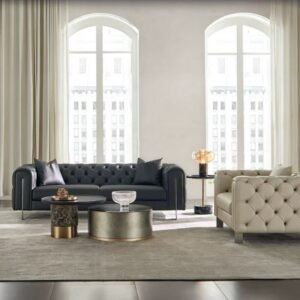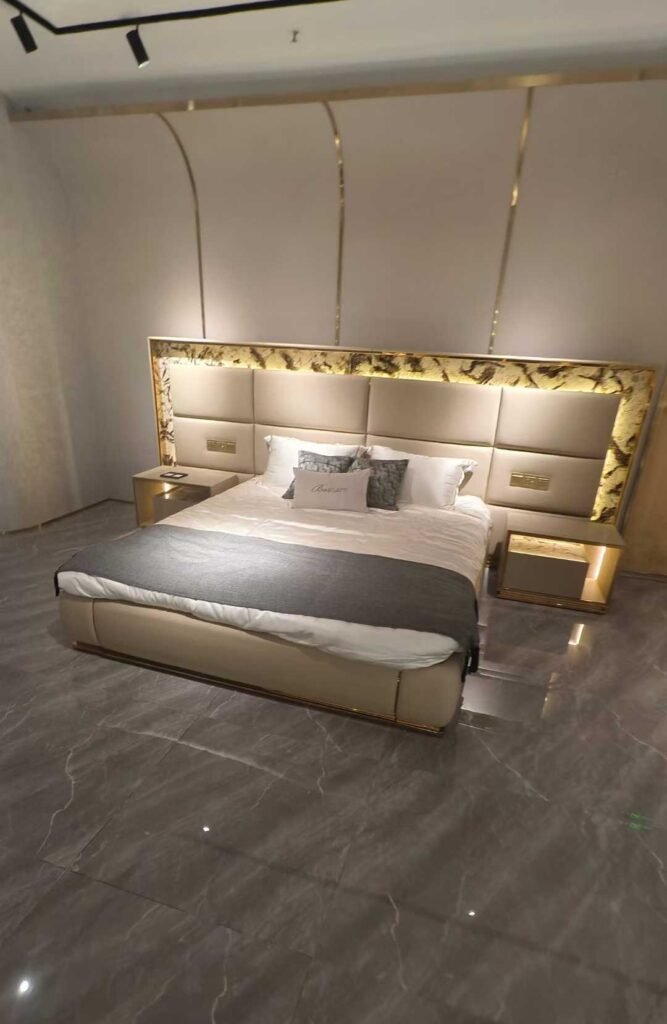
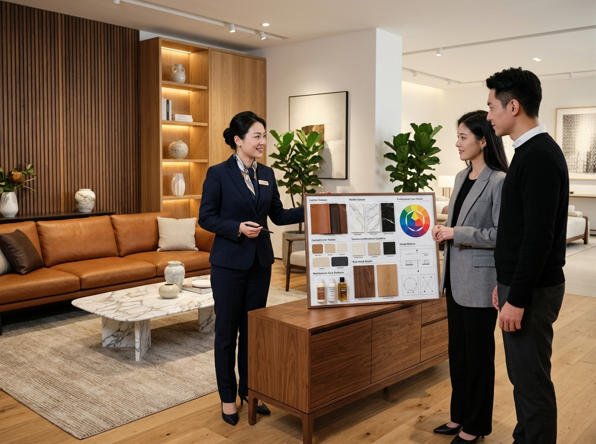

The Challenge — and the Reward — of Three Rich Materials
Italian leather, marble, and timber are each capable of commanding a room on their own. Put all three in the same space without a guiding framework, and you get exactly that — three materials fighting for attention, producing a room that feels expensive but exhausting. Achieve the balance, and the result is something different entirely: a space that reads as considered, layered, and quietly confident.
Interior designers who work at the luxury residential and hospitality level have a shared observation: the clients who are happiest with their finished spaces are almost never the ones who spent the most. They are the ones who understood how these three materials relate to each other — in color, texture, scale, and light — before any furniture was ordered or stone was sourced.
This guide gives you that framework. Whether you are designing a private villa, a boutique hotel suite, or a high-end apartment, the principles here apply equally. You will leave with specific rules for color matching, texture pairing, spatial proportion, lighting strategy, and a maintenance routine that protects materials worth preserving for decades.
Principles of Balancing Rich Materials
The first principle every professional designer applies — consciously or not — when combining multiple luxury materials is visual weight distribution. Each material occupies not just physical space, but perceptual space. Marble carries more visual weight than timber; polished marble carries more than honed; dark leather reads heavier than tan. Ignoring these weights is what produces rooms that feel unbalanced regardless of the quality of individual pieces.
Avoiding Visual Clutter
The most effective tool for avoiding visual clutter when mixing three premium materials is the 60/30/10 material ruleBorrowed from the 60-30-10 colour rule: one material dominates 60% of the visual field (typically the floor or walls), a second material covers 30% (furniture, cabinetry), and the third appears as 10% accent (decorative items, trims, statement pieces). This ratio creates harmony without monotony.. In a living room that combines all three materials, this typically translates to: timber dominating the floor and ceiling (60%), marble appearing on the coffee table, feature wall panel, or kitchen island (30%), and Italian leather concentrated in one anchor piece — a sofa, an accent chair, or a custom bench (10%).
When all three materials appear in equal proportions, the eye has no hierarchy to rest on. The result is busyness — a room that takes effort to read. When one material visually leads and the others support, the space achieves the effortless coherence that photographs well and, more importantly, lives well.
Focal Points and Rhythm
Every room anchored by premium materials needs a single, deliberate focal point — one surface or piece that says “this is where the design decision happened.” A marble-top dining table with a walnut base and leather dining chairs arranged around it creates a clear hierarchy: the table is the focal point, the chairs are the supporting material, and the timber floor provides the ground plane. Everything reads in sequence.
Rhythm is created through repetition of one material element across the room at different scales. If Calacatta marble appears on a feature wall panel, echoing it in a smaller format — a marble-topped side table, a bookend, a bathroom countertop — creates visual rhythm without additional complexity. The material appears once at large scale, once at medium scale, once as accent. Three appearances, one material, unified reading.
Note: Visual weight is a perceptual property affected by room scale, lighting, and adjacent colours. These ratings represent neutral conditions in a moderately lit residential space.

Understanding Color and Veining Harmony
The single most common reason a room with beautiful materials looks wrong is undertone conflict. Every marble has an undertone — warm (cream, beige, gold) or cool (grey, blue, green). Every timber species has a tonal temperature. Every leather is mixed with dyes that sit in either the warm or cool half of the spectrum. When undertones conflict, the materials do not fight obviously — they simply never settle. The room feels slightly off without the occupant being able to identify why.
Matching Undertones
The rule is simple to state and requires attention to apply: keep all three materials in the same undertone family, or make one deliberate, high-contrast departure that serves as the focal point. In practice, this means: if your timber floor is a warm medium oak with gold undertones, your marble should carry a warm base — Calacatta Gold, Crema Marfil, or Botticino — rather than a cool grey. Your leather then sits naturally in cognac, saddle tan, or warm caramel rather than slate or charcoal.
The alternative is intentional contrast: a very cool Calacatta Bianco marble against a very warm dark walnut timber, with the leather acting as a bridge — a warm cognac that connects the warmth of the wood to the cold precision of the stone. This approach is effective but less forgiving. One mis-specified leather color and the bridge collapses.
Coordinating Marble Veins with Leather and Wood
Marble veining is not just decorative — it is directional. The book-matched veinBook-matching is the process of opening two adjacent marble slabs like a book, creating a mirror-image vein pattern. Used on feature walls and large tabletops, it creates symmetrical movement. The veining direction should ideally flow toward the room’s primary focal point — a fireplace, a window, a view. of a Calacatta slab laid on a dining table creates movement that draws the eye along a specific axis. That axis should align with the room’s primary orientation — typically toward the focal point (a window, fireplace, or artwork). Placing a slab with strong diagonal veining perpendicular to the room’s visual flow creates visual tension that no leather color will resolve.
The color of the marble’s veining also interacts with leather and timber. Gold veining in Calacatta Gold references the warm undertones in a walnut table leg or an amber leather armchair, creating an implicit visual connection between otherwise separate pieces. Grey veining in Statuario references the cooler tones in a brushed-finish leather or a limewashed oak — again creating coherence that the eye registers as intentional rather than accidental.
| Marble Variety | Undertone | Compatible Timber | Compatible Leather | Avoid |
|---|---|---|---|---|
| Calacatta Gold | Warm (gold/cream veining) | Walnut, medium Oak, teak | Cognac, saddle tan, warm caramel | Cool grey leather |
| Calacatta Bianco | Cool-neutral (white base, grey veins) | Bleached oak, limewash oak, ash | Off-white, pale grey, slate | Deep amber leather |
| Statuario | Cool (white base, bold grey/gold veins) | Dark walnut (contrast), bleached oak | Charcoal, warm white, cognac (as bridge) | Orange-toned oak |
| Crema Marfil | Warm (beige/cream, subtle veining) | Light oak, maple, birch | Caramel, nude, warm tan | Black or dark grey leather |
| Nero Marquina | Cool-deep (black, white veining) | Pale ash (high contrast), dark smoked oak | White, charcoal, warm cognac (accent) | Medium brown timber |
| Emperador Dark | Warm-deep (brown/gold veining) | Dark walnut, mahogany | Deep cognac, oxblood, dark tan | Pale grey or white leather |
Texture and Finish Pairings: Leather, Marble, Timber
Color harmony gets a room to feel coherent. Texture harmony — the relationship between surface finishes — is what makes it feel sophisticated. The underlying principle is contrast with continuity: each material should offer a distinct tactile experience, but the degree of surface reflectivity should flow logically across the room rather than jumping unpredictably.
Matte vs Gloss Surfaces
A room where every surface is highly polished — mirror-finish marble, lacquered timber, patent-finish leather — feels cold and clinical rather than luxurious. Conversely, all-matte finishes can read as flat and heavy. The effective approach is a deliberate finish hierarchy: one material at high sheen, one at mid-sheen, one at matte. A polished Calacatta marble tabletop (high sheen) pairs well with an oiled walnut timber floor (mid-sheen, natural lustre without gloss) and a full-grain leatherFull-grain leather retains the entire outer surface of the hide — natural grain, pores, and all. It develops a patina (a darkening and deepening of color) over 5–15 years of use. Unlike corrected-grain leather, which is sanded and embossed to achieve uniformity, full-grain leather has inherent variation that becomes more pronounced and beautiful with age. It is the highest grade of genuine leather. sofa in a natural matte finish (no surface lacquer). Each material is distinct; together they occupy a finish range without any single surface overwhelming the others.
Sheen Consistency
The industry term is sheen consistency — ensuring that the finish level of each material does not clash with what sits beside it. A honed marble floor beside a highly polished marble feature wall creates inconsistency within a single material. More jarring still is polished marble beside a high-gloss lacquered timber cabinet and a patent leather sofa — three high-sheen surfaces occupying the same visual zone create a disco effect, not a luxurious one.
Industry insight: Honed marble has overtaken polished as the preferred finish in luxury residential projects, particularly in kitchens and bathrooms, because it conceals daily-use etching while maintaining the stone’s visual depth. Source: compiled from design publication surveys and project portfolio analysis.
Choosing the Right Leather: Texture and Finish
Not all leather behaves the same way in a multi-material room. The leather grade, tanning method, and surface treatment fundamentally affect how it reads beside marble and timber — and how it ages over the years you will live with it.
Full-Grain vs Corrected-Grain
Full-grain leather retains the complete outer surface of the hide, including natural pores and any minor scarring. Because the grain structure is intact, it is the strongest and most durable grade — and the only grade that develops a genuine patinaPatina: the darkening and deepening of leather’s colour that develops through contact with skin oils, light exposure, and use over time. On full-grain leather, patina enhances the material — leather that is 10 years old with visible patina is considered more beautiful than new. On corrected-grain leather, which has a synthetic surface coating, no patina forms. over time. In a room with marble and timber — both materials that show age elegantly — full-grain leather completes the triumvirate. All three materials become more beautiful as they age.
Corrected-grain leather has been sanded to remove surface imperfections and then embossed with an artificial grain pattern. It is more uniform, easier to clean, and significantly cheaper. In a room with natural marble and timber, corrected-grain leather creates a subtle incongruity: two natural materials aging alongside one that effectively does not. For hospitality environments where uniformity across hundreds of seats matters, corrected-grain has legitimate applications. For a private residence or boutique hotel where the design intention is lived-in luxury, full-grain is the consistent choice.
Leather Color Approaches
Three leather color strategies work reliably in marble-and-timber rooms. Tonal unity: the leather closely matches the warmth of the timber (a cognac leather beside a walnut table reads as one continuous warm material family). Deliberate contrast: a very pale leather — almost cream — against dark marble and deep timber creates maximum drama and requires the most compositional discipline. Neutral bridge: a warm mid-tan or caramel leather sits between the warmth of timber and the coolness of marble, functioning as a visual transition that makes the contrast between the other two materials feel intentional rather than arbitrary.
| Grade | Surface | Develops Patina | Longevity | Best Application | Price Tier |
|---|---|---|---|---|---|
| Full-Grain | Natural, visible pores, minor scars | Yes — deepens with age | 25–50+ years | Residential sofas, luxury dining chairs, armchairs | Premium |
| Top-Grain | Lightly sanded, thin protective coat | Minimal | 15–25 years | High-use commercial seating, hotels | Mid-premium |
| Corrected-Grain | Sanded + embossed artificial grain | No | 5–12 years | High-volume hospitality, office seating | Mid-range |
| Aniline (Full-Grain) | Dye-only treatment, fully natural surface | Maximum — richest patina | 30–50+ years | Statement pieces, bespoke furniture | Highest |
| Semi-Aniline | Light protective topcoat over aniline | Yes — moderate | 20–35 years | Luxury residential with practical demands | Premium |
Marble Varieties and Application Rules
Marble is not a single design decision — it is a series of decisions: variety, finish, application scale, and placement. A Calacatta Gold slab on a 4-metre kitchen island reads entirely differently from the same stone used as a 30cm side table top. The marble variety should be chosen first based on the undertone compatibility rules already discussed; the application and finish follow from that.
Vein Patterns and Room Function
Marble veining intensity — from the almost-invisible whisper of Crema Marfil to the dramatic brushstroke of Calacatta Viola — should be calibrated to the room’s function and the visual complexity already present. A living room with strong architectural features (coffered ceiling, bespoke joinery, statement fireplace) benefits from a quieter marble — Crema Marfil or soft Carrara — that does not compete with the architecture. A minimalist room with clean walls and simple furniture can carry the drama of Calacatta Gold or Nero Marquina without feeling overwrought.
The practical rule: the more visual complexity already in the room, the quieter the marble vein pattern should be. The marble’s job in a complex room is to add material richness, not additional visual events.
Polished vs Honed and Practicality
This is where design aspiration and daily life intersect. Polished marble reflects light beautifully and makes spaces feel larger and more formal — but it reveals every etch mark (the dulling caused by acidic liquids like wine, coffee, and citrus), every water spot, and every fingerprint. On a horizontal surface in a used kitchen or dining room, polished marble requires sealing every 6–12 months and daily buffing to maintain its finish. Honed marble has a satin, non-reflective surface that conceals etching dramatically better, shows fewer water marks, and has a warmer, less formal presence alongside timber and leather. For floors, honed marble is also safer — its higher slip resistance is a practical consideration that polished marble cannot match.
Timber Species and Cabinet/Flooring Roles
Timber in a material trio of leather, marble, and wood performs two distinct functions: it provides the room’s warmth anchor (marble and leather both carry associations of formality; timber humanizes the space), and it defines the ground plane through flooring or the vertical plane through cabinetry. The species chosen determines everything from the undertone match to the grain character to how the material photographs in different lighting.
Oak, Walnut, Maple Comparisons
Oak is the most versatile timber species in luxury interiors — its open grain and honey-to-mid-brown tonal range sits harmoniously beside almost every marble variety and leather color. White oak, when wire-brushed or fumed, develops a silvery-cool tone that pairs exceptionally well with grey-undertoned marbles and cool-finish leathers. Red oak runs warmer and works less predictably beside cool marble. Living room furniture in fumed oak beside a Calacatta marble fireplace surround is a combination that appears consistently in high-end residential projects in London, New York, and Singapore for a reason.
Walnut is the designer’s material for drama with warmth. Its deep chocolate-to-espresso color, combined with a flowing, sometimes figured grain, creates an immediate sense of richness that polished marble amplifies rather than diminishes. Walnut reads as formal in large pieces — a walnut dining table beside a Statuario marble feature wall is a classic pairing in luxury penthouse dining rooms. It is also unforgiving: pale or incorrectly undertoned marble beside walnut creates a muddy, flat mid-tone that neither material escapes cleanly.
Maple is the quietest of the three. Its near-white to pale gold tone and tight, almost featureless grain makes it the ideal supporting timber when the marble is the design statement. Maple cabinetry beside Nero Marquina marble creates maximum contrast; the maple’s restraint lets the black marble’s white veining speak without competition. In leather pairing, maple works best with very light leathers — pale cream, ivory, or very light tan — where the entire room sits in a high-key (light) palette.
Grain, Tones, and Durability
Grain direction in timber installation affects perceived room scale. Floorboards laid parallel to the room’s longest axis elongate the space visually — the standard approach for rectangular rooms. Boards laid perpendicular visually widen a narrow room. Herringbone or chevron patterns, increasingly specified in luxury interiors, create movement and scale-appropriate visual interest without introducing a third material. The Janka hardness rating — a measure of wood’s resistance to denting and scratching — matters in rooms where marble side tables or heavy chairs are regularly moved: walnut (1010 lbf) holds up better than maple (1450 lbf is actually harder, making it more scratch-resistant but less workable), while oak (1290 lbf) sits between them.
| Species | Tonal Range | Grain Character | Janka Hardness | Best Marble Pairing | Best Leather Pairing |
|---|---|---|---|---|---|
| White Oak | Honey → silver-grey (fumed) | Open, linear, architectural | 1360 lbf | Calacatta Gold, Crema Marfil | Cognac, caramel, warm tan |
| Walnut (American) | Mid-chocolate → espresso | Flowing, sometimes figured | 1010 lbf | Statuario, Calacatta Bianco (contrast) | Deep cognac, oxblood, saddle |
| Maple (Hard) | Pale cream → golden yellow | Tight, minimal, almost featureless | 1450 lbf | Nero Marquina, dark Emperador | Ivory, pale cream, very light tan |
| Teak | Golden brown → deep honey | Interlocked, oily surface | 1000 lbf | Calacatta Gold, Botticino | Cognac, warm amber, natural tan |
| Ash (European) | Pale cream → light brown | Bold, cathedral arch pattern | 1320 lbf | Calacatta Bianco, soft Carrara | Light grey, off-white, pale stone |
Source: YouTube — “How to Mix Wood Tones in Your Home.” The principles in this video — anchoring, warm-cool separation, and dominant/supporting material roles — apply directly to the timber selection and placement decisions in a multi-material room.
Spatial Planning: Proportion and Scale
A marble tabletop in the wrong scale is more damaging to a room’s composition than the wrong marble. Material choice and spatial proportion are inseparable decisions. A 2.4-metre Calacatta Gold dining table in a 4-metre by 4-metre square room overwhelms the space regardless of how carefully the leather chairs and timber floor are specified. The material serves the proportion; the proportion does not adjust to serve the material.
Grid and Zoning Techniques
Professional designers working with multiple premium materials use a material zoning planA material zoning plan is a top-view drawing of a room that assigns each material to specific zones — usually floor, walls, furniture, and accents — before any procurement begins. It prevents the “too much everywhere” problem by forcing decisions about where each material appears and where it does not. In a high-end residential project, this plan is typically drawn to scale with material samples attached. before any procurement begins. This is essentially a top-view room drawing where leather, marble, and timber are each assigned zones — floor, wall, furniture, accent — and the visual weight of each zone is assessed in aggregate. The goal is that no single axis of the room (looking from any doorway) shows all three materials in equal proportion.
The golden ratio (1:1.618) applied to material scale produces naturally pleasing proportions. A marble coffee table whose longest dimension is 1.618 times a leather sofa’s seat depth sits in compositional harmony with that sofa. A marble fireplace surround whose width is 1.618 times the mantel height reads as inherently balanced. These are not arbitrary rules — they reflect the same proportional relationships that appear in classical architecture and that the eye registers as “right” without conscious analysis.
Lighting and Accents to Enhance the Trio
Light is not a finishing touch in a multi-material room — it is a primary design decision. The same combination of Calacatta Gold marble, walnut timber, and cognac leather looks transformative under warm 2700K tungsten-equivalent lighting, and flat, institutional under 4000K cool-white LEDs. Marble’s veining depth, leather’s surface richness, and timber’s grain warmth all depend on specific colour temperature and directional lighting to read as intended.
Natural vs Artificial Lighting
Natural light is directional and changes throughout the day — morning light is warm and low-angle, midday light is cool and diffuse, afternoon light is the warmest and most gold-toned. A room designed for a specific mood at a specific time of day can lean into this: a breakfast room with east-facing light will warm walnut and leather naturally in the morning; a west-facing living room will cast the richest light across marble and leather in late afternoon. When designing a room for year-round use, specify artificial lighting that replicates the warmth and directionality of the room’s best natural light moment.
Artificial lighting should deliver: ambient light (ceiling or cove-mounted, warm 2700K) for general illumination that does not flatten surfaces; accent lighting (directional spotlights or wall-washers) to bring out marble veining and leather surface texture; and task lighting (pendants over dining tables or kitchen islands) that creates intimacy and focus around the marble surfaces where activity happens.
Metallic and Fabric Accents
The fourth material in a leather-marble-timber room — the one that is often overlooked but that ties the trio together — is the metal finish used in hardware, lighting fixtures, and structural legs. Brushed brass or unlacquered brass connects naturally to the gold undertones of warm marble veining and the honey tones of oak or walnut. Brushed nickel or satin steel aligns with cooler marble undertones and bleached or fumed oak. Blackened or oxidized steel provides graphic contrast against pale marble and light timber without the warmth of brass — appropriate for more contemporary or masculine compositions.
Fabric accents — cushions, curtains, throws — should be treated as material support rather than material statement. In a room anchored by three premium materials, fabric’s role is textural contrast (a bouclé cushion against full-grain leather creates a soft-hard dialogue) and colour continuity (a warm-toned linen curtain in a room combining walnut, cognac leather, and Calacatta Gold marble extends the warm undertone family without competing with any of the three primary materials). Avoid introducing a fourth strong material statement — highly patterned fabric, bold colour, or ornate texture — in a room already carrying three premium materials at significant scale.
Case Studies: Real-World Implementations
Theory clarifies principles. Case studies demonstrate outcomes. The two examples below are drawn from completed residential and kitchen projects that used the Italian leather, marble, and timber combination with documented success — measurable either by client satisfaction, resale value uplift, or publication in design media.
Residential Lounge Example
A 52 sqm open-plan living and dining area in a Hong Kong high-rise penthouse. The brief: warm, sophisticated, materials that improve with age, functional for a couple who entertain formally four to six times per month.
🪨 Marble Application
Calacatta Gold, honed finish, 3.2m × 1.6m slab on the dining table base fabricated by a Guangdong marble specialist. Vein direction runs parallel to the apartment’s primary east-west axis, leading the eye toward floor-to-ceiling city views.
Specification: 20mm slab thickness, custom steel-waterfall base in brushed brass🌳 Timber Application
American walnut, wire-brushed finish, 190mm wide boards laid end-to-end in the main axis direction. Walnut dining chairs with open back rails — the open silhouette prevents the seating from closing off the marble table’s visual presence.
Specification: 21mm engineered walnut, Rubio Monocoat oil finish, 3-coat application🛋️ Leather Application
Full-grain aniline leather in cognac on a four-seat sofa in the living zone. The sofa is the room’s only leather piece — concentrated rather than distributed, it acts as the warmest visual anchor in a room that combines the coolness of marble with the deep warmth of walnut.
Specification: Italian full-grain aniline, 1.4mm thickness, naturally tanned, no surface coating💡 Lighting & Metal
Brass pendant over dining table (2700K, dimmable), cove-wash LED around perimeter at 2700K, concealed accent spots washing the walnut floor from the ceiling edge. All hardware in brushed brass. The warm light makes the Calacatta Gold veining appear to glow at evening dining.
Outcome: Room photographed for a regional design publication; owner reports guests consistently ask about the marble-leather-timber combination as a unified impression, not separate materialsLuxury Kitchen Layout
A 38 sqm kitchen-dining in a private villa in Bali, designed for daily family use and weekly formal entertaining. The challenge: marble in a tropical climate where humidity and cooking acids are constant threats to polished stone.
🪨 Marble Decision
Honed Statuario — the cool white base and bold grey veining provides maximum contrast against the warm timber chosen for cabinetry. Honed finish chosen specifically for humidity resistance and ease of maintenance. Applied to the island (primary work surface) and a full-height backsplash section only — vertical application avoids daily contact damage.
Specification: 30mm slab island top, 12mm honed Statuario backsplash panel🌳 Timber Decision
Teak cabinetry — specified for its natural oil content and humidity resistance. The golden-brown teak creates a warm-cool dialogue with the cool Statuario marble. All cabinet interiors in lacquered maple for easy cleaning. Floor in wide-plank teak, medium brushed finish.
Specification: Teak veneer over 18mm MDF cabinet carcass, hand-oiled finish, renewable annually🛋️ Leather Accent
Leather appears only in the bar stool seating — semi-aniline cognac, chosen for its protective topcoat that resists cooking splashes while retaining a natural surface feel. Three stools at the marble island, leather seat pads with a tight, clean profile that does not visually compete with the island’s marble surface above.
Specification: Semi-aniline, Italian tannery, wax finish, replaceable seat pads💡 Outcome
After two years of daily family use, the honed Statuario shows no etch marks. The teak cabinetry has been oiled once, deepening naturally. The leather bar stools show minimal wear on the seat surface. The owner’s report: “The kitchen looks better now than the day we moved in.” Jade Ant Furniture supplied the teak dining chairs for the adjoining dining zone, specified to match the cabinetry teak profile exactly.
Resale assessment: property valued 18% above comparable non-material-specified kitchens in the same developmentPractical Checklist and Maintenance
Materials this good deserve care proportional to their quality. The maintenance routines below are not onerous — they require minutes per week and a few hours per year. The reward is a room whose materials continue improving over the years rather than degrading toward a replacement cycle.
Durable Combinations — What Lasts
Care and Maintenance Routines
Marble maintenance — the most labour-intensive of the three. Seal honed marble with a penetrating stone sealer (not a surface coating) every 12 months, or when a water droplet no longer beads on the surface. Daily cleaning: pH-neutral stone cleaner or simply warm water. Never use vinegar, lemon juice, or general household cleaners — all are acidic enough to etch marble at the molecular level. Wipe spills within 5 minutes. Re-polish small etch marks with a marble polishing powder (tin oxide) applied by hand before they deepen.
Full-grain leather maintenance — the most rewarding. Dust with a clean dry cloth weekly. Condition with a quality leather conditioner (beeswax-based or lanolin-based) every 6–12 months — this prevents drying and cracking while feeding the patina development process. Do not use products containing silicone (leaves a residue that prevents the leather from breathing) or mineral oil (darkens permanently and unpredictably). Direct sunlight will fade and dry leather — position leather pieces away from unfiltered south-facing windows. Clean spills immediately with a barely damp cloth; do not rub, blot.
Timber maintenance — depends entirely on the finish type. Oil-finished timber (Rubio Monocoat, Osmo, Treatex) should be re-oiled annually in high-use areas using the same oil product — one coat applied thin and buffed off within 30 minutes. Lacquered timber requires only damp-cloth cleaning. Wire-brushed timber holds dust in its texture — a soft brush attachment on a vacuum before damp-mopping is the correct sequence. Never use steam mops on any real timber floor; the steam penetrates the wood grain and causes irreversible expansion damage over time.
- Marble: seal annually with penetrating stone sealer; use only pH-neutral cleaners; wipe spills within 5 minutes.
- Leather: condition every 6–12 months; avoid silicone products; keep from direct sustained sunlight.
- Timber: oil annually (oil-finished); never use steam mop; vacuum with soft brush before damp mopping.
- Metal hardware: wipe brushed brass monthly with a dry cloth; avoid abrasive polishes that remove the brushed texture.
- All three materials: avoid placing on or near heating vents — dry forced air is the most common cause of timber cracking, leather drying, and marble hairline fracturing in residential interiors.
- Annual review: walk the room with the original specification sheet and compare material condition against installation photos. Catch deterioration early, when it is least expensive to address.
Looking for Furniture That Brings This Material Trio to Life?
Jade Ant Furniture manufactures custom luxury furniture — marble-top dining tables, leather-upholstered seating, and solid timber pieces — to the exact specifications your interior design requires. Every piece is designed with material harmony in mind.
Explore Marble & Timber Dining Collections →The Rules Exist to Be Applied, Then Quietly Broken
The framework in this guide is not a formula — it is a foundation. The 60/30/10 material weight rule, the undertone compatibility matrix, the finish hierarchy, the proportion principles — these are the accumulated practice of designers who have made expensive mistakes in both directions: rooms where premium materials cancelled each other out, and rooms where the restraint was so strict that the materials never fulfilled their potential.
The most memorable rooms combining Italian leather, marble, and timber are not the most technically correct ones. They are the rooms where a designer understood the rules deeply enough to know exactly which one to break, and why. A room where all three materials appear in equal proportion should produce visual noise — but occasionally, in the right geometry with the right lighting, it produces something extraordinary. The difference is intention. Every rule-break in a successful multi-material room was deliberate, informed by knowledge of what the default outcome would have been.
Start with the checklist. Apply the undertone compatibility table before you confirm any material purchase. Get the finish hierarchy right — it costs nothing extra and changes everything about the room’s coherence. Then, once the framework is in place, bring in the material that excites you — the marble slab with the extraordinary vein pattern, the leather that smells like it was made for exactly this room — and let the framework carry it.
For clients and designers looking for furniture that is made to specification — whether that means a marble-top dining table to a precise slab and base specification, leather dining chairs with a documented full-grain leather grade, or timber case goods in a species and finish matched to an existing floor — the team at Jade Ant Furniture works with interior designers, developers, and private clients to produce exactly these kinds of specification-led pieces. Their custom production process begins with design drawings, material confirmation, and sample approval — the same front-loaded discipline that prevents the expensive surprises this guide is designed to help you avoid.
Material Glossary
- Aniline Leather
- Leather dyed exclusively with transparent dyes — no pigment coating. The most natural-looking leather grade; shows the hide’s full character and develops the richest patina over time.
- Book-Matched Marble
- Two adjacent slab faces opened like a book, creating a mirror-image vein pattern. Typically used on feature walls, dining tables, and fireplace surrounds for maximum visual symmetry.
- Honed Finish (Marble)
- A smooth, non-reflective satin surface achieved by stopping the polishing process before the final buffing stage. Conceals etching and daily wear significantly better than polished finish.
- Undertone
- The secondary colour visible beneath the dominant colour of a material. Marble, timber, and leather all have undertones (warm = gold/cream/red; cool = grey/blue/green) that determine compatibility when combined.
- Visual Weight
- The perceptual heaviness of a surface in a room. Dark, polished surfaces carry high visual weight; pale, matte surfaces carry low visual weight. Balancing visual weight across materials prevents any single surface from dominating unintentionally.
- Patina (Leather)
- The darkening and deepening of full-grain leather’s colour caused by skin oils, light exposure, and use over time. Unlike surface damage, patina is considered aesthetically desirable — leather with visible patina is regarded as more beautiful than new leather.
- Janka Hardness
- A measurement of timber’s resistance to surface denting, expressed in pound-force (lbf). Higher Janka = harder wood. Important for timber used in high-traffic flooring or alongside heavy marble furniture that is frequently moved.
- 60/30/10 Rule
- A design proportion guideline: one material dominates 60% of the visual field, a second covers 30%, and a third appears as 10% accent. Creates hierarchy without monotony in multi-material rooms.
- Calacatta vs Carrara
- Both are Italian white marbles. Carrara has fine, light grey veining and a slightly blue-white base — subtle and versatile. Calacatta has bolder, thicker veining in grey or gold on a brighter white base — more dramatic and significantly more expensive.
- Wire-Brushed Timber
- A mechanical texturing process where soft wood fibres are removed with a wire brush, accentuating the timber’s grain texture. Creates a tactile, aged surface that pairs well with honed marble and natural leather in contemporary-traditional interiors.