Luxury Private Label Furniture: How to Build a Signature Collection That Commands Premium Pricing
For high-end furniture importers, distributors, private label brand owners, interior designers, villa owners, FF&E buyers, architecture firms, developers, and hotel operators
I. The Strategic Imperative of a Signature Collection
A. From “Curated Sourcing” to “Brand Ownership”
For years, many luxury importers made money by finding good pieces at trade fairs, adding a margin, and reselling them. That model is getting harder to run.
When the same sofa shows up in three competitors’ showrooms, the only thing left to compete on is price. A designer who spots your “exclusive” piece on another distributor’s website stops trusting your catalog.
A signature collection fixes this. It’s a group of furniture designed for your brand alone: your design language, your materials, your name on every label. Buyers can’t get it anywhere else.
Quick definition: Private label furniture is furniture made by a manufacturing partner to your design and specifications, then sold only under your brand.
B. Why Exclusivity Matters to HNWIs and FF&E Buyers
HNWI means High-Net-Worth Individual, usually someone with at least US$1 million in investable assets. Reports such as the Knight Frank Wealth Report follow how this group spends, and homes and interiors stay near the top of their priorities.
For these clients, being the only person who owns a piece is part of what they’re paying for. A villa owner doesn’t want to see her living room sofa in a friend’s house in the next town.
Hotel FF&E buyers care about exclusivity for a different reason. FF&E means Furniture, Fixtures & Equipment, the movable items in a hotel. If a boutique hotel’s lobby chair is also in the chain hotel next door, the boutique has lost part of its identity.
C. Objective of This Guide
This guide is a step-by-step blueprint for building a contemporary signature collection. It covers design DNA, materials, engineering, manufacturing partnerships, pricing, collection planning, marketing, and delivery.
Key Terms Glossary
| Term | Plain-English Meaning | Example |
|---|---|---|
| Signature collection | A furniture line designed for and owned by your brand | A 12-piece living and dining range sold only through you |
| Design North Star | One guiding idea that every piece in the collection must follow | “Soft architecture: strict lines, soft materials” |
| Anchor piece | A high-value hero item that sets the tone for the whole collection | A 3.6 m curved sofa or a book-matched marble dining table |
| Aniline leather | Leather dyed all the way through, with no heavy surface coating | Soft, natural-feeling leather that develops a patina |
| Grade-A marble | Top-quality stone with few cracks, fills, or color flaws | Calacatta slabs with even, bold veining |
| CMF | Color, Material, Finish: the full surface “recipe” for a product | Smoked oak + cognac leather + brushed bronze |
| Golden sample | The final approved prototype that all production must match | A signed and sealed chair kept at the factory |
| AQL | Acceptable Quality Limit: the maximum share of defects allowed in an inspection | AQL 1.0 for major defects on a luxury order |
| MOQ | Minimum Order Quantity: the smallest order a factory will accept | 1 piece per design for prototypes, 20 for production |
| A&D firms | Architecture and Design firms that specify furniture for projects | A studio choosing seating for a 120-key resort |
II. Defining the Luxury Design DNA (Modern & Contemporary)
A. A Cohesive Visual Language That Outlives Trends
A signature collection must possess a cohesive visual language that transcends fleeting trends.
Trends change every season. A good collection should still look right five to ten years from now. That only happens when every piece follows the same set of design rules.
B. Establishing a “Design North Star”
Your Design North Star is a short statement that guides every design decision. Here’s how one plays out across a collection:
| Design North Star | What It Looks Like in Practice |
|---|---|
| “Soft architecture” | Strict rectangular frames, rounded edges, bouclé and wool fabrics |
| “Warm minimalism” | Few lines, but warm woods, leather, and bronze accents |
| “Sculptural calm” | Organic curves, matte surfaces, stone and plaster textures |
| “Quiet opulence” | Simple shapes with rich details: inlays, fluting, hand-stitched seams |
The goal is to balance minimalism with luxury details. Pure minimalism can feel cold and cheap if the materials are ordinary. Heavy decoration can look dated fast. Most strong contemporary collections pair a simple shape with one or two rich details.
Real-world scenario: A European private label brand set its North Star as “one gesture per piece.” Each design was allowed a single standout detail, such as a fluted base or a brass inlay, and nothing more. Designers began recognizing the collection across rooms, and that recognition is what you’re after.
C. Matching Aesthetics to Your Target Buyer
| Buyer Type | What They Value Most | Design Direction |
|---|---|---|
| Villa owners | Personal comfort, privacy, statement pieces for entertaining | Generous scale, deep seating, rich materials |
| Boutique hotel operators | Instagram-ready identity, durability, easy cleaning | Distinct silhouettes, performance fabrics, robust frames |
| Branded residence developers | Broad appeal, consistency across many units | Timeless shapes, neutral palette, modular sizes |
| Interior designers | Flexibility, custom options, reliable specs | Wide CMF choices, clear technical drawings |
For a view of where hotel buyers are heading next, read our hospitality furniture trends forecast for private label brands.
D. A Mood Board That Bridges Architecture and Art
A mood board is a collage of images, colors, and material samples that captures the feeling of a design. For a signature collection, build it in three layers:
- Architecture layer: The buildings your furniture will live in, such as concrete villas, glass penthouses, or stone resorts
- Material layer: Physical swatches of wood, stone, leather, fabric, and metal
- Art layer: Sculpture, ceramics, or fashion references that give the collection its character
Use physical samples, not only screen images. A walnut finish looks very different on a monitor than it does under warm villa lighting.
III. Materiality and the “Tactile Luxury” Standard
A. Materials Are the First Proof of Luxury
In the high-end market, the quality of materials is the primary validator of luxury.
A client may not know the difference between two design styles. They will feel the difference between real aniline leather and coated split leather the moment they touch it.
B. Sourcing Rare and Sustainable Materials
| Material | Luxury Standard | Common Downgrade to Avoid | What to Ask Your Supplier |
|---|---|---|---|
| Marble | Grade-A slabs, matched veining | Heavily resin-filled or patched slabs | Slab photos and a block number before cutting |
| Hardwoods | FSC-certified walnut, oak, ash, kiln-dried | Uncertified or poorly dried timber | FSC certificate and moisture readings (8–12%) |
| Leather | Full-grain aniline or semi-aniline | Corrected-grain or bonded leather | Tannery name, leather type, and a hide sample |
| Metals | Solid brass, bronze, stainless steel 304 | Thin plating on zinc alloy | Material spec and plating thickness |
| Textiles | Wool, linen, mohair, performance velvets | Low rub-count polyester | Abrasion and fire test reports |
You can check wood certificates through the Forest Stewardship Council. For leather, find out whether the tannery is audited by the Leather Working Group. For stone selection and care guidance, the Natural Stone Institute is a trusted source.
Aniline leather is the most natural-looking leather. It’s soft and warm, and it shows the hide’s character. It also stains more easily, so it’s better suited to villas than to busy hotel lobbies.
C. The Role of Sensory Appeal
People judge luxury with more than their eyes:
- Weight: A heavy drawer front or a solid chair feels more valuable. Hollow, light pieces feel cheap.
- Texture: Smooth hand-rubbed wood, cool marble, and soft bouclé all ask to be touched.
- Scent: Real leather and oiled wood have a natural smell. A chemical or plastic smell points to cheap finishes or glues.
- Sound: A drawer that closes with a soft, solid sound signals quality. A rattle signals the opposite.
Industry insight: In showroom testing, buyers often open a drawer before anything else. Many private label brands now upgrade drawer runners and drawer box construction first, because it’s the cheapest way to raise how valuable a piece feels.
D. Quality Control at Raw Material Intake
Most quality problems start before production does. Set up a material intake checklist:
- Wood: Check species, grain, moisture content (with a meter), and whether there are cracks or knots.
- Stone: Check each slab against the approved photos. Look for cracks, fills, and color matches.
- Leather: Check hide grade, thickness, color match to the approved swatch, and surface marks.
- Foam: Check density (kg/m³) and firmness against the spec.
- Hardware: Check finish color, weight, and function before fitting.
Reject anything that doesn’t match the spec before it’s cut. Changing a slab costs much less than remaking a finished table.
IV. Engineering for Longevity and Performance
A. The Invisible Engineering Behind Luxury
True luxury is defined by the invisible engineering that ensures lifelong durability.
Clients rarely see the frame, the joints, or the springs. They do notice when a sofa sags, a chair wobbles, or a drawer sticks.
B. Structural Integrity: Joinery and Framing
| Component | Budget Method | Luxury Method | Why It Matters |
|---|---|---|---|
| Wood joints | Staples and glue | Mortise-and-tenon or dowel joints with corner blocks | Joints stay tight for decades |
| Sofa frame | Particleboard or soft pine | Kiln-dried hardwood or engineered plywood | No cracking or twisting |
| Seat support | Elastic webbing only | Sinuous springs or pocket springs + webbing | Even, lasting support |
| Drawers | Stapled boxes, roller runners | Dovetailed boxes, full-extension soft-close runners | Smooth action, long life |
| Table bases | Thin metal tubes | Solid or thick-wall steel, reinforced welds | Stable under heavy stone tops |
Mortise-and-tenon is a joint in which a “tongue” of wood (the tenon) fits tightly into a matching slot (the mortise). It’s one of the strongest traditional woodworking joints.
C. Balancing Residential Elegance with Commercial Durability
Hotel furniture faces far more use than villa furniture. If you want hotel operators to buy your collection, the same design may need a “contract version.”
| Feature | Residential Version | Contract (Hotel) Version |
|---|---|---|
| Fabric rub count | 25,000–30,000 Martindale | 40,000–100,000+ Martindale |
| Foam | 30–35 kg/m³ | 35–45 kg/m³, high-resilience |
| Fire rating | Local residential rules | Contract fire codes (e.g., CAL TB 117-2013, BS 7176) |
| Frame testing | Standard | Tested to commercial standards (e.g., BIFMA) |
| Finish | Delicate lacquers allowed | Harder, scratch-resistant topcoats |
| Covers | Fixed | Often removable for cleaning |
Martindale is a test that rubs fabric in a figure-eight pattern until it shows wear. The higher the number, the tougher the fabric. Commercial durability standards from BIFMA are widely used in North American hospitality specs.
For more on what hotel buyers look for in a manufacturing partner, see our guide on choosing the right hospitality contract furniture manufacturer.
D. Integrating Smart Technology Without Spoiling the Design
More villa owners and hotel guests expect built-in technology. Common features include:
- Wireless charging pads hidden under nightstand or side table tops, usually using the Qi wireless charging standard
- USB-C ports set into headboards or sofa arms
- LED strips under beds or inside display cabinets
- Motorized lift mechanisms in media consoles
The rules for doing it well:
- Hide it: Technology should be invisible until it’s used.
- Make it serviceable: Add removable access panels, so a failed charger doesn’t mean replacing the whole piece.
- Certify it: Electrical parts need certification for your sales market, such as UL for the US or CE for the EU.
- Plan cables early: Cable routes need to be designed into the frame from the start, not drilled in later.
V. Navigating the Private Label Manufacturing Partnership
A. Brand and Manufacturer Must Work as One Team
The success of a signature line depends on the synergy between the brand and the manufacturer.
Your manufacturer turns your drawings into real objects. If they don’t understand your Design North Star, your collection will drift with every production run.
B. Vetting Partners
| What to Check | What Good Looks Like | Red Flag |
|---|---|---|
| Craftsmanship | Skilled finishers, upholsterers, and stone workers in-house | Everything subcontracted |
| Machinery | CNC machines for precision, plus hand finishing | Only manual tools, or only machines |
| Project experience | Past luxury or hotel projects, with photos | Only catalog products |
| Communication | Engineers who can read and question your drawings | Says “no problem” to everything |
| Ethics | Recent social compliance audits | Won’t allow factory visits |
| Flexibility | Low MOQ for prototypes and small first runs | High MOQ even for sampling |
CNC stands for Computer Numerical Control. These machines cut wood, stone, or metal with computer precision, so every piece comes out identical.
For labor and ethics checks, ask for recent audits from programs like amfori BSCI. For a step-by-step comparison method, read our guide on how to compare top hospitality furniture manufacturers.
This video walks through what buyers should watch for in China’s main furniture hub, Foshan, including how to tell real quality from cheap copies:
https://www.youtube.com/watch?v=KpVxXqKjEZc
C. The Prototype Phase: Sample, Refine, Stress-Test
A prototype is where the design meets reality. Plan for two or three rounds:
| Round | Purpose | What You Check |
|---|---|---|
| Round 1: White sample | Proportions and comfort | Frame shape, seat height and depth, overall scale |
| Round 2: Finished sample | Look and feel | CMF accuracy, stitching, finish, hardware |
| Round 3: Golden sample | Final approval | Every detail signed off as the production standard |
Stress-testing means using the prototype the way real customers will:
- Sit on the sofa edge, again and again
- Open and close drawers hundreds of times
- Spill water, wine, and coffee on fabric and stone samples
- Leave samples near a sunny window for several weeks to check fading
Jade Ant furniture supports low-MOQ orders for prototypes, down to one piece per design depending on the project. Brands can test a full room set before committing to a production run. In practice, this is when most design changes happen, while they’re still cheap.
D. Managing Lead Times

Illustrative timeline for a 10–15 piece collection, about 42 weeks in total. Simple collections can be faster, and collections with rare stone or custom castings can take longer.
Ways to keep your supply chain agile:
- Pre-book production slots by sharing a rough 6-month forecast with your manufacturer.
- Reserve long-lead materials early, such as marble slabs, custom fabrics, and cast hardware.
- Plan around holidays. Chinese New Year 2027 falls on February 6, and most factories slow down for 4–6 weeks around it.
- Hold safety stock of best-selling staples, so you can ship quickly while bespoke pieces are in production.
VI. Strategic Pricing and Value Positioning
A. Pricing Must Match Perceived Value
Luxury pricing must reflect perceived value, exclusivity, and the cost of uncompromising quality.
If you price too low, clients doubt the quality. If you price too high without proof, they walk away. The price has to tell the same story as the product.
B. Cost-Plus vs. Value-Based Pricing
Cost-plus pricing means taking your total cost and adding a fixed markup. Value-based pricing means setting the price by what buyers believe the piece is worth.
| Example: Signature Lounge Chair | Cost-Plus | Value-Based |
|---|---|---|
| Landed cost (factory + freight + duty) | $1,400 | $1,400 |
| Method | Cost × 2.5 | Benchmarked against comparable designer chairs |
| Retail price | $3,500 | $4,800 |
| What justifies it | Nothing extra | Aniline leather, hand-stitched seams, solid walnut, numbered edition |
Value-based pricing only works if the value is real and visible. Every dollar above cost-plus should be backed by something a client can see, touch, or verify.
C. Creating “Anchor Pieces”
An anchor piece is a high-ticket statement item that sets the price expectation for the whole collection.
When a client sees a $28,000 book-matched marble dining table, the $4,800 chairs around it look reasonable. The anchor may sell in small numbers. Its main job is to raise how valuable everything else appears.
D. Tiering the Collection
| Tier | Share of Collection | Purpose | Example Pieces |
|---|---|---|---|
| Iconic (limited editions) | 10–15% | Prestige, press, social media | Numbered sculptural sofa, rare stone tables |
| Signature core | 35–45% | Main revenue and identity | Lounge chairs, dining tables, beds |
| Essential luxury staples | 40–50% | Volume, versatility, hotel orders | Side tables, nightstands, dining chairs, benches |
Industry insight: Iconic pieces usually make up a small share of unit sales but drive a large share of inquiries. Many brands find that one strong limited-edition piece shown at a trade fair brings in more designer leads than the rest of the stand combined.
VII. Curation and Collection Architecture
A. A Curated Ecosystem, Not a Random Assortment
A powerful collection is a curated ecosystem, not a random assortment of pieces.
Every piece should look like it belongs to the same family. If you put any two items from your collection side by side, they should clearly match.
B. A Cohesive Product Mix
Here’s a sample first-launch structure for a 14-piece contemporary collection:
| Category | Pieces | Role |
|---|---|---|
| Seating | 3-seat sofa, modular sofa, lounge chair, dining chair | Core comfort and identity |
| Tables | Coffee table, side table, dining table, console | Material showcase (stone, wood, metal) |
| Bedroom | Bed with signature headboard, nightstand, bench | Hotel and villa suite packages |
| Storage | Sideboard, media cabinet | High-margin casegoods |
| Accent | Floor lamp or pendant | Completes the room story |
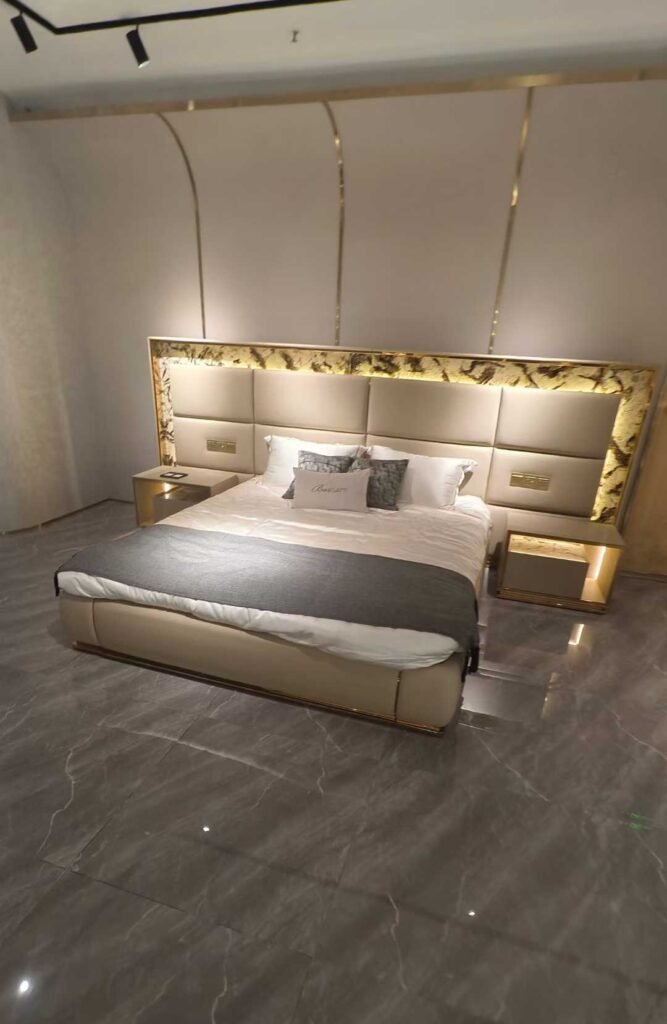
The bed is often the anchor for hotel buyers. Our luxury modern bed collection shows how a headboard design can carry a brand’s identity through a whole guest room.
What ratio of statement to staple pieces works? A common starting point is about 1 statement piece for every 4 complementary pieces. Statement pieces grab attention, and staples make the room work.
C. The “Modular Luxury” Approach
Modular furniture is made of separate units that can be combined in different ways. For interior designers, it’s a powerful tool, because the same collection can fit very different rooms.
| Modular Element | Options to Offer |
|---|---|
| Sofa units | Armless, left-arm, right-arm, corner, chaise, ottoman |
| Widths | 2–3 standard widths per unit |
| Bases | Plinth, metal legs, wooden legs |
| Upholstery | Full CMF palette |
| Headboards | Standard, extended wall-width, floor-to-ceiling |
Real-world scenario: A designer furnishing a 9-meter-wide villa salon needed a 6.5 m curved seating group. A fixed-size sofa couldn’t do it. A modular system with curved corner units could, and the brand won the order.
D. Versatility Across Architectural Settings
Before launch, test your collection in three or four very different settings, using 3D renders or a showroom:
- A concrete-and-glass modern villa
- A warm stone Mediterranean villa
- A dark, moody boutique hotel lobby
- A bright, white branded residence
If the collection only works in one, the market for it is narrow. For ideas on how supporting pieces lift an interior, see our list of must-have light luxury furniture pieces for elegant villas.
VIII. Marketing the Narrative: From Product to Heritage
A. Clients Buy the Story
Luxury clients do not buy furniture; they buy the story of craftsmanship and prestige.
Two chairs can look alike in a photo. The one with a clear story, such as “hand-stitched over 14 hours, using leather from a single audited tannery,” is the one that sells at a premium.
B. Storytelling Through “The Making Of”
Document your production process from the start:
| Content Type | What to Show | Where to Use It |
|---|---|---|
| Material origin | Marble quarry blocks, timber stacks, leather hides | Website, catalogs |
| Artisan process | Hand sanding, stitching, stone polishing | Social media, trade fair screens |
| Quality checks | Inspectors measuring and testing | Designer presentations |
| Before and after | Raw frame to finished piece | Short videos, reels |
Keep it honest. Wealthy clients and designers can tell when the story is invented.
C. High-Conversion Visual Assets
Designers and architects choose furniture through images long before they see it in person. Invest in:
- Architectural photography: Pieces shot in real luxury interiors, not on white backgrounds alone
- Detail shots: Close-ups of stitching, grain, veining, and hardware
- 3D models and renders: Files designers can drop into their own project renderings
- Technical sheets: Dimensions, materials, and test data in one clean PDF
Industry insight: Many A&D firms now shortlist furniture partly based on whether 3D files are available. If your pieces aren’t in the designer’s rendering software, they may never make it into the project.
D. Leveraging Exclusivity
- Limited drops: Release iconic pieces in numbered editions, such as 25 units worldwide.
- “By invitation” previews: Show new pieces to top distributors and designers before the public launch.
- Territory exclusivity: Give key distributors exclusive rights in their region for certain designs.
IX. Distribution and the High-Touch Client Experience
A. Delivery Is the Final Luxury Touchpoint
The delivery and installation process is the final, critical touchpoint of the luxury experience.
A client may spend months choosing a piece. A damaged crate or a careless installer can undo all of that goodwill in ten minutes.
B. White-Glove Logistics
White-glove delivery means the team carries the piece in, unpacks it, assembles it, places it, cleans it, and removes all packaging.
| Item Type | Packaging Standard |
|---|---|
| Stone and marble tops | Custom wooden crate, foam lining, shipped upright on edge |
| Lacquered casegoods | Soft wrap, corner guards, plywood crate |
| Upholstered pieces | Breathable cover, cardboard frame, then crate |
| Glass and mirrors | Braced crate with foam inserts |
| Hardware and small parts | Labeled bags fixed inside the main crate |
Ask whether packaging has been tested to International Safe Transit Association (ISTA) standards, which simulate drops, vibration, and stacking. For the import side of the process, our guide to importing and distributing high-end furniture covers customs, duties, and landed-cost planning.
Make the unboxing feel like part of the brand:
- Branded dust covers or fabric bags for upholstered pieces
- A printed care card and certificate of authenticity
- A signed or numbered plaque on limited editions
C. After-Sales Concierge Services
| Service | What It Includes | Client Benefit |
|---|---|---|
| Care guide | Cleaning, products to avoid, conditioning schedule | Fewer accidental damages |
| Warranty | Frame 5–10 years, upholstery and finish 1–3 years | Confidence in the investment |
| Spare parts | Matching fabric, hardware, finish touch-up kits | Quick repairs, no replacement |
| Annual check-up | Optional inspection for hotels and villas | Problems caught early |
For a model you can adapt for your own care guide, see our luxury bedroom furniture care framework.
D. Partnering with A&D Firms
Architecture and design firms decide what goes into many of the biggest projects. To become their go-to brand:
- Give them complete spec sheets and 3D files.
- Offer sample kits with fabric, leather, wood, and stone.
- Assign a project contact who replies quickly with technical answers.
- Be flexible on dimensions and finishes for project orders.
- Deliver on the promised date every time. Designers remember who let them down.
X. Scaling the Vision
A. From Concept to Market Leadership
Building a signature collection follows a clear path:
| Stage | Key Focus |
|---|---|
| Design DNA | A clear North Star and buyer-focused aesthetic |
| Materials | Grade-A, verified, sustainable, and tactile |
| Engineering | Strong frames, contract versions, hidden smart features |
| Manufacturing | A vetted partner, prototype rounds, golden samples |
| Pricing | Value-based, anchor pieces, tiered collection |
| Curation | Cohesive mix, modular options, versatile across settings |
| Marketing | Real craft stories, strong visuals, exclusive drops |
| Distribution | White-glove delivery, after-sales care, A&D partnerships |
B. Brand Equity That Builds Over Time
Illustrative split of a first-collection development budget. The real numbers depend on how many pieces you launch and how complex they are.
A resold catalog piece builds value for someone else’s brand. A signature collection builds value for yours. Every hotel, villa, and showroom that uses your designs adds to your reputation, and that reputation lets you raise prices, win larger projects, and attract better distributors.
C. From Distributor to Design Authority
The move from reseller to brand owner is a big one, and you don’t have to make it alone. Jade Ant furniture was founded by Anna Chow, who spent more than 10 years at an architecture firm before turning to custom luxury furniture in 2010. That background shapes how our team turns design drawings into pieces that can be built and repeated. Learn more about Jade Ant’s story and production approach, or read our complete guide to private labeling modern luxury furniture for more on branding and margins.
When you’re ready to turn your Design North Star into real prototypes, start a project conversation with our team.
Related FAQs for Luxury Brand Owners & Buyers
1. How do I ensure my private label designs are original and not derivative of existing luxury brands? Start from your own Design North Star, not from a competitor’s catalog. Work with an in-house or freelance designer, and keep dated sketches and drawings as proof of your design process. Before launch, search design registries and major brand catalogs for close matches. If a design is too similar to an existing piece, change the key details.
2. What are the key differences in manufacturing requirements for residential villas versus luxury hotel FF&E? Hotel FF&E needs higher fabric rub counts (usually 40,000+ Martindale), denser foams, stronger frames, harder finishes, and contract fire certifications. Villa furniture can use more delicate materials, such as aniline leather and silk, because it gets far less traffic. Many brands offer one design in both a residential and a contract version.
3. How can I maintain consistent quality across a large-scale production run of handcrafted pieces? Use a signed golden sample as the standard, and keep it on the production floor. Write a detailed spec sheet for every piece, check raw materials before cutting, inspect during production, and run a pre-shipment inspection against AQL standards. For big orders, compare pieces from the start, middle, and end of the run side by side.
4. What is the ideal ratio of “statement pieces” to “complementary pieces” in a contemporary collection? A common starting point is about 1 statement piece for every 4 complementary pieces, or roughly 20% statement and 80% staples. Statement pieces attract attention and set the price level. Staples drive volume and make room packages work for hotels and villas.
5. How do I vet a manufacturer to ensure they can handle the complexities of high-end materials like exotic stone or rare metals? Ask for photos and references from past projects using the same materials. Visit the factory, or arrange a live video tour, to see stone-cutting, metalwork, and finishing in action. Order a prototype using your real materials. A capable manufacturer will raise technical questions about weight, edge treatments, and shipping before you have to ask.
6. What are the most sustainable luxury materials currently trending in the modern contemporary market? Popular choices include FSC-certified hardwoods, leather from audited tanneries, recycled or responsibly sourced brass and aluminum, natural wool and linen, and plant-based or low-VOC finishes. Reclaimed timber and natural stone from transparent quarries are also in demand. Buyers increasingly ask for certificates, not just claims.
7. How do I handle the logistics of shipping oversized, fragile luxury furniture internationally? Use custom wooden crates with foam lining and edge protection, and ship stone tops upright. Design large pieces to come apart where possible, for example with modular sofas or removable legs. Check site access (doors, elevators, stairs) before shipping, insure at full replacement value, and work with white-glove installers at the destination.
8. What is the typical timeline from the initial concept phase to the final product launch? For a 10–15 piece collection, expect about 9–12 months. That includes roughly 6 weeks for design development, 4 weeks for engineering drawings, 8–12 weeks for prototype rounds, 4 weeks of testing, 8 weeks of pilot production, 4–6 weeks of freight and customs, and 4 weeks to prepare the launch.
9. How can I protect my intellectual property (IP) when working with overseas private label manufacturers? Sign an NNN agreement (Non-Disclosure, Non-Use, Non-Circumvention) before sharing drawings. For China, write it in Chinese and make it enforceable under Chinese law. Register your designs in your key markets and in the manufacturing country. The WIPO Hague System can help with international design registration. State in the contract that you own all molds and tooling. This is general information, not legal advice.
10. Should I focus on a narrow, highly specialized collection or a broad range of furniture categories? Most successful brands start narrow, with 10–15 pieces done exceptionally well in one or two categories such as living and dining. A tight first collection is easier to perfect, photograph, and sell. Once it proves itself, expand into bedroom, outdoor, or hotel packages.
11. How do I communicate the “value proposition” of a signature collection to interior designers and architects? Give them what makes their job easier: clear spec sheets, 3D files, sample kits, flexible custom options, and reliable lead times. Show the craft story with close-up photos and making-of videos. Designers trust brands that deliver on time and answer technical questions quickly.
12. What are the most common pitfalls private label brands face when entering the luxury furniture segment? The most common mistakes are launching too many pieces too soon, pricing from factory cost instead of landed cost, skipping prototype stress-tests, weak IP protection, and choosing a manufacturer on price alone. Poor packaging and delivery also damage many new brands. Our breakdown of procurement mistakes in luxury villa projects covers several of these in detail.