A dining chair gets used an average of 1,460 times per year in a household that eats together twice daily. Over a 10-year ownership cycle, that adds up to more than 14,000 sit-stand cycles, countless spilled glasses, and thousands of hours bearing load. The difference between a well-chosen dining chair and a poorly chosen one is not merely aesthetic — it is the difference between a piece that matures gracefully and one that wobbles after 18 months.
Chinese dining chairs occupy a unique position in the global furniture market. They draw from one of the world’s oldest woodworking traditions — a tradition that perfected mortise-and-tenon joinery centuries before European cabinetmakers adopted it — while also competing at price points that span from $30 plywood imports to $5,000+ solid rosewood heirlooms. That breadth creates opportunity for buyers, but also risk. A chair that looks identical in a product photo may differ radically in frame timber, joint construction, finish chemistry, and ergonomic geometry.
This guide is built for buyers who want to make informed decisions. Whether you are furnishing a personal dining room, specifying chairs for a restaurant renovation, or curating a product line for retail distribution, the sections that follow cover the dimensions that determine whether a Chinese dining chair delivers lasting value: materials, construction, comfort, style, maintenance, pricing, and sourcing channels. For readers exploring custom dining room furniture from China, we also reference practical benchmarks from manufacturers like Jade Ant Furniture, which produces bespoke dining chairs for villa, apartment, and hospitality projects.
Overview of Chinese Dining Chair Categories
Understanding Chair Types: Backless Stools, Midsize Chairs, Full Backchairs
Chinese dining seating falls into three broad structural categories, each suited to different use cases and spatial requirements.
Backless stools (凳, dèng) are the most compact option. Traditional Chinese round stools and drum stools (鼓墩, gǔ dūn) serve as flexible dining seating that tucks completely under a table when not in use. In modern applications, backless dining stools work well in small apartments or as supplementary seating for gatherings. The tradeoff is obvious: without back support, extended seating comfort beyond 30–40 minutes declines significantly for most adults.
Midsize chairs include the classic Chinese side chair (靠背椅, kào bèi yǐ) — a straight-backed chair with a seat height typically between 44 and 48 cm and a backrest that rises 30–40 cm above the seat. This is the workhorse of Chinese dining furniture. The proportions balance compact footprint with adequate lumbar engagement, making it suitable for daily meals and moderate-duration dining.
Full backchairs encompass the iconic horseshoe armchair (圈椅, quān yǐ) and high-back official’s hat chair (四出头官帽椅). These are statement pieces. Total heights range from 90 to 120 cm, with armrests that provide lateral support. In residential dining settings, full backchairs work best around larger tables (180 cm+) where space permits their wider footprint. In commercial settings — particularly Chinese restaurants aiming for cultural authenticity — they create a visual narrative that plywood alternatives cannot replicate.
How to Evaluate Suitability for Table Height and Room Style
The universal ergonomic rule for dining chairs is a 25–30 cm gap between the seat surface and the table top. Standard dining tables in Chinese and international markets measure 74–76 cm in height, which means the optimal chair seat height falls between 44–50 cm. Deviating by even 2–3 cm creates noticeable discomfort: too low, and diners hunch forward with elevated shoulders; too high, and feet dangle, placing pressure on the underside of the thighs.
Beyond height, evaluate the chair’s visual weight relative to the table and room. A heavy rosewood horseshoe chair beside a slim glass table creates a proportional mismatch. A refined Ming-style side chair beside a rustic farmhouse table creates a stylistic mismatch. The most successful dining room compositions maintain material and visual consistency — coordinated furniture sets where the chair’s wood tone, finish sheen, and design era align with the table and surrounding décor.
Common Materials Used in Chinese Dining Chairs
Wood Types (Hardwoods, Plywoods) and Their Characteristics
Wood selection is the single most consequential decision in dining chair procurement. It determines structural strength, weight, appearance, longevity, and price. China’s furniture industry uses a tiered system of wood grading that roughly aligns with global market pricing:
| Wood Type | Grade | Janka Hardness (lbf) | Key Characteristics | Wholesale Price Range (per chair) |
|---|---|---|---|---|
| Huanghuali (Chinese Rosewood) | Luxury / Collectible | 2,500+ | Honey-amber tone; fragrant; extremely dense; museum-grade durability | $2,000–$8,000+ |
| Teak | Luxury | 1,070 | Natural oil resistance to decay; golden-brown color; weather-resistant | $300–$800 |
| Black Walnut | High-End | 1,010 | Rich dark tone; excellent dimensional stability; ages beautifully | $150–$500 |
| White Oak | High-End | 1,360 | Strong grain pattern; wear-resistant; ideal for daily-use dining | $100–$350 |
| North American Ash | Mid-Range | 1,320 | Shock-resistant; good for steam-bending curved backs; light color | $80–$250 |
| Beech | Mid-Range | 1,300 | Fine straight grain; excellent for steam-bending; heavy | $60–$200 |
| Elm | Mid-Range | 830 | Decorative interlocking grain; flexible; affordable for traditional styles | $50–$150 |
| Rubberwood | Economy | 500 | Sustainable (end-of-cycle rubber trees); easy to finish; lightweight | $30–$80 |
| Plywood (multi-layer) | Budget | N/A | Uniform strength; suitable for molded seats; lower weight; cost-efficient | $15–$50 |
An industry insight worth noting: according to Interiors Projects, China accounts for approximately 40% of global wooden furniture exports, which gives manufacturers access to a wider variety of timber species — and more competitive pricing — than manufacturers in most other countries. White oak and North American ash dominate the mid-to-high-end dining chair segment because they balance grain aesthetics, structural strength, and workability at scale.
Upholstery Options: Fabric, Leather, Faux Leather
Many Chinese dining chairs pair a wood frame with an upholstered seat pad or full seat-and-back covering. The upholstery choice affects comfort, maintenance burden, and lifecycle cost:
Genuine leather develops a patina over time that many owners consider an asset rather than a defect. Top-grain leather on a dining chair seat typically lasts 10–15 years before showing significant wear, and daily maintenance requires nothing more than a dry cloth wipe-down. The tradeoff is price: leather seat pads add $40–$120 to the wholesale cost of a chair, and leather does not breathe well in hot, humid climates — a meaningful consideration in Southeast Asian and Gulf state markets.
Performance fabric (polyester-blend, Crypton, or Sunbrella-type weaves) offers the widest selection of colors and textures. Fabrics rated above 30,000 double rubs (the Wyzenbeek abrasion test) withstand 5–8 years of daily dining use. The maintenance requirement is higher than leather — fabric absorbs spills and requires periodic shampooing or steam cleaning — but the design flexibility is unmatched for buyers who need to match specific color schemes.
Faux leather (PU or PVC) provides the visual similarity of leather at 30–50% of the cost. Modern PU formulations have improved significantly; premium PU can exceed 100,000 Martindale rub cycles. However, faux leather remains susceptible to peeling and cracking after 3–5 years, particularly in environments with temperature fluctuation. For commercial dining operations that replace chairs on a 5-year cycle, faux leather represents a practical value choice. For residential buyers who expect 10+ year ownership, genuine leather or high-performance fabric is a better long-term investment.
Metals and Alternative Materials: Steel, Aluminum, Rattan
Powder-coated steel frames provide industrial durability at minimal weight. A steel-frame dining chair with a plywood or upholstered seat typically weighs 4–6 kg — roughly half the weight of an equivalent solid oak chair — and can support loads exceeding 150 kg. Steel works best in modern, industrial, or commercial dining environments where stackability and cleanability matter more than warm tactile feel.
Aluminum offers even lighter weight (3–4 kg per chair) with excellent corrosion resistance, making it the preferred frame material for outdoor or semi-outdoor dining. Chinese manufacturers in Foshan and Dongguan produce aluminum dining chairs at scale for hospitality export markets.
Rattan and woven cane — both natural and synthetic — bring organic texture that complements light-wood dining tables. Natural rattan is handwoven, which limits production speed but creates a unique tactile quality. Synthetic rattan (PE wicker over an aluminum frame) provides weather resistance for outdoor use. Both options pair well with the “New Chinese” (新中式) design movement that blends traditional material textures with contemporary silhouettes.
Durability Factors: Wood, Joints, Finishes
Joinery and Construction Quality to Look For
If there is one single indicator that separates a dining chair that lasts 20 years from one that loosens after 2, it is joinery method. Chinese furniture has a 2,000-year history of mortise-and-tenon joinery (榫卯, sǔn mǎo) — a system where interlocking wood joints create structural integrity without nails, screws, or metal fasteners. A properly cut mortise-and-tenon joint distributes load across all four surfaces of the tenon, creating a bond that actually tightens under stress rather than loosening.
In modern production, three joinery tiers define the market:
Full mortise-and-tenon (traditional): Found in high-end and artisan dining chairs. No metal fasteners. The joint relies entirely on precise wood-to-wood contact, sometimes reinforced with hide glue. These chairs can be disassembled and re-glued during maintenance — a critical advantage for heirloom pieces that may need re-tensioning after decades of use.
Modified mortise-and-tenon with corner blocks: The dominant construction method in mid-range Chinese dining chairs. Mortise-and-tenon joints connect legs to rails, with reinforcing corner blocks (glued and screwed) adding stability. This method balances production efficiency with structural performance and represents the best value for most residential buyers.
Dowel and screw assembly: Common in budget and flat-pack dining chairs. Cylindrical dowels (8–10 mm diameter) replace tenons, and screws provide additional clamping force. Dowel joints are inherently weaker than mortise-and-tenon because they offer a fraction of the glue surface area. Under repeated stress — the rocking motion when a diner leans back — dowel joints loosen faster. Expect 3–5 years of daily use before re-tightening is needed.
Finish Durability and Resistance to Wear
The finish on a dining chair serves two functions: protection against moisture, stains, and abrasion, and enhancement of the wood’s visual character. The four primary finish types used on Chinese dining chairs offer different performance profiles:
| Finish Type | Moisture Resistance | Scratch Resistance | Repairability | Maintenance Frequency |
|---|---|---|---|---|
| Catalyzed lacquer | High | High | Low (requires full strip & recoat) | Annual dusting; spot-clean spills |
| Polyurethane varnish | High | Medium-High | Medium (can be sanded & recoated locally) | Annual dusting; recoat every 5–7 years |
| Penetrating oil (tung oil, linseed) | Medium | Low-Medium | High (apply oil to worn area; blends naturally) | Re-oil every 6–12 months |
| Wax | Low | Low | High (re-wax locally) | Re-wax every 3–6 months |
For dining chairs — which face daily contact with skin oils, occasional food spills, and repeated friction at armrest and seat surfaces — catalyzed lacquer or polyurethane varnish provides the most practical protection. Oil finishes, while beautiful and easy to repair, demand commitment to a regular maintenance schedule that many homeowners underestimate. Wax finishes are best reserved for display pieces or low-use settings where the priority is tactile warmth over practical durability.
Lifecycle Expectations and Typical Maintenance Needs
When properly built and finished, Chinese dining chairs follow a predictable lifecycle curve:
Expected Lifecycle by Construction Method (Years of Daily Use)
Mortise-tenon (hardwood)
Modified M&T + corner block
Dowel + screw (softwood)
Dowel + screw (plywood)
20–50+ yrs
10–20 yrs
3–7 yrs
2–5 yrs
These figures come with a critical caveat: lifecycle is only partially determined by the chair itself. Environmental conditions matter. A solid oak chair in a climate-controlled dining room will outlast the same chair in an uninsulated sunroom where temperature swings between 5°C and 35°C cause seasonal wood movement. Humidity control — keeping indoor relative humidity between 40–60% — is the single most impactful maintenance action a homeowner can take to protect wooden furniture.
Comfort and Ergonomic Considerations
Seat Height and Depth for Different Body Types
Ergonomic research consistently points to three critical dimensions that determine dining chair comfort: seat height, seat depth, and backrest angle.
Seat height should position the diner’s feet flat on the floor with thighs roughly parallel to the ground. The standard recommendation is 44–50 cm (17.3–19.7 inches), which accommodates adults between roughly 160 cm and 185 cm in height. For households with significant height variation — parents and children dining together, for example — chairs with a seat height of 46 cm represent the best compromise.
Seat depth (front edge to backrest) should allow 5–8 cm of clearance between the front edge of the seat and the back of the diner’s knees. A depth of 40–44 cm works for most adults. Chairs with depths exceeding 46 cm force shorter individuals to either perch on the front edge (losing back support) or press their calves against the seat edge (restricting circulation).
Seat width should accommodate the widest expected user with 2–3 cm of clearance on each side. Standard Chinese dining chair seat widths range from 42 to 48 cm. For commercial applications where diverse body types are expected, 46 cm minimum is a practical threshold.
Back Support, Lumbar Comfort, and Posture Alignment
The backrest is where Chinese dining chair design diverges most visibly from Western conventions. Traditional Chinese chairs often feature a flat, vertical backrest with a single S-curved splat — a design that looks minimal but, when proportioned correctly, contacts the mid-back (thoracic spine) and gently encourages upright posture. This is fundamentally different from the reclined, cushioned approach of Western dining chairs, and it carries ergonomic implications.
For meals lasting under 45 minutes, a well-proportioned Chinese straight-back chair provides adequate comfort for most adults. The upright posture actually aids digestion — a fact referenced in traditional Chinese dining culture but also supported by modern gastroenterological research showing that upright seating reduces gastric reflux compared to reclined positions. For extended dining — dinner parties, holiday meals lasting 90+ minutes — chairs with a slight backward tilt (5–8° from vertical) and a contoured lumbar zone significantly reduce fatigue. Many manufacturers in the “New Chinese” category now incorporate these ergonomic refinements while maintaining traditional visual language. Jade Ant Furniture, for example, produces custom dining chairs where back angle, seat depth, and lumbar contour are specified by the buyer rather than fixed by the factory’s standard template.
Size and Scale for Dining Spaces
Room Proportion, Table Clearance, and Crowding Considerations
The most common mistake in dining room planning is underestimating how much space each chair occupies — not just on the floor, but in the room’s functional volume. A dining chair needs three zones of clearance to function comfortably:
Table clearance: 25–30 cm between the top of the seat and the underside of the table apron. Armchairs require additional clearance — the armrest must slide under (or at least to the edge of) the table. Verify table apron height before purchasing armchairs.
Pull-back clearance: 60–75 cm behind the chair when pushed in, to allow a seated diner to stand up and walk behind other seated diners. In tight spaces, armless chairs reduce this requirement by 5–10 cm because they allow a more compact seated position.
Adjacent chair spacing: 15–20 cm between chair edges. For tables seating 6 or more, this spacing determines whether a long table feels convivial or claustrophobic. Measure the actual chair width at its widest point (usually the back legs or armrests), not the seat width alone.
Chair Width, Footprint, and Stackability When Space Is Tight
For apartments and small dining rooms — increasingly common in urban markets across Asia, Europe, and North America — chair footprint becomes a primary selection criterion. A standard Chinese side chair occupies approximately 45 × 50 cm of floor space. A horseshoe armchair occupies 60 × 55 cm — nearly 50% more. In a 12 m² dining area (a typical size in Hong Kong, Singapore, or Shanghai apartments), that difference determines whether you seat four or six people comfortably.
Stackable chairs solve the storage problem but introduce material constraints. Solid hardwood chairs rarely stack efficiently due to their construction geometry. Metal-frame chairs with contoured plywood seats are the most stackable option — 4–6 chairs typically stack within a 60 × 55 × 120 cm footprint. For buyers who need both Chinese aesthetic character and stackability, a hybrid approach works: metal frames with wood-veneer seats and backs provide the visual warmth of wood with the practical compactness of metal construction.
Style and Design Influences: Classic vs. Modern Twists
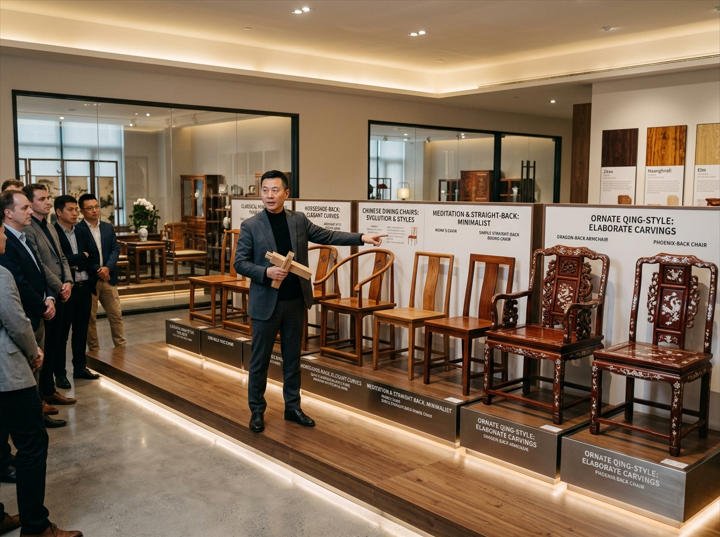
Classic Chinese Design Cues (Ming/Qing Influences) and Materials
Two dynasties dominate the vocabulary of Chinese furniture design, and understanding their differences is essential for any buyer navigating this market.
Ming dynasty (1368–1644) design is characterized by what Sotheby’s describes as “advanced engineering with minimalist aesthetic.” Ming chairs favor clean lines, gentle curves, minimal ornamentation, and the natural beauty of the wood grain itself. The iconic horseshoe armchair, with its continuous curved crest rail flowing into the armrests, is perhaps the most recognized piece of Chinese furniture in the world. Ming proportions tend toward lightness — slender legs, thin stretchers, and seat frames that appear to float. Material purity is paramount: Ming-style chairs showcase the timber rather than disguising it.
Qing dynasty (1644–1912) design moved toward opulence. Qing chairs feature intricate carved ornamentation — dragons, phoenixes, cloud scrolls, and floral medallions — applied to thicker structural members. Where Ming design whispers, Qing design projects. Qing-era pieces often use darker woods (zitan, hongmu) and incorporate inlay work with mother-of-pearl, marble, or contrasting wood species. The visual weight is substantial; a Qing carved dining chair makes a room feel furnished in a way that a Ming side chair deliberately does not.
Global Buyer Preference: Chinese Dining Chair Styles (2025–2026)
Style
Preference
New Chinese Modern 45%
Ming Minimalist 25%
Qing Ornate 12%
Western-Fusion 18%
Industry trade data from the Canton Fair and CIFF Guangzhou exhibitions suggests that “New Chinese” (新中式) — a design movement that reinterprets Ming and Qing elements through a modern lens — now accounts for the largest share of buyer interest in Chinese-origin dining furniture. The appeal is cross-cultural: New Chinese designs are legible as “Chinese” without being so traditional that they conflict with contemporary Western interiors.
How to Blend Traditional Chairs with Modern Interiors
The most effective approach to integrating Chinese dining chairs into modern interiors follows a “bridge” principle: identify one visual element that connects the chair to the rest of the room, and let the chair’s distinctiveness provide contrast on all other dimensions.
If the dining room features cool-toned modern furniture (white lacquer, chrome, glass), bridge through form — select a Ming-style chair with clean geometry that echoes the room’s linearity, but in warm walnut or ash that provides color contrast. If the room is warm and textured (natural stone, linen, wood paneling), bridge through material — select a chair in a matching wood species and let the Chinese silhouette provide the formal contrast.
Avoid the two extremes: fully matching everything (which produces a showroom-catalog look with no personality) and mixing every style simultaneously (which produces visual noise). One Chinese design element in a modern room — a pair of horseshoe chairs at the head and foot of an otherwise contemporary table, for instance — creates curated contrast. Six different chair styles around one table creates confusion.
Maintenance and Care Tips
Cleaning Routines by Material Type
Daily and periodic maintenance directly extends the functional life of any dining chair. The protocols differ significantly by material:
| Material | Daily Care | Weekly Care | Quarterly / Annual Care | Avoid |
|---|---|---|---|---|
| Solid wood (lacquered) | Dry microfiber cloth | Damp cloth with mild soap; dry immediately | Inspect finish for wear; touch up with matching lacquer pen | Abrasive cleaners; excess water; ammonia-based products |
| Solid wood (oiled) | Dry microfiber cloth | Damp cloth; dry thoroughly | Re-apply tung or linseed oil every 6–12 months | Silicone-based polishes; water pooling on surface |
| Genuine leather | Dry cloth wipe | Leather-specific cleaner if soiled | Condition with leather balm every 6 months | Harsh chemicals; direct sunlight (causes fading/cracking) |
| Faux leather (PU) | Damp cloth wipe | Mild soap solution; dry completely | Check for peeling; apply PU protectant | Bleach; alcohol-based cleaners; sharp objects |
| Fabric upholstery | Brush off crumbs | Vacuum with upholstery attachment | Professional steam clean or shampoo annually | Rubbing wet stains (blot instead); untested chemicals |
| Metal frame | Dry cloth | Damp cloth with mild soap | Check for rust spots (steel); touch up with matching paint | Abrasive scrubbers on powder coating |
| Rattan / wicker | Soft brush to remove debris | Damp cloth; dry in ventilated area | Apply furniture oil to prevent brittleness (natural rattan only) | Pressure washing; prolonged moisture exposure |
Preventive Care and Long-Term Protection Strategies
Beyond cleaning, four preventive measures significantly extend chair life. First, use felt pads (minimum 3 mm thickness) on all leg bottoms to prevent floor scratches and reduce impact vibration that loosens joints over time. Second, maintain indoor humidity between 40–60% — a $30 hygrometer is the most cost-effective furniture protection investment a homeowner can make. Third, rotate chair positions every 6 months so that UV exposure from windows ages all chairs evenly rather than fading two while leaving others untouched. Fourth, tighten any visible bolts or screws every 12 months — the 30-second tightening pass prevents the cascading joint loosening that eventually makes a chair unsafe.
Budgeting and Value: Price Ranges and What to Expect
How Materials Drive Cost: Solid Wood vs. Plywood vs. Upholstered Options
The material composition of a dining chair determines 60–70% of its final cost. Labor, finish, hardware, and packaging account for the balance. Understanding this cost structure helps buyers set realistic budgets and evaluate whether a quoted price reflects fair value or inflated margins.
Retail Price Distribution by Chinese Dining Chair Category (USD)
Rosewood / Huanghuali
Solid walnut (custom)
Solid oak (standard)
Ash / beech (mid-range)
Rubberwood (economy)
Plywood / metal frame
$800–$5,000+
$350–$1,200
$180–$600
$100–$350
$50–$150
$30–$90
A critical insight for cost-conscious buyers: the highest-value segment is often not the cheapest or the most expensive — it is the mid-range. A solid ash or beech dining chair with modified mortise-and-tenon joinery and a catalyzed lacquer finish, priced between $120 and $250 retail, delivers 85–90% of the durability of a premium walnut chair at 40% of the cost. The performance gap between a $150 ash chair and a $400 walnut chair is significantly smaller than the gap between a $40 plywood chair and a $150 ash chair. For buyers who want professional-grade construction without the premium of exotic hardwoods, Jade Ant’s dining room furniture collection demonstrates how mid-to-high-range timber (ash, oak, walnut) paired with experienced manufacturing produces chairs that compete visually and structurally with pieces priced 2–3x higher.
Timing Considerations: Sales, Bulk Purchases, Custom Orders
Furniture pricing follows seasonal patterns that savvy buyers can exploit. In the Chinese manufacturing calendar, factory capacity peaks from March to June and September to November — the pre-summer and pre-holiday export windows. Prices tend to be firmest during these periods because factories are running at capacity. Ordering during the quieter months (July–August, December–February) can yield 5–15% discounts, as factories seek to fill production gaps.
Bulk purchasing — even modest quantities of 6–12 chairs for a single dining set — typically unlocks wholesale pricing from Chinese manufacturers. The per-unit savings at 6 chairs versus 1 chair can reach 15–25% through direct factory channels. For larger orders (50+ chairs for restaurant fitouts), project-based pricing from manufacturers with hospitality experience delivers the strongest value, as production efficiencies reduce per-unit labor and finishing costs.
Where to Buy: Trusted Brands and Retailers
Reputable Brands and Showrooms to Consider
The Chinese dining chair market spans from artisan workshops producing 50 chairs per month to industrial operations producing 50,000. Navigating this spectrum requires understanding where each type of source fits your needs:
Heritage and artisan brands — manufacturers like China Furniture & Arts (U.S.-based importer of traditional rosewood), ChinaFurnitureOnline, and specialty dealers who source directly from Fujian and Guangdong workshops. Best for buyers seeking authentic traditional Chinese dining chairs in premium hardwoods with hand-crafted joinery.
Modern Chinese furniture brands — KUKA, QM (Qumei), and LINSY represent the scale-production end of the market, with showrooms in major Chinese cities and distribution across Southeast Asia, the Middle East, and North America. Best for buyers seeking contemporary or New Chinese designs at volume-competitive pricing.
Custom and project-oriented manufacturers — companies like Jade Ant Furniture serve importers, distributors, and interior design firms who need dining chairs produced to specific design briefs. This model works best when the buyer has a particular vision — custom dimensions, a specific wood-and-upholstery combination, or a design that doesn’t exist in any catalog. Jade Ant’s workflow (share concept → receive production drawings → approve sample → production in 30–60 days) provides the structure that one-off custom orders often lack from large-scale factories.
Online B2B platforms — Alibaba and Made-in-China host thousands of Chinese dining chair manufacturers. These platforms work well for experienced buyers who can evaluate factory credentials, interpret MOQ and FOB pricing, and arrange third-party quality inspection. For first-time buyers, the platform’s volume and variability can be overwhelming without sourcing expertise.
Evaluating Warranty, Return Policies, and After-Sales Service
Warranty coverage varies dramatically across Chinese dining chair sources. Heritage rosewood dealers often provide lifetime structural warranties because the furniture is built to outlast the owner. Mass-market brands typically offer 1–3 year limited warranties covering manufacturing defects but excluding normal wear, finish degradation, and upholstery damage. Online marketplace sellers may offer 30-day satisfaction guarantees but limited post-purchase support.
When evaluating warranty quality, focus on three specifics: what exactly is covered (structural frame only, or finish and upholstery as well), who bears the shipping cost for warranty claims, and whether replacement parts are available. A warranty that covers “manufacturing defects” but requires the buyer to ship a 12 kg chair internationally at their own expense is functionally useless for most residential buyers.
Assembly, Delivery, and Warranty Considerations
Common Assembly Needs and Tools Required
Chinese dining chairs arrive in one of three states depending on the manufacturer and shipping method. Fully assembled chairs are typical for domestic Chinese sales and premium international shipments — they arrive ready to use but consume more shipping volume, which increases freight cost. KD (knocked-down) assembly, where the chair ships in 3–5 pre-finished components with hardware, is the most common export configuration. Flat-pack assembly, with dozens of components and an instruction sheet, is typical of budget-priced online purchases.
For KD chairs, assembly typically requires an Allen key (included), a Phillips screwdriver, and 15–20 minutes per chair. The critical installation step is achieving correct bolt tension on leg-to-seat connections — tight enough to eliminate wobble, but not so tight that the bolt threads strip. A common mistake is using power drivers at full torque, which can strip the softer wood surrounding the bolt hole in ash, beech, or rubberwood frames. Hand-tightening the final quarter-turn is best practice.
Delivery Logistics, Assembly Supervision, and Warranty Terms
For international orders — increasingly common as buyers source dining chairs directly from Chinese manufacturers — delivery logistics follow a predictable sequence: factory production (30–60 days), inland transport to port (3–5 days), ocean freight (15–35 days depending on destination), customs clearance (3–10 days), and last-mile delivery. Total door-to-door timelines typically range from 8–14 weeks for standard orders.
White-glove delivery (in-room placement and assembly by the delivery team) is available through select retailers and manufacturers but adds $50–$150 per delivery in most markets. For buyers furnishing multiple rooms or commercial spaces, white-glove delivery is worth the premium — it eliminates the risk of assembly damage and provides immediate quality verification at the point of delivery.
How Ming Dynasty Design Shaped Modern Furniture
Understanding the design heritage behind Chinese dining chairs adds depth to any purchasing decision. This video from Christie’s auction house explains how Ming Dynasty huanghuali furniture directly influenced the mid-century modern movement — a connection that makes Ming-inspired dining chairs feel at home in contemporary interiors:
Industry Insights: What’s Driving the Chinese Dining Chair Market in 2026
Several structural trends are reshaping how Chinese dining chairs are designed, manufactured, and sold globally:
The global dining chair market is growing faster than the furniture market overall. The chair market reached $13.35 billion in 2025 and is projected to grow to $14.38 billion in 2026 at a 7.8% CAGR, according to Research and Markets. Dining chairs are a disproportionate driver of this growth, fueled by both residential renovation cycles and the post-pandemic expansion of restaurant and hospitality seating.
Premiumization is outpacing volume growth. Consumer surveys from Provoke Insights (Winter 2026) show that furniture buyers are purchasing fewer but higher-quality pieces. In the dining category specifically, the fastest-growing price tier is $200–$500 per chair — the range where solid hardwood, quality joinery, and professional finishing converge. Budget chairs under $80 are losing share to mid-range options as buyers weigh lifecycle cost rather than purchase price alone.
The “New Chinese” aesthetic is becoming a global design language. What started as a domestic Chinese trend — blending Ming-era minimalism with Scandinavian restraint — is gaining traction in Western markets where consumers seek alternatives to the dominant mid-century modern aesthetic. Trade fair data from CIFF Guangzhou and Maison&Objet Paris shows year-over-year increases in buyer inquiries for New Chinese dining sets, particularly from Middle Eastern, Southeast Asian, and European distributors.
Sustainability credentials are becoming a purchase driver, not just a marketing claim. FSC-certified timber, CARB Phase 2 formaldehyde compliance, and water-based finishes are increasingly specified in commercial dining furniture tenders. Residential buyers are following: a 2025 consumer survey found that 62% of buyers under 40 consider environmental certifications “important” or “very important” when purchasing furniture. Manufacturers who invested early in these certifications — including established players and specialized producers like Jade Ant Furniture, which uses environmentally friendly raw materials across its product lines — are gaining procurement preference over competitors who treat sustainability as an afterthought.
Choosing a Chinese dining chair well comes down to three interlocking decisions: material (which determines durability, weight, and price), construction (which determines structural longevity), and ergonomics (which determines daily comfort). Everything else — style, finish, upholstery — layers onto that foundation.
Here is a quick decision checklist for buyers:
| Decision Factor | What to Check | Red Flag If… |
|---|---|---|
| Wood species | Confirm species name in writing; check Janka hardness rating | Seller cannot name the species or says “solid wood” without specifying |
| Joinery method | Ask for construction photos or cross-section images | No visible mortise-and-tenon or corner blocks; only staples and dowels |
| Seat height | Measure from floor to top of seat surface (not cushion top) | Height is below 43 cm or above 51 cm for standard dining tables |
| Seat depth | Measure from front edge to backrest; verify 5–8 cm knee clearance | Depth exceeds 46 cm without a contoured front edge |
| Finish type | Ask whether lacquer, oil, wax, or polyurethane; request maintenance instructions | No finish specification provided; or finish name doesn’t match appearance |
| Weight test | Lift the chair — solid hardwood should feel substantial (6–10 kg) | A “solid wood” chair weighs less than 4 kg (likely veneer over particleboard) |
| Wobble test | Place on a flat surface and press down on each corner | Any rocking or clicking sounds indicate uneven legs or loose joints |
| Warranty | Request written warranty terms specifying coverage scope and claim process | Verbal-only warranty; no clear defect definition; buyer bears all shipping costs |
Consider not just the room you have today, but how that room will be used over the next decade. If your household is growing, prioritize durable hardwoods and cleanable upholstery that withstand children’s use. If you entertain frequently, prioritize ergonomic comfort for extended seating. If you are furnishing a rental or commercial space, prioritize lifecycle cost per year rather than upfront price per chair.
The right Chinese dining chair does more than fill a seat at your table. It contributes to the sensory experience of every meal, reflects your taste in craft and material, and — when chosen well — serves your household quietly and reliably for years without demanding attention. That is the mark of furniture worth owning.
Frequently Asked Questions (FAQs)
1. What materials are most durable for daily-family dining?
For families that use their dining chairs twice daily with occasional spills and regular movement, white oak and North American ash offer the best balance of durability, availability, and cost. White oak has a Janka hardness of 1,360 lbf — hard enough to resist dents from dropped utensils and chair-to-table contact — and its closed grain structure resists moisture absorption better than open-grain woods like elm. Ash, at 1,320 lbf, provides similar hardness with added shock resistance, which matters when chairs are dragged rather than lifted. Both woods accept lacquer and polyurethane finishes that create a sealed surface for easy spill cleanup. Avoid pine and rubberwood for high-traffic family dining — their lower hardness ratings (under 900 lbf) result in visible dents and scratches within 1–2 years of daily use.
2. How high should a dining chair seat be relative to a table?
The ideal gap between the chair seat surface and the table top is 25–30 cm (10–12 inches). Since most dining tables stand 74–76 cm tall, this means optimal seat height falls between 44 and 50 cm. At 46 cm, a chair accommodates adults ranging from approximately 160 cm to 185 cm in height. If household members fall outside this range, adjust accordingly: shorter adults and children benefit from 44 cm seats (or use a cushion to raise smaller children), while taller adults (185 cm+) should look for 48–50 cm seat heights. Always measure from the floor to the top of the seat’s hard surface — not the top of a removable cushion, which compresses under body weight.
3. What maintenance is required for upholstered Chinese dining chairs?
Maintenance requirements depend on the upholstery material. Genuine leather needs the least ongoing effort: a weekly dry-cloth wipe and a twice-yearly application of leather conditioner. Faux leather (PU) requires a similar dry-wipe routine but is more vulnerable to alcohol-based spills and should be cleaned with a mild soap solution rather than chemical cleaners. Fabric upholstery requires the most maintenance: weekly vacuuming with an upholstery attachment to remove crumbs and dust, immediate blotting (never rubbing) of spills, and an annual professional steam clean. Regardless of material, the single most important habit is addressing spills within 60 seconds — the longer a liquid sits, the deeper it penetrates, and the more difficult removal becomes.
4. Are traditional Chinese chairs comfortable for extended meals?
Traditional Chinese dining chairs — particularly Ming-style side chairs with flat, vertical backrests — are designed for upright posture during meals typically lasting 30–45 minutes, which aligns with traditional Chinese dining customs. For extended meals (90+ minutes), most adults will find traditional flat-backed chairs less comfortable than modern contoured alternatives. The “New Chinese” (新中式) design movement addresses this by incorporating subtle ergonomic refinements — a 5–8° backward tilt, a curved lumbar zone, and a slightly contoured seat — into traditionally styled frames. If you prefer the aesthetic of a classical Chinese chair but need comfort for dinner parties, look for these modified designs from manufacturers who specialize in custom dining furniture, where back angle and seat contour can be adjusted to your specifications.
5. How should I measure my dining space before buying chairs?
Start by measuring three things: table dimensions (length, width, height), the room’s total floor area, and the distance from the table edge to the nearest wall or obstruction. For comfortable dining, you need a minimum of 60 cm from the table edge to any wall behind a chair — this allows a seated diner to push back and stand without hitting the wall. Between the table edge and an active walkway (kitchen door, hallway), allow 90–120 cm so people can walk behind seated diners. Then calculate per-chair allocation: divide the table’s usable perimeter by the number of chairs, and verify that each slot provides at least 60 cm of width (for armless chairs) or 65 cm (for armchairs). Drawing a simple floor plan — even on paper — before purchasing prevents the frustrating discovery that your six-chair set only fits four chairs comfortably.
6. What is the difference between mortise-and-tenon joinery and dowel construction in dining chairs?
Mortise-and-tenon joinery connects two wood pieces by inserting a projecting tongue (tenon) into a matching cavity (mortise), creating a joint with four contact surfaces that distributes stress across a large glue area. This joint type has been the foundation of Chinese furniture construction for over 2,000 years and produces joints that can last centuries. Dowel construction uses cylindrical wood pins (typically 8–10 mm diameter) inserted into matching holes in both pieces. Dowel joints have significantly less glue surface area and rely more on mechanical friction, which weakens faster under the repetitive stress that dining chairs experience. In practice, a mortise-and-tenon dining chair used daily can remain tight for 20–50+ years, while a dowel-jointed chair of similar wood quality typically needs re-tightening after 3–5 years and may become structurally compromised after 7–10 years.
7. Can I mix Chinese dining chairs with a Western-style dining table?
Absolutely — and this is one of the strongest current trends in dining room design. The key is to create intentional contrast rather than accidental mismatch. A set of Ming-inspired horseshoe chairs around a simple white marble table creates a striking East-meets-West composition. A pair of carved Qing-style armchairs at the head positions of an otherwise modern table anchors the design with cultural weight. The practical rule: match either the color temperature (warm woods with warm tones; cool finishes with cool tones) or the design linearity (curved chairs with curved tables; angular chairs with rectangular tables). Avoid mixing more than two design vocabularies at the same table — the eye needs a unifying thread to read the composition as deliberate rather than random.
8. How do I verify that a dining chair marketed as “solid wood” is actually solid wood?
Three tests work without destructive inspection. First, the weight test: a solid hardwood dining chair weighs 6–10 kg; a veneered particleboard chair of similar size weighs 3–5 kg. If it feels surprisingly light, be skeptical. Second, the grain continuity test: examine the edge of the seat and the face of the seat. On solid wood, the grain pattern wraps continuously from face to edge. On veneered surfaces, the edge grain will not match the face grain because they are different pieces of material. Third, the knock test: tap the flat surface with your knuckle. Solid wood produces a clear, resonant tone; particleboard or MDF produces a dull, flat sound. Request documentation of wood species and grade from the manufacturer — reputable suppliers like Jade Ant Furniture provide material specifications as standard practice in their quoting process.
9. What is the best way to protect Chinese dining chair legs from floor damage?
Adhesive felt pads (minimum 3 mm thick) applied to all four legs are the most effective and least visible protection method. Replace felt pads every 6–12 months, as they compress and collect debris that can scratch floors. For chairs on hard floors (tile, hardwood, stone) that are moved frequently, consider silicone chair leg caps, which provide smoother sliding and last longer than felt pads. Avoid bare wood or metal legs on any finished floor surface — the micro-abrasion from daily movement creates visible scratches within weeks. For very heavy chairs (solid rosewood or teak), rubber-padded glides distribute weight more effectively than felt alone.
10. Is it worth paying more for Chinese rosewood (huanghuali or hongmu) dining chairs?
This depends on whether you are buying furniture or buying an investment-grade collectible. Genuine huanghuali (黄花梨) dining chairs — authenticated, well-provenance pieces — have appreciated in value over the past 30 years, with auction records at Christie’s and Sotheby’s showing strong demand among collectors. As functional dining chairs, huanghuali is exceptionally durable (Janka hardness exceeding 2,500 lbf), naturally aromatic, and resistant to decay without chemical treatment. However, the price premium — 10–50x versus white oak — is driven primarily by scarcity and collector demand, not proportional functional improvement. For daily dining use where the primary goal is durability and aesthetics rather than investment appreciation, solid walnut or oak delivers 90% of the functional performance at 10–20% of the cost. Reserve rosewood for settings where cultural significance and collectibility justify the premium.