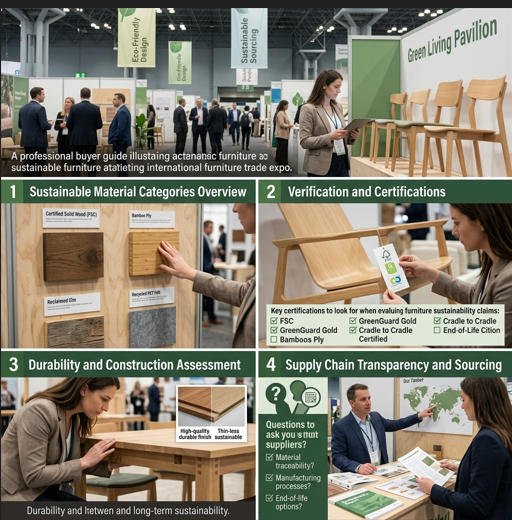

The European Environmental Bureau estimates that 10.78 million tonnes of furniture waste reach EU landfills every year — and 80–90% of it is either incinerated or buried, with only about 10% recycled. In the United States, that figure is even starker: 12.1 million tons discarded annually, an increase of 450% since 1960, with 80.1% going straight to landfills. Against this backdrop, furniture expos have become the front line where sustainability claims meet buyer scrutiny — and where the difference between genuine environmental responsibility and polished greenwashing is often just one informed question.
This guide equips designers, procurement managers, hospitality buyers, and homeowners with a practical framework for evaluating sustainable materials on the expo floor. You will leave with: a certification decoder that separates credible labels from decorative badges, a life-cycle thinking model that compares materials beyond price per unit, a VOC and off-gassing checklist for indoor air quality, a durability assessment method you can apply in 60 seconds at any booth, and a post-visit verification workflow. Whether your next show is CIFF Guangzhou, ICFF New York, or Salone del Mobile, these frameworks convert expo visits into defensible purchasing decisions.
1. Understanding Sustainable Materials in Furniture
Key Definitions: Renewable, Recycled, Upcycled, and Bio-Based Options
Sustainability in furniture materials is not a single attribute — it is a spectrum of characteristics that each address different environmental concerns. Renewable materials (FSC-certified hardwoods, bamboo, cork) come from sources that regenerate within a human lifespan. Recycled materials (reclaimed steel, recycled aluminum, post-consumer plastic lumber) divert existing waste streams from landfills. Upcycled materials (reclaimed barn wood, repurposed industrial metal) give discarded items a second life at higher functional value. Bio-based materials (soy-based foams, natural latex, hemp fiber composites) replace petroleum-derived inputs with plant-sourced alternatives.
At a furniture expo, you will encounter all four categories — sometimes blended within a single product. A dining table might feature an FSC-certified oak top (renewable), recycled steel legs (recycled), a bio-based lacquer finish (bio-based), and reclaimed brass hardware (upcycled). The buyer’s task is not to demand perfection across every component, but to understand which sustainability dimension matters most for their project and verify it with documentation.
How Sustainability Differs from Greenwashing
Greenwashing is the gap between a claim and its evidence. A booth banner reading “eco-friendly furniture” without a single named certification, test report, or material traceability document is a red flag, not a value proposition. Research by TerraChoice found that 95% of consumer products making green claims committed at least one of the “Seven Sins of Greenwashing” — including hidden trade-offs, vagueness, and irrelevance. In the furniture industry specifically, common greenwashing tactics include: labeling a product “sustainable” because one minor component (a fabric tag, a glue additive) meets a green standard while the primary material (the frame, the foam) does not; using self-created certification logos that resemble but are not affiliated with recognized bodies like FSC or GREENGUARD; and quoting percentages (“30% recycled content”) without specifying pre-consumer vs post-consumer origin.
The antidote is documentation. When a manufacturer at a furniture expo like CIFF claims FSC certification, ask for the chain-of-custody number and verify it on the FSC public certificate database. This takes under 60 seconds on a smartphone and immediately separates verified claims from marketing language.

2. Certifications and Standards to Trust
Common Verification Labels to Recognize
The furniture sustainability landscape includes dozens of certifications, but six account for the vast majority of credible claims encountered at international expos. Understanding what each one actually tests — and what it does not — is the foundation of informed purchasing.
| Certification | Issuing Body | What It Verifies | What It Does NOT Cover | Applies To |
|---|---|---|---|---|
| FSC (Forest Stewardship Council) | FSC International | Responsibly managed forest sourcing, chain of custody | Finished product emissions, durability, labor practices in non-forestry operations | Wood, paper, cork |
| GREENGUARD Gold | UL (Underwriters Laboratories) | Low VOC emissions (formaldehyde, total VOCs, aldehydes) | Material sourcing, recyclability, structural durability | Finished furniture, coatings, adhesives |
| Cradle to Cradle Certified | C2C Products Innovation Institute | Material health, material reutilization, renewable energy, water stewardship, social fairness | Specific material origin, structural performance | Any product/material |
| CARB Phase 2 / EPA TSCA Title VI | California Air Resources Board / U.S. EPA | Formaldehyde emission limits in composite wood (MDF, plywood, particleboard) | Other VOCs, overall product sustainability, sourcing ethics | Composite wood panels |
| OEKO-TEX Standard 100 | OEKO-TEX Association | Tested for harmful substances in textiles (heavy metals, phthalates, pesticides) | Environmental impact of production, material origin | Fabrics, leather, foams |
| CertiPUR-US | CertiPUR-US program | Foam made without ozone depleters, prohibited phthalates, heavy metals; low VOC emissions | Bio-based content, recyclability, fabric/frame materials | Polyurethane foam |
Manufacturers like Jade Ant furniture integrate CARB Phase 2 compliance, FSC chain-of-custody options, and GREENGUARD Gold certification across their product lines — a combination that addresses material sourcing, indoor air quality, and composite-wood safety in a single supplier relationship. This consolidation matters at the expo because verifying three certificates from one supplier takes less time than chasing a single certificate from three separate vendors.
Limitations and Regional Considerations When Evaluating Certifications
No single certification covers every sustainability dimension. FSC guarantees responsible forestry but says nothing about the formaldehyde in the MDF core beneath that certified veneer. GREENGUARD Gold confirms low emissions but does not verify whether the wood was harvested legally. Buyers need to stack certifications — FSC for sourcing plus GREENGUARD Gold for emissions plus CertiPUR-US for foam — to build a comprehensive sustainability profile.
Regional variations also matter. The EU’s formaldehyde emission standard (E1: ≤ 0.1 ppm) is roughly equivalent to CARB Phase 2, but Japan’s F**** standard (≤ 0.3 mg/L by desiccator method) uses a different testing protocol, making direct comparison complex. When sourcing from Chinese manufacturers for global markets, confirm which standard the product meets and whether test reports come from an EPA-recognized third-party certifier.
3. Life Cycle Thinking: From Raw Material to End-of-Life
Life Cycle Stages Relevant to Furniture
A furniture life cycle assessment (LCA) evaluates environmental impact across four stages: raw material extraction and processing, manufacturing and assembly, use phase (including maintenance, cleaning, and repair), and end-of-life (disposal, recycling, or reuse). A 2025 study published in the journal Resources, Conservation and Recycling assessed 25 furniture pieces across eight product groups and found that material production — not manufacturing — accounted for 55–78% of total cradle-to-grave carbon emissions. This means the single most impactful sustainability decision a buyer makes is the material choice, not the factory’s energy source.
For practical comparison: a solid-wood dining table (FSC-certified oak, water-based finish) generates approximately 15–25 kg CO₂e in production. The same-size table with a steel frame and engineered-wood top produces 40–65 kg CO₂e — roughly 2.5× the carbon footprint — primarily because steel production is energy-intensive. However, the steel table may last 30+ years with zero maintenance, while the wood table may require refinishing every 8–12 years. Life cycle thinking demands that you weigh both initial impact and longevity-adjusted impact.
Interpreting Life Cycle Assessments (LCAs) for Decision-Making
Most expo visitors will not read full LCA reports — they are 50–200 page technical documents. Instead, look for three summary metrics: Global Warming Potential (GWP, measured in kg CO₂ equivalent), which quantifies climate impact; cumulative energy demand, which measures total energy consumed across the lifecycle; and end-of-life recyclability rate, which indicates how much material can re-enter the production cycle. A credible exhibitor should be able to provide at least GWP data for their primary products. If they cannot, their sustainability claims lack quantitative backing.
Purdue University’s Wood Research Laboratory maintains one of the most comprehensive public databases of furniture LCA studies. Cross-referencing an exhibitor’s claims against published data takes 10 minutes and dramatically sharpens your assessment.
4. Material Categories Showcased at the Expo
Wood and Timber: Certified Sources, Engineered Wood, and Alternatives
Wood remains the dominant material at furniture expos, and the sustainability spectrum is wide. At one end: FSC-certified solid hardwood from managed plantations with documented chain of custody. At the other: tropical hardwoods of unclear origin, sold without documentation. Between them lies engineered wood — MDF, HDF, plywood, particleboard — which uses lower-grade timber more efficiently but introduces adhesive chemistry (and formaldehyde risk) into the equation.
Alternatives gaining expo floor space include bamboo (Janka hardness 1,380 lbf, technically a grass, reaching harvest maturity in 3–5 years vs 25–80 years for hardwoods), reclaimed wood (zero new-growth impact, but limited supply and inconsistent dimensions), and wood-plastic composites (WPC, blending recycled wood fiber with recycled polyethylene). Ask exhibitors for the species, origin country, and certification status of every wood component — including hidden structural elements like bed slats and drawer bottoms, which are often uncertified even when the visible surfaces carry FSC labels.
Metals, Composites, and Coatings with Low Environmental Impact
Recycled steel and recycled aluminum are among the most circular materials in furniture manufacturing — steel is infinitely recyclable with a current global recycling rate above 85%, and aluminum above 90%. At the expo, verify whether the “recycled metal” claim refers to post-consumer recycled content (the stronger claim) or pre-consumer scrap (which often re-enters the supply chain regardless of sustainability labeling). Powder coating — the dominant finish for metal furniture — eliminates solvent-based VOC emissions entirely and produces a durable surface with 20–30 year lifespans in indoor applications.
Fabrics, Foams, and Natural Fibers: Durability and Comfort vs Sustainability
Upholstery introduces one of the hardest trade-offs in sustainable furniture purchasing. Standard polyurethane foam is petroleum-derived, off-gasses VOCs, and is almost impossible to recycle (recovery rate under 15%). Natural latex foam — sourced from rubber tree sap — reduces petrochemical dependency and off-gasses minimally, but costs 2–3× more and has a higher raw-material carbon footprint due to plantation agriculture. Bio-based foams (soy polyol blends, typically 15–30% plant content) offer a middle path but rarely disclose the exact bio-based percentage unless CertiPUR-US certified.
For fabrics, the leading upholstered furniture manufacturers increasingly offer OEKO-TEX Standard 100 certified textiles (tested for 350+ harmful substances), recycled polyester (rPET, made from post-consumer plastic bottles), and organic cotton or linen. The durability metric to track is the double-rub count: a Martindale score of 25,000+ or Wyzenbeek score of 30,000+ indicates commercial-grade longevity, reducing the frequency of re-upholstery and the associated waste.
5. Sourcing, Supply Chain Transparency, and Ethics
Tracing Origin: Supplier Data and Provenance Storytelling
The most credible sustainability claims at an expo are those backed by traceable supply chains. Ask exhibitors: “Where was this wood harvested?” “Which mill processed the metal?” “Which tannery produced the leather?” A supplier who can answer all three with specific names and locations — rather than “our suppliers are audited” — has invested in genuine traceability. Manufacturers like Jade Ant furniture maintain material traceability documentation that includes mill certificates showing species, origin, and moisture content for wood products, and test reports for upholstery chemicals — information available upon buyer request at the booth or during factory visits.
Social and Environmental Responsibility in Supply Chains
Material sustainability is incomplete without labor ethics. FSC’s social criteria cover worker rights in forestry operations, but they do not extend to the furniture factory floor. For that, look for SA8000 certification (social accountability), BSCI audit reports, or SMETA audits. At Chinese furniture expos, asking about worker welfare is increasingly expected by international buyers, and reputable exhibitors will have audit documentation available. The guide to working with Chinese suppliers outlines which social compliance documents to request and how to verify their authenticity.
6. Indoor Air Quality, Finishes, and VOCs
Choosing Low-Emission Finishes and Sealants
Indoor furniture is the second-largest source of formaldehyde exposure in residential environments, after building materials. CARB Phase 2 limits formaldehyde emissions from composite wood panels to: 0.05 ppm for hardwood plywood, 0.11 ppm for MDF, and 0.09 ppm for particleboard. EPA TSCA Title VI mirrors these limits at the federal level. At the expo, ask for the specific panel certifier (e.g., HPVA, SCS Global) and the most recent test report date — certificates older than 12 months may not reflect current production.
Beyond formaldehyde, the finish matters enormously. Water-based polyurethane emits 50–75% fewer VOCs than solvent-based versions during application and continues to off-gas at lower levels for years. UV-cured finishes produce near-zero VOC emissions because the curing process is photochemical rather than solvent-evaporative. Catalyzed lacquers fall in between. At the booth, ask: “Is this finish water-based, solvent-based, or UV-cured?” and “Do you have GREENGUARD Gold certification for the finished product, not just the raw panel?”
Evaluating Fabric Treatments for Off-Gassing and Allergen Concerns
Stain-resistant fabric treatments (fluorocarbon-based or silicone-based) add convenience but may introduce PFAS compounds — persistent chemicals with well-documented health concerns. The safer alternative is a non-fluorinated water-repellent treatment (often labeled “PFC-free” or “PFAS-free”). For allergen management, OEKO-TEX Standard 100 Class I certification (the strictest tier, originally designed for baby products) confirms testing against 350+ harmful substances including allergenic dye intermediates. If a fabric claims to be “hypoallergenic” without OEKO-TEX or equivalent lab certification, the claim is unverifiable.
7. Durability, Repairability, and Maintenance
How to Assess Longevity and Modularity at the Expo
The most sustainable piece of furniture is the one that never needs replacing. Durability is a sustainability strategy in itself — a solid-wood dining table used for 25 years generates less than half the lifecycle carbon of two cheaper tables each lasting 10 years, even if the cheaper versions use “eco” labels. At the expo, apply a 60-second durability assessment: check joinery type (mortise-and-tenon or dowel = strong; staple-only = weak), test drawer slides for smooth operation under load, open and close hinges 3–4 times listening for play or resistance, and press firmly on load-bearing surfaces to detect flex.
Modularity is the next frontier. Furniture designed with bolt-on legs, replaceable seat cushions, and swappable hardware allows individual components to be repaired or replaced without discarding the entire piece. Ask exhibitors: “Can I order replacement parts for this product in five years?” A “yes” with a parts catalog is exponentially more credible than a vague “we support our products.” Manufacturers like Jade Ant furniture’s OEM/ODM division design products with replaceable components and maintain parts inventories specifically to extend product lifespans for their hospitality and residential clients.
Repair, Refurbishment, and End-of-Life Options
Ask three end-of-life questions at every booth: “Is this product designed for disassembly?” (Can it be taken apart without destroying components?) “What percentage of the materials are recyclable?” (Get a number, not a feeling.) “Do you offer a take-back or refurbishment program?” Cradle to Cradle certified products must score on “material reutilization,” making this certification one of the few that explicitly addresses end-of-life in its criteria. Only about 10% of EU furniture waste is currently recycled — every product designed for disassembly pushes that number upward.

8. Cost, Value, and Total Ownership
Balancing Upfront Costs with Lifecycle Savings
Sustainable materials carry a 15–35% price premium at the point of purchase. An FSC-certified oak dining table typically retails for $1,200–$1,800 vs $600–$900 for a non-certified engineered-wood equivalent. But lifecycle economics often reverse this equation. The solid-oak table lasts 20–30 years, can be sanded and refinished twice, and retains resale value at 20–40% of original price. The engineered-wood table lasts 5–8 years, cannot be refinished, and has zero resale value. On a per-year-of-use basis: the oak table costs $48–$90/year; the engineered-wood table costs $75–$180/year.
| Factor | FSC-Certified Solid Wood | Standard Engineered Wood | Recycled Steel Frame |
|---|---|---|---|
| Upfront Cost (dining table) | $1,200–$1,800 | $600–$900 | $900–$1,400 |
| Expected Lifespan | 20–30 years | 5–8 years | 25–35 years |
| Maintenance Cost (lifetime) | $200–$400 (refinishing ×2) | $0 (non-refinishable) | $50–$100 (touch-up powder coat) |
| Resale Value | 20–40% of original | ~0% | 15–25% of original |
| Cost per Year of Use | $48–$90 | $75–$180 | $29–$56 |
| End-of-Life Recyclability | 85%+ (wood, metal hardware) | ~40% (contaminated adhesives limit recycling) | 92%+ (steel is infinitely recyclable) |
| Carbon Footprint (production) | 15–25 kg CO₂e | 25–35 kg CO₂e | 30–45 kg CO₂e (recycled content) |
Trade-Offs Between Price, Performance, and Sustainability
No material wins on every metric simultaneously. Solid wood excels in renewability and repairability but carries a higher price. Recycled steel excels in recyclability and longevity but has a higher production carbon footprint. Bamboo excels in growth speed and hardness but relies on adhesives in engineered forms. The buyer’s job at the expo is not to find the “perfect” material but to match the best trade-off profile to the project’s priorities — a hotel lobby (high durability, easy maintenance) has different requirements than a residential nursery (low VOCs, allergen safety).
9. Case Studies from the Expo: Practical Takeaways
Notable Vendor Approaches and Standout Sustainable Innovations
At CIFF 2026, several exhibitors demonstrated approaches worth noting. One Foshan-based manufacturer displayed a complete dining set where the table top was FSC-certified ash finished with a UV-cured zero-VOC lacquer, the legs were recycled powder-coated steel, and the chair seats were upholstered in rPET fabric (100% post-consumer recycled plastic bottles) over CertiPUR-US foam. The entire set carried GREENGUARD Gold certification. Pricing was 18% above conventional equivalents — a premium that multiple contract buyers at the show described as “within budget” for LEED-targeted hospitality projects.
Another exhibitor showcased a modular sofa system with bolt-on arms, zip-off cushion covers, and a frame designed for 100% disassembly using standard household tools. Replacement covers and cushion cores could be ordered independently, extending the product’s lifespan to an estimated 15–20 years vs the 7–10 year average for a conventional upholstered sofa. Foshan furniture factory innovations increasingly follow this modular-design philosophy — a direct response to EU circular-economy directives that may require furniture “right to repair” provisions by 2027.
How Buyers Applied These Insights in Real Purchasing Decisions
A Portland-based interior design firm attending CIFF reported narrowing their supplier shortlist from 14 to 3 exhibitors by applying a three-filter sequence: first, eliminate any vendor unable to produce FSC chain-of-custody documentation on site; second, eliminate any vendor whose composite-wood products lacked CARB Phase 2 test reports dated within the past 12 months; third, compare remaining vendors on cost-per-year-of-use using the lifecycle model. The final three suppliers — including Jade Ant furniture’s catalog — all met the documentation standard, with pricing differentiated by customization depth and MOQ flexibility.
Watch: Choosing Sustainable Wood Furniture — What to Look For

10. Risk Management and Contingency Planning for Sustainable Buys
Red Flags to Watch During Sourcing and On-Site Evaluation
Specific warning signs that a sustainability claim may not survive scrutiny: the exhibitor uses a certification logo you cannot find in any recognized database; the “FSC” label appears on marketing materials but not on the product itself or its packaging; the vendor provides a “test report” from a lab you have never heard of, with no accreditation number; the material composition listed on the spec sheet is vague (“hardwood” instead of “white oak, Quercus alba, harvested in Missouri”); the booth features prominent “green” signage but the staff cannot name the certifying body when asked directly.
Approaches to Verify Claims Post-Purchase
Even after a successful expo evaluation, perform three post-purchase checks. First, verify certifications online — FSC’s public database, UL’s GREENGUARD product directory, and C2C’s certified-products portal all allow free lookups. Second, request third-party lab testing on the delivered product (not just the expo sample) — specifically a formaldehyde emission test per ASTM E1333 or ASTM D6007 and a total VOC content test per CDPH/EHLB Standard Method v1.2. Third, retain material samples from the delivered shipment alongside expo samples for comparison — a simple visual and tactile comparison reveals substitutions immediately. The import-vs-domestic analysis includes a verification checklist that buyers apply at the delivery stage.
11. Buyer Checklist and Workflow for Expo Visits
A Step-by-Step Scanning Method for Booths and Samples
Apply this eight-step sequence at every booth claiming sustainable materials. The entire process takes under five minutes per exhibitor and generates a structured assessment you can compare across vendors.
| Step | Action | What to Record | Time |
|---|---|---|---|
| 1 | Ask for certification documents (FSC, GREENGUARD, C2C, CARB) | Certificate numbers, certifying body, expiry date | 30 sec |
| 2 | Request material composition spec sheet | Species/type for each component (frame, panel, foam, fabric) | 30 sec |
| 3 | Ask about finish type and VOC profile | Water-based / solvent / UV-cured; GREENGUARD status | 30 sec |
| 4 | Inspect joinery and construction (flip, open, press) | Joint type, hardware quality, modularity | 60 sec |
| 5 | Ask about supply chain traceability | Wood origin, metal source, fabric mill | 30 sec |
| 6 | Request LCA data or GWP figures if available | kg CO₂e per product, energy demand | 30 sec |
| 7 | Ask about end-of-life: disassembly, recyclability, take-back | % recyclable, parts availability, refurbishment options | 30 sec |
| 8 | Collect physical samples (swatch, veneer chip, foam sample) | Label: booth #, product, date | 30 sec |
Documentation and Vendor Questions to Capture at Trade Shows
Before leaving each booth, confirm that you have collected: at least one physical material sample (labeled), the exhibitor’s business card with a specific contact name, a product spec sheet or catalog page for the items evaluated, and a written note of any pricing or MOQ discussed. Photograph the booth signage, the product label, and any certification display. These records become the basis for your post-visit shortlisting within 48 hours — the workflow described in detail in the sourcing guide for retailers on JadeAnt.com.
Selecting sustainable furniture materials at an expo is not an act of faith — it is a structured evaluation process built on documentation, lifecycle data, and the right questions. The practical framework in this guide reduces the complexity to a repeatable workflow: verify certifications against recognized databases, compare materials using lifecycle cost-per-year and carbon footprint metrics, test durability and modularity on the expo floor, and flag any claim that lacks quantitative backing.
The furniture industry’s sustainability transition is accelerating — driven by EU circular-economy regulations, buyer demand (72% of consumers now actively seek eco-friendly products), and competitive pressure among manufacturers. The buyers who benefit most are those who treat sustainability not as a marketing checkbox but as a measurable, verifiable dimension of product quality. Apply the eight-step booth-scanning checklist to your next expo visit, stack your certifications (FSC + GREENGUARD Gold + CertiPUR-US covers most scenarios), and always — always — request the documentation before the price sheet.
For sourcing sustainable furniture with full certification documentation, explore Jade Ant furniture’s manufacturing guide or browse their dining collection and bedroom furniture lines to see certified materials in application.
Frequently Asked Questions
1. How do I verify a supplier’s sustainability claims in person at the expo?
Ask for the specific certification number (e.g., FSC chain-of-custody code), then verify it on the certifying body’s public database using your smartphone. FSC, GREENGUARD, and Cradle to Cradle all maintain free online search tools. If the exhibitor cannot provide a verifiable number on the spot, the claim is unsubstantiated. Also request the most recent test report — certificates without supporting lab data from the past 12 months should be treated with caution.
2. Which certifications provide the strongest assurance for furniture materials?
For wood sourcing: FSC (Forest Stewardship Council). For indoor air quality: GREENGUARD Gold (certified by UL). For composite wood formaldehyde: CARB Phase 2 / EPA TSCA Title VI. For foam safety: CertiPUR-US. For textile safety: OEKO-TEX Standard 100. For holistic circular design: Cradle to Cradle Certified. No single certification covers all dimensions — the strongest profiles stack two or three complementary labels.
3. What are common trade-offs between cost and sustainability in materials?
Sustainable materials typically carry a 15–35% upfront premium. However, lifecycle cost analysis often reverses this: an FSC-certified oak table at $1,400 lasting 25 years costs $56/year, while a $700 engineered-wood table lasting 6 years costs $117/year. The trade-off is cash flow timing, not total expenditure. For project budgets, model the cost-per-year metric and present it alongside upfront figures.
4. How can I tell if a “green” label is genuine or greenwashing?
Five red flags: the label uses words like “eco” or “green” without naming a specific certifying body; the logo does not appear in any recognized certification database; the claim is vague (“sustainable materials” without specifying which component); the exhibitor cannot name the certifying organization when asked directly; the “test report” comes from an unaccredited lab with no ISO 17025 certification.
5. What formaldehyde emission limits should I look for in composite wood furniture?
CARB Phase 2 (equivalent to EPA TSCA Title VI) limits: hardwood plywood ≤ 0.05 ppm, MDF ≤ 0.11 ppm, particleboard ≤ 0.09 ppm. The EU E1 standard (≤ 0.1 ppm overall) is roughly equivalent. For stricter requirements (schools, healthcare), specify E0.5 or Japan’s F**** rating. Always ask for the test report date and the name of the EPA-recognized third-party certifier.
6. Is FSC-certified wood always the most sustainable option?
Not always. FSC certification addresses forestry practices and chain of custody, but it does not guarantee low emissions from the finished product (the panel may still use high-VOC adhesives) or circularity at end of life. Reclaimed wood has zero new-growth impact, and recycled steel is infinitely recyclable. FSC is the strongest single label for wood sourcing, but pair it with GREENGUARD Gold or CARB Phase 2 for a more complete picture.
7. How do I evaluate fabric sustainability at a furniture expo?
Request OEKO-TEX Standard 100 certification (ideally Class I for strictest testing). Ask whether stain-resistant treatments are PFC/PFAS-free. Check the double-rub count (Martindale ≥ 25,000 or Wyzenbeek ≥ 30,000 for commercial-grade durability). For recycled content, ask whether the polyester is post-consumer rPET and what percentage of the fabric composition it represents. Collect a physical swatch and its technical data sheet for post-visit comparison.
8. What does “Cradle to Cradle” certification actually mean for furniture?
Cradle to Cradle (C2C) evaluates five categories: material health (are components safe for humans and ecosystems?), material reutilization (can components re-enter production cycles?), renewable energy and carbon management, water stewardship, and social fairness. It is the most holistic single certification in the furniture industry. Products are rated Bronze through Platinum, with higher tiers requiring demonstrated circular-design features like full disassembly and material recovery plans.
9. How do I compare the environmental impact of different materials without reading full LCA reports?
Focus on three summary metrics: Global Warming Potential (GWP, in kg CO₂e — lower is better), end-of-life recyclability rate (higher is better), and expected product lifespan (longer is better). Divide GWP by lifespan for a “carbon cost per year” figure. The bar chart in Section 3 provides benchmarks for seven common materials. Purdue University’s public LCA database offers additional reference data for cross-checking exhibitor claims.
10. Where can I find furniture with verified sustainable materials after the expo?
Three starting points: the Sustainable Furnishings Council buyer guide, the Cradle to Cradle certified products directory, and manufacturer websites that publish certification documentation. Jade Ant furniture’s quality assessment guide lists the specific certifications available across their product lines and provides the documentation workflow for verifying each one.