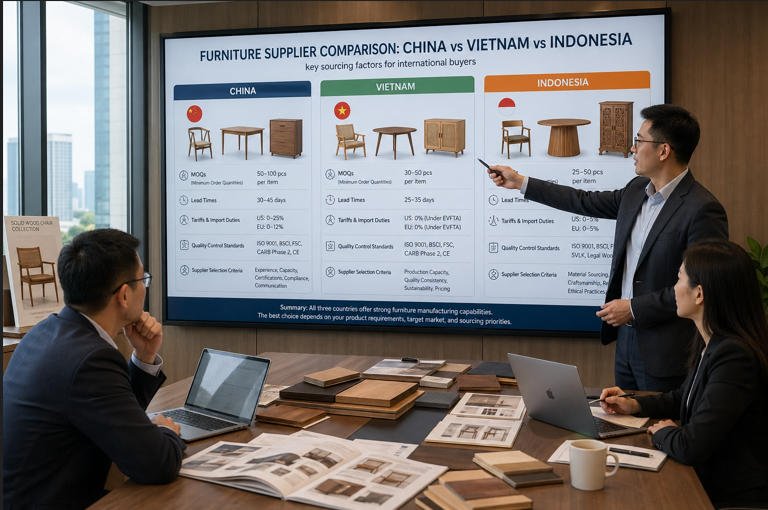
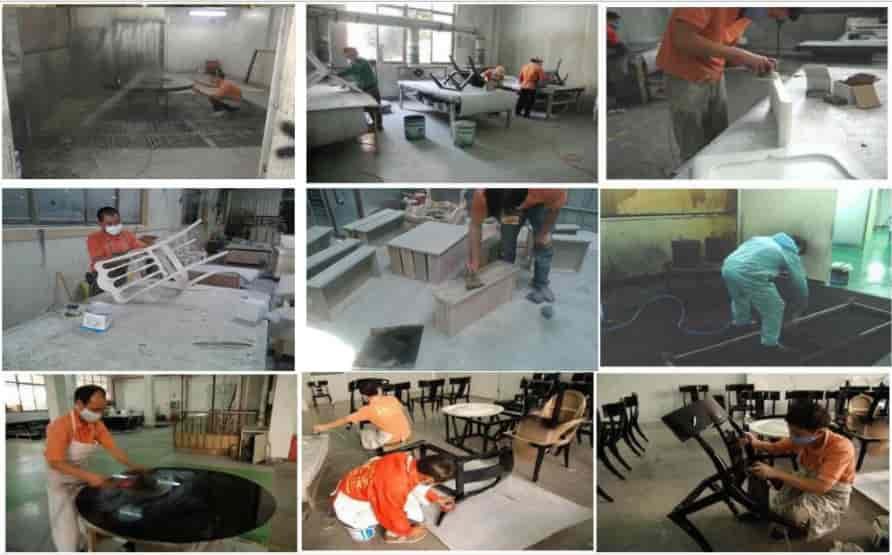
Every furniture retailer has, at some point, opened a container and felt that specific pit-of-the-stomach anxiety: the finish looks off, the joinery is loose, or the lead time blew past the seasonal window by three weeks. Almost always, that moment traces back to a sourcing decision made six months earlier — specifically, a decision made without a systematic framework for comparing suppliers across countries.
Asia accounts for roughly 60% of global furniture exports, and three countries dominate the conversation for North American and European retailers: الصين, فيتنام, و إندونيسيا. China’s furniture sector alone generated over USD 160 billion in domestic market value in 2025. Vietnam reached USD 17.6 billion in wood and furniture exports in 2024, cementing its place as the world’s second-largest furniture exporter after China. Indonesia’s furniture and handicraft exports reached USD 2.22 billion from January to November 2024, with its global market share at roughly 2.37% — a number that understates its influence in the premium handcrafted and teak segments specifically.
The post-2025 US tariff environment has reshuffled the calculus further. New Section 232 tariffs on Asian furniture imports — with upholstered furniture facing up to 30% and cabinets/vanities up to 50% — mean that landed cost comparisons that were valid in 2023 need to be completely rerun in 2026. Country of origin now carries real financial weight.
This guide gives store owners a structured, data-grounded way to evaluate all three sourcing destinations across eight dimensions: production scale, lead times, materials, pricing structure, quality control, compliance, supplier vetting, and total cost of ownership. By the end, you will have a scoring framework you can apply immediately to your next RFQ — and a clearer view of which country (or combination) actually matches your store’s business model.
Overview of Wholesale Furniture Sourcing in Asia
Why Asia Remains a Top Destination for Furniture Sourcing
Three structural factors keep Asia dominant in global furniture supply chains despite rising labor costs in the region’s more mature markets. First, vertical integration: Asian furniture clusters — Foshan in China, Binh Duong in Vietnam, Jepara in Indonesia — have developed supply ecosystems where timber mills, hardware manufacturers, foam processors, and finishing facilities operate within a 30-kilometer radius of the assembly factory. That density compresses per-unit component costs to a degree that no Western manufacturer can currently replicate.
Second, skilled labor depth: decades of furniture manufacturing in these regions have produced a workforce with highly specialized skills — CNC routing, hand carving, rattan weaving, lacquer application — that take years to develop and are not easily moved. A Vietnamese factory worker with seven years of dovetail joinery experience is not a line item you can offshore somewhere cheaper overnight.
Third, raw material proximity: Indonesia sits on some of the world’s most commercially significant tropical hardwood reserves. Vietnam has established plantation acacia and rubberwood supply chains that are FSC-certifiable. China has massive engineered wood processing infrastructure. The material and the manufacturer are often in the same logistics corridor — a supply chain advantage that keeps landed costs competitive even as factory-gate prices rise.
Key Factors Store Owners Should Evaluate When Comparing Suppliers
Industry sourcing professionals consistently identify eight dimensions that separate a profitable supplier relationship from a problematic one: production scale and capacity, product range and customization depth, lead time predictability (not just the quoted number), pricing structure and MOQ flexibility, quality control systems and certification standing, logistics infrastructure and Incoterm options, payment terms and financial risk management, and supplier communication reliability. This guide addresses all eight — by country.
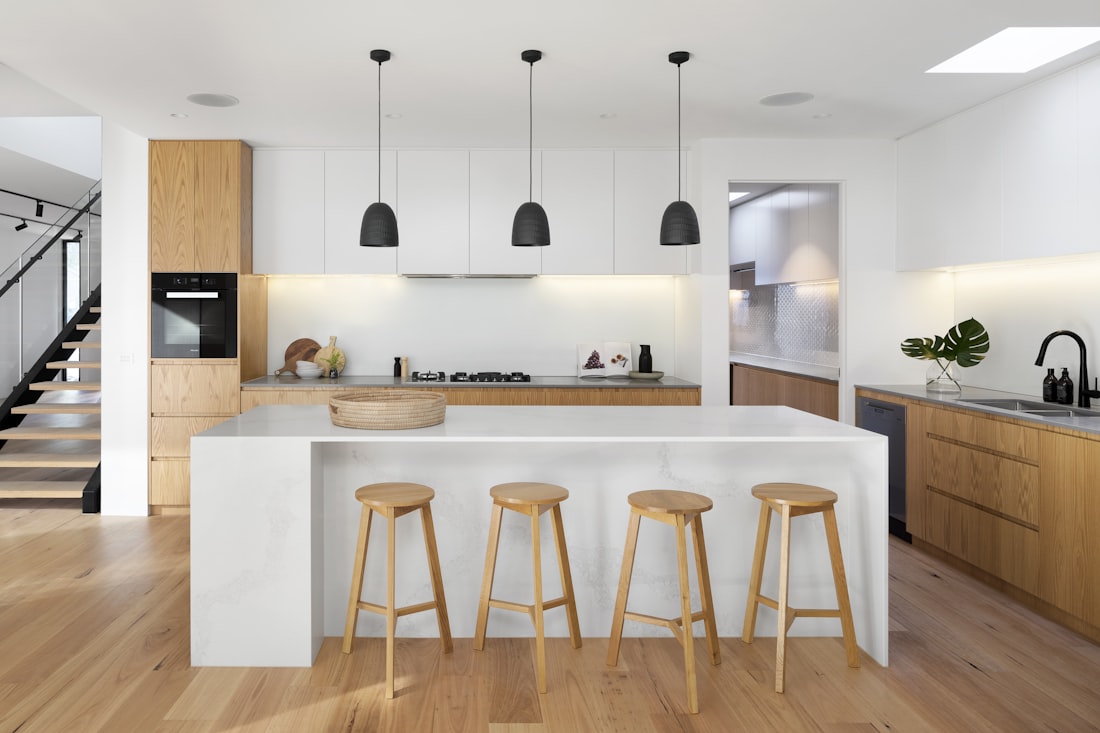
China: Market Size and Supplier Landscape
China is not merely the world’s largest furniture exporter — it is, structurally speaking, an entirely different category of sourcing destination. The country’s furniture manufacturing infrastructure spans over 50,000 registered manufacturers, concentrated in clusters including Foshan (Guangdong), Linyi (Shandong), and Zhongshan (Guangdong). The diversity of output is staggering: from flat-pack RTA living room units to hand-carved baroque bedroom sets, China can produce it all — the question is finding the factory tier that matches your store’s quality and price positioning.
Scale of Production and Product Variety
China’s scale advantage is most visible in product category breadth. No other sourcing country can simultaneously offer engineered wood bedroom sets, metal-frame dining collections, upholstered sectional sofas, and outdoor aluminum furniture at competitive price points from factories within the same industrial zone. For multi-category furniture retailers — those stocking bedroom, dining, living, and occasional furniture simultaneously — China’s one-stop sourcing efficiency is a genuine structural advantage.
The tiering within Chinese manufacturing is sharp and consequential. Tier-1 factories (typically 500+ employees, ISO-certified, with dedicated export compliance teams) produce at quality levels competitive with European manufacturing at 40–55% below North American retail equivalents, according to industry benchmarks cited across multiple sourcing platforms. Tier-3 factories (small-batch, often trading-company-mediated) can produce at prices that look attractive in a quotation email and catastrophic upon container arrival. The difference between those two outcomes is almost entirely determined by how well the buyer vets the factory before placing the first order.
China’s leading furniture factories in 2026 increasingly operate with in-house design teams, 3D rendering capabilities, and custom OEM programs — tools that were once the exclusive domain of European manufacturers. This closing of the design-and-customization gap is perhaps the most underreported shift in Chinese furniture manufacturing over the last five years.
Typical Lead Times and Logistics Considerations
Standard production lead times from Chinese furniture factories run 30–50 days for established catalog designs, and 50–75 days for new development or significant customization. Ocean freight from Guangdong or Shanghai ports to US East Coast ports adds approximately 28–35 days; West Coast ports run 18–22 days. Total door-to-door timelines of 65–100 days are the realistic planning window — not the factory-quoted production lead time alone, which is a common planning error among first-time importers.
Common Risks and Mitigation Strategies
The three most frequent failure modes when sourcing from China, based on industry QC audit data, are: finish inconsistency across a batch (particularly in lacquer and stain applications), dimensional variance from approved samples (common in upholstered items where foam density and fill weight vary without buyer-specified technical sheets), and material substitution mid-production (replacing specified solid wood with MDF or veneer without disclosure). All three are preventable with pre-production and pre-shipment inspections by an independent third party — a cost that typically runs USD 200–350 per inspection day and reliably pays for itself on the first corrected order.
The 2025–2026 US tariff environment has added a fourth risk layer: country-of-origin compliance. Some Chinese manufacturers began transshipping goods through Vietnam or Malaysia to circumvent tariffs — a practice that US Customs has actively interdicted, resulting in seizures and substantial penalty duties for the importing retailer, not the factory.
Vietnam: Strengths and Challenges
Vietnam’s furniture industry trajectory over the last decade is one of the more dramatic supply chain stories in global trade. In 2015, Vietnam exported approximately USD 6.9 billion in furniture. By 2024, that figure had grown to USD 17.6 billion — a compound growth rate that reflects both organic manufacturing development and deliberate policy support from the Vietnamese government to position the country as the premium-quality alternative to China. Its designation as the world’s second-largest furniture exporter is now structural, not cyclical.
Manufacturing Capabilities and Strengths
Vietnam’s strongest manufacturing category is solid wood — specifically acacia, rubberwood, and plantation teak — where its factories have developed finishing and joinery capabilities that now rival Taiwanese and European production lines. The Binh Duong province alone hosts over 1,200 furniture factories, many of them mid-to-large enterprises with 200–800 employees, dedicated QC departments, and export-oriented compliance infrastructure. Vietnam exported USD 9.4 billion worth of furniture to the US market in 2024 alone, cementing its position as the dominant Asian supplier to the American retail channel.
Customization capability has improved meaningfully: while Vietnam was historically a production-to-specification market (you bring the design, they execute), a growing number of factories now offer in-house design development, 3D visualization, and OEM services that approach what Chinese Tier-1 factories offer.
Cost Structure and Lead Times
Vietnam’s factory-gate pricing runs approximately 5–15% higher than China for comparable product categories — a premium that most mid-market and premium retailers consider a reasonable exchange for greater quality consistency and compliance reliability. Lead times average 45–70 days for established designs, longer than China’s equivalent due to smaller factory scale and less redundant supply chain depth. During peak seasons (Q3 production for Q4 retail), capacity constraints at mid-tier Vietnamese factories can extend lead times by 15–20 additional days.
Regulatory and Quality Considerations
Vietnam has made FSC certification, EU Timber Regulation compliance, and US Lacey Act documentation standard practice — not optional add-ons — in its export-oriented manufacturing sector. The EU-Vietnam Free Trade Agreement (EVFTA) has accelerated this compliance culture by requiring Vietnamese exporters to meet European traceability standards as a condition of preferential tariff access. For US-based retailers, Vietnam-origin goods currently face a 20% reciprocal tariff (as of mid-2025), which remains below the tariff burden on most Chinese furniture categories.
Indonesia: Opportunities and Constraints
Indonesia occupies a specific and defensible niche in the global furniture export landscape that neither China nor Vietnam can easily replicate: handcrafted hardwood and natural fiber furniture at a premium quality tier, produced from domestically sourced teak, rattan, and bamboo with mandatory legal timber certification. Its total furniture and handicraft export value of USD 2.22 billion (January–November 2024) understates its strategic importance to retailers whose product proposition centers on provenance, sustainability narrative, and artisanal differentiation.
Craftsmanship and Material Advantages
The Jepara region of Central Java has been a woodcarving center for over four centuries. That is not a marketing claim — it is an archaeological and economic reality visible in the multigenerational family businesses that form the backbone of Indonesian furniture manufacturing. When a US retailer sources a carved teak dining table from Jepara, the joinery technique used by that factory worker was most likely taught by their parent or grandparent, refined across decades of export-oriented production. Cirebon, meanwhile, has developed a parallel ecosystem centered on rattan and natural-fiber furniture, with a lineage in natural material processing that predates the modern export furniture industry.
Indonesia is the world’s largest natural teak producer. Its rattan supply chain — from forest harvest to processing to factory production — is almost entirely domestic, giving Indonesian manufacturers a raw material cost advantage in these categories that Vietnamese and Chinese competitors cannot match even if they wanted to. For retailers selling outdoor furniture, garden collections, or nature-inspired indoor pieces, this supply chain proximity translates directly into material authenticity that their retail customers increasingly seek and are willing to pay for.
Logistics and Regional Supply Network
Indonesia’s major furniture export hub is Semarang port (Central Java), with secondary volume through Surabaya and Tanjung Priok (Jakarta). Transit times to US East Coast run approximately 35–42 days; West Coast 28–34 days — slightly longer than Vietnam’s transit times due to port infrastructure differences. The trade-off is a 19% US reciprocal tariff rate (as of July 2025), which is currently more favorable than Vietnam’s 20% standard rate and dramatically more favorable than Chinese furniture tariff rates on upholstered goods (25–50% depending on category).
Regulatory Environment and Compliance
Indonesia’s SVLK (Sistem Verifikasi Legalitas Kayu) — its mandatory timber legality verification system — is the most stringent mandatory wood compliance framework of the three countries. While Chinese and Vietnamese FSC certifications are often optional and buyer-specified, every Indonesian wood furniture exporter must hold SVLK certification as a legal prerequisite to export. For US buyers operating under the Lacey Act, and for European buyers under the EU Timber Regulation and its replacement EUDR, this mandatory compliance baseline significantly reduces due-diligence burden and legal exposure.
Product Range Comparison: Materials, Styles, and Customization
Material Focus (Wood Types, Textiles, Veneers)
| فئة المواد | الصين | فيتنام | إندونيسيا |
|---|---|---|---|
| Solid Hardwood | Moderate – often imported oak/ash | Excellent – acacia, rubberwood, teak plantation | Best – local teak, mahogany, sungkai |
| Engineered Wood (MDF/Plywood) | World-class – largest production base | Good – growing capacity | Limited – not a primary category |
| Upholstery (Fabric/Leather) | Excellent – vast domestic textile supply | Very Strong – improving rapidly | Moderate – smaller volume |
| Natural Fiber (Rattan/Bamboo) | Limited – mostly imported raw material | جيد | Best – world’s largest rattan supply |
| Metal Frame (Aluminum/Steel) | Excellent – largest metal fabrication base | جيد | Limited |
| Veneer / Surface Finishes | Excellent – full spectrum available | Good – improving range | Moderate – wood-forward finishes |
Style Variety and Customization Options
China offers the broadest stylistic range — from Scandinavian minimalism to American traditional to Italian-influenced contemporary — largely because its factories serve so many different export markets simultaneously. The customization workflow is mature: submit a technical spec sheet with material specs, dimensions, finish codes, and hardware selections, and most Tier-1 Chinese factories can quote within 72 hours and produce a pre-production sample within 25–35 days.
Vietnam’s customization strength lies in solid wood construction: Vietnamese factories can execute complex joinery details, unique stain formulations, and carved hardware consistently across large batch runs in ways that Chinese factories — whose primary strength is engineered wood and upholstery — sometimes struggle to match. Indonesia’s customization model is different again: the most capable Indonesian suppliers offer collaborative design development from sketch stage, with handcraft elements (hand-applied rattan weaving, hand-carved detail work, hand-rubbed oil finishes) that cannot be standardized on a CNC line regardless of factory location.
Compliance, Certifications, and Import Standards
| Certification / Standard | الصين | فيتنام | إندونيسيا |
|---|---|---|---|
| FSC Chain of Custody | Available (voluntary, factory-specific) | Common (widely held in export factories) | Available (alongside mandatory SVLK) |
| CARB Phase 2 (Formaldehyde) | Available – critical for US import compliance | Available in major factories | Less common – check per factory |
| SVLK (Indonesian timber legality) | غير متوفر | غير متوفر | ✅ Mandatory for all exporters |
| EU Timber Regulation / EUDR | Voluntary – compliance varies | Strong – EVFTA drives compliance | Strong – SVLK aligns with EUDR |
| US Lacey Act Documentation | Variable – buyer must specify | Good – standard practice in major factories | Excellent – SVLK provides direct alignment |
| ISO 9001 (QMS) | Common in Tier-1 factories | Growing – mid-to-large factories | Selective – premium export factories |
Lead Times and Logistics
Factory Lead Times vs. Freight Timelines
Source: Suren Sourcing industry benchmarks, MPP Furniture, and trade logistics data (2025–2026)
Shipping Routes, Incoterms, and Transit Risk Management
The most common Incoterm used in Asian furniture sourcing is FOB (تسليم على متن السفينة), under which the supplier delivers the goods loaded onto the vessel at the named origin port, and all risk and cost from that point forward falls to the buyer. FOB is the professional standard for buyers who have an established freight forwarder relationship, because it gives the buyer control over carrier selection, freight rate negotiation, and cargo insurance terms — typically the three largest variables in landed cost after the factory price itself.
CIF (Cost, Insurance, and Freight) is commonly offered by suppliers to first-time buyers as a “convenience” term — the supplier arranges and pays for freight and insurance to the destination port. In practice, CIF transfers cost-control to the supplier, who has little incentive to optimize your freight spend. A study by sourcing consultancy Sorse Furniture found that CIF pricing from Chinese suppliers runs 8–12% above equivalent FOB + independent freight rates on average, across comparable shipment sizes.
EXW (أعمال سابقة) — where the buyer assumes all logistics responsibility from the factory gate — is technically the most buyer-controlled Incoterm but is impractical for buyers without in-country logistics support, because it requires the buyer to manage export customs clearance in the origin country, a task that requires local legal and logistical infrastructure.
Inventory and Demand Planning Tips
The single most consequential inventory planning error for furniture retailers sourcing from Asia is treating the factory-quoted lead time as the planning horizon rather than the total door-to-door timeline. A 45-day factory lead time in Vietnam that requires 35 days of ocean freight, plus 7–10 days of port clearance and last-mile delivery, means 87–90 days of actual product unavailability from purchase order to shelf. Retailers who plan for 45 days and order accordingly spend their peak selling windows apologizing to customers rather than selling to them. Build your reorder points and safety stock calculations on the full door-to-door timeline — then add 10% as a buffer for the unplanned delays that occur in roughly 30% of international shipments, according to freight industry data.
Pricing, MOQs, and Total Cost of Ownership
Quotation Structures and Negotiation Tips
Asian furniture suppliers quote in one of three ways: EXW (ex-factory gate), FOB (to origin port), or CIF (to destination port). When comparing quotes across China, Vietnam, and Indonesia, insist that all quotes use the same Incoterm — ideally FOB — with the origin port specified. A Chinese FOB Guangzhou quote and a Vietnamese FOB Ho Chi Minh City quote are directly comparable on factory economics. Once you add freight, the differential shifts based on port-to-destination routing.
Effective negotiation leverage in Asian furniture markets comes from three places: order volume (larger orders unlock tiered pricing), order frequency (a supplier who sees you as a recurring revenue stream rather than a spot buyer offers better pricing), and payment terms (a 30% deposit / 70% against B/L is standard; buyers who can offer 20% / 80% or letter-of-credit structures can often negotiate 3–5% price reductions, as they reduce the supplier’s working capital exposure).
MOQ, Sample Costs, and Tiered Pricing
موك
Flexibility
- China — 22% of factories flexible on MOQ
- Vietnam — 15% flexible (high-volume bias)
- Indonesia — 48% flexible (mixed-container friendly)
- Multi-country / varies — 15%
Based on MPP Furniture industry survey data, Suren Sourcing platform benchmarks, and trade buyer reports (2025–2026)
China’s standard MOQ for established catalog products runs 50–200 units per SKU. New development or custom products typically require a higher sample fee (USD 150–600 per prototype) plus a higher MOQ on first production runs (100–300 units) to amortize tooling and setup costs. Vietnam operates similarly, with MOQs of 100+ units per SKU being the standard in larger factories. Indonesia, particularly its mid-tier factory ecosystem, is notably more flexible: suppliers routinely accept mixed-item containers (a full 40-ft container with 30–50 different SKUs at low quantities per item) with no per-SKU rigid minimum — a model that is genuinely differentiated and highly valuable for retailers testing new collections or managing a diverse, low-volume product assortment.
Hidden Costs: Packaging, Duties, and Freight Insurance
The gap between factory-quoted price and actual landed cost in North American or European markets is frequently 40–65% above the FOB price, depending on country of origin, product category, and destination. The components of that gap — import duties, ocean freight, customs brokerage, port handling, inland freight, and freight insurance — are individually small but collectively enormous. In the current US tariff environment, China-origin upholstered furniture can carry a combined duty burden (Section 301 + Section 232) of 25–50%, which means a USD 300 FOB sofa from China might land at USD 550–600 before it touches a warehouse floor. Vietnam-origin equivalent goods at 20% tariff might land at USD 430. The factory price comparison alone tells less than half the story.
Quality Control, Testing, and Certifications
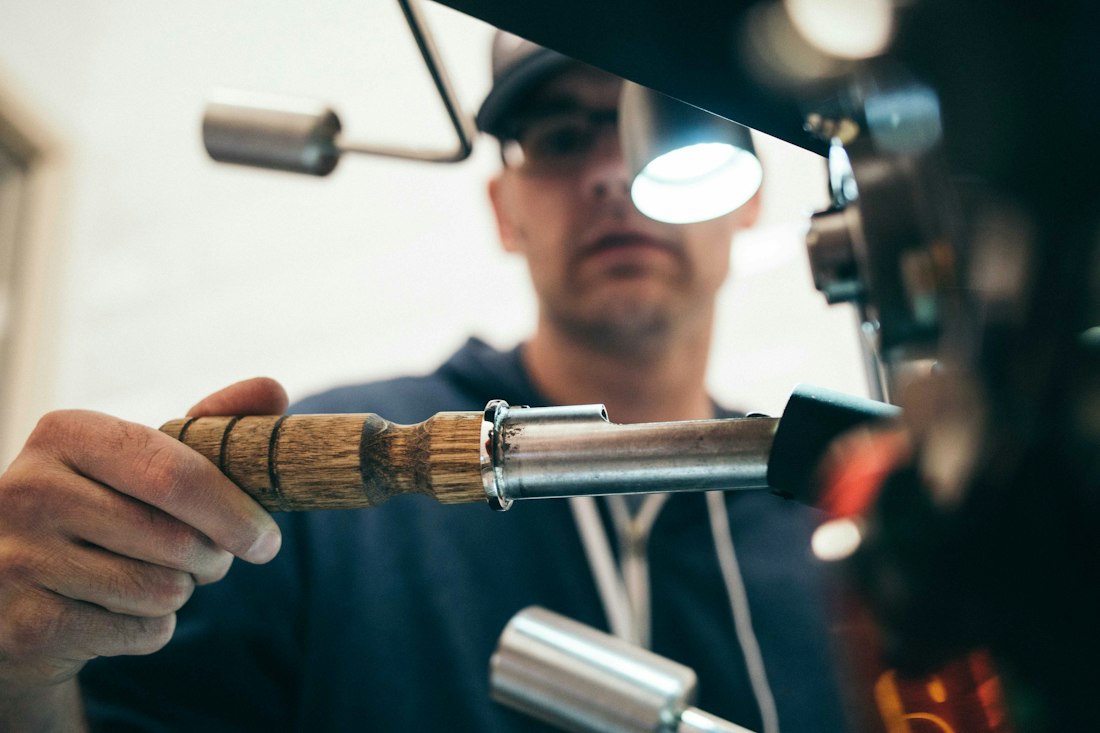
QC Processes and On-Site Inspections
A functional QC program for Asian furniture sourcing operates at three stages: pre-production (confirming raw material specifications before cutting begins — the most cost-effective intervention point), during production (validating that approved methods are being followed on the line, typically at 30–50% production completion), and pre-shipment (AQL-standard random sampling inspection of finished goods before container loading). Skipping any of these stages is not a cost saving — it is a risk transfer from the supplier to yourself.
Third-party inspection firms such as V-Trust and Bureau Veritas operate across all three sourcing countries and can be commissioned on a per-inspection basis without long-term commitment. The industry standard AQL 2.5 sampling level is the appropriate threshold for furniture — meaning inspectors will test a statistically determined sample from the lot, and accept or reject the shipment based on whether defects fall within or outside the acceptable quality threshold.
Common Product Issues by Region and How to Prevent Them
| Issue Category | China (Most Common) | Vietnam (Most Common) | Indonesia (Most Common) |
|---|---|---|---|
| Finish / Color | Lacquer inconsistency across batch; off-tone stain vs. sample | Slight color drift in natural wood stain | Oil finish variability on teak grain |
| الأبعاد | Variance on upholstered pieces (foam density) | Solid wood expansion/contraction in high-humidity transit | Rattan weave tension variation |
| المواد | Undisclosed solid-to-MDF substitution | Rubberwood sometimes substituted for acacia | Teak grade variation (A vs. B grade heartwood) |
| Hardware / Assembly | Off-spec metal hardware (gauge/finish) | Drawer slide misalignment | Rattan joint looseness over transit |
| Prevention Method | Material approval sign-off + pre-production inspection | Kiln-drying spec in purchase order + humidity logging | Teak grade certification + photo documentation pre-ship |
Certifications to Prioritize (Safety, Sustainability)
For US-market retailers, the non-negotiable certification baseline for furniture containing composite wood (MDF, plywood, particleboard) is CARB Phase 2 compliance — California Air Resources Board’s formaldehyde emission standard. While technically a California regulation, it has effectively become the national import standard because major US retailers (Wayfair, Williams-Sonoma, Target) require it from their suppliers, and customs enforcement at California ports applies it broadly. A supplier who cannot provide CARB Phase 2 test certificates from a CPSC-recognized third-party lab should not be supplying US-market product with composite wood content.
For sustainability-positioned retailers, FSC chain-of-custody certification (verifiable on the FSC public database) and SVLK certification for Indonesian suppliers provide the most defensible compliance narrative. These are not marketing claims — they are audited, verifiable standards with third-party enforcement.
This sourcing expert walkthrough from VIFA Expo compares Vietnam, Indonesia, and their Asian competitors across price, quality, and logistics — directly relevant to any retailer evaluating an Asia sourcing strategy.
Working With Suppliers: Vetting, Contracts, and Payment Terms
Vendor Vetting Checklist and Factory Audits
The factory vetting process is where the difference between a 5-year supplier relationship and a one-container disaster is determined. A rigorous vetting process for any new Asian furniture supplier should cover at minimum: business license verification (via country-specific company registry databases or commercial due diligence services), export history and US/EU market experience confirmation, production capacity assessment (employee count, floor area, monthly output), raw material sourcing documentation, current certification portfolio with verification, and references from current buyers in your target market.
✅ Supplier Vetting Checklist (Factory Audit)
- Business license and export license — verified against government registry
- Current certification portfolio — FSC, CARB, SVLK, ISO 9001 — with certificate numbers for database verification
- Export references — minimum 3 verified buyers in your target market
- Production capacity documentation — employee count, floor plan, monthly output records
- Raw material supplier list — confirm primary wood, fabric, and hardware sources
- QC department structure — on-site QC headcount, inspection protocols, AQL standard used
- Sample lead time and prototype cost — confirm alignment with your development timeline
- Payment terms offered — T/T, LC, trade credit availability
- Communication channel and English-language contact availability
- Previous QC inspection reports from third-party firms (if available)
Contract Terms, IP Protection, and Warranties
Contracts with Asian furniture suppliers should, at minimum, specify: technical product specifications (dimensions ±2mm tolerance, material grades, finish codes referenced to a physical or digital approved standard), MOQ and pricing terms locked for the contract period, delivery milestone dates with penalty provisions for late shipment, inspection rights (your right to commission third-party inspections at any production stage, at your cost), and IP ownership clauses for any custom designs developed with supplier input.
IP protection is a legitimate concern, particularly when bringing genuinely novel designs to Chinese factories. The practical mitigation strategies used by experienced sourcing professionals include: filing design registrations in the country of manufacture before sharing detailed drawings (China’s CNIPA and Vietnam’s IP authority both accept international design registrations), splitting production across two factories so no single supplier holds the complete design, and including explicit NDA and non-compete clauses in the supply agreement with specific liquidated damages provisions.
Payment Terms, Letters of Credit, and Risk Management
The standard payment structure in Asian furniture sourcing is 30% deposit upon purchase order, 70% against Bill of Lading (i.e., upon shipment confirmation). This structure gives the supplier working capital for production while ensuring the buyer retains leverage through the unpaid 70% until goods are confirmed shipped. More experienced buyers often negotiate 20% / 80% splits, and in high-volume relationships, net-30 after delivery terms become accessible.
For new suppliers or large orders, a خطاب الاعتماد المستندي (LC) provides the strongest buyer protection: the bank releases payment only when the supplier presents compliant shipping documents (B/L, packing list, certificate of origin, inspection certificate). Chinese suppliers are generally reluctant to accept LCs due to their own bank processing costs and timeline, but will often do so for orders above USD 50,000 or for new buyer relationships where the buyer insists. Vietnamese and Indonesian suppliers tend to be somewhat more LC-friendly, particularly those with European buyer relationships where LC is more common practice.
A Decision Framework: How to Choose the Right Supplier for Your Store
Scoring Rubric: Quality, Reliability, Cost, and Communication
Rather than making a binary country choice, the most effective sourcing strategy uses a weighted scoring rubric applied to specific supplier candidates. The weights should reflect your store’s actual business priorities — a high-volume furniture discounter weights price and lead time most heavily; a design-led independent retailer weights customization and quality consistency most heavily. Below is an industry-standard rubric template with suggested weightings for three common retail profiles.
🏭 High-Volume Discounter
🏡 Mid-Market Retailer
🎨 Premium / Boutique Store
Pilot Orders and Staged Onboarding
A pilot order — typically one 20-foot container of mixed product — is the standard professional approach to onboarding a new Asian furniture supplier, regardless of the supplier’s apparent credentials. The pilot order serves three purposes: it tests the supplier’s actual production quality against their sample quality (the gap between these two is the most common source of first-order disappointment), it validates lead time claims against real-world production scheduling, and it establishes a baseline for measuring subsequent order performance improvement or degradation.
Commission a pre-shipment inspection on the pilot order even if you trust the supplier — the inspection report becomes your baseline documentation. If the factory objects to an independent inspection on your pilot order, treat that objection as a significant red flag, not a negotiating position to overcome.
For retailers building a multi-country sourcing strategy — which represents best practice for stores sourcing more than USD 500,000 annually — a staged onboarding approach might look like: Year 1: establish primary supplier in Vietnam or China with pilot order, Year 2: add secondary supplier in Indonesia for handcrafted or natural-fiber categories, Year 3: optimize allocation across suppliers based on actual performance data. This mirrors the approach used by experienced furniture importers and eliminates single-country supply chain dependency.
For buyers building that multi-country strategy, مفروشات النمل اليشم — a China-based custom and luxury furniture manufacturer — operates with a model that suits exactly this kind of staged integration: custom dimensions, material specifications, and OEM program flexibility make it a viable Tier-1 China anchor supplier while retailers build out their Southeast Asia sourcing legs simultaneously.
Risk Mitigation and Contingency Planning
Every furniture importer sourcing from Asia needs a written contingency plan for three scenarios: supplier production failure (fire, financial collapse, natural disaster), port disruption or shipping delay, and product recall or defect event post-delivery. None of these are rare events — they are predictable categories of supply chain disruption that affect roughly 15–20% of import relationships in any given 12-month period, based on freight industry data.
Minimum contingency practices: maintain at least one vetted backup supplier in a different country for your top-selling SKU categories; keep 60-day safety stock on your highest-velocity products; carry cargo insurance at full replacement value (not just FOB value) on all ocean shipments; and include force majeure provisions in all supply contracts that clearly define what qualifies, who bears the cost, and what the remedy timeline looks like.
Master Comparison: China vs. Vietnam vs. Indonesia
| العامل | China 🇨🇳 | Vietnam 🇻🇳 | Indonesia 🇮🇩 |
|---|---|---|---|
| Export Value (2024) | ~USD 60B+ (global furniture leader) | ~USD 17.6B (SE Asia leader) | ~USD 2.22B (handcraft niche leader) |
| Best Product Categories | Engineered wood, upholstered, metal-frame, RTA | Solid wood dining/bedroom, outdoor, upholstery | Teak, rattan, handcrafted wood, outdoor |
| Typical MOQ | 50–200 units/SKU | 100+ units/SKU | Mixed container accepted (no rigid per-SKU MOQ) |
| Factory Lead Time | 30–50 days | 45–70 days | 50–75 days |
| Relative Unit Price | Lowest (baseline) | 5–15% above China | Premium — justified by material quality |
| US Tariff Rate (2025–26) | 25–50% (category dependent) | ~20% | ~19% |
| Key Compliance Cert | CARB Phase 2, ISO 9001 | FSC, US Lacey Act, EVFTA | SVLK (mandatory), Legal Label |
| Customization Depth | Strong – broad category range | Strong – solid wood expertise | Excellent – handcraft + OEM |
| Quality Consistency | Variable (factory-tier dependent) | Good–Excellent (mid-large factories) | Excellent (handcraft tier) |
| Sustainability Narrative | Growing – not a primary differentiator | Strong – plantation wood, FSC common | Best – SVLK mandatory, local materials |
| Best Retailer Profile | High-volume, budget-to-mid market | Mid-market, quality-conscious buyers | Premium, design-led, boutique retailers |

The most dangerous assumption a furniture retailer can make about Asian sourcing is that one country is universally better than the others. The data consistently shows that the right answer is not China, Vietnam, or Indonesia — it is the specific combination of countries and suppliers that maps precisely to your store’s product mix, order volumes, quality standards, compliance obligations, and retail positioning.
China remains the volume king for engineered wood, upholstered furniture, and metal-frame products at scale. No other sourcing country can match its production depth, style breadth, or sampling speed for high-volume retail programs. Vietnam has earned its position as the quality-and-compliance sweet spot for mid-market solid wood furniture — a market that represents the majority of specialty furniture retail revenue in North America and Europe. Indonesia occupies a genuinely differentiated position in handcrafted hardwood and natural-fiber furniture that neither China nor Vietnam can replicate at the craftsmanship level, and its current tariff position makes it genuinely competitive for US-market buyers on total landed cost.
The actionable next step is not to make a final country decision today — it is to run your top five SKUs through a total landed cost comparison across all three sourcing origins, using the tariff rates and freight benchmarks in this guide. That analysis will tell you, with real numbers, which country serves each product category in your store’s assortment. From that analysis, a pilot order in the most promising origin becomes a low-risk, high-information investment in your supply chain’s future. For those beginning that process, the product catalog at Jade Ant Furniture — covering bedroom, living room, dining room, and home office collections from a China-based custom luxury manufacturer — offers a useful starting reference point for China-origin pricing and customization depth.
📋 Action Steps for Store Owners: Starting Your Asia Sourcing Comparison
- Run a total landed cost model for your top 5 SKUs across China, Vietnam, and Indonesia (include current tariff rates, estimated freight, and customs brokerage)
- Identify which product categories align with each country’s material and manufacturing strengths (use the master comparison table above)
- Source 3–5 candidate suppliers per country via verified platforms (Alibaba, Made-in-China, direct trade show contacts)
- Run the vetting checklist on each candidate — eliminate any that cannot provide verifiable certifications
- Request quotes on the same FOB Incoterm basis from all candidates for direct comparison
- Commission pre-production samples (budget USD 150–600 per prototype)
- Plan a pilot order — one 20-ft container — with mandatory pre-shipment inspection
- Build your safety stock model on total door-to-door timelines, not factory lead times
- Document pilot order performance and use it as your baseline for supplier scoring going forward
الأسئلة الشائعة
Q1: Which country generally offers the lowest MOQs for wholesale furniture?
Indonesia offers the most flexible MOQ structure among the three countries for mid-sized retailers. While Chinese and Vietnamese factories typically require 50–200+ units per SKU, Indonesian mid-tier suppliers generally accept mixed-item containers — a full 40-foot container with multiple SKUs at low per-item quantities — with no rigid per-SKU minimum. This makes Indonesia particularly valuable for retailers who need variety without committing to high stock quantities per design. Vietnam is the least flexible on MOQ, as its large-factory export model is optimized for high-volume, standardized runs. China sits in the middle: Tier-1 factories have relatively rigid MOQs, but the sheer number of factories means it’s possible to find smaller producers willing to accept lower quantities, though typically with quality consistency trade-offs.
Q2: What are the most common QC issues when sourcing furniture from Asia, and how can I prevent them?
The three most frequent QC failures across all three sourcing countries are: finish inconsistency (stain color or lacquer sheen differing from approved samples), dimensional variance (particularly in upholstered goods where foam density and fill weight are not buyer-specified in technical sheets), and material substitution (solid wood replaced with MDF or lower-grade veneer without disclosure). Prevention requires the same three-step approach regardless of country: a pre-production inspection that confirms raw material specs before cutting begins, a mid-production check at 30–50% completion, and a pre-shipment AQL 2.5 sampling inspection before container loading. Commissioning these through an independent third-party firm (V-Trust, Bureau Veritas, SGS) costs USD 200–350 per inspection day and reliably prevents shipments that would cost 10–50x that amount to remediate after delivery.
Q3: How should I structure negotiations to ensure fair pricing and reliable delivery from Asian furniture suppliers?
Effective negotiation with Asian furniture suppliers relies on three leverage points: order volume (larger orders unlock tiered pricing — always ask for the price schedule at 2x and 5x your initial order quantity), order frequency (position yourself as a recurring buyer rather than a spot buyer from the first conversation — even if your first order is small, committing to a quarterly reorder schedule changes how the factory prices your account), and payment terms (offering 20% deposit versus the standard 30% gives you 3–5% price leverage with financially sophisticated suppliers). On delivery reliability, include explicit penalty provisions in your purchase order for shipments that miss the agreed delivery milestone by more than 14 days — not a legal threat, but a signal that you have documented the timeline and will hold the supplier accountable to it.
Q4: What is the current US import tariff situation for furniture from China, Vietnam, and Indonesia?
As of 2025–2026, the US tariff landscape for Asian furniture imports is: China faces the highest burden, with upholstered furniture at 25–30% (Section 301 + Section 232 combined), and cabinets/vanities at up to 50% in some categories. Vietnam faces approximately 20% reciprocal tariff on most furniture categories, with a higher rate (up to 40%) on goods transshipped through third countries without sufficient value-added processing. Indonesia faces approximately 19% reciprocal tariff (reduced from an earlier 32% level as of July 2025), making it currently the most cost-efficient of the three on a tariff-adjusted basis for US buyers. These rates are subject to change under US trade policy, and total landed cost models should be re-run quarterly to reflect current tariff schedules rather than relying on older benchmarks.
Q5: What certifications should I require from an Asian furniture supplier before placing an order?
The minimum certification baseline for US-market furniture imports from Asia includes: CARB Phase 2 compliance for any product containing composite wood (MDF, plywood, particleboard) — verifiable through a test report from a CPSC-recognized laboratory; a verifiable FSC chain-of-custody certificate for any supplier claiming sustainable wood sourcing — check the certificate number against the FSC public database at info.fsc.org; and SVLK certification for Indonesian suppliers. Additionally, confirm US Lacey Act documentation capability (a Plant and Plant Products Declaration form PP-1 for each shipment). For European-market retailers, EU Timber Regulation / EUDR due diligence documentation is required, and the EVFTA preferential tariff certificate of origin for Vietnam-sourced goods. Request current, dated copies of all certifications — not old files — before placing any order.
Q6: Is it better to source furniture from one country or split across multiple sourcing origins?
For stores sourcing more than USD 300,000 annually in furniture, a multi-country strategy is almost always the lower-risk, better-margin approach compared to single-country dependency. The practical model used by experienced furniture importers is to assign each product category to the country whose manufacturing strengths best match that category’s requirements — China for engineered wood or high-volume upholstered goods, Vietnam for solid wood dining and bedroom, Indonesia for handcrafted or natural-fiber collections — rather than sourcing everything from one origin and accepting the category-by-category quality compromises that approach entails. The main complexity is managing multiple supplier relationships and shipping consolidations, which becomes manageable once you have an established freight forwarder with Asia experience.
Q7: How do I verify whether a Chinese furniture supplier is a real manufacturer or a trading company?
Several verification methods work reliably: request the factory’s business license and ask a sourcing agent or commercial due diligence service to verify the registered business scope against the license — trading companies and manufacturers have different scope designations. Request photos and video of the actual production floor with dated timestamps and a current newspaper or phone display visible for authenticity. Check Alibaba’s Trade Assurance and “Verified Supplier” status, which includes an on-site inspection report from Alibaba’s verification partner. Use Google Maps or Baidu Maps satellite view to confirm the factory address shows an industrial facility, not an office building. Finally, request a sample in which you specify an unusual detail — a non-standard hardware finish or a minor design modification — and see whether the sample reflects that specification, which a trading company routing through a third factory often cannot execute cleanly.
Q8: What Incoterm should I use when importing furniture from Asia for the first time?
FOB (Free On Board) is the professional standard and the recommended Incoterm for any buyer who has, or is willing to establish, a relationship with a freight forwarder. Under FOB, the supplier is responsible for delivering the goods loaded onto the vessel at the named origin port; from that point, the buyer (or their freight forwarder) controls the carrier selection, freight rate, and cargo insurance. This gives the buyer the most cost transparency and control over the largest variable cost items in the logistics chain. Avoid CIF for recurring orders — while it feels simpler, the supplier-arranged freight consistently costs more than buyer-arranged equivalent routes, and you lose visibility into the logistics chain. EXW is only appropriate if you have physical in-country logistics support in the origin country, which first-time importers typically do not.
Q9: How long does it realistically take to onboard a new furniture supplier in Asia?
The realistic timeline from first contact to first shipment arrival runs 4–7 months for most product categories, broken down as follows: supplier identification and initial vetting (2–4 weeks), sample request and approval (4–8 weeks), pilot purchase order placed and production begins (1 week), production lead time (5–10 weeks depending on country and product), pre-shipment inspection (1 week), ocean freight to destination (3–6 weeks depending on origin and destination), and customs clearance and domestic delivery (1–2 weeks). Retailers who plan for 4 months and find the process taking 6 are the ones who run out of stock mid-season. Plan for 7 months, and if it goes faster, you have buffer inventory. If it hits 7 months, you are exactly on schedule.
Q10: What is SVLK certification and why does it matter for Indonesia-sourced furniture?
SVLK (Sistem Verifikasi Legalitas Kayu — Indonesian Timber Legality Verification System) is Indonesia’s mandatory national timber legality framework, enforced by the Ministry of Environment and Forestry. Unlike FSC certification in China and Vietnam, which is voluntary and buyer-specified, SVLK is a legal prerequisite for any Indonesian wood furniture exporter — every company in the export chain must hold it. For importing retailers, SVLK provides direct alignment with the US Lacey Act’s “due care” standard and the EU Timber Regulation / EUDR’s due diligence requirements. In practical terms, an Indonesian SVLK-certified supplier simplifies your compliance documentation significantly compared to sourcing from countries where legality certification is voluntary and factory-specific. Verify SVLK certificate authenticity through Indonesia’s SILK online verification system (silk.dephut.go.id) using the certificate registration number.
Article produced by the مفروشات النمل اليشم editorial team. Jade Ant is a China-based custom and luxury furniture manufacturer serving furniture importers, distributors, and design companies worldwide. Explore the full product range at Living Room · غرفة النوم · Dining Room.