Luxury FF&E Suppliers: What Interior Designers Require Before They Specify You

Written for furniture importers and distributors, private label brand owners, FF&E and hotel buyers, interior designers, architecture and engineering firms, developers, hotel operators, and villa owners.
The short answer: Designers specify suppliers they can trust on paper before they trust them in person. That means proven materials, precise customization, clear certifications, honest lead times, a full technical package, fair pricing, a responsive team and a quality check that catches problems before the container is loaded. The sections below show how to meet each requirement.
I. The High-Stakes Ecosystem of Luxury FF&E
A designer has one chance to get a client’s furniture right. Picture a villa owner who has just closed on a seafront property. The designer has spent four months on the concept. The dining table is the centerpiece, and it is due before the owner’s family arrives for the holidays. If that table shows up with a different grain, a different leg profile, or three weeks late, the supplier is not the one who takes the blame in the owner’s eyes. The designer is.
That is why designers guard their supplier lists carefully.
Who the specifier is. A specifier is the person who decides which products go into a project, usually an interior designer, architect or FF&E consultant. المفروشات والمعدات والأثاث stands for Furniture, Fixtures and Equipment, the movable items in a hotel or villa. According to one hospitality FF&E procurement guide, FF&E often represents 15 to 25 percent of a hotel project’s construction cost, so mistakes carry real money.
The designer as gatekeeper. Between a furniture brand and an ultra-high-net-worth (UHNW) client sits the interior designer. UHNW usually means individuals with $30 million or more in investable assets. These clients rarely browse catalogs. They trust one person to filter everything, and that person protects their own reputation first.
From “aesthetic selection” to “technical specification.” Ten years ago, a beautiful sample might have been enough. Today, designers hand contractors a binder of drawings, fire ratings, tolerances and delivery milestones. A piece that cannot be documented cannot be specified.
Three pain points come up again and again in designer conversations:
- Lead-time volatility: a promised 12 weeks quietly becomes 18.
- Quality inconsistency: the first piece is perfect, and the fiftieth is not.
- The gap between render and reality: the 3D image looks one way, and the delivered piece looks another.
Quick definition: Render vs. reality gap. The difference between the digital image a client approved and the physical piece that arrives on site. It is the most common source of designer-supplier disputes.
If you are an importer, distributor or private label owner selling to the design trade, closing these three gaps decides whether you get a second order. Buyers who read this as a checklist can use the same points to vet any supplier.
II. The Quality Benchmark: Beyond Visual Appeal
Luxury comes from structure and material honesty, not from surface design alone. A sofa can photograph beautifully and still sag in 14 months. Designers learn this once, usually on a project they cannot afford to repeat.
Material Provenance
المصدر means where a material comes from and how you can prove it. Designers want paperwork, not promises.
| المواد | What designers ask for | Proof to provide |
|---|---|---|
| Hardwood (oak, walnut, teak) | Species, grade, moisture content | Spec sheet, cross-section photo of a frame part |
| جلد | Top-grain or full-grain, hide origin | Tannery sheet, thickness, finish type |
| Marble and stone | Quarry name, slab selection method | Slab photos, block numbers |
| Foam | Density and firmness | Supplier label, test slip |
| Metal and hardware | Alloy, plating thickness, brand | Material certificate, part numbers |
A phrase like “premium solid wood” tells a designer nothing. “Kiln-dried American walnut, 25 mm, 8 to 12 percent moisture” tells them everything.
Craftsmanship Standards
Three things separate a luxury piece from a lookalike:
- Joinery: how wood parts connect. Mortise-and-tenon joints (a projecting tongue fits into a cut slot) outlast stapled or glued corners.
- Stitching and upholstery: straight seams, matched patterns and even tension across every cushion in a set.
- Weight-bearing capacity: how much load a chair, bed frame or shelf can hold without stress.
نظرة ثاقبة على القطاع: Designers often judge a supplier by what they cannot see. They open a drawer, look at the underside of a seat, and check the corner blocks. A clean hidden side tells them the factory cares when nobody is watching.
Durability Testing for the Environment
A hotel lobby chair and a private villa chair face very different lives. Test the piece for the life it will have.
| Setting | Typical wear | What to specify |
|---|---|---|
| Hotel lobby or restaurant | Hundreds of users per week, cleaning chemicals | Contract-grade fabric, reinforced frames, cleanable finishes |
| Hotel guest room | Daily turnover, luggage impact | Impact-resistant edges, durable hardware |
| Private villa | Lower use, higher expectation of finish | Fine finishes, delicate fabrics with care guidance |
Fabric abrasion is measured in Martindale cycles, a lab test that rubs the fabric until it wears. Our hospitality guides treat roughly 30,000 cycles as a common contract-grade floor. For more on how these tests are explained, read this plain-English guide to Martindale rub counts.
For a buyer’s view on what to examine before committing, our luxury furniture investment checklist walks through the same questions.
III. Customization Capabilities: The “Bespoke” Requirement
The ability to make precise changes is what separates a top-tier supplier from a catalog seller. Designers rarely find a piece that fits a project exactly. They find one that comes close and then ask you to adjust it.
Dimensional Flexibility
Architecture is not standard. An alcove might be 2,150 mm wide. A hotel corridor might force a narrower nightstand. A double-height villa living room might need a sofa with a taller back to hold the scale.
Good suppliers do three things here:
- Confirm the changes in a revised drawing before cutting any material.
- Explain what the change does to structure, comfort and cost.
- Flag any limits upfront, such as a seat depth that stops being comfortable.
For a deeper look at scale in large homes, see our villa furniture strategy guide.
Material Agility
Designers carry fabric swatches, stone samples and finish cards from their own libraries. Your supplier should work from them.
COM (Customer’s Own Material) means the client or designer supplies the fabric, and the factory builds the piece with it. COL is the same idea for leather. A clear explanation of how COM and COL work saves a lot of back-and-forth.
Finish matching works best with codes rather than words. Use a standard such as RAL, a numbered color system, so “warm grey” is never a matter of opinion.
At Jade Ant furniture, customized orders can include material and paint color changes, and low MOQ requests can go as low as one piece per furniture type, subject to confirmation. That matters to designers who need a single sample piece before committing to a full room.
Prototype Precision
A prototype is a physical sample made to the final specification. A first-article approval means the designer signs off on the very first piece off the line before mass production begins.
| الخطوة | Who signs | What gets checked |
|---|---|---|
| Drawing approval | Designer | Dimensions, details, hardware |
| Material and finish approval | Designer and client | Fabric, wood tone, sheen |
| Prototype or first article | Designer | Comfort, proportions, build quality |
| Pre-shipment photos | Designer or inspector | Match to approved prototype |
Skipping the prototype to save two weeks is the most expensive shortcut in the business.
IV. Sustainability and Ethical Sourcing: The New Luxury Standard
Modern luxury is tied to environmental responsibility and a supply chain you can explain. Hotel brands report on sustainability. Developers face green-building targets. UHNW clients ask where the wood came from.
Certification Requirements
| التصديق | What it covers | Why designers ask for it |
|---|---|---|
| FSC | Wood from responsibly managed forests | Chain-of-custody proof for timber |
| OEKO-TEX | Textiles tested for harmful substances | Safety for guest rooms and children’s spaces |
| LEED | A green building rating for the whole project | Furniture documentation can support project credits |
One note: LEED rates the building, not the sofa. Your products help a project earn credits, but the project holds the rating. Ask the design team which documents they need rather than guessing.
The same trend shows up in hotel design, as covered in our look at high-end hotel furniture trends.
Circularity and Longevity
Circularity means designing furniture to be repaired, refreshed and reused instead of thrown away. In practice that looks like:
- Removable, replaceable cushion covers.
- Frames that can be re-upholstered without breaking joints.
- Spare parts and finish touch-up kits shipped with the original order.
- Records of material codes kept for years, so a replacement leg matches the original.
A designer who can tell an owner “this table can be refinished in 10 years” wins an easier sale.
Ethical Labor and the Story Behind the Craft
High-end clients like a story, but it has to be true. Designers increasingly ask whether workers are treated fairly, whether the factory has had third-party social audits, and who actually made the piece. Share real details: how many artisans handle finishing, how long they have worked there, and what the factory conditions look like. Photos and short factory videos work better than slogans.
V. Logistics and Project Management: The Invisible Value Add
A perfect piece that arrives damaged or late is still a failed order. Designers remember the delivery experience more vividly than the product.
White-Glove Delivery and Installation Coordination
White-glove service means the delivery team unpacks, places, assembles and cleans up, then removes the packaging. For luxury projects, this is not an extra. A designer expects:
- Delivery windows confirmed in advance.
- Installers who know the project and the floor plan.
- Room-by-room labeling on every carton.
- A site walk-through with a punch list at handover.
Transparent Lead-Time Tracking
Honest lead times beat optimistic ones. Share a production timeline with milestones and update it weekly. The chart below shows typical total lead times, from production through ocean freight, that we use for planning hospitality furniture from China. Ranges come from our hospitality contract manufacturer guide.
These are planning ranges, not guarantees. Complex finishes, COM fabric delays and port congestion can all push them out. Add a buffer of 10 to 15 percent before you promise a date.
A simple milestone report helps designers keep their own clients calm:
| Milestone | Update to send |
|---|---|
| Materials confirmed | Photos of wood, fabric and hardware lots |
| Frames complete | Photo set of every frame type |
| Finishing complete | Close-ups under daylight |
| Pre-shipment inspection | Full report with photos |
| Container loaded | Bill of lading and ETA |
Damage Mitigation and Rapid Replacement
Even careful shipments get damaged sometimes. What matters is the plan. Agree these points in the contract:
- How damage is documented (photos before opening, notes on the delivery receipt).
- How fast the supplier responds, for example within 24 hours.
- Whether spare units, extra fabric or touch-up kits are included. Many projects order a small overage, meaning a few extra units beyond the count, so a damaged piece can be swapped on site.
- Who pays for the replacement, and how it is shipped.
For a hotel with an opening date, a replacement plan is the difference between a minor delay and a headline.
VI. The Technical Specification Package: Speaking the Designer’s Language
Designers need complete technical data to reduce risk and avoid mistakes. A pretty photo does not go into a project binder. A spec sheet does.
High-Fidelity 2D and 3D Assets
Designers draw in software, so give them files they can drop straight in:
- DWG files: 2D drawings used in AutoCAD.
- Revit families: digital objects for Revit, a design tool. They plug into a BIM model, which is a shared 3D digital version of the building.
- High-resolution renders: several angles, with close-ups of finish and material.
A product with ready-made files gets specified faster than a better product without them.
Detailed Specification Sheets
| Item | What to include |
|---|---|
| الأبعاد | Width, depth, height, seat height, clearances, in millimeters and inches |
| Weight | Per piece and packed |
| المواد | Species, foam density, fabric codes, hardware brands |
| COM/COL | Yardage per piece, pattern-matching notes, fabric width limits |
| Fire rating | Standard met, such as California TB 117-2013 for upholstered seating, or BS 5852 for the UK |
| Finishes | Codes and sheen level |
| Packing | Carton size, crate type, cubic meters |
نظرة ثاقبة على القطاع: The most-requested item is the one many suppliers forget: yardage for COM. If a designer cannot calculate fabric needs, they will pick a different supplier.
Many designers also work from an FF&E schedule, a master spreadsheet of every item in a project. This short video shows how one is built, which helps suppliers see what data designers need to fill in:
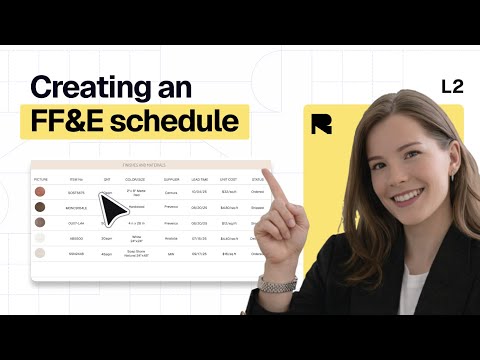
Watch: how designers organize FF&E schedules and procurement documents.
Clear Care and Maintenance Guides
End users are the last link. A one-page guide per product should cover cleaning methods, what to avoid, and how often to inspect joints and finishes. We cover this in more depth in our care and maintenance framework. A good guide prevents warranty claims that were never the supplier’s fault.
VII. Pricing Architecture and Value Engineering
Pricing for the trade has to balance exclusivity with budgets. Designers do not want the cheapest price. They want a price they can defend to their client.
Tiered Pricing for Trade vs. Retail
| Buyer type | Typical approach | What it protects |
|---|---|---|
| Interior designers and architects | Trade price with a clear discount from list | Designer’s margin and relationship |
| FF&E and hotel buyers | Project price tied to quantity | Large-volume fairness |
| Distributors and importers | Wholesale price with MOQ and exclusivity terms | Reseller margin |
| Private label brands | Custom pricing based on development and volume | Brand ownership and exclusivity |
| Retail clients | List price | Brand positioning |
Keep these tiers consistent. A designer who finds a lower price for the same piece elsewhere will stop recommending you.
Value Engineering: Keep the Look, Optimize the Cost
Value engineering means finding ways to cut cost without cutting what the client sees and feels. It is not “making it cheaper.”
A fair example: a 120-room hotel specifies a solid walnut headboard. Value engineering might keep solid walnut on the visible front edge and use a stable engineered core behind it. The guest sees the same walnut, and the project saves cost and avoids warping. The designer approves the change in writing before production.
What does not belong in value engineering: swapping foam density, reducing hardware quality or cutting finish steps without telling anyone. Our cost versus quality analysis breaks down where it makes sense to save and where it does not.
Transparency on Customs, Duties and Shipping
For international importers, the unit price is only the start. Ask for the full landed cost, meaning everything it costs to get the product to your door.
| Cost item | What to confirm |
|---|---|
| Ex-factory price | What is included (packing, QC) |
| Freight and insurance | Ocean or air, port to port or door to door |
| Duties and taxes | Rate by destination country |
| Customs clearance | Who handles it |
| Last-mile delivery | White-glove or standard |
المصطلحات التجارية الدولية are standard trade rules that say who pays for what and who carries risk at each step. Common ones are فوب (the seller delivers goods onto the ship) and البرنامج الإنمائي (the seller covers everything, including duties, up to the buyer’s door). Know which one your quote uses before you compare prices.
If you are building a private label range, our private labeling guide explains how to price from landed cost, not from FOB.
VIII. Relationship Management: From Vendor to Strategic Partner
In FF&E, trust and reliability matter more than a single sale. Designers repeat what works. Their next hotel will use the supplier who handled the last one without drama.
Dedicated Account Management
Designers dislike repeating themselves. Assign one named person who knows the project, the drawings and the history. That person should answer within a set time (a same-day acknowledgment is a good rule), speak the designer’s language, and have the authority to make decisions.
After-Sales Support and Warranty Fulfillment
Put the warranty in writing before the order is placed. A good warranty document states:
- What is covered (structure, finish, upholstery, hardware).
- For how long.
- What evidence is needed for a claim.
- How fast the supplier responds and what the remedy is.
The same applies to spare parts. Keep production records so a replacement drawer front or a matching fabric can be sourced two years later.
Collaborative Problem-Solving On Site
Something always surprises you at installation. A door is narrower than expected. A floor is not ready. A stone top is a few millimeters off.
The best suppliers do not argue about whose fault it is. They send photos, propose three fixes, and agree on one within a day. Designers remember that behavior.
The team at Jade Ant furniture shares production photos at key milestones and works with a project brief from the first inquiry, so questions like these get answered before they become site problems. You can read more about Jade Ant and how the team works with importers, designers and developers.
IX. Risk Mitigation: Avoiding the “Project Nightmare”
Most luxury procurement failures come from a handful of known weak points. Knowing them lets you plan around them.
Managing Expectation vs. Reality Through Physical Sampling
A render shows intent, not material behavior. Silk catches light differently from a render. Stone veining varies from slab to slab. Always send:
- A physical sample of every finish and fabric.
- A photo or video of the prototype in daylight.
- A written note on natural variation, for example “wood grain and stone veining will vary within the approved range.”
Setting expectations for natural variation in writing prevents most “that’s not what I ordered” calls.
Handling Unforeseen Site Conditions and Modification Requests
Changes after approval are normal on large projects. Make them manageable:
- Log every change request in writing with a version number.
- State the cost and schedule impact before work begins.
- Get the designer’s signature on the revised drawing.
- Freeze changes once production starts, or agree on the price for late changes in advance.
Quality Control Checkpoints Before Shipment
QC (quality control) works best when it is spread across the process, not left to the last day.
| Checkpoint | What is checked |
|---|---|
| Incoming materials | Wood moisture, foam grade, fabric lot |
| Frame stage | Dimensions, joinery, stability |
| Pre-finishing | Surface prep, grain match |
| Upholstery stage | Seam alignment, tension, pattern matching |
| Final inspection | Compare with approved prototype |
| Packing | Crating, corner guards, moisture barrier |
Independent inspectors, such as QIMA, can check goods at the factory on your behalf. Sampling uses AQL (Acceptable Quality Level), a rule that says how many defects a batch can have and still pass. This furniture inspection and AQL checklist lists the defects worth testing.
For a quick visual overview of what buyers inspect, watch this video:

Watch: the main types of furniture quality control inspections.
Sourcing from China adds its own checks on documents and verification. Our guide to sourcing luxury furniture from China covers these steps.
How Designers Weigh a Supplier
If you want to see where designers put their attention, the chart below shows a suggested weighting. This is a starting point, not a universal rule. Adjust it to your project.
Price sits lower than most suppliers expect. Designers will usually pay more for fewer surprises.
X. The Future of Luxury Procurement
The specifier’s mindset comes down to one question: can I defend this choice to my client? Everything in this guide helps a designer say yes. Proven materials, precise customization, clean documentation, honest timelines, fair pricing, a reliable team and verified quality all feed that answer.
The shift to make: from seller to solution provider. A seller shows a catalog. A solution provider arrives with a spec package, a prototype plan, a milestone calendar, a damage protocol and a named contact. Designers pay a premium for that, and they come back for it.
What to do this month:
- Audit your top five products against the spec table in Section VI. Fill any gaps.
- Write a one-page lead-time and milestone policy you can share.
- Create a standard prototype and first-article approval process.
- Set up a warranty and replacement document.
- Add certificates and test reports to a single shared folder.
If you want a manufacturing partner who builds this way, talk to أثاث النمل اليشم. Share your project brief through the contact page, or browse more guides on the Jade Ant blog.
Importers who also want to see the big picture of the trade can start with our guide to importing and distributing high-end furniture.
الأسئلة الشائعة
1. How do I verify if a manufacturer’s “luxury” claim matches professional FF&E standards?
Ask for evidence, not adjectives. Request named project references with photos, a written material spec for a sample product (species, foam density, fabric rub count, hardware brand), current certificates you can check with the issuing body, and a factory video of the production floor. A real luxury manufacturer answers these quickly and in detail. If the answers are vague, treat the claim as marketing.
2. What are the non-negotiable certifications required for hotel and commercial luxury projects?
It depends on the destination and the project brief, so confirm with the design team first. Common requirements include fire safety compliance for upholstery (such as California TB 117-2013 in the US or BS 5852 in the UK), FSC chain-of-custody for wood, low-emission or low-VOC finish documentation, and textile safety such as OEKO-TEX where specified. Ask the designer for their list before production starts.
3. How can I effectively present a private label brand to an established interior design firm?
Lead with the designer’s problems, not your logo. Bring a short brand deck, a spec sheet for each hero product, DWG and Revit files, physical finish samples, and a clear lead-time and warranty page. Offer a trade price and a sample program. Designers respond to brands that reduce their workload and protect their reputation.
4. What is the industry standard for lead times in bespoke luxury furniture?
Planning ranges commonly fall between 12 and 22 weeks for custom upholstery and case goods from approved drawings to delivery, and longer for complex or large-volume programs, which can run 24 to 34 weeks when ocean freight is included. Always add a buffer of 10 to 15 percent and confirm production capacity in writing before you promise a date.
5. How do I handle the discrepancy between a 3D render and the final delivered product?
Prevent it with physical approvals: signed finish samples, a prototype in daylight, and a note on natural variation in wood and stone. If a gap still appears, compare the delivered piece to the approved prototype and the signed specification, not to the render. Document the differences with photos and measurements, and agree on a fix in writing.
6. What are the most common reasons interior designers reject a high-end supplier?
The usual causes are missed or shifting lead times, finish or size differences from the approved sample, poor communication during production, incomplete technical files, damage in transit without a fast replacement plan, and inconsistent quality between batches. Most rejections come from broken trust on small things, not one big failure.
7. How should I structure my trade pricing to attract top-tier architects and developers?
Use clear tiers: a trade price for designers and architects, project pricing based on quantity for developers and hotel buyers, and wholesale terms for distributors. Keep each tier consistent and never undercut your own trade clients. Explain what is included in the price, such as QC, packing and documentation, so the comparison with other suppliers is fair.
8. What is the best way to manage COM (Customer’s Own Material) requests without risking production errors?
Agree on the fabric details in writing before it ships: pattern repeat, width, yardage per piece, and any directional or stripe-matching needs. Ask for the fabric to arrive early, check it on arrival, and approve a cut sample on the real frame before full production. Keep the lot number of every roll so a later reorder can match.
9. How do I implement a QC process that satisfies the demands of a luxury villa owner?
Use several checkpoints instead of one: incoming materials, frames, pre-finish, upholstery and final inspection. Set tolerances for size and finish in advance, compare everything to the approved prototype, and use an independent inspector for the final check. Share photos with the designer at each stage. Villa owners care about the details they can see, so inspect finish quality under natural light.
10. What digital assets (BIM, CAD) are absolutely necessary to be included in a product catalog today?
At minimum: DWG files for 2D plans and elevations, high-resolution renders from several angles, and a full spec sheet. Revit families are strongly recommended for any supplier targeting architects and hospitality projects. Add material and finish codes, COM yardage and fire rating details so designers can complete their schedules without calling you.
11. How do I balance the need for mass-production efficiency with the demand for bespoke customization?
Standardize what the client cannot see and customize what they can. Keep frames, joinery systems and hardware consistent across a collection, then offer choices in fabric, finish, dimensions and details. A fixed set of customization options with known lead times keeps production efficient while still feeling bespoke to the designer.
12. What are the best practices for shipping oversized luxury pieces to avoid transit damage?
Use piece-level wrapping with foam corner protection, dense foam and rigid cartons or wooden crates for stone, glass and large items. Brace and block the container so nothing shifts, and keep a photo record of the packing. Agree in advance how damage is documented on delivery, and plan an overage or spare parts kit for critical items. For marble or glass tops, ship them with edge protection and, where possible, in separate crates.
مسرد المصطلحات الأساسية
| المصطلح | Plain-English meaning | Example |
|---|---|---|
| المفروشات والمعدات والأثاث | Furniture, Fixtures and Equipment: the movable items in a project | Beds, chairs, lamps |
| Specifier | The person who chooses products for a project | Interior designer, architect |
| UHNW | Ultra-high-net-worth: very wealthy individuals | A villa owner with $30M+ investable assets |
| COM / COL | Customer’s Own Material or Leather | Designer supplies fabric for a custom sofa |
| Prototype / first article | The first physical piece, approved before mass production | A signed-off armchair sample |
| Martindale cycles | A lab test that measures fabric wear | 30,000 cycles as a common contract floor |
| DWG | A 2D drawing file format | Plan and elevation drawings |
| Revit / BIM | Software and method that build a shared 3D model of a building | A sofa object loaded into a hotel model |
| Value engineering | Cutting cost without cutting what the client sees | Solid wood on visible edges, stable core behind |
| المصطلحات التجارية الدولية | Trade rules that say who pays for what in shipping | FOB, DDP |
| AQL | Sampling rule that decides if a batch passes | Maximum number of allowed defects |
| White-glove | Full-service delivery with unpacking and placement | Installers place and clean up |
| Overage | Extra units ordered to cover damage or loss | A few spare chairs per order |