Navigating the market for classical Asian antiquities requires more than a passing appreciation for aesthetics. This guide helps buyers distinguish authentic Chinese lacquer furniture from mass-produced imitators, understand key materials and craftsmanship, and establish proper care routines to preserve both value and beauty.
Why does true lacquerware matter? Historically, it was a symbol of dynastic wealth and artisanal dedication, taking months or even years to complete a single piece. Today, by mastering the practical buying tips, care guidelines, and maintenance expectations outlined below, you can confidently invest in pieces that carry centuries of cultural heritage.

History and regional traditions behind Chinese lacquer furniture
Origins of lacquer in China and regional styles
The art of lacquering in China dates back over 7,000 years to the Neolithic period. It evolved from a simple protective coating to a highly sophisticated decorative art. Regional styles emerged based on local climates and available materials.
For instance, pieces from the southern regions often feature intricate carved cinnabar, while northern traditions favored painted gold on black substrates. Understanding these regional hallmarks is the first step in establishing a piece’s origin.
Influence of dynastic periods on design and technique
The Ming (1368–1644) and Qing (1644–1912) dynasties represent the golden age of furniture design. Ming pieces are celebrated for their minimalist, structural elegance and restraint in decoration. In contrast, Qing dynasty furniture is characterized by elaborate carvings, heavy ornamentation, and extensive inlay work.
Modern relevance and collectible potential vs. reproduction
Today, authentic antique lacquerware commands high auction prices due to its scarcity. However, not all modern pieces are mere “fakes.” High-end contemporary studios, including bespoke collections from أثاث النمل اليشم, continue to use historically accurate techniques to create new heirloom pieces.
Glossary of Lacquer Terminology
- Urushi / Qi (漆): The toxic sap of the Toxicodendron vernicifluum tree. When cured under specific humidity, it creates a highly durable, waterproof, and solvent-resistant natural plastic.
- Cinnabar: A bright red mineral (mercury sulfide) historically ground into powder and mixed with raw lacquer to create the iconic deep red hue of carved lacquerware.
Key craftsmanship indicators of authentic lacquer pieces
Layered lacquering process and hand-applied coatings
Authentic lacquer is not a single coat of paint. It requires applying anywhere from 30 to 200 micro-thin layers of raw sap. Each layer must dry in a specialized humid, warm environment before being hand-polished. This creates a depth and luminosity that modern polyurethane sprays simply cannot replicate.
Inlay, carving, and marquetry as signs of skill
Look closely at mother-of-pearl or soapstone inlays. In genuine pieces, these are meticulously cut and embedded directly into the wet lacquer layers, meaning the surface feels perfectly flush when you run your hand across it. Imitations often glue pre-fabricated designs onto the surface, leaving tactile ridges.
Tool marks, symmetry, and finish inspection
Perfect symmetry is a red flag. Hand-carved details will always feature slight irregularities. Inspect the undersides and backs of drawers; authentic artisans often left faint, rhythmic tool marks from hand planes, whereas modern reproductions show the uniform, circular scarring of electrical rotary tools.
Materials used in genuine Chinese lacquer furniture
Lacquer types, such as natural vs. polymer-based alternatives
As noted, genuine pieces use tree sap. It is incredibly hard and reacts differently to light over time, developing a soft, warm patina. Polymer-based paints (often used in cheap reproductions) look highly reflective, like glass, and feel plastic to the touch.
Wood substrates and underlayers (cotton, cloth, or plywood considerations)
The base beneath the lacquer is crucial. Traditional makers wrapped the wooden core in ramie (a type of fabric) or raw silk mixed with clay and animal glue. This flexible underlayer prevented the wood’s natural expansion and contraction from cracking the hard lacquer on top. If a piece chips and reveals modern MDF (Medium-Density Fiberboard), it is a recent reproduction.
Material Composition of Traditional vs. Reproduction Lacquer Substrates
Inner Ring: Authentic Antique Composition | Outer Ring: Modern Mass-Market Reproduction
Hardware, hinges, and fittings: brass, iron, and traditional joinery
Hardware provides massive clues. Authentic antique hinges and pulls are made from “paktong” (a copper-nickel-zinc alloy) or hand-hammered brass, secured with split pins, not modern Phillips-head screws.

Finish quality and surface characteristics to examine
Gloss depth, orange peel texture, and uniformity
If you shine a flashlight onto an authentic lacquer surface, the reflection seems to come from deep within the wood, rather than sitting on the surface. Look closely at an angle: you should not see an “orange peel” texture. Orange peel is a common defect in modern spray-painted finishes.
Crackle patterns (craquelé) as an intentional feature vs. damage
Over decades, real lacquer develops a fine, spider-web network of cracks known as craquelé. This happens as the wood substrate shifts microscopically. In genuine pieces, this crackle is highly prized and uniform. Fake antiques often use chemical agents to forcefully crack the finish, resulting in unnatural, jagged scaling.
Color stability and signs of repainting or touching up
Black lacquer tends to fade to a subtle brownish-charcoal under centuries of UV exposure. If an 18th-century cabinet is perfectly jet-black, it has likely been heavily restored or entirely repainted, significantly diminishing its historical value.
Construction methods: joinery, joints, and stability
Traditional mortise-and-tenon vs. modern fasteners
Chinese furniture is renowned for its complex, interlocking joinery that rarely relies on nails or glue. The mortise (the hole) and tenon (the peg) are cut to fit together perfectly. This allows the furniture to “breathe” with humidity changes.
Frame rigidity, alignment, and hidden repairs
Gently test the rigidity of the piece. A well-crafted antique, despite its age, should not wobble excessively. However, examine the joints with a UV blacklight. Modern glues used in unauthorized repairs will fluoresce under UV light, revealing where a piece has been altered.
Authenticity vs. imitation pitfalls to watch for
Machine-made patterns, prints, and faux finishes
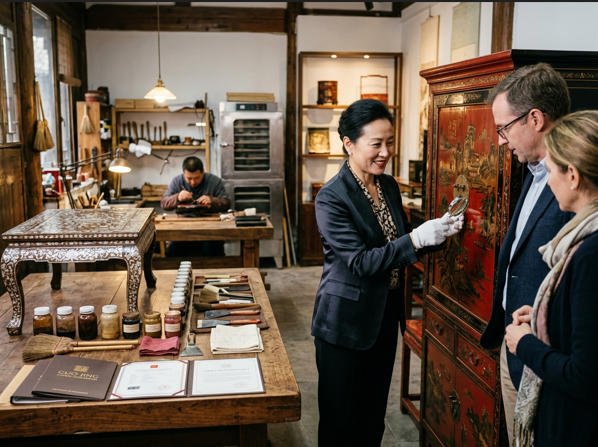
Modern printing technology can replicate gold leaf landscapes flawlessly. To spot a printed fake, use a jeweler’s loupe. If you see tiny, uniform dots (like a newspaper print) making up the image, it is a modern transfer. Authentic gold painting will show fluid, continuous brushstrokes.
Overly perfect modern look vs. natural aging cues
Look at the feet of a cabinet. A piece that has stood on damp stone floors for 200 years will show natural rot, wear, and darkening at the very bottom. If the feet are perfectly pristine while the top is “aged,” the piece is a reproduction.
Provenance documents and maker marks
Unlike European furniture, traditional Chinese makers rarely signed their work. Therefore, establishing provenance relies heavily on unbroken ownership records, auction catalogs, and export documentation.
Sourcing responsibly: how to verify origin and ethics
Vendor reputation, certifications, and trade records
Always purchase from specialized dealers who offer a lifetime guarantee of authenticity. Reputable dealers will provide detailed condition reports mapping out exactly which parts of the piece are original and which have been restored.
Import/export regulations and anti-counterfeit signals
Be aware of international laws. Authentic pieces made of protected woods like Huanghuali أو Zitan fall under CITES regulations and require specific permits to transport across borders. A dealer offering these without paperwork is either selling fakes or operating illegally.
Care and maintenance best practices for lacquer furniture
Cleaning routines: dusting, polishing, and avoiding water
Never use commercial chemical dusters or aerosol waxes on natural lacquer. Dust gently with a dry, lint-free microfiber cloth. If a spill occurs, wipe it immediately with a barely-damp cloth and dry it instantly. Standing water will cause the lacquer to turn cloudy.
Humidity and temperature considerations to prevent cracking
Lacquer’s greatest enemy is dry air. To prevent the wood substrate from shrinking and cracking the surface, maintain an indoor relative humidity of 50% to 60%. Avoid placing pieces near HVAC vents, radiators, or fireplaces.
Protective strategies for display and daily use
If you intend to use a lacquer table daily, have a piece of tempered glass custom-cut to cover the top. Place felt pads under the glass to allow air circulation, preventing moisture buildup between the glass and the lacquer.

Common restoration and upkeep pitfalls
When to hire a professional restorer
If lacquer begins to flake or lift, do not touch it. Place the flaked pieces in a safe envelope and contact a conservator specializing in Asian antiquities. Consolidating lifting lacquer requires specialized protein glues and heat tools.
Avoiding over-cleaning or inappropriate products
Applying linseed oil or heavy furniture wax to lacquer will create a sticky residue that traps dirt and dulls the finish permanently. Less is always more when caring for these items.
Documenting restoration history for resale value
Keep an ongoing log of any conservation work performed. High-end auction houses require transparency regarding restorations; hiding a repair can drastically lower an item’s appraisal value once discovered by their specialists.
Buying checklist: questions to ask sellers
Before transferring funds, ensure you have addressed the following:
- Can you provide a detailed condition report under UV light?
- What percentage of this piece is original versus restored?
- Does this contain materials restricted by CITES?
Price guidance and investment considerations
Why authentic lacquer furniture commands premium
The price reflects hundreds of hours of hazardous, highly skilled manual labor, combined with centuries of survival. It is an intersection of fine art and functional design.
Factors Influencing the Market Price of Antique Lacquerware
How condition, rarity, and size affect price
Size does not always dictate price. A pristine, intricately inlaid tabletop jewelry box from the Ming dynasty will easily out-price a massive, heavily restored 19th-century wardrobe.
Avoiding common over- or under-valuations
Beware of the “married” piece—a cabinet created by merging parts from two different broken antiques. While the materials are technically old, the piece itself is a modern creation and should be priced as a reproduction, not a historical artifact.
Conclusion and quick-reference summary
Authentic Chinese lacquer furniture represents a miraculous blend of artistry, material science, and traditional joinery. From the toxic origins of raw Urushi sap to the intricate, nail-free mortise-and-tenon construction, these pieces were built to endure for generations—provided they receive the proper care.
Remember to rely on tactile inspections, UV light analysis, and environmental control. When in doubt, consult specialists, request comprehensive condition reports, and document all provenance for future generations. By approaching the market with education and a discerning eye, you ensure your investment protects both your capital and global cultural heritage.