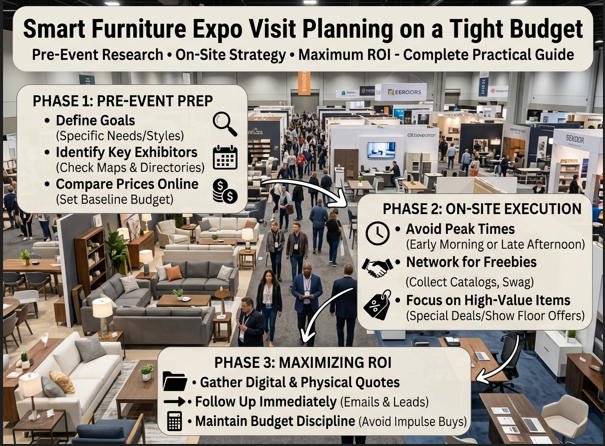
 The average cost to attend a trade show is $600–$1,000 per person per event — and for international furniture expos like CIFF Guangzhou, that figure easily climbs past $3,000 when flights, hotels, and multi-day meals are included. Yet industry data reveals a troubling disconnect: 80% of trade show leads are never followed up on, 73% of exhibitors at European fairs cannot calculate their cost per lead, and companies that delay post-event outreach beyond 48 hours see conversion rates drop by 50–70%. The problem is not attendance — it is the absence of a system that connects spending to outcomes.
This guide provides that system. It covers the complete lifecycle of a budget-conscious expo visit: defining measurable objectives before booking a flight, building a pre-event budget with contingency reserves, researching exhibitors and sessions for maximum relevance, cutting travel and lodging costs without cutting access, executing an on-site strategy that generates qualified leads, and running a post-event follow-up process that converts contacts into contracts. Whether you are a solo designer attending your first Chinese furniture expo, a procurement team managing a multi-show calendar, or a retailer scouting new supplier relationships, the frameworks here scale to any budget and any venue.
1. Define Clear Objectives for ROI
Identify Target Goals: Leads, Partnerships, Market Insights
Every dollar spent at an expo should trace back to a defined outcome. “See what’s new” is not an objective — it is tourism. Before committing budget, categorize your goals into three measurable tiers. Lead generation goals: “Collect qualified contact information from 15–25 potential suppliers who manufacture solid-wood dining furniture with MOQ under 100 units and FOB pricing under $150.” Partnership goals: “Identify 3–5 manufacturers offering OEM/ODM capability for custom hospitality furniture, and schedule post-show factory visits.” Market intelligence goals: “Document pricing trends across five product categories, photograph 20+ new product innovations, and attend two trend-forecasting seminars.”
The specificity matters because it directly determines how you allocate your budget. A lead-generation-focused visit prioritizes booth time and networking events (allocate 60–70% of on-site hours). A market-intelligence visit prioritizes seminars, demonstration areas, and trend zones (allocate 40–50% of on-site hours). Mixing the two without clear ratios produces a pleasant but financially unjustifiable trip.
Align Objectives with Budget Constraints
Apply a simple ROI filter before approving any expo visit: estimate the revenue potential of your goals, then compare it to total trip cost. If your objective is to find two new suppliers who each represent $50,000 in annual purchasing volume, and your total trip costs $3,500, the potential ROI is 28:1 — easily justified. If your goal is “general inspiration” with no revenue connection, the $3,500 is a marketing expense with no measurable return. Organizations that formalize this calculation before every event — as outlined in Jade Ant furniture’s sourcing guide for retailers — report 40–60% higher satisfaction with their expo investments.
2. Budgeting Essentials Before You Go
Create a Pre-Event Budget and Reserve Contingency
A complete expo budget covers seven categories. Industry benchmarks from trade show analytics firms provide the following allocation percentages for attendees (not exhibitors):
| Budget Category | % of Total | Solo Visitor Estimate (USD) | Cost-Saving Lever |
|---|---|---|---|
| Registration / Admission | 5–8% | $0–$150 | Pre-register for free or early-bird rates |
| Flights / Transport | 25–35% | $400–$1,200 | Book 6–8 weeks ahead; use fare alerts |
| Lodging (hotel / Airbnb) | 20–30% | $300–$900 | Non-central hotels, group rates, loyalty programs |
| Meals & Ground Transport | 10–15% | $150–$400 | Local restaurants vs venue food; metro vs taxis |
| On-Site Assets (catalogs, samples, shipping) | 5–10% | $50-$200 | Digital catalogs; photograph instead of collect |
| Networking / Events | 3–5% | $50–$150 | Prioritize free networking events; RSVP early |
| Contingency Reserve | 10–15% | $150–$400 | Covers overruns, last-minute changes, emergencies |
| Total (3-day international expo) | 100% | $1,100–$3,400 |
The contingency reserve — 10–15% of total budget — is non-negotiable. Trade show budget overruns average 40% when no contingency is planned, according to Custom Canopy Tent’s 2026 analysis. A planned reserve absorbs unexpected costs (visa rush fees, rebooking a canceled flight, shipping samples home) without derailing the entire trip.
Prioritize Spend: Registration, Travel, Lodging, and On-Site Assets
For budget-constrained visitors, the priority stack is: registration first (lock in free or early-bird admission), flights second (price volatility makes early booking the highest-leverage savings move), lodging third (flexible cancellation policies let you optimize later), and on-site spend last (this is the most controllable category). A common mistake is over-budgeting for on-site expenses — meals at CIFF Guangzhou’s on-site restaurants cost $5–$12 per meal; in surrounding districts, the same quality costs $3–$7. Ground transport via Guangzhou Metro Line 8 to Pazhou Complex costs under $1 per trip vs $15–$25 for a taxi from central Guangzhou.

3. Pre-Event Research: Exhibitors, Sessions, and Maps
Build a Target List of Exhibitors and Decision-Makers
Every major furniture fair publishes its exhibitor directory 4–8 weeks before opening. CIFF lists 5,100+ exhibitors with booth numbers, product categories, and preview galleries. Download the directory and filter by your target criteria. Build a tiered shortlist: Tier 1 (must-visit, 8–10 exhibitors matched to your primary objectives), Tier 2 (visit if time allows, 10–12 exhibitors), Tier 3 (opportunistic, only if nearby). For each Tier 1 exhibitor, identify the specific decision-maker you need to speak with — a sales manager, product designer, or export department head — and attempt to schedule a meeting before the show via email or the expo’s matchmaking platform (CIFF uses “Click2Connect”).
Pre-scheduling transforms expo economics. A pre-booked meeting with a targeted exhibitor generates 3–5× more actionable intelligence per minute than a cold walk-up conversation, according to data from procurement consulting firms. For buyers evaluating Chinese manufacturers, cross-reference exhibitor names with verified factory databases to distinguish actual manufacturers from trading companies — a distinction that saves time and improves negotiation leverage on the floor.
Map Sessions, Demos, and Speaking Tracks That Align with Goals
Large expos run parallel programming — trend seminars, material demonstrations, design competitions, and networking receptions. Map each scheduled session against your three goal tiers. A lead-generation visitor should skip trend seminars in favor of live product demonstrations where exhibitors showcase new capabilities; these demos attract decision-makers and create natural conversation openings. A market-intelligence visitor should prioritize trend-forecasting sessions and new-material exhibits. Print your personalized schedule and carry it in a pocket — venue Wi-Fi at peak hours is unreliable for app-based schedules.
4. Travel and Accommodation on a Shoestring
Compare Travel Options and Optimize Timing
Flights represent 25–35% of total expo cost, making them the largest single controllable expense. Three strategies reduce this cost measurably. First, book 6–8 weeks before the event — airfare analysis from Google Flights and Hopper consistently shows this window offers the lowest average prices for international travel. Second, fly midweek (Tuesday–Thursday departures are 15–30% cheaper than weekend flights on most transpacific routes). Third, consider indirect routing: a Guangzhou trip via Hong Kong with a high-speed rail connection (45 minutes, $25) can save $200–$400 compared to a direct international flight to Baiyun Airport, depending on origin.
For domestic U.S. expos (High Point Market, ICFF New York), compare driving cost vs airfare — for trips under 300 miles, driving with a shared vehicle often saves $100–$200 per person after parking and fuel costs.
Save on Lodging with Group Rates, Non-Central Options, and Loyalty Programs
Hotels within walking distance of expo venues charge a 40–80% premium during event weeks. At CIFF Guangzhou, hotels in the Pazhou district (adjacent to the convention center) run $120–$250/night during the fair — compared to $60–$100/night in the Haizhu or Tianhe districts, a 20–30 minute metro ride away. Guangzhou’s Metro Line 8 provides direct service to Pazhou Complex, making non-central hotels operationally identical in terms of access time while saving $60–$150 per night.
Stack savings further with: hotel loyalty programs (Marriott Bonvoy, Hilton Honors, IHG — late check-out and room upgrades cost zero loyalty points), group booking discounts (3+ rooms often unlock 10–20% off published rates), and Airbnb for stays longer than three nights (kitchens eliminate $20–$40/day in restaurant spending). The CIFF sourcing trip planning guide includes recommended hotel zones by budget tier.

5. On-Site Strategy: Scheduling and Networking
Create a Daily Plan with Time-Blocks for Meetings
An unscheduled expo day produces roughly 3.2 hours of productive booth engagement out of a 10-hour visit. A time-blocked day pushes that to 5.0+ hours — a 56% increase in output for the same cost of attendance. Structure each day into 90-minute blocks: Morning Block 1 (9:00–10:30) for Tier 1 booths, Morning Block 2 (10:45–12:15) for pre-scheduled meetings, Lunch (12:15–13:00, off-site to avoid peak-crowd zones), Afternoon Block 1 (13:00–14:30) for sessions or demonstrations, Afternoon Block 2 (14:45–16:15) for Tier 2 booths, and End-of-Day Review (16:15–17:00) for note consolidation and next-day adjustments.
Each block should have a primary goal and a fallback. If your Tier 1 meeting finishes early, have a Tier 2 booth within walking distance identified. If a seminar runs over time, skip the networking portion and proceed to the next block. This systematic approach mirrors how procurement teams at Foshan manufacturer comparisons structure their sourcing trips — maximum coverage, minimum wasted transit.
Use Social Discovery and Badges for Quick Introductions
LinkedIn’s “Events” feature and WeChat’s “Nearby People” function let you identify attendees with relevant job titles before approaching them. At CIFF 2026, the iConnect program uses digital badges that display visitor profiles — scan a QR code on someone’s badge to see their company, role, and product interests. This pre-qualifies networking conversations: you can approach a “Hotel Procurement Manager” with a tailored pitch rather than a generic introduction, increasing the conversion rate of each interaction while spending zero additional budget.
6. Low-Cost Lead Capture and Data Hygiene
Leverage Digital Badges, QR Capture, and Offline-to-Online Sync
Lead capture at expos does not require expensive scanning hardware. Three low-cost or free methods cover most needs. First, use the expo’s official badge-scanning app (CIFF, ICFF, and most major fairs offer this at no cost to attendees). Second, create a personal QR code linked to a Google Form or Typeform that captures name, company, email, product interest, and follow-up action — print it on a small card and hand it out as an alternative to business-card exchanges. Third, photograph every business card immediately using a card-scanning app (CamCard, Microsoft Lens — both free) that auto-extracts contact data into a spreadsheet.
Total cost of this three-layer system: $0–$50 (for printed QR cards). Total setup time: 45 minutes before the event. The result: every contact captured digitally, tagged by date and context, and ready for CRM import within hours of the event’s close.
Clean Data Collection to Improve Follow-Up Quality
Raw lead data from an expo is 30–40% unusable without cleaning: duplicate entries, misspelled emails, missing company names, and contacts who were polite but unqualified. Build a one-line qualification note into every capture: immediately after the conversation, add a tag — “Hot” (expressed budget and timeline), “Warm” (expressed interest, no commitment), or “Cold” (informational only). This 5-second step at the point of capture saves 30+ minutes of post-event sorting per 20 leads and dramatically improves follow-up conversion by letting you prioritize Hot leads within the critical 48-hour window.
The chart above illustrates a stark reality: leads contacted within 24 hours convert at 7× the rate of those contacted after one week — yet only 12% of exhibitors manage that speed. The lead-capture hygiene practices described above directly enable rapid follow-up by eliminating the post-event data-cleaning bottleneck.
7. Maximizing Sessions, Demos, and Content ROI
Prioritize High-ROI Sessions and Live Demos
Not all expo sessions deliver equal value per hour invested. Rank each available session against three criteria: direct applicability to your stated objectives, speaker credibility (look for practitioners, not just commentators), and networking opportunity (smaller workshops with 20–30 attendees generate more connections than 500-seat keynotes). Live product demonstrations — where exhibitors showcase manufacturing processes, material testing, or new technology — consistently rank as the highest-ROI activity at furniture expos because they combine product evaluation, technical education, and supplier interaction in a single time block.
At CIFF 2026, the interzum guangzhou component (Phase 2, March 28–31) featured live demonstrations of Foshan factory innovations including automated CNC routing, water-based lacquer application, and smart hardware integration. Attending two such demos produced more actionable supplier intelligence than touring 15 standard booths — and cost nothing beyond the time investment.
Capture Takeaways and Contact Details for Post-Event Outreach
For every session you attend, capture three items: one key insight (a trend, a data point, or a technique), the speaker’s contact information or LinkedIn profile, and one connection with another attendee (exchange cards during breaks). This three-capture rule ensures that even a mediocre session yields at least one follow-up opportunity. Record these in a dedicated note — separate from your exhibitor notes — tagged by session name and date for easy retrieval.
8. Post-Event Follow-Up Plan That Pays Off
Schedule Immediate Next Steps After the Event
Trade show leads contacted within 48 hours convert at 3–7× the rate of leads contacted after one week. Yet 80% of expo leads are never followed up on at all. This single statistic represents the largest ROI leak in the entire expo process — and it costs nothing to fix except discipline.
Block two hours on Day 1 post-event (before you unpack from the trip) to: sort leads into Hot / Warm / Cold, send personalized emails to all Hot leads (referencing the specific product, conversation, and agreed next step), send standardized but personalized emails to Warm leads (expressing continued interest and proposing a timeline for next contact), and file Cold leads for quarterly nurturing. A simple email template: “Dear [Name], thank you for the conversation at [Expo] about [specific product]. I’d like to move forward with [sample request / quote / factory visit] as discussed. Are you available for a brief call on [date]?”
Nurture Leads with Tailored, Value-Driven Communication
Hot leads should receive a personal follow-up every 5–7 days for the first month, then monthly for three months. Each touchpoint should deliver value — a relevant market report, a product comparison, or an answer to a question raised during the expo conversation. Warm leads should receive monthly communication with industry content (not sales pitches) for 90 days before re-qualifying. The guide to working with Chinese furniture suppliers includes email templates optimized for post-expo nurturing sequences that maintain momentum without being aggressive.
For buyers sourcing from manufacturers like أثاث النمل اليشم, post-expo follow-up typically involves requesting samples, confirming MOQ and pricing details, and scheduling factory visits. The 48-hour email should include specific product references and quantity ranges to demonstrate serious purchasing intent — exhibitors who receive hundreds of generic “nice to meet you” emails will prioritize responses to buyers who reference SKUs and timelines.
9. Metrics to Track ROI and Learning
Define Key Metrics: Cost per Lead, Pipeline Impact, Meeting Quality
Five metrics transform an expo from an intuitive gut-check into a measurable investment. Track these for every event:
| متري | Formula | Industry Benchmark | Target for Budget Visitors |
|---|---|---|---|
| Cost per Lead (CPL) | Total trip cost ÷ total qualified leads | $112 average across trade shows | ≤ $80 (budget-optimized) |
| Pipeline Impact | Total potential deal value from expo leads | 3× total trip cost (industry median) | ≥ 5× total trip cost |
| Meeting Quality Score | % of pre-scheduled meetings held as planned | 60–70% completion rate | ≥ 80% |
| Follow-Up Speed | % of Hot leads contacted within 48 hours | 20% (industry reality) | 100% |
| Conversion Rate | Leads that became orders ÷ total qualified leads (measured at 90 days) | 5–8% for trade shows | ≥ 10% with systematic follow-up |
Create a Simple Dashboard for Ongoing Review
A single spreadsheet with five rows (one per metric), measured at three intervals (immediately post-event, 30 days, 90 days), provides a complete picture of expo ROI. At 90 days, compare actual performance to pre-event projections. If CPL exceeded $80, identify the cost-driver (was it flight prices? too many unproductive booth visits?). If conversion rate fell below 10%, audit the follow-up sequence (was the 48-hour rule met? were emails personalized?). This post-mortem becomes the planning document for your next expo visit — a continuous improvement loop that compounds savings and ROI across every event in your annual calendar.
10. Risk Management and Contingency Planning
Prepare for Travel Delays, Exhibit Overlaps, and Budget Overruns
Three categories of risk merit advance planning. Travel disruptions: book refundable or flexible-change flights when the price premium is under 15% of the base fare; carry copies of your passport, visa, and hotel confirmation in both digital and printed formats. Exhibit overlaps: when two target exhibitors schedule events at the same time, send one team member (or a colleague attending the same expo) to cover the conflict, or pre-schedule one meeting and attend the other’s next available session. Budget overruns: the 10–15% contingency reserve in your pre-event budget absorbs single-event overruns; for multi-event calendars, track cumulative spend vs budget weekly and pause discretionary expenses (networking dinners, premium transport) if cumulative actuals exceed 105% of plan.
Develop Backup Plans for Meetings and Backup Data Capture
Two backup systems cost nothing and prevent catastrophic data loss. First, sync your lead-capture spreadsheet to a cloud service (Google Drive, Dropbox) every evening — if your phone is lost or stolen, no data is lost. Second, carry a physical notebook as backup for your digital note system — battery death at hour 8 of a 10-hour expo day is common, and a $2 notebook preserves the final two hours of conversations. For pre-scheduled meetings that cancel, have a list of three “backup booths” in the same hall that you can visit without backtracking — this converts a schedule gap into a productive discovery session. Manufacturers like Jade Ant furniture’s OEM/ODM team often accommodate walk-in conversations when their scheduled meeting slots open unexpectedly — being nearby and prepared turns a cancellation into an opportunity.
Watch: 19 Tips to Maximize Trade Show ROI
An expo visit on a tight budget is not about cutting corners — it is about directing every dollar toward a measurable outcome. The visitors who extract the highest ROI per dollar spent are those who: define quantified objectives before booking a flight, build a budget with a 10–15% contingency reserve, research exhibitors and pre-schedule meetings to maximize productive booth time, choose non-central lodging and leverage loyalty programs to cut accommodation costs by 30–50%, capture leads with low-cost digital tools and tag them at the point of contact, follow up with Hot leads within 48 hours (capturing the 3–7× conversion advantage), and track five metrics at 30-day and 90-day intervals to continuously improve their expo strategy.
The cumulative effect of this system is significant. A budget-conscious visitor spending $2,000 on a CIFF trip who captures 25 qualified leads at a CPL of $80 and converts 10% into orders generates pipeline value of 5–15× the trip cost. That same $2,000 spent without a system — random browsing, no lead capture, no follow-up — generates zero measurable return. The difference is not money. It is method.
For pre-event research, factory evaluation frameworks, and post-expo supplier communication templates, explore Jade Ant’s import-vs-domestic analysis or browse their directory of China’s leading furniture factories. Start planning your next expo visit with the budget template above, and measure the results at 90 days.
Frequently Asked Questions
1. How do I estimate ROI before the expo?
Use this formula: Projected ROI = (Estimated revenue from leads ÷ Total trip cost). Estimate lead revenue by multiplying the number of qualified leads you expect to capture (based on your Tier 1 shortlist size) by the average order value per lead and your historical conversion rate. For a first-time visitor with no historical data, use the industry average conversion rate of 5–8%. If the projected ROI exceeds 3:1, the trip is financially justified. If not, reconsider the event or reduce costs until the ratio improves.
2. What is the best way to capture leads cost-effectively?
Three free-to-low-cost methods: the expo’s official badge-scanning app ($0), a personal QR code linked to a Google Form ($0–$10 for printed cards), and a business-card scanning app like CamCard or Microsoft Lens ($0). Tag every lead immediately with a Hot/Warm/Cold qualifier. This system captures data digitally, eliminates manual entry, and enables same-day CRM import — total setup cost under $50.
3. How soon should I follow up with exhibitors and attendees?
Within 48 hours. Research from multiple trade show analytics firms confirms that leads contacted within 24 hours convert at 7× the rate of those contacted after one week. Leads contacted within 48 hours convert at 3×. After one week, the conversion advantage disappears almost entirely. Block two hours on the first day after the expo for follow-up emails — this is the highest-ROI activity in the entire expo process.
4. What’s a reasonable budget for attending an international furniture expo?
For a solo visitor attending a 3-day international expo like مهرجان CIFF جوانزو: $1,100–$3,400 depending on origin city, hotel selection, and meal choices. Budget-conscious visitors can target $1,500–$2,000 by booking flights 6–8 weeks early, choosing non-central hotels connected by metro, and eating at local restaurants. Always include a 10–15% contingency reserve.
5. How do I calculate cost per lead at a trade show?
Cost per Lead (CPL) = Total trip cost ÷ Number of qualified leads captured. The industry average CPL across trade shows is $112. Budget-optimized visitors targeting $80 or below should focus on pre-scheduling meetings (higher qualification rate), using structured lead-capture tools (fewer lost contacts), and prioritizing Tier 1 booths (more relevant leads per hour). Track CPL at every event to identify improvement opportunities.
6. Should I attend a furniture expo as a visitor or an exhibitor?
For buyers and sourcing professionals, attending as a visitor is almost always more cost-effective. Exhibition costs (booth rental, setup, staffing) range from $10,000–$50,000+ per event — 10–30× the cost of visitor attendance. Attend as a visitor when your primary goals are supplier discovery, market intelligence, and relationship building. Exhibit only when your primary goal is generating inbound buyer leads for your own products.
7. How do I avoid wasting time at an expo?
Three disciplines prevent time waste: a tiered exhibitor shortlist (researched before arrival), a time-blocked daily schedule (90-minute blocks with primary goals and fallbacks), and the 60-second product-snapshot method (visual, tactile, structural, and decide in under a minute whether to engage deeper or move on). Unscheduled visitors spend 26% of their time just walking and navigating — a planned route through adjacent halls cuts this in half.
8. What tools should I bring to an expo for maximum ROI on a budget?
Essential budget-friendly tools: a power bank (10,000+ mAh, $15–$25), a pocket laser distance meter ($20–$30 for measuring furniture), a pre-formatted comparison spreadsheet (printed or on tablet), business cards, a refillable water bottle, a small notebook as digital backup, and color/material swatches from your current project. Total investment: under $75 for items you likely already own.
9. How do I track expo ROI across multiple events per year?
Create a single spreadsheet with one row per event and columns for: total cost, leads captured, CPL, pipeline impact (measured at 90 days), conversion rate, and an ROI score (pipeline value ÷ total cost). Review quarterly. Events with CPL above your target or conversion rates below 5% warrant either different preparation strategies or elimination from next year’s calendar. This dashboard converts anecdotal “the show felt productive” into data-driven event selection.
10. Can I source furniture effectively at an expo without placing orders on-site?
Yes — and for most first-time visitors, this is the recommended approach. Use the expo for supplier discovery, qualification, and relationship initiation. Place orders only after post-expo steps: sample evaluation, factory visit or third-party audit, pricing comparison across your shortlist, and contract negotiation. Manufacturers like أثاث النمل اليشم welcome post-expo factory visits where buyers can inspect production lines, verify certifications, and negotiate terms with full context — a process that consistently produces better pricing and quality outcomes than on-site impulse orders.







 Arabic
  English
  Portuguese