An Interactive Guide for Hotel Developers, FF&E Buyers, Interior Designers, Luxury Furniture Importers, and Distributors
1. Executive Summary: Why FF&E Clarity Matters in Hotel Development
Here is the scenario that derails more hotel projects than any other: a developer reviews the FF&E budget line in a construction pro forma, sees a number that appears reasonable for the room count, and approves it — without anyone in the room having agreed on what FF&E actually includes. Six months before opening, the procurement team discovers that outdoor furniture, back-of-house equipment, and installation labor were never in scope. The budget shortfall is resolved with cuts that compromise the very spaces guests will photograph and review first.
This is not a theoretical risk. According to Hospitalitydesigns.com, most hotel FF&E projects exceed budget not because the furniture cost too much, but because of everything that happened around the furniture: uncounted soft costs, procurement timeline compression, import duties absorbed at the end rather than planned at the beginning, and installation labor treated as a site contractor responsibility until it was not.
المفروشات والمعدات والأثاث — Furniture, Fixtures, and Equipment — is the category of movable assets that define the guest experience from the moment they enter a lobby to the moment they check out of their room. It is the single most visible line item in any hotel development, and it is the one most consistently underdefined at the point in a project when underdefinition is most expensive.
The global hotel FF&E market was valued at $63.1 billion in 2025 ومن المتوقع أن يصل إلى $107.9 billion by 2033, ، وفقًا ل جراند فيو للأبحاث. That growth reflects the accelerating investment in hospitality infrastructure across Asia-Pacific, the Middle East, and luxury residential hospitality segments globally. The professionals navigating this market successfully are those who define FF&E precisely, budget for it completely, and procure it strategically.
This guide delivers that precision — across every category, with real cost benchmarks, procurement timelines, compliance requirements, and strategic opportunities — for every stakeholder who touches an FF&E budget.
2. What Is FF&E? A Professional Definition

المفروشات والمعدات والأثاث stands for Furniture, Fixtures, and Equipment. In the professional context of hotel development and procurement, it refers specifically to movable assets — items that are not structurally integrated into the building and can be removed, relocated, or replaced without alteration to the building fabric.
The three components break down as follows:
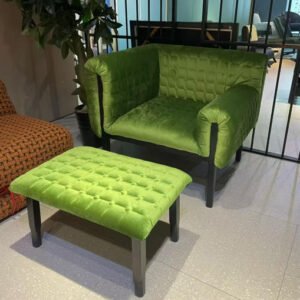
الأثاث encompasses all freestanding and semi-freestanding pieces: beds, sofas, chairs, tables, desks, wardrobes, nightstands, and outdoor loungers. These are the highest-visibility items and typically the largest single spend within an FF&E budget.
Fixtures covers items attached to the building but not structural — lighting fixtures, mirrors, towel bars, decorative wall panels, and artwork mounting systems. The gray area: a mirror glued to a tiled wall is a fixture; a freestanding mirror in a frame is furniture. The distinction matters for capital expenditure classification and import customs tariff codes.
Equipment includes the operational hardware that is movable and functional — fitness equipment, commercial kitchen equipment classified under FF&E (if movable), AV equipment, minibars, and in-room safes.
How FF&E differs from OS&E and structural construction:
OS&E (Operating Supplies and Equipment) is the category most frequently confused with FF&E. OS&E covers the consumable and operational items required for daily hotel operations: linens, towels, cutlery, glassware, cleaning supplies, and printed collateral. These are not capital assets — they are operational expenses that deplete and replenish on a continuous cycle.
The distinction matters practically for three reasons. First, procurement timelines differ: FF&E requires 9–16 weeks for custom pieces; OS&E can often be sourced in days. Second, capital expenditure reporting treats FF&E as a depreciating fixed asset and OS&E as an operating expense — a distinction that affects financing, tax treatment, and EBITDA presentation. Third, import duty classification varies significantly between FF&E and OS&E categories, with upholstered furniture, solid wood case goods, and lighting fixtures each carrying distinct tariff codes in most jurisdictions.
Structural construction — walls, ceilings, plumbing infrastructure, HVAC systems, and built-in cabinetry that is load-bearing or infrastructure-integrated — is excluded from FF&E regardless of whether it serves a decorative function.
3. The 10-Pillar FF&E Breakdown: What’s Actually Included
The following breakdown covers every FF&E category that a hotel development team should define, budget, and procure. Each pillar has a distinct specification requirement, lead time profile, and procurement complexity level.
Pillar 1 — Guestroom Furniture
The guestroom furniture package is the largest single FF&E category in almost every hotel type, typically representing 38–45% of the total FF&E budget. It is also the category with the longest procurement lead time for custom pieces, and the one where quality failures have the most direct impact on guest review scores.
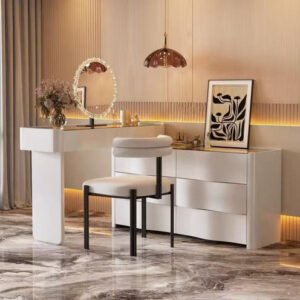
Core guestroom furniture items include: beds (platform, divan, or four-poster depending on brand tier), headboards (flush-upholstered or architectural panel), nightstands, desk-and-chair configurations, luggage racks, armchairs or lounge seating, wardrobes or closet systems, and full-length mirrors.
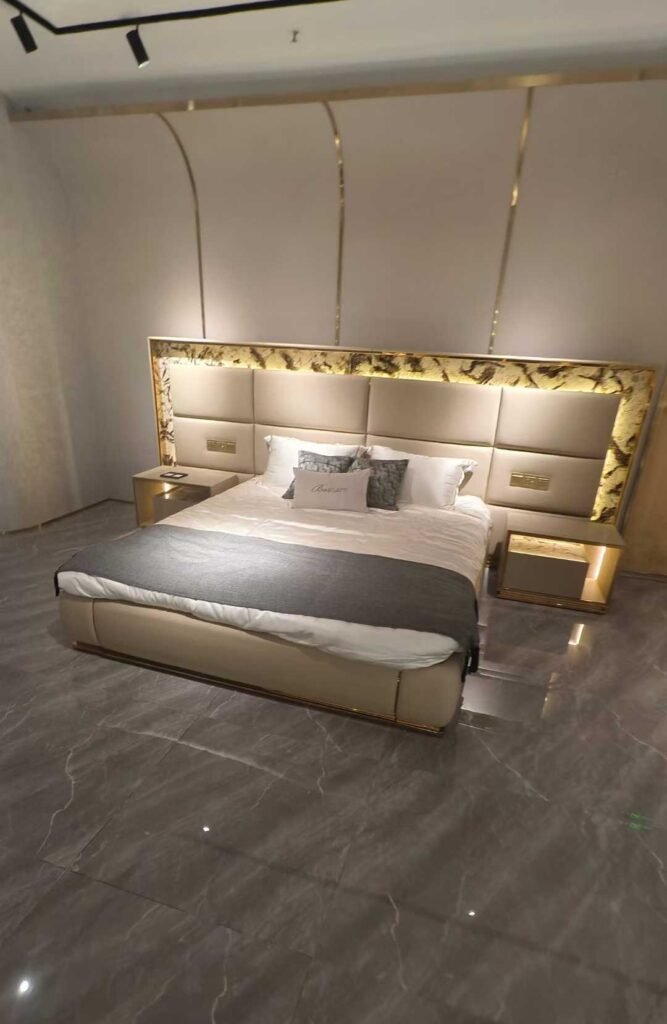
Luxury specification note: In five-star and boutique properties, guestroom furniture is often custom-manufactured to the property’s specific dimensions, finish references, and material selections. A custom platform bed in hand-lacquered walnut with an integrated bedside panel and embedded ambient LED strip — the kind of piece that appears in every marketing photograph and every guest’s social media post — requires a 10–14 week lead time from confirmed purchase order to delivery, and a premium of approximately 35–50% over catalog equivalent pieces. That premium is recoverable through ADR (Average Daily Rate — the average room revenue per occupied room per night), which consistently correlates with interior quality scores.
Pillar 2 — Guestroom Soft Furnishings & Textiles
Soft furnishings cover everything upholstered, woven, or textile in origin within the guestroom: window treatments (curtains, sheers, blackout systems), bedding (duvet covers, bed skirts, decorative throws, pillowcases and pillow inserts), bathrobes and slippers (when provided to guests rather than laundered centrally, these cross into OS&E territory — confirm classification with your accountant), and upholstered accent pieces.
Fabric specification matters beyond aesthetics. For drapery in a tropical or coastal environment, solution-dyed fabrics resist UV fading significantly longer than surface-dyed alternatives. For bedding, a minimum 400-thread-count percale or an 80-gram sateen weave is the practical specification floor for four-star properties — below this threshold, guests notice the feel before they notice the room.
The key durability standard for upholstered guestroom textiles is the Martindale count (a standardized European test for abrasion resistance, expressed in cycles — one cycle simulates one pass of a friction instrument over the fabric surface under controlled pressure). Guestroom seating should meet a minimum of 40,000 Martindale cycles; upholstered headboards in contact with guests’ hair and skincare products benefit from 60,000+ cycles and a moisture-resistant finish.
Pillar 3 — Bathroom Fixtures & Vanity Furniture
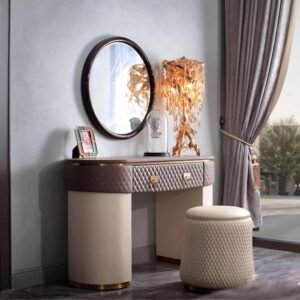
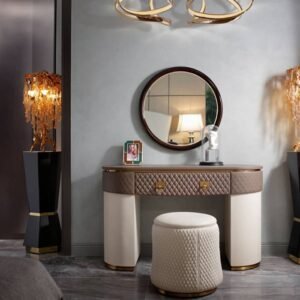
Bathroom FF&E occupies the gray zone between construction and procurement. The rule of thumb: if it can be disconnected and removed without altering the building structure, it is FF&E. Freestanding bathtubs (connected to visible floor supply lines), vanity units (freestanding or wall-hung on standard brackets), medicine cabinets (surface-mounted), towel bars and hooks, toilet roll holders, soap dispensers, and illuminated mirrors all qualify as FF&E.
Built-in shower trays, in-wall plumbing fixtures, and integrated tile shower niches are hard construction — not FF&E.
High-margin opportunity for importers: Stone-top vanities — particularly those featuring engineered stone or sintered stone (produced by firing natural minerals at extreme temperature, creating a non-porous surface impervious to water, acids, and staining) — and frameless illuminated mirrors with integrated LED strips represent among the highest per-unit margin items in luxury hotel procurement. A stone-top vanity unit that costs $800–$1,200 to manufacture in a mid-tier Chinese factory typically retails in the luxury specification market at $2,800–$4,500, with logistics and installation adding $300–$600 per unit. At a 100-room luxury property, this single category can generate significant margin for a well-positioned importer.
Pillar 4 — Public Area & Lobby Furniture
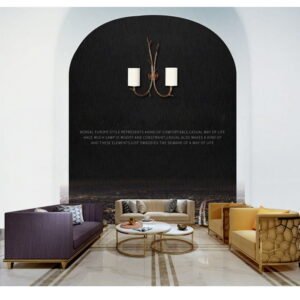
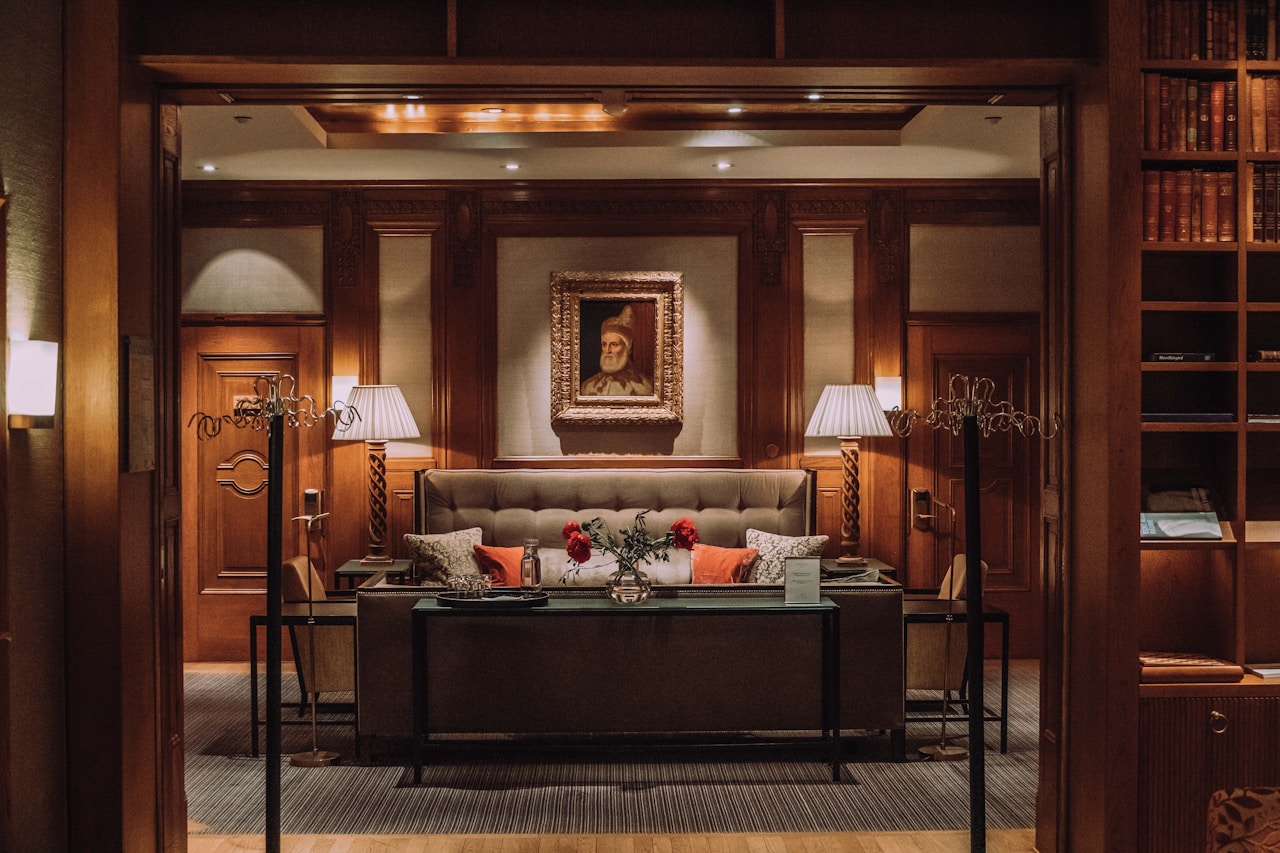
The lobby is the hotel’s brand in physical form. Every procurement decision in this space — the seating arrangement, the reception desk finish, the coffee table scale, the lighting fixture specification — communicates the property’s market position to every guest within the first 90 seconds of their arrival.
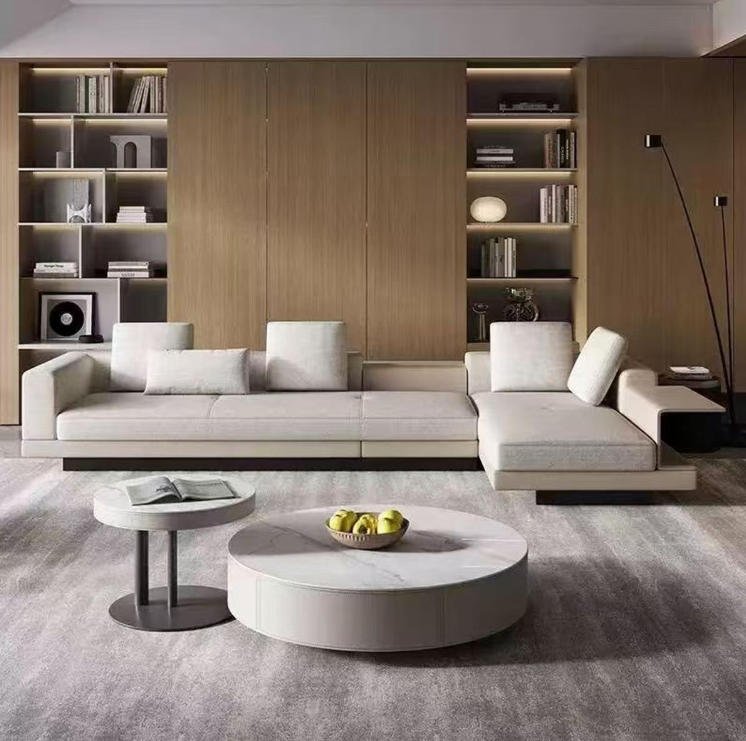
Public area FF&E includes: lobby lounge seating clusters (sofas, armchairs, occasional chairs), reception desk (typically custom-manufactured to match the lobby’s architectural language), coffee tables and side tables, feature lighting (pendants, floor lamps, architectural uplights), check-in counters, concierge stations, and decorative plants if in movable planters.
Developer ROI note: Public areas typically receive 25–30% of FF&E budget allocation in luxury and upscale properties. This weighting is deliberate: the lobby is photographed more than any other space, appears in every OTA (Online Travel Agency — platforms such as Booking.com, Expedia, and Hotels.com that distribute hotel inventory) listing image, and is the primary driver of first-impression scores in post-stay surveys. A $400,000 lobby furniture investment that produces a 0.5-point improvement in overall review scores translates — based on Cornell University’s documented ADR correlation — to a 0.45% ADR uplift that compounds annually across the property’s full operating lifecycle.
Pillar 5 — Food & Beverage (F&B) Furniture & Fixtures
F&B spaces require furniture that performs at commercial grade across multiple daily service cycles, resists aggressive cleaning chemicals, accommodates the physical demands of seated dining (a dining chair in a hotel restaurant is repositioned approximately 180–240 times per day under normal service conditions), and maintains a visual standard consistent with the property’s brand positioning.
F&B FF&E includes: restaurant dining tables and chairs, banquette seating, bar stools and bar counter stools, host station, wait station, outdoor dining sets (if restaurant extends to terrace), and private dining room furniture.
Material resilience matters here more than in any other space. The fabric or vinyl on a restaurant dining chair is a precision specification: it must be rated at minimum 100,000 Martindale cycles, be bleach-cleanable without color loss, and maintain structural integrity through the compression cycles of repeated seating. The table top must resist heat to 180°C (hot plates set directly on unprotected surfaces), moisture from spilled liquids, and the abrasion of commercial-grade cleaning. Sintered stone and compact laminate (a high-pressure laminate fused under heat to produce a surface that is scratch, stain, and moisture resistant) are the benchmark table top materials for high-traffic F&B environments.
Pillar 6 — Meeting & Event Spaces Equipment
Meeting and event furniture is the category most operationally driven on this list. The primary requirement is not aesthetic — it is flexibility. A meeting room that seats 20 boardroom-style should convert to a classroom for 35, a U-shape for 15, and a reception standing space for 50 with the same furniture set, reconfigured by operations staff in under 45 minutes.
Meeting and event FF&E includes: conference tables (fixed or folding), stackable banquet chairs, modular seminar chairs and tablet-arm seating, AV trolleys and equipment stands, portable lecterns, folding and modular partition systems, and registration tables.
Operator concern: Folding and stacking furniture for event spaces is where the quality premium pays the most direct operational dividend. A stacking chair that tolerates 10,000 stack-and-deploy cycles without leg joint failure, seat pad delamination, or frame flex costs approximately 40% more than its mass-market equivalent. The equivalent chair at a lower price point typically requires replacement within 3–4 years in heavy event use — at a replacement cost and operational disruption that exceeds the initial quality premium by a factor of 2–3.
Pillar 7 — Back-of-House FF&E
Back-of-house FF&E is the most consistently underbudgeted category in hotel development. It does not appear in marketing photography, it does not influence guest reviews, and it is invisible to every stakeholder except the operations team that uses it daily. For these reasons, it is frequently left out of early budget drafts and added back under cost pressure with whatever allocation remains — which is almost never enough.
Back-of-house FF&E includes: staff locker units and benches, breakroom tables and chairs, administrative office desks and task chairs, manager office furniture, housekeeping trolleys and linen carts, security desk equipment, and employee welfare facilities.
For a 100-room hotel, back-of-house FF&E should be budgeted at $80,000–$150,000 depending on staffing model and operational complexity. Including this figure in early-stage budget development avoids the scenario where a developer discovers a $120,000 gap in the FF&E budget six weeks before staff move-in — at which point every solution is expensive.
Pillar 8 — Fitness Center & Spa Equipment
Fitness and spa FF&E sits at the intersection of the most technically specialized and the most commercially significant amenity categories in luxury hotel development. Properties with credible fitness and spa offerings command RevPAR (Revenue Per Available Room — a combined measure of occupancy and ADR that is the primary operating efficiency metric in hotel finance) premiums of 15–25% over comparable properties without these facilities.
Fitness center FF&E includes: cardiovascular machines (treadmills, ellipticals, stationary bikes — these are FF&E only if freestanding and not structurally anchored), free weight equipment, stretching and yoga mats, and functional training rigs.
Spa FF&E includes: treatment beds and tables, facial chairs, pedicure stations (if freestanding), sauna benches and interior fittings (if freestanding module), relaxation lounge seating, and changing room furniture.
Luxury differentiator: High-end imported wellness equipment — Technogym cardiovascular machines, Sonova or Gharieni treatment beds — carries price premiums of 200–400% over mass-market equivalents and signals investment to guests in a category where they are particularly attuned to quality. A $35,000 Technogym treadmill versus a $4,000 mass-market equivalent is a visible distinction that fitness-oriented guests — a high-value segment in luxury hotels — notice and mention in reviews.
Pillar 9 — Outdoor & Poolside Furniture
Outdoor FF&E in luxury resort and villa hotel contexts is one of the highest-stakes specification categories, both aesthetically and commercially. The pool deck of a Bali resort, the rooftop terrace of a Dubai hotel, or the beach club of a Mediterranean property is the primary backdrop for guest social media content — which is, in 2026, the most cost-effective marketing distribution channel available to a hotel.
Outdoor FF&E includes: sun loungers with cushions, cabana structures (if semi-permanent and removable), poolside side tables, outdoor dining sets (if separate from interior F&B), pool bar seating, and umbrella and shade systems.
Climate-specific material guidance:
| المواد | أفضل تطبيق | Key Performance Specification | Service Life |
|---|---|---|---|
| Grade-A Teak | Tropical, coastal, humid | Natural oil content; salt-spray resistant | 15–25 years |
| Powder-Coated Aluminium | All outdoor climates | Marine-grade coating rated 1,000+ hrs salt spray | 10–20 years |
| Woven Synthetic Rattan (HDPE) | Tropical, high UV | UV-stabilized for 5+ years without fading | 8–15 years |
| Solution-Dyed Acrylic (Sunbrella) | High UV coastal outdoor | 100,000+ Martindale, bleach-cleanable, 5+ yr fade resistance | 5–10 years (cushion) |
| Sintered Stone (tabletops) | Universal outdoor | Zero porosity; UV, scratch, acid resistant | 20+ years |
| Cast Concrete | Feature/permanent pool furniture | Structural permanence — may cross into hard construction | Permanent |
Pillar 10 — Art, Décor & Brand-Integrated Installations
The art and décor category is where a hotel’s physical FF&E meets its brand identity. A sculpture in the lobby, a commissioned mural in the corridor, a custom lighting installation above the main staircase — these are not decorative afterthoughts. They are the elements that make a property unique, that appear in media coverage, and that guests photograph, share, and remember.
Art and décor FF&E includes: framed artwork, sculptures, decorative ceramic vessels, custom lighting installations (if freestanding or surface-mounted without structural integration), feature wall panels (if non-structural), and branded installations.
Private label opportunity: For distributors and furniture suppliers working with hotel brand owners, this category represents the most commercially compelling opportunity for brand exclusivity. A hotel group that commissions a series of handcrafted ceramic vessels from a named artisan for exclusive use across their portfolio creates a design signature that competitors cannot replicate — and that serves as a brand differentiator at zero additional marketing cost. أثاث النمل اليشم supports custom décor development alongside core FF&E programs for hospitality clients, allowing a single-supplier approach to specification across multiple categories.
4. FF&E Exclusions: What’s Not FF&E
Knowing what FF&E includes is only half the clarity a developer or buyer needs. Knowing what it excludes prevents the double-counting and procurement gaps that create budget crises.
Definitively excluded from FF&E:
HVAC systems and ductwork, structural plumbing (supply and drainage infrastructure embedded in walls or floors), fire suppression and alarm systems, structural built-in cabinetry (cabinetry that is anchored to the building structure and cannot be removed without alteration), all-in-wall electrical conduit and wiring infrastructure, and elevator systems.
Gray areas — and how to classify them:
| Item | Classification | Determining Factor |
|---|---|---|
| Smart mirror (digital display) | المفروشات والمعدات والأثاث | If plug-and-play, surface-mounted, disconnectable |
| Smart mirror (hardwired, in-wall) | Construction | If hardwired into building electrical system |
| Minibar / bar unit | المفروشات والمعدات والأثاث | If freestanding and movable |
| Built-in minibar (in-wall) | Construction | If recessed into cabinetry integrated with wall |
| Freestanding bathtub | المفروشات والمعدات والأثاث | If connected via visible floor supply lines |
| Built-in soaking tub | Construction / Plumbing | If set into structural floor or tile surround |
| Decorative wall panel | المفروشات والمعدات والأثاث | If surface-mounted, non-structural |
| Cladding integrated into wall | Construction | If structural or load-bearing |
| In-room safe | المفروشات والمعدات والأثاث | If freestanding or bolted to furniture, not to building structure |
| Artwork on loan | OS&E / Operating | If on consignment arrangement; FF&E if purchased asset |
Misclassifying items between FF&E and construction creates problems in two directions: items classified as FF&E that should be in construction scope create procurement team liability for items outside their remit; items classified as construction that are FF&E may miss the FF&E budget entirely. Both scenarios generate cost overruns — just in different places on the P&L.
5. Real-World FF&E Budget Allocation by Hotel Type
The following benchmarks are based on 2025–2026 industry data from HVS, Grand View Research, and operational project experience. They represent planning ranges, not fixed targets — actual allocation depends on room size, design specification, import content, and brand standard requirements.
Boutique Hotel (50 Rooms)
A 50-room boutique property’s FF&E strength lies in its design narrative. Guests pay a premium for spaces that feel considered and specific — which means the public area and art/décor allocations are proportionally higher than in larger properties.
FF&E Budget Allocation — Boutique Hotel (50 Rooms, ~$1.8M Total)
──────────────────────────────────────────────────────────────────
Guestroom Furniture & Soft Furnishings:  ████████████████████  45% │ $810,000
Public Area & Lobby:                     ████████              20% │ $360,000
Food & Beverage:                         ██████                15% │ $270,000
Back-of-House:                           ████                  10% │ $180,000
Art, Décor & Brand Installations:        ████                  10% │ $180,000
──────────────────────────────────────────────────────────────────
Total FF&E:  $1,800,000  │  Per Room Average:  $36,000
Mid-Range Chain (150 Rooms)
At 150 rooms, volume procurement becomes a lever. Standardized guestroom packages reduce per-unit cost, and F&B becomes a larger allocation as the property typically includes a branded restaurant.
FF&E Budget Allocation — Mid-Range Chain (150 Rooms, ~$2.25M Total)
────────────────────────────────────────────────────────────────────
Guestroom Furniture & Soft Furnishings:  █████████████████████ 50% │ $1,125,000
Public Area & Lobby:                     ██████                15% │ $337,500
Food & Beverage:                         ████████              20% │ $450,000
Back-of-House:                           ████                  10% │ $225,000
Art & Décor:                             ██                     5% │ $112,500
────────────────────────────────────────────────────────────────────
Total FF&E:  $2,250,000  │  Per Room Average:  $15,000
Luxury Resort (100 Rooms + Villas)
The luxury resort allocation reflects the higher per-unit specification required for all categories, the addition of spa and fitness as a distinct budget line, and the outdoor furniture investment that resort properties require.
FF&E Budget Allocation — Luxury Resort (100 Keys, $6M+ Total)
──────────────────────────────────────────────────────────────
Guestrooms & Villas:                     ████████████████      40% │ $2,400,000
Public Areas & Lobby:                    ██████████            25% │ $1,500,000
Food & Beverage:                         ██████                15% │ $900,000
Spa & Fitness:                           ████                  10% │ $600,000
Outdoor & Poolside:                      ████                  10% │ $600,000
──────────────────────────────────────────────────────────────
Total FF&E:  $6,000,000+  │  Per Room Average:  $60,000+
Source: HVS 2025 U.S. Hotel Development Cost Survey; Grand View Research Hotel FF&E Market Report 2025
The following table provides a consolidated per-room benchmark across hotel segments:
| Hotel Segment | FF&E Cost Per Room (2026) | FF&E as % of Total Dev Cost | Primary Budget Driver |
|---|---|---|---|
| Budget / Economy | $4,000 – $12,000 | 6% – 8% | Guestroom volume efficiency |
| Midscale / Select-Service | $12,000 – $25,000 | 8% – 10% | Standardization across room type |
| Upscale / Boutique | $25,000 – $45,000 | 10% – 12% | Design narrative, public areas |
| Upper-Upscale / Luxury | $45,000 – $80,000 | 10% – 14% | Custom pieces, imported materials |
| Ultra-Luxury / Lifestyle Resort | $80,000 – $120,000+ | 12% – 18% | Bespoke + imported + art program |
المصدر: HVS 2025 Development Cost Survey; One Stop Hotel FF&E 2026 Cost Breakdown
6. FF&E Procurement Roadmap: From Design to Delivery

The most expensive FF&E decisions are not the ones made at a high price point. They are the ones made too late. A furniture item that costs $800 per piece and is ordered 18 weeks before opening delivers value. The same item ordered 8 weeks before opening — forcing expedited production, air freight instead of ocean, and rushed installation — costs $1,400 per piece and arrives in a compressed site schedule that increases the probability of damage and misplacement.
The full-cycle timeline for a hotel FF&E program — from initial design development to white-glove installation — runs 9–12 months for new-build projects and 6–9 months for renovation projects with defined scope. Here is the milestone structure:
| المرحلة | Timeframe | Key Activities | Responsible Party |
|---|---|---|---|
| Schematic Design & FF&E Scope Definition | Month 1–2 | Define FF&E categories, room counts, and preliminary budget | Designer + Developer |
| Design Development & Specification | Month 2–4 | Finalize specifications, select materials, identify suppliers | Interior Designer + FF&E Consultant |
| Supplier Tendering & Selection | Month 3–5 | Issue RFPs, evaluate bids, factory audits, sample requests | Procurement Team / Importer |
| Sample Approval | Month 4–6 | Physical sample review, finish approval, dimensional confirmation | Designer + Developer |
| Purchase Order & Production | Month 5–9 | Bulk production, milestone reporting at 30%/60%/90% completion | Manufacturer + PM |
| Pre-Shipment QC Inspection | Month 8–10 | Third-party inspection at factory before container loading | QC Firm (SGS, Bureau Veritas, etc.) |
| Shipping & Customs Clearance | Month 9–11 | Ocean freight (4–6 weeks), customs filing, port clearance | Freight Forwarder / Importer |
| Warehousing & Staging | Month 10–12 | Secure storage, pre-installation staging by room type | Logistics / White-Glove Firm |
| On-Site Installation | Month 11–12 | Room-by-room installation, placement per approved plans | Installation Team |
| Punch List & Final Inspection | Month 12 | Defect identification, replacement orders, final sign-off | Project Manager + Designer |
Importer advantage: Established importers with existing supplier relationships, bonded warehouse arrangements in destination markets, and pre-negotiated freight contracts can compress the timeline by 3–4 أسابيع compared to a first-time buyer navigating the same process independently. This compression, in the context of a hotel opening date that cannot move, is frequently worth more than any per-unit cost saving.
Jade Ant furniture’s contract furniture procurement guide for hospitality-grade projects covers the supplier selection framework and lead time management strategies in detail for buyers managing large-scale hotel FF&E programs.
7. Common FF&E Budgeting Mistakes (And How to Avoid Them)
These are not theoretical mistakes. They are the six patterns that appear, with depressing regularity, in post-mortem reviews of hotel FF&E projects that ran over budget, over time, or both.
Mistake 1: Treating the furniture price as the FF&E cost. The product price is the starting point. Total landed cost — including ocean freight (typically 8–12% of product cost for FCL shipments from Asia to the Middle East or Europe), import duties (which vary by material and destination but commonly add 5–25% for furniture categories), port handling, inland freight to site, warehousing, and installation labor — routinely adds 30–45% above the ex-factory product price. Budget this total figure from day one, not as a late-stage adjustment.
Mistake 2: Ignoring installation and assembly costs. Professional FF&E installation — white-glove delivery, room-by-room assembly, placement per approved floor plans, protective packaging disposal, and post-installation inspection — costs approximately 8–12% of the total FF&E product budget, ، وفقًا ل Artone FF&E installation benchmarks. On a $3 million FF&E program, this is $240,000–$360,000. It is not a site contractor’s responsibility unless specified as such in the construction contract.
Mistake 3: No contingency reserve. A standard contingency allocation for hotel FF&E is 5–10% of the total budget, held separately and released only for documented scope changes, damage replacements, or specification adjustments during installation. Projects that start without a contingency reserve resolve unexpected costs by cutting scope — which typically means cutting the categories (art, outdoor furniture, back-of-house) that were lowest priority in the original budget but are highest frustration in daily operations.
Mistake 4: Not accounting for replacement cycles. FF&E is not a one-time purchase. Mattresses in luxury hotels should be replaced every 5–7 سنوات (guestroom case goods at 7–10 years, soft furnishings at 5–8 years, carpeting at 7–10 years, according to Oxmaint FF&E lifecycle data). A developer who does not build a FF&E replacement reserve (typically 2–4% of total FF&E value per year, accumulated in a capital reserve fund) into the hotel’s operating pro forma will face a replacement budget crisis on the precise schedule that the original procurement team predicted.
Mistake 5: Ignoring regional compliance requirements. Upholstered furniture destined for California must meet California TB 117-2013 fire retardancy standards. UK and European properties require BS 5852 compliance. Gulf projects may require compliance with local municipality fire safety codes that differ from both. Non-compliant furniture discovered at the installation phase means either replacement (expensive), retrofit treatment (often not fully effective), or regulatory risk. Confirm compliance requirements before the supplier shortlisting stage, not after production.
Mistake 6: Starting procurement too late. The single most expensive mistake in hotel FF&E is compressing the procurement timeline. Every week of compression at the production end costs approximately 3× that same week’s cost in expedited freight, overtime production premiums, and installation rush fees. For a 200-room luxury hotel, the cost of a 4-week timeline compression forced by a late procurement start routinely exceeds $200,000 — which is the kind of overrun that typically triggers a procurement post-mortem and a reassignment of the purchasing team.
8. Maximizing Margin: Strategic Opportunities for Suppliers & Designers
The FF&E procurement process, managed strategically by suppliers, designers, and importers, contains multiple margin expansion opportunities that the majority of market participants leave unrealized.
Private label development for hotel brand exclusivity. Hotel brands with more than three properties have a commercial incentive to own their furniture design — preventing competitors from purchasing identical pieces and creating a consistent brand signature across their portfolio. An OEM manufacturing relationship (where the factory produces furniture to the hotel brand’s specifications and labels) with an established manufacturer delivers this exclusivity at 35–47% higher margins than catalog purchasing, while providing the hotel brand with design IP (Intellectual Property — proprietary design rights that prevent competitors from producing identical pieces) that appreciates in brand value.
Bundling high-margin décor with core furniture. A furniture supplier who presents a complete FF&E package — case goods, upholstery, outdoor furniture, and custom decorative elements — rather than individual category quotes captures a higher share of the project budget and makes the decision to fragment sourcing across multiple suppliers less attractive to the buyer. The décor category (art, ceramics, sculptural pieces) typically carries higher margins than structural furniture with equivalent complexity, making it the most commercially efficient addition to a comprehensive FF&E bid.
FF&E lifecycle management as a recurring revenue service. The replacement cycle data is predictable: mattresses at 5–7 years, soft furnishings at 5–8 years, case goods at 7–10 years. A supplier who offers a documented lifecycle management service — scheduled inspection visits, replacement proposal packages at cycle milestones, priority production scheduling for repeat orders — converts a transactional project relationship into a recurring revenue stream. For a 150-room hotel relationship, this represents $300,000–$800,000 in replacement order revenue over a 10-year operating period.
Modular systems for multi-property developers. A developer managing five properties in three markets is not buying furniture five times independently. They are buying a furniture system that they want to standardize, adjust regionally, and replace predictably. Manufacturers who design modular systems — where individual components are interchangeable, finish-consistent across batches, and available for replacement orders years after initial procurement — win this type of client relationship on value, not price.
9. FF&E Compliance & Sustainability: The New Competitive Edge
Sustainability compliance in hotel FF&E has crossed the line from optional to expected in the upper segments of the market. ESG (Environmental, Social, and Governance) reporting requirements for listed hotel groups, green financing instruments tied to LEED and BREEAM certification, and guest preference data all point in the same direction: buyers who cannot demonstrate sustainable sourcing practices are being filtered from tier-one hotel project shortlists.
The certification matrix for hotel FF&E procurement in 2026:
| التصديق | What It Validates | جهة الإصدار | FF&E Relevance |
|---|---|---|---|
| FSC Chain-of-Custody | Timber from certified sustainable forests | Forest Stewardship Council | All wood case goods, frames, decorative elements |
| GREENGUARD Gold | Low chemical emissions, safe indoor air quality | بيئة UL | All finishes, adhesives, foam upholstery |
| BIFMA e3 / LEVEL | Environmental, health, and social impact of commercial furniture | BIFMA | Full contract furniture specification |
| ISO 14001 | Environmental management system at manufacturer level | الأيزو | Manufacturer-level governance |
| معيار OEKO-TEX 100 | Harmful substance limits in textiles | جمعية OEKO-TEX | All upholstery, soft furnishings, drapery |
| California TB 117-2013 | Upholstered furniture fire safety | California Bureau of Home Furnishings | North American market compliance |
| BS 5852 | Upholstered furniture fire resistance | British Standards Institution | UK/EU/Gulf market compliance |
| Cradle to Cradle (C2C) | Full lifecycle recyclability and material health | معهد C2C لابتكار المنتجات C2C | Premium sustainable product lines |
The LEED connection: Hotel properties pursuing LEED (Leadership in Energy and Environmental Design — the world’s most widely used green building rating system) certification from the U.S. Green Building Council can earn points for FF&E choices in multiple credit categories: recycled content materials, regional sourcing (reducing transportation emissions), low-emitting materials (GREENGUARD-certified furniture), and certified wood (FSC-certified timber). Builders and developers using LEED-compliant FF&E may also qualify for green financing instruments at 0.25–0.75% lower interest rates — a meaningful advantage on a $30M hotel financing package.
Designer tip — eco-luxury selling points: Recycled brass hardware, organic cotton and linen upholstery textiles with OEKO-TEX certification, and solid wood pieces with FSC chain-of-custody documentation are not merely compliance checkbox items. In the luxury segment, they are marketing assets — tangible evidence of the property’s investment in guest wellbeing and environmental responsibility that can be communicated at every guest touchpoint. Review BIFMA’s e3 sustainability standard for the complete framework your suppliers should be evaluated against.
10. FF&E Budget Planning Framework
Use the following framework to build, pressure-test, and present your hotel FF&E budget across any project type. The inputs are adjustable for your specific hotel type, room count, and specification tier.
Step 1 — Establish the baseline per-room allocation:
For a 120-room upscale boutique hotel at $38,000/room:
Step 2 — Add landed cost multiplier:
Step 3 — Add contingency:
Step 4 — Allocate by category (upscale boutique model):
| FF&E Category | Allocation % | الميزانية |
|---|---|---|
| Guestroom Furniture & Soft Furnishings | 40% | $2,757,888 |
| Public Areas & Lobby | 22% | $1,516,838 |
| Food & Beverage | 15% | $1,034,208 |
| Back-of-House | 8% | $551,578 |
| Outdoor & Poolside | 8% | $551,578 |
| Art, Décor & Brand Installations | 7% | $482,631 |
| Total | 100% | $6,894,720 |
This framework is the starting point. Adjust the tier multiplier upward for heavy import content (European furniture, custom lighting from Italy or Germany) and downward for regionally sourced programs with shorter logistics chains.
Watch: How to Create a Professional FF&E Schedule
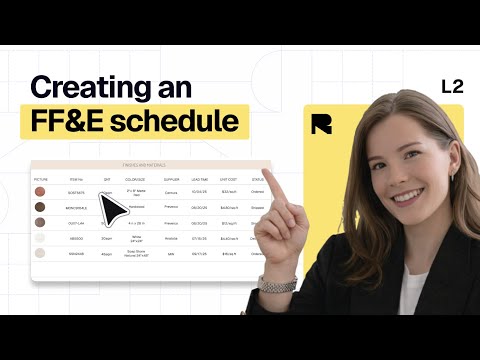
This video walks through the professional process of building a complete FF&E schedule — covering procurement documentation, specification organization, supplier coordination, and timeline management. Essential viewing for interior designers, FF&E buyers, and procurement professionals managing hotel projects from design to delivery.
مسرد المصطلحات الأساسية
FF&E (Furniture, Fixtures & Equipment) — The category of movable assets in a hotel that define the guest experience: furniture (beds, seating, tables), fixtures (lighting, mirrors, towel bars), and equipment (fitness machines, minibars, AV stands). Distinct from structural construction and operating consumables.
OS&E (Operating Supplies & Equipment) — The consumable and operational items required for daily hotel operations: linens, cutlery, cleaning chemicals, printed collateral. Unlike FF&E, OS&E is an operating expense rather than a capital asset.
ADR (Average Daily Rate) — A hotel performance metric measuring average room revenue per occupied room per night. Furniture quality and interior design have a documented positive correlation with ADR through guest satisfaction scores.
RevPAR (Revenue Per Available Room) — The combined measure of hotel ADR and occupancy rate. The primary operating efficiency metric in hotel financial analysis.
CAPEX (Capital Expenditure) — Spending on long-term fixed assets, including FF&E. Distinct from OPEX (Operating Expenditure), which covers day-to-day costs. FF&E is typically classified as CAPEX and depreciated over a defined asset life.
FCL (Full Container Load) — A shipping arrangement where a single buyer occupies an entire shipping container. Standard freight arrangement for large hotel FF&E programs shipped from manufacturing origin.
OTA (Online Travel Agency) — Platforms such as Booking.com, Expedia, and Hotels.com that distribute hotel room inventory. Hotel photography quality — including FF&E aesthetics — directly influences OTA listing performance and booking conversion.
LEED (Leadership in Energy and Environmental Design) — The world’s most widely used green building rating system, administered by the U.S. Green Building Council. FSC-certified and GREENGUARD-certified FF&E contributes to LEED certification points.
Martindale Count — The European standard for measuring upholstery fabric abrasion resistance in cycles. Higher counts indicate greater durability. Commercial contract minimum: 40,000 cycles. Heavy hospitality use: 100,000+ cycles.
BIFMA e3 — The Business and Institutional Furniture Manufacturers Association’s sustainability standard for assessing the environmental, health, wellness, and social impact of commercial furniture. The most comprehensive compliance framework for hotel FF&E specification.
FF&E Reserve — A capital reserve fund established by hotel operators to fund the periodic replacement of FF&E assets at their scheduled lifecycle end-points. Typically funded at 2–4% of FF&E asset value per year.
White-Glove Delivery — A premium FF&E logistics and installation service covering delivery to the specific room location, assembly, placement per approved floor plans, packaging removal, and post-installation inspection. The standard service tier for luxury hotel FF&E programs.
الأسئلة الشائعة (FAQs)
Q1. What is the difference between FF&E and OS&E in a hotel context?
FF&E (Furniture, Fixtures and Equipment) covers the movable capital assets that define the guest environment — beds, sofas, tables, lighting fixtures, gym equipment. These are long-lived assets that depreciate on a capital schedule, typically 5–10 years. OS&E (Operating Supplies and Equipment) covers the consumable items required for daily operations — linens, towels, cutlery, cleaning supplies, printed menus. These are operating expenses that deplete continuously and are replenished from the operating budget. The practical distinction matters for procurement timelines (FF&E requires months; OS&E can often be sourced in days), tax treatment (FF&E is CAPEX; OS&E is OPEX), and budget ownership (FF&E is typically a developer or owner responsibility; OS&E is an operator responsibility in managed hotel structures).
Q2. How much should I budget per room for hotel FF&E in 2026?
The 2026 industry benchmarks are: Budget/Economy: $4,000–$12,000 per room; Midscale/Select-Service: $12,000–$25,000; Upscale/Boutique: $25,000–$45,000; Upper-Upscale/Luxury: $45,000–$80,000; Ultra-Luxury/Lifestyle Resort: $80,000–$120,000+. These are product cost figures — add 35–45% for freight, duties, and installation to arrive at total landed budget. Source: HVS 2025 U.S. Hotel Development Cost Survey.
Q3. Are custom furniture pieces worth the investment for hotel FF&E?
For upscale, boutique, and luxury properties, yes — with a measurable ROI justification. Custom pieces create the design signatures that appear in marketing photography, generate social media content, and differentiate a property in competitive markets where catalog furniture is accessible to every competitor at the same price. The premium for a custom piece over a catalog equivalent typically runs 35–50%. The ADR premium generated by a property with a distinctive, high-quality interior — documented at +0.89% per review score point by Cornell’s hospitality research — compounds annually across the operating lifecycle, typically recovering the custom premium within the first 18–24 months of operation.
Q4. How do import duties affect FF&E costs, and how do I plan for them?
Import duties vary significantly by material category, country of manufacture, and destination market. Upholstered furniture from China into the U.S. currently carries tariffs in the 25–37.5% range under Section 301 measures (verify current rates with a licensed customs broker — rates change). Solid wood furniture and stone-top pieces carry different duty classifications. European-origin furniture into Gulf markets typically carries 5% GCC common external tariff. The practical approach: engage a licensed customs broker at the supplier selection stage, before purchase orders are raised, to calculate landed cost including all applicable duties for your specific product categories and destination market. Treating import duties as a post-order discovery adds 15–25% to your effective FF&E cost unannounced.
Q5. When should FF&E procurement begin in a hotel development project?
في schematic design phase — typically 18–24 months before opening for new-build luxury and upscale properties. The critical logic: custom furniture has a 12–16 week production lead time, plus 4–6 weeks for ocean freight, plus 4–6 weeks for sample approval before production. Working backward from an opening date, purchase orders for custom FF&E should be placed no later than 26–28 weeks (approximately 7 months) before the required on-site installation date. Starting the supplier selection and specification process 6 months before that means procurement should begin at least 13–14 months before opening. Projects that begin FF&E procurement later than this consistently experience timeline compression that increases costs by 20–35%.
Q6. Can FF&E choices affect LEED or BREEAM building certification?
Yes, directly. LEED v4.1 for Hospitality includes credits for Low-Emitting Materials (requiring GREENGUARD Gold or equivalent for furniture finishes and adhesives), Certified Wood (requiring FSC chain-of-custody for timber-based furniture), Recycled Content materials, and Regional Sourcing (rewarding procurement from manufacturers within 500 miles of the project site to reduce transportation emissions). BREEAM equivalent credits apply in UK and European markets. Developers seeking LEED or BREEAM certification should provide their FF&E specification team with the specific credit targets before supplier selection begins, as the documentation requirements (certificate numbers, test reports, regional sourcing evidence) must be collected during procurement — not retrofitted after installation.
Q7. Who legally owns the FF&E after a hotel opens?
In most hotel structures, FF&E is owned by the hotel owner or asset manager, not the operating brand or management company. This distinction is critical for three reasons: first, FF&E is classified as a capital asset on the owner’s balance sheet and depreciated accordingly; second, FF&E assets are typically pledged as security in hotel financing arrangements and must be clearly documented as owner assets; third, in a hotel management agreement, the brand operator does not own the FF&E they specify — they specify to the owner’s account. In REIT (Real Estate Investment Trust) hotel structures, this ownership distinction is particularly important for tax and EBITDA reporting purposes. Always confirm FF&E ownership structure with your legal and financial advisors before procurement contracts are signed.
Q8. How do I ensure quality control on imported FF&E?
A three-stage quality assurance protocol is the industry standard for large-scale imported hotel FF&E: (1) Pre-production inspection — verify that production samples match the approved specification in material composition, dimensional accuracy, and finish quality before bulk production begins; (2) Mid-production inspection — review partially completed production at 50–60% completion to identify systematic defects before they multiply across the full batch; (3) Pre-shipment inspection — a third-party QC firm (Bureau Veritas, SGS, or TÜV SÜD are the most widely accepted) inspects the completed batch at the factory before container loading, providing a photographic and dimensional compliance report against the approved specification. Furniture that fails this inspection is rejected and corrected before shipment — not discovered at the hotel site three weeks before opening.
Q9. What is included in FF&E installation costs, and what percentage should I budget?
Professional FF&E installation includes: furniture delivery from the warehouse to the specific room location within the property, assembly of flat-pack or component pieces, placement per approved floor plans, protective packaging removal and disposal, minor touch-up of transit damage (within a pre-agreed scope), and post-installation inspection and punch list documentation. Budget 8–12% of the total FF&E product cost for this service — a $3 million FF&E program should carry $240,000–$360,000 in installation budget. This cost is separate from general contractor site labor and should be contracted with a specialist FF&E installation firm or the furniture supplier’s white-glove delivery service.
Q10. Can FF&E be reused during a hotel renovation?
Selectively. The practical rule: hard goods can often be refurbished; soft goods should almost always be replaced. Casegoods (wardrobes, desks, nightstands) in good structural condition can be refinished, revenered, or reupholstered at 30–50% of replacement cost. Significant artwork and sculptural pieces retain value and should be assessed individually. Mattresses, pillows, and all upholstered soft goods in contact with guests should be replaced on their scheduled lifecycle regardless of visual condition — guest hygiene expectations and review platform scrutiny make any compromise in this category commercially counterproductive. A professional FF&E lifecycle assessment at the renovation planning stage — identifying what to refurbish, what to replace, and what to retain — typically saves 15–25% of the total renovation FF&E budget.
Q11. How do hotel brand standards influence FF&E specification?
Flagged hotel brands — Marriott, Hilton, IHG, Accor, Four Seasons, and their sub-brands — maintain detailed brand standards documents that specify precise dimensional requirements, material grades, approved finishes, and sometimes approved vendor lists by furniture category. These documents, provided to owners at the franchise agreement stage, set the floor specification that FF&E buyers and designers must meet. Some brand standards are prescriptive (specific foam density, specific thread count for linens, dimensional ranges for bed frames); others are performance-based (a minimum ADR positioning that implies a minimum specification level). The critical procurement action: obtain and review the full brand standards document before issuing any supplier RFP (Request for Proposal) — any supplier shortlisted without this review may produce compliant samples that fail brand sign-off at a later stage.
Q12. What is the typical lead time for imported luxury hotel furniture?
European ateliers (Italy, Germany, France): 12–16 أسبوعًا for standard custom orders; 18–22 weeks for highly complex or structurally modified pieces. Southeast Asian manufacturers (Vietnam, Indonesia): 8–12 weeks with established suppliers. China-based manufacturers: 10–14 weeks for custom orders from experienced factories. Add 4–6 weeks for ocean freight to Middle Eastern and European destination ports; 3–4 weeks to Southeast Asian regional ports; 5–7 weeks to U.S. East and West Coast ports. Air freight compresses the logistics window to 1–2 weeks but costs 8–12× the ocean freight rate and is economically viable only for small accent pieces or urgent replacements. Plan procurement timelines from these numbers, not from a manufacturer’s optimistic verbal estimate. Jade Ant furniture’s review of Chinese furniture manufacturers for commercial projects covers production capacity, lead time reliability, and quality assurance frameworks for buyers evaluating Asian supply options.
Q13. Should I buy FF&E in bulk for multiple hotel properties?
Yes, for established hotel groups managing two or more properties in consistent brand tiers — the volume procurement advantages are significant and compounding. Unit cost reductions for volume orders typically run 15–25% for furniture and 20–30% for textiles and soft goods. Brand consistency is maintained automatically across properties. Production scheduling priority is easier to negotiate with suppliers when annual volume is contractually committed. Logistics can be consolidated — shared containers, shared freight contracts, and consolidated customs filings reduce per-unit landed cost. The practical requirement is a standardized specification package that applies across properties with regional adjustments, managed by a central procurement function or an importer who holds the supplier relationship on behalf of the hotel group.
Q14. How do I protect against currency fluctuation in international FF&E orders?
Three practical approaches, in order of protection level: (1) Fixed-price contracts in your billing currency — negotiate with suppliers to invoice in USD or EUR rather than their local currency, transferring exchange risk to the supplier who is closer to the hedging mechanism; (2) Forward currency contracts — your bank can lock in today’s exchange rate for a future payment date, eliminating fluctuation risk on known payment schedules; (3) Working with a local distributor or importer who absorbs exchange risk as part of their margin model and invoices in your local currency. For large-scale programs exceeding $500,000 in foreign currency exposure, formal currency hedging through a treasury function or specialist FX provider is the most financially sound approach. The cost of hedging (typically 0.5–1.5% annualized) is consistently lower than the cost of an adverse 10–15% currency move on an unhedged procurement program.
Q15. Can FF&E be financed separately from hotel construction?
Yes — and for many hotel development structures, it should be. FF&E-specific financing instruments are available from specialist hospitality lenders, including programs that provide up to $10 million per property in FF&E-dedicated capital at competitive rates, as documented by Access Point Financial’s hospitality CAPEX programs. In construction loan structures, FF&E is typically included as a separate draw schedule within the total CAPEX facility — meaning the FF&E budget is funded progressively as procurement milestones are met, rather than as a single lump-sum draw. For hotel owners using SBA 504 loans, CMBS (Commercial Mortgage-Backed Securities) financing, or REIT-level capital structures, FF&E assets can often be separately collateralized. Engage your lender and financial advisor at the project inception stage to structure the FF&E financing as a distinct line within your capital stack — this provides both budget discipline and draw flexibility as the procurement program progresses.
Your Next Step: Source FF&E with Confidence
Every decision in this guide — from the definition of FF&E at the project outset to the QC protocol at the factory, to the white-glove installation on opening day — is designed to protect your budget, your timeline, and your property’s long-term commercial performance.
أثاث النمل اليشم works with hotel developers, FF&E buyers, interior designers, and luxury furniture importers to deliver custom and private-label FF&E programs that meet commercial specification standards, carry the required compliance documentation, and are delivered within project timelines across global destinations. Explore their hotel and hospitality furniture range for an overview of available categories, or review the guide to sourcing from Chinese manufacturers for a structured approach to building an Asia-based FF&E supply chain.
For compliance and certification benchmarks, the BIFMA e3 standard و U.S. Green Building Council LEED resources provide the authoritative frameworks that hotel-grade FF&E procurement should be built around.
This guide is published by the Jade Ant furniture editorial team. Market data is sourced from HVS, Grand View Research, Dataintelo, and publicly available industry benchmarks current as of 2026. All certification standards referenced are current as of the publication date.