The upholstered furniture market reached USD 68.88 billion globally in 2025 and is projected to grow to USD 122.45 billion by 2034, expanding at a CAGR of 6.55% according to Fortune Business Insights. That growth is not evenly distributed across manufacturers. Some companies are investing heavily in automation, digital planning tools, and circular-economy material sourcing. Others are riding brand recognition while allowing construction standards to drift.
This review evaluates five leading upholstered furniture manufacturing companies — IKEA, West Elm, CB2, Spradling, and Designtex — across criteria that matter to global buyers making purchasing decisions in 2026: durability under real-world use, design innovation, eco-friendly material practices, and value relative to price. Each of these companies occupies a different segment: IKEA and West Elm serve the affordable-to-mid-range residential market, CB2 targets design-forward consumers willing to pay a premium for aesthetics, and Spradling and Designtex supply the contract and commercial sectors where fabric performance determines whether a sofa survives 50,000 users in a hotel lobby or fails after 5,000.
The criteria we applied — construction integrity, material sourcing transparency, abrasion-test data, warranty terms, and third-party sustainability certifications — are the same ones that experienced procurement teams at hospitality groups, commercial interior firms, and furniture retailers use daily. Manufacturers like أثاث النمل اليشم, which supplies custom upholstered pieces to hotel and residential projects worldwide, apply these same benchmarks when evaluating fabric suppliers and frame construction standards for their own production lines.
Quick List of Leading Brands
Our evaluation identified five manufacturers that represent distinct segments of the upholstered furniture market. Each earned its place through measurable performance — not brand sentiment.
ايكيا — The global volume leader, generating EUR 26.3 billion in FY2025 revenue and offering upholstered sofas from $399 to $2,499. Their KIVIK and UPPLAND lines carry 10-year structural warranties and deliver consistent value for budget-conscious residential buyers. West Elm — A mid-range design brand with more than 50% FSC-certified wood in its furniture frames and the first international home retailer to offer Fair Trade Certified products. Their Harmony and Haven lines sit at $1,200–$3,200 and target the design-aware homeowner. CB2 — Crate & Barrel’s contemporary sibling, positioned as trend-forward with editorial styling and price points from $1,500 to $4,500 on upholstered seating. Spradling — A coated-fabrics manufacturer whose Silvertex vinyl achieves 100,000 Wyzenbeek double rubs, carbon-neutral certification, and GREENGUARD Gold compliance — making it a staple in healthcare, hospitality, and marine upholstery. Designtex — A Steelcase subsidiary providing performance textiles including Crypton-finished fabrics tested to 400,000+ double rubs, with a material library used on more than 100 Steelcase product lines.
What Makes These Sofas Stand Out
What separates these five from the hundreds of other upholstered furniture brands is verifiable performance data — not marketing copy. IKEA’s 10-year warranty on sofa frames is backed by an in-house testing lab that subjects each model to 50,000 seat-edge loading cycles before it reaches production. West Elm’s sustainability commitments are auditable through FSC chain-of-custody certificates and Fair Trade USA documentation. Spradling publishes its Wyzenbeek abrasion data, flammability ratings, and chemical resistance results in downloadable specification sheets for every product line. Designtex shares Cradle to Cradle certifications and full material health assessments.
For commercial projects — hotel FF&E packages, restaurant seating, healthcare waiting rooms — the distinction between “feels nice in the showroom” and “holds up after 3 years of daily use” is the difference between a $200,000 investment that performs and one that requires replacement at $150,000. That distinction is why procurement specifications increasingly demand third-party test data rather than manufacturer claims.
How We Selected Furniture Manufacturing Companies
Research Process Overview
Our evaluation drew on multiple data sources: published product testing from Wirecutter, Forbes Vetted, و علاج الشقق (which tested every sofa at both IKEA and West Elm showrooms); consumer review aggregation from Trustpilot, Yelp, and Reddit communities including r/BuyItForLife and r/InteriorDecorating; manufacturer-published specification sheets and third-party test reports; sustainability certifications verified through FSC, GREENGUARD, and OEKO-TEX databases; and pricing data collected across official brand websites in March 2026.
We also consulted the Lectra 2026 Upholstered Furniture Industry Report, which identifies automation, digital planning, and near-market sourcing as the three operational strategies separating profitable manufacturers from those losing margin. These macro trends informed how we weighted each manufacturer’s production sophistication.
Evaluation Criteria for Quality
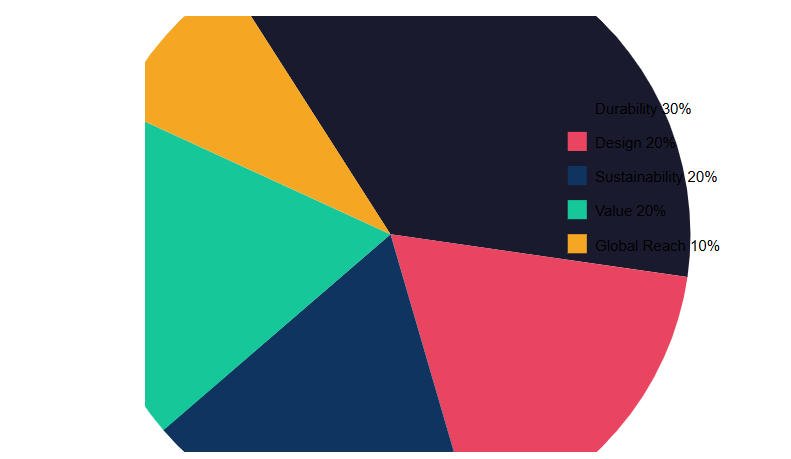
We scored each manufacturer across five weighted criteria:
Evaluation Criteria and Weighting
| Criteria | Weight | What We Measured |
|---|---|---|
| Durability & Construction | 30% | Frame material, joinery method, cushion density (lbs/ft³), abrasion test results (Wyzenbeek or Martindale), warranty length |
| Design Innovation | 20% | Customization options, fabric/leather variety, modular configurations, trend responsiveness |
| Sustainability & Eco Practices | 20% | FSC certification, recycled material content, GREENGUARD/OEKO-TEX certifications, published environmental targets |
| Value for Price | 20% | Cost per year of expected lifespan, price-to-quality ratio relative to segment peers |
| Global Availability & Appeal | 10% | Number of markets served, e-commerce accessibility, international shipping capability |
Evaluation Criteria Weighting
Reviews of Top Furniture Manufacturing Companies
ايكيا
Strengths
IKEA’s upholstered furniture operates at a scale no competitor matches — 471 stores across 64 markets with annual revenue of EUR 26.3 billion in FY2025. Their sofa range spans from the $399 LINANÄS (a no-frills two-seater that Apartment Therapy rated as “looks more expensive than it is”) to the $2,499 STOCKHOLM series. The structural warranty across all upholstered seating is 10 years — a commitment backed by testing protocols that include 50,000 seat-edge loading cycles, 25,000 armrest loading cycles, and fabric abrasion testing per EN 12947 (Martindale method).
IKEA’s sustainability credentials are among the most auditable in the industry. Their FY25 sustainability statement reports that 95% of wood used in IKEA products is third-party certified (predominantly FSC), 19% is recycled wood, and the company has committed $1 billion through Ingka Investments into recycling companies. Their sofa covers are increasingly made from recycled polyester — the Vissle fabric used on the LINANÄS, for example, uses dope-dyed recycled polyester that reduces water consumption in the dyeing process by up to 50% compared to conventional methods.
For budget-conscious residential buyers, the value proposition is straightforward: a KIVIK three-seat sofa at $799 with a 10-year warranty and washable covers delivers a cost-per-year of approximately $80 — roughly one-quarter of what a comparable West Elm sofa costs annually over the same warranty period.
Weaknesses
IKEA’s construction compromises are most visible in cushion longevity. Multiple long-term reviews — including a 5-year KIVIK owner review — note that seat cushions lose approximately 15–20% of their original firmness within the first 18 months of daily use. The foam density in most IKEA sofa cushions runs 1.5–1.8 lbs/ft³, below the 2.0+ lbs/ft³ threshold that contract-furniture specifications typically require for commercial durability.
Customization is essentially non-existent. You choose from the SKUs available — dimensions, cushion firmness, arm height, and frame depth are fixed. For buyers who need specific configurations (a 94-inch sofa instead of the standard 89-inch, or a 22-inch seat depth instead of 24-inch), IKEA cannot accommodate those requirements. This is where manufacturers like أثاث النمل اليشم fill the gap — accepting custom dimensions, fabric specifications, and frame modifications on orders as small as a single piece.
Design aesthetic leans functional rather than distinctive. Interior designers consistently note that IKEA sofas serve as background pieces rather than statement furniture. The brand’s design language prioritizes universal appeal over the kind of bold silhouettes that define spaces in high-end residential or boutique hospitality projects.
West Elm
Strengths
West Elm occupies the mid-range design segment with strong sustainability credentials and a visual identity that resonates with design-aware homeowners aged 28–45. More than 50% of their wood furniture carries FSC certification, and they were the first international home retailer to offer Fair Trade Certified products — a distinction that extends to select upholstery lines where production facilities meet Fair Trade USA labor and community investment standards.
Their Harmony Sofa (starting at $1,599) earned a 4.5-star average across Apartment Therapy’s hands-on testing, with reviewers noting “supportive back cushions that maintain shape through daily use” and “a construction quality that feels notably above its price point.” The Harmony’s kiln-dried hardwood frame and reinforced corner blocks represent a meaningful construction step up from IKEA’s engineered-wood framing.
Fabric and configuration options are extensive: most West Elm sofa models are available in 50+ upholstery options (including performance fabrics with Crypton treatment for stain resistance), multiple size configurations, and modular sectional layouts. Dweva’s 2026 review scored West Elm’s durability at 4.2 out of 5, noting that “the frame felt stable, and cushions benefit from routine fluffing and rotation.”
Weaknesses
West Elm’s most persistent quality criticism centers on cushion construction inconsistency. A detailed negative review from Living After Midnite documented cushion collapse within the first year, and Reddit threads on r/BuyItForLife and r/InteriorDecorating contain recurring complaints about foam degradation in the first 12–18 months. The issue appears model-specific rather than brand-wide: the Harmony and Haven lines perform significantly better in long-term durability reports than the Urban and Eddy models, which use lower-density foam fills.
Delivery logistics remain a consistent pain point. Thingtesting’s aggregated review data shows West Elm earning “polarized reviews” — with product quality rated favorably but delivery experience generating frequent complaints about delays, scheduling difficulties, and damaged-on-arrival incidents. For commercial buyers ordering multiple pieces, these logistics issues can compound into project timeline risks.
At $1,200–$3,200 for standard sofas, West Elm’s per-year cost (assuming 5–7 years of primary use based on review consensus) runs $170–$640 — significantly higher than IKEA and approaching the range where contract-grade alternatives offer better long-term value.
CB2
Strengths
CB2 delivers the most visually distinctive upholstered furniture of the brands reviewed. As the contemporary subsidiary of Crate & Barrel Holdings, its design language targets buyers who treat furniture as expressive rather than purely functional. Apartment Therapy’s editorial team described CB2’s sofas as “some of the most stylish we’ve ever seen” while also recognizing the brand’s commitment to sustainable material sourcing — including FSC-certified wood, OEKO-TEX certified textiles, and increasing use of recycled materials across their upholstery lines.
The design range is genuinely broad: from the minimalist Club Sofa ($1,599, compact enough for apartments at 74 inches) to dramatic curved sectionals and boucle-upholstered statement pieces approaching $4,500. For interior designers working on residential projects where the sofa is the centerpiece, CB2 provides options that photograph well and convey a specific aesthetic point of view that mass-market brands do not achieve.
CB2’s online experience — 3D room planning tools, fabric swatch ordering, and AR visualization through their app — reflects the digital-planning trend that Lectra’s 2026 industry report identifies as increasingly important for furniture manufacturers and retailers.
Weaknesses
Construction quality does not always match the price tag. The Sofa Review rates CB2 at 2.5 out of 5 stars, noting “love them for their wide offering of both classics and trendy styles at a fairly reasonable price point” but warning to “expect long lead times.” Trustpilot reviews of CB2 contain recurring themes of delivery delays, customer service difficulties, and instances where construction did not meet expectations at the $2,000–$4,500 price tier.
The premium pricing is driven substantially by design and brand positioning rather than construction superiority. A side-by-side comparison of CB2’s $2,499 Gwyneth Boucle Sofa versus a comparably sized West Elm Harmony ($1,899) reveals similar frame construction (kiln-dried hardwood, sinuous spring suspension) and comparable foam densities, with CB2’s markup attributable primarily to the fabric choice and design silhouette. For buyers prioritizing durability per dollar, the math favors West Elm or, at scale, a custom manufacturer like أثاث النمل اليشم that can produce comparable aesthetics with contract-grade construction at wholesale pricing.
Customization flexibility is limited to fabric and configuration choices within existing designs. CB2 does not accept bespoke dimension modifications, custom frame alterations, or non-catalog fabric applications — a constraint that limits their appeal for hospitality and commercial projects requiring specific spatial configurations.
Watch: 10 Best Sofas & Couches for 2026 — Expert Review
Video: An independent review of the best sofas and couches available in 2026, comparing construction quality, comfort, and value.
Spradling
Strengths
Spradling operates in a fundamentally different segment from the retail brands above — they manufacture coated fabrics that other furniture makers use to upholster commercial, marine, healthcare, and hospitality seating. Their relevance in this review reflects the reality that upholstered furniture quality is ultimately determined by two factors: frame construction and covering material. Spradling dominates the latter for commercial applications.
Their flagship Silvertex line delivers 100,000 Wyzenbeek double rubs (tested per ASTM D4157 with #10 cotton duck), GREENGUARD Gold certification for low chemical emissions, carbon-neutral production, and Indoor Air Emissions A+ rating. In practical terms, 100,000 double rubs translates to approximately 8–12 years of heavy commercial use — the kind of durability required for airport lounge seating, hospital waiting rooms, and hotel lobby furniture that processes thousands of users weekly.
Spradling’s Permablok3 technology — a patented stain-fighting and abrasion-resistant topcoat — has made Silvertex the default specification for healthcare furniture manufacturers who need upholstery that can withstand daily bleach-based cleaning without degradation. The fabric is also antimicrobial, UV-stable (tested per AATCC TM 16-3), and available in 90+ colorways. For custom furniture manufacturers producing hospitality and commercial seating, Spradling fabrics are among the most frequently specified coverings because they solve the durability equation definitively.
Weaknesses
Spradling’s product is a PVC vinyl — and despite its textile-like appearance and soft hand feel, it does not replicate the warmth, breathability, or aging characteristics of natural leather or woven fabrics. In residential settings where tactile experience matters as much as durability, Silvertex reads as a commercial material. It performs exceptionally in environments where hygiene and wear resistance are priorities, but it is not a substitute for natural upholstery materials in high-end residential or boutique hospitality where sensory quality defines the brand experience.
Pricing is premium for the coated-fabric category: Silvertex runs approximately $25–$35 per linear yard at wholesale, compared to $8–$15 for standard commercial vinyl alternatives. The cost is justified by the performance data, but it does push total upholstered-piece costs higher — a consideration for budget-constrained commercial projects.
Spradling does not sell direct to consumers or offer finished furniture. Buyers must source through fabric distributors or specify through their furniture manufacturer, adding a coordination step that retail brands handle seamlessly.
Designtex
Strengths
Designtex, acquired by Steelcase in 1988, is the textile arm of the world’s largest office furniture manufacturer. This relationship gives Designtex a unique position: their fabrics are engineered in tandem with the furniture they cover, tested on the actual seating platforms they’ll be applied to, and backed by the R&D infrastructure of a $3+ billion parent company. Their integration with Steelcase’s product ecosystem means that when a designer specifies a Designtex fabric for a Steelcase Leap chair, the material has been validated for that specific application — not just lab-tested in isolation.
Designtex pioneered environmentally responsible textile design. They commissioned William McDonough to create the first Cradle to Cradle certified fabric in the 1990s — a milestone in sustainable manufacturing that predated the current ESG movement by two decades. Today, their sustainability commitments include PFAS-free performance fabrics, Crypton-finished upholstery tested to 400,000+ double rubs (four times Spradling’s already impressive Silvertex rating), and published material health assessments for their entire product line.
The Crypton partnership is particularly significant for commercial buyers. Crypton-finished Designtex fabrics are EPA-approved as disinfectable — meaning they can withstand hospital-grade cleaning protocols without losing structural integrity or color fastness. No competitor offers a textile that combines this level of stain resistance, abrasion performance, and regulatory approval in a single product.
Weaknesses
Designtex is exclusively a contract/commercial brand. Their fabrics are not available through consumer retail channels, and pricing reflects the commercial specification market — typically $40–$120 per yard depending on pattern, content, and performance level. For residential projects, these costs push the total upholstered piece price into luxury territory that may not be justifiable outside of commercial ROI calculations.
Design aesthetic serves the corporate and institutional market more than residential. While the product line includes hundreds of patterns and textures, the overall visual language skews toward workplace-appropriate neutrals and geometric patterns rather than the fashion-forward textiles that brands like CB2 offer. Designers working on residential projects often need to supplement Designtex’s performance qualities with aesthetic choices from other textile houses.
Lead times for custom Designtex orders can extend 6–10 weeks — a timeframe that works within commercial project schedules but can strain residential renovation timelines.
Comparing Global Buyers’ Favorites
Runner-Up Brands Overview
Beyond the five manufacturers reviewed in depth, several brands merit attention for specific use cases. Article delivers mid-century modern upholstered furniture with Wirecutter-recommended models at the $1,000–$2,500 range. Burrow has built its reputation on modular sofa systems with tool-free assembly and stain-resistant Olefin fabric — their Union sectional earned top picks from both Hernest and Forbes Vetted for 2026. Rowe Furniture offers made-in-America upholstered pieces with 750+ fabric options and 8-way hand-tied spring construction at the $2,000–$4,000 range. And for luxury contract applications, B&B Italia و Minotti represent the pinnacle of Italian upholstered furniture design, though at price points ($5,000–$25,000+) that place them in a different purchasing conversation entirely.
How They Compare on Quality and Value
Head-to-Head Comparison: Top 5 Upholstered Furniture Manufacturers (2026)
| Criteria | ايكيا | West Elm | CB2 | Spradling | Designtex |
|---|---|---|---|---|---|
| الجزء | Budget Residential | Mid-Range Residential | Design-Forward Residential | Commercial Fabric Supplier | Contract Textile Supplier |
| Sofa Price Range | $399–$2,499 | $1,200–$3,200 | $1,500–$4,500 | $25–$35/yd (fabric only) | $40–$120/yd (fabric only) |
| Durability Rating | 3.8 / 5 | 4.2 / 5 | 3.5 / 5 | 4.8 / 5 | 4.9 / 5 |
| Abrasion Resistance | 15,000–30,000 Martindale | 25,000–50,000 Martindale | 25,000–40,000 Martindale | 100,000 Wyzenbeek | 400,000+ Double Rubs |
| الضمان | 10-year structural | 3–5 years | 1 year standard | Product-specific | Product-specific |
| Sustainability Certs | FSC (95% wood), Recycled polyester | FSC (50%+ wood), Fair Trade | FSC, OEKO-TEX | Carbon Neutral, GREENGUARD Gold | Cradle to Cradle, PFAS-free |
| Customization | None (fixed SKUs) | Fabric & configuration | Fabric & configuration | Color selection (90+) | Full custom specification |
| الأفضل لـ | Budget homes, rentals, student housing | Design-aware homeowners | Style-first residential | Healthcare, marine, hospitality | Corporate, institutional, healthcare |
| Overall Score | 7.8 / 10 | 7.5 / 10 | 6.8 / 10 | 8.5 / 10 | 9.0 / 10 |
Scores reflect weighted evaluation across durability, design, sustainability, value, and global reach criteria. Fabric-only suppliers scored on material performance rather than finished-product metrics.
Overall Scores: Top 5 Upholstered Furniture Manufacturers (2026)
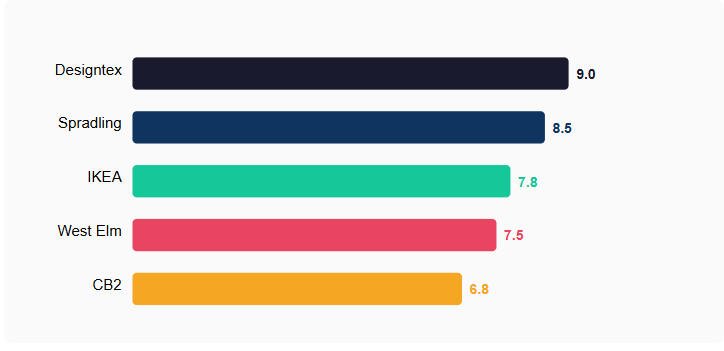
Weighted composite scores across durability (30%), design (20%), sustainability (20%), value (20%), and global reach (10%).
The scores reveal a clear pattern: commercial fabric specialists (Designtex, Spradling) outperform retail furniture brands on durability and sustainability metrics, while retail brands (IKEA, West Elm, CB2) score higher on design accessibility and value for residential buyers. This is not a failure of the retail brands — it reflects fundamentally different use-case requirements. A sofa that needs to survive 3 years in a young family’s living room faces different demands than one that needs to survive 10 years in a corporate reception area.
For buyers who need the design distinction of a retail brand combined with the durability of commercial-grade construction, the solution is often a custom manufacturer that can bridge both worlds. أثاث النمل اليشم operates in precisely this space — producing custom upholstered pieces using contract-grade frames and client-specified fabrics (including Spradling and Designtex materials) with the design flexibility to match any aesthetic direction. Their clients include hospitality groups requiring 200+ identical pieces with Silvertex upholstery and residential developers specifying performance-fabric sofas for luxury apartment staging.
The five manufacturers reviewed here each earn their position through genuine strengths. IKEA delivers unmatched value at scale — a 10-year warranty on a $799 sofa is a proposition no competitor can replicate at that price point. West Elm bridges design appeal and sustainability commitments in a way that resonates with an increasingly eco-conscious mid-market buyer. CB2 provides the boldest aesthetic options for buyers willing to pay a design premium. Spradling’s Silvertex vinyl has become the de facto standard for commercial upholstery applications where hygiene and wear resistance are non-negotiable. And Designtex, with its Steelcase integration and Cradle to Cradle heritage, represents the most advanced thinking on how performance textiles and environmental responsibility can coexist.
For global buyers — whether you are a furniture retailer sourcing inventory, a hospitality procurement manager specifying FF&E packages, or a residential designer selecting pieces for a client — the selection decision should begin with use case, not brand affinity. A healthcare waiting room requires Spradling or Designtex performance fabrics on a commercial-grade frame. A young professional’s apartment needs IKEA’s value equation. A design-forward living room benefits from West Elm or CB2 aesthetics.
When the project demands both design flexibility and commercial-grade durability — a combination that none of the five reviewed brands fully covers on its own — consider working with a custom manufacturer. أثاث النمل اليشم provides exactly this integration: custom-dimensioned upholstered pieces, built with contract-grade frames and your choice of performance fabrics, produced at wholesale pricing with the design control of a bespoke workshop. For buyers sourcing from China, their end-to-end service — from design drawings through production, quality inspection, and logistics — eliminates the coordination overhead of managing separate frame builders, fabric suppliers, and upholstery shops.
Wherever your project falls on the spectrum, prioritize verifiable performance data over marketing claims, specify third-party tested materials, and build long-term relationships with manufacturers who demonstrate consistency across orders. The upholstered furniture market will continue growing at 5–7% annually through 2034. The manufacturers who earn your repeat business will be the ones whose products still look and feel right three, five, and ten years after delivery.
الأسئلة الشائعة (FAQ)
1. What is the most durable fabric for upholstered furniture in 2026?
For commercial applications, Designtex’s Crypton-finished fabrics lead the market with 400,000+ Wyzenbeek double rubs — meaning they withstand roughly 4 times more abrasion than the next major competitor, Spradling’s Silvertex at 100,000 double rubs. For residential use, performance fabrics with Crypton or Revolution treatment (typically rated at 50,000–100,000 double rubs) offer a strong balance of durability and tactile comfort. Olefin and solution-dyed acrylic are the most stain-resistant fiber choices for households with children or pets.
2. How long should an upholstered sofa last?
Expected lifespan depends heavily on construction quality and usage intensity. Budget sofas (IKEA tier, $400–$900) typically maintain acceptable comfort for 5–8 years with regular cushion rotation. Mid-range sofas (West Elm, CB2 tier, $1,200–$4,500) should last 7–12 years with proper care. Contract-grade upholstered furniture built with 8-way hand-tied springs, hardwood frames, and high-density foam (2.0+ lbs/ft³) — the kind produced by manufacturers like أثاث النمل اليشم — can deliver 12–20 years of use in commercial environments.
3. Is IKEA furniture good enough for long-term use?
IKEA’s structural frames are backed by a 10-year warranty and pass standardized load-testing protocols. The limiting factor is cushion longevity: foam densities of 1.5–1.8 lbs/ft³ will lose 15–20% of firmness within 18 months of daily use, based on long-term owner reports. For renters, first-apartment buyers, or households that refresh furniture every 5–7 years, IKEA’s value-to-lifespan ratio is among the best available. For buyers expecting 10+ year use from a single purchase, mid-range or contract-grade options provide better long-term returns.
4. What should I look for when buying upholstered furniture for a hotel or commercial space?
Specify frame construction using kiln-dried hardwood with doweled and corner-blocked joints. Require foam density of 2.0+ lbs/ft³ for seat cushions. Specify upholstery fabrics with a minimum of 100,000 Wyzenbeek double rubs (Spradling Silvertex or equivalent) or higher for high-traffic areas. Require GREENGUARD Gold certification for indoor air quality compliance. Verify that the manufacturer has documented experience producing at the volume your project requires — a factory accustomed to 50-piece residential orders may not have the quality control systems to maintain consistency across a 500-piece hotel order.
5. What is the difference between Wyzenbeek and Martindale abrasion testing?
Both tests measure fabric durability, but they use different methods and are not directly convertible. Wyzenbeek (ASTM D4157) rubs fabric back and forth in a straight line using a #10 cotton duck or wire screen abrader — results are reported in “double rubs.” Martindale (ISO 12947) uses a circular rubbing motion with a worsted wool abrader and reports results in “cycles.” As a rough guideline, 30,000 Martindale cycles is approximately equivalent to 15,000 Wyzenbeek double rubs, but the correlation is imprecise due to the different motion patterns and abrading materials. Always compare test results within the same method.
6. Are sustainable upholstered furniture options actually durable?
Sustainability and durability are not in opposition — in fact, longer-lasting furniture is inherently more sustainable because it delays replacement. FSC-certified kiln-dried hardwood provides the same structural performance as non-certified wood. Recycled polyester performance fabrics (like IKEA’s Vissle range) match or exceed the abrasion resistance of virgin-fiber equivalents. Designtex’s Cradle to Cradle certified fabrics represent the most environmentally advanced textiles available while simultaneously delivering 400,000+ double rubs of abrasion resistance. The key is verifying that sustainability claims are backed by third-party certifications, not just marketing language.
7. How do I choose between buying from a retail brand versus a custom manufacturer?
Retail brands (IKEA, West Elm, CB2) are optimal when you need 1–5 pieces, prefer to see and test the product in person before purchasing, and are comfortable with standard sizes and configurations. Custom manufacturers — such as أثاث النمل اليشم — are the better choice when you need specific dimensions, non-standard fabrics, volume pricing for 10+ identical pieces, or contract-grade construction that retail brands do not offer. For hospitality and commercial projects, custom manufacturing almost always delivers better per-unit value and more precise specification compliance.
8. What is the global upholstered furniture market size in 2026?
According to استخبارات موردور, the upholstered furniture market is projected to grow from USD 65.72 billion in 2025 to USD 69.18 billion in 2026, reaching USD 89.36 billion by 2031 at a CAGR of approximately 5%. Fortune Business Insights estimates a higher trajectory: USD 73.71 billion in 2026 growing to USD 122.45 billion by 2034 at 6.55% CAGR. The variance reflects different methodology and market-scope definitions, but all major research firms agree on sustained growth driven by urbanization, hospitality sector expansion, and rising consumer expectations for both comfort and sustainability.
9. Which upholstered furniture manufacturer is best for eco-conscious buyers?
Among the brands reviewed, Designtex offers the strongest sustainability credentials in the commercial segment (Cradle to Cradle certification, PFAS-free fabrics, material health transparency). In the retail segment, West Elm leads with 50%+ FSC-certified wood, Fair Trade Certified production, and a growing commitment to recycled and organic materials. IKEA’s sustainability impact is amplified by scale — their $1 billion investment in recycling infrastructure and 95% certified-wood target affect more physical product units than any other brand reviewed. For buyers who prioritize sustainability without compromising on durability, a custom approach — specifying FSC-certified frames with Designtex or Spradling carbon-neutral fabrics through a manufacturer like Jade Ant furniture — delivers the most comprehensive solution.
10. Can I source upholstered furniture from China with the same quality as Western brands?
Yes — if you apply the right verification and specification protocols. China manufactures approximately 39% of the world’s furniture, including upholstered seating that supplies many Western retail brands’ supply chains. The key is working with established manufacturers who hold verifiable ISO 9001 quality management certification, use the same material grades (CertiPUR-US foam, FSC-certified wood, Oeko-Tex certified fabrics), and submit to third-party pre-shipment inspection. Companies like أثاث النمل اليشم demonstrate this by producing custom upholstered furniture for international hospitality and residential clients using contract-grade materials, documented quality control processes, and full supply-chain transparency — at wholesale pricing that typically runs 40–60% below comparable retail brand products.






 Arabic
  English
  Portuguese