The Chinese office chair market has undergone a fundamental shift. A decade ago, procurement teams sourcing from China were largely making a cost trade-off. Today, manufacturers in Guangdong, Zhejiang, and Shandong supply seating to Fortune 500 headquarters, Tier-1 hotel operators, and government tenders worldwide — competing directly on materials, mechanism engineering, and compliance documentation. The question for B2B buyers is no longer whether China can produce quality office seating, but how to read the signals that separate category-leading products from the commodity ocean.
This guide covers material composition, upholstery grades, frame engineering, foam science, ergonomic adjustment systems, mechanism types, base and caster engineering, safety standards, and procurement budgeting — from a buyer’s perspective rather than a product marketing angle. Whether you are specifying 50 task chairs for a regional office fit-out or evaluating 2,000-unit procurement for a multi-site corporate rollout, the same evaluation framework applies.
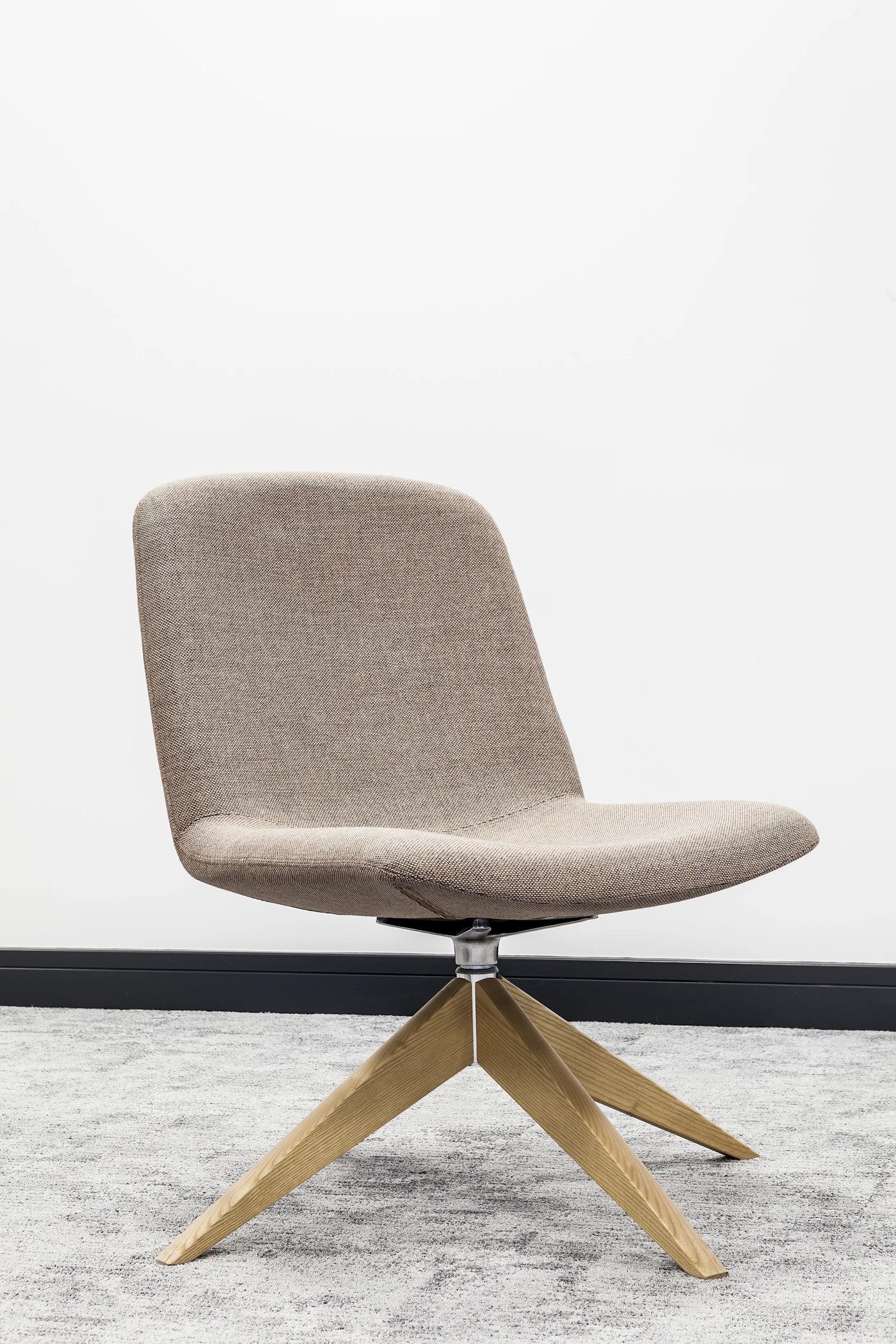
A well-specified workplace investment: ergonomic seating that performs across thousands of working hours.
Who this guide is for: Procurement and facilities leaders managing multi-seat office fit-outs; interior designers specifying commercial seating for corporate clients; sourcing consultants evaluating Chinese factory proposals; and workplace strategists building vendor shortlists for office refurbishment programs. Consumer retail buyers will find this level of technical detail exceeds their needs — this is deliberately a B2B document.
Material Quality Overview for Office Chairs
What to Look for in Material Quality
Material quality in office chairs is not a single attribute — it is a compound of five intersecting variables: tensile strength of structural components, recovery characteristics of padding, surface durability of upholstery, chemical safety of all materials, and consistency across production batches. Each of these matters differently depending on use intensity: a training room chair used 6 hours per day by rotating occupants demands very different specifications than an executive task chair used by one person for 8 hours daily.
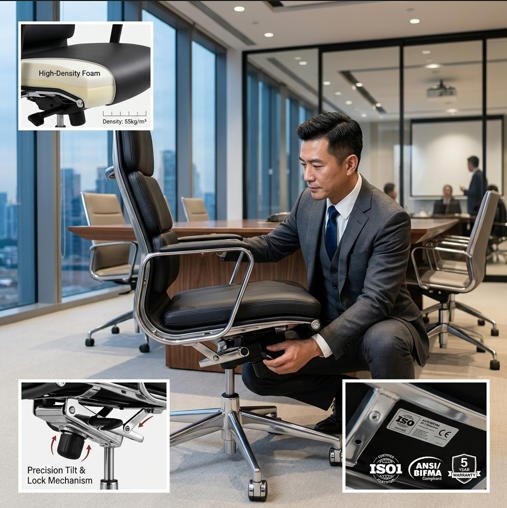
When reviewing supplier quotations, the most important discipline is resisting specification vagueness. Terms like “high-quality foam,” “genuine leather,” or “durable frame” are commercially meaningless without quantified backing. Credible suppliers should be able to provide foam density values (expressed in kg/m³ or lb/ft³), leather grade designation with origin traceability, steel gauge measurements, and third-party test reports. If a supplier cannot provide these on request, treat the gap as a quality signal, not an administrative delay.
One particularly revealing indicator used by experienced procurement teams is the specification sheet cross-check: request the bill of materials alongside the commercial quotation, then verify that key components — particularly foam density, fabric abrasion rating (measured in Martindale cycles), and frame steel grade — match what was represented during showroom or sample review. Manufacturers with genuine quality control capability will provide this documentation readily; those relying on visual impression alone will often resist or deflect.
Common Red Flags in Chairs
Several patterns consistently appear across underperforming chairs that initially appear competitive on price. Understanding these before factory visits or sample evaluations can prevent costly specification errors.
⚠ Red Flags — What to Test Before Committing to a Production Order
- Foam that feels soft in the showroom but collapses within 90 days — Low-density foam (below 40 kg/m³) may pass initial feel tests but loses shape after repeated compression cycles. Ask for the foam density spec in writing.
- Stitching irregularities on upholstered panels — Inconsistent stitch spacing indicates batch quality variation, particularly relevant for large orders where production may be split across shifts or sub-suppliers.
- Mechanism play under load — Apply side-lateral force to the backrest while seated. Excessive lateral wobble suggests loose mechanism mounting, worn bushings, or under-specified steel thickness.
- Gas cylinder compression loss — Sit in the chair and wait 30 seconds. Any downward drift in seat height indicates a failing pneumatic cylinder, typically caused by poor-quality internal seals.
- Plastic components with visible parting lines — Parting lines on armrests, base connectors, or mechanism covers indicate single-cavity mold tooling, which is associated with lower injection pressure and reduced impact resistance.
- Certifications without product-specific coverage — A factory ISO certificate does not certify a specific chair model. Request test reports that reference the actual model number being purchased.
Upholstery Options and Trade-offs

Upholstery selection directly impacts perceived premium quality, maintenance cost, and user comfort over multi-year deployment cycles.
Fabrics vs. Leatherette vs. Genuine Leather
The upholstery decision in B2B office chair procurement is rarely a simple preference question — it is a lifecycle cost and user experience calculation that interacts with office environment, cleaning protocols, climate control, and the density of seating use. Each material category carries different cost structures across a typical 7–10 year office chair deployment cycle.
| المواد | Abrasion Rating (Martindale) | Avg. Lifespan (Heavy Use) | Breathability | Maintenance Complexity | B2B Cost Index | Best-Fit Scenario |
|---|---|---|---|---|---|---|
| Commercial-Grade Mesh | 100,000+ cycles | 8–12 years | ممتاز | Low — spot wipe | $$ | Open-plan task seating, hot-desking |
| Technical Fabric (Polyester Blend) | 60,000–100,000 cycles | 6–9 years | جيد | منخفضة-متوسطة | $ | Training rooms, multi-user environments |
| PU Leatherette | 50,000–80,000 cycles | 4–7 years | معتدل | Low — wipe clean | $$ | Mid-tier executive, reception, healthcare |
| PVC Synthetic Leather | 30,000–50,000 cycles | 3–5 years | منخفض | منخفض | $ | Budget-tier general seating |
| Top-Grain Genuine Leather | 150,000+ cycles | 10–15 years | جيد | Medium — conditioning required | $$$$ | C-suite, boardroom, client-facing seating |
| Bonded Leather | 20,000–40,000 cycles | 2–4 years | معتدل | متوسط | $$ | Avoid for heavy use |
A point that consistently surprises procurement teams making first-time B2B chair purchases from China: the word “leather” on a Chinese supplier’s quotation can mean anything from full-grain cattle hide to a PU-coated non-woven fabric with a 2-year lifespan. The Chinese market uses the designation 真皮 (zhēn pí) for genuine animal leather and PU皮 (PU pí) for synthetic alternatives — but these distinctions are not always clearly translated into English specifications.
For C-suite and boardroom applications — where seating is a brand statement and replacement costs are visible — top-grain genuine leather sourced from established tanneries (Italian, Brazilian, or South American-origin hides are the industry benchmarks) outperforms all synthetic alternatives over a 10-year horizon. One corporate real estate director managing a 15-floor headquarters fit-out in Shanghai noted that switching from PU leatherette to top-grain leather on 80 executive chairs added approximately $180 per unit upfront but eliminated the full replacement cycle that PU chairs typically require at the 4-year mark — generating a net per-chair saving of $94 over 10 years, even before accounting for contractor labour.
Breathability, Stain Resistance, and Maintenance
Climate control conditions in the target office environment should directly influence upholstery selection. In offices without adequate HVAC, non-breathable synthetics create measurable thermal discomfort: skin surface temperature under PVC upholstery in 26°C ambient conditions can exceed 35°C after 30 minutes of seated use — a well-documented source of productivity-reducing discomfort. Mesh backrests eliminate this entirely; fabric and genuine leather perform comparably well.
For maintenance, the B2B benchmark is the ability to clean the chair to a presentable standard using the in-house facilities team without specialist products or techniques. Mesh and PU leatherette both meet this test under normal office soil conditions. Fabric seating in food-adjacent environments — near coffee stations or collaborative breakout areas — requires higher abrasion and stain resistance ratings, with 80,000+ Martindale cycles and fluorocarbon stain treatment being the appropriate floor specification.
Frame Materials and Durability
Steel vs. Aluminum Frames vs. Molded Plastics
The frame is the hidden infrastructure of every office chair — the component that determines structural integrity across the chair’s lifespan, yet the one most B2B buyers are least equipped to evaluate visually. Frame material selection has direct consequences for weight capacity compliance, long-term lateral stability, and warranty cost exposure for procurement teams.
| مادة الإطار | Tensile Strength | Typical Weight Capacity | مقاومة التآكل | Repair-ability | Relative Weight | B2B Verdict |
|---|---|---|---|---|---|---|
| Cold-Rolled Steel | Up to 2,000 MPa | 150–250 kg (330–550 lbs) | Medium (requires coating) | High — weldable | Heavy | Best for heavy-duty / high-density use |
| Die-Cast Aluminum | 300–500 MPa | 120–180 kg (265–400 lbs) | High (natural oxide layer) | متوسط | Light | Executive / premium aesthetics + portability |
| Glass-Filled Nylon | 80–200 MPa | 100–150 kg (220–330 lbs) | ممتاز | Low — not field-repairable | Very Light | Acceptable for standard-weight users, budget-tier only |
| Standard PP Plastic | 30–50 MPa | 80–120 kg (175–265 lbs) | ممتاز | None | Lightest | Avoid for primary seating in B2B environments |
Steel frames remain the structural standard for commercial seating that needs to meet weight capacity requirements above 150 kg. The key specification to request is steel wall thickness — not just “steel construction.” Industry best practice for task chair backframes is a minimum wall thickness of 1.5mm for standard loading and 2.0mm+ for heavy-duty applications. A supplier who cannot specify wall thickness in their technical documentation is almost certainly using thinner gauge material than the market standard.
Weight Capacity Considerations and Long-Term Rigidity
BIFMA X5.1 — the North American benchmark standard for office chair structural testing — subjects task chairs to a 113 kg (250 lbs) seated load cycling test of 100,000+ repetitions. EN 1335 Part 2 (the European equivalent) applies similar cyclic loading protocols. Specifying chairs to these standards provides a documentable baseline for procurement justification and warranty conversations. Chairs claiming BIFMA compliance should be asked to provide the specific test report, including the testing laboratory name, test date, and model designation — a legitimate certificate will always carry these details.
Foam Density and Seating Comfort
Density, Resilience, and Seat Depth
Foam is where office chair quality diverges most dramatically between price tiers — and where the divergence is least visible to non-specialist buyers. Two chairs with identical visual presentation and comparable price points can differ by a factor of three in foam density, with direct consequences for comfort under prolonged use and lifespan of shape retention.
Foam density (the mass per unit volume, expressed in kg/m³ or lb/ft³) and foam resilience (the elastic recovery percentage after compression) are the two primary technical variables. They are frequently confused. A foam can be high-density but low-resilience (hard and slow to recover), or lower-density and high-resilience (soft but bouncy). Premium seating typically combines a density of 50–60 kg/m³ with a resilience of 40–50%, which translates to firm initial support that does not fatigue under 8-hour continuous use.
The industry threshold most referenced by ergonomics professionals is 45 kg/m³ (approximately 2.8 lb/ft³) as the minimum for a chair intended for full-day seated work. Below this level, compression set — the permanent deformation of foam after repeated loading — begins to appear within 18–24 months of normal use. A chair that feels comfortable during a showroom visit may feel noticeably softer after one year of deployment. Critically, this degradation is invisible without physical inspection: the chair looks identical but delivers measurably less spinal support.
Durability Testing and Shape Retention
Professional buyers should request a compression set test result (expressed as a percentage change after 70°C / 22-hour protocol per ISO 1856 or equivalent). A compression set below 15% indicates foam that will retain its profile shape reliably over the chair’s commercial lifespan. Values above 25% are a predictor of premature sagging — and the associated productivity and wellbeing impact on the employees using those chairs.
Dual-density foam construction — using a firmer base layer (60–70 kg/m³) topped with a comfort layer (40–45 kg/m³) — has become the design standard in premium commercial seating. This construction mirrors the approach taken by leading European ergonomics brands and is now widely available from quality-oriented Chinese manufacturers operating in the export market. At مفروشات النمل اليشم, this specification approach is part of our standard consultation for B2B buyers specifying chairs across multi-site projects, ensuring that material sheets translate into real-world performance rather than showroom impressions.
Essential Ergonomic Adjustments for Posture

Ergonomic adjustability is not a luxury feature — it is a health infrastructure investment for a workforce that spends 40+ hours per week seated.
Seat Height, Backrest Tilt, and Lumbar Support
Ergonomic adjustability transforms a chair from a fixed posture enforcer into an adaptive support system. The three adjustments with the highest documented impact on musculoskeletal health outcomes are seat height range, backrest tilt tension and lock, and lumbar support — both in terms of vertical position and depth of the lumbar projection.
ارتفاع المقعد should accommodate the full range of your workforce. The ergonomic standard for seated work requires feet flat on the floor with knees at approximately 90°. For a mixed population, this means a pneumatic adjustment range of at least 42–52 cm (16.5–20.5 inches) from floor to seat surface. Chairs with only a 38–48 cm range — still common in budget commercial seating — will be ergonomically incompatible with users above 180 cm or below 155 cm.
Lumbar support (the curved support element that maintains the spine’s natural inward curve, or lordosis, at the L4–L5 vertebral level) needs to be both height-adjustable and depth-adjustable to serve meaningfully. Fixed lumbar pads positioned at the factory’s average height are an ergonomic compromise that suits nobody precisely. Research from Canada’s Centre for Occupational Health and Safety (CCOHS) consistently identifies adjustable lumbar support as one of the top three chair features for reducing lower back discomfort in prolonged seated workers.
📐 Ergonomic Adjustment Specification Checklist for B2B Procurement
- Seat height range: minimum 42–52 cm (adjustable via pneumatic lift)
- Seat depth adjustment: 38–50 cm range to fit different thigh lengths (preventing pressure behind the knee)
- Backrest height: adjustable or self-adjusting to different torso lengths
- Lumbar support: height-adjustable (vertical range ≥6 cm) and depth-adjustable
- Backrest tilt angle: minimum 15° range with lockable recline positions
- Seat pan tilt: forward tilt option for active sitting postures
- Tilt tension control: user-adjustable to accommodate different body weights
Proper Adjustment Ranges for Different Body Sizes
When specifying chairs for a multi-national or diverse-body-size workforce — a common scenario in Asian offices serving both local and expatriate employees — the seat depth adjustment becomes particularly critical. A standard Chinese market seat depth of 46 cm may create thigh compression for users with shorter leg proportions (common in East Asian body profiles) and may be insufficient for taller users. Specifying a seat depth range rather than a fixed dimension is standard practice in well-executed corporate procurement.
How to Test In-Store or In-Showroom for Comfort Over Time
Showroom evaluations are notoriously poor predictors of 8-hour seated comfort — a chair that feels impressive during a 10-minute sit can cause significant discomfort after 3 hours. A more revealing evaluation protocol involves three tests: (1) a seated wait of at least 20 minutes with deliberate posture shifts, including forward lean and recline, to identify pressure points; (2) active testing of every adjustment mechanism while seated to confirm smooth operation and adequate range; and (3) lateral load testing — pressing outward on the backrest and armrests to identify unwanted flex or mechanism play.
Video: Step-by-step ergonomic chair adjustment guide — seat height, lumbar support, and armrest configuration for all-day seated work. Source: UC Berkeley Health.
Armrests and Their Adjustability
Types of Armrests and Their Impact on Posture
Armrests are a frequently underspecified component in B2B chair procurement — treated as a visual and comfort feature rather than a functional ergonomic system. In reality, armrest type and adjustability have a direct measurable impact on shoulder tension and upper trapezius muscle fatigue. A 2019 review by Humanscale’s ergonomics research team identified poorly positioned armrests as a contributing factor in 34% of reported upper-limb discomfort cases in sedentary office workers.
| Armrest Type | Adjustments Available | الأفضل لـ | B2B Application | Limitation |
|---|---|---|---|---|
| Fixed Arms | None | Short-duration seating | Visitor / guest chairs only | Creates postural constraint for prolonged use |
| 1D (Height Only) | Height | Basic task seating | Budget-tier workstations | No lateral or pivot alignment |
| 2D (Height + Width) | Height, width | General task chairs | Standard open-plan seating | No depth or pivot adjustment |
| 3D (Height + Width + Depth) | Height, width, forward/back | Executive / managerial | Manager-level and above | No pivot; limits typing-position optimization |
| 4D (Full Adjustment) | Height + Width + Depth + Pivot rotation | Ergonomic task chairs | Heavy keyboard users, design/finance roles | Higher unit cost; requires user training to optimize |
For B2B procurement across a standard corporate office environment, the practical minimum for task seating is 2D armrests with adjustable height and width. For roles involving intensive keyboard use — data entry, coding, financial modelling — the upgrade to 4D armrests typically costs $30–60 per unit at the source level and delivers measurable return via reduced RSI-related absence. This is a straightforward ROI calculation that HR data in medium-to-large enterprises can readily validate.
When to Avoid Fixed Arms
Fixed armrests should be restricted to seating applications where user movement and hot-desking are primary factors: conference chairs that need to stack, visitor reception seating, and training room configurations where armrests may impede row density. In any deployment where a chair is assigned to a specific user for 6+ hours of daily use, fixed armrests become a postural liability that will predictably generate shoulder and neck complaints within the first 12 months of use.
Mechanisms and Chair Construction
Tilt, Recline, and Synchro Mechanisms Explained
📖 Mechanism Terminology — Key Terms Defined
The synchro-tilt mechanism has become the de facto standard for quality task seating in B2B procurement, and for good reason: the 2:1 backrest-to-seat recline ratio maintains a hip angle of approximately 100–110° during reclined postures, reducing lumbar disc pressure compared to the more acute hip angle produced by basic tilt mechanisms. For a corporate fleet of 200+ chairs used primarily for desk-based knowledge work, specifying synchro-tilt as the minimum mechanism standard is a defensible ergonomic baseline.
Quality Indicators and Common Failure Points
Mechanism quality is difficult to assess visually but reveals itself rapidly under use. The primary quality indicators accessible during showroom inspection are: the smoothness of tilt motion (no binding or grinding through the full arc), the range of tilt tension adjustment (a credible mechanism should allow meaningful resistance adjustment across a body weight range of at least 55–110 kg), and the precision of lock engagement (excessive play at the lock point indicates worn detent mechanism or insufficient steel thickness in the lock plate).
Common failure points in lower-quality mechanisms include: plastic tilt-tension knob housings that crack under repeated adjustment torque; welded mechanism plates with incomplete penetration welds that fracture under dynamic loading; and gas cylinder connection points that develop wobble after 12–18 months due to worn polymeric bushings. For volume procurement above 100 units, requesting a factory mechanism durability test report — specifically cycling data showing the number of recline cycles completed without failure — is standard practice among experienced procurement teams.
Wheels, Base, and Durability
Base Materials and Wheel Types for Different Flooring
The five-star base and caster system represents a disproportionate share of warranty complaints in commercial chair deployments relative to its cost share in the total chair BOM. Floor damage claims from facilities management teams and caster breakage across fleet deployments are two of the most avoidable cost centres in office chair procurement — and both are resolved at the specification stage, not after installation.
| Caster Type | Wheel Material | Floor Compatibility | Noise Level | Floor Protection | Recommended For |
|---|---|---|---|---|---|
| Standard Carpet Caster | Hard nylon | Carpet / low-pile only | منخفض | Poor on hard floors | Carpeted offices only |
| Hard-Floor Caster (PU-coated) | Polyurethane over nylon core | Hardwood, tile, polished concrete, vinyl | Very Low | ممتاز | Modern open-plan offices, co-working spaces |
| Dual-Wheel Carpet Caster | Hard nylon (twin wheel) | Medium-pile carpet | منخفض | Medium on hard floors | Standard corporate carpeted offices |
| Locking Caster (Brake) | Polyurethane / nylon | All floor types | منخفض | جيد | Reception desks, standing-height workstations |
| Soft-Roll Polyurethane | Full polyurethane | All floor types, including sensitive hardwood | Near-silent | ممتاز | Executive offices, boardrooms, premium fit-outs |
Floor Protection and Noise Considerations
For modern offices with polished concrete, luxury vinyl tile (LVT), or engineered hardwood — all increasingly common in premium commercial fit-outs across Chinese Tier-1 cities — the specification of polyurethane (PU) soft-roll casters is not optional. Standard hard nylon casters will scratch and mark these surfaces within weeks of deployment, generating facilities claims and replacement costs that dwarf the per-unit cost differential between caster grades.
Base material selection also has weight capacity implications. Die-cast aluminum bases rated for 136 kg (300 lbs) are appropriate for most commercial deployments. Glass-filled nylon bases, while lighter and less expensive, have a lower failure threshold under impact loading (such as a chair being kicked or dropped during reconfiguration) and are not recommended for heavy-duty or high-turnover seating environments.
Safety Standards and Certifications
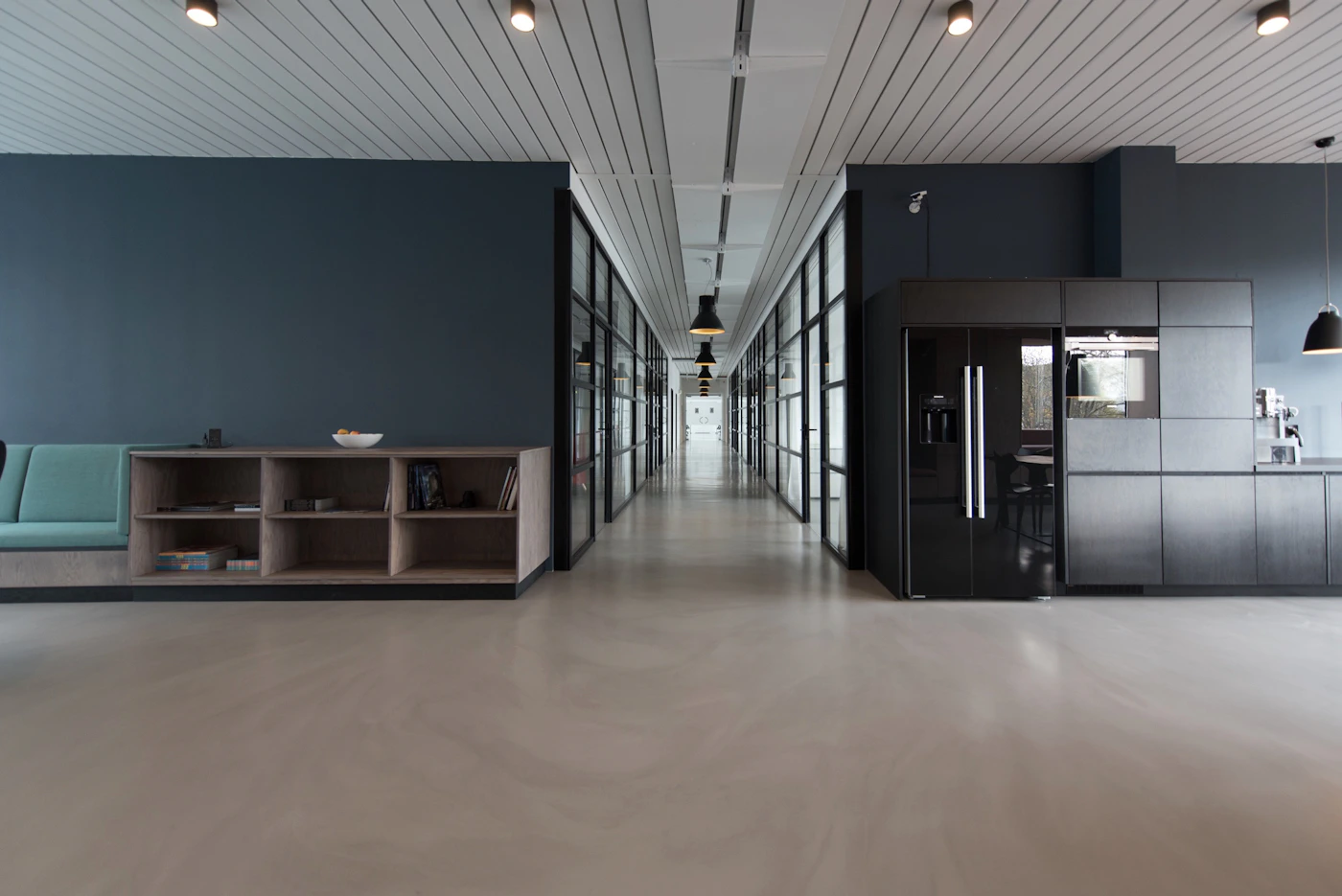
Certification verification is a non-negotiable step in B2B procurement — factory certificates do not automatically extend to individual product models.
Key Safety Standards to Verify
Safety certification in office seating is a layered landscape that procurement teams must navigate carefully. The most common mistake is treating certification as a binary pass/fail factory characteristic, when in practice certifications apply to specific product models, tested at specific production configurations, at specific points in time.
🏆 Primary Office Chair Standards Reference Guide
- BIFMA X5.1 (North America) — Business and Institutional Furniture Manufacturers Association standard for general-purpose office chairs. Covers structural durability, stability under load, backrest and armrest strength, and caster/glide performance. The benchmark for North American market specification.
- EN 1335 (European Union) — Three-part standard covering dimensions (Part 1), safety and durability (Part 2), and test methods (Part 3). Mandatory for CE-marked seating sold in EU markets.
- GB/T 3325 (China Domestic) — China’s national recommended standard for metal furniture, including office chairs. Covers structural load testing, surface quality, and dimensional requirements. Widely applied in domestic procurement and increasingly required for export compliance documentation.
- GB/T 38733-2020 (China Ergonomic) — China’s dedicated ergonomic office chair standard, covering adjustability ranges, lumbar support dimensions, stability testing, and mechanism durability. A more recent and more ergonomics-specific standard than GB/T 3325.
- GREENGUARD Gold — Covers VOC (volatile organic compound) emissions from foam, adhesives, upholstery, and finishes. Particularly relevant for procurement in enclosed office environments and for projects with green building certification requirements (LEED, BREEAM, WELL).
Certifications to Look for in the Chinese Market
When sourcing from Chinese manufacturers for export markets, the certification hierarchy matters for market access and warranty defensibility. For North American clients, BIFMA X5.1 compliance should be contractually required, with test reports provided at quotation stage. For EU markets, EN 1335 compliance is non-negotiable. For the Chinese domestic market or Southeast Asian projects, GB/T 38733-2020 compliance provides a credible ergonomic baseline.
One practical verification step: BIFMA’s public member search allows buyers to verify whether a supplier’s self-declared compliance is backed by formal certification. Legitimate BIFMA-compliant products are searchable in the database; claims that cannot be verified there should be investigated further before procurement commitment.
Budgeting and Buying Tips for the Chinese Market
Total Cost of Ownership Considerations
The unit price of an office chair is almost never its total cost. For B2B procurement teams building a business case or managing a multi-site rollout, total cost of ownership (TCO) — the complete financial exposure across the product’s deployed lifespan — is the correct comparison metric. Sourcing teams that evaluate chairs on unit cost alone routinely end up with higher TCO than those who pay a higher upfront unit price for demonstrably better material and mechanism specifications.
| Cost Category | Budget Chair (≈$120/unit FOB) | Mid-Grade Chair (≈$280/unit FOB) | Premium Chair (≈$520/unit FOB) |
|---|---|---|---|
| Initial Unit Cost | $120 | $280 | $520 |
| Freight + Duties (est. 30%) | $36 | $84 | $156 |
| Assembly + Installation | $25 | $25 | $25 |
| العمر المتوقع | 3–4 years | 6–8 years | 10–12 years |
| Replacement Cycle Cost (10 yrs) | $362 × 2.5 cycles = $905 | $389 × 1.5 cycles = $584 | $701 × 1 cycle = $701 |
| Warranty Claim/Repair Est. | $80 | $35 | $15 |
| 10-Year TCO per Unit | $985 | $619 | $716 |
The TCO analysis above demonstrates a counterintuitive but well-established procurement finding: the mid-grade specification often delivers the lowest 10-year total cost, because it combines acceptable material durability with a price point that does not require premium-tier justification processes. Budget-tier chairs generate the highest TCO due to accelerated replacement cycles; premium chairs may be TCO-comparable but require longer internal approval cycles.
Negotiation Tips, Warranties, and After-Sales Service
Negotiating with Chinese office chair manufacturers for B2B volume orders involves levers beyond price. The most effective negotiation positions include: committing to a defined annual volume in exchange for locked pricing for 12–24 months; requesting foam and mechanism grade upgrades at cost (rather than retail) as part of a higher-volume deal; and negotiating an extended warranty period — 5 years on structural components versus the standard 1–2 years — as a quality commitment rather than just a warranty cost liability.
Warranty terms in the Chinese export market vary enormously and are frequently opaque. Specific items to contractualise include: the definition of “structural defect” (ensuring it covers foam compression set and mechanism play, not only visible fractures); the response time for warranty replacement parts (maximum 45-day lead time is a reasonable standard for export clients); and spare-part availability commitment (key mechanisms, cylinders, and casters should be available for a minimum of 7 years after purchase).
For sourcing teams who need a trusted procurement partner with transparent documentation, production visibility, and B2B-oriented service protocols, Jade Ant Furniture’s due diligence framework provides a practical starting point for evaluating any Chinese furniture factory — covering legal verification, quality system assessment, production capacity, and export compliance in a structured checklist format.

Premium workspace investments require procurement decisions that balance per-unit cost, ergonomic performance, and total fleet lifespan — all three simultaneously.
Building a Defensible Chair Specification
The Chinese office chair market in 2025–2026 offers B2B procurement teams a wider quality range than has ever been available — from commodity seating that will require complete replacement within 3 years to genuinely competitive products matching European ergonomic benchmarks at significantly lower landed costs. The difference between a successful fleet deployment and an expensive procurement mistake lies entirely in the specificity of the evaluation process applied before the purchase order is placed.
Material quality assessment is not a general impression exercise — it is a structured review of documented specifications: foam density values, fabric abrasion ratings, steel gauge measurements, mechanism cycle test data, and certification reports that name the actual model being purchased. Ergonomic assessment is not a comfort check in a showroom — it is verification that the chair’s adjustment ranges accommodate the full body-size diversity of the workforce that will use it for 8 hours daily, 250 days per year, across a 7–10 year service life.
For procurement teams ready to move from general awareness to specific action, the following procurement checklist compresses the evaluation criteria from this guide into a pre-purchase verification protocol.
✅ B2B Buyer Procurement Checklist — Chinese Office Chairs
- Request full BOM (Bill of Materials) including foam density, fabric Martindale rating, and steel gauge
- Verify certification documents reference the specific model number being purchased
- Confirm BIFMA X5.1 or EN 1335 test reports with laboratory name, date, and model reference
- Confirm foam density minimum of 45 kg/m³ and compression set ≤15% in writing
- Verify seat height adjustment range accommodates your workforce body-size distribution
- Specify caster type appropriate to office flooring material (PU for hard floors)
- Request synchro-tilt mechanism as minimum standard for full-day task seating
- Confirm warranty covers structural components, mechanism, foam (not surface wear only)
- Negotiate spare-part availability commitment for minimum 7 years post-purchase
- Request production photos and pre-shipment inspection for orders above 50 units
For B2B buyers specifically evaluating Chinese furniture partners with the documentation depth and customisation capability to support multi-site office fit-outs, مفروشات النمل اليشم works directly with procurement teams, interior architects, and workplace consultants to align factory capabilities with project requirements — from initial specification to production supervision and export logistics.
For a broader understanding of how to assess the Chinese commercial furniture landscape, the Jade Ant guide to major Chinese contract furniture brands provides a structured comparison of how different manufacturers serve different B2B segments, which is directly applicable to the office seating sourcing context.
Further procurement intelligence on Chinese furniture manufacturing is available from independent sources including the BIFMA Standards overview (for North American market compliance baseline) and ISO 9001 quality management reference (for assessing supplier QMS credibility).
الأسئلة الشائعة
What is a good foam density for office chairs used in corporate environments?
For B2B commercial applications where chairs are used 6–8 hours daily, the recommended minimum foam density is 45 kg/m³ (approximately 2.8 lb/ft³). Premium executive and boardroom seating typically specifies 50–65 kg/m³ with a dual-density construction — a firmer base layer for structural support topped with a softer comfort layer. Below 35 kg/m³, foam will show measurable compression set (permanent deformation) within 12–18 months of heavy use, compromising both comfort and lumbar support. Always request the foam density value in writing, as terms like “high-density” or “premium foam” carry no standardised definition in supplier marketing materials.
How do I verify a chair’s stated weight capacity before placing a bulk order?
Request the specific structural test report, not just a marketing claim. For North American specifications, BIFMA X5.1 testing is the benchmark — it includes cyclic loading tests at defined weight levels (minimum 113 kg / 250 lbs for standard task chairs) across 100,000+ cycles. The test report should name the specific chair model, the testing laboratory, and the test date. If the supplier provides a factory-level ISO certificate rather than a product-specific test report, follow up specifically for the model-level structural test documentation. For very large orders (500+ units), pre-production sample destructive testing conducted by a third-party inspection service is standard practice.
Are there specific certifications common in China that I should look for when sourcing office chairs?
The primary Chinese national standard for office chairs is GB/T 3325 (general metal furniture structural testing) and the more ergonomics-specific GB/T 38733-2020 (ergonomic office chair standard covering adjustability, lumbar dimensions, and mechanism durability). For export to North American markets, BIFMA X5.1 compliance should be contractually required. For European markets, EN 1335 Part 2 compliance is the legal baseline. For green building projects (LEED, WELL, BREEAM certifications), GREENGUARD Gold certification for VOC emissions is increasingly required. Importantly, verify that all certifications reference the specific model being purchased, not the factory generally.
What is the difference between PU leatherette and genuine leather on office chairs, and which is better for B2B procurement?
PU (polyurethane) leatherette is a synthetic material with a fabric or non-woven backing coated with polyurethane. It offers easy cleaning, a leather-like appearance at lower cost, but typically has a lifespan of 4–7 years under heavy commercial use before delamination, cracking, or peeling occurs. Genuine top-grain leather sourced from quality tanneries has a lifespan of 10–15 years with basic maintenance, offers natural breathability, and develops a patina over time. For C-suite, boardroom, and client-facing seating where the chair is a brand statement and multi-decade use is expected, genuine leather delivers better TCO. For general task seating deployed across open-plan offices, PU leatherette or commercial-grade mesh are more practical choices.
What ergonomic features are most critical when specifying office chairs for a diverse workforce?
For a workforce with body-size diversity — common in multinational offices — the critical specifications are: (1) seat height range of at least 42–52 cm to accommodate users from approximately 155 cm to 195 cm in height; (2) adjustable seat depth (38–50 cm range) to prevent thigh compression for shorter-legged users; (3) height-adjustable lumbar support with a minimum vertical range of 6 cm; and (4) armrests with at least 2D adjustability (height + width). Synchro-tilt mechanism is the recommended minimum for chairs used in full-day desk work. Fixed lumbar support and single-position armrests should be avoided in any deployment where user turnover or hot-desking is a feature of the environment.
What caster type should I specify for a modern office with polished concrete or LVT flooring?
For hard floor surfaces including polished concrete, luxury vinyl tile (LVT), engineered hardwood, ceramic tile, and marble, you must specify polyurethane (PU) soft-roll casters rather than standard hard nylon casters. Hard nylon casters on these surfaces will cause visible scratching within weeks of deployment, generating floor damage claims and replacement costs. PU soft-roll casters are near-silent, do not mark sensitive floor finishes, and roll more easily under occupant weight — which also reduces the physical strain of chair movement for users. The cost difference at factory level is typically $3–8 per chair — a trivially small investment relative to the floor damage risk it eliminates.
How should I evaluate a Chinese office chair manufacturer’s quality system before placing a large order?
A credible quality evaluation for large B2B orders should include: (1) factory audit covering production flow, material storage, in-process QC checkpoints, and finished goods inspection; (2) review of documented quality control records from recent production batches; (3) foam and upholstery sample collection with independent laboratory testing against the specification; (4) mechanism cycle test documentation; (5) verification that certification documents are product-specific, not factory-generic. For orders above 200 units, pre-shipment inspection by a qualified third-party service (SGS, Bureau Veritas, Intertek are the leading providers) is standard practice and typically costs $300–500 per inspection day — a marginal cost against a large procurement value. The Jade Ant factory due diligence checklist provides a structured framework for this evaluation process.
What is the typical lead time for a large office chair order from a Chinese manufacturer, and how should I plan for it?
For a standard B2B order of 100–500 units with no significant customisation, the typical production lead time from confirmed order to goods-ready-for-shipment is 25–35 working days. Add ocean freight time (18–28 days to European ports; 25–35 days to North American West Coast) and customs clearance (5–10 days) for total planning horizons of 8–12 weeks. For customised specifications — non-standard upholstery, custom colour matching, logo integration, or mechanism upgrades — add 15–20 working days for sample approval before mass production commences. Planning buffers of 2 weeks for sample revisions and 1 week for pre-shipment inspection are standard practice for procurement teams managing fit-out schedule risk.
What is synchro-tilt and why does it matter for office chair specification?
Synchro-tilt (synchronous tilt) is a chair mechanism in which the backrest reclines at approximately twice the speed of the seat pan — a 2:1 ratio. This maintains a more open hip angle (approximately 100–110°) during reclined postures compared to basic tilt mechanisms where the seat lifts steeply at the front as you lean back, compressing the hip angle and increasing pressure on the thighs. Research in occupational ergonomics consistently associates synchro-tilt mechanisms with reduced lumbar disc pressure during reclined postures and better postural variety throughout the working day. For full-day task seating in knowledge work environments, synchro-tilt should be the contractual minimum mechanism specification.
How can I calculate total cost of ownership when comparing office chair options from different Chinese suppliers?
TCO calculation should include: (1) ex-factory unit price; (2) freight and import duties (typically 25–35% added to FOB price for landed cost in most markets); (3) assembly and installation labour; (4) projected replacement cycle — a $120 chair replaced every 3.5 years costs more over 10 years than a $280 chair with a 7-year lifespan; (5) warranty claim administration cost; (6) the productivity value of reduced ergonomic complaints (OSHA data indicates $15–20B in annual U.S. workers’ compensation is ergonomics-related). When all variables are included, mid-grade chairs ($250–350 FOB) typically deliver the lowest 10-year TCO across a standard corporate fleet — the budget tier’s apparent cost advantage is largely consumed by accelerated replacement cycles and higher warranty incident rates.