How NeoCon 2026 is Reshaping Your Commercial Interior Design Practice — What You Need to Know About This Year’s Innovations to Stay Competitive and Win More Client Projects
 NeoCon 2026 confirmed what the best commercial designers already knew: the workplace is no longer about fitting people into a space — it’s about designing space around how people actually work.
Why NeoCon 2026 Matters to Your Design Business
NeoCon 2026 ran June 8–10 at The Mart in Chicago, under the theme “Where Design Connects.” Design professionals from 88 countries walked those floors. 274 products were entered for the Best of NeoCon Awards, judged by 45 jurors drawn from architecture, design, facility management, and business media. 71 products were recognized across 42 categories.
But if you weren’t there, or if you were there and are still processing what it all means for your practice, this guide is written for you.
NeoCon isn’t just a trade show. For furniture distributors, showroom directors, interior designers, and hotel fit-out specialists, it is the clearest signal available of where client expectations are moving — and where your product mix, your sourcing conversations, and your sales approach need to go next.
The central message from NeoCon 2026 was this: human-centered design has stopped being a category and become the baseline standard. Products that cannot make a clear, specific case for how they support the person using them — ergonomically, acoustically, emotionally, cognitively — are no longer competitive in a market where the best manufacturers are building those answers into their default specifications.
This year, three structural shifts defined the show floor: the maturation of wellness as a measurable design criterion (not a buzzword), the integration of acoustic performance as a standard specification rather than an add-on, and the emergence of lighting as a wellness infrastructure category in its own right, with the debut of Illuminate at NeoCon pulling more than 60 global lighting brands onto the 7th floor.
What does this mean for your business in the next 12 months? That’s exactly what this guide answers.
The 10 Workplace Structures That Will Define Client Expectations in 2026
Structure 1 – Activity-Based Working Zones
Activity-Based Working (ABW) — a model where employees choose their workspace based on the task they’re performing rather than sitting at an assigned desk — is no longer a Silicon Valley experiment. It is the dominant planning logic behind virtually every significant corporate workplace fit-out being designed right now. According to research from DLR Group’s 2026 Workplace Design analysis, organizations implementing ABW report measurable improvements in space utilization efficiency — in some cases reducing total square footage requirements by 20–30% while improving employee satisfaction scores.
How This Shifts Your Design Approach
This structure changes what clients ask you to specify. Instead of “200 task chairs,” you’re designing a palette of seating typologies across focus zones, collaboration zones, social zones, and recovery zones. Each zone has a distinct furniture language. A focus zone demands acoustic shielding, minimal visual distraction, and ergonomic task seating. A social zone calls for the lounge-worthy, cocooned silhouettes that dominated NeoCon 2026’s floor — pieces that signal comfort and encourage people to stay longer.
Practical Implementation for Your Projects
The practical challenge is phasing. Most existing clients cannot convert their entire office footprint to ABW in a single project cycle. The most effective approach — and the one that creates multiple revenue touchpoints — is zone-by-zone implementation, starting with a pilot collaboration zone or wellness area, measuring occupancy and employee feedback, then using that data to justify the next phase. Your role as designer or distributor is to guide that sequencing, which requires understanding the full system, not just individual products.
Structure 2 – Biophilic Integration in Open Offices
Biophilic design — the intentional integration of natural elements, materials, and patterns into built environments — is not about putting a plant in the corner. Research cited by Gable’s 2026 Office Design Trends Report shows that employees in workplaces with genuine biophilic elements report 15% higher wellbeing scores, 6% higher productivity, and up to 15% more creative output compared to those in conventional offices. These are numbers your corporate clients can put in front of their boards.
Sourcing Materials and Products Your Clients Will Request
At NeoCon 2026, biophilic influence showed up not just in the expected timber and stone surfaces but in the texture vocabulary of upholstered pieces — woven fabrics with organic movement, bouclé finishes, and curved silhouettes that echo natural forms rather than machine-cut geometry. Deep wood tones, tactile materiality, and soft curves were consistent across the show floor. Clients will arrive at your showroom having seen these images on Instagram and will want to know what you stock in that direction.
Profitability and Specification Opportunities
Biophilic specification tends to increase average order values because it is inherently multi-element. A genuinely biophilic zone requires complementary material choices across flooring, upholstery, panel systems, and accessories. The designer who controls the full specification — not just the seating — captures significantly more of the project value. Develop your biophilic material palette as a bundled specification story, not a list of individual products.
Structure 3 – Agile Collaboration Pods
Enclosed or semi-enclosed collaboration pods — prefabricated, acoustically managed, technology-ready spaces for small group work — were prominently featured at NeoCon 2026. Silen Space Gen 2 received a Business Impact Award, reflecting not just its design quality but its demonstrable commercial success with institutional buyers.
Design Flexibility Your Clients Demand
The key specification variable for pods in 2026 is acoustic performance combined with reconfigurability. Clients — particularly those managing frequent team restructuring in hybrid work environments — want pods that can be repositioned without significant disruption to the surrounding space. Wheeled base systems, modular acoustic panels, and furniture-grade interior finishes (rather than the utilitarian approach of early-generation pods) are now the specification standard.
Product Lines to Stock and Recommend
For distributors and showroom owners, pods represent a high-margin category with strong specification pull from both interior designers and corporate facilities managers. They also have a demonstrable lead time challenge — popular configurations can run 12–16 weeks from order to delivery. Building strategic inventory or securing allocation agreements with manufacturers before demand peaks is a meaningful competitive advantage.
Structure 4 – Modular Seating Systems
Modular seating — systems where individual seat, back, arm, and connection elements can be combined and recombined into different configurations — was the dominant seating typology at NeoCon 2026, reflecting client demand for furniture that can adapt to organizational change without capital replacement.
Why Modularity Drives Client ROI
A lounge seating investment that can be reconfigured from a 6-person reception arrangement to a 12-person town-hall gathering space to four individual focus seats as the space evolves is a fundamentally different value proposition than a fixed sofa. For clients managing offices through ongoing hybrid work transitions, this adaptability directly reduces their total furniture spend over a 5–7 year ownership period.
Competitive Advantages for Your Showroom
Modular seating is also a specification category where the initial sale creates natural upsell opportunities. Clients who buy a base configuration at project completion routinely add modules 12–18 months later as their team grows or their space use evolves. Stocking complementary pieces and maintaining records of client configurations positions your showroom as the logical re-engagement point.
Structure 5 – Smart Storage Solutions
Storage is the unglamorous backbone of every functional workplace, and NeoCon 2026 confirmed that the category is undergoing a significant design upgrade. HALCON’s VESPER was a Best of Competition finalist and People’s Choice Award winner — a storage solution that competes aesthetically with feature furniture rather than disappearing into the background.
Space Optimization as a Selling Point
Vertical storage systems — floor-to-ceiling, architecturally integrated, and material-matched to the broader design scheme — allow designers to recover floorplate area for activated workspace rather than storage. In dense urban office markets where real estate costs run $80–$150+ per square foot annually, every square foot of floor area recovered through vertical storage has a quantifiable financial return. Frame this conversation with your clients.
Integration with Digital Workplace Tools
Smart storage incorporating RFID asset tracking, electronic locking, and sensor-based occupancy monitoring is moving from premium specification toward standard offering in large corporate and hospitality projects. This creates a new conversation with clients around integration: who manages the technology layer, who maintains it, and what data it generates. Your role as a specification expert requires you to understand these systems well enough to ask the right questions, even if the technology implementation falls to an IT partner.
Structure 6 – Wellness-Focused Breakout Spaces
The wellness breakout space — a dedicated zone for rest, recovery, informal social connection, and decompression — has graduated from perk to infrastructure in the corporate workplace design playbook. Companies reporting the highest employee retention rates are increasingly those that have invested in non-transactional space: areas where employees are not expected to produce, but where they recharge sufficiently to produce better elsewhere.
Addressing Client Pain Points Around Employee Retention
The data is specific enough to use in client conversations. Research from the World Green Building Council shows that workplace design accounts for a measurable portion of employee satisfaction scores that correlate with retention rates. For a corporate client spending $15,000–$25,000 to recruit and onboard a single mid-level professional, a wellness zone investment of $30,000–$50,000 that meaningfully improves retention across a team of 50 delivers a positive ROI within 12 months of the first retained hire.
Premium Product Positioning Opportunities
Cocooned lounge seating, acoustic privacy pieces, soft lighting systems, and tactile textiles — the dominant aesthetic at NeoCon 2026’s social spaces — command genuine price premiums because they are visible, differentiating, and emotionally resonant to the employees who use them daily. These are the pieces that end up in the company’s recruitment photography. They are worth the investment, and clients who have made it will tell you they’d make it again.
Structure 7 – Hybrid Work Neighborhoods
Hybrid work neighborhoods are designated zones where a consistent team or department has home-base affiliation without assigned seating. The neighborhood includes a mix of focus, collaboration, and social furniture typologies, creating a community identity within the larger open office.
Designing for Flexibility and Uncertainty
The critical specification challenge here is designing for a headcount that fluctuates day by day. A neighborhood designed for a department of 40 people may see 15 people on Monday and 38 on Thursday. The furniture system needs to accommodate both realities without either feeling empty or overcrowded. Modular seating, height-adjustable desks, and mobile storage units that can be repositioned within the neighborhood are the core specification vocabulary.
Multi-Use Furniture That Justifies Higher Margins
Multi-use pieces — seats that convert from lounge to task configuration, tables with integrated power and adjustable height, storage that doubles as room dividers — carry higher margins precisely because their specification requires expertise. The designer or distributor who can demonstrate a complete neighborhood system — showing how the components work together across different occupancy scenarios — is selling a solution, not a product. Solutions justify higher price points.
Structure 8 – Acoustic Performance Zones
Noise was named the single most common complaint in open office environments in multiple workplace surveys conducted between 2023 and 2025. NeoCon 2026 responded with the deepest acoustic product offering the show has ever featured — from the sculptural ceiling acoustic tiles recognized in multiple award categories to the integration of acoustic performance into seating and pod systems.
Why Clients Are Investing in Sound Management
The business case is no longer abstract. Research from acoustic design specialists shows that employees in high-noise environments experience cognitive performance reductions equivalent to a 5–10 IQ point deficit during sustained noise exposure. For knowledge workers — the dominant workforce in the offices your clients are designing — this represents a measurable productivity cost that exceeds the specification cost of acoustic intervention in most cases.
Strategic Partnerships with Manufacturers
For distributors, acoustics represents a category where manufacturer partnerships are particularly valuable. Acoustic product specifications are highly technical, involving NRC ratings, STC values, and installation requirements that most clients cannot evaluate independently. A distributor who has invested in acoustic product knowledge and can guide specification decisions is differentiated in a way that is difficult to replicate on price.
Structure 9 – Sustainable Material Specifications
The global sustainable office furniture market was valued at approximately $12.4 billion in 2025 and is projected to reach $26.9 billion by 2035 — a compound growth rate of 8.1% annually. This is not a niche segment. It is where the commercial furniture market is moving.
Meeting Corporate ESG Requirements
ESG (Environmental, Social, and Governance) refers to the framework through which institutional investors and regulators evaluate corporate sustainability performance. As of 2026, 67% of Fortune 500 companies require GREENGUARD Gold certification for furniture procurement, up from 42% in 2023. This is a procurement requirement, not a preference — and it means that distributors and designers who cannot supply certified product are disqualified from a growing segment of the most valuable commercial contracts.
Sourcing Competitive Advantages
Manufacturers with verified FSC certification, GREENGUARD Gold, and ISO 14001 environmental management systems are increasingly pre-qualified in corporate procurement frameworks. Establishing sourcing relationships with these manufacturers — and maintaining current copies of their certificates — creates a competitive specification advantage that is difficult for less-prepared competitors to replicate quickly.
Structure 10 – Ergonomic Seating Innovation
KI’s Kiaura Collection Task Chair — built around Cognetic Technology, which uses gravity as its operating principle (meaning no levers, no presets, no tilt locks — the chair responds to the sitter’s actual body weight distribution) — won Best of Competition at NeoCon 2026. The jury’s description was precise: it “moves with your body and how you want to move.” That is the direction of the entire category.
Health and Productivity Claims Your Clients Can Make
Ergonomic certification from BIFMA (Business and Institutional Furniture Manufacturers Association) and ANSI standards provides clients with a documented basis for health and productivity claims — relevant for insurance conversations, HR wellness programs, and increasingly, for the workers’ compensation and productivity data that finance teams track. A task chair that can demonstrate it reduces musculoskeletal complaint rates within a workforce is a defensible capital expenditure in a way that a competitively priced, uncertified alternative is not.
Warranty and Support Differentiators
Premium ergonomic seating typically carries 10–12 year structural warranties, which spread the cost basis significantly when total cost of ownership is calculated over a realistic usage cycle. A $1,200 BIFMA-certified task chair with a 12-year warranty and documented ergonomic performance data has a lower cost-per-year of ownership than an $400 uncertified alternative replaced every 4 years — and it generates fewer complaints in the process.
Seating Innovation: What NeoCon Revealed About Future Demand
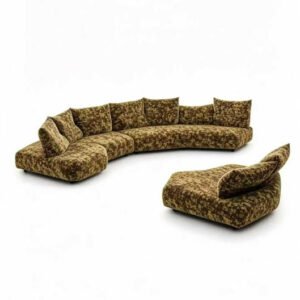
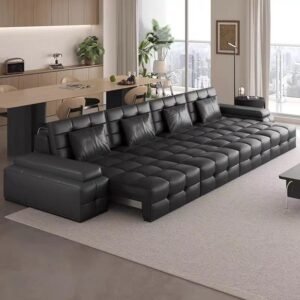
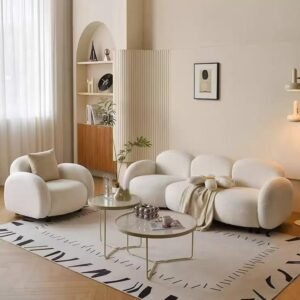
 Cocooned seating silhouettes like these dominated NeoCon 2026 — designed not just to look impressive but to create the acoustic and psychological privacy that open office workers increasingly demand.
The Shift from Static to Dynamic Seating
Static seating — chairs and sofas that hold a fixed position regardless of how the occupant moves — is losing specification share to dynamic seating systems that respond to movement. The KI Kiaura is the most awarded example from NeoCon 2026, but the principle extends across the seating category. Clients are increasingly aware that sitting still in a fixed position is physiologically stressful over a full workday, and they are asking designers to specify differently.
Client Conversations You Should Be Having Now
The conversation to initiate with corporate clients is not “do you want ergonomic chairs?” — the answer is almost always yes. The productive conversation is: “How do you currently measure the return on your seating investment, and what does your HR data show about musculoskeletal-related absence?” This shifts the discussion from product to outcome, which is where specification decisions become easier to justify.
Why Your Competitors Are Already Stocking These Lines
The distributors who attended NeoCon 2026 and came back with ordering commitments on dynamic seating systems have a 3–6 month specification window advantage. By the time a client request for these products reaches your showroom and you begin the procurement process, your competitor who stocked them in July already has them available. This is the compounding advantage of treating NeoCon as a sourcing intelligence event, not just an inspiration event.
Ergonomic Certifications That Close Sales
The certifications that matter to corporate procurement departments — and that your sales team needs to be fluent in — are BIFMA X5.1 (office seating structural and durability performance), ANSI/BIFMA e3 (sustainability standard), and GREENGUARD Gold (low VOC chemical emissions). These are the standards that appear on corporate preferred-supplier lists and RFP requirements. A product without them is not bidding for the same contracts as a product with them.
Customization and Upholstery Trends
From NeoCon 2026’s showrooms: deep, saturated earth tones, rich bouclé textures, velvet in warm terracotta and forest green, and performance fabrics engineered to hold their appearance through 50,000+ Martindale rub cycles. For distributors managing upholstery inventory, the commercial-grade performance fabric story — durability data alongside aesthetic appeal — is the specification language your clients need to justify premium seating to their finance teams.
Storage Solutions: Maximizing Space Without Sacrificing Design
Vertical Storage Systems That Sell
The most significant storage specification shift from NeoCon 2026 is the elevation of storage from functional infrastructure to design element. HALCON’s VESPER — a Best of Competition finalist and People’s Choice Award winner — demonstrates that storage systems can anchor a space aesthetically rather than retreating to the perimeter.
| Storage System Type | Avg. Floor Space Recovery | Price Premium vs. Standard | Typical Specification Context |
|---|---|---|---|
| Vertical integrated shelving | 25–40% floorplate recovery | 35–60% premium | Premium corporate, hospitality lobbies |
| Mobile pedestal with smart lock | الحد الأدنى | 15–25% premium | Hot-desking and ABW environments |
| Acoustic storage partition | Active acoustic benefit | 40–70% premium | Open-plan offices, collaboration zones |
| Technology-integrated cabinets | معتدل | 50–80% premium | Executive suites, reception areas |
Integrated Cable Management and Technology
The hidden problem in most commercial furniture specifications is cable management. Corporate clients almost universally underestimate the visual disruption and safety risk of unmanaged cabling across an open office — until they see it in their installed space and call to complain. Specifying integrated cable management systems as a standard component of desk and storage systems, rather than an optional add-on, eliminates the most common post-delivery client dissatisfaction point.
Aesthetic Storage That Doubles as Branding
For showroom directors: storage systems with custom branding capabilities — interchangeable panel inserts, fabric-wrapped units, color-matched metal frames — give corporate clients the opportunity to reinforce their brand identity through their furniture environment. This creates specification differentiation, increases order values, and generates the kind of distinctive client environment that wins design awards and generates referrals.
Collaborative Workspace Solutions: The Real Opportunity
Why Collaboration Spaces Are Where Margins Live
A complete collaboration zone specification — pods, soft seating, technology integration, acoustic treatment, lighting — routinely generates total project values 3–5x higher per square foot than standard open-plan office specification. The misconception among some distributors is that collaboration spaces are expensive to propose and difficult to close. In reality, they are easier to close when presented correctly, because they address a pain point that clients feel acutely.
Technology-Enabled Meeting Spaces
Cisco’s AI-Powered Plug-n-Play Rooms و Cisco Spaces Workspace Designer received Business Impact Awards at NeoCon 2026 — recognizing the commercial success of technology-integrated meeting infrastructure. The integration challenge for clients is real: AV systems, booking software, occupancy sensors, and video conferencing hardware all need to work with the furniture system rather than fighting it.
Your role as a specification expert is to ask the right questions early: “Who is managing your AV integration, and have they seen the furniture specifications?” Introducing this conversation before installation — rather than letting it surface during fit-out — positions you as a project management partner rather than a product vendor.
Informal Gathering Spaces That Drive Productivity
Research consistently shows that unplanned, informal conversations between employees are among the highest-value interactions in a knowledge-work organization — generating the cross-functional connections that drive innovation. Spaces designed to facilitate these interactions (comfortable, technology-accessible, acoustically appropriate, visually distinctive) are investment-justified through productivity frameworks, not just aesthetic preference.
What Hotel Fit-Out Designers Need to Know from NeoCon 2026
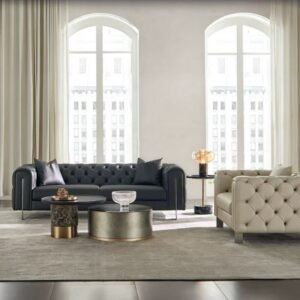
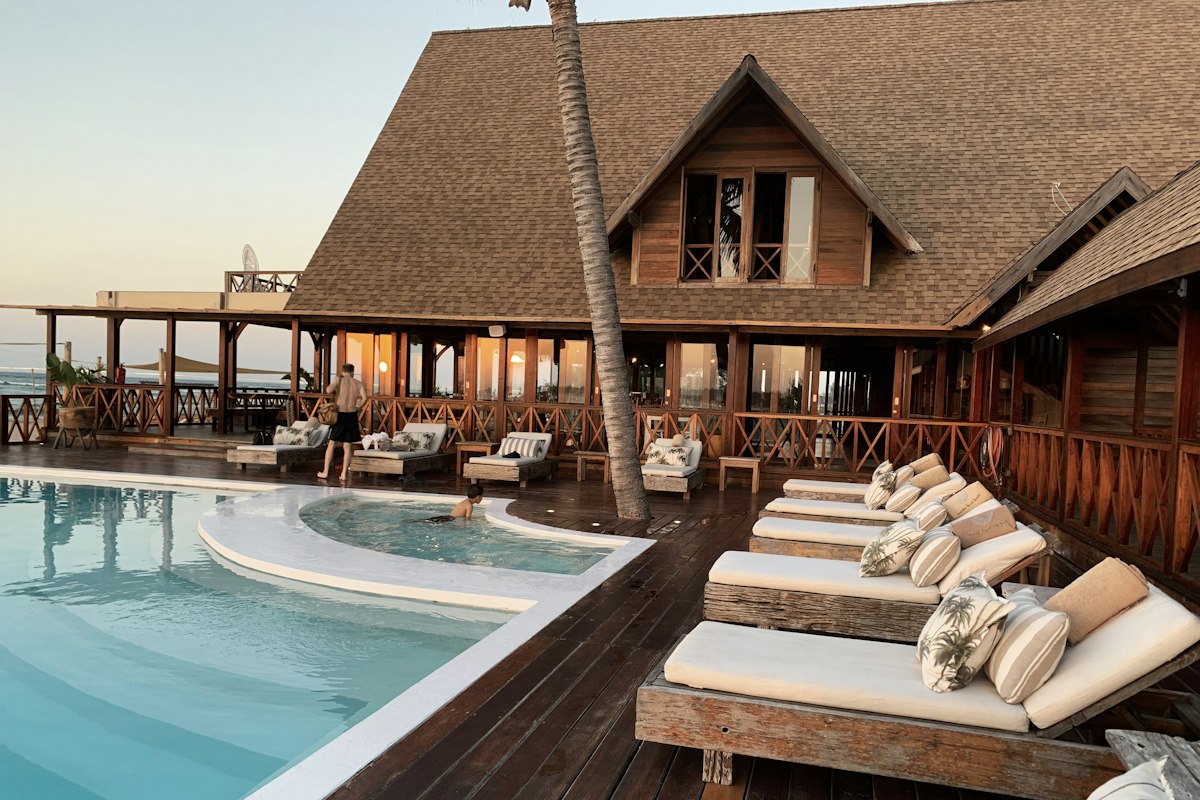 Hotel lobbies in 2026 are being designed as hybrid work and social destinations — requiring contract-grade furniture that performs under sustained commercial use while projecting residential-level luxury.
Guest-Facing Collaboration Spaces in Hospitality
إن hybrid hotel concept — where hotels design their lobbies, lounges, and F&B spaces to serve both overnight guests and day-use business travellers, remote workers, and local professionals — is no longer a boutique operator experiment. It is the competitive strategy of every major international hotel brand’s next development pipeline. This changes the specification brief for hospitality furniture fundamentally.
Lobby seating in a hybrid-use hotel is now specified to the same durability and acoustic performance standards as corporate contract furniture, while maintaining the residential warmth and visual luxury that guests expect. The specification sweet spot — contract durability with hospitality aesthetics — is exactly where manufacturers like مفروشات النمل اليشم operate, producing pieces built for real occupancy performance rather than showroom photography.
Durability Standards for High-Traffic Environments
For hotel public-space furniture, the specification minimum is 50,000 Martindale cycles on all upholstered surfaces, structural load testing to BIFMA X5.4 or equivalent, and finish durability rated for commercial cleaning protocols. Pieces that pass residential durability tests but fail under commercial hospitality usage generate warranty claims and replacement costs that eliminate any initial pricing advantage. Require documented test reports, not manufacturer assurances.
Staff Wellness Spaces Behind the Scenes
The hospitality industry is facing a genuine labor retention crisis — with some markets reporting turnover rates of 60–80% annually among front-line hospitality workers. Hotel operators investing in back-of-house staff break spaces, wellness rooms, and quality locker room environments are seeing measurable improvement in retention metrics. This is an emerging specification category with real client need and limited competition among hospitality furniture specialists.
Flexible Event and Meeting Infrastructure
Reconfigurable banquet and event furniture — tables and seating systems that can transition from a 200-person conference setup to a cocktail reception to a 10-person boardroom in under 2 hours — maximizes revenue per square foot for hotel event spaces. The specification requirements are demanding: structural reliability through repeated reconfiguration, surface durability through commercial cleaning, and stacking/nesting efficiency to minimize storage requirements. This is a category where the sourcing relationship matters enormously, because the documentation required to support these specifications at institutional procurement level goes well beyond a standard product catalogue.
Interior Designers: Translating Trends Into Client Wins
How to Brief Your Furniture Suppliers on NeoCon Insights
The most effective briefing documents for furniture suppliers translate NeoCon trends into specific product requirements: materials, dimensions, certifications, lead times, and minimum order quantities. A brief that says “we want a cocooned biophilic lounge aesthetic” is a starting point. A brief that specifies “curved high-back lounge chair, bouclé or woven performance fabric in earth tones, NRC 0.7+ acoustic back panel, BIFMA X5.4 structural testing, 12-week lead time, 10-unit MOQ” is a procurement document.
Presenting Trend-Forward Designs to Conservative Clients
The language that converts conservative clients is not aesthetic — it is financial. Frame trend-forward specifications around: employee retention improvement, real estate efficiency gains, talent attraction in a competitive hiring market, and brand differentiation in a physical space that employees share on social media. These are the metrics that reach past the taste preferences of a single decision-maker to the financial logic that gets a budget approved.
Staying Ahead of Client Expectations
The designers winning the most competitive commercial project tenders in 2026 are those who arrive at the first briefing meeting having already anticipated the client’s next two questions. That requires staying engaged with industry intelligence between the annual NeoCon cycle — through publications like Contract و Metropolis, through manufacturer product updates, and through professional networks that surface emerging client needs before they become RFP requirements.
Distributors and Showroom Owners: Inventory and Strategy for 2026
Which Product Categories Deserve Shelf Space
Based on NeoCon 2026 awards, buyer behaviour at the show, and the commercial project pipeline for 2026–2027, the product categories with the strongest specification pull are: dynamic and ergonomic task seating (driven by corporate wellness investment), acoustic pods and panels (driven by open-plan office remediation projects), modular lounge seating (driven by ABW and hybrid work neighborhood implementations), and integrated storage systems (driven by space optimization in high-cost real estate markets).
| Category | Demand Driver | Margin Range | Lead Time | Stock Recommendation |
|---|---|---|---|---|
| Ergonomic task seating (BIFMA certified) | Corporate wellness mandates | 35–50% | من 8 إلى 14 أسبوعاً | Strategic stock, priority lines |
| Acoustic pods | Open-plan remediation | 40–60% | 12–16 weeks | Allocation agreements |
| Modular lounge seating | Hybrid work zones | 45–65% | 10–14 weeks | Core range stocked |
| Smart storage systems | Space optimization | 40–55% | 10–16 weeks | Specification-led ordering |
| Biophilic accent pieces | Design differentiation | 50–70% | 8–12 weeks | Showroom display essential |
Training Your Sales Team on New Solutions
The most effective sales training for complex workspace solutions is scenario-based, not product-based. Train your team around client situations: “A tech company with 150 employees wants to implement hybrid work neighborhoods but has never done ABW before. They are worried about losing their culture. Walk me through how you’d approach that conversation.” Comfort with the problem space comes before confidence with the product specification.
Positioning Your Showroom as a Trend Leader
Showrooms that physically demonstrate NeoCon 2026 directions — with a functioning biophilic zone, an acoustic pod experience, a modular seating reconfiguration demonstration — generate client conversations that begin with “how do we implement this?” rather than “what does this cost?” The display investment is a lead-generation tool, not a sunk cost.
Sustainability and ESG: No Longer Optional
What Corporate Clients Are Actually Demanding
Corporate ESG procurement requirements have shifted from a preference to a vendor qualification criterion. Clients with published net-zero commitments, Scope 3 emissions reporting obligations, or institutional investor ESG oversight are increasingly unable to work with furniture suppliers who cannot provide: manufacturer environmental certifications (ISO 14001), product chemical compliance documentation (GREENGUARD Gold or equivalent), material origin verification (FSC for wood products), and end-of-life recovery documentation or circular economy compliance.
Communicating Environmental Value Without Greenwashing
Greenwashing — making sustainability claims that are not supported by verifiable evidence — is not just ethically problematic; it is increasingly a legal and reputational liability. The honest sustainability conversation with clients covers: what specific certifications this product holds, what those certifications actually test for, and what documentation the client will receive to support their own ESG reporting. Specificity builds trust. Vague claims about “eco-friendly” or “sustainable design” without documentation are a red flag for sophisticated procurement teams.
Premium Positioning Through Sustainability
Sustainably specified furniture commands price premiums in the 10–20% range in most commercial procurement contexts — and buyers who are ESG-motivated accept those premiums willingly. More importantly, ESG-compliant specification creates stickier client relationships: a client who has built their sustainability reporting around your supply chain documentation has a real switching cost if they move to an alternative supplier who cannot match that documentation framework.
Pricing Strategy in a Trend-Driven Market
Justifying Premium Pricing for Innovation
The pricing conversation for trend-forward, certified, and specification-complex products should never start with the unit price. It should start with the client’s objectives — talent retention, real estate efficiency, brand expression, ESG compliance — and work backward to the specification that delivers those outcomes. By the time you reach the price, you have established the value context. A $3,000 ergonomic chair that sits within a $50,000 wellness zone specification that reduces turnover by 10% is not a premium purchase — it’s a capital efficiency decision.
Volume vs. Margin: Finding Your Sweet Spot
| Business Model | Volume Strategy | Margin Strategy |
|---|---|---|
| Specification-led distributor | Fewer, larger project wins | 45–65% gross margin on complex specification |
| High-volume contract supplier | Repeat large-order corporate clients | 30–40% margin on certified, compliant lines |
| Showroom-led retail | Walk-in and designer-referred projects | 50–70% on exclusive or custom pieces |
The distributors most at risk in 2026 are those competing on unit price for commoditized product lines against online platforms with lower overhead. The distributors best positioned for growth are those who have invested in specification expertise, certification knowledge, and project management capability that online platforms cannot replicate.
The Supply Chain Reality Check
Lead Times and Availability Post-NeoCon
Every year, the 6–8 weeks following NeoCon see a significant increase in specification orders for products that won awards or generated floor traffic. Lead times on the most talked-about products from NeoCon 2026 — dynamic task seating, acoustic pods, modular lounge systems — will extend through Q3 and Q4 as demand concentrates. Buyers who placed orders in June are ahead of buyers who place orders in September.
For clients with project deadlines in Q4 2026 or Q1 2027, the procurement conversation needs to happen now. Building interim solutions — using existing inventory to activate a space while awaiting custom or long-lead pieces — is a service that sophisticated distributors offer and that clients value when the alternative is a delayed opening.
Navigating Manufacturer Relationships
Demand concentration post-NeoCon creates an opportunity for distributors with established manufacturer relationships to secure allocation that isn’t available to new or infrequent buyers. If you have volume commitments, payment reliability, and relationship history with a manufacturer producing a high-demand product, use it now. Call your account manager, ask about current allocation, and confirm your priority position before the general-market ordering wave hits.
For distributors looking to diversify their supply base with manufacturers capable of producing contract-grade commercial and hospitality furniture at specification-driven quality levels, the Jade Ant Furniture manufacturing network offers access to production capabilities spanning ergonomic office seating, modular lounge systems, and hospitality contract furniture — all with the certification documentation that B2B specification requires.
Digital Integration: The Invisible Trend Everyone’s Missing
🎬 Watch: Luxury Office Design — High-End Custom Furniture Sourcing Strategies

This video breaks down how to source and specify high-end custom furniture for commercial and hospitality projects — including what questions to ask suppliers and how to manage specification quality.
Why Technology Integration Matters to Your Bottom Line
The smart furniture market — furniture with embedded sensors, integrated power, digital connectivity, and data generation capability — was valued at $5.42 billion in 2026 and is growing at 10.97% annually toward a projected $9.12 billion by 2031. This is not a luxury segment. It is the commercial specification direction across corporate, hospitality, and education sectors.
Client Expectations Around Smart Workplace Features
Clients managing hybrid work environments are increasingly asking for furniture that generates occupancy data — which zones are used at what times, which configurations generate collaboration, which desk arrangements correspond with productivity metrics. This data informs future space decisions and justifies the capital investment in the original specification. Distributors and designers who understand how smart furniture data integrates with workplace management platforms are operating in a specification layer that most competitors haven’t yet entered.
Data and Analytics in Workplace Design
The forward-looking metric for commercial space in 2026 is not square footage — it is utilization rate (the percentage of time a given space is in active use). Clients investing in workplace design increasingly want to measure this metric and use it to demonstrate ROI to their leadership. Furniture systems that generate occupancy data — directly or through integrated sensor networks — enable this measurement. Specifying them positions you as a design partner who understands the client’s business metrics, not just their aesthetics.
Preparing Your Team for 2026 Client Conversations
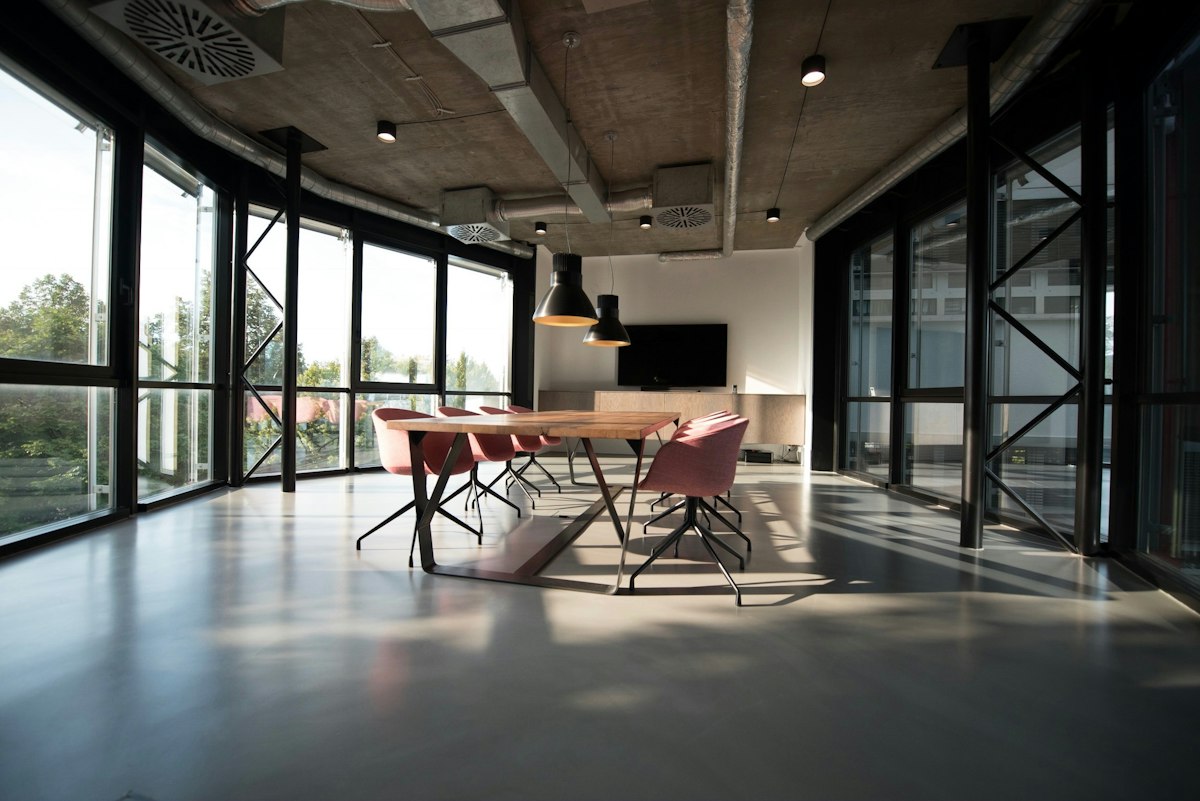 The client conversations that win complex commercial projects in 2026 require specification fluency across seating, acoustics, technology integration, and sustainability — not just product knowledge.
Sales Enablement Materials You Need Now
Every member of your sales team should be equipped with: a NeoCon 2026 trends summary (maximum two pages), specification comparison sheets for your top ergonomic seating and acoustic product lines, a sustainability documentation package (certifications, test reports, environmental claims), and a project case study library with before/after documentation of completed workspace implementations.
Certification and Continuing Education
Professional credentials that build credibility with corporate and hospitality clients include NCIDQ (National Council for Interior Design Qualification), LEED AP ID+C (for sustainability-focused specification), and the IIDA (International Interior Design Association) professional development programs. For product specialists and showroom sales teams, manufacturer certification programs — particularly from BIFMA and GREENGUARD — provide technical depth that translates directly into specification confidence.
Regional Variations: Not All Markets Are the Same
Geographic Differences in Adoption Rates
ABW and hybrid work neighborhoods are furthest advanced in major tech and finance markets — San Francisco, New York, London, Sydney, Singapore. Secondary markets and traditional industry sectors (manufacturing, government, healthcare administration) are 18–36 months behind on these structural shifts, which means the specification opportunity curve is at different points depending on where your clients operate. Understanding your local market’s position on this adoption curve is essential for inventory and messaging decisions.
Cultural Considerations in Workplace Design
Workplace design preferences vary meaningfully across cultural contexts. Collaborative, open-plan configurations that are standard in Scandinavian markets may conflict with expectations of private workspace in East Asian corporate cultures. Hospitality design in the Middle East market requires different acoustic privacy specifications and spatial hierarchies than equivalent European hotel projects. For designers and distributors serving diverse client bases, avoiding the assumption that NeoCon’s North American-centric trends translate directly to every market context is a basic professional discipline.
Your Action Plan for the Next 12 Months
NeoCon 2026 confirmed the direction the commercial furniture market has been moving for three years. Human-centered design is now the specification floor, not the premium tier. Wellness, acoustic performance, and sustainability documentation have moved from differentiators to baseline requirements. Dynamic seating, modular systems, and technology-integrated furniture are the specification vocabulary of the projects that win today’s most competitive tenders.
The practitioners who come away from this moment with competitive advantage are not those who attended the show — they are those who use the intelligence from the show to make specific, actionable decisions: which product categories to invest in, which manufacturer relationships to deepen, which client conversations to initiate, and which specification capabilities to build.
If you are a distributor, review your inventory against the NeoCon 2026 award categories and secure allocation on high-demand lines before lead times extend further into Q4. If you are a designer, translate the trend directions in this guide into specific briefing language for your supplier conversations. If you are a hotel fit-out specialist, start the conversation about hybrid-use public space furniture with your hospitality clients now — before their next renovation budget cycle closes.
The clients who will define the commercial interior landscape in 2027 are making their furniture decisions today. The question is whether your business is positioned to be part of those conversations.
Download Your NeoCon 2026 Implementation Checklist — a structured action plan covering product category priorities, certification requirements, inventory decisions, and client conversation frameworks — designed specifically for commercial furniture distributors, showroom directors, and interior design professionals. Contact the Jade Ant Furniture team at JadeAnt.com to discuss your specific market needs and product sourcing requirements.
الأسئلة الشائعة
1. How do I know which NeoCon 2026 trends are actually relevant to my specific client base?
The answer is in your project history, not the trade press. Review your last 24–36 months of completed projects and identify which client types — corporate, hospitality, healthcare, education — generated your highest revenue and margin. Then map NeoCon 2026’s structural categories against those client types. Activity-based working zones and acoustic solutions are most relevant to corporate clients with flexible staffing. Hybrid hotel concepts and staff wellness spaces are the priority for hospitality fit-out work. Ergonomic innovation matters to clients in sectors with high knowledge-worker density and competitive talent markets. Start where your existing client relationships are strongest — trend adoption there is both faster and more profitable.
2. What’s the realistic timeline for implementing these new workspace structures in existing client facilities?
Most organizations phase implementations over 12–18 months, beginning with a single pilot zone — a collaboration pod cluster, an acoustic breakout space, or a modular lounge area — before committing to full-floor implementation. This phased approach is actually advantageous for your business: it creates multiple specification touchpoints, allows clients to measure occupancy and satisfaction data before scaling, and generates natural upsell conversations as initial zones prove successful. Communicate this timeline to clients from the first briefing — framing it not as a limitation but as a risk-managed investment pathway that protects their capital and generates evidence for future phases.
3. How do I convince cost-conscious clients that premium seating and storage solutions are worth the investment?
Build your case around total cost of ownership, not unit price. A $3,000 ergonomic task chair with a 12-year structural warranty and documented BIFMA certification costs $250 per year of ownership — compared to $133 per year for a $400 alternative with a 3-year replacement cycle, before accounting for the HR cost of musculoskeletal complaints the cheaper chair generates. For corporate clients managing 150+ employee workstations, a 5% reduction in musculoskeletal-related sick days across the team typically exceeds the entire seating specification premium within 18 months. This is a financial model you can build for clients, and it changes the conversation from taste to strategy.
4. Which product certifications and standards should I prioritize when sourcing new inventory?
The non-negotiable certifications for corporate and hospitality contract specification are: BIFMA X5.1 or X5.4 (structural and durability performance for seating), GREENGUARD Gold (low VOC chemical emissions — required by 67% of Fortune 500 procurement departments as of 2026), FSC Chain of Custody (for any wood-containing products entering ESG-conscious client environments), and ANSI/BIFMA e3 Level certification (sustainability standard for full product-line specification). Do not stock products with certifications that corporate procurement teams don’t recognize — they create friction rather than confidence in the sales process.
5. How do I manage lead times when clients want to implement trends immediately?
Transparency from the first conversation prevents almost every lead time conflict. When a client requests a product, tell them the current lead time before they approve the specification. Simultaneously, offer an interim solution: a bridge specification using available inventory that activates the space while custom or long-lead pieces are in production. Some distributors maintain strategic inventory of popular modular pieces — particularly seating and acoustic panels — specifically to bridge this gap. This positions you as a problem-solver and generates goodwill that translates into client loyalty on future projects.
6. What’s the difference between biophilic design and greenwashing in workplace specifications?
Genuine biophilic design incorporates measurable natural stimuli: living plant systems, natural material surfaces with real grain and texture variation, views of outdoor environments, and dynamic natural light. It is not green paint on a wall or a nature-themed print on a synthetic panel. Greenwashing occurs when sustainability claims are made without documentary support — describing a product as “eco-friendly” without certifying what that means. The practical test: if the claim cannot be supported by a specific certification number from a verifiable issuing body, it is not a specification-grade sustainability claim. Be honest about what your products deliver — clients who discover overstated claims don’t give second chances.
7. How do I train my sales team to sell complex collaborative workspace solutions?
Scenario-based training is dramatically more effective than product-knowledge training for complex specifications. Build training sessions around real client situations: “A 250-person accounting firm wants to implement hot-desking but their partners are resistant to losing private offices. How do you approach that conversation?” Walk your team through the structural solutions — hybrid work neighborhoods, acoustic semi-private zones, dedicated team alcoves — and the business case language for each. Role-play the partner objections. Fluency with the problem space comes before confidence with the product specification, and that fluency comes from practice, not catalogues.
8. Should I be investing in smart/connected furniture, or is that still too niche?
Smart furniture is moving from niche to standard faster than most distributors have adjusted for. The smart furniture market is growing at 10.97% annually — and in corporate and large hospitality segments, technology integration is increasingly a specification baseline rather than a premium option. The practical approach: start by understanding which of your current clients have the IT infrastructure and budget to implement smart furniture meaningfully (generally, organizations with 100+ employees and a facilities management function). Offer it as an informed upsell in those conversations rather than leading with it across your full client base. Build the product knowledge and supplier relationships now, so you’re ready when the broader market catches up to the early adopters.
9. How do I compete with larger distributors who have bigger inventory and lower prices?
Compete on expertise, speed, and accountability — not price. The distributors losing market share to larger competitors are those trying to match their pricing on commoditized product lines. The distributors gaining share are those who have become the recognized specialist for a defined market segment: hotel fit-out in their region, tech company office design, healthcare workspace, or educational environments. Specialization allows you to offer specification depth, project management competence, and supplier relationships that generalist large distributors cannot match. Your local responsiveness — site visits, rapid specification revisions, installation coordination — is a genuine competitive advantage for any client who has experienced the alternative.
10. What’s the most common mistake distributors and designers make when adopting NeoCon trends?
Assuming the trend applies uniformly to all clients. A modular ABW specification designed for a 50-person design agency with a flat organizational structure will fail completely in a 500-person insurance company with a hierarchical culture and fixed department territories. The structural innovations from NeoCon 2026 are tools, not prescriptions. The skill is diagnosing which tools fit which organizational context — and that diagnosis requires asking better questions in the first client meeting, not just presenting a trend-forward specification and hoping it resonates.
11. How do I position sustainability and ESG requirements without sounding preachy to skeptical clients?
Frame sustainability as business risk management and commercial opportunity — never as a values position. The most effective framing for skeptical clients: “Your institutional investors are now requiring Scope 3 emissions reporting, which includes purchased goods. If you can’t provide sustainability documentation for your furniture specification, your procurement team will flag it at the next ESG audit.” This converts a values conversation into a compliance conversation, which is a much easier path to decision-making for finance-led organizations.
12. What’s the best way to present multiple workspace structure options to a client without overwhelming them?
Tiered proposals are consistently the most effective presentation format. Present three configurations: Baseline (essential, phased, lower capital — activates the most critical pain points), Recommended (full implementation of the highest-priority structural zones based on their organizational needs), and Comprehensive (complete vision across all ten structural categories with phased delivery). Each tier should show total project cost, implementation timeline, and the specific client outcomes it addresses. This format gives clients agency and decision clarity — and it naturally anchors them toward the recommended configuration rather than the baseline.
13. How do I handle clients who want NeoCon 2026 trends but have 2019 budgets?
Value engineer without compromising the structural logic. Start by identifying which two or three of the ten workplace structures from NeoCon 2026 will have the highest impact for their specific organizational challenges — those are non-negotiable in your recommendation. For the remaining elements, propose lower-cost approaches: acoustic panels instead of full pods, a biophilic material palette on existing furniture rather than full replacement, modular lounge additions to existing open-plan spaces rather than full reconfiguration. The phased approach keeps the project alive, maintains the client relationship, and builds toward future specification phases as budgets recover.
14. Which workspace structures are most profitable for my business?
Based on 2026 commercial project data: acoustic pods and modular seating systems typically carry 40–60% gross margins and generate project values of $80,000–$300,000+ for medium corporate fit-outs. Complete activity-based working zone specifications — covering all furniture typologies across multiple zones — generate the highest total project values, often exceeding $500,000 for mid-size corporate clients. Ergonomic seating lines with BIFMA certification carry 35–50% margins and generate strong repeat purchase rates through replacement cycles and additional workstation specifications. Analyze your own margin data by category — regional supplier relationships and competitive dynamics mean these figures vary, and your actual numbers are the only ones that matter for your inventory strategy.
15. How do I stay informed about NeoCon trends year-round without attending every event?
A consistent, low-time-investment intelligence routine is more effective than sporadic deep dives. Subscribe to Contract Magazine و Metropolis for monthly industry coverage. Follow key manufacturers — KI, Haworth, HALCON, Andreu World, Davis Furniture — on LinkedIn for product announcement and specification update timing. Join IIDA أو ASID for peer network access and continuing education programming. Set a Google Alert for “commercial furniture specification” and “NeoCon” to capture trade news between major events. Attend one manufacturer showroom visit per quarter — these conversations give you real-time market intelligence on what clients are specifying and what’s coming through the product pipeline. Consistent, light-touch engagement beats annual information overload every time.