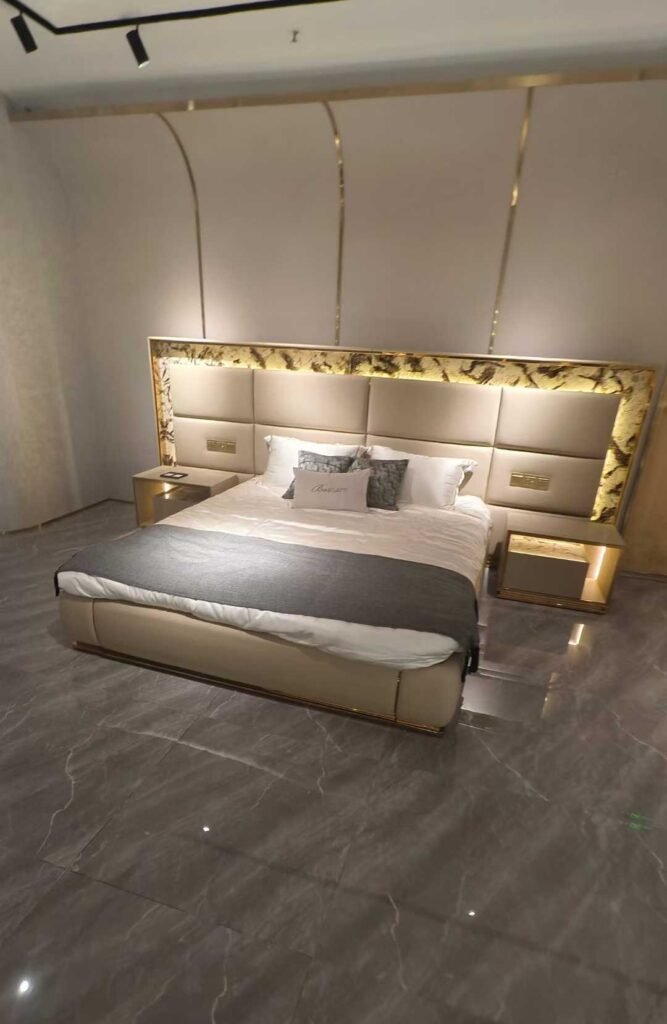

Modern digital solutions are transforming how your customers select console tables online. Learn how AR visualization, sizing calculators, and virtual consultations can reduce returns, increase confidence in purchasing decisions, and strengthen customer loyalty — while positioning your showroom or distribution business as a forward-thinking partner.
Picture this: a hotel fit-out designer in Dubai is specifying console tables for 240 guest rooms. She’s working remotely, her client presentation is in four days, and the supplier she’s talking to just sent her a PDF with six static photos and a spec sheet in millimeters. She has no way to know whether the walnut finish photographs warmly under the room’s ambient lighting, whether the proportions will work against the feature wall she’s specified, or whether the drawers are deep enough for the guest amenity kit the hotel operator requires.
She picks a competitor who sent her a link to a 3D configurator and offered a 45-minute video walkthrough.
That lost order — worth $180,000 — wasn’t a product problem. It was a digital capability gap.
The challenge of selecting the right console table online has become a critical pain point for your clients — whether they’re interior designers specifying for residential projects, hotel fit-out teams furnishing lobbies, or showroom managers managing remote inquiries. Total retail returns are projected to reach $849.9 billion in 2025 (NRF), and furniture sits at the top of the returns leaderboard with a 15.8% return rate — the highest of any product category. Every return you process represents not just a logistics cost, but a relationship strain with a client you’ve worked hard to acquire.
This guide is a practical playbook for furniture distributors, showroom owners, interior designers, and hospitality specifiers who want to understand, evaluate, and implement the digital tools that are reshaping how console tables — and furniture more broadly — get selected, specified, and sold. You won’t find generic technology cheerleading here. You’ll find specific tools, real performance benchmarks, and implementation guidance calibrated to the way your clients actually make decisions.
 The specification decision for a piece like this — placed in a 240-room property — depends entirely on whether your digital presentation tools give the designer enough confidence to commit.
Why Console Table Selection Is Harder Than It Looks
The Real Problem Your Customers Face
Your most experienced clients — interior designers who’ve been specifying furniture for fifteen years, hotel procurement teams who’ve outfitted dozens of properties — still make selection mistakes when working remotely. This is not a competence problem. It’s an information problem.
Space visualization challenges, proportion uncertainty, and finish matching concerns are persistent even for professionals, precisely because the traditional information set (photography, spec sheets, sample swatches) asks the human brain to perform a spatial computation it wasn’t designed to do: mentally inserting a three-dimensional object into a real space using two-dimensional references.
A study by Shopware found that 74% of customers report uncertainty about furniture dimensions before purchase — and this figure holds even among professional buyers. For your clients who are specifying for end-customers (a designer presenting options to a homeowner, a showroom manager responding to a hotel procurement brief), this uncertainty compounds: they need to be confident enough in their recommendation to stake their professional reputation on it.
Scale and Spatial Awareness Issues
The most common cause of furniture returns is dimensional mismatch — the piece is technically the right size per the spec sheet, but it doesn’t work in the space as expected. A 48-inch console table that reads as proportionally balanced in a photography studio feels overwhelming in a 280-square-foot hotel room. An entryway console that looks elegant against a white backdrop disappears visually against the dark feature wall your client has specified.
Translating dimensions (1,200mm × 350mm × 820mm) into spatial reality requires a cognitive leap that even experienced designers struggle with consistently. Every time a client makes this leap without support, you’re accepting the return risk on their behalf.
Material and Color Accuracy Online
Screen calibration variations mean that “warm walnut” on a MacBook display looks entirely different from “warm walnut” on a Windows laptop, and both look different from the actual finish under the halogen lighting of a hotel reception. For console tables — where finish is often the primary differentiator between a $1,400 piece and a $4,200 piece — this visual uncertainty has direct commercial consequences.
Clients who aren’t confident about finish accuracy either delay decisions (lengthening your sales cycle), demand physical samples (adding logistics costs), or make educated guesses and return what they ordered (costing you both money and goodwill).
The Business Impact of Poor Selection
Poor selection doesn’t just create returns. It creates a chain of downstream costs that most distributors don’t fully account for.
Hidden Costs of Returns and Exchanges
A 15% furniture return rate at a distribution operation doing $3 million in annual console table revenue means $450,000 in goods returned per year. But the actual cost to your business is higher than that figure suggests. Return freight on a mid-size console table typically runs $150–$350 per piece. Restocking labor, inspection, repackaging, and inventory re-entry add another $80–$150 per unit. Pieces that return damaged — which happens at a meaningful rate in furniture logistics — need to be marked down or written off. A Butler Specialty analysis found that a 15% return rate can slash monthly profit by $9,750 even before accounting for the customer service time involved in managing each return case.
For B2B accounts — a design firm with ongoing project work, a hotel chain specifying multiple properties — a single poor return experience creates hesitation in the relationship that takes months to rebuild.
Trust Erosion in Your Brand
Interior designers and hotel procurement teams talk to each other. A specification decision that goes wrong — wrong finish, wrong proportions, piece that doesn’t photograph as expected in the space — circulates as a cautionary story in professional networks where your reputation lives. One poor experience with a high-value client doesn’t just cost you that account. It costs you the referrals and introductions that account would have generated over the next three to five years.
Digital selection tools don’t just reduce returns. They change the story your clients tell about you: from “they sent me the wrong finish and the return process was a headache” to “they walked me through the AR visualization and I knew exactly what I was getting.”
Augmented Reality (AR) Visualization: Seeing Before Buying
How AR Technology Works in Furniture Selection
Augmented Reality (AR) — technology that overlays digital objects onto a real-world view through a device camera — has moved from novelty to commercially viable specification tool in the furniture industry. The AR in retail market was valued at $7.8 billion in 2024 ومن المتوقع أن يصل إلى $105.9 billion by 2033 at a 32.4% CAGR (Grand View Research). For furniture retailers, the commercial case is even clearer than the market growth numbers: furniture AR implementations consistently report 150–250% ROI in the first year (1center.co).
The mechanism is straightforward: a customer opens an AR-enabled app or web interface, points their device camera at the space where a console table will be placed, selects a model from your catalog, and the table appears in their actual space at accurate scale. They can walk around it, view it from different angles, test it in different positions, and switch between finishes — all without moving a single piece of physical furniture.
The Technology Behind Virtual Placement
Modern furniture AR platforms use device cameras in combination with spatial mapping algorithms to measure room dimensions and surface geometry in real time. The software then renders a 3D model of the furniture item — built from accurate dimensional data provided by the manufacturer — and places it in the mapped space at correct scale. High-quality implementations achieve dimensional accuracy of approximately 98% (documented in Sage Journals research on IKEA’s AR Place app).
Web-based AR (accessed through a browser, requiring no app download) has lowered the adoption barrier significantly. Your clients no longer need to convince their end-customers to install a dedicated application — they can send a link that works in Safari or Chrome on any modern mobile device.
Real-World Application for Your Customer Base
For interior designers: AR enables them to present multiple console table options to end-clients during the same meeting, showing each piece in the actual space being designed. Instead of asking a client to imagine how a piece will look, they show them. Client approval cycles that previously took three to four rounds of revisions compress to one conversation.
For showroom managers: AR allows staff to conduct remote demonstrations for clients who can’t visit the showroom. A client in Hong Kong reviewing console table options for a Singapore hospitality project can see each piece in their actual project space during a video call, guided by your team.
For hotel fit-out designers: AR allows rapid configuration testing — comparing a slim, wall-hugging design against a more sculptural option in the actual guest room environment without physical prototypes.
Key Benefits for Distributors, Showrooms, and Designers
The business case for AR in your operation is built on five measurable outcomes: reduced returns, higher conversion rates, faster sign-off, larger average order values, and competitive differentiation.
AR visualization reduces furniture return rates by 40–70% according to 1center.co data, with size-related returns (the most common category) dropping by up to 71% when customers have used AR before purchase. Conversion rates increase 25–40% when AR is available and promoted. Consumers who engage with AR are up to eight times more likely to convert than those who don’t (Cylindo research).
Faster Client Sign-Off and Reduced Revisions
When a designer can show their client an accurate visualization of a console table in the actual space — matching the floor finish, the wall color, the ambient light — approval conversations become confirmations rather than negotiations. The “can we try it in a slightly lighter finish?” request, which previously required generating new renderings or waiting for sample returns, can be answered in real time by switching the AR model’s finish parameter.
For distributors managing B2B accounts with multiple decision-makers (a hotel procurement team includes the designer, the operator, and often the asset owner), AR visualizations serve as shared reference points that align everyone’s expectations before the order is placed.
Competitive Advantage in Pitching Projects
When a competing distributor sends a PDF and you send a link to an AR experience, the contrast is immediate and unmistakable. Your client doesn’t need to be told your service is more sophisticated — they experience the difference directly. For high-value projects where multiple suppliers are being evaluated, this experiential gap is often the deciding factor.

This is the kind of piece that sells itself in person — and with AR visualization, it sells itself remotely with the same confidence.
Sizing Calculators and Dimension Tools: Precision Meets Simplicity
Moving Beyond Static Specification Sheets
A static specification sheet tells your client that a console table is 1,200mm wide, 350mm deep, and 820mm tall. What it doesn’t tell them is whether that’s the right size for their specific space, how it relates proportionally to the sofa it will sit behind, or whether the depth works with the wall outlet position they’re working around.
Interactive sizing calculators replace the cognitive burden of translating numbers into spatial decisions with a guided, question-driven workflow that produces a confident recommendation. For your clients — designers and hospitality specifiers who are already managing dozens of variables on any given project — removing this friction is a meaningful service improvement.
How Intelligent Calculators Work
A well-designed sizing tool walks users through a structured set of questions: What are the wall dimensions? What other furniture is in the space? Is this a primary or secondary visual element in the room? What is the intended use (display surface, storage, workspace)?
The tool then applies proportion rules — console tables typically look best at 60–75% of the wall width they’re placed against; depth should not exceed 25% of the room’s shortest dimension in compact spaces; height should relate to the adjacent furniture it will visually pair with — and returns a recommended size range filtered to your actual inventory or production capabilities.
For showroom managers who field daily inquiries from designers and procurement teams, a public-facing sizing tool reduces the volume of “can you recommend the right size?” consultations by 30–40%, freeing staff time for higher-value interactions.
Integration with Your Product Catalog
The step that transforms a sizing calculator from a useful tool into a sales engine is catalog integration: the tool’s recommendations link directly to available products in your inventory, filtered by the recommended dimensions and available in the client’s required lead time window.
A designer who completes the sizing workflow and sees three recommended console tables — each linked to a product page with full specifications, 360-degree photography, and AR preview — has moved from browsing to specification in a single guided session. Integrated tools of this type are documented to increase order placement rates by 20–30% compared to unguided catalog browsing.
Solving the Measurement Anxiety Problem
Even experienced interior designers experience measurement anxiety — the uncertainty about whether they’ve measured correctly, accounted for all relevant variables, and selected appropriately. This hesitation is rational: specifying the wrong size for a hotel project with a 14-week custom lead time is a serious professional and financial problem.
Guided Measurement Workflows
Step-by-step measurement guidance — with annotated diagrams showing exactly which dimensions to measure and how to handle irregular room geometries — reduces measurement errors and builds client confidence. Video-format measurement guides embedded in the tool further lower the barrier for clients who learn better visually.
The best implementations include a “measurement confidence check” — asking clients to confirm their measurements against a simple sanity test (for example, confirming the measured room width matches their architectural drawing) before committing to a recommendation. This one step catches the majority of transposition errors and wrong-unit mistakes (a common problem when switching between metric and imperial specifications).
Proportion and Scale Recommendations
Beyond basic fit confirmation, proportion tools provide qualitative guidance: “At this width, we recommend a console table that’s 60–65% of the wall span. The two options below are both within this range, but the wider option (72 inches) will read as a statement piece, while the narrower option (54 inches) gives the room more breathing room.” This is the kind of guidance your experienced showroom staff provides in person — and it can be delivered at scale through well-designed digital tools.
Console Table Digital Tool ROI Benchmarks
| Digital Tool | Implementation Cost Range | Key Metric Improvement | Typical ROI Timeline |
|---|---|---|---|
| AR Visualization | $500–$2,000/mo (third-party) | Returns ↓ 40–70%; Conversion ↑ 25–40% | 6–12 months |
| Sizing Calculator | $5,000–$20,000 (build) | Support inquiries ↓ 30–40%; Order rate ↑ 20–30% | 3–9 months |
| 360° Product Photography | $200–$500/item | Conversion ↑ 10–40%; Returns ↓ up to 50% | 6–12 months |
| Virtual Consultation Platform | $200–$800/mo | Sales cycle ↓ 20–35%; Client satisfaction ↑ | 6–18 شهراً |
| AI Recommendation Engine | $1,000–$5,000/mo | Conversion ↑ 15–25%; AOV ↑ 10–20% | 12–24 months |
| CRM Integration | $500–$3,000/mo | Admin time ↓ 25–40%; Repeat orders ↑ | 12–18 months |
| Live Inventory Dashboard | Part of ERP/WMS | Overselling incidents ↓ significantly | 3–6 months |
Sources: 1center.co, Grand View Research, NRF, AI Agents Square, internal industry benchmarks.
Virtual Consultations and Digital Showroom Experiences
Replacing In-Person Showroom Visits with Seamless Online Alternatives
By 2025, 80% of all B2B sales interactions between suppliers and buyers occur in digital channels (Gartner/Martal). For furniture distributors and showrooms, this isn’t a future projection — it’s the current reality. Your clients are already conducting the majority of their selection process before they visit a physical showroom, and many never visit at all.
The question isn’t whether virtual consultations should be part of your service model. It’s whether yours are good enough to justify the trust your clients are placing in them.
Live Video Consultations with Product Experts
A structured 45-minute video consultation with a knowledgeable product specialist — equipped with access to your full catalog, sample swatches, and the ability to share AR visualizations during the call — delivers more value than an unsupported showroom visit by a client who doesn’t know what questions to ask.
The key is preparation. Before the call, send the client a brief intake form: project type, space dimensions, design direction, budget range, timeline. This transforms the consultation from a generic product tour into a targeted recommendation session that demonstrates your team’s expertise and your organization’s seriousness about their project.
For high-value clients — a hospitality designer specifying for a multi-property rollout, an interior designer managing a residential development — this kind of structured consultation is the touchpoint that converts a transactional vendor relationship into a preferred supplier relationship.
360-Degree Product Photography and Immersive Views
360-degree product photography — images that allow users to rotate a product view through a full circle, examining every angle — delivers a 10–40% increase in conversion rates and up to 50% reduction in returns (Big Turn Tables, 2025 data). For console tables, where finish quality, joinery details, and hardware character are significant differentiators, this format lets clients examine the piece with the scrutiny they’d apply in a physical showroom.
The investment case is clear: at $200–$500 per item for professional 360-degree photography, covering a catalog of 50 console table SKUs represents a $10,000–$25,000 investment that pays back through return reduction within the first year at most moderate-volume operations.
Building Relationships in a Digital-First Environment
The concern most frequently raised about virtual consultations is the loss of personal connection. This concern is valid in one direction only: a poorly executed virtual consultation — generic, rushed, conducted by someone who doesn’t know the product — is indeed less valuable than a good in-person interaction. But a well-executed virtual consultation, with a prepared specialist who demonstrates deep product knowledge and takes time to understand the client’s project, builds the same trust and rapport.
Customization Discussions and Specification Clarity
Virtual consultations create structured space for the detailed customization conversations that drive premium orders. When a designer asks “can we get this in a slightly cooler walnut tone with matte black hardware instead of brass?” — a question that would get a vague answer from a catalog or a rushed response in a busy showroom — the virtual consultation allows your specialist to walk through the customization options available through your manufacturing partners, reference finish samples visually, and document the specification in writing during the call.
Suppliers like مفروشات النمل اليشم are built for exactly this kind of B2B specification conversation — custom dimensions, finish variations, hardware choices, and interior storage configurations that get documented and confirmed during the consultation rather than lost in email threads.
Documentation and Follow-Up
Recorded consultations, shared digital notes, and automated follow-up sequences ensure that nothing discussed during a virtual consultation is lost or misremembered. For complex projects with multiple decision-makers, this documentation becomes the project brief that everyone refers back to — eliminating the “I thought we agreed on…” conversations that erode trust and delay orders.

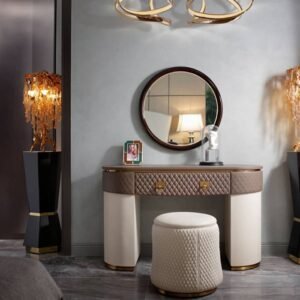
A piece like this — specified for a boutique hotel suite — is selected through a detailed virtual consultation and confirmed via AR visualization. The physical visit is the handover walkthrough, not the decision moment.
Inventory Visibility and Real-Time Stock Management Tools
Transparency Builds Trust with Your B2B Clients
Interior designers and hotel procurement teams operate on project timelines. When a designer has committed to a client that the console tables will be delivered and installed by a specific date, they need certainty — not approximations — about product availability, lead times, and shipping schedules. The single most common source of B2B relationship friction in furniture distribution is timeline surprises: being told a product is available when it isn’t, or receiving a lead time that shifts after the order is placed.
Real-time inventory visibility eliminates this friction class entirely. When a designer logs into your client portal and sees that the console table she’s specifying is in stock (18 units), available for delivery within 2–3 weeks, that information directly enables her to commit confidently to her client’s timeline.
Live Inventory Dashboards
A live inventory dashboard — synchronized with your warehouse management system in real time — shows clients exactly what’s available by SKU (style, finish, size), along with available quantities, current lead times for out-of-stock configurations, and incoming shipment dates. For distributors managing multiple product lines across multiple warehouses, this visibility tool also allows your internal team to make confident commitments without manual stock checks.
The operational benefit compounds: when your sales team doesn’t need to interrupt warehouse staff for stock confirmation calls, both teams work more efficiently. CRM data from distribution companies shows that inventory visibility tools reduce back-and-forth communication by 35–50% per order cycle.
Lead Time Clarity and Order Status Tracking
Custom or made-to-order console tables — the category where Jade Ant Furniture’s B2B manufacturing partnerships deliver the strongest value — require transparent lead time communication from the moment an inquiry is received. A client portal that shows order status in real time (order confirmed → production scheduled → production complete → quality inspection → shipping → customs clearance → delivery scheduled) transforms a 14-week custom production cycle from a source of anxiety into a managed, visible process.
For hospitality clients coordinating furniture delivery with construction milestones, this level of visibility is not a premium feature — it’s an operational requirement. Distributors who provide it retain clients; those who don’t lose them to competitors who do.
Reducing Friction in the Ordering Process
Every manual step between a client’s specification decision and a placed order is an opportunity for the order to stall. A designer who has to email to confirm availability, wait for a response, then call to discuss lead times, then receive a proforma invoice, then arrange bank transfer approval — is a designer who may use that time to reconsider whether this supplier is worth the friction.
Preventing Overselling and Stockouts
Real-time inventory integration prevents the professionally embarrassing situation of confirming an order that can’t be fulfilled — a scenario that happens regularly in operations relying on manual stock tracking or spreadsheet-based inventory systems. For a distributor serving ten to fifteen active designer accounts simultaneously, the risk of duplicate commitments to the same limited inventory is real and recurring without live inventory visibility.
Enabling Faster Project Timelines
When designers and hotel teams can confirm availability and lead times independently — without waiting for sales team responses — project timelines compress. A specification decision that might take three days of email exchanges can be resolved in a single client portal session. At the scale of a mid-size distribution operation, this acceleration in decision velocity meaningfully increases monthly order throughput.
Digital Mood Boards and Design Inspiration Tools
Helping Clients Visualize Style and Aesthetic Fit
A console table doesn’t exist in isolation. It exists in relation to the flooring material, the wall finish, the lighting scheme, the adjacent sofa, the art on the wall, and the overall design direction of the space. Your clients — interior designers especially — think in complete rooms, not individual pieces. Digital mood board tools give them the ability to evaluate your console tables in the context of a complete design scheme, accelerating both their confidence and their approval timeline.
Professional design platforms like Houzz Pro (trusted by over 3 million contractors and design professionals) enable designers to build client-facing mood boards that integrate furniture selections with material samples, paint colors, and architectural references. When your product catalog integrates with these platforms, your console tables appear in professionally styled mood boards that designers are already showing their clients — dramatically expanding your reach into active project specifications.
Style Matching and Design Coherence
Well-designed inspiration tools can suggest console table options that align with the design direction a client has already established — Japandi minimalism, warm transitional, maximalist Art Deco — rather than requiring the client to filter through your entire catalog looking for the right aesthetic fit. A client who has already pinned ten images that define their project’s direction needs to see your console tables in that context, not in a decontextualized product catalog view.
Inspiration Libraries and Design Trends
Curated collections that show console tables in real interior settings — boutique hotel lobbies, residential foyers, corporate reception areas — provide the social proof and inspiration that accelerates client decisions. When a hotel designer sees a console table styled identically to the design direction they’re pursuing for their property, the selection anxiety dissolves. They’re not imagining how the piece might look — they’re seeing it.
Streamlining the Design Process for Professionals
Interior designers bill by the hour. Showroom managers are measured on order conversion rates. Hotel procurement teams are evaluated on project delivery speed. Every tool that removes decision friction from their workflow is a business case argument, not a feature discussion.
Client Collaboration and Feedback
Shareable mood boards — where designers can send a curated selection to their clients and receive comments, approvals, or feedback requests directly in the platform — compress the approval cycle that would otherwise happen through email chains with confusing attachment references. A mood board where the client can click “approve” or “let’s discuss” on each piece creates a documented decision trail and eliminates the ambiguity of “I thought you liked the darker option.”
Portfolio Building and Proposal Enhancement
For interior designers competing for project work, beautiful digital mood boards in project proposals are now a competitive baseline expectation. Your product photography, 3D models, and styling content that integrates into designer mood boards isn’t just a marketing asset — it’s a tool that helps your designer clients win projects, creating a virtuous cycle where their success directly drives your orders.
Customer Reviews, Ratings, and Social Proof Integration
Leveraging Peer Validation in the Decision Process
Your clients are professionals. When they evaluate a console table from a new distributor or manufacturer, generic consumer reviews carry minimal weight. What they respond to is peer validation: documented experiences from other interior designers who specced the same piece for a comparable project, hotel procurement teams who’ve managed the same supply chain, showroom managers who’ve handled the same product line.
This is why the most effective review and social proof strategies for B2B furniture businesses focus not on volume (hundreds of four-star reviews from anonymous purchasers) but on specificity and peer relevance: detailed case studies from recognized design professionals describing real project outcomes.
Contextual Reviews from Your Target Market
A review that reads “The custom sizing option allowed us to fit the console table within a 14-inch-deep alcove on the 3rd floor corridor. The soft-close hardware survived the first year of the hotel’s operation without any reported maintenance issues. Finish consistency across all 36 units was excellent” is worth more to a hotel procurement team than fifty generic “great quality, fast shipping” ratings.
Actively solicit detailed, context-specific feedback from your B2B clients after project completion. Provide a simple template that prompts for project type, specific performance observations, and outcome metrics. This takes thirty minutes of a client’s time and generates a review asset that influences purchase decisions for years.
Photo Evidence and Real Installation Stories
Customer-submitted installation photos — showing your console tables in real completed projects, styled and lit as intended — are among your most powerful conversion tools. They demonstrate product quality under real conditions, provide styling inspiration, and build the credibility that professional photography in controlled studio settings cannot replicate.
For hospitality projects especially, where guest room photography is part of the property’s marketing collateral, requesting permission to share installation photography creates a mutually beneficial exchange: the hotel gets a professional documentation of their property, and you get peer-validated evidence of your product’s performance in a commercial context.
Building Community and Thought Leadership
Case studies, project spotlights, and documented success stories position your business as a knowledge resource in your clients’ networks — not just a product supplier. When a designer references your console table in their project publication, when a hospitality designer includes your product in their portfolio, you’re receiving the highest-value marketing signal available: peer recommendation in professional context.

A practical styling and selection guide for console tables — useful reference content for training showroom staff and sharing with designer clients who are making selection decisions remotely.
Personalization Engines and Smart Recommendation Systems
Moving Beyond Generic Product Suggestions
A designer specifying for a boutique hotel in Bali and a designer furnishing a corporate headquarters in Frankfurt are both looking for console tables — but they have almost nothing else in common. Generic product catalog browsing asks both of them to filter through the same catalog, applying the same search parameters, without acknowledging the fundamentally different contexts of their projects.
AI-driven recommendation engines (systems that learn from browsing and purchase behavior to surface contextually relevant product suggestions) solve this by personalizing the catalog experience to each user’s demonstrated preferences and project context. For furniture distributors managing complex catalogs with dozens of console table variations across finishes, sizes, and styles, this personalization layer is the difference between a catalog that helps clients find the right piece and one that overwhelms them into paralysis.
AI personalization has been shown to boost conversion rates by 15–25% on average, with high-traffic operations seeing 25–35% lifts, and average order values increasing 10–20% (AI Agents Square, 2026 data). For a distributor doing $2 million annually in console table revenue, a 20% conversion lift represents $400,000 in additional annual revenue from the same catalog, the same traffic, and the same marketing investment.
Behavior-Based Personalization
The system tracks which styles, finishes, and sizes a user explores, how long they spend on each, and which items they save or add to project boards. Over time — often within a single session — the recommendation engine surfaces products aligned with the pattern it has observed, rather than defaulting to bestsellers or editorial picks.
For a designer who has spent time on three solid walnut pieces with brass hardware, the next recommended console table should be a solid walnut piece with brass hardware — not the site’s current promotional feature in white lacquer. This sounds obvious, but most product catalogs still don’t deliver this level of personalization.
Project-Type Customization
Recommendation engines can shift their logic based on declared project context: a user who indicates they’re furnishing a boutique hotel receives recommendations emphasizing commercial-grade durability, neutral finishes with broad appeal, and available stock depth. A user specifying a luxury residential interior receives recommendations emphasizing statement finishes, unique design details, and custom configuration options.
This context-sensitivity is what transforms a recommendation engine from a data processing tool into a specification partner.
Accelerating the Path to Purchase
The average B2B sales cycle in furniture is approximately 10 months (Wavecnct, 2025). Digital selection tools collectively reduce this timeline by compressing the browsing, comparison, visualization, and approval stages that consume the majority of that cycle.
Reducing Search Time and Cognitive Load
Research consistently shows that presenting too many options degrades decision quality and increases abandonment — a phenomenon psychologists call decision fatigue. For a designer browsing a catalog of 200 console tables, the experience of reducing that to 12 highly relevant recommendations is not just convenient — it’s the difference between making a selection this session and coming back next week.
Cross-Selling and Bundling Opportunities
Recommendation engines that suggest complementary pieces — “Clients who specified this console table also selected this wall mirror and these accent side tables” — increase average order values by surfacing relevant products that the client would have needed to find independently. For distributors who carry coordinated collections from manufacturers like مفروشات النمل اليشم, this bundling capability is particularly powerful: a designer who specifies a console table and three coordinating pieces from the same collection generates significantly higher revenue than one who specifies the console table alone.

Recommendation engines surface pieces like this to the right clients at the right moment — rather than waiting for them to find it in page seven of a catalog.
Mobile-First Design and On-the-Go Access
Empowering Field-Based Decision Making
An interior designer on-site at a residential project, measuring a wall for a console table placement while simultaneously discussing finish options with her client, needs your digital tools to work on her phone — flawlessly, quickly, without requiring a login dance, a desktop switch, or a five-minute load time. She is not at a desk. She is in a real space, making a real decision, under real time pressure.
Mobile commerce now accounts for 59% of total retail eCommerce sales, representing $4.01 trillion in 2025 (Sellers Commerce). For B2B furniture transactions — where decisions are increasingly made during site visits, client meetings, and project walk-throughs — mobile accessibility is not a convenience feature. It is a prerequisite for participation in how decisions actually get made.
Responsive Design and Fast-Loading Interfaces
A mobile experience that requires horizontal scrolling on product pages, presents images that load slowly on cellular connections, or shows forms with buttons too small to tap accurately on a phone screen is not a mobile experience — it’s a desktop experience that happens to be accessible on mobile. The distinction matters because frustrated users abandon. The moment a designer experiences friction in your mobile interface while showing a client something on-site, she switches to a competitor whose site works.
Specify mobile-first performance standards for any digital platform investment: pages should load in under two seconds on a 4G connection; all interactive elements should be comfortably tappable with a thumb; AR visualization should work through the browser without app installation.
Offline Functionality and Saved Preferences
Designers frequently visit spaces where cellular and WiFi connectivity are unreliable — construction sites, historic buildings, remote hospitality properties. Digital tools that save previously accessed product information, saved preferences, and project notes for offline access ensure that a connectivity gap doesn’t interrupt a client consultation at its most critical moment.
Capturing Opportunities in Real Time
The highest-quality sales moments in furniture specification happen when a designer is standing in a space they’re designing — when their spatial intuition is engaged, when they can feel proportions, when their client is present and enthusiastic. If your digital tools are available and functional in that moment, you capture the order. If they require a desk, a stable internet connection, and a thirty-minute form-filling session, you lose the moment and often the order.
Quick Order Placement and Instant Confirmation
Streamlined mobile checkout — pre-populated account details, saved delivery addresses, one-tap reorder for established clients — reduces the mechanical friction between a specification decision and a purchase commitment. For regular B2B clients, the ability to place a confirmed order from a phone in under two minutes, with instant order confirmation and lead time visibility, is a service quality marker that drives loyalty.
Photo Capture and Space Documentation
Mobile camera integration for space documentation — photos with embedded EXIF data recording location and timestamp, annotated floor plan sketches, room measurement capture — enables clients to build a space specification record during their site visit that feeds directly into the digital selection and consultation workflow. A designer who can capture, annotate, and submit a space specification from the job site, triggering an automatic consultation booking and product recommendation, has experienced a workflow so smooth she will not willingly go back to email attachments and spec sheet PDFs.
Data Analytics and Insights for Continuous Improvement
Understanding Customer Behavior Patterns
Every interaction your clients have with your digital tools generates data: which console table styles attract the most attention, where in the selection process clients abandon, which finishes generate the most “saved to project” actions without converting to orders, which user segments engage with AR versus sizing calculators. This behavioral data is a strategic asset — and most furniture distributors are not yet systematically using it.
Identifying Bestsellers and Slow-Moving Inventory
Analytics platforms that track product page engagement, AR session duration, sizing tool outputs, and conversion rates by SKU give you a dramatically more accurate picture of what your clients want than order history alone. A console table that generates high engagement but low conversion signals a specific problem — price point, lead time, finish options — that can be diagnosed and addressed. A console table that generates both high engagement and high conversion identifies a core winning product that should inform your next sourcing cycle.
For distributors managing inventory across multiple suppliers — including sourcing from Chinese manufacturers through partners like Jade Ant — this data directly informs procurement decisions: which styles to stock deeper, which to reduce, and which to discontinue in favor of configurations that behavioral data shows your clients actually want.
Spotting Trends and Emerging Preferences
Pattern analysis across your client base can surface trend signals before they appear in trade publications: the growing proportion of clients filtering by matte black hardware, the increasing dwell time on pieces with integrated storage, the seasonal shift toward lighter wood tones. For forward-planning your inventory and customization program, these signals are more valuable and more timely than trade show observations.
You can cross-reference your internal data against industry trend sources like the American Home Furnishings Alliance و High Point Market trend forecasts to confirm whether your platform data is showing early adoption of broader market trends or idiosyncratic client preferences.
Optimizing Your Business Based on Real Customer Insights
Data-driven decisions in inventory management, product development, and marketing strategy are consistently more profitable than intuition-driven ones. The question is not whether to use data, but whether your digital infrastructure is set up to capture and organize the data your clients’ behaviors are generating.
Reducing Unsold Stock and Improving Turnover
Understanding which console table configurations drive the most engagement and fastest conversions allows you to rationalize your inventory toward high-turn pieces and away from configurations that carry for six months before selling. A mid-size distributor who uses behavioral analytics to guide quarterly inventory decisions typically reduces carrying costs by 15–25% while maintaining or improving service levels — because they’re stocking what clients want rather than what seemed like a good idea at the last trade show.
Informing Product Development and Customization Options
Client-expressed preferences that don’t match your current product offering are the most direct signal you have for product development. If your sizing tool data shows that 40% of clients are specifying spaces where none of your standard widths fit optimally, that’s a production brief for a new SKU. If your AR session data shows that clients consistently switch finishes from warm tones to cool tones during their sessions, that’s a signal to add a cool walnut or light ash option to your standard palette.
Integration with CRM and Business Management Systems
Creating a Seamless Workflow Across Your Organization
Digital selection tools create value for clients. CRM integration (CRM: Customer Relationship Management system — software that centralizes all client interaction data, communication history, and project records in one accessible platform) creates value for your organization by ensuring that value is captured, acted upon, and compounds over time.
A designer who uses your AR tool, saves three console tables to her project board, starts a sizing calculator session, and then abandons without placing an order has given you a rich set of behavioral signals that should trigger a targeted follow-up — “We noticed you were specifying for a compact entryway space. We’d love to share some options that might be a better fit.” This kind of timely, contextually relevant follow-up is only possible when your digital tools are integrated with your CRM.
Unified Customer Data and Interaction History
When all client touchpoints — virtual consultations, AR sessions, sizing tool completions, order history, support interactions — feed into a single client record, every member of your team has complete context for every client interaction. A sales representative picking up a conversation from a colleague doesn’t need to ask “have you worked with us before?” — they already know this client’s project history, their preferred finishes, their typical lead time requirements, and the last consultation they attended.
This continuity of context is what large-scale operations — hotel chains, multi-property developers, design firms with multiple project managers — specifically value in their supplier relationships. They are trusting you with their operational calendar and their client commitments. A supplier who demonstrates organizational memory earns a higher level of trust and a higher probability of repeat specifications.
Automated Follow-Up and Project Management
CRM integration enables automated workflow triggers: a consultation that doesn’t result in an order within two weeks triggers a follow-up email with relevant content; a client whose last order was six months ago receives a new product notification tailored to their demonstrated preferences; a designer who has specified a console table receives a reminder as their project’s delivery date approaches to confirm shipping details.
These automated touchpoints maintain the relationship in periods between active project work — keeping your business visible and relevant in a client’s professional life without requiring manual effort from your sales team.
Strengthening Relationships with High-Value Clients
High-value clients — design firms with consistent project pipelines, hotel chains with rolling renovation programs, development companies with multiple properties — generate disproportionate revenue and require disproportionate service quality. CRM integration is the operational infrastructure that makes delivering this service quality consistently possible.
Personalized Communication and Proactive Service
A CRM-integrated system that surfaces a notification when a designer client’s typical project cycle suggests they should be specifying furniture soon — proactively, before they’ve reached out to you — is the kind of intelligence that transforms a vendor relationship into a partnership. “We noticed you completed a similar project last year around this time — we have some new console table options that might suit your pipeline” is a communication that feels like service, not sales.
Efficiency Gains and Reduced Administrative Burden
Distribution company data consistently shows that CRM integration reduces administrative time by 25–40% per order cycle by eliminating manual data entry, duplicate communication, and internal information requests. For a sales team spending significant time on order-related administration, this efficiency gain translates directly into capacity for more client-facing activity — more consultations, more project reviews, more relationship investments that drive long-term revenue.
 The right digital infrastructure means a designer specifying a piece like this — for a project she’s managing remotely — has the same confidence as if she were standing in your showroom.
Positioning Your Business for the Digital Future
The furniture retailers leading their markets in 2025 are not the ones with the largest catalogs or the lowest prices. They are the ones who have removed the friction between their clients’ design intentions and their purchasing decisions. AR visualization, sizing calculators, virtual consultations, inventory visibility tools, personalization engines, and CRM integration are not technology investments for their own sake — they are service infrastructure investments that solve specific, documented problems your clients face every day.
The financial case is clear: AR reduces returns by 40–70%. Sizing tools increase order placement rates by 20–30%. Personalization engines lift conversion by 15–25% and average order values by 10–20%. CRM integration reduces administrative burden by 25–40%. These are not marginal improvements. They are the compounding advantages that determine which distributors, showrooms, and designers win projects — and which ones lose them to competitors who are better equipped to serve the way clients want to buy.
For your B2B clients — interior designers, hotel fit-out teams, showroom managers, hospitality procurement specialists — these tools are no longer differentiators. They are the baseline of a professional digital experience. The businesses that invest in this infrastructure now will win more projects, retain more clients, and build the sustainable competitive advantages that outlast any individual product cycle or market trend.
The console table category is a microcosm of the broader furniture market: high-consideration, relationship-dependent, professionally specified, and increasingly decided before anyone visits a showroom. Your digital capability is your showroom now. Build it accordingly.
Ready to Transform Your Console Table Selection Process?
Discover how leading furniture distributors and showrooms are using digital tools to accelerate sales and delight clients. Whether you’re evaluating AR visualization for your first time, looking to integrate your product catalog with a designer-facing selection platform, or planning a comprehensive digital infrastructure upgrade, the right manufacturing and distribution partnership is the foundation.
Explore the Jade Ant Furniture B2B Catalog — solid wood console tables with full specification documentation, available customization options, and production lead times designed for professional project work.
Contact Our B2B Specialist Team — schedule a consultation to discuss how digital selection tools and our manufacturing partnerships can work together for your specific business model and client base.
Read Our Sourcing Guide — understand how to build the supply chain foundation that makes digital tools perform at their best.
الأسئلة الشائعة
1. How much does it cost to implement AR visualization for console table selection?
AR solutions range from affordable third-party platforms starting around $500–$2,000 per month to custom-built applications starting at $10,000–$50,000+. For most showrooms and distributors beginning their digital transformation, a third-party platform like Cylindo or Threekit is the right starting point — it allows you to test adoption rates and ROI before committing to custom development. Most furniture-focused AR platforms include 3D model creation services, eliminating the need for in-house 3D capabilities. The industry benchmark is 150–250% first-year ROI when AR is actively promoted to clients, which means a $1,000/month platform investment pays for itself within six to eight months at moderate sales volumes.
2. Do I need to photograph every console table in my inventory for AR to work?
No. Modern AR platforms use 3D models rather than photographs. Most platforms will generate 3D models from your existing product dimensions and photography — you provide accurate specifications and reference images, and the platform handles the 3D rendering. Some solutions offer automated 3D model creation from a standard photographic set (typically eight angles plus a top-down view), reducing your workload to providing what you likely already have. Focus initial AR investment on your top 20–30 selling SKUs rather than your full catalog — these will generate the majority of your AR usage and ROI.
3. How long does it take to set up a sizing calculator for console tables?
A basic sizing tool that filters your catalog by room dimensions and provides proportion recommendations can typically be live in one to two weeks using configurable third-party tools (like those built on Typeform, Jotform, or specialized furniture configurator platforms). More sophisticated implementations that integrate with your inventory management system and provide real-time availability alongside size recommendations typically require four to eight weeks of technical setup. The setup effort pays off quickly: a well-designed sizing tool reduces inbound “what size should I order?” inquiries by 30–40%, measurably freeing your team’s time.
4. Will virtual consultations actually replace in-person showroom visits for high-value clients?
Not entirely — but they fundamentally change the role of in-person visits. Virtual consultations handle the information-gathering, option evaluation, and specification-confirmation stages of the purchasing process effectively. For most B2B clients, this represents 70–80% of the total time they previously invested in physical showroom visits. The remaining value of in-person visits — final finish confirmation, physical sample assessment, relationship investment — is preserved and elevated: clients who arrive at a showroom having completed their evaluation process digitally are ready to decide, not browse. Most businesses that implement robust virtual consultation programs see showroom conversion rates improve because clients arrive better informed and more committed.
5. How do I ensure my digital tools don’t cannibalize in-person showroom traffic?
Position digital tools as access channels that extend your showroom’s reach rather than replacing it. Clients who engage with your AR tool, sizing calculator, or virtual consultation are demonstrating higher engagement with your brand — they are more likely to visit your showroom, not less. Frame every digital interaction as a path to deeper engagement: AR sessions can include a “visit our showroom to see this piece in person” CTA; virtual consultations should be offered as complements to, not replacements for, showroom visits for clients who are nearby. The data consistently shows that digital pre-engagement increases both showroom visit quality (clients arrive with specific questions) and showroom visit conversion rates.
6. What data should I prioritize collecting from digital selection tools?
Focus on four categories of behavioral data that directly inform business decisions: (1) Product engagement data — which styles, sizes, and finishes attract the most attention and generate the highest time-on-page; (2) Drop-off points — where in the selection process clients abandon, which identifies friction that can be removed; (3) Conversion correlation data — which tool interactions (AR session, sizing calculator completion, virtual consultation) most reliably predict order placement; and (4) Segment behavior — how interior designers, hotel teams, and showroom managers behave differently in your digital environment, enabling segment-specific optimization. Track these monthly and review quarterly against sales performance data to build an evidence base for product development and inventory decisions.
7. Can I integrate digital selection tools with my existing e-commerce platform?
Yes — most modern digital selection tools offer API integrations (API: Application Programming Interface — a technical connection that allows two software systems to share data automatically) or plug-in compatibility with major e-commerce platforms including Shopify, WooCommerce, Magento, and custom systems. Integration timelines typically range from two to six weeks depending on the complexity of your existing systems and the level of data synchronization required. The most business-critical integration is between your digital selection tools and your inventory management system — this ensures that sizing calculator outputs and AR sessions surface only products that are genuinely available in the required configuration, preventing the trust-damaging experience of a client discovering post-selection that their chosen piece isn’t in stock.
8. How do I train my team to use new digital tools effectively?
الميزانية two to four hours per team member for initial tool training, supplemented by role-specific practice scenarios (a showroom associate needs different skill fluency than a B2B account manager). Identify one team member as the internal champion for each tool — someone who goes deeper into the platform’s capabilities and becomes the resource their colleagues turn to for questions. Schedule quarterly tool reviews where the champion presents usage data, highlights successful applications, and identifies underutilized features. Most platform vendors provide training materials, webinars, and dedicated onboarding support — use them, and require your team to complete them rather than self-teaching, which leads to inconsistent adoption and missed capabilities.
9. Will customers actually use AR visualization, or is it just a gimmick?
Adoption rates vary by client segment, but the data is clear: 60–70% of customers who are aware of AR features use them — particularly when the tool is solving a real, specific problem rather than being presented as a technology novelty. The key factors driving adoption are: (1) the AR tool must be easy to access (browser-based, no app install); (2) it must be prominently promoted, not buried in a product page; and (3) it must clearly solve a recognized problem (visualizing fit, confirming proportions). Hospitality designers and younger residential designers adopt AR fastest. Senior procurement teams and commercial specifiers who are already confident in their spatial judgment adopt more slowly but still use the tool when they’re presenting options to less-experienced clients.
10. How do I measure ROI on digital selection tool investments?
Track five metrics that directly connect to revenue impact: (1) Return rate — the most direct measure of whether clients are making better selection decisions; (2) Sales cycle length — days from first inquiry to placed order, which should shorten as digital tools reduce decision friction; (3) Average order value — which should increase as recommendation engines surface complementary products and higher-specification options; (4) Customer support inquiry volume — which should decrease as self-service tools answer the questions that previously required sales team responses; and (5) Client retention rate — the proportion of B2B clients who specify again within 12 months, which should increase as digital tools improve the experience quality of working with your business. Most businesses implementing a coordinated digital tool strategy report positive ROI within 6–12 months.
11. What happens if a customer uses AR to visualize a console table but then doesn’t buy?
This is valuable commercial intelligence, not a wasted interaction. A client who spends significant time with your AR tool and doesn’t convert is typically experiencing one of four friction points: price (the piece they love is outside budget), availability (the configuration they want has an unacceptable lead time), specification gap (they need a dimension or finish your catalog doesn’t currently offer), or stakeholder alignment (the end-client hasn’t approved yet). Your CRM integration should capture this AR session as a behavioral signal and trigger a targeted follow-up within 48 hours: “We noticed you were visualizing our walnut console tables — can we help with a custom quote, or would a slightly different configuration work for your project?” This follow-up converts a significant proportion of AR-engaged non-purchasers into orders.
12. Can I use the same digital tools for other furniture categories beyond console tables?
Absolutely. Most AR, sizing calculator, and recommendation engine platforms are furniture-agnostic — the same infrastructure that works for console tables applies equally to dining tables, accent chairs, sofas, and storage pieces. The 3D model assets and catalog data integration do require category-specific setup, but the platform investment scales across your full catalog without proportional cost increases. For distributors carrying multiple furniture categories, this catalog-wide ROI calculation makes the investment case even stronger. Jade Ant Furniture’s full B2B product range, which extends well beyond console tables, is designed to support exactly this kind of catalog-depth digital integration.
13. How do I handle custom console table specifications through digital tools?
Build a “custom configuration request” flow — either within your product pages or as a standalone tool — that lets clients specify their required dimensions, preferred finish, hardware choice, and interior storage configuration. This structured intake form should feed directly into your quoting system, allowing your team to generate accurate pricing and lead time estimates without manual specification gathering. For manufacturers like Jade Ant Furniture who operate with customization-first production capabilities, this digital intake process directly supports the manufacturing workflow — custom specifications arrive as structured data rather than email chains, reducing errors and accelerating the quote-to-order cycle.
14. What if my inventory changes frequently — how do I keep digital tools updated?
Integrate your digital tools directly with your inventory management system (IMS) via API so that updates happen automatically and in real time. This is the most important technical integration in your digital tool stack: a client who experiences the AR visualization of a piece that turns out to be discontinued, or completes a sizing calculator that recommends a product currently out of stock, loses confidence in both the tool and your business. Direct IMS integration eliminates this failure mode entirely. For catalog changes (new products, discontinued lines, finish additions), build a weekly catalog review process where your digital tools team confirms that product data is current before new inventory arrives in your warehouse.
15. Should I offer digital tools to all customers, or only high-value accounts?
Start with all clients — the data collection, brand positioning, and service quality arguments apply across your entire client base, and restricting access creates an unnecessary barrier to adoption. Once you have usage data across your full client population, introduce tiered service features: standard access includes the AR tool, sizing calculator, and product catalog; premium access (for established B2B accounts above a revenue threshold) adds priority virtual consultations, dedicated account manager coordination, and custom AR session support. This tiering creates a clear progression path for growing accounts and a retention mechanism for your highest-value relationships — without restricting the digital tools that build brand quality for your entire client base.