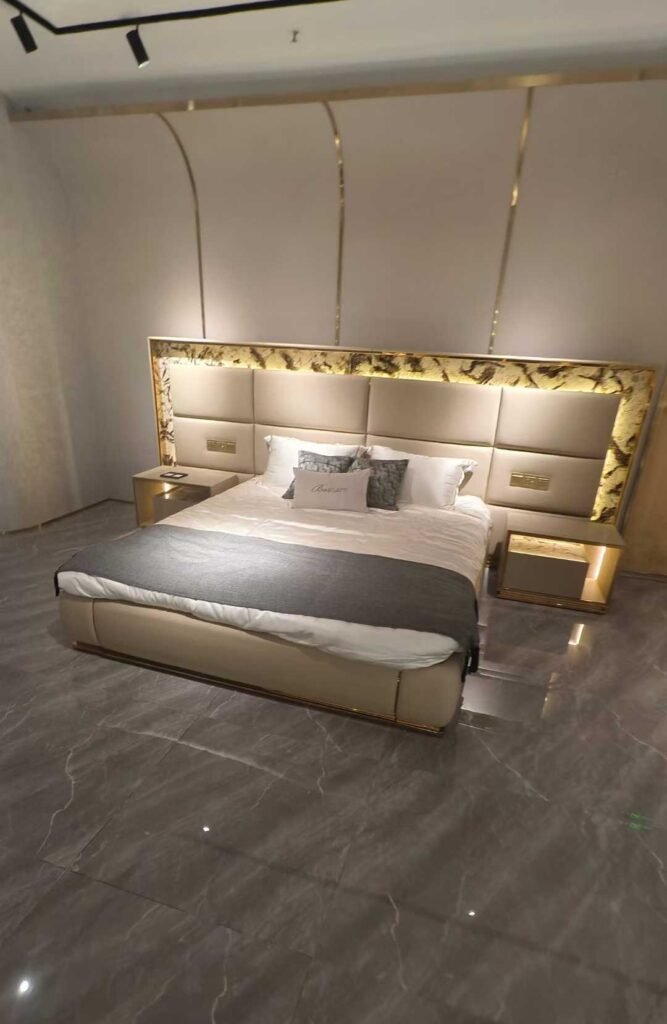
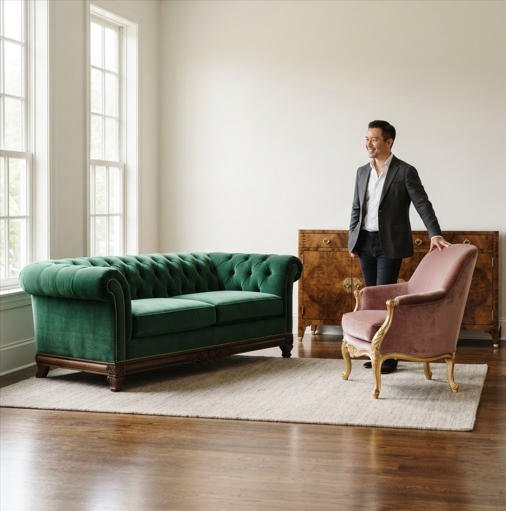
A Strategic Guide for Furniture Distributors, Showroom Owners, and Design Professionals to Capture Market Share Through Authentic Asian Collections
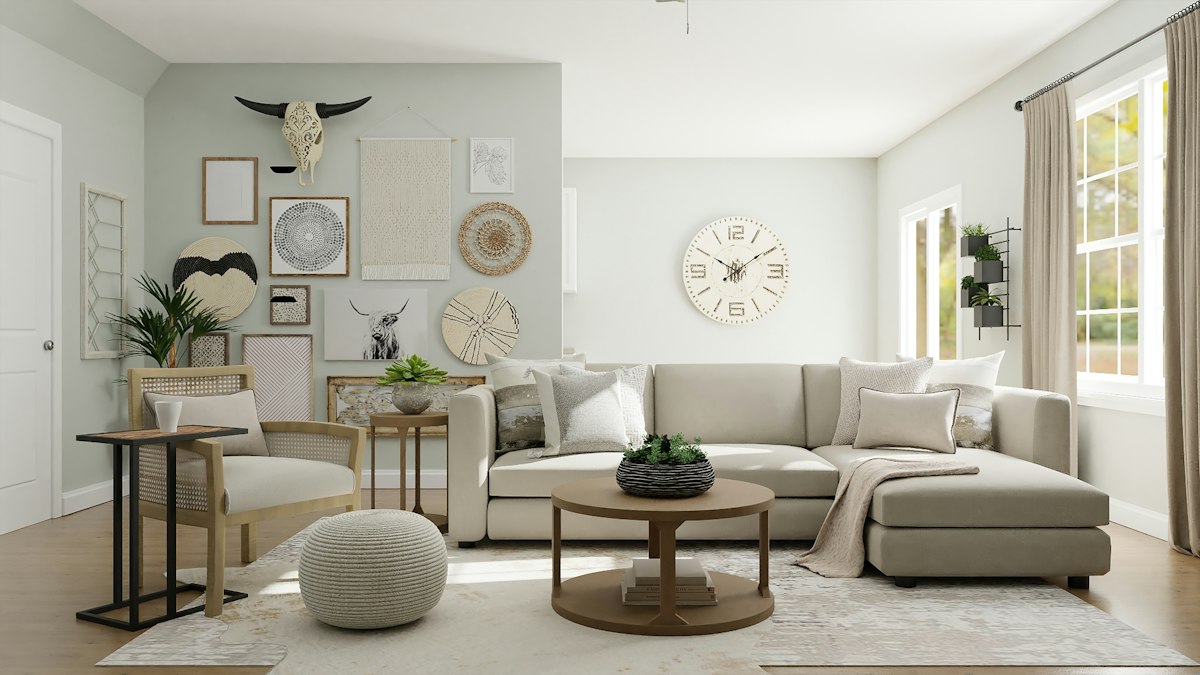 The kind of environment that converts a casual inquiry into a committed specification — authenticity visible at every angle. Image: Unsplash
The furniture distribution landscape is shifting, and the direction of movement is clear to anyone paying attention to where design professionals are actually spending their budgets.
Mass-market retailers are fighting harder than ever over a shrinking slice of the market. Meanwhile, specialty importers of authentic Asian furniture are capturing premium segments by offering what no big-box retailer can replicate: curated authenticity, genuine cultural expertise, and collections that command higher margins precisely because they cannot be replicated at the factory-floor pricing that mass retail demands.
The Asia Pacific furniture market was valued at $6.71 billion in 2025 ومن المتوقع أن يصل إلى $13.78 billion by 2034. Within that growth story, specialty furniture stores held 38.61% of the market share in 2025 — outperforming the digital channel and holding their ground as the primary discovery point for design professionals who need to see, touch, and specify with confidence.
This guide is written for the furniture distributors, showroom operators, agents, and interior design professionals who are already in this market — or who are making a deliberate move into it. Not to explain why Asian furniture is appealing in the abstract, but to show precisely how the specialty players are winning right now, and how you can apply those same strategies to your business.
Why Big-Box Retailers Are Losing Ground in Asian Furniture Markets
The Authenticity Gap That’s Costing You Sales
Walk into any large furniture chain and you’ll find a “Japanese-inspired” collection featuring veneered MDF frames with brass-toned hardware manufactured to a price point that bears no relationship to the joinery traditions it claims to evoke. Your clients — interior designers managing $500K renovation projects, hotel developers fitting out boutique properties, and high-end showroom customers who have researched their purchases for months — know the difference immediately.
The authenticity gap is not subtle. It’s the difference between a dining table with mortise-and-tenon joinery that a master craftsman spent three hours perfecting in Guangdong Province and a flat-pack imitation that shares the same aesthetic language but none of the structural integrity or cultural provenance.
And when that imitation piece fails — a drawer front delaminates, a joinery point shifts after 18 months — the damage doesn’t stay with the mass retailer who sold it. It lands on the interior designer who specified it, or the hotel procurement team who signed off on it, or the showroom that advised the purchase. Your professional reputation is inseparable from the authenticity of what you sell.
What Your Customers Actually Want (But Aren’t Finding in Mass Market)
Research into the luxury furniture segment shows that 41% of consumers specifically value artisanal craftsmanship when making premium furniture decisions, with 36% actively demanding sustainable materials — both factors that mass-market production cannot credibly deliver. Among interior designers specifically, the specification process has become increasingly documentation-driven: clients are asking where pieces came from, how they were made, and who made them.
The demand signal is not just aesthetic preference. It is a professional liability calculation. When a designer specifies an authentic, provenance-documented piece from a specialist importer and it performs flawlessly in a high-visibility installation, that specification decision reflects well on them and on their sourcing partner. When they specify a mass-market alternative that fails or disappoints, the story goes in the opposite direction.
Your clients are not finding what they need in mass market because mass market is structurally incapable of providing it. This is your opening.
The Margin Opportunity Hidden in Authenticity
The financial reality of specialty positioning in Asian furniture is significant. Industry data shows that specialty Asian furniture — correctly positioned and sourced — typically commands 40–60% higher margins than mass-produced alternatives. Artisanal and handcrafted pieces regularly support 50–100% markups when presented to design professionals and hospitality buyers who understand their value.
This margin differential is not the result of price gouging. It reflects genuine scarcity, skilled labor costs, authentic materials, and the curatorial expertise that goes into sourcing and presenting these collections. It is also a reflection of competitive dynamics: nobody else in your market can sell the same piece at the same story.
How Specialty Importers Command 40–60% Higher Margins
The Price-to-Perceived-Value Equation
The pricing conversation in specialty furniture is fundamentally different from commodity retail, and understanding this distinction is the foundation of sustainable margin protection. When a designer is specifying a hand-carved solid teak sideboard with documented craftsmanship provenance for a client who has budgeted $85,000 for a dining room, the question is not “is this cheaper than the alternative?” It is “does this piece do what the project requires?”
The price-to-perceived-value equation works in your favor when you have done the work to establish the value context before price is discussed. That means your showroom presentation, your photography, your product documentation, and your sales team’s ability to articulate craftsmanship and provenance all contribute to a perception of value that makes your pricing feel appropriate rather than expensive.
Distributors who skip this positioning work and try to compete on premium product at mid-market presentation consistently fail. The product is only half the equation — the positioning context is the other half.
Building Exclusive Distribution Relationships
The most durable competitive advantage in specialty Asian furniture distribution is not a specific product or collection — it is an exclusive or semi-exclusive sourcing relationship with a manufacturer whose work is genuinely desirable to your market. When you are the only source your regional market has access to for a particular maker’s pieces, you have permanently exited the price comparison conversation.
These relationships are built through consistent volume commitments, respectful long-term engagement, and a demonstrated ability to sell the manufacturer’s work at prices that reflect its genuine value. Manufacturers in the premium segment — family workshops in Jepara, lacquerware studios in Hanoi, solid wood craftsmen in the Guangdong highlands — are not primarily motivated by the highest price. They are motivated by relationships with distributors who understand and respect their work.
The Supply Chain Advantage Specialty Retailers Possess
Establishing Direct Connections with Asian Manufacturers
The supply chain difference between specialty importers and mass retailers is not a matter of scale — it’s a matter of depth. Mass retailers buy from trading companies who aggregate factory output. Specialty importers build direct relationships with the factories and workshops themselves.
This directness delivers three operational advantages that mass retailers structurally cannot replicate. First, you have visibility into production schedules and can plan your inventory with a level of accuracy that trading company intermediaries cannot provide. Second, you have the ability to influence production — dimensions, finishes, materials, and construction details — in ways that catalog buying never allows. Third, you have the manufacturer’s trust, which becomes critical when you need priority production for a hospitality fit-out deadline or need to fast-track a replacement for a damaged piece.
مفروشات النمل اليشم maintains direct manufacturer relationships across China’s primary production regions as a foundational element of their sourcing model — understanding that the quality of these relationships directly determines the quality and exclusivity of what reaches their distribution partners.
For a practical overview of China’s primary manufacturing regions and what each produces, the China Furniture Sourcing Hubs guide provides a distributor-focused breakdown of where to source what.
Reducing Lead Times While Increasing Customization Options
Counter-intuitively, direct manufacturer relationships often deliver shorter effective lead times than trading company intermediaries, despite the additional complexity of direct negotiation. When you have a production relationship — not just a purchasing relationship — manufacturers will carve out production slots for your priority orders and communicate proactively when their schedules shift.
Standard lead times from Asian manufacturers range from 8–16 أسبوعًا depending on complexity and customization level. With a direct manufacturer relationship and a track record of reliable volume, specialist importers consistently negotiate these down to 6–10 weeks for standard pieces, with 4–6 week lead times for in-production modifications. This gives you the flexibility to offer customization to your design clients without creating the timeline anxiety that destroys high-value project relationships.
Understanding the Asian Furniture Trends Your Clients Are Demanding
Sustainable and Ethically-Sourced Materials — What Designers Are Specifying
The eco-furniture market is projected to grow at an annual rate of 8.6% through 2030, and this growth is not driven by consumer preference alone — it is increasingly driven by designer and developer specification requirements. Hotel brands operating under ESG commitments, corporate office developers pursuing LEED certification, and residential designers working with environmentally conscious clients are all specifying sustainability criteria before they specify aesthetics.
In practical terms, this means FSC certification (Forest Stewardship Council — the internationally recognized standard for responsibly managed forest products) is shifting from a differentiator to a baseline requirement for serious specification work. Source of Asia’s recent renewal of FSC certification for 2026–2031 reflects the industry-wide movement toward documented sustainability across ASEAN production regions. For importers, it means that sourcing from non-certified suppliers is an increasing liability, not just a missed opportunity.
How to Identify Genuinely Sustainable Suppliers (Not Greenwashing)
Greenwashing — making sustainability claims without documentation or third-party verification — is unfortunately common in the Asian furniture manufacturing sector, and it creates real liability for importers who repeat those claims to professional clients. When a hotel developer’s procurement team asks for your FSC documentation and you produce a supplier’s marketing materials instead of a certification number, the conversation ends badly.
Genuine sustainability verification requires three elements: third-party certification (FSC, PEFC, or equivalent), transparent documentation of the supply chain from forest or plantation to finished product, and manufacturing practice audits that cover labor conditions and environmental impact — not just wood sourcing. Suppliers who resist providing this documentation should be treated as unable to make credible sustainability claims.
إن Forest Stewardship Council’s certificate database allows you to verify any FSC certificate number in real time — a two-minute check that protects you from claims that cannot be substantiated.
Communicating Sustainability to Your Design and Hospitality Clients
Sustainability communication that converts professional clients is specific and documented, not aspirational and vague. “We source sustainably” is a phrase that designers have learned to discount. “All solid wood in our collection carries FSC certification from factories audited by [third-party auditor], and we can provide documentation for any piece on request” is a statement that closes specifications.
Build a sustainability documentation package for your collection — certification references, manufacturing audit summaries, and material sourcing maps — and make it available digitally and in your showroom. Design professionals increasingly need this documentation to satisfy their own clients’ requirements, and being able to provide it immediately positions you as a partner who understands the professional workflow, not just a product seller.
Minimalist and Japandi Design — The Trend Reshaping Commercial Interiors
Japandi — the fusion of Japanese wabi-sabi philosophy and Scandinavian hygge sensibility — is not a passing trend in the Asian furniture market. It is the dominant design language for a broad range of commercial applications that represent the highest-value B2B furniture market segments: boutique hotels, corporate wellness spaces, high-end residential, and food and beverage environments where experiential design commands premium pricing.
The aesthetic vocabulary of Japandi — solid wood with visible natural grain, muted neutral palettes, clean geometric lines with subtle organic variation, functional forms without ornamentation, and high-quality joinery as a visible design element — translates directly to the manufacturing strengths of Asian artisanal production. This is not coincidental. The design movement and the production capability are aligned in a way that creates genuine competitive advantage for specialty importers sourcing from the right manufacturers.
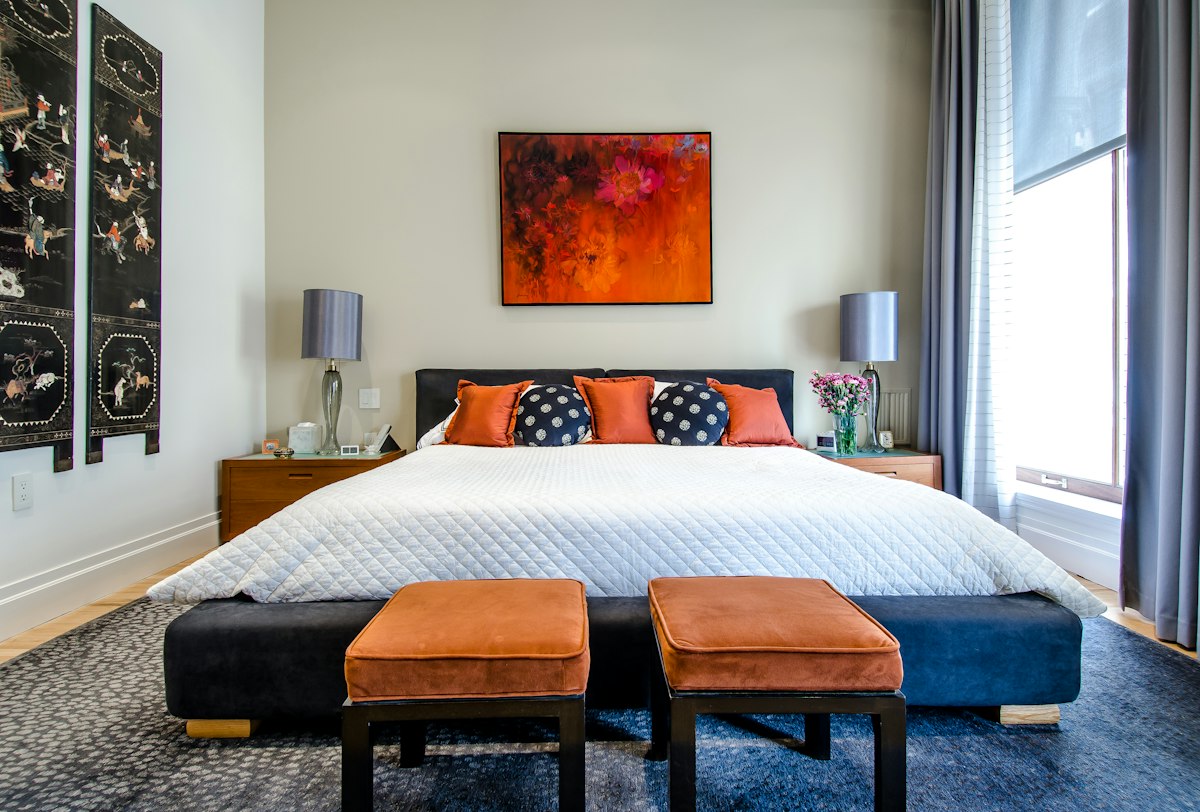 Japandi in a hospitality context — every piece earns its place. This is the aesthetic driving specification decisions at boutique hotels globally. Image: Unsplash
Why Japandi Works for Hotel and Commercial Fit-Outs
Hotel procurement teams and commercial interior designers are drawn to Japandi for reasons that are more operational than aesthetic. The style’s emphasis on natural, durable materials means pieces hold their appearance through heavy commercial use cycles. The neutral palette means individual pieces integrate with a wide range of other design elements without requiring complete collection replacement when properties refresh. The minimalist composition means installations read as intentional and sophisticated in photography, which matters enormously for hotel marketing.
A boutique hotel property that fitted out its 40-room inventory with a curated Japandi collection from a specialist importer in 2022 saw their average nightly rate increase 18% over the following two years, with guest review sentiment around “design,” “atmosphere,” and “quality” rising proportionally. The furniture investment paid for itself not through the rooms it filled but through the premium pricing the design environment commanded.
Curating a Japandi Collection That Stands Out
The risk in Japandi’s popularity is that it has become a label applied loosely to any piece with a light wood finish and straight lines. Your job as a specialist importer is to curate a Japandi collection with genuine aesthetic coherence — pieces that were actually designed with Japandi sensibility, not mass-produced approximations wearing the label.
This means prioritizing pieces with visible, high-quality joinery as a design element, natural oil or wax finishes that show the wood’s character rather than hiding it, proportions that reflect Japanese spatial relationships (lower profiles, considered negative space), and a color vocabulary rooted in natural, undyed materials. The difference between a curated Japandi collection and a collection of “vaguely minimal Asian pieces” is immediately apparent to the designers who will specify it.
Artisanal Craftsmanship as a Competitive Differentiator
Hand-carved wood, traditional joinery, and artisanal finishing techniques are not simply product features in the specialty Asian furniture market — they are the commercial foundation of premium pricing and client loyalty. When a designer walks into your showroom and you can show them the specific joinery technique used in a cabinet door, explain the traditional wood carving process that produced a decorative panel, and connect the piece to a specific workshop and craftsperson, you have created a selling conversation that no mass retailer can have.
Traditional Chinese joinery — mortise-and-tenon connections, the “three-way Chinese joinery” used in cabinet frames — and Japanese joinery techniques dating back centuries create structural integrity that modern furniture fasteners cannot match. These joints allow wood to move with seasonal humidity changes without cracking, which is why well-made traditional Asian pieces frequently outlast the interiors they were installed in by decades.
The Stories Behind Pieces — How Craftsmanship Drives Sales
Every handcrafted piece in your collection is a story waiting to be told — and stories sell in ways that specifications cannot. A dining table made by a third-generation craftsman in a family workshop outside Foshan, using the same joinery techniques his grandfather developed, is not just a piece of furniture with a high-quality finish. It is a connection to a living craft tradition. That story — when documented, photographed, and confidently told by your sales team — converts interior designers who are researching pieces for clients who want meaning alongside aesthetics.
The most commercially effective specialty showrooms have developed what amounts to a provenance system for their collection: each piece tagged with its origin workshop, production method, materials, and where applicable, the individual craftsperson involved in its creation. This documentation is not a marketing exercise — it is a sales tool that shortens specification timelines and reduces price objections.
Documenting and Communicating Artisanal Techniques to Designers
Build a physical or digital “craft library” for your collection — a resource that documents the production processes behind your key pieces. Photographs of the workshop, images of the joinery technique in progress, close-ups of hand-finishing details, and video content of the production process give designers the reference material they need to explain their specification decisions to their clients.
Design professionals who receive this documentation from a supplier treat it as a professional asset — material they can share with their clients and incorporate into their own project presentations. Every time a designer uses your craft documentation in their client work, your brand is present in that conversation without any additional marketing investment from you.
Customization and Bespoke Services — What High-End Designers Expect
The most demanding segment of your professional client base — high-end interior designers and hotel developers managing bespoke projects — will test your supply chain’s ability to deliver modified dimensions, custom finishes, alternative upholstery selections, and occasionally entirely bespoke production runs. The distributors who can say “yes” to these requests — reliably, with clear lead time commitments — win the relationships that generate the most valuable ongoing business.
According to the 1stDibs annual designer survey, customized pieces represent approximately 46% of all furniture designer specifications across projects. This proportion is higher in the premium and hospitality segments, where custom dimensions for architectural alcoves, finish matching to existing interior palettes, and fabric selections from designer-specified materials are standard practice rather than exceptional requests.
Building Flexible Supply Chains That Support Custom Orders
Customization capability begins with manufacturer selection. Not all Asian furniture manufacturers have the design department capacity, the materials inventory, and the production flexibility to accommodate custom orders at the volumes and lead times that your clients require. Identifying and prioritizing manufacturers who have built customization infrastructure — dedicated design coordination teams, flexible production scheduling, finish sample libraries — is the first supply chain decision that determines your customization capability.
The practical parameters of customization that most specialist importers can offer with the right manufacturer relationships: dimension modifications of ±20% on standard designs (most manufacturers can accommodate this within standard lead times), finish modifications within their existing product range (2–4 week addition to standard lead time), fabric substitutions for upholstered components (dependent on designer fabric lead times), and custom production for orders above a minimum quantity threshold (typically 3–6 pieces, 12–20 week lead time).
Managing Lead Times and Client Expectations for Bespoke Work
The relationship-damaging scenario in bespoke furniture work is not a production delay — it is a production delay that the designer learns about when the piece doesn’t arrive on the promised date. Managing client expectations for custom work requires communicating lead times in full at the time of order, building buffer time into every custom commitment (if production takes 14 weeks, commit to 18), and implementing a proactive update communication protocol that reaches your designer clients at agreed milestones throughout the production cycle.
Designers who have experienced this level of project management reliability with a specialty importer become extraordinarily loyal sourcing partners. The bar set by most of their suppliers is low enough that reliability itself becomes a differentiator.
Building a Curated Asian Furniture Collection That Sells
Strategic Sourcing: Finding the Right Asian Manufacturers and Artisans
Not all Asian furniture manufacturers are appropriate sources for a specialty, design-focused collection, and the difference between right and wrong sourcing decisions compounds over time. A wrong sourcing decision — a manufacturer whose quality is inconsistent, whose production schedules are unreliable, or whose claimed sustainability credentials don’t survive scrutiny — creates the kind of operational and reputational problems that take years to recover from.
The right approach to manufacturer identification is methodical: start with clear criteria for the quality tier, aesthetic direction, and customization capability you need, then evaluate potential manufacturers against those criteria through a structured vetting process rather than responding to inbound solicitations from trade fair contacts.
Vetting Suppliers: Quality, Reliability, and Ethical Standards
The vetting framework that experienced specialty importers use combines documentation review, sample evaluation, and direct factory engagement. Documentation review covers business registration, production certifications, sustainability credentials (FSC, fair trade), and compliance with importing-country requirements (TSCA compliance for formaldehyde in composite materials is mandatory for US imports, for example).
Sample evaluation should go beyond aesthetic approval to include structural testing: finish durability under commercial-use conditions, joint integrity under load, and dimensional accuracy against provided specifications. A manufacturer whose samples are consistently within ±3mm of specified dimensions across multiple orders has production quality control discipline; one whose samples arrive consistently beautiful but dimensionally inconsistent will create problems when pieces need to fit into designed alcoves.
For a comprehensive working framework for evaluating Chinese furniture suppliers specifically, the guide at Jade Ant Furniture’s supplier evaluation resource covers the specific criteria and red flags that experienced importers use.
| Vetting Criteria | ما يجب التحقق منه | Minimum Standard |
|---|---|---|
| Sustainability Credentials | FSC certification number (verify via FSC database) | Current, verifiable certificate |
| Production Capacity | Factory size, employee count, monthly output | Sufficient for your volume + buffer |
| Quality Control | QC process documentation, defect rate data | < 3% defect rate on reference orders |
| Customization Capability | Design team, finish library, MOQ for custom | MOQ ≤ 6 pieces for dimensional mods |
| Lead Time Reliability | Reference checks with existing importers | ≥ 90% on-time in past 12 months |
| Financial Stability | Operating history, payment term flexibility | ≥ 3 years in operation |
| Communication Quality | Response time, English capability, clarity | ≤ 24h response, clear written communication |
Negotiating Exclusive or Semi-Exclusive Distribution Agreements
Exclusivity negotiations with Asian manufacturers require understanding what exclusivity means to them before structuring your ask. A family workshop producing 200 units per month does not need global exclusivity from you — they need the assurance that your volume commitments are reliable and that you will represent their work professionally. Regional exclusivity — your country, your state, or your specific distribution channel — is often achievable without the volume commitments that full global exclusivity would require.
The negotiation currency is not primarily price. It is volume reliability, market representation quality, and the speed at which you pay. A manufacturer who has experienced importers who place large orders and then push payment terms for 90 days will prioritize a smaller importer who pays within 30 days and represents their work with genuine care. Be that importer.
Creating a Cohesive Collection That Tells a Story
The showrooms that design professionals return to again and again are not the ones with the most pieces or the broadest range. They are the ones with a clear, coherent design point of view — a curation that communicates a perspective and makes the individual pieces more meaningful through their context.
A showroom that stocks Ming-influenced case goods alongside Japandi dining furniture, Japanese wabi-sabi ceramics, and Vietnamese rattan accent pieces can make this work if there is a unifying thread that the entire collection expresses. But that thread must be visible and intentional, not just the accumulation of individual sourcing decisions made over several years.
Developing Your Showroom’s Design Point of View
Start with a written collection brief — a single page that defines the aesthetic territory your showroom occupies, the design professionals you serve, and the design vocabulary that connects your pieces. This document is not marketing copy — it is a sourcing tool. Every purchasing decision you make should be evaluated against it, and pieces that don’t belong in your design territory should not enter your showroom regardless of their individual merit.
Your design point of view should be specific enough to be exclusive (not “we sell Asian furniture” but “we curate natural material collections with a shared philosophy of material honesty, craft visibility, and functional beauty drawn from East Asian design traditions”) and broad enough to encompass a commercially viable range of pieces across furniture categories.
Balancing Inventory: Core Pieces vs. Trend-Driven Selections
A sustainable inventory strategy for specialty Asian furniture operates on a two-tier model. Core pieces — your bestselling items that designers consistently specify across project types, that photograph beautifully, and that have proven commercial velocity — should represent 60–70% of your buying commitment and 70–80% of your floor space. These pieces fund your business.
The remaining 30–40% of your buying capacity is for trend-responsive and statement pieces — items that represent emerging aesthetic directions, create visual excitement in your showroom, generate social media and editorial interest, and allow you to lead rather than follow market movements. These pieces differentiate your collection; your core pieces sustain it.
Pricing Strategy for Specialty Asian Furniture
Understanding Landed Costs and Setting Wholesale/Retail Markups
Pricing discipline in specialty Asian furniture begins with a complete and accurate landed cost calculation before a single wholesale price is set. Landed cost includes factory price (FOB), ocean freight, destination country import duties, customs clearance fees, inland freight to your warehouse, quality inspection costs, and storage costs until sale. Distributors who price against FOB alone consistently find their margins compressed at the retail level once all the costs between factory gate and showroom floor are accounted for.
A typical fully-landed cost for a solid wood Asian furniture piece will run 35–55% above FOB pricing depending on the shipping lane, duty category, and logistics model. Building this accurately into your pricing model protects margins that look healthy on a factory invoice but disappear by the time the piece is in your showroom.
For wholesale pricing to retail partners, a keystone markup of 2.0–2.5x landed cost is appropriate for standard specialty positioning. For direct retail (showroom sales to designers and consumers), 3.5–4.5x landed cost is achievable for authentically positioned, well-presented pieces. Premium artisanal or bespoke pieces can support higher multiples when provenance, craftsmanship, and design narrative are communicated effectively.
Premium Pricing Without Losing Competitive Sales
The pricing conversation with professional clients is easier than many specialty retailers expect — when it happens in the right context. A designer who has just spent 20 minutes in your showroom having a knowledgeable conversation about joinery techniques, provenance, and customization options is not in the same psychological frame as a buyer comparing product pages on a commodity e-commerce site. The context of the conversation is part of the pricing environment.
What destroys premium pricing is attempting it without the supporting context: quoting premium prices on low-quality photography, through underprepared sales staff, or in a showroom environment that doesn’t reflect the premium positioning of the collection. If your pricing says “luxury,” every other signal in the customer experience needs to confirm that statement.
Marketing Your Specialty Asian Collection to Design Professionals and Hospitality Buyers
Positioning Your Showroom as a Destination, Not a Vendor
The commercial goal of specialty Asian furniture positioning is not to be one of multiple options that designers consider — it is to be the option they think of first when a project brief calls for anything in your territory. That “first call” positioning is built through a consistent combination of showroom experience, professional reputation, relationship depth, and demonstrated expertise.
Interior designers and hotel fit-out teams have experienced the full spectrum of vendor relationships — from manufacturers who treat them as an order number to specialty importers who function as genuine design partners. The latter relationships are profoundly more valuable to them, and they will pay a premium — in price tolerance, loyalty, and referrals — to maintain them.
Creating Showroom Experiences That Impress Design Professionals
Design professionals evaluate showrooms differently than retail consumers. They are not browsing for inspiration — they are assessing capability. They want to know whether your collection has depth and coherence, whether your staff can answer technical questions about materials, dimensions, and lead times, whether you can support the documentation requirements of professional projects (specification sheets, sustainability certifications, installation guides), and whether the overall presentation reflects the standard their clients expect.
A showroom experience calibrated for design professionals includes vignettes that are staged at a quality level comparable to the projects those designers work on (not consumer room settings), complete specification documentation readily accessible for every piece, samples of available finishes and materials for pieces that can be customized, and staff who open with questions about the designer’s project rather than leading with product features.
Building Relationships with Interior Designers and Hospitality Procurement Teams
High Point Market attracts 70,000–80,000 attendees annually and remains the most concentrated access point for building design and hospitality trade relationships in the North American market. But the relationship work that converts show contacts into long-term sourcing partnerships happens between markets — through project consultations, shared editorial content, designer-event showroom evenings, and consistent follow-through on every commitment made during show season.
The most effective relationship builders among specialty importers treat designer relationships as a portfolio investment: a defined number of active relationships receiving active attention (project updates, trend information, early access to new arrivals), rather than a broad mailing list receiving periodic promotional communications.
Digital Presence: How to Showcase Authenticity Online
Design professionals research before they visit. A designer who finds your showroom through a colleague’s recommendation will spend 20–40 minutes on your digital presence before booking a visit — and if that presence doesn’t communicate the level of expertise and curation they’re expecting, the visit may not happen. Your digital presence is the pre-screening that either earns you the in-person meeting or sends the designer to look elsewhere.
 This is the image that makes a designer stop scrolling. Craft detail photography communicates what general product shots cannot. Image: Unsplash
Photography and Storytelling That Conveys Craftsmanship and Authenticity
The photography standard that converts design professionals is specifically different from general furniture photography. Lifestyle shots showing pieces in full-room settings are necessary but not sufficient. Craftsmanship detail photography — close-ups of joinery, surface texture, material grain, hand-finishing detail — is what communicates the authentic quality that professional buyers are trying to assess.
Every hero product on your website should have at minimum: a full-piece hero image in a styled environment, 2–3 detail shots of craftsmanship elements, a close-up of materials and finish, and a scale reference showing the piece in a realistic spatial relationship. Video content showing the production process — even a 60-second workshop clip — generates engagement from design professionals that static photography cannot match.
SEO and Content Strategy for Reaching Design Professionals
Design professionals research through a combination of search engines, professional publications, and peer recommendations. An SEO and content strategy calibrated for this audience targets the specific queries they use: specification-level terms (“solid teak dining table dimensions specifications”), trend research terms (“Japandi furniture commercial specification”), and sourcing terms (“authentic Asian furniture importer [city]”).
Creating educational content — guides to Asian joinery techniques, trend analysis pieces for commercial interiors, sustainability sourcing documentation — positions your brand as an expertise source rather than just a product seller. Design professionals who discover your content through search develop a relationship with your brand’s expertise before they ever contact your showroom.
Case Studies and Project Portfolios — Proof That Drives Specification
Collecting and Presenting Project Photography and Designer Testimonials
For hospitality and commercial design clients, a case study portfolio is your most powerful sales tool. A written description of your pieces and their features does not close specifications. A documented portfolio of successful installations — high-quality photography of completed projects, testimony from the designers involved, and quantified outcomes where available (guest satisfaction data, designer client feedback, project award recognition) — demonstrates that your pieces perform in professional settings at the standard your clients require.
Build your portfolio systematically: develop relationships with the designers you supply that include post-installation photography access. Offer a complementary photography contribution for installations that showcase your collection well. Every completed project is a portfolio asset — and portfolio assets close future specifications.
Using Case Studies to Address Specific Design Challenges
The most commercially effective case studies in specialty furniture are problem-solution narratives: a hospitality designer needed furniture that could withstand commercial use while maintaining the aesthetic of a premium guest experience; a corporate interior required pieces that supported a wellness brief without compromising functionality; a residential client wanted authentic Asian provenance that could be documented for an art collector’s standards of acquisition. Your pieces provided the solution.
This narrative structure gives designers a framework for how to specify your work in their own client conversations — and it demonstrates that you understand professional application requirements, not just product aesthetics.
Networking and Industry Presence
Strategic Trade Show Participation and Sponsorships
Trade show participation for specialty Asian furniture importers should be evaluated on relationship quality rather than booth traffic volume. A presence at a regional interior design conference that 800 high-quality design professionals attend is often more commercially valuable than a booth at a mass consumer furniture show with 15,000 attendees — because your product is not for the 15,000, it is for the 800.
Evaluate every trade show and industry event against this filter: will the attendees include people who specify, procure, or advise on the type of furniture you sell? If yes, your investment builds your professional network. If no — regardless of attendance numbers — it’s the wrong event for a specialty positioning strategy.
Building Partnerships with Interior Design Firms and Hotel Developers
The most accelerated path to a established position in the design trade is direct partnership with 3–5 design firms whose aesthetic and project profile aligns with your collection. These are not vendor-client relationships — they are collaborative sourcing partnerships where the designer’s access to new arrivals, custom production support, and documentation assistance is reciprocated by their active specification of your collection and their willingness to co-develop project case studies.
Hotel developers who have successfully fit out a property with your collection and achieved measurable guest satisfaction improvements are the most valuable references in the hospitality sector. One documented hotel fit-out success story, shared through hospitality industry channels with the developer’s endorsement, reaches procurement decision-makers in a way that conventional advertising never will.
Operational Excellence: The Systems That Support Specialty Retail Success
Inventory Management for Specialty Retailers
The inventory challenge that distinguishes specialty Asian furniture retail from mass-market furniture distribution is specific: you need enough collection depth to impress a design professional doing serious project specification research, while not overextending capital in slow-moving pieces that tie up cash and create eventual margin pressure from aging stock.
The resolution to this tension is not a simple formula — it’s a combination of sales data discipline, designer relationship intelligence (knowing what your top design clients are specifying before they formally order), and a conservative approach to trend-driven purchasing that limits speculative buying to quantities that can be absorbed through closeout promotion if the trend doesn’t develop as anticipated.
Balancing Stock Levels Across Core and Seasonal Collections
A practical inventory model for specialty Asian furniture distributes open-to-buy budget roughly as follows: 60% to core, proven pieces that turn consistently and that designers actively specify; 25% to emerging trend pieces that the collection needs to stay current; and 15% to statement and hero pieces that create showroom impact and PR interest without representing a significant volume commitment.
This allocation prevents the common failure mode of specialty retailers who spend disproportionate buying budgets chasing the newest trend pieces and find themselves with inadequate depth in their core commercial movers — the pieces that actually fund the business.
Managing Lead Times and Pre-Orders Without Disappointing Clients
Pre-order selling — committing to client orders before inventory is in your warehouse — is a legitimate and necessary capability for specialty importers offering a broader catalog than they can physically stock. It becomes a client relationship problem only when lead time communications are optimistic, inconsistent, or not proactively updated.
A pre-order management system that tracks every committed order against its production and shipping milestone, triggers proactive client communications at defined points (order confirmation, production completion, vessel departure, estimated arrival), and flags potential delays 4+ weeks before promised delivery dates converts what could be a tension-generating process into a demonstration of operational professionalism.
Customer Service and Expertise — Your Competitive Advantage
Your team’s knowledge of Asian design history, craftsmanship techniques, material properties, and trend context is an operational asset that takes years to build and cannot be purchased off a shelf. When a designer asks your sales team about the difference between Japanese wenge and African wenge, about the structural implications of traditional mortise-and-tenon versus modern biscuit joinery, or about which pieces from your collection would be appropriate for an outdoor tropical hospitality installation — the quality of that answer is the quality of your competitive position.
Building a Knowledgeable Sales Team That Speaks Design Language
Investment in team expertise is investment in your most durable competitive advantage. This means structured training in Asian design history and aesthetic traditions, hands-on material education (the team should be able to identify wood species by sight and touch), site visits to key manufacturing partners where possible, and active subscription to the design publications and trend resources that your designer clients use.
Sales team members who can engage designers as peers — discussing project briefs, suggesting specifications, and solving design challenges with product knowledge — generate conversion rates that product-catalog-reading staff cannot approach. The difference between a 20% showroom conversion rate and a 45% rate is almost always the quality of the design conversation, not the quality of the product.
Providing Technical Support and Installation Guidance to Designers
Technical support extends beyond the sale. Installation guidance for large solid wood pieces — covering weight requirements, clearance specifications, leveling and anchoring requirements, care and maintenance instructions — is the kind of post-sale support that design professionals remember when they’re choosing their next sourcing partner. Creating technical documentation packages for each product category, and having team members available to consult on installation challenges, positions you as a genuine project partner rather than a product supplier who becomes unreachable after payment.
Logistics and Fulfillment: Delivering on Your Premium Promise
 Premium packaging is not overhead — it’s brand protection at every stage of the supply chain. Image: Unsplash
Managing International Shipping and Customs Clearance
International furniture importing involves a documentation and compliance layer that, if managed carelessly, creates delays, unexpected duties, and compliance failures that damage your reliability with the retail and design clients depending on your supply. The standard documentation set for an Asian furniture import shipment includes a commercial invoice with accurate HS code classification, a packing list with detailed product descriptions, a bill of lading or airway bill, and where required, a phytosanitary certificate for solid wood products and a certificate of origin for duty preference calculations.
HS code accuracy is worth particular attention: misclassified furniture imports are a common source of customs delays and unexpected duty assessments. Working with a customs broker who specializes in furniture imports from Asia is a professional investment that typically pays for itself through avoided delays and accurate duty planning — find a specialist through the National Customs Brokers & Forwarders Association of America.
Quality Control and Damage Prevention in the Supply Chain
The quality failure that destroys designer relationships is not a piece that was wrong when it left the factory — it is a piece that was fine when it left the factory and damaged during transit. Premium solid wood furniture requires specific transit protection: padded corner protection on all finished edges, moisture barrier wrapping for pieces crossing humidity climate zones, individual piece bracing in containers to prevent movement, and a loading configuration that protects the most vulnerable pieces.
Implementing a documented pre-shipment inspection protocol — conducted by a third-party inspection service in the origin country, with photographic documentation of packaging quality and piece condition before container sealing — creates both quality control and liability documentation that protects you in the event of transit damage claims. Third-party inspection services operating in major Asian furniture production hubs typically charge $200–$400 per inspection and prevent claims that regularly run $800–$5,000 per piece.
Overcoming Common Challenges in Specialty Asian Furniture Distribution
Competing on Quality and Authenticity, Not Price
A designer who has spent 30 minutes with your collection, heard the provenance story of three specific pieces, seen the joinery detail photography, and received a complete specification package with sustainability documentation is not in a price-comparison frame of mind. The experience you have created has already done most of the work of price justification. The challenge is when that groundwork has not been laid — when a price objection arrives before the value context has been established.
When Clients Push Back on Price — How to Hold Your Positioning
The most effective response to a price objection in specialty furniture is not a discount — it is a redirection to value context. “I understand the price point is higher than you’d find at a mass retailer. Let me show you what’s behind it” — followed by a joinery detail, a provenance document, a sustainability certificate, or a comparable installation photograph — reframes the conversation from commodity comparison to design and value comparison.
The clients who cannot be retained at premium pricing after a complete value presentation are not your target clients. A specialty positioning strategy accepts — and even benefits from — the self-selection dynamic that filters for professional buyers who understand and respect quality.
Communicating ROI to Interior Designers and Hospitality Buyers
Professional clients — especially those making decisions for commercial projects — respond to ROI framing. For hospitality buyers, the ROI conversation is about durability (fewer replacement cycles over the property lifecycle), guest experience impact (reviews, ratings, and pricing power driven by design quality), and maintenance cost (solid wood furniture with quality finishing requires less maintenance than composite alternatives). A hotel piece that lasts 15 years versus 5 is not three times the price — it’s a fraction of the cost per year of service.
For interior designers, ROI is about their own professional reputation: the designs they’re proud to show in their portfolio, the clients who return because previous project results exceeded expectations, and the referrals that come from projects done at a quality level that inspires word-of-mouth recommendation.
Managing Supply Chain Disruptions and Lead Times
International sourcing introduces complexity that purely domestic distribution avoids, and the distributors who manage this complexity most effectively are not those who experience the fewest disruptions — they’re those who have built the infrastructure to absorb disruptions without passing the consequences to their professional clients.
Building Redundancy in Your Supplier Network
A sourcing strategy that depends on a single manufacturer for any product category that represents more than 15–20% of your revenue has a concentration risk that creates existential exposure during disruptions. The COVID-era supply chain crisis made this explicit for furniture importers in ways that were painful — and the lesson has not been uniformly absorbed.
Practical redundancy for specialty Asian furniture involves identifying and maintaining active relationships with at least two qualified manufacturers per key product category. The second relationship may not receive regular volume — it is maintained through sample orders, factory visits, and ongoing communication rather than production business. When your primary source experiences a disruption, the second relationship allows you to ramp alternative production faster than a cold search ever would.
Transparent Communication About Lead Times and Delays
The relationship-preserving approach to supply chain disruptions is simple and consistently underused: communicate proactively, specifically, and early. A designer who learns about a 4-week production delay from you 8 weeks before the delivery date has time to adjust their installation schedule. A designer who learns about it 2 weeks before the promised date, because you were hoping the situation would resolve itself, has a crisis — and a story to tell about you to their network.
Build a disruption communication protocol: who gets notified, in what order, within what timeframe, with what level of information. When every member of your team knows the protocol, disruption communication becomes a professional demonstration of operational control rather than an embarrassing scramble.
Staying Current With Trends Without Chasing Every Fad
The specialist importer who reallocates buying budget to chase every trend featured in Architectural Digest will accumulate a showroom of dated inventory within 18 months. The one who ignores trend signals entirely will find their collection aging out of relevance. The commercial discipline lies in distinguishing between design movements with structural duration — driven by demographic preferences, architectural trends, and changing space use patterns — and passing media moments with no commercial depth.
Monitoring Market Trends and Design Publications
The publications and intelligence sources that matter for specialty Asian furniture trend monitoring are trade-focused rather than consumer-facing. Architectural Digest’s AD PRO, the Interior Design Magazine specification data, and the High Point Market trend reports from major forecasting firms give you the professional-grade trend signal that filters for the movements that actually drive specification decisions, rather than social media aesthetics that generate clicks but not contracts.
Making Confident Collection Decisions Based on Data, Not Guesswork
Your own sales data is your most reliable trend indicator for your specific market. Which pieces are you selling most frequently, to which client types, for which project applications? This data, accumulated over 12–24 months of detailed tracking, tells you more about your collection’s commercial future than any trend forecast. Trend publications tell you what might become important; your sell-through data tells you what is already important in your specific market.
Case Studies: How Specialty Importers Are Winning in Real Markets
The Showroom That Became a Design Destination
A mid-sized showroom in a secondary market — a city of 400,000 people with a strong university presence and a growing professional class — had been operating for six years as a general Asian furniture importer, carrying a broad catalog that ranged from mass-market rattan to premium solid wood. Their margins were mediocre, their designer relationships were thin, and their differentiation from a large regional furniture chain was primarily geographic convenience.
How They Differentiated and Built Designer Relationships
The transformation began with a deliberate collection edit: over 18 months, they reduced their SKU count by 40%, concentrating on premium solid wood collections with documented provenance and authentic craft techniques. They rebuilt their showroom floor around this edited collection, investing in professional vignette staging and craft documentation displays. They hired a design-trained floor manager who had previously worked in an architecture firm.
Simultaneously, they launched a quarterly “Material Conversations” evening for local interior designers — informal events at the showroom where a manufacturer or craftsperson spoke (via video call) about the production process behind a specific collection. These events cost approximately $800 per quarter to produce and consistently attracted 15–25 local designers.
The Results: Margin Improvement and Market Position
Within 24 months, their average transaction value with design professionals had increased from $3,200 to $7,800. Designer specification accounts represented 58% of revenue (up from 22%). Their gross margin on the premium collection ran 12 percentage points higher than their previous broad catalog. And the “Material Conversations” event attendees had become their most reliable referral sources — designers who consistently brought new clients and colleagues through the showroom because the experience was genuinely worth sharing.
The Distributor Who Built an Exclusive Supply Chain
A furniture distributor supplying 14 independent showrooms across a three-state region had been competing primarily on price and range. Their showroom partners could — and occasionally did — source similar pieces from competing distributors. There was no structural loyalty in the relationship, only the convenience of an established ordering process.
The Negotiation Strategy That Secured Exclusivity
Working with their four highest-volume manufacturing partners in Asia, the distributor developed a proposal that offered guaranteed minimum annual purchase volumes in exchange for regional exclusivity on specific collections. The volumes were significant but not extreme — 10–15% above the prior year’s purchasing — and the exclusivity was geographic rather than global.
From the manufacturers’ perspective, this offered predictability and partnership depth. From the distributor’s perspective, it created a collection that their 14 showroom partners could not access elsewhere. The distributor also committed to co-investing in photography and marketing materials for the exclusive collections — work that benefited both their showroom partners and the manufacturers they represented.
How Exclusivity Translated to Market Share Growth
Within 18 months of the exclusivity agreements taking effect, the distributor’s churn among showroom partners dropped from 3–4 per year to zero. Four new showrooms joined the network specifically because of the exclusive access to collections they couldn’t source elsewhere. The average showroom partner’s purchase volume with the distributor increased 34%, largely because the exclusive collections were driving more designer traffic to those showrooms — traffic that resulted in orders placed through the distributing partner.
The Designer-Led Showroom That Became a Manufacturer’s Preferred Partner
An interior design firm with a strong commercial portfolio — primarily boutique hotel and high-end residential projects — developed a small showroom adjacent to their studio, initially as a convenience for their own project sourcing. What began as a project resource became a meaningful revenue stream as other designers and design-conscious consumers discovered the collection.
Leveraging Design Expertise to Build Supplier Relationships
The firm’s competitive advantage in manufacturer relationships was their documented project portfolio. When they approached Asian manufacturers as potential distribution partners, they came not as unknown importers but as a design firm with a demonstrated track record of high-quality, high-visibility installations. The ability to show manufacturers their pieces in professionally photographed, award-recognized projects was a conversation-opener that pure distribution relationships could not match.
Within two years, two of their primary Asian manufacturers had made the firm their only US distribution partner — a preferred relationship that included first access to new collections, custom production at reduced MOQs, and pricing that reflected the marketing value the firm provided through their project installations.
Converting Design Projects Into Retail Showroom Traffic
The virtuous cycle was powerful: their interior design projects showcased the furniture in professional contexts that other designers aspired to; those designers visited the showroom to see the pieces in person; and some became both retail customers and referral sources for new design project clients. The design firm’s own projects became their most effective marketing channel — and the furniture manufacturer relationships funded by those projects deepened as the volume of both project and showroom sales grew.
Future-Proofing Your Business: What’s Next in Asian Furniture Markets
The Rise of Direct-to-Designer Customization
The manufacturing landscape across Asia’s major furniture production regions is evolving in a direction that changes the competitive dynamics for specialty importers. Lead manufacturers — those investing in design department capability and flexible production systems — are increasingly offering smaller minimum order quantities and more accessible customization options to established distribution partners.
This trend creates both opportunity and risk for specialty importers. The opportunity is an expansion of your customization service capability without proportional operational investment. The risk is that direct-to-designer channels from manufacturers — bypassing importers entirely — could eventually erode the distribution layer for commodity catalog products.
The protection against this risk is deepening the value you add beyond product access: curation expertise, local market relationships, logistics management, documentation support, and the physical showroom experience that digital ordering cannot replicate. The importers who survive direct-channel pressure are those whose value proposition goes beyond product selection.
Positioning as a Customization Partner Rather Than Just a Vendor
Specialty importers who have developed genuine customization capability — the ability to take a designer’s brief and translate it into a manufacturing specification that a trusted Asian partner can execute reliably — provide a service that designers cannot easily replicate independently. Building this capability means investing in the design interface skills (CAD literacy, material specification knowledge, finish matching capability) that allow you to translate client design briefs into production specifications.
Technology and Tools That Enable Bespoke Production
Digital tools are increasingly accessible for managing customization workflows: 3D visualization software that allows clients to preview modifications before committing to production, cloud-based project management platforms that track custom orders from specification to delivery, and specification sheet generation tools that produce manufacturer-ready documentation from client-facing design presentations. These tools reduce the labor overhead of customization management and improve the client experience at every touchpoint.
Sustainability and Traceability — The Non-Negotiable Future
The sustainability trajectory in specialty Asian furniture is one directional: more transparency, more documentation, more rigorous third-party verification, at lower and lower cost as the verification infrastructure matures. Importers who build this infrastructure now will meet tomorrow’s requirements with an established system; those who defer will find themselves building it under client deadline pressure.
Documenting Supply Chains and Manufacturing Practices
Supply chain documentation at the level required for serious sustainability claims means knowing — and being able to demonstrate — where materials originate (specific forest certification unit, plantation location), where components are manufactured (factory address, third-party audit status), what worker conditions exist at each production stage (audit reports, certification documentation), and what environmental impacts the manufacturing process creates (water usage, chemical use, energy source).
This level of traceability is not achievable in a single season. It is built incrementally through manufacturer relationship investment, documentation infrastructure development, and progressive improvement in supply chain visibility. The importers who begin this work now will have a 3–5 year lead over those who wait for client mandates to force it.
Communicating Environmental and Ethical Commitments to Clients
Sustainability communication that is credible to professional clients is specific, documented, and third-party verified. “We are committed to sustainability” is not a statement that design professionals or hotel developers will accept as meaningful. “100% of solid wood in our collection carries verified FSC Chain of Custody certification, and we can provide the specific certificate number for any piece on request” is a statement that closes procurement evaluations.
Omnichannel Retail: Showroom, Digital, and Direct Relationships
The most commercially successful specialty Asian furniture retailers in 2025 are not operating as either pure showrooms or pure digital presences — they are integrated operations where each channel feeds the others. The showroom provides the sensory experience and relationship depth that justifies premium positioning; the digital presence provides discovery and pre-qualification for design professionals researching before their visit; and direct relationships with key designer accounts provide the recurring revenue base that stabilizes the business.
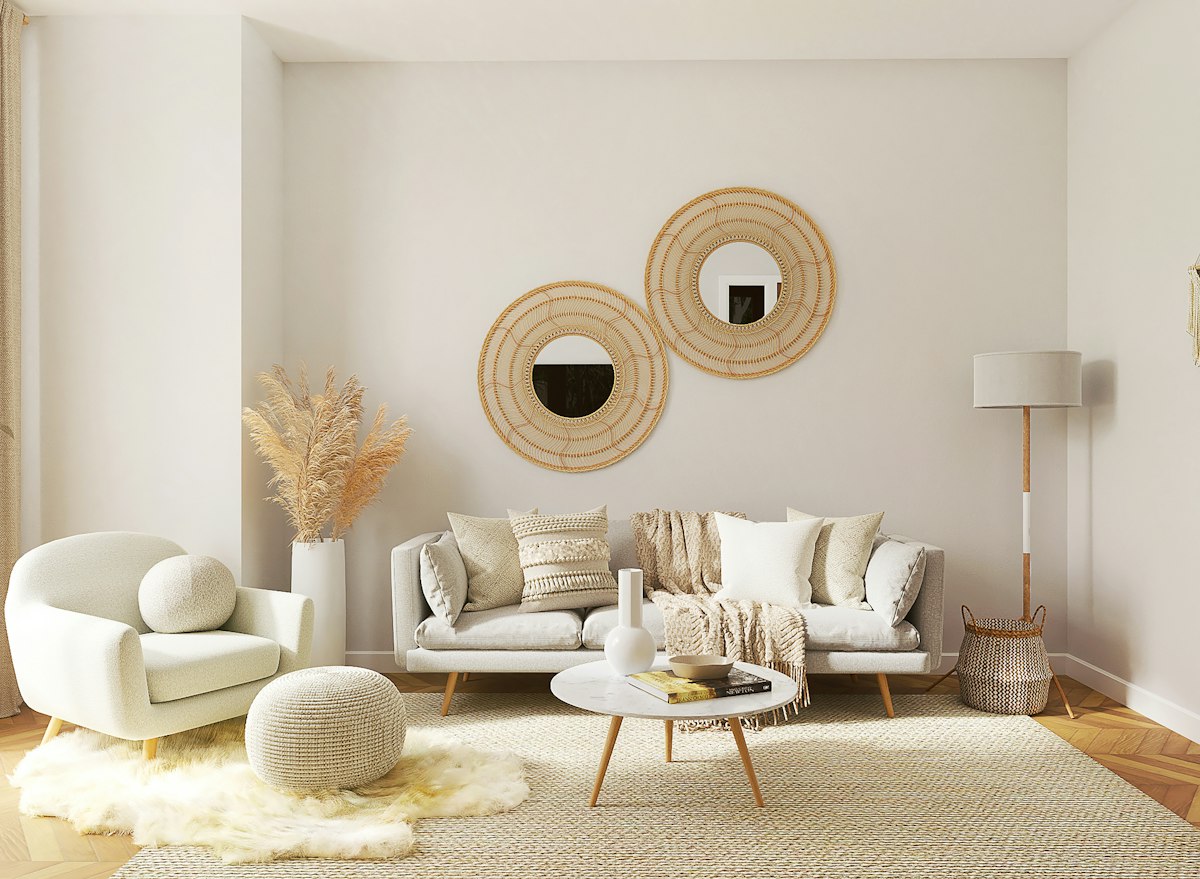 The physical showroom is irreplaceable for specialty Asian furniture — it’s where craftsmanship becomes experience, and experience becomes specification. Image: Unsplash
Integrating Showroom Experiences With Digital Discovery
The customer journey for a design professional typically begins digitally — a search for a specific style, a referral from a colleague, or the discovery of your content through a professional publication. What makes them move from digital discovery to showroom visit is the quality of what they find online: curated imagery, detailed product information, evidence of project experience, and a sense that visiting will yield something they cannot access digitally.
After the showroom visit, digital channels reinforce and extend the relationship — email updates on new arrivals, social media content documenting projects and craftsmanship, and a website that functions as an ongoing reference resource for designers who have met your team and want to maintain engagement between visits.
Direct Client Relationships While Supporting Showroom Partners
For distributors operating through a showroom network, the omnichannel question involves channel management: how do you build digital presence and direct design professional relationships without creating channel conflict with your showroom partners? The answer lies in channel design: your direct digital efforts should focus on designer education, trend content, and awareness of your collection — content that drives designers to your showroom partners for the actual specification and purchasing experience, rather than bypassing them.
Your Competitive Advantage Starts With Authenticity
The furniture market is fragmenting along the lines that were visible five years ago to those who looked carefully. Mass retailers are fighting a race to the bottom on price and speed. Specialty importers who have built authentic collection identities, deep manufacturer relationships, and genuine expertise in Asian design are capturing the premium segment — and finding that the premium segment is more loyal, more valuable, and harder to compete against than the mass market ever was.
Your professional clients — interior designers managing significant project budgets, hotel developers investing in brand-defining property aesthetics, showroom operators building destination reputations — are not primarily motivated by finding the lowest price. They are motivated by finding partners they can trust to deliver work that reflects their professional standards and serves their clients at the level their reputations demand.
The opportunity is structurally sound. The global luxury furniture market is projected to grow from $22.8 billion in 2023 to $39.7 billion by 2033. The Asia Pacific furniture market is expanding at strong CAGR, driven partly by the rising global recognition of Asian design traditions as premium aesthetic languages rather than simply low-cost production alternatives.
Build your position in this market through authentic sourcing relationships with the right Asian manufacturing partners, a curated collection that reflects a coherent design philosophy, and professional relationships with the designers and developers who need exactly what you offer. The window is open — and the specialty importers who move decisively now are building the competitive positions that will define the next decade of the premium furniture market.
Ready to Position Your Business as a Specialty Asian Furniture Leader?
Download our “Specialty Retailer’s Supplier Vetting Checklist” to identify manufacturers and artisans that match your quality standards and design vision — the exact criteria used by successful specialty importers to build collections that designers specify and clients love.
Download Your Free Checklist →
Or schedule a consultation with the مفروشات النمل اليشم sourcing specialists to discuss your specific distribution, showroom, or design practice challenges. Let’s talk about how to build a competitive advantage through authentic Asian furniture.
📺 Video Resource: Japandi Design in Hospitality Spaces
See how leading hospitality designers are applying Japandi and Asian-inspired design to create interiors that command premium positioning — and what furniture specification decisions drive the most impactful results:
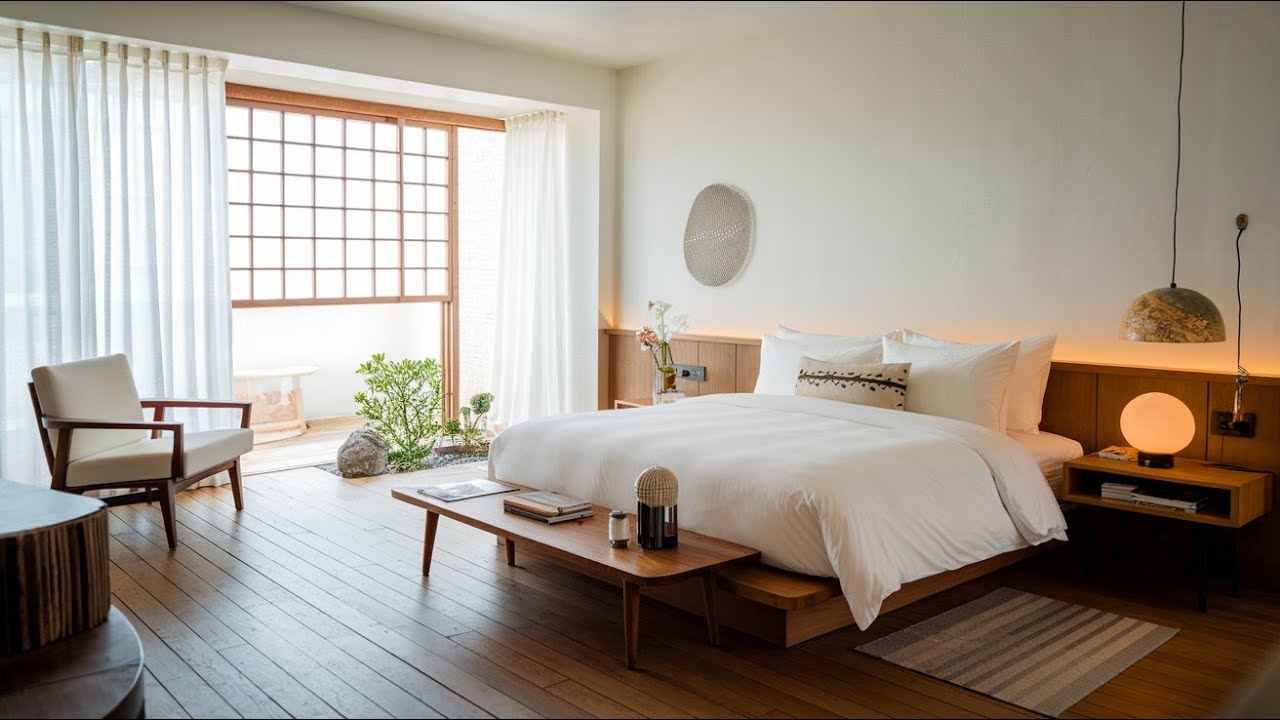
A tour of beautifully designed Japandi hotel interiors featuring natural materials, neutral tones, and the craftsmanship-forward specification approach that is reshaping hospitality design in 2025.
Frequently Asked Questions: Asian Furniture for Distributors, Showroom Owners, and Design Professionals
How do I differentiate my showroom from big-box retailers when they can undercut my prices?
Position on authenticity, expertise, and design integrity — the factors your professional clients value more than price. Document craftsmanship with provenance photography and maker stories, build designer relationships through consistent project support, and create a curated showroom experience that tells a coherent design story. Mass retailers cannot replicate a specialist’s depth of knowledge, quality of curation, or the genuine relationships built through years of design community engagement.
What’s the realistic margin I can expect on authentic Asian furniture versus mass-market pieces?
Specialty Asian furniture correctly positioned to design professionals and hospitality buyers typically supports 40–60% higher margins than mass-produced alternatives. Artisanal and handcrafted pieces — especially when paired with strong provenance documentation and a premium showroom context — regularly achieve 50–100% markups over landed cost. The key variable is positioning quality: the same piece at the same price point can feel appropriate in a premium specialty context and expensive in a commodity context.
How do I find reliable Asian manufacturers without risking quality or ethical compliance failures?
Vet manufacturers through a structured framework: verify all certifications independently (FSC certificate numbers via the FSC database), request 12-month quality data from existing clients of comparable order size, conduct sample orders with documented quality evaluation before committing to volume, and visit facilities in person when the relationship reaches significant volume. Start with conservative order sizes and build volume as reliability is confirmed. The Jade Ant Furniture sourcing guide provides a detailed manufacturer evaluation framework used by experienced importers.
What lead times should I expect when sourcing directly from Asian manufacturers?
Standard production lead times for solid wood furniture from Asian manufacturers range from 8–16 أسبوعًا depending on complexity and customization. Ocean freight from primary Asian production regions (Southeast China, Vietnam, Indonesia) to US ports adds 3–5 weeks depending on routing. Total import-to-availability timelines of 14–20 weeks are standard for custom and semi-custom pieces. With established direct manufacturer relationships, distributors typically negotiate priority production that can reduce this to 10–14 weeks for standard pieces.
How do I communicate the value of handcrafted, sustainable furniture to price-sensitive clients?
Reframe the conversation from price per unit to cost per year of service and design impact per project. A solid teak dining table lasting 25+ years in commercial use is a fraction of the cost per year of a mass-produced alternative that requires replacement every 5–7 years. For design professionals, the relevant frame is project quality: authentic, craftsmanship-verified pieces differentiate their projects in ways that designer clients recognize and attribute to the designer’s judgment. Use project photography, craftsmanship documentation, and sustainability certificates as tangible proof points that make value concrete.
Should I stock inventory or operate on a pre-order model?
A hybrid model consistently outperforms either extreme. Maintain in-stock inventory for your top 15–20 core pieces — the items designers specify repeatedly and that drive the majority of your commercial velocity. Operate on pre-order for your broader catalog and all custom or customized pieces. This approach balances capital efficiency (not tying up working capital in slow-moving SKUs) with the immediate availability that closes urgent project specifications. Communicate the model transparently to design professional clients so they can plan their project sourcing timelines appropriately.
What are the most profitable Asian furniture trends driving specification right now?
Japandi (the fusion of Japanese and Scandinavian design sensibilities) is currently the dominant commercial trend in premium hospitality, boutique hotel, and high-end residential specifications. Sustainable and FSC-certified solid wood collections are transitioning from differentiator to specification requirement in professional project work. Artisanal collections with documented craft provenance are commanding the strongest margin premiums. Bespoke customization capability — modified dimensions, custom finishes, designer fabric selections — is increasingly the deciding factor in high-value commercial specification decisions.
How do I handle customization requests without overcommitting my manufacturers?
Define clear customization parameters — what can be modified (dimensions within ±20% of standard, finishes within existing product range, upholstery fabrics from an approved list) versus what requires bespoke production — and communicate these parameters proactively during the designer briefing conversation, before customization requests are made. Build manufacturer customization capability assessment into your supplier vetting process. Set customization lead time commitments with buffer, and over-communicate progress milestones throughout the production cycle.
What certifications and standards should I verify when sourcing sustainable Asian furniture?
The primary certifications relevant to Asian furniture sourcing are: FSC (Forest Stewardship Council) certification for solid wood, verified through the FSC certificate database; PEFC certification as an alternative sustainable forest management standard; GREENGUARD certification for low chemical emissions (relevant for commercial and healthcare applications); and fair trade certifications for labor practice verification. For US imports of composite wood products, CARB (California Air Resources Board) and TSCA Title VI compliance for formaldehyde emissions are regulatory requirements, not optional certifications.
What’s the difference between positioning as a distributor, showroom, or designer-retailer, and which generates the best margins?
Distributors supply multiple showrooms (highest volume, lowest margins — typically 20–35% gross margin), operating as a B2B layer that requires scale to be viable. Showrooms sell direct to designers and consumers (medium volume, 45–65% gross margin), with the margin opportunity increasing with specialty positioning quality. Designer-retailers combine design service revenue with furniture retail (lower volume, highest margins — 60–100%+ on furniture, plus design fee revenue), but require both design credibility and retail infrastructure to operate effectively. The optimal model depends on your capital, market size, and existing expertise — but the highest margin potential clearly lies in the designer-retailer model or a high-specialty showroom positioned to serve the design trade.
How do I build and maintain relationships with interior designers and hotel procurement teams?
Consistency and genuine value are the foundations of professional relationships in this market. For interior designers: provide project-relevant content (trend guides, material samples, specification sheets), offer preferred pricing or early access to new arrivals, follow up on project outcomes, and be the partner who solves problems rather than creates them. For hotel procurement teams: understand their project timeline structure (fit-out contracts are awarded 12–18 months before opening), provide comprehensive specification documentation, and build a hospitality project portfolio that demonstrates you can meet the unique demands of commercial fit-out work. Attending هاي بوينت ماركت and regional design trade events provides the concentrated relationship-building access that replaces dozens of individual outreach efforts.
Can a specialty retailer build a viable position in a smaller market?
Yes — and smaller markets often offer structural advantages for specialty positioning. Less competition from other specialty importers means your curation stands out more clearly. Strong local designer relationships are easier to build and maintain when the design community is smaller. A reputation for expertise travels faster in a compact professional network. Use digital channels — a content-rich website, social media focused on craft and design storytelling, and trade publication contributions — to extend your reach beyond your immediate geography. Serious design professionals will travel for, or order remotely from, a source with genuinely exceptional curation and demonstrated expertise.
Useful Professional Resources:
- Jade Ant Furniture – Working with Chinese Furniture Suppliers Guide — Manufacturer evaluation framework
- Jade Ant Furniture – China Sourcing Hub Guide — Regional production expertise
- FSC Certificate Verification Database — Verify supplier sustainability credentials
- هاي بوينت ماركت — Industry’s premier trade relationship platform
- Interior Design Magazine – AD PRO — Design professional trend intelligence
- National Customs Brokers & Forwarders Association of America — Find specialist furniture import brokers
© Jade Ant Furniture | www.JadeAnt.com | Market data sourced from Mordor Intelligence Asia Pacific Furniture Market Report 2025, Grand View Research Furniture Market Report, Market.us Luxury Furniture Market Analysis, and 1stDibs Annual Designer Survey 2025.