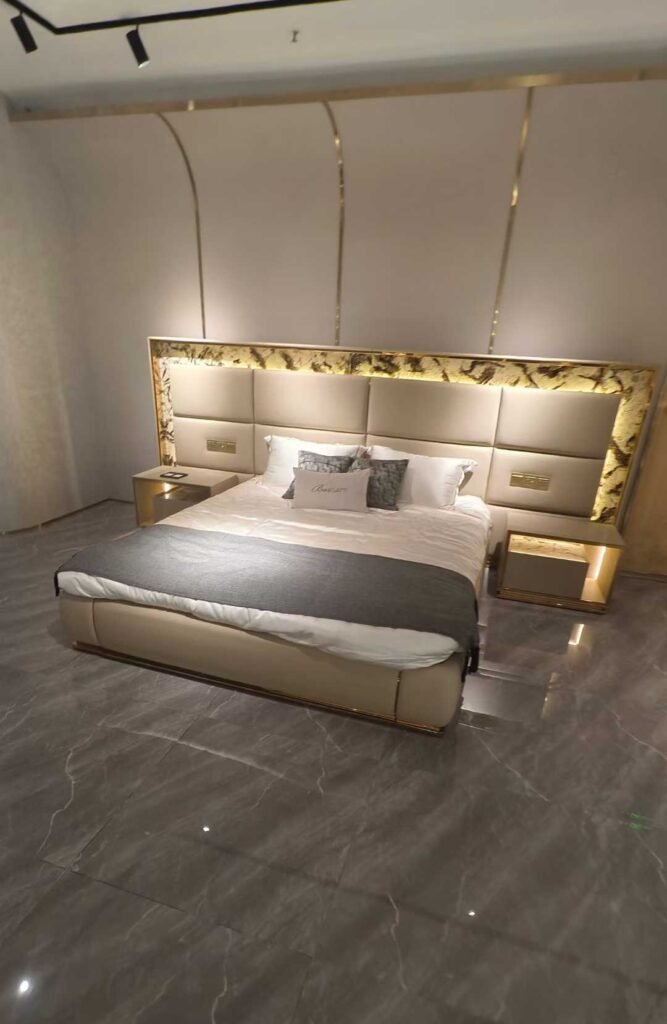
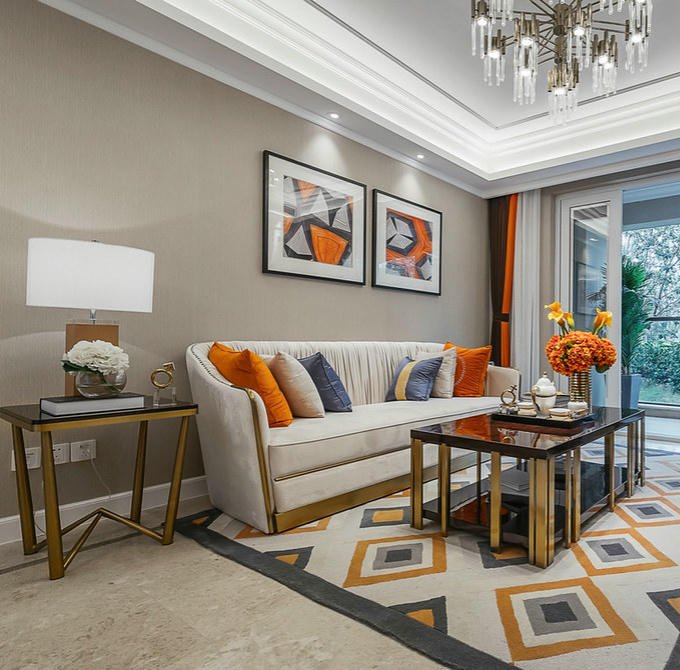
A room does not read as expensive because everything in it is expensive. It reads as expensive because of what the eye compares.
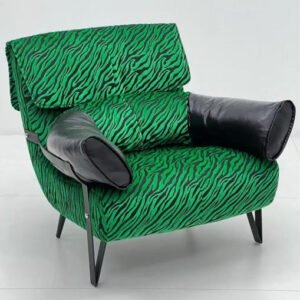
Put one well-made chair in a plain room and the room lifts. Put twenty average chairs in the same room and it goes flat. The eye needs a reference point. When every object sits at the same level, the brain stops looking.
This is the whole idea behind affordable luxury. You are not buying a cheaper version of a luxury room. You are choosing where the money lands.
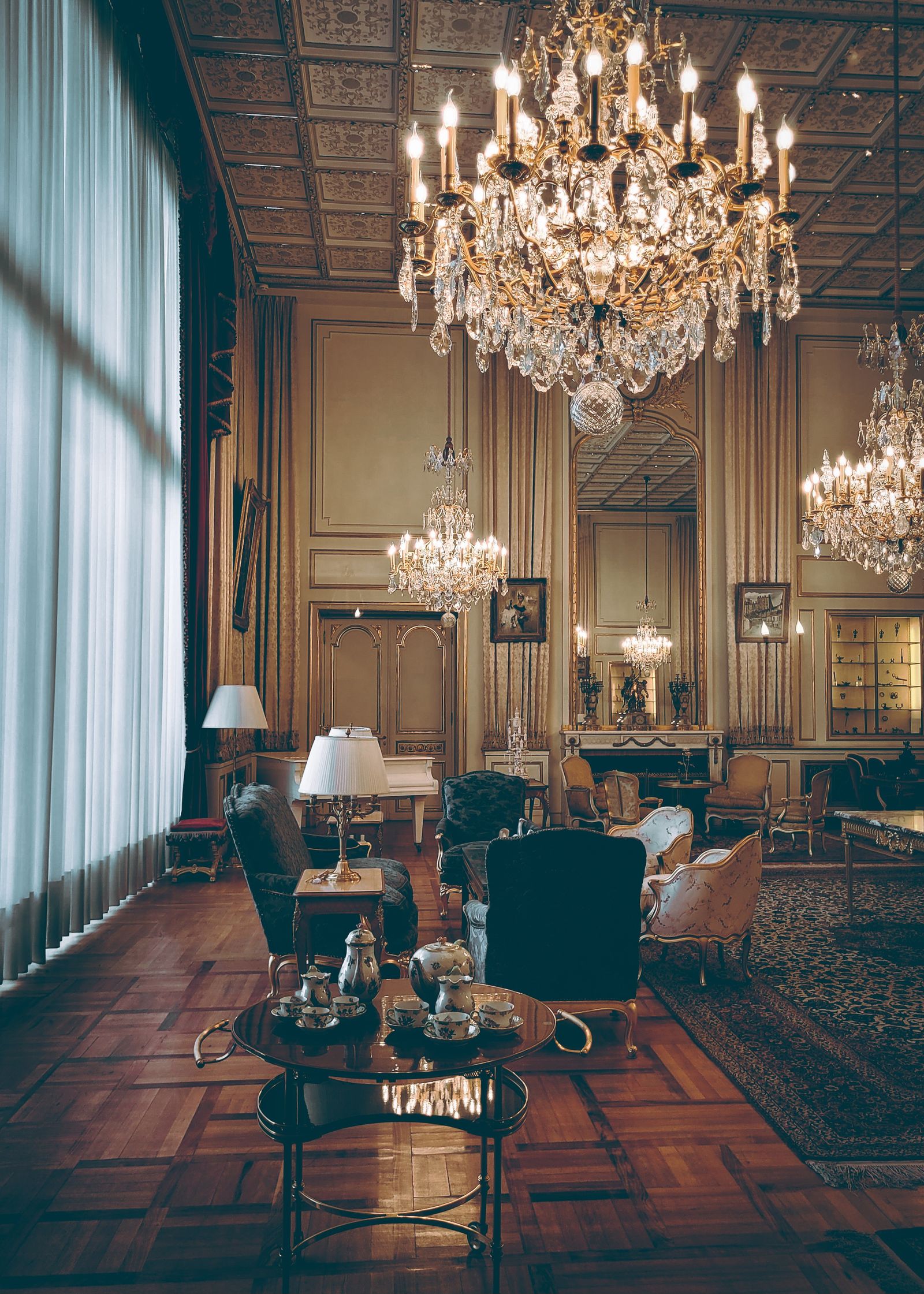
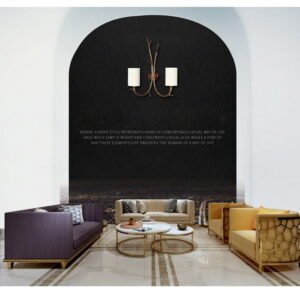
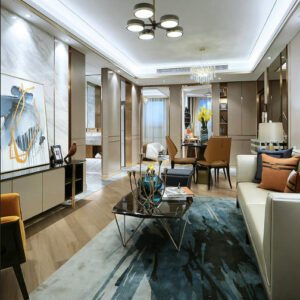
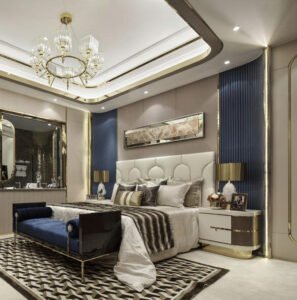
A room like this is built on contrast: heavy chandeliers, low seating, one dark accent. The cost sits in a few places, not everywhere.
Most people spend evenly. They buy twelve mid-priced items and hope the total feels rich. It rarely does. The room ends up correct and forgettable.
This guide is for the people who cannot afford forgettable. It is written for importers, distributors, villa owners, interior designers, private label owners, FF&E buyers, developers and hotel operators. Every section answers one question: where does the next dollar do the most work?
I. The Paradox of Luxury
Affordable luxury is a contested term. Some people use it to mean cheap furniture with a nice photo. That is not what this article means.
Affordable luxury means a piece that carries the signals of high-end design at a price below the brand premium. The signals are proportion, material weight, finish quality and construction. The premium you skip is the name on the label.
Three tiers get confused in almost every budget meeting.
| Cheap furniture | Affordable luxury | Designer brand | |
|---|---|---|---|
| الإطار | Particle board, stapled joints | Kiln-dried hardwood or 18 mm birch ply | Same as middle, plus tested to contract standards |
| الرغوة | 22–25 kg/m³, soft | 30–35 kg/m³, high resilience | 35–40 kg/m³, tested for compression set |
| الأقمشة | 220–280 g/m², loose weave | 380–450 g/m², tight weave | 400–600 g/m², often with a brand mill name |
| الأجهزة | Painted zinc alloy | Solid brass or brushed stainless | Same, usually custom tooled |
| Price for a lounge chair | 150–300 USD | 450–900 USD | 1,800–4,500 USD |
| Fails first | Joints, foam, seam | Finish, occasionally foam | Almost nothing within ten years |
The middle column is the one most projects should be buying. It is not a compromise. It is where the design work actually lives.
Why the middle tier exists at all
A designer chair costs what it costs for three reasons. The brand pays for its own retail space, its marketing and its licensing. It pays for a supply chain built around small runs. And it pays for the designer’s royalty.
A factory that builds to the same drawing carries none of the first two costs. That is why the same silhouette can sell for 500 USD and 3,000 USD. The gap is not a quality gap. It is a business model gap.
This is why professional buyers stopped asking “who makes it” and started asking “who builds it, and to what spec”. That question is the difference between paying for design and paying for a logo.
The professional’s real problem
Designers and procurement managers rarely get to choose their budget. They get handed a number and a date. The client wants a lobby that looks like the render. The render was made with unlimited pieces.
The job is translation. You take the intent of the render and rebuild it at the real number. That means deciding which two or three elements carry the look, and which ten can step back.
If you are still working out what “high-end” means in material terms, this breakdown of what separates luxury furniture from expensive furniture sets out the checks that matter.
II. The Hero Piece: One Anchor Per Room
Every room needs one object that sets the tone. Designers call it the anchor piece, or the hero piece.
A hero piece is the single item a guest reads first. It sets the colour, the scale and the quality level that everything else is judged against.
Choose it before you buy anything else. The hero piece decides the palette, the metal finish and the texture mix. Buy it last and you will spend the whole project matching it.
What makes a good hero piece
It should be big enough to hold the room. It should have a clear silhouette. It should look finished from behind, because people walk around furniture.
Good candidates:
- A sculptural sofa with a curved or low back
- An oversized dining table in stone or solid timber
- A single lounge chair with a strong profile
- A sideboard with book-matched veneer
- A bed with an upholstered headboard that reaches past the mattress line
Bad candidates: a coffee table, a rug, a floor lamp, a set of dining chairs. These are supporting cast. They cannot carry a room on their own.

One strong chair, one stone surface, one object of interest. The room works because nothing competes.
The contrast effect, in plain numbers
People judge value by comparison. A 900 USD chair looks ordinary beside four other 900 USD chairs. The same chair looks considered beside a 2,200 USD sofa and a 60 USD cushion.
Researchers call this anchoring. Buyers call it the reason a showroom works. The expensive item reframes the cheap one.
Practically, this means you should never buy your hero piece and your supporting pieces at the same price point. The gap is the design. Without a gap, the room reads as flat, and flat reads as cheap.
How much should the hero piece cost?
A rough rule from residential projects: 25–35% of a room’s furniture budget goes to the hero piece and its lighting.
On a 12,000 USD living room, that is 3,000–4,200 USD. Spend it on one sofa or one chair plus the light above it. Do not spread it across three items.
On a tight budget, the ratio goes up, not down. A 5,000 USD room might put 40% into one piece. The smaller the budget, the more the room depends on a single strong object.
When a client wants a shape that no range carries, Jade Ant furniture builds the hero piece to a drawing and keeps the rest of the room on a standard line. That split protects both the look and the schedule.
III. Material Intelligence: Where Cheap Reads as Cheap
Luxury is felt before it is seen. People touch a sofa arm within four seconds of sitting down. They register weight, temperature and give.
You can fake a silhouette. You cannot fake weight.
The three numbers that predict how a fabric feels
Ask for these before you approve a sample. Most suppliers will have them. The ones who do not are guessing.
| Number | ماذا يعني ذلك | Cheap | Affordable luxury | Contract grade |
|---|---|---|---|---|
| Weight (g/m²) | Grams per square metre. Heavier fabric drapes and holds shape. | 220–280 | 380–450 | 450–600 |
| Martindale (rubs) | Rubs survived before visible wear. A wear test, not a softness test. | 15,000–20,000 | 25,000–30,000 | 40,000+ |
| Composition | Fibre mix. Wool and linen blend well. Cheap polyester pills. | 100% low-grade polyester | Wool blend, cotton-linen, quality velvet | Wool, mohair, performance weave |
A 400 g/m² wool blend costs maybe 30% more per metre than a 250 g/m² polyester. It looks and feels twice as expensive. That is the best trade in the whole budget.
Bouclé, velvet and the look-alikes
Bouclé is a looped yarn fabric. The loops create a nubby surface that catches light. It photographs beautifully and hides marks well.
Good bouclé runs 450–600 g/m² with a tight, dense loop. Cheap bouclé runs 300 g/m² with loose loops that pull and snag within a year. The difference shows at the arm edge, where hands rest. Our fabric and finish checklist lists the tests we run on a sample before it is approved for production.
Velvet works on the same principle. Real cotton velvet has a dense pile that changes shade when you brush it. Polyester velvet has a flat, uniform sheen that looks wet under downlights.

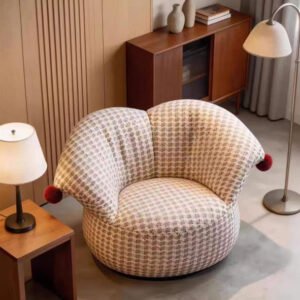
Bouclé works when the loop is dense. At this weight the fabric holds its shape at the arm and the seat edge.
Performance fabric has improved faster than any other category. Modern solution-dyed acrylics now pass 50,000 Martindale and feel like linen. For a villa with children or a hotel with daily cleaning, that is a better buy than a delicate natural fibre that has to be replaced in year three.
Mix textures, not patterns
Depth comes from contrast in surface, not from print. A matte linen cushion on a sheen velvet sofa reads richer than two patterned cushions.
A simple rule for any room: use three textures and one metal. Matte, soft, and smooth. Then one brass or bronze note. Stop there.
More than three textures starts to look busy. Busy looks cheap, because the eye cannot find a resting point.
The video below walks through the same idea from a designer’s side. Watch the sections on texture and on scale. Neither one needs a bigger budget, and both change how a finished room is read.
https://www.youtube.com/watch?v=sgrrrxaN6q4
Materials also move with the market. Dezeen tracks which finishes appear in new collections each season, and the shift toward heavier weaves and matte surfaces has been steady for several years.
IV. The Art of the Mix: 70/30 in Practice
A room where everything matches looks like a showroom. A room where nothing matches looks like a jumble. The middle path is deliberate mixing.
The 70/30 rule means 70% of the budget goes to foundational pieces and 30% to pieces that carry the look. Foundation means the things you sit on, sleep on and eat at. Impact means the hero piece, the lighting and the finishes people notice.

The chart shows one workable split. The point is not the exact figures. The point is that one line is bigger than the rest.
Break the set
Matching suites are the fastest way to make a room look bought in one afternoon. A sofa, two armchairs and a coffee table from the same range share the same timber, the same leg profile and the same cushion. The eye reads repetition as factory output.
Buy the sofa from one range. Buy the chairs from another. Change the leg finish on the coffee table. Keep the palette tight and let the shapes differ. That single habit does more for a room than an extra 5,000 USD.
Use one vintage or aged piece
New furniture has no history. One older piece gives the room a story it cannot otherwise have.
It does not need to be an antique. A 1970s sideboard from a house clearance, a brass tray from a market, a pair of old dining chairs recovered in new linen. The age shows in the patina, and patina is the one finish no factory can copy.
The resale market is deep enough to shop properly. 1stDibs lists enough vintage and licensed pieces that you can check a price before you commit.
Where mixing goes wrong
Three mistakes account for most bad mixes.
- Mixing eras without a common thread. Pick one thing that repeats: a metal, a wood tone, or a colour. Without it, the room reads as clutter.
- Mixing quality levels in the same sightline. A 200 USD chair beside a 3,000 USD sofa is fine at opposite ends of a room. Side by side, the gap becomes the subject.
- Mixing too many finishes. Brushed brass, polished chrome, black steel and aged bronze in one room is four decisions, not one.
V. Scale and Proportion: The Cheapest Luxury There Is
Scale is free. It costs nothing to buy the right size and everything to buy the wrong one.
Perceived luxury rises with proportion, not with price. A correctly scaled 600 USD sofa reads better than an undersized 3,000 USD one.
Buy bigger than feels safe
Most people buy furniture that is 10–20% too small. The room then looks half furnished, and half furnished looks cheap.
Working rules from project reviews:
- A sofa should run at least 55% of the wall it faces.
- A coffee table should sit 400–450 mm from the sofa front.
- A rug should extend at least 200 mm past the front legs of every seat in the group.
- A pendant over a dining table should hang 750–900 mm above the tabletop.
- In rooms above 3.5 m, drop pendants 300–400 mm lower to bring the eye down.
None of these rules cost money. All of them change how a room is read. For a room-by-room sequence in a private house, this villa furnishing plan sets out the order to buy in, so the hero piece is chosen before the accessories.
Leave the space empty
Negative space is the empty area around an object. It is the thing most home projects remove by accident, one cushion at a time.
A hero piece needs about 600 mm of clear space on its main viewing side. A dining chair needs 900 mm behind it to pull out. A bed needs 600 mm on each side to be usable.
When those gaps disappear, the room feels full. Full rooms feel small. Small rooms cannot feel luxurious, no matter what the furniture cost.
Some rooms cannot be fixed with standard sizes. A column, a low window or an odd corner needs a made-to-measure piece, and the maths on that decision is set out in this cost model for custom versus off-the-shelf furniture.
VI. Details: Hardware, Finish and Light
The gap between standard and luxury is often 3 mm wide. It is the thickness of a handle, the line where a seam meets a frame, the sheen on a painted leg.
Swap the hardware
This is the highest-return change in the whole budget. A standard zinc handle costs 2 USD and looks like it. A solid brass pull costs 12–20 USD and changes the read of the whole piece.
| Upgrade | Typical cost per unit | Visual lift | ملاحظات |
|---|---|---|---|
| Zinc handle to solid brass pull | 12–20 USD | عالية | Match finish across the room, not just the piece |
| Painted leg to solid oak leg | 15–30 USD | متوسط | Check the fixing plate, not just the shape |
| Plastic glides to felt or brass | 3–8 USD | Low but audible | Removes the plastic scrape sound on hard floors |
| Standard hinge to soft-close | 6–12 USD | منخفض | Matters in kitchens and wardrobes more than living rooms |
| Open shelf to veneered back panel | 40–90 USD | عالية | The back is what people see when they walk past |

A solid brass pull on a fluted door. The metal is the detail, and the hand goes there first.
Layer one colour, not five
An expensive room usually has fewer colours than a cheap one. Designers build depth with shades of a single neutral: ivory, sand, taupe, bronze.
Three shades of one tone plus one metal is enough. The eye reads the variation as richness. Five unrelated colours read as noise.
Watch the light reflectance value, or LRV. It measures how much light a surface bounces back, on a scale from 0 to 100. Keep adjacent surfaces 8–12 points apart. Closer than that, the difference looks like a mistake rather than a decision.
Treat lighting as jewellery
Light is the cheapest way to change perceived value. A 400 USD lamp can lift a 2,000 USD seating group. A single ceiling fitting cannot.
Use three layers: ambient, task and accent. Set warm bulbs at 2700K in living areas. Put the whole room on dimmers. Then light the hero piece from two directions, because one source flattens it.
Check what the light lands on, too. Cheap finishes off-gas for weeks, and the smell sits in a sealed room. Specify low-VOC products and look for GREENGUARD Gold on the finish schedule. Jade Ant furniture flags the certified options on every quote, because a client always asks in week two.
VII. The Sensory Layer: What Guests Remember
Hotels and developers learned this before homeowners did. Comfort is a set of small physical signals, and each one is cheap relative to the furniture.
Tactile signals carry more weight than visual ones, because guests touch before they judge.
Weight you can feel
A throw that weighs 1.2 kg feels expensive. The same size throw at 400 g feels like a towel. The difference is wool content and weave density, not brand.
The same applies to cushions. A feather-down insert at 600 g holds a karate chop. A hollowfibre insert at 250 g springs back and looks flat within a week. The insert costs less than the cover and decides how the cover looks.
Rugs follow the rule too. A hand-knotted wool rug at 2,500 g/m² sits flat and quiet underfoot. A machine-made polypropylene at 900 g/m² slides and rustles.
Layout decides how a room feels
A room with a clear path feels calm. A room where you have to walk around a chair feels tight.
Keep 900–1,200 mm on main circulation routes. Group seating so knees point at each other, not at a television. Leave one obvious way in and one obvious way out.
Guests do not analyse this. They just move easily, and easy movement reads as good design.
Scent and sound
These cost almost nothing and change everything.
A hotel lobby with a signature scent is remembered as a place, not a building. A villa with a hard floor and no textiles echoes, and echo reads as empty. Add a rug, a curtain and an upholstered headboard, and the room goes quiet.
If you run multiple properties, standardise the scent and the playlist the way you standardise the palette. Consistency is the luxury, not the individual element.
Operators who buy loose furniture, joinery and lighting as one package find this easier to control. One supplier, one material list, one set of spares. Our one-stop furnishing model explains how that package is assembled.
VIII. Sourcing: How Professionals Buy This
Buyers who do this well are not finding cheaper shops. They are changing the route to market. If you are still deciding whether to manufacture or distribute, this comparison of manufacturer and distributor roles sets out where margin, control and risk sit.
White label versus private label
White label means a factory’s existing product sold under your brand. Private label means a product made to your specification and sold under your brand.
| Route | Who designs | Minimum order | الهامش | الأفضل لـ |
|---|---|---|---|---|
| Brand purchase | The brand | None | Low, fixed retail | A single hero piece with resale value |
| White label | The factory | 20–50 pieces | متوسط | Fast range building, tested designs |
| Private label | You, with the factory | 100+ pieces | Highest | Building a defensible range |
| Custom project | You, per room | 1+ | Project margin | Villas, hotels, awkward spaces |
The margin gap is the reason importers move toward private label. A brand piece carries 40–60% gross margin for the brand. A private label piece carries 45–55% for you. Our private label collection was built from one material palette, not from a list of bestsellers.
That shift is not free. It needs drawings, samples and a quality system. Our sourcing plan for importers sets out how to split a range between stocked models and made-to-order pieces.
It also changes how you sell. A private label range needs a story before it needs a price list, and this brand positioning guide covers how to build one from materials and proportion.
The specification is the product
A factory builds to a document. If the document is vague, the factory fills the gaps with whatever is on the floor that week.
A usable specification names the frame timber and moisture content, the foam density, the fabric weight and Martindale, the seam type, the finish system, and the tolerance on every dimension. Our FF&E specification guide shows the sheet format we hand to production.
If the project reports on sourcing, add certification to the sheet. FSC chain of custody covers the timber, and the certificate belongs to a factory and a product line, not to a brand name. Ask for the number and the expiry date.
Quality control you can actually run
Do not rely on a factory tour. A tour shows the best bench on the best day. Use a checklist and photograph every step. Most contract buyers also settle the standard in person at trade shows such as NeoCon, where frames and foam can be compared side by side.
| Check | الطريقة | Pass standard |
|---|---|---|
| Frame rigidity | Twist opposite corners, listen | No movement, no rattle |
| كثافة الرغوة | Weigh a cut sample from a hidden cushion | Within 5% of spec |
| Seam integrity | Pull test at the stress point | No gap, no loose thread |
| Fabric match | Compare panels under daylight | No visible step |
| Finish | Rub with a white cloth | No colour transfer |
| الأجهزة | Operate 20 times | No binding, no marks |
| Carton | Drop test one box | Frame undamaged |
Jade Ant furniture photographs each of these stages and sends the file before the container is sealed. That file is the only evidence that survives a six-week sea freight and a change of site manager. The custom manufacturing process we use covers how each stage is signed off, from shop drawing to crate.
IX. Longevity: The Quiet Half of the Budget
A cheap piece is not cheap if you buy it three times. This is the argument that changes budget meetings.
Illustrative model for a 40-seat lounge. Purchase, freight and install are included on every route. The budget route also counts two full replacement rounds.
The middle route wins, and it wins for a reason most buyers miss. A 380 USD lobby chair lasts about two and a half years under daily use. Over six years the lounge needs three rounds of them. Each round adds freight, install and six weeks of half-empty seating.
The designer route lasts the full six years and costs 71% more. The mixed route gets the same visual result for 49,000 USD, because the twelve seats guests photograph are built properly and the other twenty-eight are built to a sensible spec.
Protect the finish, not just the fabric
Most damage in a luxury room is not wear. It is chemistry. An all-purpose spray on marble etches it. Ammonia on lacquer clouds it. A beater bar on velvet crushes the pile for good.
Three products cover most of a house: a pH-neutral cleaner, a stone cleaner and a leather cleaner. Add a microfiber cloth and a hygrometer. The whole kit costs less than one re-cover.
Hold indoor humidity at 45–55%. Wood moves when humidity swings, and veneer lifts at the edges first. Our care routines for luxury furniture list the intervals by material.
Damage can also start before delivery. A sealed container crossing the equator can sit above 60°C for days. Our import roadmap covers the packing and acclimatisation steps that prevent it.
Buy timeless shapes
A trend has a three-year life. A proportion does not.
Low, deep seating has worked for seventy years. A round dining table has worked for two thousand. A fluted plinth is having a moment and will pass.
If the budget is tight, spend it on shapes that will still look right when the paint colour changes. Trend pieces are for the accessories, where replacement is cheap.
The property effect
Appraisers and buyers read furniture as maintenance. Worn pieces read as deferred cost. Well-kept pieces read as a finished asset.
For developers, a show unit furnished at this level supports a higher asking price per square metre, because buyers compare finished homes rather than floor plans. For operators, the effect lands in the FF&E replacement line of the annual budget.
The finished look depends on the brief. A drawing that leaves three decisions open comes back as three different pieces. This outline of what interior designers need from an FF&E supplier covers the pack that closes those gaps before production starts.
X. Conclusion
The framework is simple, and none of it depends on a bigger budget.
Pick one hero piece per room and let it set the palette. Spend on weight and weave, not on print. Mix sources so nothing matches a set. Buy the correct scale and leave the gaps. Upgrade the hardware and layer the light. Then protect what you bought.
Luxury is a design philosophy, not a price tag. A 12,000 USD room planned this way will outread a 40,000 USD room bought from one catalogue, because the eye rewards intention.
The shift starts in procurement, not in the showroom. Write a specification instead of a shopping list. Ask for the foam density and the fabric weight. Then decide where the hero piece goes.
If you are planning a villa, a hotel floor or a private label range, send us the room schedule and the budget line. Jade Ant furniture reviews the specification before quoting, so the money lands where it shows. Talk to our project team with your drawings, or browse our current catalogue to see how the pieces are built.
Glossary: Terms Used in This Guide
| المصطلح | ماذا يعني ذلك |
|---|---|
| Affordable luxury | A piece with high-end proportion, material and finish at a price below the brand premium. |
| Hero piece | The one object a guest reads first. It sets colour, scale and quality for the room. |
| Anchoring | A pricing effect. The eye judges value by comparison with the most prominent item nearby. |
| Martindale | A wear test. It counts the rubs a fabric survives before it shows damage. |
| GSM (g/m²) | Grams per square metre. A weight measure for fabric. Higher usually means better drape. |
| Bouclé | A fabric with a looped yarn surface. Dense loops hold shape. Loose loops snag. |
| LRV | Light reflectance value, 0–100. It measures how much light a surface bounces back. |
| Negative space | The clear area left around a piece so it can be seen and used. |
| White label | A factory’s own product sold under a buyer’s brand. |
| Private label | A product made to the buyer’s specification and sold under the buyer’s brand. |
| Patina | The surface change that comes with age and use. Factories cannot reproduce it. |
| Value engineering | Swapping a material or method for a cheaper one while keeping the look and the function. |
الأسئلة الشائعة
How do I tell “cheap” from “affordable luxury” furniture?
Check four things. The frame should be kiln-dried hardwood or 18 mm birch ply, not particle board. The foam should be 30 kg/m³ or more. The fabric should weigh 380 g/m² or more. The hardware should be solid metal, not painted alloy. A piece that passes all four is affordable luxury. A piece that fails two is cheap with a good photo.
Which materials give the highest perceived value for the lowest cost?
Wool-blend upholstery at 400 g/m², solid brass hardware, and stone or solid timber tops. Each one adds weight, temperature or reflection — the three signals people read as quality. A wool blend costs roughly 30% more than polyester and reads twice as expensive. Brass hardware costs 12–20 USD per unit and changes the whole piece.
Can mixing different styles of affordable furniture make a room look cluttered?
Yes, if there is no repeated element. Pick one thing that appears in every piece: a metal, a wood tone or a colour. Then limit the room to three textures and one metal. With that thread, mixed eras look collected. Without it, they look random.
What are the best hero pieces for a living room versus a bedroom?
In a living room, the sofa or one lounge chair. Choose the piece with the strongest silhouette and the largest footprint you can afford. In a bedroom, the bed and its headboard, because the headboard sets the height line for the whole room. In both cases, spend 25–35% of the room budget there and keep the rest quieter.
How do I make affordable furniture meet hotel durability standards?
Specify to the contract numbers, not the retail numbers. Ask for 40,000+ Martindale on lobby fabric, 38 kg/m³ foam, and a frame tested to 136 kg static load. Ask for the test report, not the brochure. Then require removable covers and a spare foam set per seat type, so a repair does not need a new production run.
Which colour palettes make a space look more expensive?
Fewer colours, more shades. Three tones of one neutral plus one metal covers most high-end rooms. Keep adjacent surfaces 8–12 LRV points apart so the difference reads as a decision. A tight palette makes cheap pieces look considered and makes expensive pieces look calm.
How do I convince a client that mixing budget and luxury pieces is better?
Show them two sample boards at the same total cost. One uses twelve mid-priced items. The other uses one strong piece plus eleven supporting items. Most clients pick the second board before you explain why. Then give them the number: the mixed route usually costs 30–40% less than an all-designer room with the same visual weight.
What are the most common mistakes in trying to get a luxury look on a budget?
Four. Buying furniture 10–20% too small. Spending evenly instead of concentrating the budget. Buying a matching set. And ignoring the fabric weight because the colour was right. Each one is fixable before the order and expensive after it.
How does scale affect how luxurious a piece looks?
Scale changes the ratio between object and room. An undersized sofa in a large room leaves gaps that read as incomplete. A correctly sized piece fills the volume and makes the ceiling feel intentional. A sofa at 55% of its wall, with 400–450 mm to the coffee table, reads richer than the same sofa bought at twice the price in the wrong size.
Which hardware upgrades give the biggest visual lift?
Solid brass pulls on doors and drawers, solid timber legs in place of painted ones, and a veneered back panel on any open shelving. The first changes how a hand feels. The second changes how the piece meets the floor. The third matters because people see the back of a cabinet every time they walk past it.