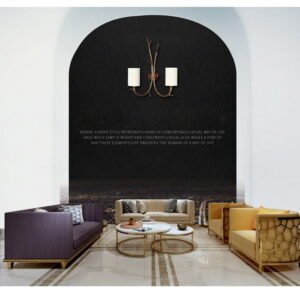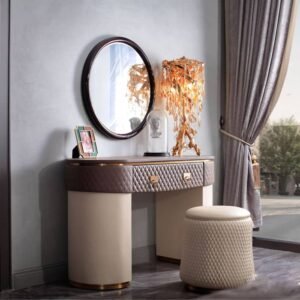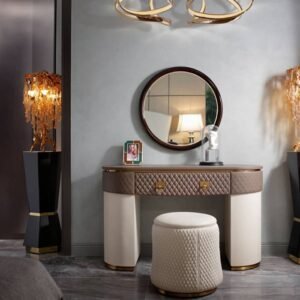
Custom Luxury Furniture Manufacturing: How Designers and Developers Move Beyond Catalog Luxury
For high-end importers and distributors, villa owners, interior designers, private label brand owners, FF&E and hotel buyers, architecture and engineering firms, developers, and hotel operators.
The short answer: Custom manufacturing lets you design furniture for the room instead of fitting the room around a catalog piece. You get the exact size, material and finish you specified. You also get a look that competitors cannot buy off a shelf. To make it work, you need three safeguards: shop drawings, a golden sample, و independent inspection.
I. Luxury is shifting from “ready-to-ship” to “designed-to-order.”
A few years ago, a designer could open a catalog, pick a sofa, and call it done. That still works for some jobs. But on projects where the building, the brand and the client are all one-of-a-kind, a catalog piece often feels like a compromise.
The conflict: big visions meet standard catalogs.
Picture a designer with a curved lobby wall and a brand story built around warm bronze. The catalog sofa is 2.4 meters long and comes in six fabrics. The wall curves at 2.1 meters. The bronze is the wrong shade. Something has to give, and it is usually the design.
The solution: a strategic partnership with a specialized manufacturer.
More buyers now work directly with custom manufacturers, in China and in other global hubs. Instead of picking from a fixed range, they hand over drawings, material references and a brand brief. The factory builds to that brief.
The “sameness” problem, solved.
Walk through ten luxury hotels and you will often see the same lounge chair in four of them. Bespoke sourcing solves this. Your pieces are drawn for your project, so no one else has them.
This guide shows how it works, where the money is made, and how to avoid the “quality gap” fear that holds many buyers back. If you are new to the wider process, our guide to importing and distributing high-end furniture covers the basics before you dive in.
The luxury furniture market is growing, which raises the stakes. Business Research Insights values it at $38.2 billion in 2026, heading toward $60.79 billion by 2035, according to its luxury furniture market report. As more brands compete for the same buyers, being different matters more.
II. The Limitations of Off-the-Shelf Luxury
Standard luxury collections often cannot meet the exact spatial and design needs of elite homes and hotels. They are great products. They are just not made for your project.
Quick definition: Off-the-shelf luxury (also called ready-made or ready-to-ship) means premium furniture made in fixed sizes, fixed finishes and fixed fabrics, sold from a catalog.
Point 1: The “Catalog Look”
When many projects pull from the same collections, the same pieces show up everywhere. Guests may not notice. But the owner does, and so does the next client who has seen it three times.
Branded Italian and French houses do offer strong design heritage. Our review of top branded luxury manufacturers shows that even they limit customization to their own collection frameworks. That is fine for some jobs. It is a risk when your brief is “no one else has this.”
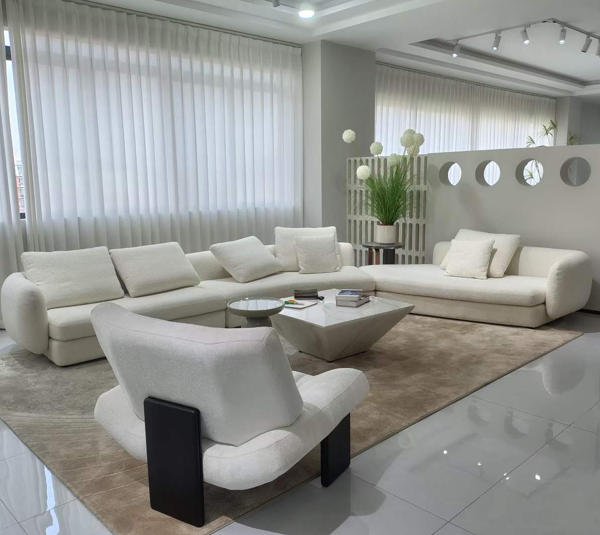
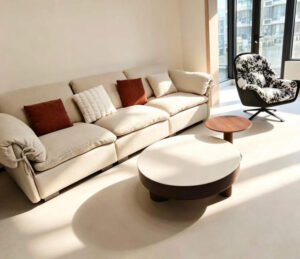
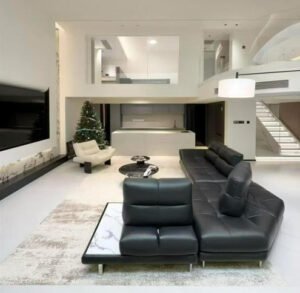
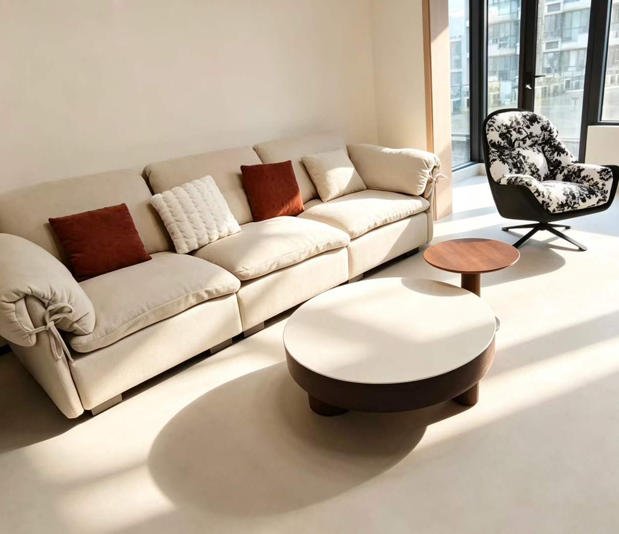
In a penthouse like this, a standard-depth sofa can cut into the walkway. Custom sizing keeps the view and the flow.
Point 2: Dimensional Incompatibility
Architecture rarely follows catalog sizes. Common problems include:
- An alcove 2,150 mm wide, where the nearest catalog sofa is 2,300 mm.
- A curved wall that leaves dead gaps behind straight-backed seating.
- A hotel corridor that needs a nightstand 30 mm slimmer than any standard model.
- A double-height villa room that needs a taller backrest to hold its scale.
Each time, the choice is to move a wall, shrink the plan, or accept a poor fit.
Point 3: Material Rigidity
Catalogs offer a set list of finishes and fabrics. If your brand color is a specific warm bronze, or your client wants their own fabric from a Belgian mill, you are stuck.
Quick definition: COM (Customer’s Own Material). The designer or client supplies the fabric, and the factory upholsters the piece with it.
نظرة ثاقبة على القطاع: Designers tell us the most common reason they leave a catalog is not size. It is finish. A “close enough” shade across 80 rooms is visible every day to the owner.
| Limit | What it costs you | Custom fix |
|---|---|---|
| Fixed sizes | Compromised layout | Made to the plan, in millimeters |
| Fixed finishes | Off-brand color | Matched to your sample or code |
| Same collection as others | Weak differentiation | Original silhouette or details |
| Long wait for restock | Opening delays | Production slot booked against your timeline |
III. Architectural Synergy: Designing for the Space, Not the Furniture
Custom manufacturing flips the design process. You start with the room. The furniture becomes part of the architecture.
Point 1: Precision Engineering
A custom piece can slot into built-in millwork (wall-fitted cabinetry and joinery) and awkward structural voids (gaps around columns, bulkheads and stair landings).
The key is accurate drawings. A shop drawing is a detailed technical plan that shows the exact size, materials, joints and hardware of one piece. It is the factory’s instruction sheet, and the designer approves it before anything is cut. This shop drawing explainer shows the common types.
Jade Ant furniture works this way. It accepts custom dimensions, material specifications, COM fabric and finish documentation, and it produces technical shop drawings for designer approval before mass production begins.

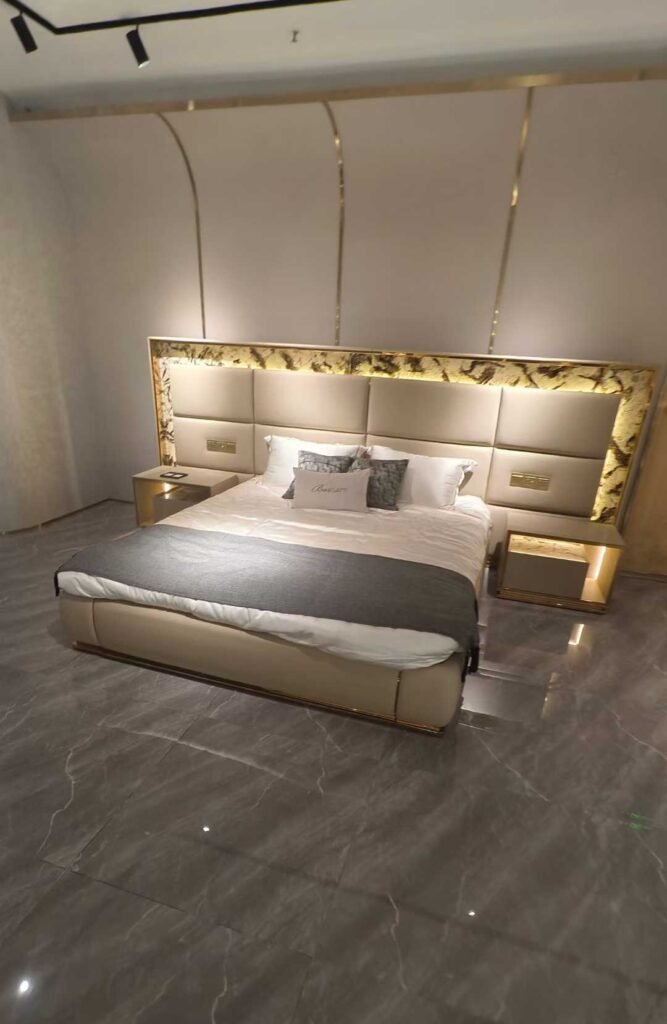
A bed, nightstands and a bench built as one coordinated set sit better in a room than catalog pieces from three collections.
Point 2: Scale Optimization
Scale is how the size of a piece relates to the room. A lobby with a 6-meter ceiling can swallow a standard lounge chair. A slightly taller back, a deeper seat and a longer sofa change how big the room feels.
Here is a simple way to think about it:
| Space | Catalog problem | Custom adjustment |
|---|---|---|
| Hotel lobby with tall ceiling | Seating looks small and lost | Higher backs, longer modules, one tall anchor piece |
| Compact boutique suite | Standard desk blocks the path | A narrower, wall-hugging desk with slim legs |
| Large villa living room | Sofa floats with no relationship to the room | Sectional sized to the rug and sight lines |
For more on proportion in large homes, see our villa furniture strategy guide.
Point 3: Site-Specific Functionality
Custom pieces can also solve problems, not just fill space:
- A bench with hidden storage for a stair landing.
- A console table with a built-in cable channel for a media wall.
- A bar cabinet that doubles as a room divider in an open-plan villa.
- A headboard with integrated lighting and charging for a hotel suite.
If the problem is specific, the answer should be too. Catalogs are built for the average room, and few rooms are average.
IV. Material Innovation and the Pursuit of Exclusivity
Working directly with a custom manufacturer opens up a much wider range of materials and techniques. You are no longer limited to what a brand has already decided to stock.
Point 1: Sourcing Rare Elements
Custom buyers can specify:
- Exotic stones: one bookmatched marble slab for a dining top, with a pattern no one can repeat.
- Specialty metals: hand-patinated brass, blackened steel, or bronze-tinted stainless.
- Artisanal leathers: top-grain or full-grain hides from a named tannery.
Quick definition: Bookmatched. Two mirrored cuts from the same stone or wood block, laid side by side so the pattern forms a symmetrical design.
Skilled hand work on solid wood is what separates a bespoke frame from a stapled one.
Our guide to sourcing luxury furniture in China explains how to check material origin and provenance before you pay a deposit.
Point 2: Bespoke Finishes
A proprietary finish is a color or texture developed just for your brand or project. Examples include a signature lacquer shade, a hand-aged patina on brass, or a woven textile in your brand palette.
To keep a finish consistent across batches, use numbered color standards instead of words. RAL is a European color system used for paints and coatings. A code like “RAL 7016” means the same thing in Foshan and in Milan. “Warm grey” does not.
نظرة ثاقبة على القطاع: For a bespoke finish, sign off three things: a physical color chip, a sheen level (matte, satin or gloss), and a limit sample showing the lightest and darkest versions you will accept. This removes opinion from the dispute.
Point 3: Quality Control and Grade-A Specification
Custom work lets you name the grade of every material. For high-traffic FF&E, that matters.
المفروشات والمعدات والأثاث means furniture, fixtures and equipment: the movable items in a hotel or villa.
| Item | What to specify | Why it matters |
|---|---|---|
| Hardwood | Species, grade, moisture content | Prevents warping and cracking |
| Foam | Density and firmness | Stops early sagging |
| الأقمشة | Abrasion rating, such as Martindale cycles | Lobby seating needs more than a guest room chair; see this rub count guide |
| Hardware | Brand and model | Keeps replacement parts easy to find |
| Finish | Code, sheen and test method | Keeps batches matching |
Not sure what to check? Our luxury furniture investment checklist lists the questions buyers should ask on every spec.
V. Economic Viability: The ROI of Direct Custom Sourcing
Custom manufacturing is a financial decision as much as a design one. For developers and brand owners, the numbers matter.
Point 1: Eliminating the “Brand Markup”
A big part of a luxury showroom price pays for the brand, the retail space and the sales team. That is not a bad thing, but you should know what you are buying.
Here is one clue. Jade Ant’s guide to branded luxury manufacturers notes that distributors of luxury Italian brands typically negotiate 40 to 55 percent off retail. That gap shows how much of the shelf price goes into the retail structure.
Buying direct from a custom manufacturer moves part of that budget into materials, finish or a better spec. Here is a simple, illustrative way to picture the shift:
Illustrative model only, not survey data. Real splits vary by brand and market.
A caution: direct sourcing adds costs too. Freight, duties, inspection and your own management time all count. The right comparison is التكلفة الشاملة, meaning everything it takes to get the piece to your site. In Jade Ant’s bulk sourcing guide, a $200 FOB sofa ends up at about $266.60 delivered to Los Angeles, a 33 percent uplift. Always compare quotes on landed cost.
فوب (مجاناً على ظهر السفينة) means the seller’s price covers the piece up to loading at the origin port. The buyer pays freight, insurance and duties from there.
Our cost versus quality analysis shows how to run the full comparison.
Point 2: Scalability for FF&E
Custom design is not only for one-off pieces. Once a design is drawn, approved and sampled, it can be repeated across 60 rooms or 12 hotels.
Jade Ant’s hospitality case-study guide describes a resort group that moved from several suppliers to one manufacturer with a modular design system. According to that guide’s aggregated figures, on-time delivery rose from 62% to 91% and defects at pre-shipment dropped from 8.4% to 2.1%. The numbers are drawn from comparable programs, so treat them as a guide, not a promise.
Once a bespoke bed and nightstand are approved, they can be replicated across a full hotel floor.
Point 3: Asset Value Enhancement
Unique interiors do two things. They help a hotel earn a higher ADR (average daily rate, the average revenue per occupied room). And they give a villa a story that photographs well and sells.
A signature lobby chair that appears in magazines and guest photos becomes a marketing asset. A standard catalog chair does not.
VI. Navigating the Global Supply Chain: The China Advantage
Modern manufacturing hubs, especially in China, combine skilled handwork with industrial efficiency. For custom luxury, that combination is rare.
China’s luxury furniture market alone is valued at about USD 4.1 billion in 2025 and forecast to reach USD 6.8 billion by 2035, per GM Insights. It is also the export base for many global brands. For a deeper look at the sector, read Jade Ant’s China furniture industry guide.
Segment shares are 2025 estimates published in Jade Ant’s bulk sourcing guide, which cites Lesprom, Mordor Intelligence and GACC China.
Point 1: Advanced Prototyping
A prototype is a physical sample built to your final specification. Chinese hubs can often turn samples around faster than other regions, because the materials, upholstery and finishing teams are close together.
A sample gives you three things:
- A chance to feel the comfort and proportions.
- A check on finish color under real light.
- A chance to catch construction problems before mass production.
A typical first-time custom order moves through clear phases. This example from Jade Ant’s bulk sourcing guide covers 200 upholstered dining chairs:
| المرحلة | Activity | Duration |
|---|---|---|
| 1 | Supplier selection | Weeks 1 to 3 |
| 2 | Counter sample produced and reviewed | Weeks 4 to 6 |
| 3 | Pre-production sample approved | Weeks 7 to 8 |
| 4 | Pilot run (20 units) | Weeks 9 to 11 |
| 5 | Full production | Weeks 12 to 16 |
| 6 | Pre-shipment inspection and loading | Weeks 17 to 18 |
| 7 | Ocean transit | Weeks 19 to 21 |
| 8 | Customs and delivery | Weeks 22 to 23 |
That is roughly 23 weeks end to end for a first order. Repeat orders are faster because approvals already exist.
Ranges come from the OEM, ODM and ready-made comparison in Jade Ant’s bulk sourcing guide.
Quick definition: OEM vs. ODM. With OEM (original equipment manufacturer), the factory builds your design. With ODM (original design manufacturer), the factory offers a base design that you adjust and brand.
Point 2: Vertical Integration
Vertical integration means one factory (or one tight cluster) handles fabrication, upholstery and finishing under one roof, or within a short drive.
Why it matters to you:
- Fewer handoffs, so fewer places for errors or delays.
- Quicker fixes. A finish issue can be corrected in days, not weeks.
- Easier quality control, since one team owns the outcome.
Foshan in Guangdong is the best-known furniture cluster. See this overview of Foshan for background, and this video on how China became the center of the furniture trade:

Watch: how Foshan and other Chinese clusters grew into global furniture hubs.
A visible QC station and organized material zones are signs of a factory that controls its process.
Point 3: Infrastructure and Logistics
China’s established shipping lanes help you plan. Guangzhou, Shenzhen and Ningbo are the main furniture export ports, and transit from China to the US West Coast is typically about 14 to 18 days, per Jade Ant’s bulk sourcing guide.
Container loading at a major port. Plan your project dates around the vessel, not the factory gate.
Pick your shipping term early. Our guide to FOB, CIF and EXW terms explains which suits which buyer.
نظرة ثاقبة على القطاع: Plan around Chinese New Year, when many factories close for two to four weeks and ramp up slowly after. For a Q4 delivery, orders are best placed by June.
VII. Risk Mitigation in Bespoke Procurement
The “quality gap” fear is real, and it is solvable. Most failures come from vague instructions and skipped checks, not from bad factories.
Point 1: Technical Drawing Alignment
Most disputes start with a photo and a verbal brief. Replace both with drawings.
A strong technical package includes:
- Dimensioned drawings in millimeters (plan, front, side and section).
- A BOM (bill of materials), which lists every part, material and hardware item.
- Finish codes and physical swatches.
- Tolerances, meaning the amount a measurement may vary before it counts as a defect.
- Packaging notes.
Learn more about how professionals move from a concept to production drawings in this custom furniture design process guide. Jade Ant furniture also states that CAD drafting is part of its quoting process for custom projects.
A signed reference piece, like this platform bed, becomes the benchmark every later unit must match.
Point 2: Third-Party Inspection
An independent inspector works for you, not the factory. Providers such as QIMA inspect goods on site and send photo reports.
Use a three-stage plan:
| المرحلة | عندما | What is checked |
|---|---|---|
| Pre-production inspection | Before manufacturing starts | Materials match the spec |
| During-production inspection | At 20 to 30% completion | Early errors still cheap to fix |
| Pre-shipment inspection | When 80% or more is finished | Measured, tested and photographed units |
Sampling is usually based on AQL (Acceptable Quality Level), a rule that says how many defects a batch may contain and still pass. For luxury work, many buyers set critical defects at zero and major defects tighter than standard. See this furniture AQL guide and defect checklist for examples.
The effect is large. In inspection data shared in Jade Ant’s bed manufacturer comparison, a structured three-checkpoint program cut defect rates across every category:
Data source: pre-shipment inspections in Guangdong, 2024 to 2025, as reported in Jade Ant’s bed manufacturer guide. Results will vary by factory and product.
This video explains the main inspection types buyers use:

Watch: furniture quality control inspections for buyers and importers.
For more on how to judge a factory before you place an order, read how to assess furniture quality from Chinese manufacturers.
Point 3: Sampling Protocols
A golden sample is the approved production-quality piece that every later unit must match. In bulk orders, it is often called the pre-production sample (PPS).
Jade Ant’s bulk sourcing guide reports that roughly 62% of quality disputes trace back to a factory using a different material grade or process in mass production than in the approved sample. That is why a signed sample agreement matters.
Follow this simple protocol:
- Approve drawings and finish chips first.
- Review a counter sample and mark corrections.
- Sign off the final sample in writing. The factory keeps one, and you keep one if you can.
- For orders above about 500 units, ask for a 20-to-30-unit pilot run.
- Compare the pre-shipment inspection to the golden sample, not to the render.
Before you sign with any factory, our guide to choosing a hospitality contract manufacturer lists the questions to ask.
VIII. Brand Identity and the Private Label Opportunity
For brand owners, custom manufacturing is the engine of a distinct market position. You are not just selling furniture. You are selling a look no one else has.
Quick definition: Private label means the manufacturer builds furniture to your design and brand, and you sell it under your name.
A signature bed with a distinctive headboard can anchor a whole private label collection.
Point 1: Intellectual Property Protection
A unique silhouette is hard to copy only if you protect it. Basic steps include:
- Sign an NDA (non-disclosure agreement) before you share drawings.
- Register your design where you plan to sell and manufacture. In China, design rights generally go to the first party to file, so file early. Read more about industrial design rights.
- Keep ownership of drawings, molds and patterns in the contract.
- Share only what each supplier needs to see.
This is general information, not legal advice. Have a lawyer who knows cross-border manufacturing review your agreement. Our private label furniture guide covers the business side in more detail.
Point 2: Cohesive Collection Building
A collection works when pieces look related. Fix a short design language: the leg shape, the edge radius, the metal finish, the stitching detail. Then repeat it across sofas, beds, tables and storage.
Jade Ant’s review of Chinese contract furniture brands shows how different manufacturers handle multi-category collections.
In one Jade Ant case study, a design studio that moved from three separate manufacturers to one partner launched three collections over 18 months. Its private label range reached an average gross margin of 62%, compared with 41% on third-party furniture it had sold before. That is one case, not a guarantee, but it shows why design ownership matters.
Point 3: Market Agility
Catalog brands refresh once or twice a year. A custom partner can adjust a leg height, a fabric or a finish in a single sample round.
That helps when:
- A new color trend takes off.
- A client asks for a tweak for a showroom launch.
- A competitor copies one piece and you want to evolve it.
You are not waiting for the next catalog. You are updating the drawing.
IX. Sustainability and Ethical Luxury
Custom production can support a more conscious approach to luxury. Making what you need, with materials you can trace, helps clients who ask hard questions.
Natural materials with documented origin are now a standard request on luxury projects.
Point 1: Reducing Waste
Just-in-time (JIT) production means making goods when they are needed, instead of building large stock in advance. Just-in-time manufacturing reduces unsold stock, storage and markdowns.
For custom furniture, it means you order what your project needs. There are no warehouses of unsold sofas in a color no one wanted.
Point 2: Material Traceability
Traceability means you can trace a material from the finished piece back to its source. Ask your manufacturer for:
| Document | What it proves |
|---|---|
| FSC chain-of-custody certificate | Wood comes from responsibly managed forests; verify numbers at the FSC certificate database |
| OEKO-TEX label | Fabric tested for harmful substances; see معيار OEKO-TEX 100 |
| ISO 9001 certificate | The factory runs a documented quality system; see the ISO 9001 standard |
| Fire test report | Upholstery meets the destination rule, such as California TB 117-2013 |
| Commercial durability test | Seating and storage meet commercial standards; see the نظرة عامة على معايير BIFMA |
Check certificate numbers with the issuing body, not just the PDF.
Trends toward documented materials are growing fast. Jade Ant’s hospitality furniture trends guide notes that major hotel groups now include sustainability documents in their supplier requirements.
Point 3: Longevity and Circularity
Heirloom quality means a piece is built to last for decades and be repaired, not replaced. The key features are:
- Solid hardwood frames with mortise-and-tenon joints.
- Removable, replaceable covers.
- Hand-rubbed finishes that can be touched up on site.
- A written care plan. Our furniture care framework is a good model.
The longest-lasting chair is also the lowest-waste chair. That is a straightforward sustainability argument, and a financial one.
X. The shift is from sourcing products to sourcing capabilities.
A catalog gives you a product. A custom manufacturer gives you a capability: drawings, prototypes, materials, finishing, inspection and logistics, all tuned to your project.
The main steps in one place:
- Start with the room. Measure, then draw.
- Choose the materials on purpose, and write down the grades.
- Compare landed cost, not just unit price.
- Use a manufacturing cluster with prototyping and vertical integration.
- Control risk with shop drawings, a golden sample and three-stage inspection.
- Protect your designs and build a collection you own.
- Document your materials to meet sustainability requests.
Final thought. The future of luxury is not in the brand name on the label. It is in the precision of the fit and the uniqueness of the vision.
Your next step. Audit your current sourcing plan. Pick one upcoming project, list three places where a catalog piece forces a compromise, and ask a custom manufacturer to quote just those pieces. If you want a partner with more than 15 years in custom and luxury furniture, talk to أثاث النمل اليشم. Read about the Jade Ant team and capabilities, send your brief through the contact page, or browse more guides on the Jade Ant blog.
مسرد المصطلحات الأساسية
Quick definitions for the terms used in this guide.
| المصطلح | Plain-English meaning | Example |
|---|---|---|
| Off-the-shelf luxury | Premium furniture in fixed sizes and finishes, sold from a catalog | A ready-to-ship lounge chair |
| Bespoke / custom | Made to your drawings and specification | A sofa cut to fit a curved wall |
| OEM | Factory builds your design under your brand | A designer’s signature chair |
| ODM | Factory offers a base design you adapt and brand | A bed frame with your fabric and leg height |
| Private label | Furniture sold under your brand, made by a manufacturer | A studio’s own furniture line |
| Shop drawing | Detailed technical plan for one piece | Dimensions, joints and hardware |
| قائمة المواد (BOM) | Bill of materials: a list of every part and material | Wood species, foam density, hinge model |
| COM | Customer’s Own Material | A client-chosen fabric sent to the factory |
| Tolerance | Allowed variation from target | ±3 mm on seat height |
| Golden sample / PPS | The approved reference piece | A signed armchair stored at the factory |
| AQL | Sampling rule that decides pass or fail | Zero critical defects allowed |
| المفروشات والمعدات والأثاث | Furniture, fixtures and equipment | Beds, chairs, lamps in a hotel |
| ADR | Average daily rate: hotel revenue per occupied room | A higher rate from a signature lobby |
| فوب | Seller’s price up to loading at the origin port | $200 sofa before freight |
| Landed cost | Total cost delivered to your site | Price plus freight, duty and inspection |
| JIT | Make goods when needed | Production against a confirmed order |
| Bookmatched | Two mirrored cuts laid side by side | A marble tabletop with a symmetrical pattern |
الأسئلة الشائعة
1. How do I ensure the quality of a custom piece from an overseas manufacturer without visiting the factory?
Use documents, samples and independent eyes. Approve shop drawings and a signed golden sample before production. Ask for photo and short video updates at set milestones, such as frames complete and finishing complete. Hire a third-party inspector for pre-production, during-production and pre-shipment checks. A live video tour of the production line can show you a lot about how the factory runs. If a supplier refuses an independent inspection, treat that as a warning sign.
2. What is the typical lead time for bespoke luxury furniture compared to ready-to-ship luxury brands?
Ready-made pieces often arrive in about 4 to 8 weeks. Semi-custom (ODM) typically takes 10 to 16 weeks. Fully custom (OEM) commonly runs 16 to 24 weeks for a first order, including sampling and shipping. Branded Italian houses quote about 10 to 16 weeks for standard items and 14 to 24 weeks for custom commissions, according to Jade Ant’s manufacturer review. Always add a buffer of about 10 to 15 percent, and check Chinese New Year dates before you set a date.
3. How do I protect my original designs from being copied by the manufacturer?
Layer your protection. Sign an NDA before you share files. Register your design in the countries where you will make and sell it, ideally before you send drawings. Keep ownership of drawings, molds and patterns in the contract. Share only the parts a supplier needs, and avoid giving one factory your entire collection. Add penalties for unauthorized production or sales. This is general information, so have a lawyer review the agreement.
4. What documentation (CAD, 3D renders, tech packs) is required to get an accurate quote?
A good package has dimensioned CAD drawings in millimeters (DWG or PDF), several 3D render angles, a material list with species, fabric codes and foam density, finish codes with physical swatches, hardware brands and models, tolerances, and packaging notes. Add the target quantity, your yearly forecast, the delivery port and your preferred shipping term. The more precise your brief, the closer the quotes will be to each other, so you can compare them fairly.
5. How is the pricing structured for custom work, and is there a minimum order quantity (MOQ) for one-off pieces?
Custom pricing usually combines materials, labor, finishing, hardware and a share of setup cost such as drawings and pattern making. One-off pieces cost more per unit because that setup is spread across fewer items. MOQs vary: large factories may ask for 50 to 200 units per item, while luxury-focused makers can take far smaller runs. Jade Ant furniture can also pool small runs across its production network. Ask for a price at several quantities, such as 1, 10 and 50, so you can see the curve.
6. How do I handle logistics and customs for oversized, high-value custom furniture?
Measure doors, lifts and stair turns against the packed size, not the product size. Use wooden crates with foam corners and moisture barriers for stone, glass and large upholstered pieces. Insure the cargo and choose a shipping term that matches your experience; the ICC Incoterms rules explain each one. Prepare the commercial invoice, packing list, certificate of origin and any test reports in advance. Photograph packaging before opening on arrival and note any damage on the delivery paperwork.
7. What are the most reliable ways to verify material authenticity (e.g., genuine Italian leather or Grade-A marble)?
Ask for paperwork and proof you can check. For leather, request the tannery name, the hide invoice and a thickness and finish description. For marble, ask for the quarry name, block or slab numbers and slab photos before cutting. For wood, ask for a mill certificate, a cross-section sample and a weight check. For high-value items, send a sample to an accredited lab. Write the exact material into the purchase order, with a penalty for substitution.
8. Can a custom manufacturer help engineer a design that looks great but is structurally challenging?
Yes, a strong manufacturer should. Their engineers can review a concept and suggest changes that keep the look but add strength, such as hidden steel reinforcement in a cantilevered seat, upgraded joinery, or a different foam density. Ask for a prototype and a load or durability test before you approve production. The earlier you involve the engineering team, the cheaper changes are. Fixing a design after opening costs far more than fixing it on paper.
9. How do I manage the “Golden Sample” process to ensure the final shipment matches the prototype?
Sign off drawings, finishes and the final sample in writing, and store one sample at the factory and one with you. Give each piece an ID and date. For large orders, run a 20-to-30-unit pilot. At pre-shipment inspection, ask the inspector to compare units against the golden sample and photograph differences. Record any approved change in a change-log with a version number, so nothing shifts without a written trail.
10. Which materials are currently trending in the high-end custom market?
Based on current hospitality and residential briefs, the most requested are FSC-certified solid oak, ash and walnut; performance fabrics and bouclé that balance touch and durability; sintered stone and honed marble tops; woven rattan and natural fiber accents; matte brass and blackened steel; and low-VOC finishes with bio-based foams. “Warm minimalism” is a recurring theme: simple shapes, natural textures and quiet color. Your outline mentioned 2024 and 2025; these notes reflect where briefs stand in 2026.
11. How do custom manufacturing costs compare to purchasing from a luxury showroom?
There is no fixed percentage, so compare like for like. Take a showroom piece and request a custom quote for the same size, materials and finish. Add freight, duties, inspection and your management time to get the landed cost. Showroom prices include brand, retail space and sales costs, and distributors of luxury Italian brands typically buy at 40 to 55 percent off retail. A custom piece may cost less, the same, or more depending on the materials and the quantity. The advantage is usually fit, exclusivity and spec control.
12. What are the risks of sourcing from China, and how can a professional importer mitigate them?
The main risks are quality drift between sample and production, trading companies posing as factories, schedule delays around Chinese New Year, compliance gaps, payment risk and IP leakage. Mitigate them with a verified business license and live factory tour, signed golden samples, three-stage third-party inspection, certificates checked with the issuing body, staged payments (for example 30 percent deposit and 70 percent against inspection), and design registration plus an NDA. Our guide to sourcing luxury furniture from China walks through these steps in order.
Planning a project that a catalog cannot fit? Send your drawings or brief to the Jade Ant team and ask for a shop drawing review before you commit to a collection.