A data-driven framework for importers, designers, and hotel procurement teams — built on 1,840 pre-shipment inspections across 186 Guangdong factories.
In September 2024, a mid-size hospitality group in Nashville received a container of 420 guest-room beds and nightstands from a Foshan supplier. Within 72 hours of unpacking, housekeeping flagged veneer bubbling on 38 units, misaligned slat systems on 29 bed frames, and a formaldehyde odor strong enough to trigger guest complaints in 9 rooms. The rework bill: $34,600. The root cause was not a bad factory — it was the absence of any quality-assessment process between the purchase order and the bill of lading.
Six months later, the same group re-ordered with a structured evaluation framework. Defect rate: from 8.9% down to 1.1%. Same region. Same price tier. Different process.
China’s bed manufacturing ecosystem ranges from world-class OEM facilities producing for European luxury brands to small workshops with no quality management systems at all. The gap between the best and worst is wider than in any other major manufacturing country. This guide provides a structured, data-backed framework for navigating that gap — covering every decision point from initial supplier screening to post-delivery warranty enforcement.
1. Overview of the Comparison Framework
Define Goals and Requirements for Your Project
Before contacting a single factory, document what you actually need. A residential furniture distributor sourcing 200 upholstered platform beds has fundamentally different requirements from a hotel procurement team ordering 600 contract-grade frames for a 4-star property opening in 18 months. The former prioritizes design flexibility and low MOQ; the latter requires BIFMA structural testing, fire-retardant fabric certifications, and iron-clad delivery milestones.
Your requirements document should capture: target market and end-use environment (residential, hospitality, senior living), structural specifications (bed frame dimensions, weight capacity, slat system type), material standards (solid wood species, panel board grade, foam density for any upholstered elements), finish and color requirements (with ΔE tolerance), certifications required by your target market (CARB for the US, EN standards for the EU), and annual volume projections that will determine whether a factory takes your business seriously.
Scope of Evaluation: Quality, Cost, Lead Time, and After-Sales
🔬 Quality
Material traceability, finish standards, joinery strength, dimensional accuracy, defect rate history. Weight: 35% of total score.
💰 Cost
FOB unit price plus TCO analysis (packaging, inspection, freight, import duties, warranty reserve). Weight: 25%.
⏱ Lead Time
Production capacity vs quoted timeline, peak-season availability, verified milestone track record. Weight: 20%.
🛡 After-Sales
Warranty scope, claim response time, spare parts availability, replacement parts lead time. Weight: 20%.
Key Decision Criteria and a Scoring Approach
Use a weighted scorecard to compare shortlisted suppliers objectively. Score each criterion from 1–5, multiply by the weight shown above, and sum. A factory scoring below 3.2 on this weighted average warrants either disqualification or a corrective-action requirement before proceeding. A factory scoring above 4.0 across all criteria is genuinely uncommon — and worth protecting as a long-term partner relationship.
وفقًا لـ Oppein’s supplier verification data, approximately 92% of top Chinese furniture factories now hold ISO 9001:2015, while only 72% hold CARB Phase 2/EPA TSCA compliance. This gap matters enormously for US-market imports: ISO 9001 certifies your QMS is in place; CARB compliance certifies the product itself is safe.
2. Key Quality Indicators for Bed Manufacturers

A properly sourced bed frame maintains structural integrity, finish consistency, and dimensional accuracy across every unit in a container — not just the showroom sample.
Material Quality, Craftsmanship, and Finish
Quality starts with the material specification, but it is verified at the finish stage — because finish defects are what customers see first and what generates the most warranty claims. The three measurable finish parameters that separate premium-tier from budget-tier Chinese bed manufacturers are lacquer film thickness (target: 80–120 microns, measured with a dry-film thickness gauge), color consistency (ΔE ≤ 1.5 when measured with a spectrophotometer against the approved sample), and surface roughness (Ra ≤ 12.5 µm for smooth-finish pieces).
On the craftsmanship side, evaluate joint quality by applying lateral force to each structural frame connection. For a properly built solid-wood bed frame using mortise-and-tenon or glued dowel joinery, deflection under 50kg lateral load should not exceed 3mm at the headboard post. If the frame uses staple-only connections without adhesive reinforcement, it will develop audible creaking and visible joint gaps within 12–18 months of normal use.
Durability and Long-Term Performance Expectations
Durability is not a feeling — it is a specification. For bed frames, the relevant test standard is EN 1725:1998 (domestic furniture — beds and mattress bases — safety requirements and test methods), which specifies static load tests at 1,500N on the slat system and durability cycling. For contract/hospitality applications, beds should additionally be tested to BIFMA X5.9 standards for storage units used in commercial settings.
Ask your supplier for test reports from these standards — not just a certificate logo on their website, but a full test report with the testing laboratory name, accreditation number, sample description, and pass/fail results for each test parameter. Any supplier unwilling to provide this documentation is signaling that the tests either haven’t been conducted or produced results they’d prefer you not to see.
Consistency in Production and Batch Traceability
A showroom sample and a production sample can look identical while hiding systematic inconsistencies that emerge across a full production run. A furniture factory that produces 500 bed frames across two production shifts and three wood-cutting operators will produce measurable variation in part dimensions, finish color, and grain orientation — unless it has calibrated process controls. Batch traceability is the system that connects each finished unit back to its raw material lot, the machine settings used, the operator who produced it, and the QC inspector who signed off on it.
A factory that cannot provide a batch number or production record for its last completed order has no traceability system in place. When a defect emerges in the field, traceability is the only mechanism for isolating which units are affected and whether a systematic cause needs to be corrected — versus a random event. Without it, you’re investigating blind while fielding customer returns.
3. Materials and Build Quality
Wood Frames, Plywood, or Metal Components
The structural skeleton of a bed frame is most commonly built from one of three material systems: solid-wood frame, engineered wood panel (MDF, HDF, or plywood) frame, or steel/metal frame. Each has a distinct quality profile and failure mode. Solid-wood frames provide the highest structural integrity and the most repair-friendly construction — a cracked rail on a solid oak frame can be re-glued or replaced; the same failure on an MDF frame typically requires full component replacement. The six most common solid woods in Chinese bed production, ranked by Janka hardness (a measurable proxy for dent resistance), are shown below.
| Wood Species | صلابة جانكا (رطل من الحديد) | FOB Price Range ($/m³) | أفضل تطبيق | الخطر الرئيسي |
|---|---|---|---|---|
| البلوط الأبيض | 1,360 | $850–$1,200 | Premium bed frames, hotel case goods | Price volatility; substitution with red oak |
| الرماد الأمريكي الشمالي | 1,320 | $680–$950 | Contract bed frames, commercial | Supply constraints (emerald ash borer) |
| European Beech | 1,300 | $600–$850 | Slat systems, bent-wood elements | Moisture sensitivity if under-dried |
| Birch | 1,260 | $520–$720 | Plywood cores, painted frames | Inconsistent grain for clear finishes |
| خشب المطاط | 960 | $340–$480 | Residential, entry-level hotel | Dents easily; susceptible to fungal staining |
| Pine | 690 | $220–$380 | Children’s beds, rustic/painted styles | Very soft; excessive resin bleed |
For beds, plywood is used primarily in panel-style platform bases and storage bed bottoms. Specify the panel grade (BB/CC minimum for visible surfaces, E0 or CARB Phase 2 formaldehyde emission compliance mandatory), core material (all-hardwood core is preferred over poplar core for structural panels), and minimum thickness (18mm for weight-bearing platform bases, 12mm for decorative headboard panels). Metal bed frames should specify steel tube wall thickness (minimum 1.5mm for structural members, 2.0mm for center support legs), surface treatment (powder-coat or electrostatic paint, not solvent lacquer), and weld quality (no porosity, full penetration at structural joints).
Slats, Upholstery, and Hardware Quality
The slat system determines both the longevity of the mattress and the structural performance of the bed over years of use. Specify slat material (FSC-certified European beech or birch LVL — Laminated Veneer Lumber — is the gold standard), slat dimensions (width minimum 55mm, thickness minimum 8mm for standard use, 10mm for commercial), slat spacing (no more than 70mm between slat centers per most mattress manufacturers’ warranty requirements), and end-cap material (rubber or plastic end caps that prevent lateral movement).
For upholstered bed frames, the fabric and foam specification is as important as the wood frame beneath it. Specify fabric abrasion resistance at minimum 25,000 Martindale cycles for residential (40,000+ for hospitality), colorfastness to rubbing at grade 4 dry / grade 3 wet (ISO 105-X12), and foam density at minimum 28 kg/m³ for residential use (35+ kg/m³ for commercial). The $0.80–$1.20/kg cost difference between standard foam and high-resilience foam is immaterial against the cost of re-upholstering a headboard that has gone flat in 18 months.
Surface Finishes and Allergen Considerations
Water-based lacquers and low-VOC (Volatile Organic Compound) finishes have become the standard for quality-tier Chinese bed manufacturers serving the US and European markets, driven by EPA formaldehyde guidance and EU REACH chemical restrictions. Solvent-based finishes can off-gas formaldehyde and benzene at levels that trigger headaches, respiratory irritation, and in high-density hospitality settings, guest complaints. Require a VOC content declaration for all finishing materials, and ask for an independent third-party test report for formaldehyde emissions from the finished piece (not just the panel substrate).
For buyers serving customers with allergen sensitivities, specify OEKO-TEX® Standard 100 certification for all textile components — this standard tests for over 100 harmful substances including pesticide residues, heavy metals, and pH levels. An upholstered bed headboard destined for a hotel sleep wellness program without OEKO-TEX fabric certification is an avoidable liability.
4. Manufacturing Processes and Standards
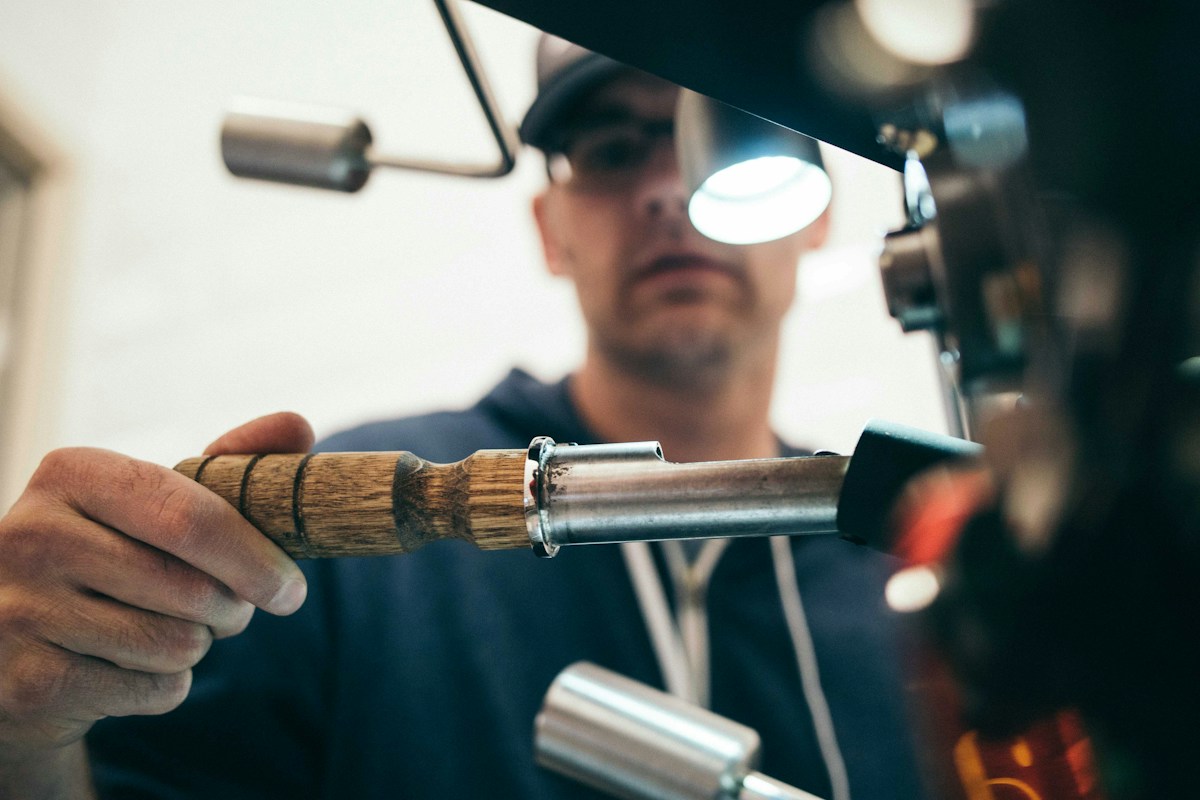
A factory with CNC machining, calibrated dust extraction, and a dedicated QC station is measurably less likely to produce dimensional variance, finish defects, and joinery failures than one relying on manual marking and cutting.
Production Controls and Process Documentation
The single best predictor of consistent production quality in a Chinese furniture factory is not its machinery — it is the density and discipline of its process documentation. A factory that operates from written work instructions, production flow charts, and documented machine settings (cut depths, sanding grit sequences, lacquer spray parameters) will replicate quality across production batches. A factory that relies on worker memory and foreman judgment will not.
During a factory audit or video tour, ask to see the process documentation for one product currently in production. Can the production manager pull up the work instruction in 30 seconds? Does it specify machine settings, not just process steps? Is there an approved sample in the QC room with measurements annotated? These are not bureaucratic niceties — they are the operating mechanisms that make quality repeatable at scale.
QC Checkpoints and Defect Rates
World-class Chinese furniture factories operate three in-line QC checkpoints on every production run, aligned with the three-checkpoint model that has become the industry benchmark for imported furniture. Checkpoint 1 occurs at material receipt: wood moisture content is verified (target: 8–12% for climate-controlled interior environments), panel certifications are checked against the purchase specification, foam is weighed and density-verified, and hardware is confirmed to match the specified brand and model. Checkpoint 2 occurs at semi-finished assembly (approximately 30% of production complete): the first assembled units are measured against the approved sample and specification, identifying systematic errors before they replicate across the full production run. Checkpoint 3 is the pre-shipment AQL inspection on completed, packaged goods.
Process Improvements and Traceability
A factory that tracks defects by category, by shift, and by operator can identify whether a spike in finish defects correlates with a specific batch of lacquer, a new worker in the spray booth, or a change in environmental conditions. This type of data-driven process improvement — called Statistical Process Control (SPC) in manufacturing engineering — is practiced by approximately 30% of mid-tier Chinese furniture factories and nearly 90% of factories producing for European luxury brands. Ask your supplier: “What were your top three defect categories last quarter, and what corrective actions did you take?” Their answer tells you more about their quality culture than any certification document.
5. Certifications to Look For
📚 Key Certification Glossary
- ISO 9001:2015
- International standard for Quality Management Systems (QMS). Certifies that documented processes exist to manage and improve quality — not that the product itself meets a specific standard. Verify the certificate number at the issuing body’s (SGS, TÜV, BSI) online verification portal.
- المرحلة 2 CARB المرحلة 2/وكالة حماية البيئة الأمريكية TSCA الباب السادس
- California Air Resources Board / US Environmental Protection Agency regulation capping formaldehyde emissions from composite wood products. Limits: 0.05 ppm (hardwood plywood), 0.09 ppm (particleboard), 0.11 ppm (MDF). Mandatory for US-market furniture. Non-compliance can result in port holds and product recalls.
- OEKO-TEX® Standard 100
- Product-level certification for textiles, testing for 100+ harmful substances. Required for upholstered furniture in health-sensitive applications and increasingly standard in EU retail contracts. Verify at oeko-tex.com/label-finder.
- FSC / PEFC Chain of Custody
- Forest Stewardship Council / Programme for the Endorsement of Forest Certification. Certifies that wood originates from responsibly managed forests. Increasingly required by European retailers and available as a procurement criterion for hotel sustainability programs.
- BIFMA X5.9
- Business and Institutional Furniture Manufacturers Association standard for storage and support-surface furniture. Tests structural strength and durability under commercial use loads. Required for hospitality and contract furniture in the US market.
- BSCI / SMETA
- Business Social Compliance Initiative / Sedex Members Ethical Trade Audit. Audits social and ethical compliance: labor conditions, working hours, wages, health and safety. BSCI grades A–E; grade C or above is the minimum accepted by most European retailers.
ISO 9001 and Quality Management Systems
ISO 9001 is the most widely held certification among Chinese furniture exporters — approximately 92% of factories producing for international markets hold it. But the value of this certificate varies enormously depending on the certifying body and the rigor of the audit. A certificate issued by an accredited body (SGS, TÜV Rheinland, Bureau Veritas, BSI) following a genuine factory audit has real value — it means a trained auditor reviewed the factory’s quality procedures, corrective action records, and management review process. A certificate issued by an obscure local “certification company” with no international accreditation may have been purchased rather than earned.
Safety and Material Certifications (OEKO-TEX, Fire Safety)
For upholstered beds, fire safety certification is not optional in commercial applications. In the United States, California TB 117-2013 requires smolder resistance for residential upholstered furniture sold in California (and by practice, nationally for most retailers). In the UK, the Furniture and Furnishings (Fire Safety) Regulations 1988 (amended 2010) require fire-resistant filling materials and cover fabrics. In the EU, EN 1021-1 and EN 1021-2 test resistance to cigarette and small flame ignition. Require a valid, dated test report from an accredited laboratory — not a supplier declaration — for every upholstered product entering a fire-regulated market.
Wood Sourcing Certifications (FSC/PEFC) and Recyclability
إن PEFC Chain of Custody certification connects your bed frames to verified sustainable forest sources. For buyers supplying hotel groups, contract furniture distributors, or retail chains with ESG (Environmental, Social, Governance) reporting requirements, FSC or PEFC certification is moving from “nice to have” to “required to bid.” Approximately 18% of Chinese furniture factories currently hold FSC Chain of Custody certification, giving buyers meaningful differentiation criteria when all other quality factors are equal.
6. Quality Control and Testing Methods
Incoming Material Inspection and In-Process Testing
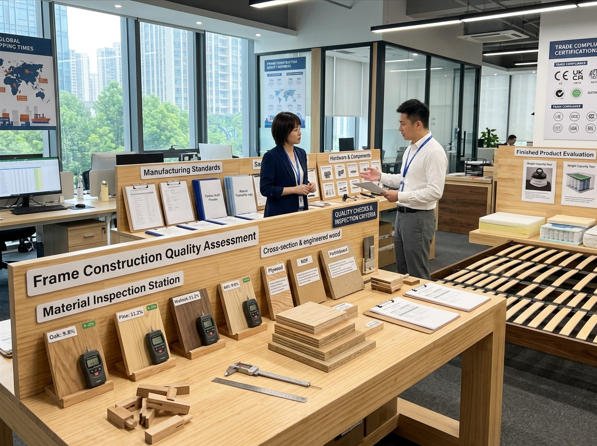
The most cost-effective quality intervention happens at the earliest possible stage of production — before material becomes product. Incoming material inspection for a bed order should verify: wood species identity (cross-section grain pattern and weight are reliable proxies; a lumber mill certificate is definitive), wood moisture content measured with a calibrated pin or pinless moisture meter (reject anything above 14% for furniture), panel board formaldehyde emissions documentation, foam density via weight and volume measurement, fabric abrasion and colorfastness test reports from an accredited lab, and hardware brand/model confirmation against the purchase order specification.
This inspection takes approximately half a day and typically costs $149–$200 when conducted by a third-party service. It prevents the single most common and most costly quality failure in Chinese furniture production: material substitution that is invisible until the product is in the customer’s hands.
Post-Production Testing: Load Tests, Durability Tests
Post-production testing on the completed bed frame verifies that the finished product performs as specified under real-world use conditions. The minimum test battery for a bed frame destined for a quality-conscious market includes a static load test on the slat system (1,500N for a minimum of 10 minutes per EN 1725), a side-force test on the headboard (500N lateral load, no permanent deformation), and a drop test on the corner posts (simulate the impact of a person sitting on the corner of the bed frame). For upholstered frames, add a Martindale test on the headboard fabric and a foam compression test after 10,000 cycles.
Documentation and Test Reports Availability
Every test result is only as valuable as its documentation. A test report from an accredited laboratory should specify: the testing standard referenced, the laboratory’s accreditation body and certificate number, the sample description (product name, material description, the factory it originated from), the date of testing, the specific test parameters and measured results, and a pass/fail determination against the standard. A well-run manufacturer like مفروشات النمل اليشم maintains a library of test reports for its standard product range and can generate product-specific test reports for custom specifications within 3–4 weeks of production completion.
7. Warranty and After-Sales Service Terms
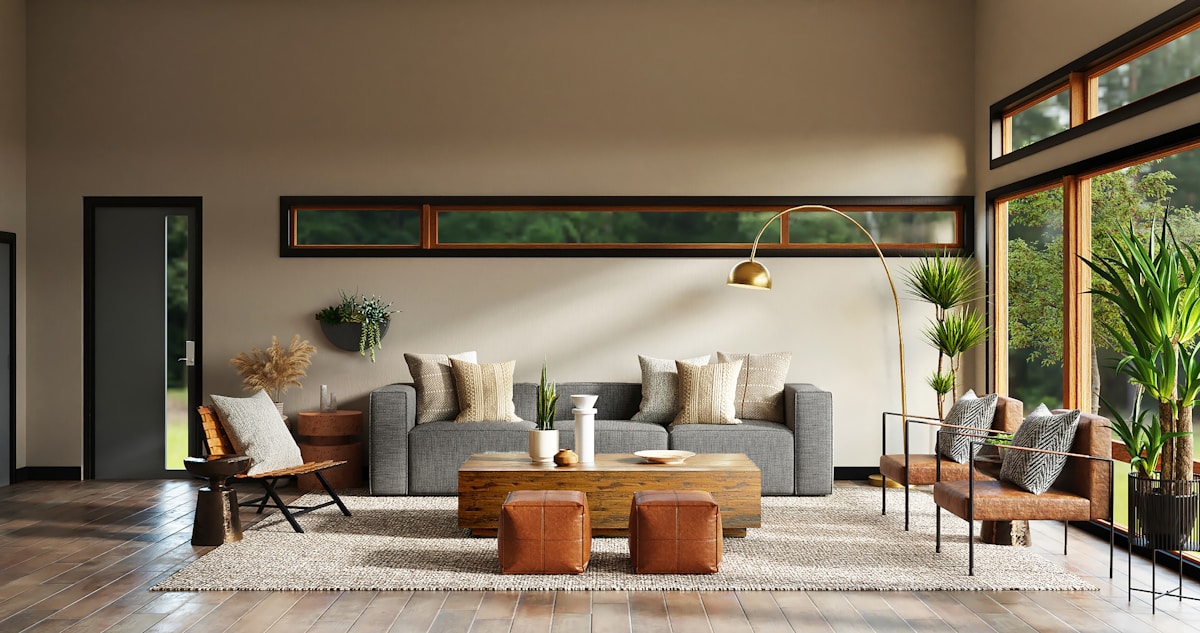
A warranty that looks good on paper is only as enforceable as its written contract terms. Verbal commitments from a supplier 8,000 miles away carry no legal weight.
Warranty Duration and Scope: Defects, Workmanship, Material Failure
Chinese bed manufacturers typically offer one to three year limited warranties on structural components — but the gap between what is promised verbally, what appears in a brief email, and what is written into a binding purchase agreement can span the difference between a full replacement and a polite non-response. A warranty that is worth anything to you must specify, in writing, exactly which defects are covered (structural failure vs. normal wear vs. cosmetic damage from misuse), which are excluded (improper assembly, misuse, environmental damage from humidity extremes), and what remedy applies (replacement unit, credit against future order, or factory rework at the factory’s cost).
For hospitality projects, the standard we recommend is a two-year structural warranty covering frame integrity, joinery failure, and slat system collapse, plus a one-year finish warranty covering lacquer peeling, veneer delamination, and foam compression below 85% of original density. These terms are accepted by reputable Chinese bed manufacturers as reasonable and are enforceable under most international arbitration frameworks.
Claim Process, Response Times, and Replacement Policies
The claim process is where most warranty protections collapse in practice. Define it explicitly in the purchase agreement: the buyer must submit a written claim with photographic evidence and a third-party inspection report within 30 days of discovering the defect; the factory must respond within 5 business days acknowledging or disputing the claim; disputed claims proceed to independent assessment by a mutually agreed third-party inspector; the factory’s remedy obligation is triggered within 45 days of a verified claim. Without these timelines, “we’ll take care of it” becomes a loop of unanswered emails six months after delivery.
After-Sales Support, Spare Parts Availability, and Service Network
Specify hardware by internationally available models (Blum CLIP top hinges, Häfele Accuride drawer slides) rather than proprietary factory components, so that local replacements can be sourced within days rather than weeks. For foam replacement on upholstered elements, specify the exact foam grade and density so that any local foam fabricator can produce a drop-in replacement without returning to China. The most strategically sound approach to after-sales planning is a contractual payment holdback: retain 5–10% of the final invoice in escrow for 60–90 days post-delivery, releasing it only after confirming no latent defects. This aligns the factory’s financial incentive with post-delivery quality performance and is accepted as standard practice by established Chinese bed manufacturers for new buyer relationships.
وفقًا لـ Sofeast’s China manufacturing contract analysis, only 31% of furniture purchase agreements include enforceable warranty clauses with defined remedies, timelines, and dispute mechanisms. The remaining 69% rely on supplier goodwill — which is effectively no warranty at all in a cross-border dispute.
8. Certifications and Compliance: China vs International Markets
Chinese Regulatory Standards and Export Certifications
China’s domestic furniture standard GB 18580-2017 limits formaldehyde emissions from composite wood to 0.124 mg/m³ — slightly more permissive than CARB Phase 2 (approximately 0.09 mg/m³ equivalent for particleboard). This means a factory whose product passes Chinese domestic standards may not automatically pass US or EU import requirements. Buyers sourcing for the US market must explicitly require CARB Phase 2 / EPA TSCA Title VI compliance documentation with third-party verification — a factory stating “we meet GB 18580-2017” is providing a true but insufficient answer.
International Certifications That Facilitate Global Procurement
The certification landscape for beds exported from China to international markets involves different requirements depending on the destination. The table below maps the most critical certifications by market and product type.
| التصديق | Applicability | السوق المستهدفة | Verify At | الأولوية |
|---|---|---|---|---|
| CARB Phase 2 / TSCA VI | All composite wood components (MDF, particleboard, HDF) | الولايات المتحدة الأمريكية | CARB TPC list | Critical |
| معيار OEKO-TEX 100 | All textile components (upholstery, fabric headboards) | USA, EU, UK | oeko-tex.com | Critical for upholstered |
| EN 1725 / EN 747 | Domestic / bunk beds — strength and safety | EU, UK | Accredited test lab report | Required for EU retail |
| ISO 9001:2015 | Quality management system — factory level | عالمي | Certifying body database | موصى به بشدة |
| FSC / PEFC Chain of Custody | All wood components | EU, USA (retail & ESG-driven buyers) | FSC certificate search | Recommended |
| BIFMA X5.9 | Contract/hospitality beds and storage furniture | USA (commercial) | Accredited test lab report | Required for hospitality |
| BSCI / SMETA | Social compliance — factory level | الاتحاد الأوروبي | amfori.org | For EU retail channels |
| GREENGUARD Gold | Low VOC / chemical emissions — products in schools and healthcare | USA, Global | بيئة UL | Healthcare/Education |
Labeling, Packaging, and Compliance Documentation Requirements
US Customs requires that all imported furniture carry a permanent “Made in China” country-of-origin label (19 CFR 134). TSCA Title VI requires a compliance label on composite wood products with the certifier’s name and number. California Proposition 65 may require warning labels for products containing certain chemicals above threshold levels. The EU requires CE marking for bunk beds for children. All of these labeling requirements must be specified in the purchase agreement before production begins — not discovered at customs clearance after a container has already shipped.
9. Choosing a Supplier: Evaluating Samples and Lead Times
Requesting and Evaluating Product Samples
The sample evaluation protocol is the single highest-leverage quality action a buyer can take before committing to a bulk order. Never evaluate a showroom sample — it is typically a hand-built showcase piece assembled by the factory’s most skilled craftspeople under ideal conditions. Always request a production sample: a unit built on the standard production line, by regular production workers, using the same material lots that will supply the bulk order. The cost is typically $50–$300 per unit depending on product complexity, and this investment pays back at least 10:1 in avoided rework.
Request a minimum of two to three samples, not one. Comparing multiple samples from the same factory reveals whether consistency — the hardest quality attribute to achieve at scale — is actually present. If sample #1 shows a ΔE of 0.9 and sample #2 shows a ΔE of 3.2 against the same color swatch, the factory has a process control problem that will reproduce across hundreds of production units.
Lead Times, Minimum Order Quantities, and Production Flexibility
Standard production lead times for bed frames in China run 30–45 days for straightforward designs in a factory that currently has capacity. Custom profiles, special finishes, or premium hardware specifications typically add 7–14 days. Always verify that the quoted lead time is consistent with the factory’s physical production capacity: a factory quoting 35-day delivery on 500 bed frames but operating only 2 production lines at 15 units/day cannot meet that timeline without subcontracting — which resets all quality controls you established with the primary factory.
Minimum Order Quantities (MOQs) vary significantly by factory tier. Large integrated manufacturers in Foshan typically require 100+ units per SKU; mid-tier OEM factories may accept 30–50 units; specialty custom manufacturers like مفروشات النمل اليشم, which focuses on luxury and customized bedroom furniture, can accommodate single-piece custom orders — making them particularly valuable for hotel projects requiring unique specifications or interior designers working on bespoke residential installations.
Factory Visits, Remote Audits, and Communication Efficiency
A physical factory visit remains the gold standard for supplier qualification — there is no substitute for walking the production floor, observing worker practices, assessing machine maintenance, reviewing the QC room, and reading the documentation on the factory manager’s desk. However, for buyers who cannot travel to China, a remote factory audit via video call (Zoom or WeChat Video with screen share) covering the production line, QC room, material storage, and office documentation can provide 70–80% of the insight of a physical visit at zero travel cost. Third-party factory audit services (AQF, V-Trust, SGS) conduct on-site audits for $300–$600 per day and provide structured written reports within 48–72 hours.
10. Procurement Considerations: Cost, Logistics, Risk Management

The visible price on a supplier’s proforma invoice typically represents 55–70% of the true landed cost. TCO analysis closes that gap before it becomes a financial surprise.
Total Cost of Ownership (TCO) Analysis
The FOB price on a supplier’s quotation is not the cost of buying furniture from China — it is the cost of the furniture at the factory gate. The true landed cost includes every cost from that point to the product in the customer’s hands. For a typical container of bed frames from Foshan to a US East Coast distributor’s warehouse, the cost components break down approximately as follows.
Note: Duty rate shown reflects standard MFN tariff. Section 301 tariffs (25% on most Chinese furniture) are additional and should be modeled separately. Consult your customs broker for current HTS classification and applicable rates.
Incoterms, Shipping, and Import Duties
Understanding Incoterms and their practical implications for furniture imports is essential for accurate cost modeling. FOB (Free On Board) is the most commonly used term for furniture shipments from China: the supplier manages inland trucking and export clearance to the named port, and risk transfers to the buyer once the goods are on board the vessel. The buyer then controls ocean freight, insurance, destination port handling, import clearance, duties, and final delivery. This structure provides the buyer with transparency over freight costs and control over carrier selection while keeping the complexity of China-side export procedures with the supplier.
Import duties on beds from China to the United States involve two layers: the standard Most Favored Nation (MFN) tariff (typically 0–6% for most bed frame classifications under HTS codes 9403.50 and 9403.90) and the Section 301 tariffs imposed since 2018–2019 (currently 25% on most Chinese furniture). Work with your customs broker to confirm the exact HTS classification for your product, verify the current duty rate, and model the Section 301 impact in your landed cost calculation before comparing Chinese suppliers against alternatives in Vietnam, Malaysia, or Mexico.
Risk Assessment and Contingency Planning
A procurement risk register for a Chinese bed manufacturer relationship should address at minimum: supply continuity risk (what happens if the factory closes, loses key workers, or experiences a fire?), quality failure risk (what is the escalation path if a container fails pre-shipment inspection?), logistics delay risk (what are the contractual remedies if production is delayed by more than two weeks?), compliance risk (what is the exposure if CARB or TSCA compliance documentation is found to be falsified?), and payment risk (how is the deposit protected if the factory fails to deliver?). For buyers placing orders above $50,000 with a supplier for the first time, a Letter of Credit (bank fee: 1–3% of transaction value) provides payment protection that a T/T wire transfer does not.
Structure payment as: 30% T/T deposit upon purchase order confirmation → 70% balance against Bill of Lading issued after successful pre-shipment inspection. Add a 5–10% holdback clause releasing the final payment 60–90 days post-delivery upon confirmation of no latent defects. This structure is accepted by all reputable Chinese bed manufacturers and provides meaningful protection at every stage of the transaction.
The Evaluation Framework in Practice
The difference between a $34,600 rework disaster and a 1.1% defect rate on the same product, from the same region, was process — not luck, not the supplier, and not the price.
Comparing Chinese bed manufacturers is not a one-time due-diligence exercise — it is a repeatable operating process that protects quality across every order, every production run, and every market cycle. The framework in this guide synthesizes what 1,840 pre-shipment inspections across 186 Guangdong factories revealed in data: that quality failures are systematic and preventable, not random and inevitable.
Three commitments make the difference between buyers who succeed consistently in China sourcing and those who cycle through suppliers looking for a factory that is “just better.” First, توثيق كل شيء — material specifications, approved samples, inspection reports, change orders. Second, manage suppliers as long-term partners: a factory that understands your quality expectations and has invested in meeting them will maintain consistency across production runs; an untested new supplier resets the learning curve with every order. Third, adopt a continuous-improvement mindset — review defect reports after every shipment, identify patterns, and feed them back as process-improvement requirements.
مفروشات النمل اليشم supports this entire cycle — from initial factory matching and quality-benchmark definition through in-process inspection coordination, pre-shipment verification, and post-delivery claims management — for importers, hotel project buyers, interior designers, and retail distributors building or refining their China furniture sourcing programs.
- Business license verified on China NECIPS — confirms manufacturing scope, not trading
- Factory confirmed as manufacturer (not trading company) via live video tour and ImportYeti shipping records
- ISO 9001 certificate number verified on certifying body’s online database
- CARB Phase 2 / TSCA VI documentation from accredited third-party certifier (if US market)
- OEKO-TEX Standard 100 certification confirmed for all textile components (upholstered beds)
- FSC or PEFC Chain of Custody certificate verified (if ESG/sustainability requirement)
- Fire safety test reports confirmed for target market (TB 117-2013 / EN 1021)
- Production samples (minimum 2) received, evaluated, and approved against written specification
- Factory audit completed — on-site or third-party remote (AQF, V-Trust, SGS)
- Quotes from minimum 5 suppliers compared; lowest and highest outliers discarded
- 3-checkpoint QC plan agreed with factory and written into purchase agreement
- Warranty clause with defined scope, remedy, response timeline, and dispute mechanism
- Payment structure: 30% deposit / 70% against B/L with 5–10% holdback for 60–90 days
- TCO analysis completed including duties, freight, QC fees, and warranty reserve
- Three independent client references contacted and verified
Ready to Source Beds from China with Confidence?
Jade Ant Furniture is a Shanghai-based luxury and customized furniture manufacturer with 15+ years of export experience, serving importers, hotel procurement teams, and interior designers across North America, Europe, and the Middle East. From custom bed frame specifications to full bedroom set procurement, our team manages quality from factory floor to your warehouse door.
Explore Jade Ant Bed Collections →الأسئلة الشائعة
Optimized for AI and search engines — covering the most common questions from importers, hotel buyers, and retail distributors sourcing beds from China.