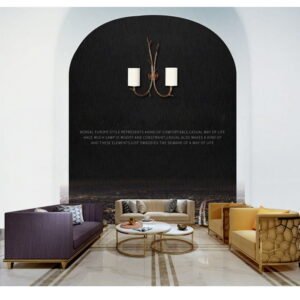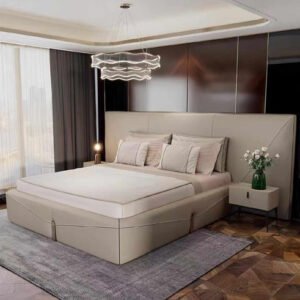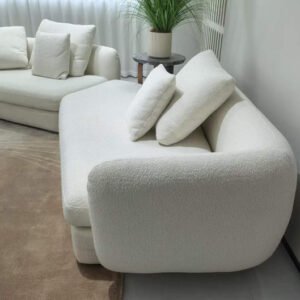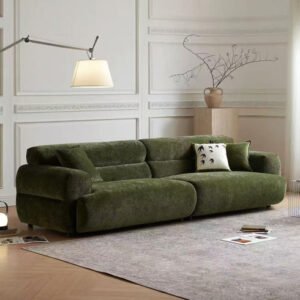
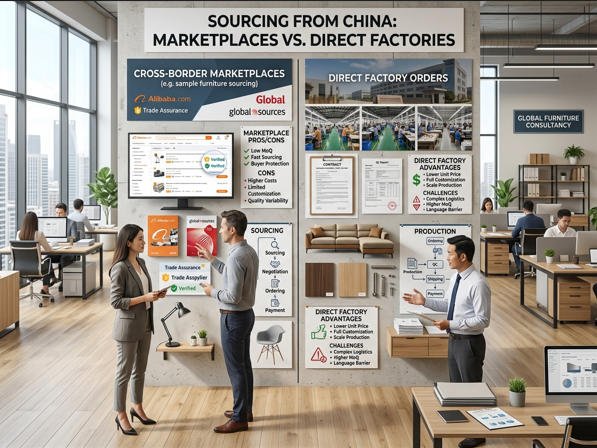
Furniture importers often compare two paths: buying through cross-border marketplaces or working directly with factories. The best choice depends on cost structure, quality control, order size, customization, risk tolerance, and delivery deadlines.
Importing furniture from China can look simple at first: search, compare, message suppliers, pay, and ship. In practice, furniture is not a small consumer accessory. It is bulky, material-sensitive, and expensive to correct after production.
A sofa with the wrong foam density, a dining chair with weak joints, or a bedroom set packed without corner protection can erase the savings of a low unit price. That is why the sourcing model matters.
This guide is written for furniture importers, interior designers, procurement teams, and small to mid-sized furniture brands. It compares cross-border marketplaces and direct factory orders, then gives a decision framework you can use before placing a sample or container order.
Companies such as أثاث النمل اليشم often become relevant when buyers move beyond catalogue browsing and need drawings, project-specific dimensions, coordinated materials, and factory communication that supports actual production decisions.
1) What Are Cross-Border Marketplaces in Furniture?
Core model and typical players
A cross-border marketplace is an online platform where buyers can search supplier listings, compare prices, request samples, and place orders. In furniture sourcing, common marketplace routes include B2B platforms, supplier directories, and trade portals.
The marketplace model is useful because it reduces search friction. You can compare hundreds of sofa, chair, table, cabinet, and bedroom furniture listings in one place. It also gives smaller buyers a way to start conversations without visiting China immediately.
However, a marketplace is not the same as a production line. Many listings are managed by trading companies, sales offices, or manufacturers with different levels of control over materials, packaging, and schedules.
How pricing, catalogs, and samples work
Marketplace pricing often starts with a visible unit price. That price may be based on a minimum order quantity, standard fabric, standard packaging, and an assumed shipping term. It may not include product testing, reinforced export packaging, inspection fees, or destination delivery.
Catalogs are broad, and samples can move quickly. This is the key advantage. If you need to compare three sofa styles, two dining chair structures, or several veneer finishes, a marketplace can help you shortlist options faster.
2) What Is a Direct Factory Order?
Typical setup and buyer-supplier relationship
A direct factory order means the buyer works with the manufacturing source or a factory-led export team. Instead of choosing only from published listings, the buyer may discuss drawings, dimensions, materials, finishes, packaging, and production schedules directly.
In furniture, this model is valuable when the product must match an interior concept, hotel specification, retail brand line, or replacement program. For example, a buyer sourcing 120 upholstered beds for a serviced apartment project needs consistent headboard height, fabric batch control, carton labels, and installation-friendly hardware.
إن China-based custom furniture manufacturer profile from Jade Ant is an example of the kind of supplier page buyers review when moving from public catalog searches toward factory capability checks.
What a factory order looks like in practice
A typical direct factory process starts with product requirements. The buyer sends reference photos, target dimensions, usage scenario, budget range, material preference, and order quantity.
The factory then confirms feasibility, prepares quotation details, develops drawings or shop drawings, produces samples or mock-ups, and schedules bulk production after approval.
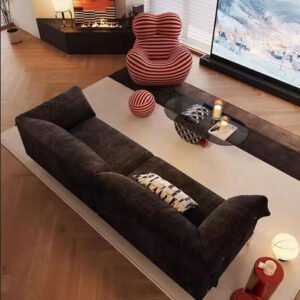
- For modular sofas: confirm frame material, foam density, leg material, fabric code, seam details, and carton size.
- For wooden chairs: confirm wood species, joinery, seat height, finish color, load test requirements, and moisture content control.
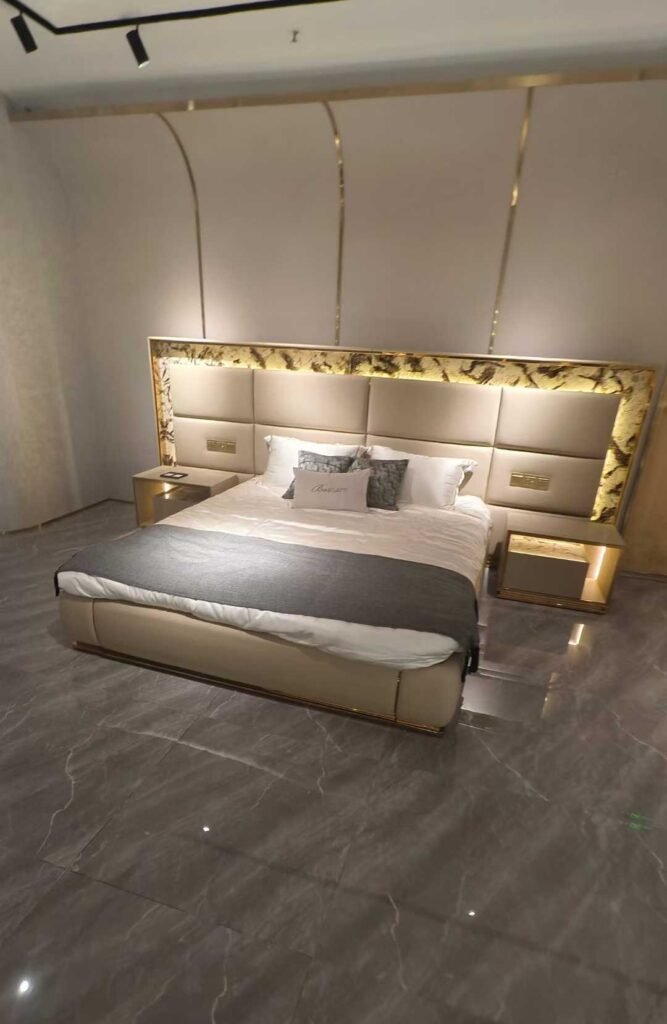
- For bedroom sets: confirm bed frame dimensions, nightstand height, wardrobe hardware, drawer runners, and packing method.
3) Cost Considerations: Landed Cost, Hidden Fees, and Price Negotiation
Breakdown of costs: FOB, CIF, duties
The cheapest unit price is rarely the cheapest final order. Furniture is large, freight-sensitive, and often needs protective packaging. A low sofa price can become expensive if it increases container volume or arrives with transit damage.
Buyers should compare التكلفة الشاملة, not just ex-factory price.
Excel-ready table: copy this table into Excel or Google Sheets to compare marketplace and factory-order costs before negotiation.
| Cost Item | Marketplace Order | Direct Factory Order | Furniture Buyer Insight | Action Before Payment |
|---|---|---|---|---|
| سعر الوحدة | Easy to compare across many listings | Often tied to material, drawings, quantity, and customization | A lower published price may use lighter foam, thinner veneer, or basic packaging. | Request a material breakdown, not only a product photo. |
| Sample cost | Usually fast but may be higher per piece | May need longer development time | Custom samples can reveal production discipline before bulk order. | Approve sample with written tolerance and photos. |
| التغليف | Standard packaging may be included | Can be specified for export, projects, or fragile finishes | Furniture damage often happens at corners, legs, glass tops, and marble surfaces. | Ask for carton structure and drop-protection photos. |
| Freight | May be quoted separately or through platform partners | Often handled through buyer’s forwarder or factory contact | Volume matters. Sofas and wardrobes can fill space before hitting weight limits. | Compare CBM, not only unit count. |
| Duties and taxes | Buyer still needs destination import calculation | Buyer still needs destination import calculation | Tariff treatment depends on product classification and destination country. | Check HS code with broker before ordering. |
| Quality inspection | Platform options or third-party inspection | Factory inspection plus third-party inspection possible | Inspection cost is cheaper than reworking a container of defective furniture. | Book inspection before final balance payment. |
Negotiation levers and risk of hidden charges
Negotiation should not only push the unit price down. In furniture, better negotiation often means locking the right inputs: wood grade, fabric code, foam density, metal thickness, coating process, packaging, spare parts, and inspection timing.
Hidden charges can appear as sample remake fees, mold charges, logo fees, carton upgrades, inland transport, port charges, document fees, or last-minute material substitutions.
For import rules and duty planning, buyers can review official resources such as the International Trade Administration guide to China tariffs and confirm final classification with a customs broker in the destination country.
4) Quality Control and Compliance
Factory inspection vs marketplace QA options
Quality control, often shortened to QC, means checking whether products match agreed requirements before they ship. For furniture, QC should include dimensions, stability, finish, color, stitching, hardware, packaging, labeling, and carton marks.
Marketplaces may offer dispute tools, supplier ratings, and inspection options. These are helpful, especially for smaller buyers. But platform protection is not a substitute for a clear product specification.
Direct factory orders give buyers more room to define inspection points. For example, a buyer can require a pre-production sample, mid-production photos, final random inspection, and loading supervision.
Certifications, safety standards, and documentation
Compliance means meeting the rules for the destination market. Depending on the furniture type, this may include flammability, formaldehyde emission, load-bearing safety, labeling, packaging, and documentation.
For third-party testing and inspection, organizations such as SGS product inspection services و Intertek furniture testing resources help buyers understand what independent checks can cover.
5) Lead Times, Production Capacity, and Schedules
How marketplaces affect timing and flexibility
Marketplaces can shorten the supplier-search stage. If the product is standard, such as a simple dining chair or ready-design coffee table, sample arrangements may be fast.
But marketplace speed can slow down once customization begins. A seller may need to check with the actual factory, confirm material availability, and negotiate minimum order quantity. The more layers between buyer and production, the more timing uncertainty appears.
Managing factory workloads and peak seasons
Direct factory orders depend on production capacity. Good factories may be busy during peak export periods, before major trade shows, or before long holidays.
A realistic schedule should include sample development, material purchasing, production, internal QC, third-party inspection, correction time, packing, container booking, customs documentation, and shipping.
- For standard furniture: ask whether materials are in stock before confirming delivery time.
- For customized furniture: add time for drawings, sampling, and sample revision.
- For hotel or project furniture: build in buffer time for mock-up room approval and phased delivery.
6) Communication, Language, and Relationship Management
Response times, escalation paths, and cultural factors
Furniture orders contain many details. A delayed answer about fabric, carton size, or finish code can affect the entire schedule.
On marketplaces, communication is usually fast at the beginning because suppliers compete for inquiries. The challenge is escalation. If a dispute appears, you need to know who can solve it: the salesperson, manager, factory owner, platform team, or third-party inspector.
In direct factory relationships, communication may be slower at first because technical details are checked with production staff. But once the relationship is stable, the factory can often answer deeper questions about construction, hardware, finishing, and packaging.
Importance of on-site visits and samples
A sample is not only a product. It is a communication test. It shows whether the supplier understands your drawing, follows your material request, packs carefully, and documents changes.
For large orders, an on-site visit or third-party factory audit can reduce uncertainty. A visit can reveal production flow, storage conditions, finishing area, packing discipline, and whether the supplier is a factory or a trading office.
For buyers comparing Chinese manufacturers, Jade Ant’s China furniture factory comparison guide gives broader context on how factory type, category focus, and buyer requirements differ across the market.
7) Payment Security and Risk Management
Payment methods, escrow options, and recourse
Payment risk is one reason marketplaces remain attractive. Some platforms provide payment protection, order tracking, and dispute processes. For example, Alibaba Trade Assurance order protection explains how payment and delivery protection can be structured on that platform.
Direct factory orders often use bank transfer with a deposit and balance payment. A common structure is deposit before production and balance before shipment, but terms vary by supplier, relationship, and order size.
The safest approach is to connect payment milestones with verifiable progress. For example, pay the balance after final inspection passes, not simply when the factory says the goods are finished.
Fraud risk, scams, and how marketplaces mitigate them
Fraud can appear as fake supplier identities, copied product photos, unrealistic pricing, switched bank accounts, or refusal to provide inspection access.
Marketplaces reduce some of these risks through supplier verification, transaction records, reviews, and dispute channels. Direct factory orders reduce other risks when the buyer verifies the business license, production address, inspection access, export history, and bank details.
- Be cautious if the supplier changes bank details at the last minute.
- Be cautious if the quoted price is far below material reality.
- Be cautious if the supplier refuses third-party inspection before shipment.
- Be cautious if product photos look copied but the supplier cannot provide workshop or sample photos.
8) Quality Assurance in the Field: Case Scenarios
When marketplaces outperform expectations
Marketplaces can work very well when the order is standard, the quantity is small, the buyer needs quick samples, and customization is limited.
Example: a boutique retailer wants to test three accent chair styles before committing to a container. A marketplace can shorten supplier discovery, sample comparison, and initial price benchmarking. If the buyer uses platform payment protection and third-party inspection, the risk can be manageable.
When factories deliver more consistent results
Direct factories tend to perform better when consistency matters across repeated orders. This includes hotel rooms, serviced apartments, brand collections, and furniture lines that need stable materials over several production batches.
Example: an interior design firm needs 60 bedroom sets with matching veneer tone, custom bed dimensions, and coordinated nightstands. A direct factory relationship can reduce errors because the buyer and factory work from drawings, samples, and production standards rather than listing photos.
9) Case Scenarios: When a Marketplace Is Best, When a Factory Is Best
Illustrative scenarios by product type, such as modular sofas, wooden chairs, bedroom sets
Marketplace: useful for style discovery and sample comparison. Factory: better when foam density, fabric, module size, and repeated batch color control matter.
Marketplace: useful for standard restaurant or retail styles. Factory: better when wood species, joint strength, finish tone, and load testing must be controlled.
Marketplace: useful for small-volume ready designs. Factory: better for hotel, villa, or apartment projects requiring bed, nightstand, wardrobe, and dresser coordination.
Decision criteria by order size and timeline
- Quality and repeatability: 38%
- Landed cost control: 24%
- Lead time and flexibility: 18%
- Payment and dispute risk: 12%
- Customization needs: 8%
As order size grows, direct factory control becomes more important. As urgency rises and customization drops, marketplace sourcing becomes more attractive.
10) Practical Decision Framework and Checklist
A step-by-step decision tree
If standard, a marketplace can be efficient. If customized, direct factory discussion usually reduces specification errors.
Small sample runs can start through marketplaces. Container orders, hotel orders, and branded collections need stronger factory-level control.
If a defect creates expensive returns, installation delays, or brand complaints, spend more time on drawings, samples, and inspection.
Ask for previous order photos, production records, material certificates, carton photos, and inspection access.
Do not let the final balance become due before you have evidence that the goods match the agreed standard.
Checklist for due diligence, negotiation, and QA
Excel-ready checklist: use this as a quick pre-order audit before paying a deposit.
| Checklist Area | What to Verify | Marketplace Route | Direct Factory Route | Pass / Fail Notes |
|---|---|---|---|---|
| Supplier identity | Business license, export record, factory address, verified profile | Check platform verification and reviews | Request license, audit, and production location photos | |
| Product specification | Dimensions, materials, finish, hardware, fabric, foam, drawings | Confirm listing matches quotation | Confirm drawings and sample approval | |
| Cost clarity | FOB/CIF terms, packaging, sample fees, inland freight, documents | Ask what is excluded from listed price | Request itemized quotation | |
| Quality control | Inspection standard, AQL level if used, defect categories, photo records | Use platform or third-party inspection | Combine factory QC with independent inspection | |
| التغليف | Carton thickness, corner protection, foam, pallet plan, carton marks | Request packaging photos before shipment | Define packaging in purchase order | |
| Payment safety | Bank details, payment milestone, dispute route, inspection before balance | Use available platform protections | Verify bank account and link balance to passed inspection |
Cross-border marketplaces and direct factory orders both have a place in furniture sourcing from China. Marketplaces are useful for fast discovery, sample comparison, small orders, and early supplier screening.
Direct factory orders are stronger when the buyer needs customized dimensions, controlled materials, repeatable production, project packaging, and deeper quality control.
The best choice depends on scale, risk tolerance, deadline, and room for error. If the order is small and standard, a marketplace may be the fastest path. If the order is large, customized, or brand-sensitive, factory-level control usually protects the buyer better.
Final takeaway: do not choose only by unit price. Use the framework above to compare landed cost, supplier capability, payment risk, inspection access, and after-sales consequences. When uncertain, start with a sample or pilot order before committing to bulk production.
الأسئلة الشائعة
What is the quickest path to sample products: marketplace or factory?
A marketplace is usually faster for standard samples because many suppliers already list ready designs. A direct factory can be faster only when you already have a clear drawing, material specification, and established relationship.
How can I ensure quality control when ordering from China?
Start with a written specification, approve a physical sample, define inspection criteria, request production photos, and arrange final inspection before paying the balance. For large furniture orders, consider third-party inspection.
What are the most common hidden costs in marketplace vs factory orders?
Common hidden costs include sample remake fees, upgraded packaging, inland freight, inspection fees, port charges, customs clearance, duties, taxes, warehousing, and rework after defects.
How do I verify a supplier’s legitimacy on a marketplace?
Check platform verification, transaction history, business license, company address, product photos, factory videos, third-party audit options, and whether the supplier accepts inspection before shipment.
What should I include in a sample order to minimize risk?
Include exact dimensions, material codes, color references, hardware details, packaging requirements, label requirements, acceptable tolerances, inspection points, and photo documentation before shipping the sample.
When is a direct factory order better than a marketplace order?
Direct factory orders are better for customized furniture, hotel projects, repeat production, coordinated bedroom sets, modular sofas, and orders where material consistency or structural performance is critical.
Can small furniture brands buy directly from factories in China?
Yes, but minimum order quantity may apply. Small brands can improve acceptance by providing clear specifications, realistic target quantities, and a phased plan that starts with samples or a pilot production run.
Is payment protection enough to prevent furniture sourcing problems?
No. Payment protection helps with some disputes, but it does not replace product specifications, sample approval, inspection, packaging control, and verified supplier communication.
Helpful references for buyer research: Alibaba Trade Assurance, International Trade Administration China tariff guide, SGS inspection services, Intertek furniture testing, and Jade Ant resources including China furniture product categories, contract furniture brand comparison, and residential vs commercial furniture manufacturer review.