Choosing between solid wood and engineered wood is one of the most consequential decisions a furniture buyer makes — and the stakes are higher when you’re sourcing by the container, not by the piece. A wrong material spec can mean warped tabletops in a humid lobby, delaminated veneers after a single shipping season, or a returns rate that quietly erodes a whole quarter’s margin.
This guide is written for B2B buyers: procurement managers, hospitality FF&E specifiers, retail buyers, interior contractors, and importers evaluating Chinese furniture suppliers. If you’re comparing factory quotes, vetting samples, or building a purchase spec, the goal here is to help you read past the marketing and judge what actually arrives on the dock.
Quick definitions before we start
Solid wood means furniture built from boards milled directly from a tree — the same material throughout, top to bottom. Engineered wood (sometimes called composite or manufactured wood) is a category of products built by bonding wood layers, fibers, or particles together. The two most common types you’ll see in Chinese furniture are plywood (thin veneers glued in cross-grain layers) and MDF — medium-density fiberboard, made from wood fibers compressed with resin.

What buyers should consider
For a B2B order, four factors usually outweigh everything else: longevity under real use, dimensional stability during ocean freight and across climates, landed cost per unit, و compliance (emissions, certifications, documentation). We’ll work through each, with the kind of detail that lets you write a defensible spec sheet.
Industry context: the global wooden furniture market was estimated at roughly USD 417.5 billion in 2025 and is projected to grow at about a 4.9% CAGR through 2035, per GMInsights. A large share of that volume still flows through Chinese manufacturing — though, as recent sourcing analyses note, some low-to-mid-end production has migrated to Vietnam, pushing China’s better factories toward higher-value, better-engineered goods. That shift matters for buyers: the quality ceiling in China is rising, but so is the spread between top-tier and bottom-tier suppliers.
Understanding Solid Wood and Engineered Wood
What solid wood is, and the types used in Chinese furniture
Solid wood furniture is built from natural lumber. In Chinese production you’ll commonly encounter oak, الرماد, elm (榆木), الجوز, rubberwood (an affordable plantation hardwood), and at the premium end the classical rosewoods — huanghuali و zitan — historically prized for Ming-style pieces. Christie’s describes huanghuali and zitan as the most desired hardwoods in classical Chinese furniture, valued for grain warmth and density respectively.
For volume B2B orders, rubberwood, oak, and ash dominate because they balance cost, workability, and supply reliability. True rosewood is largely a collector and ultra-luxury category today, with CITES export restrictions adding paperwork.
What engineered wood is, and common constructions
The three you’ll meet most often:
- خشب رقائقي — thin veneer layers glued at 90° to each other. The cross-grain construction makes it strong and resistant to warping. This is the “good” engineered wood for furniture.
- MDF (medium-density fiberboard) — wood fibers compressed with resin into a dense, smooth panel. Excellent for painted finishes and CNC routing; weak against moisture.
- Particleboard — larger wood chips bonded together. Cheapest, heaviest, and the least durable; common in flat-pack and budget lines.
A veneer is a thin slice of real wood (or sometimes printed foil) laid over an engineered substrate, giving a composite panel the look of solid timber.
Side-by-side comparison of core properties
Here’s how the categories stack up on the dimensions a buyer actually specs against:
| العقارات | Solid Wood | خشب رقائقي | MDF | Particleboard |
|---|---|---|---|---|
| المتانة | Highest | عالية | معتدل | منخفض |
| Moisture resistance | Moderate* | جيد | Poor | Very poor |
| Dimensional stability | Moderate (moves with humidity) | ممتاز | جيد | معتدل |
| قابل لإعادة الطلاء | Yes, many times | Limited | No | No |
| Weight | Heavy | معتدل | Heavy | Heaviest per strength |
| Relative cost | $$$$ | $$$ | $$ | $ |
*Solid wood resists water at the surface but expands and contracts with humidity — that movement, not water itself, is its main vulnerability.
Durability and Construction Quality
How joinery and frame construction affect longevity
The single biggest predictor of a piece’s lifespan isn’t the wood — it’s how the parts are joined. A solid oak table held together with staples and hot glue will fail long before a well-built plywood cabinet.
Chinese furniture has a deep advantage here: the mortise-and-tenon joint (榫卯), a glue-free interlocking system perfected over centuries in pieces like the luohan bench and used throughout the Forbidden City. A tenon (a projecting tongue) slots precisely into a mortise (a cavity), creating a joint that flexes slightly under load instead of snapping. Specialists note this is the most famous and widely used method in classical Chinese joinery.
For your spec sheet, the durability hierarchy reads: mortise-and-tenon or dowel-and-glue joints > screwed-and-corner-blocked frames > cam-lock (RTA) fittings > stapled joints. A supplier like أثاث النمل اليشم that publishes its joinery method and corner-block details up front is signaling something a glossy catalog photo can’t.
Common veneer and substrate issues to watch for
Engineered failures usually show up in predictable ways. According to a NC State wood products study, veneer checking — fine cracks that always run parallel to the grain — is a leading defect, often caused by veneer that’s too thin or substrate that wasn’t properly moisture-balanced.
Other red flags: delamination (layers separating, usually at edges), telegraphing (the substrate seam showing through a thin veneer), and swollen edges on MDF where it met moisture. As comparative durability data shows, plywood holds strength in humidity while MDF swells and rarely returns to shape — a critical distinction for buyers shipping into tropical or coastal markets.

Aesthetic Appeal and Finish Options
Grain patterns, stains, and finishes on solid wood
Solid wood’s selling point is that no two pieces are identical — natural grain, knots, and color variation read as authenticity, which premium retail and boutique hospitality buyers actively want. It takes oil, wax, and penetrating stains beautifully, and the finish deepens with age. The trade-off: that same variation makes color matching across a large order harder, so for a 200-room hotel rollout you’ll want to confirm the supplier can hold a consistent stain batch.
Surface textures and veneers in engineered wood
Engineered panels win on consistency and design flexibility. A real-wood veneer over plywood gives you the look of book-matched walnut at a fraction of solid-walnut cost and weight. MDF is the go-to for flawless painted and lacquered finishes — its fiber-smooth surface has no grain to telegraph, which is why high-gloss contemporary lines are almost always MDF-cored. For curved fronts and CNC-detailed panels, engineered substrates simply outperform solid wood.
Environmental Impact and Sustainable Sourcing
Growth cycles, certifications, and life-cycle considerations
Engineered wood uses timber more efficiently — plywood and MDF can be made from fast-growing or smaller-diameter trees and from mill offcuts, getting more product per tree than solid lumber. But efficiency isn’t the same as responsibility.
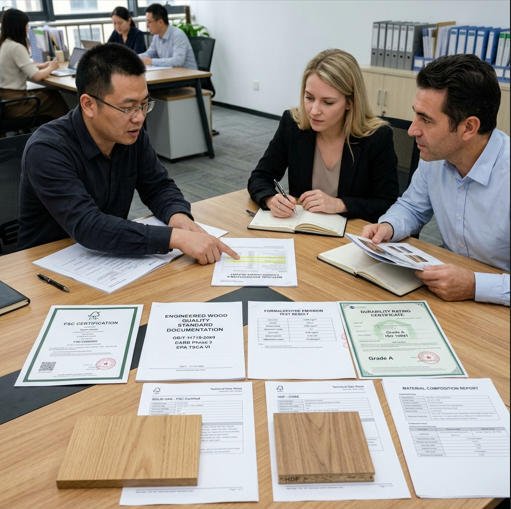
For a defensible sustainability claim, the certification that carries the most weight with Western buyers is مجلس رعاية الغابات (FSC). Its chain-of-custody system tracks wood from a responsibly managed forest all the way to the finished product. The WWF Wood Furniture Scorecard has pushed major retailers to demand FSC, so if you sell into those channels, an FSC certificate from your factory is increasingly non-negotiable.
Indoor air quality and finishes to look for
This is where engineered wood gets serious for B2B. The resins that bond MDF and plywood can off-gas formaldehyde. In the U.S. market, composite wood products must meet الباب السادس من قانون TSCA لوكالة حماية البيئة الأمريكية emission limits (harmonized with California’s المرحلة 2 CARB المرحلة 2), and since 2019 they must carry a compliance label. If you import to the U.S., un-labeled product is a customs and liability risk, not just a quality one.
Ask suppliers for E0 or E1 / CARB Phase 2 / TSCA Title VI documentation, and prefer low-VOC water-based finishes for any project targeting LEED or WELL building credits.
Price, Value, and Total Cost of Ownership
Upfront cost versus long-term value
Engineered wood almost always wins the line-item price war — often 30–50% cheaper than comparable solid-wood pieces. But sophisticated buyers price the total cost of ownership (TCO), not the unit cost. TCO folds in shipping weight, breakage and return rates, replacement frequency, and refinishing.
The illustrative chart below shows why a low purchase price can be deceptive over a typical 10-year commercial-use horizon:
Illustrative 10-Year Cost per Unit (commercial use, indexed)
100
78
92
118
Index includes purchase + freight + estimated replacement/repair over 10 years. Lower is better. Note how particleboard’s low sticker price is overtaken by replacement costs, while quality plywood lands as the value sweet spot.
Resale value and refinishing considerations
Solid wood is the only category that meaningfully holds resale value and can be refinished repeatedly — a real factor for hospitality groups that refresh interiors on a cycle and sell off old inventory. Veneered plywood can be refinished once or twice if the veneer is thick enough (look for >0.6mm); MDF and particleboard, once the surface is compromised, are effectively disposable.
Maintenance, Care, and Longevity
Cleaning practices and seasonal care
Both materials prefer a damp (not wet) soft cloth and wiping with the grain, as Herman Miller’s veneer care guidance recommends. The key difference is humidity discipline: solid wood needs a relatively stable indoor humidity (ideally 40–55%) to avoid seasonal cracking, while MDF needs protection from standing water and steam. Felt pads, coasters, and keeping pieces out of direct sun and heating vents extend the life of either.
Refurbishing, refinishing, and policy on repairs
For B2B, the practical question is your warranty and repair policy. Solid-wood frames are field-repairable — a loose joint can be re-glued, a scratched top sanded. Engineered pieces usually require panel replacement. Build this into your supplier agreement: spare-part availability and a clear defect-replacement window are worth more than a longer-but-vaguer warranty.

Design Features Specific to Chinese Furniture
Traditional joinery and its benefits
Beyond durability, traditional Chinese joinery is a shipping and serviceability advantage. Many Ming-style pieces can be partially knocked down and reassembled without losing structural integrity — useful when you’re optimizing container fill. The flex built into a mortise-and-tenon joint also helps pieces survive the vibration of long ocean freight better than rigid glued-only frames.
Common design elements influenced by regional styles
Chinese production spans clean Ming-inspired minimalism (straight lines, exposed joinery, restrained ornament), more elaborate Qing-style carving, and fully contemporary lacquered designs aimed at export markets. For B2B buyers, the useful insight is that a single Chinese supplier can often serve very different end markets — a boutique hotel’s heritage look and a chain’s modern flat-pack — which simplifies your vendor list if you consolidate orders.
A look at the mortise-and-tenon joinery that underpins quality Chinese furniture construction.
When to Choose Solid Wood
Ideal uses and environments for solid wood
Specify solid wood for: high-touch, high-prestige pieces (executive desks, restaurant tabletops, headboards in premium suites), items that will be refinished over a long service life, and any product where natural grain is part of the brand story. It’s also the safer call for heavy-load structural components like table aprons and chair frames.
Signs of quality to verify in solid wood pieces
Check that grain runs continuously across what claims to be a single board (interrupted grain means it’s a glued laminate sold as solid). Confirm kiln-dried lumber at 6–8% moisture content — under-dried wood is the number-one cause of post-shipment cracking. And inspect joints: a quality maker exposes its joinery with pride rather than hiding it under filler.
When to Choose Engineered Wood
Practical advantages for certain room setups
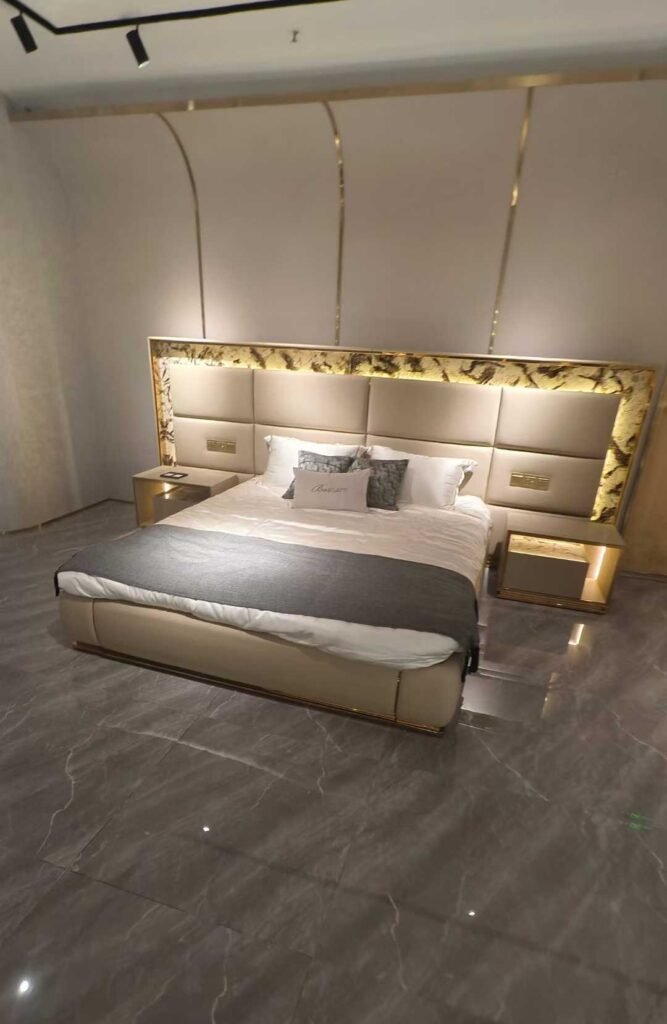
Engineered wood is often the smarter spec for large flat surfaces (wardrobe doors, headboards, wall units) where solid wood would warp, for high-volume budget-conscious rollouts, for painted or high-gloss aesthetics, and for any piece where reducing shipping weight cuts freight cost meaningfully. In humid markets, a quality plywood core can actually outlast solid wood on broad panels.
How to assess the quality of engineered wood products
Insist on plywood or high-density MDF cores over particleboard for anything load-bearing. Verify veneer thickness (thicker resists checking), demand edge-banding that’s machine-applied and seamless, and require emissions certification (CARB Phase 2 / TSCA Title VI). A simple field test: tap the panel — a hollow or papery sound on something sold as quality engineered wood is a warning.
Shopping Tips and Red Flags from Retailers and Makers
What to inspect in person (or in samples)
Always order physical pre-production samples, never spec from photos alone. Check the underside and back — that’s where corners get cut. Look for solid corner blocks, smooth drawer glides, consistent finish coverage on hidden surfaces, and clean joinery. Run your hand along edges for veneer lift.
How to evaluate warranties and return policies
For containers, the warranty is only as good as the defect-handling clause. Confirm: what counts as a defect, who pays return freight, the claim window, and whether the supplier holds a quality-control inspection report (ideally a third-party one). Build inspection checkpoints into the contract — pre-production, during production, and pre-shipment.
Questions to ask suppliers about sourcing and production
A short, revealing list to send any factory:
- What is the exact wood species and core material, and can you provide FSC and emissions (CARB/TSCA) certificates?
- What moisture content is your lumber dried to, and how is it acclimatized before assembly?
- What joinery method is used on frames and drawers?
- Do you allow third-party pre-shipment inspection?
- What is your defect rate on the last three export orders of this product?
The quality of the answers tells you as much as the answers themselves. You can see how a structured supplier presents this kind of documentation on the أثاث النمل اليشم product and capabilities pages, which is a useful benchmark when you’re comparing how transparent a prospective vendor is willing to be.
Recap of the trade-offs
Solid wood delivers the longest life, the best resale, and a premium feel — at higher cost, more weight, and more humidity sensitivity. Engineered wood (especially quality plywood) delivers stability, design flexibility, lighter freight, and lower upfront cost — with the catch of emissions compliance and limited refinishing. Neither is universally “better”; the right choice is the one that matches the piece’s job, environment, and your channel’s expectations.
A practical decision checklist
| If your priority is… | Lean toward… |
|---|---|
| Longest service life & refinishing | Solid wood |
| Large flat panels in humid climates | Quality plywood |
| Lowest landed cost at volume | Engineered (plywood > MDF) |
| Flawless painted / gloss finish | MDF core |
| Premium brand story & resale | Solid wood |
Final tips for an informed purchase
Spec the material to the application, never as a blanket rule. Always require samples, certifications, and a written defect policy. And remember the rising-ceiling reality of Chinese sourcing: the best factories are now genuinely world-class, so the value is in vendor selection, not in avoiding the country. Treat your supplier shortlist — including options like أثاث النمل اليشم — as a comparison on transparency and documentation, not just price per piece.
الأسئلة الشائعة
What is the best wood type for durability in high-traffic spaces?
For high-traffic commercial environments like hotel lobbies or restaurants, dense solid hardwoods (oak, ash, walnut) are the most durable for structural and high-touch surfaces because they resist dents and can be refinished. For broad flat surfaces in those same spaces, quality hardwood plywood often outperforms solid wood by resisting warping. Particleboard should be avoided entirely in high-traffic use.
How can I tell if a piece is solid wood or veneer on engineered wood?
Check whether the grain pattern continues seamlessly around edges and onto the underside — solid wood shows continuous grain on all faces, while veneer typically shows a different or absent grain on hidden surfaces and at edges. Weight is another clue: MDF cores feel notably heavier and denser than solid wood of the same size, while particleboard edges look chunky and speckled. A look at the unfinished underside is the most reliable test.
Are engineered wood pieces stable in varying humidity levels?
It depends on the type. Plywood is highly stable in humidity thanks to its cross-grain construction and often outperforms solid wood on large panels. MDF and particleboard are the opposite — they swell when exposed to moisture and rarely recover their original shape. For humid or coastal markets, specify plywood cores and avoid MDF for any surface that may contact water.
How often should I refinish a solid wood Chinese furniture piece?
Under normal commercial use, a solid wood piece typically needs refinishing every 5–10 years, depending on traffic and the original finish. High-touch surfaces like tabletops may need attention sooner. Penetrating oil finishes can often be spot-refreshed annually without a full refinish, while lacquered surfaces require professional re-coating when worn. One of solid wood’s key advantages is that it can be refinished many times over its life.
Is engineered wood furniture safe regarding formaldehyde emissions?
Modern engineered wood can be very safe, but only if it meets emission standards. In the U.S., composite wood products must comply with EPA TSCA Title VI and CARB Phase 2 limits and carry a compliance label. When sourcing, require E0/E1, CARB Phase 2, or TSCA Title VI certificates from the factory, and prefer low-VOC finishes. Un-certified product is both a health concern and a customs/liability risk for importers.
Which is more cost-effective for a large B2B order, solid or engineered wood?
On the sticker price, engineered wood is usually 30–50% cheaper. But evaluated on total cost of ownership over a typical 10-year commercial life — including freight weight, breakage, returns, and replacement — quality veneered plywood often becomes the value sweet spot, while particleboard’s low price is eroded by replacement costs. Solid wood costs the most upfront but retains resale value. Match the material to how long the piece must last.
What certifications should I require when importing Chinese furniture?
At minimum, request FSC chain-of-custody for sustainability claims, CARB Phase 2 / TSCA Title VI for any composite wood entering the U.S., and ideally a third-party pre-shipment quality inspection report. For projects targeting LEED or WELL building credits, also ask for low-VOC finish documentation. These certificates protect you on compliance, marketing claims, and customs clearance.