Resort-grade outdoor dining set — the specification decisions made before ordering determine whether this furniture lasts 5 years or 50.
Walk around the pool deck of any five-star resort in Dubai, a rooftop bar in Amsterdam, or a private villa terrace in Tuscany, and there is a strong probability that the furniture beneath your guests originated in a factory in Guangdong or Fujian Province. China supplies over 60% of the world’s outdoor furniture exports, producing everything from precision-welded aluminum dining frames to hand-woven HDPE rattan lounge sets and FSC-certified teak sun loungers.
But sourcing outdoor furniture from China for commercial or large-scale residential projects is genuinely complex — and the complexity is invisible until a container lands. A buyer who specified “aluminum chairs with PE rattan seat” on a purchase order may receive chairs with standard PE (not HDPE) rattan that begins fading and cracking within 18 months. A hotel group that approved an FSC certificate at the factory level may discover on closer inspection that the certificate belongs to the factory’s parent group and does not cover the specific product ordered. These are not hypothetical scenarios — they represent the two most common quality disputes in furniture importing, documented across dozens of procurement reviews.
This guide exists to prevent those outcomes. It covers every decision that determines durability and weather resistance: material selection by climate, certification verification, construction quality markers, maintenance planning, supplier vetting, and total cost of ownership. The goal is to give B2B buyers — furniture distributors, agents, showroom buyers, interior designers, and hotel procurement teams — a concrete operational framework they can apply directly to their next sourcing round.
1. Understanding Durability Benchmarks for Outdoor Furniture
Durability in outdoor furniture is not a single metric — it is the intersection of at least five measurable variables. A supplier who claims their chairs are “high quality and very durable” without reference to any of the following numbers is not giving you information you can act on.
Key Durability Metrics: Load, Fade Resistance, UV Stability
Static load capacity is the maximum downward force a chair, lounger, or table can bear without permanent deformation. EN 581EN 581: European standard for outdoor seating and tables. Part 1 covers general requirements; Part 2 covers mechanical safety for seating; Part 3 covers mechanical safety for tables. Mandatory for furniture sold in the EU commercial market. specifies a minimum static seat load of 1,000 N (approximately 100 kg) for outdoor chairs in the European market. Commercial contract-grade pieces from reputable Chinese manufacturers are typically tested to 1,300–1,500 N — a margin that matters in hospitality environments where furniture is used by guests of all body types, often roughly.
UV fade resistance is measured using a Xenon arc testXenon arc testing (ISO 105-B02): simulates sunlight exposure using a xenon lamp. Results are rated on a Blue Wool Scale of 1–8; 6 or above is considered acceptable for commercial outdoor use. HDPE PE rattan should achieve Blue Wool 6+; powder-coated aluminum should achieve Blue Wool 7+. that simulates years of solar exposure in hours. HDPE rattan from quality Chinese factories achieves a Blue Wool rating of 6–7, meaning color remains stable for 1,000+ hours of simulated sunlight. Standard PE rattan from lower-tier factories typically achieves Blue Wool 4–5 — visible fading begins within the first full outdoor season.
Corrosion resistance for metal frames is quantified by the ASTM B117 salt spray testASTM B117: the standard salt spray (fog) test method. 500 hours of salt spray in the test chamber broadly corresponds to several years of coastal outdoor exposure. Powder-coated aluminum should pass 500 hours minimum; premium marine-grade specifications require 1,000 hours.. A commercial-grade powder-coated aluminum frame should pass a minimum 500-hour ASTM B117 salt spray test without corrosion creep. For coastal hotel environments — think beach resort sunloungers in the Maldives or poolside chairs in Miami — the specification should be 1,000 hours minimum.
How to Interpret Product Specs and Certifications
The single most important rule when evaluating product specifications from a Chinese supplier: ask for the test report, not the certification. A factory can hold a valid ISO 9001 certificate — which covers their quality management system — without ever having tested a specific product to EN 581 or ASTM B117. ISO 9001 confirms the factory has documented procedures; it does not confirm the actual product meets any performance standard.
Request test reports that are product-specific (identifying the exact SKU by name and dimensions), issued by an accredited laboratory (SGS, Bureau Veritas, Intertek, TÜV Rheinland), and dated within the past three years. Any test report more than five years old is unlikely to reflect current production specifications, since material suppliers and production processes change.
2. Materials Commonly Used in China for Outdoor Furniture
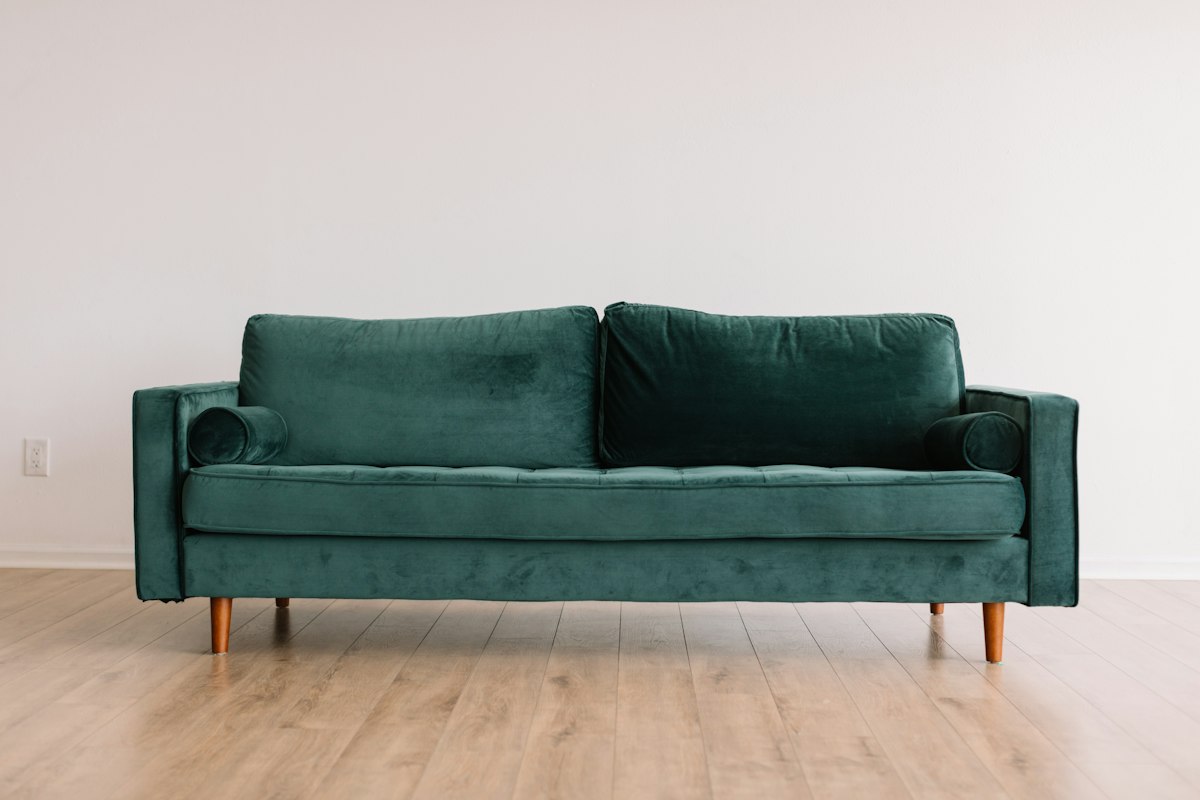
HDPE rattan woven over precision-welded aluminum frames: the dominant combination in five-star resort outdoor furniture globally.
Wood: Teak, Acacia, and Eucalyptus — Variants in Durability
Teak remains the gold standard for premium outdoor wood furniture — and for measurable reasons. Grade A teak, harvested from trees aged 45–50 years, contains 5–7% natural oil content that repels moisture without any treatment, resists insects, and delivers dimensional stability across temperature and humidity cycles. Documented examples of Grade A teak furniture in commercial use exceed 75 years of outdoor service.
However, most Chinese factories do not supply Grade A teak unless specifically requested and contracted. The default in the China outdoor furniture supply chain is plantation teak — trees harvested at 10–25 years, containing 1–4% natural oil. This “Grade C” material looks identical to Grade A in a showroom photograph but begins showing cracks, joint separation, and moisture damage within 3–5 years of outdoor use in a humid climate. The buyer who does not specify grade, oil content percentage, and kiln-drying standard (8–12% moisture content to EN 13756EN 13756: European standard for solid wood flooring and outdoor timber, covering definitions of wood species and technical requirements including moisture content. Kiln-dried outdoor furniture should reach 8–12% equilibrium moisture content before delivery.) has no contractual grounds to object when the cheaper material arrives.
Acacia is the most widely used wood alternative in the China outdoor furniture export market. It is harder than plantation teak (Janka hardness ~1,700 lbf vs. ~1,070 lbf for plantation teak), costs 20–40% less, and lasts 10–15 years with proper annual sealing. It is an appropriate choice for mid-tier hospitality and B2B showroom applications where budget constrains teak specification. Eucalyptus is a third option — dense, affordable, and moderately weather-resistant — but with the highest maintenance requirement of the three, requiring sealing every 6–12 months in temperate climates and every 3–6 months in tropical environments.
Metal: Aluminum, Steel, and Coatings Considerations
Powder-coated aluminum is the industry’s most widely specified metal for outdoor furniture in the commercial segment — and for good reason. It does not rust (aluminum oxidizes naturally, forming a protective layer that prevents deeper corrosion), weighs roughly one-third of steel, and holds powder coatingPowder coating: a dry finishing process where electrostatically charged powder is applied to a metal frame and cured under heat (typically 160–200°C) to form a hard, uniform layer. Measured in microns (µm). Minimum 60 µm for standard outdoor commercial; 80 µm for coastal/marine environments. Thinner coatings under 50 µm are a common cost-cutting measure invisible before delivery. exceptionally well. A correctly specified powder-coated aluminum frame — 60+ µm coating to AAMA 2604 standard — carries a 10-year warranty from reputable manufacturers and requires nothing more than an annual rinse.
Galvanized or powder-coated steel is cheaper than aluminum (typically 20–30% lower FOB cost for equivalent pieces) but heavier and, critically, prone to rust if the coating is damaged. In poolside or coastal environments where chlorine, salt air, or high humidity is constant, the total cost of ownership for steel often exceeds aluminum when repainting costs and reduced lifespan are calculated into the model. For dry temperate environments where cost is a primary constraint, high-quality powder-coated steel with a zinc primer layer is a defensible choice — but only when the coating thickness specification is enforced.
Resin, Rattan, and Synthetic Wicker Trends
PE rattan (polyethylene synthetic wicker) is the most visually popular material in the global outdoor segment. Understanding the two tiers of PE rattan is essential before writing a specification.
Standard PE (LDPE, low-density polyethylene) rattan is cheaper but loses color intensity within 2–3 seasons and becomes brittle when UV-degraded. HDPE (high-density polyethylene) rattan, the commercial-grade standard, has a strand density of at least 1.4 g/cm³, achieves Blue Wool 6+ on UV testing, and maintains structural integrity for 5–8 years in direct outdoor exposure. HDPE rattan is typically 25–40% more expensive at FOB, but when selling into hotel or contract environments, specifying HDPE is not optional — it is the minimum.
A rapidly growing category is GRS-certified recycled PE rattan: HDPE strands manufactured from post-consumer recycled plastic, meeting the Global Recycled Standard (GRS)Global Recycled Standard (GRS): an international, voluntary, full product-chain standard that sets requirements for third-party certification of recycled content, chain of custody, social and environmental practices, and chemical restrictions. GRS transaction certificates should be requested per production batch, not just the factory’s annual scope certificate.. Several major hotel procurement programs — including those of Marriott and IHG supplier approval networks — now require GRS documentation as part of vendor qualification. Chinese factories in Anji, Zhejiang, and Guangdong are increasingly GRS-certified; verify by requesting the transaction certificate for each specific production run.
6. Materials Comparison: Wood, Metal, Rattan, Resin
| المواد | العمر المتوقع | Weather Resistance | Maintenance Level | FOB Range (chair) | Best Climate Fit | الشهادة الرئيسية | Rating |
|---|---|---|---|---|---|---|---|
| Grade A Teak | 50–75+ years | ممتاز | Low (annual cleaning) | $120–$350 | All climates | FSC CoC, ISO 9001 | ★★★★★ |
| Cast Aluminum | 15–25 years | ممتاز | Low (annual rinse) | $65–$180 | Coastal, tropical | AAMA 2605, BSCI | ★★★★★ |
| Extruded Aluminum | 10–20 years | ممتاز | منخفض | $45–$130 | All climates | QUALICOAT, ISO 9001 | ★★★★☆ |
| HDPE PE Rattan | 5–10 years (weave) | Very Good | منخفض | $35–$95 | Tropical, poolside | ISO 9001, GRS | ★★★★☆ |
| Acacia Wood | 10–15 years | جيد | Medium (bi-annual seal) | $55–$160 | Temperate, dry | FSC CoC, ISO 9001 | ★★★★☆ |
| WPC Composite | 10–20 years | Very Good | منخفض | $50–$120 | Temperate, humid | REACH, FSC, ISO | ★★★★☆ |
| Powder-Coated Steel | 5–10 years | معتدل | Medium (inspect annually) | $25–$75 | Dry temperate only | ISO 9001, BSCI | ★★★☆☆ |
| Standard PE Rattan | 2–4 years | Poor–Moderate | عالية | $20–$55 | Covered/shaded only | ISO 9001 | ★★☆☆☆ |
| Natural Rattan | 1–3 years (outdoor) | Poor | مرتفع جدًّا | $30–$80 | Indoor/covered only | FSC CoC if certified | ★☆☆☆☆ |
Sources: FOB price ranges compiled from Made-in-China.com wholesale listings and China factory price sheets (2025). Lifespan data referenced from Windsor Teak Furniture Grade Guide, Authenteak All-Weather Wicker Guide, and HiNeighbor material comparisons.
Chart 1 — Expected Outdoor Lifespan by Material (Years, Commercial Grade)
Comparative lifespan under continuous outdoor exposure with correct specification and routine maintenance. Grade A teak axis truncated to 75 for visual scale.
3. Weather Resistance Features to Look For
UV Protection, Water Resistance, Corrosion Resistance
Weather resistance is not a single property — it is a stack of performance characteristics that must each be specified and verified independently. A frame can be perfectly corrosion-resistant while the cushion fabric fades to grey in eight months. A rattan weave can maintain color through UV testing while the aluminum frame beneath corrodes at the weld points due to thin coating application.
UV protection should be verified by solution-dyeing specification for fabric covers and rattan strands. Solution-dyeing means color pigment is embedded throughout the material fiber during manufacturing — not applied as a surface coat — so color loss only occurs as the material itself physically degrades, not as dye migrates to the surface. Ask specifically: “Is the rattan solution-dyed or surface-coated?” A supplier who cannot answer this question precisely is unlikely to have specified it either.
Water resistance for wood starts with natural oil content (teak) or applied penetrating sealers (acacia, eucalyptus). For metal frames, the key is coating adhesion under wet conditions. A powder-coated aluminum frame that passes 500 hours of ASTM B117 salt spray without corrosion creep beyond 1 mm from a scribe line meets commercial-grade water resistance for most applications outside coastal marine environments.
Corrosion resistance for coastal applications demands 316 marine-grade stainless steel hardware — not 304 stainless, which can develop rust pitting within two to three years in salt air. If a supplier offers “stainless steel hardware” without specifying grade, the default assumption should be 304 or lower. Specify 316 explicitly in the purchase order and request the material certificate.
Finish Types and Protective Coatings
The quality of a powder-coat finish is determined by four variables: coating thickness (measured in microns), adhesion quality (cross-hatch tape test per ISO 2409), impact resistance (direct and indirect impact per ASTM D2794), and UV chalk resistance (per ISO 11507 or AAMA 2604). A supplier who checks all four on an outgoing inspection report is operating at a professional standard; a supplier who can only offer “the coating looks good” is not.
For wood furniture, the distinction between a 7-stage lacquer process and a 2-stage mass-market process is visible under natural light but rarely disclosed without asking. A 7-stage process — sanding, filler, primer, sealer, two topcoats, UV-resistant final coat — creates the depth and uniformity expected in luxury hospitality furniture. A 2-stage process delivers a flat, thin finish that begins peeling or checking within 2–3 years of outdoor UV exposure. Ask for the finishing specification sheet and the number of lacquer application stages as part of your standard pre-order documentation request.
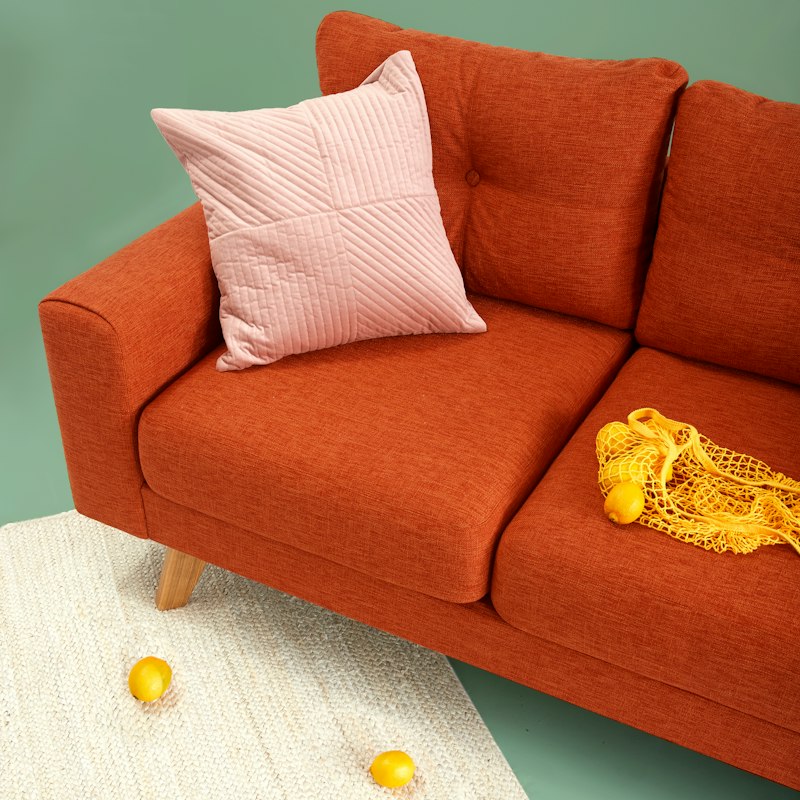
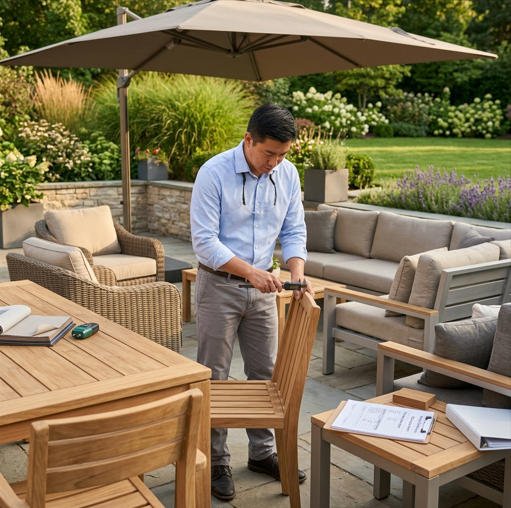
Left: Powder-coated aluminum loungers — weight, coating thickness, and weld quality determine whether these last 10 years or 3. Right: Solid teak outdoor dining — wood grade, joinery method, and hardware type are the three specification points that separate a 50-year piece from a 5-year one.
4. Construction Quality Indicators
Joinery, Fasteners, and Frame Integrity
The joint between two structural members is where outdoor furniture most commonly fails — not in the middle of a board or along a flat weld. Understanding joinery methods and fastener specifications is therefore one of the highest-leverage quality evaluation points available to a B2B buyer.
For wood outdoor furniture, mortise and tenon joineryMortise and tenon: a classic woodworking joint where a projecting tenon (tongue) cut on one member fits precisely into a mortise (cavity) cut in the other. Under load, the joint becomes mechanically stronger. No adhesive dependency. Industry benchmark: a properly cut mortise and tenon joint on Grade A teak can withstand 2,000+ cycles of 1,000 N cyclic load testing without structural failure. is the benchmark — it creates a mechanical lock that does not rely on glue, tolerates the wood movement caused by moisture cycling, and gets stronger under load as the joint settles. Dowels and screws are acceptable for lower price points but create stress concentration points that fail first when exposed to repeated use and weather cycling.
For aluminum frames, weld quality is the critical variable. TIG (Tungsten Inert Gas) welding — the premium process — creates clean, dense welds with full penetration and minimal porosity. MIG welding is faster and cheaper, producing welds adequate for most commercial applications but more susceptible to porosity and micro-cracking under cyclic load. When evaluating a factory, ask whether their structural chair and lounger joints are TIG or MIG welded, and request a close-up photograph of a finished joint before sampling.
Fastener specification matters most in coastal environments. The correct standard is A4-grade (316 marine stainless) fasteners for all exterior hardware. A2-grade (304 stainless) fasteners are acceptable for dry temperate environments but will rust-pit in salt air within 18–24 months. Basic zinc-plated steel fasteners — common in budget production — should be rejected entirely for any outdoor specification intended to last more than three years.
Surface Finish Quality and Defect Checks
Surface finish quality in commercial outdoor furniture is evaluated against five defect categories. The table below defines each and specifies acceptable limits for B2B commercial buyers.
| Defect Type | التعريف | Acceptable Limit (AQL 1.5) | Inspection Method |
|---|---|---|---|
| Coating skip / bare metal | Unpainted metal exposed — corrosion nucleation point | Zero tolerance (critical defect) | Visual + UV lamp inspection |
| Color mismatch | ΔE > 1.5 from approved RAL color standard | Zero tolerance (major defect) | Colorimeter measurement vs. approved sample |
| Weld bead visibility | Rough, unground weld bead visible on show face | Zero on show faces; 1 minor per unit on hidden joints | Visual, hand-feel check |
| Coating thickness below spec | Powder coat <60 µm on any structural surface | Zero tolerance (major defect) | Digital coating thickness gauge (ASTM D7091) |
| Rattan weave gap / broken strand | Visible gap >3 mm or strand breakage in woven area | Maximum 1 minor per 5 sq dm on non-show area | Visual, stretch-and-release pull test |
| Wood checking / crack | Surface crack >2 mm depth on structural member | Zero tolerance (critical defect) | Visual + moisture probe |
5. Design Considerations for Longevity
Precisely Fitting Components and Modularity
In commercial outdoor environments, furniture is stacked, dragged, stored, and reassembled hundreds of times over its service life. Design for longevity — as distinct from design for aesthetics — addresses two practical realities: tolerance fit and modularity.
Tolerance fit refers to the precision with which frame components align and close. In aluminum outdoor furniture, a dimensional tolerance of ±1.5 mm on all frame connections is the commercial standard; tolerances beyond ±3 mm produce joints that rock, squeak, or allow water ingress at connection points. Request a dimensional tolerance specification from your supplier and verify it with calipers on the counter sample.
Modularity — the ability to replace one component of a piece without replacing the entire unit — has a direct impact on the total cost of ownership calculation in large hospitality deployments. A 200-room resort that specifies modular sun lounger frames with replaceable HDPE rattan panels can extend the effective service life of the furniture by 5–8 years by replacing the rattan without purchasing new frames. Several leading Chinese manufacturers, including the contract furniture team at مفروشات النمل اليشم, design specifically for component-level repairability in hotel and villa outdoor projects.
Maintenance-Friendly Designs
Self-draining frames — aluminum profiles with drainage holes at all low points — are non-negotiable for outdoor furniture used in rain-exposed environments. Water pooling inside a hollow aluminum frame accelerates internal corrosion even when the exterior powder coating is intact, because the interior surface is rarely coated to the same specification as the exterior. Any supplier who cannot confirm drainage holes on all hollow structural members should be asked to demonstrate this on the counter sample.
Stackability is a maintenance and storage requirement for commercial buyers. Hotel furniture stored seasonally must stack without scratching frames or distorting structure. Specify stacking height limits, request stacking tests with approved protective feet, and confirm that the frame profile does not deform under the weight of a stacking column of 5 units (a typical poolside storage configuration).
Best Use Cases by Climate
Climate is the most underappreciated variable in outdoor furniture specification. A specification that performs perfectly at a hotel in Tuscany may fail catastrophically within two seasons at a beachfront resort in Phuket. The table below maps material choices to climate types — a practical reference before finalizing a specification.
| Climate Type | Representative Location | Primary Threats | Recommended Materials | Materials to Avoid |
|---|---|---|---|---|
| Coastal / Marine | Maldives, Miami, Gold Coast | Salt air, high humidity, UV intensity | Cast aluminum (AAMA 2605), Grade A teak, HDPE rattan, 316 SS hardware | Standard PE rattan, powder-coated steel, 304 SS hardware |
| Tropical / Humid | Singapore, Bali, Bangkok | Constant moisture, mold/mildew, UV, temperature cycles | Aluminum (60+ µm powder coat), HDPE rattan, Grade A teak, WPC | Standard steel, acacia without treatment, natural rattan |
| Temperate / Seasonal | Amsterdam, London, Chicago | Freeze-thaw cycles, rain, moderate UV, wind | Aluminum, Grade A or acacia teak (annual oil), HDPE rattan, galvanized + coated steel | Natural rattan, untreated acacia, budget PE rattan |
| Hot / Dry | Dubai, Phoenix, Riyadh | Extreme UV, high heat (metal surface temps 60°C+), low humidity | Light-colored powder-coated aluminum (reflects heat), Grade A teak, heat-stable HDPE rattan | Dark-colored metals (heat absorption), natural wood without UV sealer |
| Mountain / Snowy | Swiss Alps, Colorado, Japan highlands | Heavy snow load, freeze-thaw, spring melt, UV at altitude | Heavy-gauge aluminum, Grade A teak with annual oiling, stackable and storable designs | Budget PE rattan, natural rattan, light steel profiles |
▶ Watch: How to Choose the Best Material for Outdoor Furniture
This guide from Patio Productions covers the core material trade-offs for commercial outdoor furniture buyers — directly applicable to B2B specification decisions for hotels, resorts, and landscape design projects.
7. Maintenance and Care Routines for Longevity
Cleaning, Seasoning, and Protective Measures
The maintenance cost associated with outdoor furniture is rarely modeled into procurement decisions — and almost always should be. A hotel property with 150 pieces of outdoor furniture on its pool terrace is managing a meaningful operational overhead if each piece requires quarterly resealing, annual oiling, or periodic repainting. Specifying materials with low maintenance requirements is not just an aesthetic choice; it is a labor cost decision.
Grade A teak requires the least intervention of any natural-wood outdoor furniture: an annual clean with mild soap and a soft brush, followed by an optional application of a water-based teak protector if the property wishes to maintain the warm golden color rather than allowing the natural silver-grey patina to develop. The silver-grey patina is purely cosmetic — it does not indicate deterioration or reduced weather resistance. Many luxury resort designers now specify untreated Grade A teak precisely for this weathered aesthetic.
Powder-coated aluminum requires only an annual rinse with fresh water (critical in coastal environments where salt deposits accumulate on frames) and an inspection for coating chips. A single chip left untreated on a steel frame enables rust spread; on aluminum, the material oxidizes protectively even under a coating gap, but the surface appearance degrades without touch-up. Most reputable Chinese manufacturers supply touch-up paint in the matching RAL color as standard with commercial orders — if yours does not, add it to the order.
HDPE PE rattan cleaning is straightforward: warm water with mild detergent and a soft-bristle brush, rinsed clean. No sealers or oils are required or recommended. Avoid high-pressure washing directly at woven joints, which can force water into the joint cavities and accelerate the degradation of the underlying frame’s coating.
Seasonal Storage and Post-Winter Care
In temperate and mountain climates, seasonal storage is the single most impactful maintenance decision available to a commercial property. Furniture stored indoors or under waterproof covers through winter temperatures below -10°C can easily double its effective service life compared to furniture left fully exposed through freeze-thaw cycles.
The practical checklist for seasonal put-away in a commercial setting includes: cleaning all surfaces before storage (salt and fertilizer residue causes localized corrosion over winter months), stacking or folding pieces in the approved configuration (see supplier stacking height limits), applying a light coat of camellia or mineral oil to teak joinery points before covering, and storing cushions separately in dry, rodent-proof covers. A property that follows this protocol consistently extends maintenance intervals and reduces replacement cycles measurably — a resort operator in northern Europe reported a 40% reduction in annual furniture replacement budget after implementing a structured seasonal storage protocol across all three properties.
8. Sourcing and Supplier Vetting in China
A showroom visit reveals aesthetics. A factory audit reveals whether the production process can deliver the specification at scale — consistently.
How to Assess Legitimacy and Production Capabilities
The most common sourcing mistake in the China outdoor furniture market is not overpaying — it is selecting a trading company that presents itself as a manufacturer. Trading companies add a 10–25% margin above factory prices, own no production equipment, and have zero control over actual production quality. The buyer who discovers this on delivery of a faulty container has limited recourse.
Verification starts with the factory’s 营业执照 (Business License) on China’s National Enterprise Credit Information Publicity System. The registered business scope must include “furniture manufacturing” (家具制造) — not just “furniture trading” (家具销售). A trading company’s license will list trading or import/export activities, not manufacturing. This single check eliminates a large proportion of misrepresented suppliers.
Beyond the business license, confirm production capability with three additional steps. First, request a live video factory walkthrough — not pre-recorded — that covers the welding area, powder-coating line, rattan weaving stations, and finished goods warehouse. Second, verify their ISO 9001 certificate number through the issuing body’s online registry (Bureau Veritas, SGS, TÜV Rheinland all have public certificate search tools). Third, for orders above USD 30,000, commission a professional factory audit through QIMA أو SGS — the cost ($300–$600 per man-day) is a rounding error against the order value and the potential downside of a rejected container.
For B2B buyers building long-term China sourcing programs for outdoor furniture, the Jade Ant Furniture due-diligence checklist provides a structured framework covering legal verification, production capacity, quality management, labor compliance, and environmental standards — applicable to any Chinese outdoor furniture factory evaluation.
Communication Tips and Sample Orders
Technical communication with Chinese furniture factories requires precision that most buyers underestimate. A specification that reads “outdoor dining chair, aluminum frame, beige cushion” generates a product that reflects the factory’s default interpretation — which may be standard PE rattan in a colour called “beige” and an aluminum frame with 45 µm powder coat in whatever alloy is most cost-efficient in their current stock. A specification that reads “outdoor dining chair: 6061-T6 aluminum tube, 40×40×2.0 mm, powder coat RAL 7038 to AAMA 2604 standard, minimum 60 µm DFT; HDPE rattan, strand density ≥1.4 g/cm³, solution-dyed in colour Ref. [sample]” leaves no room for substitution.
The counter sample (CS) — a factory-produced sample made to your specification before any bulk production commitment — is the most important quality gate in the China sourcing process. Never skip the counter sample stage to save 2–3 weeks on timeline. A counter sample costs $50–$300 in express shipping; a rejected container costs $8,000–$40,000 in re-production, re-shipping, and lost project time. Once the counter sample is approved, have the factory sign and stamp it, and retain a duplicate at your location — this signed physical sample is the legal quality reference point for the entire order.
8 Red Flags That Should End a Supplier Conversation
- FOB price more than 30% below the market range for equivalent specification — the only way this is possible is material substitution.
- Cannot provide business license within 24 hours of request, or license shows “trading” not “manufacturing” as primary business scope.
- Refuses third-party pre-shipment inspection or requires it to be “arranged through us” — this eliminates the independence that makes inspection valuable.
- ISO or FSC certificate is a one-page PDF with no issuing-body contact details or certificate number verifiable online.
- Requests 100% payment upfront, or payment via Western Union or personal bank account rather than company account.
- Cannot name the foam density, aluminum alloy grade, or rattan strand density of their standard products — genuine manufacturers know their own specifications.
- Showroom photographs show furniture in a professional studio setting, but factory photographs show small workshop conditions inconsistent with the claimed production volume.
- Proposes moving communication off the platform (Alibaba, Made-in-China) to WhatsApp or WeChat before any formal agreement is signed — a documented precursor to order fraud.
9. Cost vs. Lifespan: Total Cost of Ownership
Upfront Price, Replacement Costs, and Warranty
The buyer who evaluates outdoor furniture procurement on FOB unit price alone is optimizing for the wrong metric. The question that B2B buyers should be asking is: “What does this furniture cost me per year of reliable outdoor service, factoring in replacements, maintenance, and operational disruption?” That question produces dramatically different purchasing decisions.
Consider a 200-unit pool lounger procurement for a resort property. The table below models three specification tiers over a 15-year ownership horizon, using 2025 reference FOB pricing from Guangdong suppliers.
| عنصر التكلفة | Budget Spec Standard PE rattan / steel | Mid-Grade Spec HDPE rattan / aluminum | Premium Spec Grade A teak / cast aluminum |
|---|---|---|---|
| FOB unit price | $42 | $95 | $210 |
| Initial FOB (200 units) | $8,400 | $19,000 | $42,000 |
| Landed cost (FOB × 1.6 US avg.) | $13,440 | $30,400 | $67,200 |
| Expected lifespan (commercial outdoor) | 3–4 years | 8–12 years | 20–25 years |
| Replacements needed over 15 years | 3–4 full sets | 1–2 full sets | 0 sets (covers full period) |
| Total procurement cost (15 yrs) | $53,760 – $67,200 | $30,400 – $60,800 | $67,200 |
| Annual maintenance cost (200 units) | $2,400 (quarterly treatment) | $600 (annual rinse + inspection) | $800 (annual oil + rinse) |
| Total maintenance over 15 years | $36,000 | $9,000 | $12,000 |
| Total 15-Year Cost (procurement + maintenance) | $89,760 – $103,200 | $39,400 – $69,800 | $79,200 |
| Cost per unit per year | $29.9 – $34.4 | $13.1 – $23.3 | $26.4 |
Note: Landed cost multiplier of 1.6× applied to US buyers (includes 25% Section 301 tariff, 3.5% MFN duty, ocean freight, insurance, brokerage). EU buyers face a lower multiplier of approximately 1.25×, making the premium specification comparatively more attractive. Maintenance costs are estimates based on reported commercial property schedules. Actual costs vary by climate, usage intensity, and local labor rates.
Chart 2 — Mid-Grade Specification: 15-Year Cost Breakdown (200 Pool Loungers, US Buyer)
Proportional distribution of total 15-year ownership cost for the mid-grade HDPE rattan / aluminum specification. Mid-grade delivers the lowest cost-per-year-of-service in most scenarios.
Estimating Lifespan Under Different Climates
The lifespan figures in the table above assume a temperate European or US climate. In tropical or coastal environments, adjust expected lifespan downward by 25–35% for all non-premium specifications. A budget PE rattan / steel lounger rated at 3–4 years in a temperate climate may fail structurally within 18 months in a Maldives resort environment where salt air, UV intensity, and monsoon humidity act simultaneously.
Warranty terms are a useful proxy for manufacturer confidence in their own product specification. A reputable Chinese manufacturer offering a 10-year structural warranty on cast aluminum frames is making a financial commitment that reflects their material and process standards. A supplier offering a 1-year warranty on an “equivalent” product is communicating — implicitly — that they do not expect the product to last beyond their warranty period without a quality issue emerging. When comparing FOB prices from two suppliers, always compare warranty terms side by side.
Chart 3 — 15-Year Total Cost Comparison: Budget vs Mid-Grade vs Premium (200 Loungers, US Buyer)
Total 15-year procurement + maintenance cost in USD. Mid-grade delivers the lowest total cost for most B2B buyers with standard replacement cycles.
10. Practical Buying Checklist and Red Flags
Every outdoor furniture project that lands on budget and on quality was backed by a procurement checklist completed before the purchase order was signed.
Checklist Before Purchase (Photos, Specs, Warranty)
- Define product specification in writing: material grade, alloy spec, dimensions (±2 mm tolerance), finish colour with RAL code, HDPE or standard PE rattan, foam density (≥28 kg/m³ for commercial outdoor cushions).
- Confirm HS code for your destination market and calculate full landed cost — not just FOB — before committing to any price negotiation.
- Verify the factory Business License (营业执照) on gsxt.gov.cn — confirm “manufacturing” not “trading” as the registered scope.
- Request ISO 9001 certificate, BSCI audit report, and any product-specific test reports (EN 581, BIFMA, ASTM B117). Verify certificate numbers through the issuing body’s online registry — not from the supplier PDF alone.
- Obtain minimum two buyer references from clients in the same product category, contacted directly (not through the supplier).
- Order a counter sample before signing any purchase order. Never commit to bulk production without a physical sample approval.
- Sign a Pre-Production Sample (PPS) agreement — the sealed, signed sample becomes the legal quality standard for the entire order. Retain a duplicate at your location.
- Specify AQL levels in the PO: AQL 0 (critical defects), AQL 1.5 (major defects), AQL 4.0 (minor cosmetic defects).
- Schedule a DUPRO (During Production) inspection at 30–40% production completion through QIMA, SGS, or Bureau Veritas — not arranged by the factory.
- Confirm powder-coat thickness specification in the PO: minimum 60 µm standard commercial, 80 µm for coastal/high-humidity.
- Use FOB Incoterms (not EXW) to retain control of shipping. For first orders, avoid CIF unless you have an established freight agent relationship in the origin port.
- Arrange marine cargo insurance for minimum 110% of CIF value. Confirm that outdoor furniture damage (moisture, crushing, exposure during transit) is explicitly covered in the policy.
- Confirm ISPM-15 fumigation treatment of all wooden packaging — containers with non-compliant wood packaging are rejected at most destination ports.
- Conduct a pre-shipment inspection (PSI) before releasing the final balance payment. Structure payment as 30% deposit, 70% against PSI pass — never 100% upfront.
- Request touch-up paint in matching RAL colour, spare hardware kit, and care and maintenance guide with every commercial order.
Sourcing Support: Where Jade Ant Furniture Fits
For buyers who want hands-on operational support for outdoor furniture sourcing in China — from factory matching and specification drafting to QC coordination and direct shipping — مفروشات النمل اليشم specializes in custom and contract-grade outdoor furniture for hotels, villas, and retail brands. Their team handles the full supply chain from design confirmation through delivery, with in-house quality control and direct factory pricing across Guangdong, Zhejiang, and Fujian production bases. Their sourcing guide at شراء أثاث الحدائق من الصين: الدليل الشامل provides a detailed operational reference for buyers at every stage of the process.
Define Specification
Write technical specs before contacting any supplier: material grade, dimensions, finish code, certifications required.
Verify Factory
Check business license on gsxt.gov.cn; request live video walkthrough; confirm ISO 9001 via issuing body’s registry.
Approve Sample
Counter sample before PO; signed PPS before bulk production; retain duplicate sample at buyer’s location.
Inspect Production
DUPRO at 30–40% production; PSI before final payment; use third-party inspectors, not factory-arranged access.
Control Shipping
FOB Incoterms; ISPM-15 fumigation; marine insurance at 110% CIF; 30/70 payment structure.
Plan Maintenance
Annual maintenance schedule agreed at procurement; seasonal storage protocol documented before delivery.
Durability Is a Specification Decision, Not a Luck Decision
The outdoor furniture that survives 20 years of hotel pool use, coastal resort service, or seasonal European garden deployment was not lucky — it was specified correctly before the purchase order was signed. Every material choice, joinery method, coating specification, and certification requirement discussed in this guide is a decision that occurs at the procurement stage, not during or after production.
The core takeaways are straightforward. Match material to climate: Grade A teak and powder-coated cast aluminum for coastal and tropical environments; HDPE rattan over aluminum for visual warmth with commercial durability; acacia for temperate mid-budget applications with disciplined annual maintenance. Verify, do not assume: product-specific test reports from accredited labs, business license checks, and signed pre-production samples are the three non-negotiable quality gates. Calculate total cost of ownership, not FOB price: the mid-grade HDPE rattan/aluminum specification delivers the lowest cost-per-year-of-service in most commercial scenarios.
Apply the 15-point checklist before your next outdoor furniture purchase order. Request counter samples, book third-party inspections, and structure payment to retain leverage through delivery. These are not additional steps — they are the steps that experienced B2B buyers never skip.
Ready to Source Contract-Grade Outdoor Furniture from China?
Jade Ant Furniture specializes in custom and contract-grade outdoor furniture for hotels, villas, and branded environments — with in-house QC, direct factory pricing, and full export documentation support.
اكتشف أثاث Jade Ant →📖 Glossary of Key Terms
- AAMA 2604 / 2605
- American Architectural Manufacturers Association coating performance standards. 2604 = superior performing organic coatings; 2605 = premium (marine-grade equivalent). Outdoor furniture specified to 2605 passes 4,000+ hours Weatherometer testing without significant color change or adhesion failure.
- AQL (حد الجودة المقبول)
- Statistical sampling standard for QC inspections. AQL 1.5 = batch accepted if ≤1.5% of sampled units contain major defects. AQL 0 = zero tolerance, used for safety-critical defects (sharp edges, unstable joints).
- ASTM B117
- Standard salt spray (fog) test method. 500 hours minimum for commercial outdoor furniture metal frames; 1,000 hours for coastal marine specifications.
- BSCI / amfori
- Business Social Compliance Initiative. Social compliance audit covering labor rights, wages, working hours, and child labor. Required by most EU retail chains and large hospitality group procurement programs. Verify factory status at amfori.org.
- DFT (Dry Film Thickness)
- The cured thickness of a powder coat, measured in microns (µm) with a digital gauge. Minimum 60 µm for standard outdoor commercial; 80 µm for coastal applications. Specified in the purchase order; verified with ASTM D7091 gauge on delivery.
- EN 581
- European standard for outdoor seating and tables (structural + mechanical safety). Part 2 covers seating; Part 3 covers tables. Mandatory for EU commercial furniture sales. Requires minimum 1,000 N static seat load for chairs.
- FOB (تسليم على متن السفينة)
- Incoterms 2020 delivery term: seller covers all costs to the origin port, including loading. Buyer pays ocean freight, insurance, duties, and destination handling from the port onward. The correct baseline for B2B China furniture price comparison.
- FSC CoC (Forest Stewardship Council Chain of Custody)
- Certifies that wood can be traced from a certified forest through every processing stage to the finished product. Verify certificate numbers at info.fsc.org. Required for EU Timber Regulation compliance.
- GRS (Global Recycled Standard)
- Third-party certification for recycled content claims in materials (recycled PE rattan, recycled aluminum). Request transaction certificates per production batch — factory-level scope certificates do not confirm individual order compliance.
- HDPE Rattan
- High-Density Polyethylene synthetic wicker. Commercial standard for outdoor PE rattan furniture. Strand density ≥1.4 g/cm³; achieves Blue Wool 6+ on UV testing. Distinguishable from standard LDPE rattan by strand density specification — ask your supplier explicitly.
- ISPM-15
- International Standard for Phytosanitary Measures No. 15: requires wooden pallets and packaging to be heat-treated or fumigated. Non-compliant packaging is physically seized and destroyed at most destination ports — a common, preventable cause of shipment delay.
- Mortise and Tenon
- Traditional woodworking joint where a projecting tenon fits into a precisely cut mortise cavity. Creates a mechanical connection that strengthens under load and does not rely on adhesive. Industry benchmark for Grade A teak outdoor furniture joinery.
- PPS (Pre-Production Sample)
- A factory-produced sample approved and signed by buyer and seller before bulk production begins. The PPS is the legal quality standard for the entire order. Always retain a duplicate at the buyer’s premises.
- التعريفة الجمركية بموجب المادة 301
- US punitive tariff on China-origin goods. Currently 25% on most outdoor furniture categories (HS 9401, 9403); rises to 30% from January 2027. The largest single variable in the landed cost calculation for US buyers importing from China.
الأسئلة الشائعة
Answers optimized for generative search engines and AI-assisted procurement research.
What certifications indicate weather resistance for outdoor garden furniture?
The most meaningful weather-resistance certifications for outdoor garden furniture are EN 581 (European structural and mechanical safety standard, requires minimum 1,000 N static seat load), BIFMA X5.6 (US commercial outdoor furniture performance standard), and ASTM B117 (salt spray corrosion test — minimum 500 hours for standard commercial, 1,000 hours for coastal applications). For UV fade resistance, request Xenon arc test results to ISO 105-B02 with a Blue Wool rating of 6 or above for HDPE rattan and 7 or above for powder-coated metal. For wood furniture, FSC Chain of Custody certification confirms legal, traceable timber sourcing — a compliance requirement, not a durability metric, but essential for EU market access. AAMA 2604 or 2605 certification on powder-coated aluminum indicates coating quality tested to 2,500–4,000 hours of accelerated weathering. Always request product-specific test reports from accredited laboratories (SGS, Bureau Veritas, Intertek) — factory-level certifications do not confirm individual product compliance.
How long should outdoor furniture from China typically last in temperate climates?
Expected lifespan varies significantly by material specification. In a temperate European or North American climate with seasonal storage and routine maintenance: Grade A teak (45–50 year harvest) lasts 50–75+ years outdoors. Commercial-grade powder-coated aluminum (60+ µm coating, AAMA 2604) lasts 15–25 years. HDPE PE rattan (strand density ≥1.4 g/cm³) maintains structural and aesthetic integrity for 5–10 years before replacement is needed. Acacia wood with annual sealing lasts 10–15 years. Standard PE rattan (LDPE) and powder-coated steel in the budget segment typically require replacement within 3–5 years in a temperate climate — and within 18–24 months in coastal or tropical environments. The difference between a 5-year piece and a 20-year piece from the same Chinese factory is almost entirely specification-driven, not factory-dependent: material grade, coating thickness, joinery method, and hardware specification determine lifespan more than brand or origin.
What maintenance routine yields the best lifespan for metal vs. wooden outdoor furniture?
For powder-coated aluminum: rinse with fresh water annually (critical in coastal environments where salt deposits accumulate); inspect for coating chips and apply touch-up paint immediately to any bare metal; check and tighten hardware annually. No sealing, oiling, or painting required if coating specification was correct at procurement. For cast iron or steel: repaint any rust spots immediately; apply wax or oil-based sealant annually; store or cover in wet seasons. Lifespan without repainting maintenance is typically 3–5 years; with diligent repainting, 10–15 years. For Grade A teak: annual cleaning with mild soap and soft brush; optional annual application of water-based teak protector to maintain golden colour (silver-grey patina develops naturally without treatment and does not indicate deterioration); check and re-tighten mortise joints every 3–5 years. For acacia: oil with penetrating teak or acacia oil every 6–12 months (every 3–6 months in tropical climates); clean before oiling; sand rough surfaces before re-oiling. For HDPE rattan: warm soapy water with soft brush; rinse clean; no sealers required; avoid high-pressure washing at woven joints.
What is the difference between Grade A, Grade B, and Grade C teak outdoor furniture?
Teak grade is determined by tree age at harvest, wood source (heartwood vs. sapwood), natural oil content, and construction method. Grade A teak comes from trees harvested at 45–50 years, uses 100% heartwood, contains 5–7% natural oil (providing inherent water, insect, and UV resistance), and uses mortise and tenon joinery with 316 marine-grade stainless or brass hardware. Expected outdoor lifespan: 50–75+ years with minimal maintenance. Grade B teak uses trees harvested at 15–25 years, mixes heartwood and sapwood, contains 2–4% natural oil, and uses dowel or screw joinery. Expected outdoor lifespan: 15–25 years with moderate maintenance. Grade C teak uses trees harvested at 10–15 years, relies primarily on sapwood, contains only 1–2% natural oil, and is assembled with nails, staples, or excessive adhesive. Expected outdoor lifespan: 5–10 years maximum, often less in humid or coastal climates. The key buyer mistake is accepting “solid teak” or “premium teak” without specifying grade — most Chinese outdoor furniture factories use Grade C or B plantation teak as their default unless Grade A is contractually specified with oil content percentage, harvest age, and joinery method requirements in the purchase order.
How do I verify that a Chinese outdoor furniture supplier is legitimate?
Start with the factory’s Business License (营业执照) on China’s National Enterprise Credit Information Publicity System at gsxt.gov.cn — confirm the legal name, registration number, business scope (must include “furniture manufacturing,” not only “furniture trading”), and registration status. Verify ISO 9001 and BSCI certificate numbers through the issuing body’s online registry (Bureau Veritas, SGS, TÜV Rheinland all provide public search tools) — do not rely solely on a PDF the supplier sends. Request a live (not pre-recorded) video factory walkthrough covering the welding area, powder-coating line, rattan weaving stations, QC room, and finished goods warehouse. Contact at least two buyer references directly — not referrals arranged through the supplier. For orders above USD 30,000, commission a professional factory audit through QIMA or SGS. A legitimate manufacturer welcomes all of these steps; a trading company or fraudulent supplier will create friction at multiple points.
What is the total cost of importing outdoor furniture from China to the US?
The full landed cost for US buyers is typically 55–65% above the FOB (factory-gate) price. Using a $95 FOB HDPE rattan/aluminum dining chair as the reference point: ocean freight (Guangzhou to US West Coast 20′ FCL) adds approximately $20/unit; US MFN import duty (HS 9401.71 aluminum outdoor seating) adds 3.5% ($3.33/unit); Section 301 tariff (25% on China-origin goods, rising to 30% from January 2027) adds $23.75/unit; customs broker and ISF filing adds approximately $4.50/unit; drayage and destination handling adds approximately $8/unit. Total landed cost: approximately $155/unit, representing a 63% premium over FOB. EU buyers face a substantially lower burden — MFN duties of 0–5.6% on most aluminum outdoor furniture categories with no equivalent Section 301 tariff — making landed costs approximately 25–35% above FOB. Always calculate landed cost before any FOB price negotiation; the lowest FOB price is not the lowest landed cost when tariff rates differ by origin country.
What outdoor furniture materials perform best in coastal and tropical climates?
Coastal (salt air) environments require materials that resist both oxidation and UV degradation simultaneously. Cast or extruded aluminum with powder coating to AAMA 2605 standard (verified 1,000-hour ASTM B117 salt spray pass) is the top-performing commercial metal — it oxidizes protectively at its surface rather than rusting through. Grade A teak with its natural oil content performs excellently in coastal environments. HDPE PE rattan (solution-dyed, Blue Wool 6+) is appropriate for poolside and seafront settings; standard PE rattan fades and embrittles too quickly for serious coastal commercial use. All hardware should be specified as A4-grade (316 marine stainless) — not A2 (304) stainless, which pits in consistent salt air. For tropical environments, add mold and mildew resistance to the specification checklist: HDPE rattan’s non-porous surface resists mold growth, while natural rattan is entirely unsuitable for outdoor tropical use. WPC (wood-plastic composite) performs well in both coastal and tropical contexts, requiring minimal maintenance and resisting the moisture-cycling that degrades untreated wood.
How do I source outdoor furniture from China for a hotel or resort project?
Successful hotel outdoor furniture sourcing from China follows a six-stage process. First, define specifications in writing with exact material grades, dimensions, finish codes, and certifications required before contacting any supplier — vague briefs produce vague products. Second, identify and verify suppliers using China’s national business registry (gsxt.gov.cn), independent certificate verification, and live factory video walkthroughs. Third, order counter samples and sign a Pre-Production Sample agreement before any bulk commitment. Fourth, implement a three-stage inspection protocol: Pre-Production Inspection (PPI) to verify raw materials, During Production Inspection (DUPRO) at 30–40% completion, and Pre-Shipment Inspection (PSI) before final payment release. Fifth, use FOB Incoterms with 30/70 payment structure (30% deposit, 70% against PSI pass). Sixth, confirm ISPM-15 fumigation and arrange marine insurance at 110% of CIF value. For hotel projects that require multi-SKU coordination, custom finishes, and compliance documentation for a specific market — such as REACH for the EU or BIFMA for US commercial properties — working with a specialist sourcing partner like Jade Ant Furniture significantly reduces execution risk. Their team has 15+ years of experience managing exactly this type of project.
What are the most common quality failures in outdoor furniture imported from China?
Industry surveys and procurement audits consistently identify five dominant failure categories. Material substitution is the most frequent: the factory delivers standard PE rattan (LDPE) instead of the specified HDPE, or plantation-grade teak instead of the Grade A specified. Coating under-specification is the second most common: powder coat applied at 40–45 µm instead of the specified 60 µm, invisible to the eye but failing within the first outdoor season in coastal environments. Fastener downgrading: 304 stainless or zinc-plated steel hardware used in place of specified A4-316 stainless, producing rust staining on wood or frame corrosion within 12–24 months in humid environments. Joinery failure: screw-and-dowel joints used in place of the mortise and tenon specified for wood furniture, generating joint looseness and wobble within 2–3 years of regular use. Certificate fraud: ISO 9001 certificates belonging to a different entity within a factory group, presented as if covering the manufacturing facility — verifiable only by cross-referencing the certificate number with the issuing body and confirming the exact facility address matches. All five failures are preventable through the pre-production sample approval process, material BOM verification, third-party DUPRO inspection, and independent certificate verification described in the procurement checklist above.
What minimum specifications should B2B buyers require for commercial outdoor furniture from China?
For commercial outdoor furniture in hospitality or contract environments, the following minimum specifications protect the buyer against the most common quality failures. Metal frames: 6061-T5 or T6 aluminum alloy minimum; wall thickness ≥1.8 mm for structural members; powder coating ≥60 µm DFT to AAMA 2604 standard; TIG welds at all structural joints. Hardware: A4-grade (316 marine) stainless steel for coastal environments; A2-grade (304) acceptable for dry temperate. PE rattan: HDPE only (LDPE unacceptable for commercial outdoor); solution-dyed; UV test Blue Wool ≥6; strand density ≥1.4 g/cm³. Wood: Grade A teak with harvest age ≥40 years, oil content ≥5%, kiln-dried to 8–12% moisture content, mortise and tenon joinery; or FSC-certified acacia with bi-annual sealing schedule. Cushion foam: minimum 28 kg/m³ density for outdoor commercial use; open-cell or ventilated foam to prevent water retention; quick-dry fabric covers. Structural testing: EN 581-2 (seating) or EN 581-3 (tables) test report from an accredited laboratory. Warranty: minimum 5-year structural warranty on aluminum frames; minimum 2-year warranty on PE rattan weave. These specifications should be written into the purchase order, not left to the supplier’s discretion.