
High-End Furniture Care: Keeping Modern Pieces Intact

Boucle, marble and polished stone in one room. Every surface here has a different enemy.
Two sofas leave the same workshop in the same month.
One sits in a villa in Coral Gables. The owner covers it with a throw when the grandchildren visit. The house runs at 50% humidity. Six years later the frame is still tight and the cushions still hold their shape.
The other sits in a lobby in Doha. Housekeeping wipes it with an all-purpose spray twice a day. The glass wall behind it faces west. Three years later the arms are shiny, the leather is cracked at the seams, and the replacement quote lands at 42,000 USD.
Same sofa. Different care.
That gap is what this guide is about. It is written for the people who own that risk: villa owners and estate managers, hotel operators, FF&E buyers, interior designers, developers, importers and private label brands.
A luxury piece is not fragile. It is specific. Each material has a narrow band of conditions where it performs well. Care is the work of keeping the piece inside that band.
I. Why Care Is a Capital Decision, Not a Chore
Luxury furniture is a capital asset with a maintenance liability attached. Most owners budget the first number and ignore the second.
The purchase price is fixed. The care cost is not. It moves with the climate, the traffic, the cleaning crew and the training behind that crew.
| Cost line | Ignored for 5 years | Managed from handover |
|---|---|---|
| Cleaning products | Cheap, wrong, damaging | Correct, small annual spend |
| Repairs | Reactive, at emergency rates | Scheduled, at planned rates |
| Replacement | Whole pieces, at current prices | Cushions, covers, small parts |
| Guest or owner impact | Visible wear in photos and reviews | Surfaces hold their finish |
A hotel that re-covers twelve lobby chairs is paying twice. It pays for the new hide. It also pays for the downtime, the freight and the labor to strip the old covers.
The value case is simple. Care spending is predictable and small. Replacement spending is unpredictable and large. Buyers who plan the first number protect the second.
The same logic applies to a private villa. A dining table that survives twenty years without refinishing is not a table with better wood. It is a table that was never left wet.
If you want the broader picture first, this overview of luxury furniture care covers the whole life cycle from delivery to resale.
II. Material Composition: What You Are Actually Maintaining
Care starts with knowing the material. “Wood” and “leather” are not materials. They are families of materials with different rules.
Solid wood and veneer
Solid walnut and oak move with moisture in the air. The wood takes in water in a humid month and releases it in a dry one. The movement is small, but it is real, and it never stops.
A veneered panel has the same wood on the outside and a stable core inside. That construction resists movement better than solid wood. It also fails differently. When a veneered top dries out too fast, the veneer can lift at an edge.
Both need the same thing: stable humidity. You can read more on why panels split in this guide to why solid wood cracks, and on how the two builds differ in this comparison of veneered and solid construction.
Upholstery fibers
Boucle is a looped yarn. The loops give it that soft, nubby surface. The same loops catch rings, watch clasps and pet claws. A pulled loop cannot be pushed back invisibly.
Velvet and mohair are pile fabrics. They show every brush mark and every handprint. They also crush flat where people sit, and the crush becomes permanent if nothing lifts the pile.
Performance fabrics trade touch for toughness. They resist stains and clean easily. They also feel different under the hand, and buyers notice that difference in the first ten seconds.
Leather
Full-grain aniline leather is dyed through and left almost bare. It breathes, it darkens with use, and it absorbs liquid fast. Semi-aniline has a thin protective coat. Pigmented leather has a full color coat and a top seal.
Each one needs a different product. The details sit in this guide to caring for leather sofas.
Finishes
High-gloss lacquer is a film. It sits on top of the wood and reflects light. Once it scratches, the scratch is visible from across the room, and spot repair rarely matches.
Hand-rubbed oil soaks into the wood. It looks softer, ages more gracefully, and needs re-oiling every year or two. It also stains if a glass of red wine sits on it overnight.
Powder coating sits on metal frames. It chips at edges and at floor contact points, and a chip becomes a rust spot in a coastal building.
| Material | Main weakness | What protects it | What destroys it |
|---|---|---|---|
| Solid walnut or oak | Humidity swing | Stable RH, felt pads | Dry air, direct heat |
| Veneered panel | Edge lift | 45–55% RH, no steam | Water rings, steam cleaners |
| Boucle | Loop snagging | Vacuum without a beater bar | Pet claws, velcro, bleach |
| Velvet or mohair | Pile crush | Regular brushing, rotation | Repeated sitting in one spot |
| Aniline leather | Liquid absorption | pH-neutral cleaner, conditioner | Soap, sun, body oil |
| High-gloss lacquer | Micro-scratches | Soft dry cloth only | Abrasive polish, ammonia |
| Oiled wood | Water marks | Re-oiling, coasters | Standing water, degreasers |
Certification tells you what you are maintaining. FSC covers timber sourcing, OEKO-TEX covers textile safety, and UL GREENGUARD Gold covers low emissions for sealed rooms. BSI publishes the test standards behind contract furniture durability, and WBDG covers indoor environmental design targets. Market context sits with Statista.

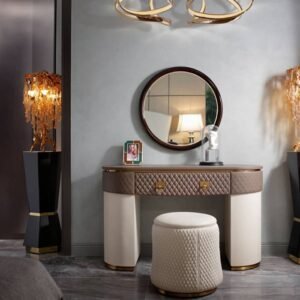
Marble top, veneered body, brass inlay. Three materials, three cleaning rules, one piece of furniture.
How long each of these materials lasts depends less on price than on care. This model compares the two approaches.

Service life is not fixed at purchase. It is set by the care regime.
III. Environment: The Damage You Cannot See
Most of the damage in a luxury interior arrives before anyone touches the furniture. It comes through the window and out of the air conditioning.
Light
Window glass blocks most UVB. It lets most UVA through. UVA is the part that fades dye and dries leather.
A south or west-facing glass wall can bleach the back of a sofa in one season. The damage is uneven, because the sun moves. The seat that sits in the afternoon beam fades first, and the rest of the sofa stays dark.
Three fixes work. Low-e glass with a UV filter cuts the load at the window. Sheer curtains or solar shades break the direct beam. Rotating loose cushions spreads the exposure.
Humidity and temperature
Wood, leather and textiles all settle at a stable moisture level. Push the room too dry and wood shrinks. Push it too wet and joints swell and veneer lifts.
| Condition | Target | What goes wrong outside it |
|---|---|---|
| Relative humidity | 45–55% | Below 35%: cracks, lifted veneer. Above 65%: swelling, mold |
| Temperature | 18–24°C | Above 26°C: leather dries, glue softens |
| Air movement | Gentle, indirect | Direct vents dry one side of a piece |
| Sun exposure | Diffuse daylight | Direct beam fades and heats the surface |
Hotel rooms are the hardest case. Guests set the thermostat to 18°C in summer. Housekeeping opens the balcony door. The room swings twenty points of humidity in a day, and the timber headboard takes the hit.
Placement
A few placement rules prevent most avoidable damage:
- Keep furniture at least 30 cm from radiators, fireplaces and heat vents.
- Keep leather and timber out of the direct path of a ceiling diffuser.
- Leave a 5 cm gap behind sofas so air can move and the wall can dry.
- Put the heaviest pieces away from walk-through routes in villas with staff circulation.
- Never place a piece where the sun lands at the same hour every day.
That fifth rule is the one designers break most often. A beautiful chair in a beautiful beam of light is also a chair that fades on schedule.

Floor-to-ceiling glass looks calm. It is also a slow bleaching machine for anything in the direct beam.
A quick look at where the damage actually comes from, based on service records and site inspections.
Most damage is environmental. Cleaning is only the third-largest cause.
IV. Hard Surfaces: Cleaning Without Cutting
The wrong product does more damage in five minutes than five years of dust.
The pH rule
Most interior finishes sit near neutral. Marble, limestone and lacquer all react to acid. Ammonia and bleach attack seals and top coats.
Use a pH-neutral cleaner at the dilution on the label. Use less than you think you need. Rinse with clean water and dry with a soft cloth.
That single habit solves most hard-surface problems in luxury interiors.
Stone, marble and glass
Marble etches on contact with acid. A lemon slice, a vinegar spray or a glass of white wine leaves a dull mark that no polish will lift, because the acid has eaten the surface.
Blot first. Clean with a stone-safe neutral product. Dry immediately.
Sealing helps, but it is not permanent. Honed marble in a busy dining room needs resealing every 12 to 18 months. Polished marble in a low-traffic hallway can go two years.
Glass tops scratch from grit, not from glass cleaner. Dust with a dry microfiber first, then clean. Wipe in one direction, not in circles.
Dusting and polishing without micro-scratches
- Remove loose grit with a dry microfiber cloth or a soft vacuum brush.
- Work top to bottom so dust does not fall onto a clean surface.
- Use a second, clean cloth for the polish step.
- Never spray product directly onto a finish. Spray the cloth.
- Buff with a dry cloth until the surface is dry to the touch.
- Stop. More polish does not mean more protection.
Paper towels are wood pulp. Wood pulp is abrasive. Keep them away from lacquer, gloss and glass.
If you need a base routine for oiled and lacquered timber, this short guide on everyday furniture care covers the weekly steps.
V. Textiles: Keeping the Hand-Feel
Expensive fabric is judged by touch. Cleaning that changes the touch has failed, even if the stain is gone.
Vacuum technique
Use a soft upholstery head with low suction. Go over the whole piece, not just the visible seat.
Turn off the beater bar on loop piles like boucle. A rotating brush pulls loops. Once a loop is pulled, the fix is a repair, not a clean.
On velvet and mohair, vacuum in the direction of the pile, then brush the pile back up with a soft clothes brush. Steam the crushed areas lightly from 20 cm away. Let the pile dry undisturbed.
Protectors
Fabric protectors work. Over-application does not.
A thin, even coat on a clean, dry fabric adds a liquid barrier. Three coats on a dirty fabric trap soil in the pile and change the hand-feel to something slightly stiff. On aniline leather, most protectors are the wrong product entirely.
Ask for the product data sheet. Check that it is safe for the specific fiber, and check the reapplication interval. Most interior textiles need it every 12 to 24 months, not every quarter.
Spills
The first sixty seconds decide the outcome.
- Blot, do not rub. Use a clean white cloth.
- Work from the outside of the spill inward so the mark does not spread.
- Use cool water, never hot. Heat sets protein stains.
- Do not scrub boucle. Lift, then blot.
- Call a specialist for ink, red wine, coffee and oil on light-colored aniline.
Keep a small spill kit in every villa and every housekeeping closet: white cloths, a neutral spotter, blotting paper and a written escalation number.
VI. Leather: Hydration, Not Polishing
Leather is skin. It holds natural oils, and it loses them over time. The goal is to keep it supple, not to make it shine.
Know your hide
| Leather type | Surface | Cleaning | Conditioning |
|---|---|---|---|
| Full-grain aniline | Bare, open pore | Dry cloth, pH-neutral foam | Every 6–12 months |
| Semi-aniline | Thin pigment coat | Damp cloth, mild cleaner | Every 9–12 months |
| Pigmented | Full color coat | Damp cloth, mild soap | Every 12 months |
| Nubuck and suede | Brushed nap | Dry brush, eraser | Protectant spray only |
A simple test tells you what you have. Put one drop of water on a hidden area. If it soaks in within a minute, the leather is porous and needs gentle, water-light care. If it beads and sits, the surface has a protective coat.
The conditioning routine
Clean first. Conditioner applied over dust and body oil pushes both into the grain.
Apply a thin layer with a soft cloth, using small circles. Let it sit for 15 minutes. Buff off the excess with a dry cloth. Never leave a wet film.
In a climate-controlled villa, twice a year is enough. In a dry desert climate or a ski house with strong heating, go to every four months on the seats and arm tops.
Do not use olive oil, coconut oil or saddle soap on finished upholstery leather. Oils go rancid, and saddle soap is alkaline.
Patina or damage?
Patina is even. It darkens where hands rest, and the color shift follows the shape of the piece. It looks like age, and it reads as quality.
Damage is patchy. It shows as light, dry patches on the arm fronts, fine cracks that follow a seam, or a color that has gone gray in one area near a window.
If the surface feels dry and looks chalky, it needs conditioning. If cracks open when you press the leather, the finish has failed and a restorer should see it.

Even color and soft sheen at the arm. This is patina, not wear.
VII. Structure: The Part Nobody Photographs
A sofa fails from the inside first. The cover looks fine while the frame underneath is already working loose.
Check these five points every 12 months in a private home, and every 6 months in a hotel:
- Joints. Rock the piece gently with one hand on the arm. Any movement means a loose joint.
- Glides and feet. Look for compression marks on the floor and splits at the base.
- Suspension. Press the seat center. A thud instead of a spring means webbing or springs have dropped.
- Hardware. Tighten bolts and brackets to the maker’s torque. Do not overtighten into timber.
- Moving parts. Recliners, extension tables and swivel bases need dry lubricant, not oil.

Webbing, springs and frame. None of this is visible from the room, and all of it decides how long the piece lasts.
Most structural damage is caused by movement, not by weight. Staff drag a chair across stone. A guest drops onto one corner of a sofa. A table is lifted by the top instead of the frame.
Fix the handling, and the structure lasts.
VIII. High-Traffic Environments: Layering Protection
A hotel lobby and a private living room need different plans. One has twenty users a day, the other has two.
The principles do not change. The frequency does.
Barriers that stay invisible
Felt pads under every leg. A tray under every lamp and vase. Coasters in every seating group. A glass or sealed stone top on any timber surface that will hold drinks.
These are not decorative choices. They are the cheapest form of insurance in the building.
A maintenance calendar that people actually follow
| Task | Villa | Boutique hotel | Large hotel |
|---|---|---|---|
| Dust and vacuum upholstery | Weekly | Daily, public areas | Daily |
| Leather wipe-down | Monthly | Weekly | Weekly |
| Wood polish | Monthly | Monthly | Monthly |
| Stone reseal check | Yearly | Every 6 months | Every 6 months |
| Frame and joint check | Yearly | Every 6 months | Quarterly |
| Deep clean and condition | Yearly | Every 6 months | Quarterly |
| Upholstery restoration review | Every 5 years | Every 3 years | Every 2 years |
Put the calendar on the housekeeping system, not in a binder. A schedule that lives in a folder is a schedule that stops in month three.
Training beats product
Housekeeping teams damage more furniture than guests do. A spray bottle of all-purpose cleaner and a rough cloth will strip a lacquer top coat in a season.
Train three things:
- Which cloth goes with which surface.
- Which bottle is allowed on leather, stone and lacquer.
- How to lift and move a heavy piece, and who to call when it is too heavy.
Ten minutes at induction saves more than any annual deep clean.
Jade Ant furniture ships a one-page finish card with every order: product names, dilution rates and the products to keep away. Housekeeping teams change. The card does not.
For a commercial asset, the cost argument is easier to settle with a ten-year view than with a single invoice.
The cheapest line is the one with the most care hours in it. Replacement is what makes the top line expensive.
A note on this chart: the saving is not in the cleaning products. It is in avoided re-upholstery, avoided freight and avoided room downtime. A 100-key hotel that replaces forty lobby and suite pieces early spends more than a decade of scheduled care.

A lounge like this takes more contact in one week than a private living room takes in a year.
IX. When to Call a Restorer
Some problems are maintenance. Some are restoration. Mixing them up costs money.
Call a professional when you see:
- Cracks that open when the leather is pressed
- Veneer lifting or bubbling at an edge
- A joint that moves under hand pressure
- Water rings that have gone through the finish, not just the wax
- Fading that covers more than a third of one surface
- Any damage on a signed or antique piece
Do not call a professional for dust, light soil, dry leather or a crushed pile. Those are routine.
Why home remedies fail
The internet is full of them. Most of them work on cheap furniture and fail on expensive furniture.
Toothpaste on a water ring is an abrasive. It cuts through lacquer. Mayonnaise on a scratch feeds oil into raw timber and darkens it permanently. Hairdryer on a wet ring drives moisture deeper into the grain.
On high-gloss lacquer, a water ring sits in the top film. The correct fix is a controlled polish by someone who can match the sheen. On aniline leather, a “leather repair kit” from a general store usually leaves a color patch that is visible in daylight.
Build the relationship before you need it
Find a restorer at handover, not at the first crack. Ask three questions: what is your leather experience, what is your lacquer experience, and can you match a finish sample?
The American Institute for Conservation keeps a searchable directory of accredited conservators. The Getty Conservation Institute publishes free technical guidance on materials and cleaning methods.
For a commercial asset, put the restorer on a retainer. A quarterly visit costs less than one emergency call, and it catches problems while they are still small.
If you want the sourcing side of this argument, the luxury furniture care framework sets out how a professional maintenance contract is scoped, and the bedroom care framework covers the pieces guests touch most.
https://www.youtube.com/watch?v=OuyQpjiIb6Y
A restorer working on the frame of a chair. Structural repair is slow, careful and almost never visible afterwards.
X. Conclusion
Care is a design decision made after the design is finished.
The pieces that survive twenty years in a luxury interior are not the most expensive ones. They are the ones that stayed inside their material limits: stable humidity, filtered light, correct products, and a schedule someone actually follows.
Three habits protect almost everything:
- Control the room before you clean the furniture.
- Match the product to the material, not to the stain.
- Fix structure early, before the cover hides the problem.
Jade Ant furniture builds pieces for hotels, villas and private label collections, and we specify the care routine for each finish at the same time as the finish itself. Our team works from a written quality control checklist before every shipment, and we keep finish samples on file so a repair can match years later.
If you are planning a project or replacing a set that failed early, send us the details and we will price the specification and the care plan together.
Browse the sofa range and the dining table range to see how these finishes are specified, or look at the full product catalog for the material options on each piece.

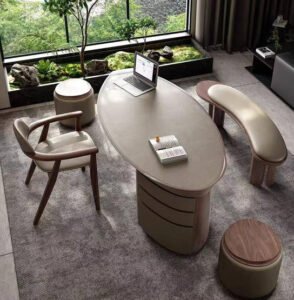
Walnut, marble and boucle in one sightline. Each one will age at a different speed.
Terms Used in This Guide
| Term | Plain meaning | Why it matters |
|---|---|---|
| Aniline leather | Leather dyed through with almost no surface coating | Absorbs liquid fast, shows patina, needs gentle care |
| Patina | Even darkening from light, air and hands | A sign of quality, not damage |
| Boucle | Fabric woven from looped yarn | Soft surface, but loops snag and pull |
| Pile | The upright fibers in velvet or mohair | Crushes flat with use, lifts with brushing |
| Veneer | Thin slice of real wood glued to a stable core | Stable in humidity, but edges can lift |
| 2K lacquer | Two-part polyurethane coating | Hard and glossy, very hard to spot-repair |
| RH (relative humidity) | How much moisture the air holds at a given temperature | The single biggest factor in wood and leather life |
| pH-neutral | A cleaner close to pH 7 | Safe on most finishes; acid and alkali are not |
| Beater bar | The rotating brush inside a vacuum head | Pulls loops in boucle and flattens pile |
Frequently Asked Questions
How do I remove a water ring from a high-gloss lacquer finish without scratching it?
Act within a day. Wipe the ring with a dry soft cloth and leave the surface alone for 24 hours, because many rings sit in surface moisture and disappear on their own. If it stays, use a dedicated lacquer polish on a foam pad with light pressure, then buff to match the sheen. Do not use toothpaste, vinegar or a hairdryer.
Which pH-neutral cleaners are safe for exotic wood veneers?
Look for a product labeled pH-neutral and safe for finished wood, diluted as the label states. Apply it to a cloth, not to the surface, and dry immediately. Avoid anything with ammonia, citrus oil or silicone, because those attack the finish or leave a film that traps dust.
How often should aniline leather be conditioned in a climate-controlled villa?
Twice a year is enough at 45–55% humidity. Go to every four months if the heating runs hard in winter or the villa sits in a dry desert climate. Condition thin, buff off the excess, and never leave a wet film.
Can I use a steam cleaner on high-end boucle or velvet upholstery?
No. Steam plus suction distorts loop piles and can shrink backing. Use low-suction vacuuming and a soft brush. For a deep clean, use a dry extraction method with a technician who knows the fiber.
What is the ideal humidity to stop solid wood from cracking?
45–55% relative humidity, held steady. The stability matters more than the exact number. A room that swings from 30% to 70% through the year will crack timber that would have been fine at a constant 40%.
How do I protect a white luxury sofa in a busy hotel lobby?
Three layers. Seal the fabric with a protector rated for the fiber. Place the sofa out of the main traffic line. Ban food and drink service on that seat, and give housekeeping a white-cloth spill kit with a written escalation contact.
Are fabric protector sprays safe for designer textiles, or do they change the feel?
Most are safe when applied thin and evenly on a clean, dry fabric. Over-application is what stiffens the hand. Ask for the data sheet, test on a hidden area, and reapply every 12–24 months rather than every quarter.
How can I tell natural patina from real damage on a leather piece?
Patina is even and follows where hands rest. Damage is patchy: light dry patches on arm fronts, cracks that open when pressed, or a gray area near a window. Dry and chalky means condition it. Cracks that open mean a restorer.
What is the best way to clean brass, chrome and gold leaf without tarnishing them?
Dust first with a soft dry cloth. For brass and chrome, use a pH-neutral metal cleaner on a small hidden area, then buff dry. Never use abrasive pads. Gold leaf takes no polish at all, only a soft dry brush, because any rubbing lifts the leaf.
How should oversized modern pieces be moved without structural stress?
Lift, never drag. Support the frame, not the top or the arm. Use two people for anything over 40 kg, a furniture dolly with felt pads for stone tops, and remove cushions and shelves first. On site, protect the route before the piece moves.