The key differences between traditional and modern furniture manufacturing come down to how pieces are built, what they are built from, and how long they are built to last. Traditional methods rely on skilled artisans using hand tools, solid hardwoods, and time-tested joinery techniques to produce furniture that can endure for generations. Modern methods leverage CNC machinery, engineered materials, and automated assembly lines to produce furniture at scale, at speed, and at price points accessible to a far broader market.
Understanding these differences matters because furniture is one of the most significant purchases people make for their homes and businesses — and the manufacturing method behind a piece directly shapes its quality, sustainability, durability, and long-term value. In a global furniture market projected to reach $831 billion in 2026 according to Grand View Research, consumers and professionals have more choices than ever, making it more important than ever to understand what those choices actually mean.
This article provides a thorough, actionable comparison of both manufacturing approaches — examining materials, tools, design philosophy, durability, sustainability, cost, and practical decision-making criteria. Whether you are a homeowner furnishing a new space, an interior designer specifying for a project, or a buyer working with manufacturers like Jade Ant Furniture to source quality pieces for international markets, this guide will equip you to make informed decisions based on what truly differentiates traditional craftsmanship from modern production.
Overview of Manufacturing Furniture Methods
Traditional Furniture Approach
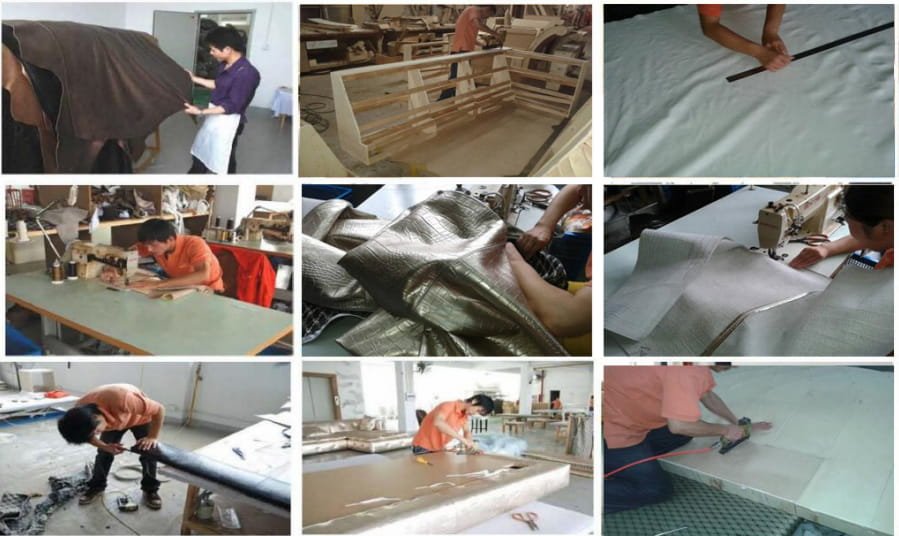
Traditional furniture manufacturing is defined by the primacy of human skill. An artisan working in the traditional method begins with raw, solid hardwood — species like oak, walnut, cherry, mahogany, or beech — and transforms it through a sequence of hand-guided processes: measuring, marking, cutting, shaping, joining, finishing, and assembling. Each step requires judgment, experience, and a tactile understanding of wood that no machine can fully replicate.
The production timeline for traditional furniture is measured in days, weeks, or even months per piece. A hand-built dining table with mortise-and-tenon joinery might require 40 to 80 hours of skilled labor. A set of hand-cut dovetail drawers for a chest of drawers could take a full day for a single drawer. This pace is not inefficiency — it is the time required to achieve the material integrity, aesthetic nuance, and structural precision that define heirloom-quality furniture.
Traditional furniture workshops are typically small operations — a solo craftsman, a master-apprentice pair, or a small team of five to twenty artisans. The geographic distribution of these workshops follows historic patterns of craft specialization: the Amish communities of Pennsylvania and Ohio, the furniture-making districts of Brianza in northern Italy, the woodworking traditions of Japan and Scandinavia, and increasingly, artisan workshops across Southeast Asia and China. Production volumes are inherently limited, which is both a constraint and a value proposition — every piece is, by definition, rare.
Modern Furniture Approach
Modern furniture manufacturing inverts nearly every characteristic of the traditional approach. It prioritizes speed, consistency, scalability, and cost efficiency. The production environment is a factory floor equipped with CNC routers, automated panel saws, edge-banding machines, robotic spray-coating systems, and computer-controlled assembly lines. Materials include engineered wood products (MDF, particleboard, plywood), metals (steel, aluminum), glass, plastics, and synthetic upholstery fabrics — chosen for their uniformity, availability, and cost.
The scale differences are staggering. A modern furniture factory producing flat-pack bookcases can output thousands of identical units per day. The global CNC router market alone reached $17.37 billion in 2025 and is projected to reach $25.62 billion by 2030, according to industry data — reflecting the massive investment in automated production technology across the furniture sector. Major manufacturing hubs like Foshan (China), which houses over 7,000 furniture factories, can produce and ship furniture to over 180 countries with lead times measured in weeks rather than months.
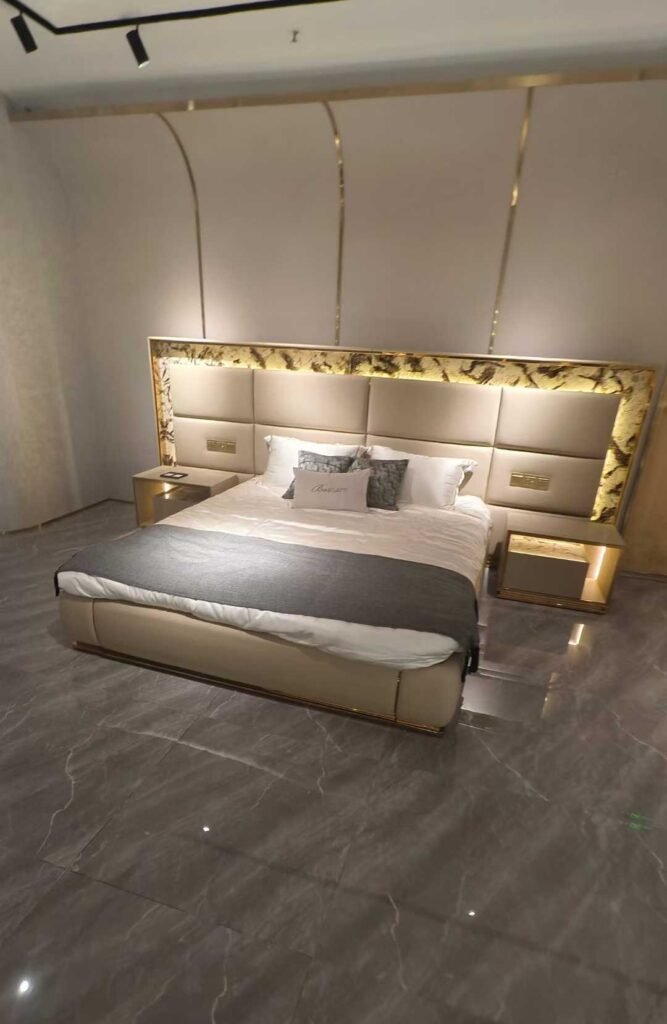
Modern manufacturing is not monolithic, however. It spans a wide quality spectrum — from disposable “fast furniture” at the bottom end to precision-engineered, design-forward pieces at the top. Companies like Jade Ant Furniture operate at the higher end of modern manufacturing, combining automated production efficiency with rigorous quality control, sustainable material sourcing, and design sophistication that bridges the gap between factory precision and artisan sensibility.
Materials & Craftsmanship in Furniture
Wood, Metal, and Glass in Modern Furniture
Modern furniture manufacturing draws from a far broader material palette than traditional methods. Engineered wood products form the backbone of mass-market furniture production. MDF (medium-density fiberboard) offers smooth, uniform surfaces ideal for lacquering and veneering. Particleboard provides an economical substrate for laminate-covered casegoods. Plywood, particularly higher grades like Baltic birch, offers excellent strength-to-weight ratios and dimensional stability that solid wood cannot always match.
Metals play an increasingly important role in modern furniture design. Powder-coated steel provides structural strength for table legs, bed frames, and shelving systems. Brushed brass and aluminum add visual warmth and a luxury aesthetic. Chrome and stainless steel deliver the clean, reflective surfaces that define industrial and contemporary design styles. These metals are typically processed through automated cutting, bending, welding, and coating operations that deliver remarkable consistency across production runs.
Glass — both tempered and laminated — is used for tabletops, shelving, display cabinets, and decorative elements. Synthetic materials including injection-molded plastics, acrylic (Perspex), and composite stone (sintered stone, engineered quartz) round out the modern material vocabulary. The defining advantage of these materials is their predictability: unlike solid wood, which varies piece to piece, engineered materials deliver consistent dimensions, finishes, and performance characteristics.
Skill and Artistry in Traditional Furniture
Traditional furniture craftsmanship centers on the relationship between the artisan and solid, natural wood. The craftsman selects each board individually, assessing grain direction, moisture content, color variation, and structural soundness. This selection process alone requires years of experience — understanding how a piece of walnut will move as it acclimates, predicting how cherry will darken over years of exposure to light, knowing where to cut a mahogany board to reveal the most beautiful figure.
The shaping of wood is done through hand planes, spokeshaves, chisels, rasps, and files — tools that remove material incrementally, allowing the artisan to respond to the wood’s behavior in real time. Hand-planing a tabletop to a glass-smooth finish, for example, requires reading the grain direction constantly to avoid tearout — a skill that takes years to develop and cannot be taught through written instruction alone.
The finishing process in traditional work is equally labor-intensive. Hand-rubbed oil finishes (such as tung oil or Danish oil) penetrate deep into the wood fibers, enhancing the natural grain while providing protection from within. French polish — a shellac-based finish applied by hand in dozens of thin layers — creates a depth and luminosity that no spray-applied finish can match. These finishes age gracefully, developing a patina over decades that many furniture lovers consider the most beautiful aspect of traditionally made pieces.

Quality Differences
The quality gap between traditional and modern furniture is real, but it is not a simple binary. The table below provides a detailed comparison across key quality dimensions.
| Quality Dimension | Traditional / Handcrafted | Modern / Mass-Produced |
|---|---|---|
| Primary Materials | Solid hardwoods (oak, walnut, cherry, mahogany) | Engineered wood (MDF, particleboard, plywood), metals, glass, plastics |
| Joinery | Mortise-and-tenon, dovetail, finger joints, hand-cut | Cam locks, dowels, staples, pocket screws, glue-based connections |
| Finish Quality | Hand-rubbed oils, French polish, wax; deep penetration | Spray-applied lacquer, UV-cured coatings; surface-level protection |
| Consistency | Each piece unique; slight natural variations | Highly uniform; identical across production runs |
| Structural Integrity | Exceptional; mechanical joints distribute stress naturally | Variable; depends on fastener quality and assembly precision |
| Moisture Resistance | Naturally resistant (solid wood swells/contracts but does not delaminate) | Sensitive (MDF/particleboard can swell and fail when exposed to moisture) |
| Repair Potential | Highly repairable; joints can be re-glued, surfaces refinished | Difficult to repair; laminated surfaces chip, engineered boards crumble |
| Expected Lifespan | 50–100+ years with proper care | 5–15 years (mass-market); 15–30 years (premium modern) |
Table: Quality comparison between traditional and modern furniture manufacturing methods. Lifespan estimates based on industry data and EPA furniture waste reports.
Tools & Techniques for Manufacturing Furniture
Hand Tools vs. Machinery
The tool sets that define traditional and modern furniture production could hardly be more different. Traditional woodworkers rely on a core collection of hand tools that has remained largely unchanged for centuries: hand saws (tenon saws, dovetail saws, panel saws), hand planes (jack planes, smoothing planes, block planes, jointer planes), chisels of various widths, marking gauges, try squares, mortise gauges, mallets, scrapers, and files. Each tool performs a specific function in the production sequence, and mastering the full set requires years of dedicated practice.
Modern factories rely on power tools and automated machinery. CNC (Computer Numerical Control) routers can cut, drill, mill, and carve wood, MDF, and composites with tolerances under 0.1mm — a level of precision that even the most skilled hand worker would struggle to match consistently. Panel saws, edge banders, boring machines, wide-belt sanders, and robotic spray booths handle the remaining production steps. A single CNC machine can perform operations that would require dozens of individual hand tools and hundreds of hours of manual labor.
The comparison is not simply one of quality versus speed. Modern CNC technology can produce furniture of genuinely excellent quality — particularly when paired with quality materials and skilled programming. The distinction is more about where value is created: in traditional work, the value resides in the artisan’s hands and judgment; in modern work, the value resides in the engineering of the process and the precision of the machinery.
Modern Joinery Innovations
Joinery — the method by which two pieces of wood or material are connected — is perhaps the single most important differentiator between furniture manufacturing methods. Traditional joinery relies on mechanical interlocking: mortise-and-tenon joints, dovetails, finger joints, and wedged through-tenons create connections that derive their strength from precise geometry rather than adhesives or fasteners. These joints can last centuries because they allow wood to expand and contract seasonally without loosening.
Modern joinery has developed its own innovations, many driven by the flat-pack furniture revolution. Cam-lock and dowel systems (popularized by IKEA) allow furniture to be shipped in compact boxes and assembled by consumers with minimal tools. Pocket screws and biscuit joints enable rapid assembly in factory settings. CNC-cut joints — including CNC-routed dovetails and finger joints — combine the aesthetic appeal of traditional joinery with the speed of machine production.
Some manufacturers are bridging both worlds. Jade Ant Furniture, for example, employs CNC precision to cut traditional-style joinery at production scale, delivering furniture that maintains the structural integrity associated with hand-cut joints while achieving the consistency and efficiency that modern buyers expect. This hybrid approach represents one of the most promising directions in contemporary furniture manufacturing.
Watch: Traditional vs. Modern Woodworking Tools
Video: A detailed comparison of traditional hand tools and modern power tools in furniture making — exploring where craftsmanship meets technology.
Mass Production vs. Bespoke
The production model shapes everything about a piece of furniture — from its design possibilities to its price, availability, and environmental footprint. Mass production operates on the principle of standardization: identical designs, identical materials, identical processes, producing identical outputs. This model delivers enormous economies of scale — a dining table that costs $300 at retail may have a factory cost of $50–$80 — but it constrains design to what can be efficiently replicated thousands of times.
Bespoke production operates on the opposite principle: every piece is conceived and executed as a one-of-one commission. The client specifies dimensions, materials, finishes, and design details; the maker produces the piece accordingly. This model delivers maximum personalization and quality but at significantly higher cost and longer lead times. A bespoke dining table in solid walnut with hand-cut joinery might cost $3,000–$15,000 and take 4–12 weeks to produce.
Between these extremes lies a growing middle ground that the best modern manufacturers occupy: semi-custom production. This approach offers a curated range of designs with meaningful customization options — choice of wood species, dimensions, finishes, hardware — while leveraging modern production technology to keep costs manageable and lead times reasonable. This middle ground is where much of the furniture industry’s innovation is occurring, and it is where companies serving discerning international buyers tend to operate.
Design & Aesthetics in Furniture
Minimalism in Modern Furniture
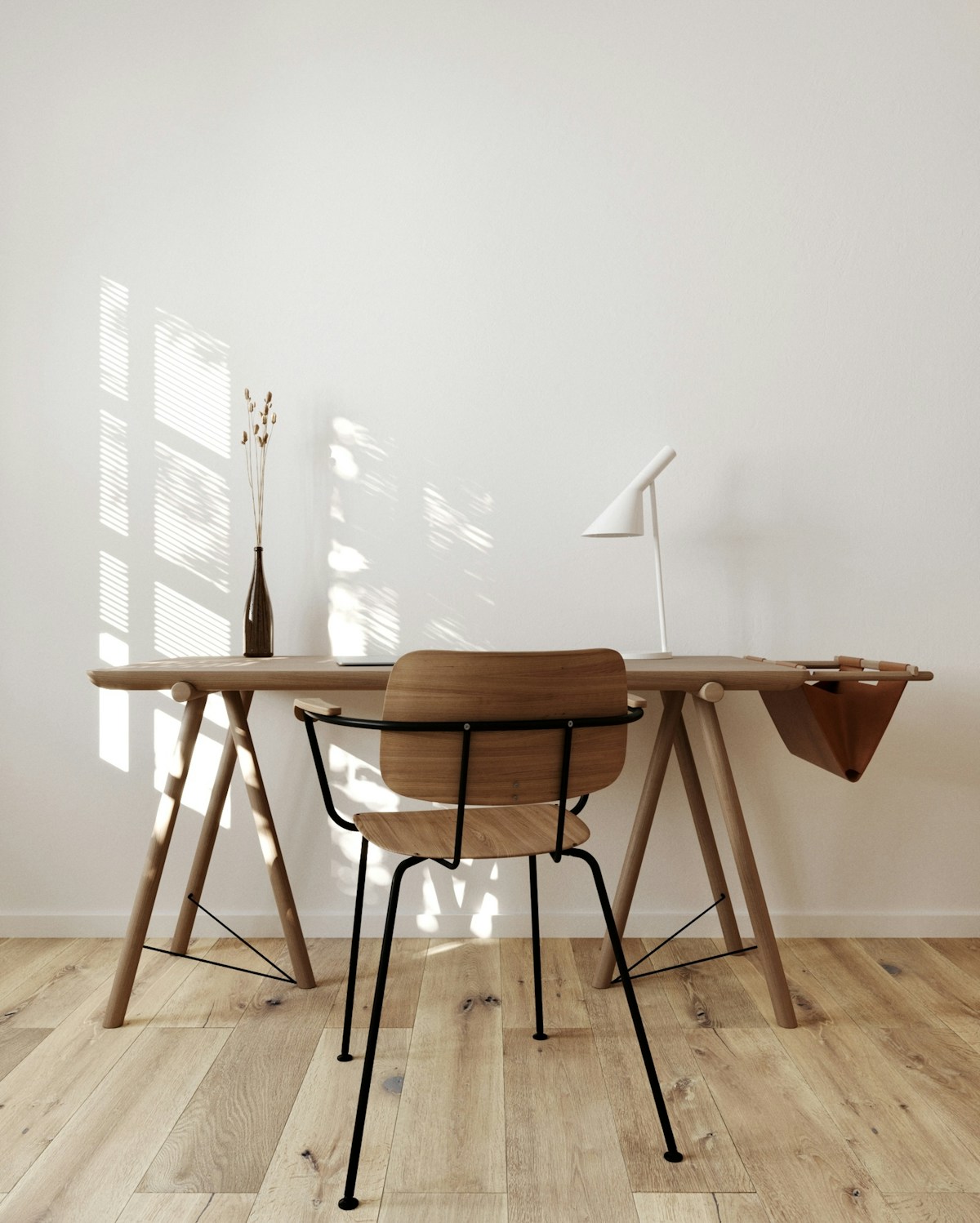
Modern furniture design is dominated by minimalist aesthetics — clean lines, geometric forms, neutral color palettes, and an emphasis on functionality over ornamentation. This design philosophy, which traces its roots to the Bauhaus movement of the 1920s and the mid-century modernism of designers like Charles and Ray Eames, has become the default visual language of contemporary interiors worldwide.
Minimalism is not just an aesthetic choice — it is also an engineering response to the constraints and capabilities of modern manufacturing. Clean, straight lines are easier to produce on CNC machines than complex curves. Flat surfaces are more efficient to cut from sheet materials than sculpted forms. Simple geometric joinery is faster to assemble on a production line than elaborate hand-cut connections. The result is furniture that is genuinely beautiful in its simplicity and remarkably well-suited to mass production.
The best modern minimalist furniture — from brands like Muji, HAY, Menu, and manufacturers like Jade Ant Furniture — achieves a sophistication that transcends its apparent simplicity. The proportions are carefully calibrated, the materials are thoughtfully selected, and the details (edge profiles, hardware, fabric textures) are refined to create pieces that feel considered and intentional despite their visual restraint.
Heritage and Detail in Vintage Furniture
Traditional and vintage furniture design operates in a fundamentally different aesthetic register. It celebrates complexity, ornamentation, and the visible expression of craftsmanship. Curved legs, carved aprons, inlaid surfaces, hand-turned spindles, and elaborate molding profiles are not decorative additions — they are structural and aesthetic elements that demonstrate the maker’s skill and the piece’s cultural heritage.
Each historical period contributed distinctive design vocabularies: the cabriole legs and ball-and-claw feet of Queen Anne style, the tapered legs and shield-back chairs of Hepplewhite, the rectilinear geometry of Arts and Crafts, the organic curves of Art Nouveau. These styles were developed within specific cultural contexts and reflect the values, technologies, and aesthetic sensibilities of their eras. A genuine antique piece from any of these periods carries historical significance alongside its functional value.
The appeal of heritage furniture design remains powerful. Many contemporary buyers — particularly those furnishing spaces with character, such as period homes, boutique hotels, or culturally expressive interiors — seek furniture that carries visual richness and storytelling capacity that minimalist modern pieces cannot provide. This demand sustains both the antique market and a thriving community of contemporary makers working in traditional styles.
Customization Options
Customization capability differs dramatically between traditional and modern manufacturing, though both offer meaningful options within their respective frameworks.
Traditional furniture making offers essentially unlimited customization. Because every piece is built individually, the maker can adjust any parameter: dimensions, wood species, grain orientation, joinery type, finish, hardware, and decorative details. Want a dining table that is exactly 94 inches long, made from book-matched walnut slabs, with hand-cut through-tenon joinery and a hand-rubbed oil finish? A skilled traditional maker can deliver precisely that.
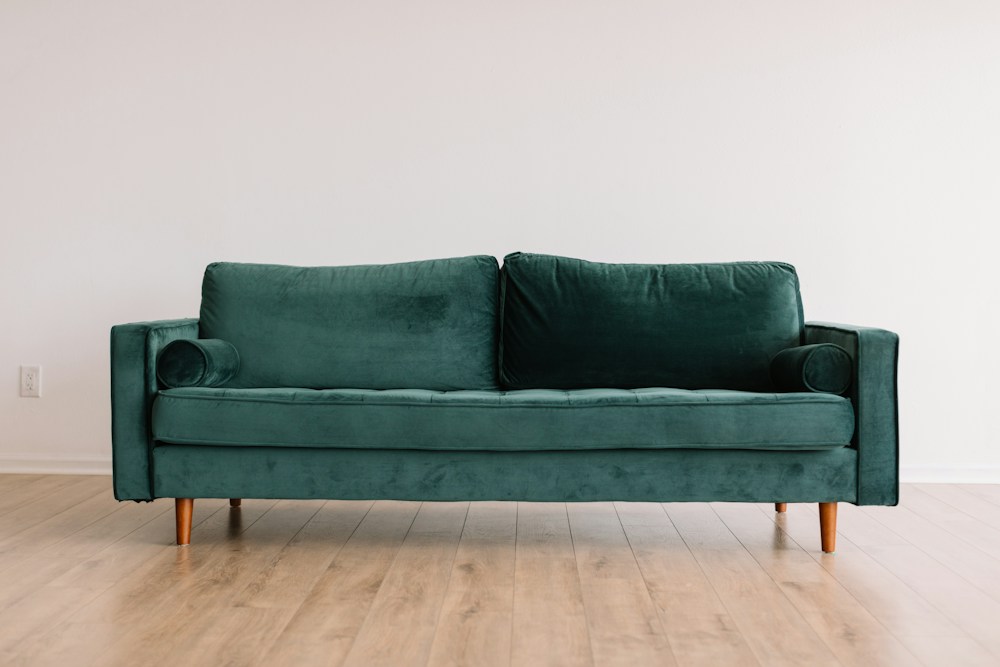
Modern manufacturing offers customization within defined parameters. A modular sofa system might offer twelve fabric options, three frame colors, and six configuration layouts. A cabinet line might offer four wood finishes, two door styles, and seven standard widths. These options are meaningful and allow consumers to personalize their selections, but they operate within the boundaries established by the manufacturer’s production engineering. The growing trend toward “mass customization” — using flexible manufacturing systems and digital configurators to offer broader personalization at near-mass-production costs — is steadily expanding these boundaries.
Durability & Care of Furniture
Longevity of Traditional Furniture
The durability advantage of traditional furniture is not an opinion — it is a measurable, documented fact. According to Artisan Furniture, “With proper care, quality handcrafted furniture can last between 50 to 100 years, while mass-produced items generally need replacement within 5 to 15 years.” Industry data on furniture lifespan reinforces this range: a mass-market sofa lasts 5–8 years on average, while a high-quality handcrafted sofa can serve for 15–25 years or more. A mass-market dining table lasts 10–15 years; a solid wood, traditionally joined dining table can last 50–100+ years.
The structural reasons for this longevity gap are straightforward. Mortise-and-tenon joints — the workhorse joint of traditional furniture — create a mechanical interlock that distributes stress across large surface areas. Even if the glue holding the joint eventually weakens, the mechanical fit maintains structural integrity. Dovetail joints in drawer construction resist the pulling forces that drawer use creates, which is why antique chests-of-drawers from the 18th century often have perfectly functional drawers while mass-produced equivalents fail within years.
Solid wood itself is inherently more durable than engineered alternatives. It can absorb impacts without delaminating. It can be refinished when its surface becomes worn. It develops a patina that many people find more beautiful than a fresh finish. And when damage does occur — a scratch, a dent, a water ring — it can be repaired by a skilled craftsman to a condition indistinguishable from new.
Maintenance for Modern Furniture
Modern furniture, particularly pieces made from engineered materials with laminate or veneer surfaces, requires a different maintenance approach. The surfaces are typically more resistant to staining and moisture in the short term (thanks to sealed, non-porous coatings) but less forgiving when damage occurs. A scratch through a laminate surface cannot be sanded out — the underlying substrate is exposed, and the damage is effectively permanent. A water spill that penetrates the edge of an MDF panel can cause irreversible swelling.
Proper maintenance for modern furniture involves avoiding excessive moisture exposure, using coasters and trivets consistently, cleaning with appropriate products (usually damp cloth, no harsh chemicals), and protecting surfaces from direct sunlight that can fade finishes unevenly. Hardware should be tightened periodically, particularly on cam-lock connections that can loosen with repeated assembly/disassembly or heavy use.
Premium modern furniture — made from higher-quality materials with superior finishes — requires less intensive maintenance and holds up significantly better than budget alternatives. This is one of the key areas where manufacturers like Jade Ant Furniture differentiate their products: by using quality substrates, durable edge treatments, and multi-layer finishing processes that dramatically extend the functional lifespan of modern production furniture.
Repair and Upkeep
Repairability is one of the starkest contrasts between traditional and modern furniture. Traditional solid-wood furniture is, by its nature, repairable. A loose joint can be disassembled, re-glued, and re-clamped. A scratched or stained surface can be sanded and refinished. A broken spindle can be turned to match and replaced. Even significant structural damage — a cracked leg, a split top — can often be repaired by a skilled craftsman at a fraction of the replacement cost.
Modern furniture made from engineered materials is inherently more difficult to repair. MDF cannot be sanded and refinished — the material has no grain structure, and its surface layer is typically less than 1mm of veneer or laminate. Cam-lock fittings that have been over-tightened or repeatedly assembled and disassembled strip out of particleboard and cannot be meaningfully repaired. Chipped laminate, peeling veneer, and swollen edges from moisture damage are all effectively terminal conditions for engineered furniture.
This repairability gap has significant economic and environmental implications. A traditional piece that costs $2,000 and lasts 80 years (with occasional $200 repairs) has a lifecycle cost of roughly $30 per year. A mass-produced piece that costs $500 and lasts 8 years (with no realistic repair option) has a lifecycle cost of roughly $63 per year — more than double. When environmental costs (landfill burden, carbon emissions from manufacturing replacements) are included, the lifecycle advantage of traditional furniture becomes even more pronounced.
Average Furniture Lifespan: Traditional vs. Modern
Chart: Average expected lifespan by furniture type. Traditional handcrafted pieces consistently outlast mass-produced alternatives by a factor of 4–8x. Data compiled from EPA reports, Artisan Furniture industry studies, and manufacturer warranty data.
Sustainability in Manufacturing Furniture
Eco-Friendly Practices
Sustainability in furniture manufacturing operates on two fundamentally different models depending on the production method. Traditional furniture making is inherently sustainable in several respects: it uses solid natural wood (a renewable resource when responsibly harvested), generates relatively little waste (skilled woodworkers optimize material usage through careful layout and planning), employs non-toxic or low-toxicity finishes (oils, waxes, shellac), and requires minimal energy compared to industrial manufacturing.
Modern manufacturing has a more complex sustainability profile. On the positive side, mass production can achieve material efficiency through computerized nesting (optimizing how parts are cut from sheet materials to minimize waste) and waste recycling programs. Many modern manufacturers have adopted FSC-certified wood products, water-based finishes, and recycled content materials. On the negative side, the production of engineered materials like MDF involves formaldehyde-based adhesives, significant energy consumption, and chemical processing. The transportation footprint of globally distributed supply chains adds further environmental cost.
The most sustainable approach, arguably, is a hybrid model that combines the material integrity and longevity of traditional methods with the efficiency and waste-minimization capabilities of modern technology. Forbes notes that “sustainable furniture should be made from renewable and nontoxic materials, such as natural wood, bamboo or recycled materials” — a standard that the best manufacturers in both traditional and modern categories strive to meet.
Resource Use and Waste
The furniture industry’s environmental impact extends far beyond the factory floor. According to the U.S. Environmental Protection Agency (EPA), Americans discard more than 12 million tons of furniture annually, with approximately 80% ending up in landfills. This “fast furniture” waste stream has grown from just 2.1 million tons in 1960 to its current level — a nearly sixfold increase driven primarily by the proliferation of inexpensive, short-lifespan, mass-produced furniture.
The resource implications are significant. Each piece of furniture that goes to landfill within 5–10 years of purchase represents not only the waste of its own materials but also the carbon emissions from its manufacturing, transportation, and disposal — plus the need to manufacture a replacement. When traditional furniture lasts 50–100 years, the total material and energy consumption per year of use is dramatically lower, even if the initial production process uses more labor and premium materials.
Some modern manufacturers are addressing this challenge through design-for-disassembly principles, modular construction that allows component replacement rather than whole-piece disposal, and take-back programs that recover end-of-life furniture for recycling or refurbishment. These initiatives represent meaningful progress, but the fundamental equation remains: longer-lasting furniture is more sustainable furniture, regardless of how it is manufactured.
Lifecycle Impact
A full lifecycle assessment of furniture considers four phases: raw material extraction, manufacturing, use phase (including maintenance and repair), and end-of-life (disposal, recycling, or reuse). The comparison between traditional and modern methods across these phases reveals important tradeoffs.
Where Discarded Furniture Ends Up in the United States
Chart: Destination of discarded furniture in the United States. A staggering 80.2% ends up in landfill. Source: U.S. EPA Facts and Figures about Materials, Waste, and Recycling.
Traditional furniture has a lower lifecycle environmental impact per year of use due to its longer lifespan, repairability, and use of natural materials that can biodegrade at end-of-life. Modern mass-produced furniture has a lower per-unit manufacturing cost but a higher lifecycle environmental cost when replacement cycles are factored in. The sustainability calculus clearly favors durability: investing in well-made furniture — whether traditional or high-quality modern — is one of the most effective environmental decisions a consumer can make.
Cost Factors in Furniture Manufacturing
Price Range Comparison
Price is the factor that most immediately differentiates traditional from modern furniture, and it is where the tradeoffs become most tangible for buyers. The table below provides representative price ranges across common furniture categories.
| Furniture Type | Mass-Produced (Budget) | Mass-Produced (Premium) | Handcrafted / Bespoke | Antique / Collector |
|---|---|---|---|---|
| Dining Table (6-seat) | $300–$800 | $800–$2,500 | $2,500–$15,000 | $3,000–$50,000+ |
| Sofa (3-seat) | $500–$1,200 | $1,200–$4,000 | $3,000–$12,000 | $2,000–$30,000+ |
| Chest of Drawers | $200–$600 | $600–$2,000 | $2,000–$8,000 | $1,500–$25,000+ |
| Dining Chair (each) | $50–$200 | $200–$700 | $500–$3,000 | $500–$10,000+ |
| Bookcase | $100–$400 | $400–$1,500 | $1,500–$6,000 | $1,000–$15,000+ |
| Bed Frame (Queen) | $300–$800 | $800–$3,000 | $2,000–$10,000 | $2,000–$20,000+ |
| Coffee Table | $100–$400 | $400–$1,500 | $1,000–$5,000 | $800–$15,000+ |
Table: Representative price ranges for common furniture types across manufacturing categories. Prices reflect typical U.S. retail market in 2026. Actual prices vary by material, design complexity, and region.
Value for Money
The “value for money” equation shifts dramatically when time horizon is considered. As noted in the durability section, a $2,000 handcrafted dining table that lasts 80 years costs roughly $25 per year. A $400 mass-produced table that lasts 10 years costs $40 per year. A $150 budget table that lasts 4 years costs $37.50 per year. The cheapest purchase price does not necessarily deliver the lowest cost of ownership.
Premium modern furniture occupies an interesting middle position. A well-made modern dining table at $1,200 that lasts 20 years costs $60 per year — more expensive per year than the handcrafted option, but offering a significantly lower upfront commitment. This is the value proposition that quality-focused modern manufacturers like Jade Ant Furniture aim to deliver: modern production efficiency combined with material quality and construction standards that substantially extend the useful life of the furniture beyond what budget alternatives can achieve.
Investment vs. Disposable Furniture
The concept of “investment furniture” versus “disposable furniture” captures a philosophical divide in how people relate to their possessions. Investment furniture is purchased with the expectation that it will serve for decades, potentially be passed down to the next generation, and possibly appreciate in value. Disposable furniture is purchased with the tacit understanding that it will be replaced within a few years when styles change, circumstances evolve, or the piece simply wears out.
Neither approach is inherently wrong — they serve different needs at different life stages. A college student furnishing a first apartment may rightly prioritize affordability over longevity. A family furnishing a permanent home may just as rightly prioritize durability and aesthetics over initial cost savings. The important thing is to make the choice consciously, understanding the full implications — economic, environmental, and experiential — of each approach.
Choosing the Right Furniture Method
Assessing Needs and Preferences
The right choice between traditional and modern furniture depends on a clear-eyed assessment of your priorities. Ask yourself the following questions: How long do you plan to keep this piece? Is customization important, or will standard options meet your needs? Do you value visible craftsmanship and natural materials, or do you prefer clean modern aesthetics? Is the piece for a high-use environment (daily family dining) or a lighter-use setting (guest room)? What is your total budget, and are you optimizing for lowest initial cost or lowest lifetime cost?
For high-use, high-visibility pieces — dining tables, sofas, bed frames — investing in quality (whether traditional or premium modern) typically delivers the best return. For secondary pieces, accent furniture, or environments where styles are likely to change, modern production furniture offers practical value without excessive commitment.
Lifestyle and Budget Considerations
Your lifestyle context shapes the optimal manufacturing method for your furniture. Urban apartment dwellers who relocate frequently may prioritize lightweight, easy-to-move modern furniture. Homeowners settling into a long-term residence may invest in heavier, more durable traditional pieces. Families with young children may need scratch-resistant, easily-cleaned surfaces (favoring certain modern materials) or may want furniture that ages gracefully through everyday use (favoring solid wood). Hospitality and commercial buyers need furniture that combines visual appeal with extreme durability — a requirement that often points toward the hybrid approach of premium modern manufacturing with traditional quality standards.
Budget is always a constraint, and it is important to be honest about it. If your total furniture budget for a room is $1,500, spending $3,000 on a single handcrafted piece is not practical, regardless of its long-term value. In this scenario, thoughtfully selected modern furniture from quality manufacturers represents the best available option. The key is to allocate budget strategically — investing more in the pieces you will use most and that matter most to your daily experience, and economizing on pieces that serve supporting roles.
Practical Scenarios
Consider three practical scenarios that illustrate how the choice between methods plays out in real life.
Scenario 1: First-time homeowner, moderate budget. A couple purchasing their first home with a $10,000 total furniture budget for the main living areas. The optimal strategy: invest in one or two anchor pieces (a quality sofa, a solid dining table) from a premium manufacturer like Jade Ant Furniture, and furnish the remaining spaces with well-selected modern production pieces. This “anchor and fill” approach establishes a quality foundation that can be upgraded over time.
Scenario 2: Interior designer specifying for a boutique hotel. Thirty guest rooms requiring identical bed frames, nightstands, desks, and seating. Traditional bespoke manufacturing cannot deliver the volume consistency required. Premium modern manufacturing — with custom finish options, durable commercial-grade construction, and coordinated production scheduling — is the clear choice. The specification should prioritize durability, repairability, and compliance with commercial fire safety standards.
Scenario 3: Collector furnishing a period home. A homeowner restoring a Victorian-era house who wants furniture that matches the architectural character. Traditional craftsmanship — either antique sourcing or commissioning contemporary makers working in period styles — is the appropriate approach. The cultural and aesthetic coherence that traditionally made furniture provides is central to the project’s purpose.
Traditional and modern furniture manufacturing methods each represent legitimate, well-developed approaches to a fundamental human need. Traditional methods deliver unmatched durability, material authenticity, aesthetic richness, and repairability — at the cost of higher prices, longer lead times, and limited production scale. Modern methods deliver accessibility, consistency, design versatility, and affordability — with tradeoffs in longevity, material character, and environmental lifecycle impact.
The most meaningful distinction is not about which method is “better” in the abstract — it is about which method is better suited to your specific needs, values, and circumstances. For buyers prioritizing durability and sustainability, investing in quality is the clearest path, whether that means a handcrafted heirloom piece or a premium modern product from a manufacturer like Jade Ant Furniture that applies rigorous quality standards to efficient production processes. For buyers prioritizing immediate affordability or high-volume consistency, modern manufacturing is the practical choice — with the caveat that selecting the highest quality you can afford will always deliver better long-term value than defaulting to the lowest price.
Ultimately, the furniture you choose will shape your daily environment for years or decades. Consider not just the price tag but the full picture: how the piece was made, what it was made from, how long it will serve you, and what will happen to it when its time in your home is done. That consideration is the foundation of a truly informed furniture decision.
Frequently Asked Questions (FAQ)
1. What is the main difference between traditional and modern furniture manufacturing?
The core difference lies in the production process and materials. Traditional furniture manufacturing relies on skilled artisans using hand tools (planes, chisels, saws) to work with solid natural hardwoods, employing time-tested joinery techniques like mortise-and-tenon and dovetail joints. Each piece is individually crafted over days or weeks. Modern furniture manufacturing uses CNC machines, automated assembly lines, and engineered materials (MDF, particleboard, plywood, metals, glass) to produce standardized pieces at high volume and lower cost. Traditional methods prioritize durability and material authenticity; modern methods prioritize efficiency, consistency, and affordability.
2. How long does handcrafted furniture last compared to mass-produced furniture?
Quality handcrafted furniture can last 50 to 100+ years with proper care, while mass-produced furniture typically lasts 5 to 15 years. The longevity difference stems from materials (solid hardwood vs. engineered board), joinery (mechanical interlocking joints vs. cam locks and staples), and repairability (solid wood can be refinished and reglued; engineered materials typically cannot). A solid wood dining table built with mortise-and-tenon joinery can be passed down through multiple generations. A particleboard table with cam-lock assembly will likely need replacement within a decade.
3. Is handcrafted furniture worth the higher price?
When evaluated on a cost-per-year-of-use basis, handcrafted furniture often provides better value than mass-produced alternatives despite its higher upfront cost. A $2,000 handcrafted dining table lasting 80 years costs approximately $25 per year of use. A $400 mass-produced table lasting 10 years costs $40 per year. Beyond economics, handcrafted furniture offers uniqueness, aesthetic depth, superior tactile quality, and the satisfaction of owning a piece made with genuine human skill and care. The answer depends on your priorities and budget constraints.
4. What are the most important joinery techniques in traditional furniture?
The most important traditional joinery techniques include the mortise-and-tenon joint (used for structural connections in tables, chairs, and frames — one of the oldest and most reliable joints in woodworking), the dovetail joint (used primarily for drawer construction, providing exceptional resistance to pulling forces), the finger joint (similar to dovetails but with symmetrical interlocking fingers, used for box construction and frame corners), and the wedged through-tenon (a decorative and structural joint where the tenon passes completely through the mortise and is secured with a wedge). These joints derive their strength from precise geometry and mechanical interlocking rather than relying solely on adhesives.
5. Can modern manufacturing produce furniture as good as handcrafted pieces?
Modern manufacturing can produce furniture of excellent quality — particularly at the premium end of the spectrum. CNC machines can cut joints with sub-millimeter precision, and automated finishing systems can apply consistent, durable coatings. However, certain qualities of traditional craftsmanship remain difficult to replicate at industrial scale: the aesthetic depth of hand-rubbed finishes, the structural adaptability of hand-fitted joints, and the unique character that comes from an individual craftsman’s interpretation of a design. The best results often come from hybrid approaches that combine CNC precision with hand-finishing and quality material selection — an approach that manufacturers like Jade Ant Furniture employ to bridge the gap between production efficiency and artisan quality.
6. What is the environmental impact of disposable furniture?
The environmental impact is severe. According to the U.S. EPA, Americans discard more than 12 million tons of furniture annually, with approximately 80% going to landfill. This “fast furniture” waste stream has increased nearly sixfold since 1960. Each discarded piece represents wasted materials, wasted manufacturing energy, transportation emissions, and landfill burden — plus the environmental cost of producing its replacement. Engineered wood products containing formaldehyde-based adhesives can leach chemicals into soil and groundwater when landfilled. The most effective environmental strategy is to buy less, buy better, and keep furniture in use longer.
7. What should I look for when buying quality furniture?
Regardless of whether furniture is handcrafted or machine-made, key quality indicators include the weight and solidity of the piece (quality furniture feels substantial), the smoothness and consistency of finishes (look for even coverage without drips, bubbles, or rough spots), the operation of moving parts (drawers should slide smoothly, doors should close firmly, hinges should be solid), the quality of joinery (examine how pieces connect — tight-fitting joints indicate quality construction), the material specification (solid wood, high-grade plywood, and quality metals outperform particleboard, staple construction, and plastic components), and the manufacturer’s warranty and reputation (brands with strong warranties stand behind their quality claims).
8. How do I maintain solid wood furniture properly?
Solid wood furniture requires regular but straightforward maintenance. Dust regularly with a soft cloth. Clean with a slightly damp (not wet) cloth, drying immediately. Apply appropriate wood conditioner or oil (tung oil, Danish oil, or furniture-specific products) once or twice per year to maintain moisture balance and finish integrity. Avoid placing furniture in direct sunlight, which causes uneven fading and drying. Use coasters, trivets, and placemats to protect surfaces from moisture, heat, and scratches. Maintain stable humidity levels in your home (40–60% relative humidity is ideal) to prevent wood movement. Address spills immediately. With this care regimen, solid wood furniture will maintain its beauty and structural integrity for decades.
9. Is it possible to combine traditional and modern furniture in one space?
Combining traditional and modern furniture is one of the most effective interior design strategies. The 80/20 rule is a reliable guideline: choose one dominant style (80% of the room’s furniture) and accent with the other (20%). A modern sofa paired with a traditional solid-wood coffee table, or a minimalist dining set anchored by a hand-carved sideboard, creates visual interest and depth that a single-style approach cannot achieve. The key to successful mixing is finding common elements — shared colors, complementary proportions, or compatible material temperatures (warm woods with warm metals, cool tones with cool metals) — that create cohesion without uniformity.
10. Where can I find furniture that combines traditional quality with modern design?
The growing “premium modern” segment of the furniture market specifically addresses this demand. Manufacturers who combine CNC precision with quality materials, thoughtful design, and rigorous quality control produce furniture that delivers modern aesthetics and production efficiency alongside traditional durability and material integrity. Jade Ant Furniture represents this approach, offering collections that draw on both heritage craftsmanship principles and contemporary manufacturing technology to serve buyers who want quality, design, and value without compromise. Trade shows like Salone del Mobile (Milan), High Point Market (USA), and CIFF (China) showcase manufacturers across the full quality spectrum and are excellent resources for discovering brands that bridge traditional and modern approaches.
Disclaimer: Price ranges, lifespan estimates, and market data cited in this article are based on industry reports, manufacturer specifications, and publicly available sources as of early 2026. Actual figures may vary by region, material, and specific manufacturer. Readers should conduct independent research when making purchasing decisions.







 English
  Portuguese
  Arabic