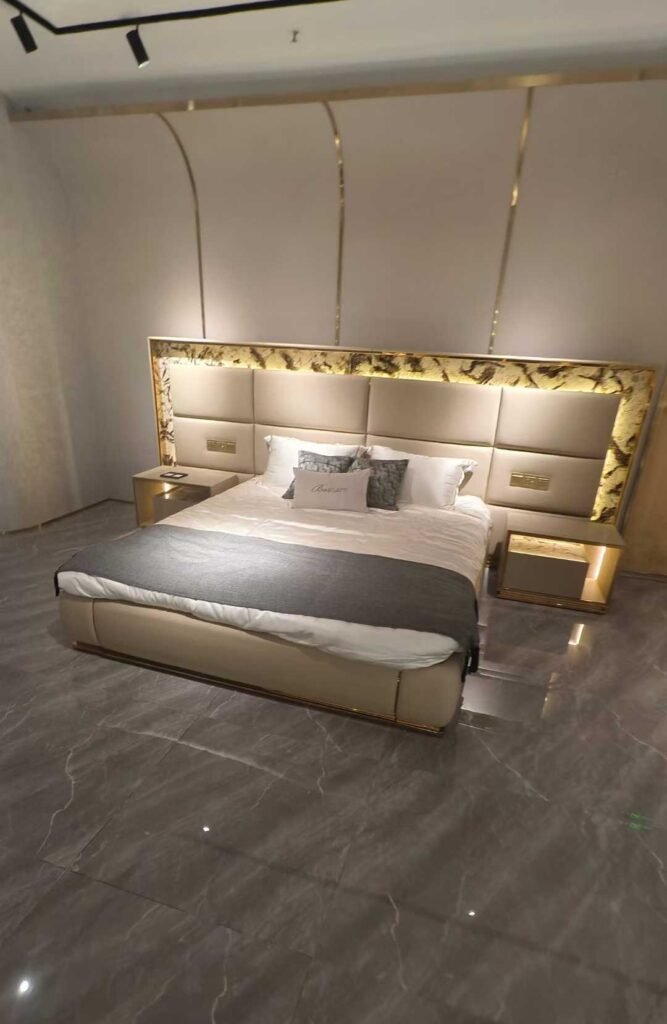
In 2024, a European contract furniture distributor placed a USD 280,000 order with a Guangdong factory they had vetted exclusively through a B2B platform profile and a single video call. Eleven weeks later, the container arrived at Rotterdam — 30% of the units showed lacquer defects, the composite panels tested above CARB Phase 2 emission limits, and the factory’s business license turned out to be registered under a trading company with no manufacturing scope. The total exposure: rework costs, customs compliance re-testing, a delayed project handover, and a client relationship on the line.
The failure was not a bad factory. It was the absence of a structured verification process before the purchase order was signed.
China remains the world’s dominant furniture manufacturing hub. In 2025, cumulative export value reached USD 67.81 billion, supplying hospitality projects, commercial fit-outs, and residential developments on every continent. With over 50,000 registered furniture manufacturers — including 7,000+ in Foshan alone — the market offers unmatched scale, customization capability, and price-to-quality ratios. But the gap between a world-class OEM facility producing for European luxury brands and a small workshop subcontracting through a trading company can be invisible from a product catalog.
This checklist was designed for B2B buyers, procurement managers, hospitality project owners, and furniture importers who need a repeatable, field-tested framework for verifying a Chinese furniture factory before committing capital, placing orders, or entering a long-term supply relationship. It covers every dimension that determines whether a factory will be a reliable partner or a source of legal, financial, and operational risk.
How to use this checklist: Work through each section sequentially during vendor shortlisting and onboarding. Weight the sections according to your project risk profile — a 500-room hotel FF&E package carries higher supply-chain and compliance exposure than a 50-unit residential fit-out. For contract furniture with strict North American or EU regulatory requirements, the legal, quality, and environmental sections are non-negotiable. For high-volume standard products, financial health and supply chain integrity may warrant the deepest scrutiny.
At Jade Ant Furniture, we apply this exact framework when onboarding new manufacturing partners and when buyers ask us to source from third-party factories on their behalf. The sections below reflect what we have learned across 15+ years of operating in China’s furniture manufacturing ecosystem.
Understanding the Purpose and Scope of the Verification
Due diligence on a Chinese furniture factory is not a single-event audit — it is a structured risk-assessment process that runs from initial supplier shortlisting through the first production cycle and into ongoing relationship management. Understanding what you are trying to achieve, and what constraints you are operating under, will determine how deeply you apply each section of this checklist.
Define Objectives
Before sending a single information request to a potential supplier, establish the specific outcomes this verification needs to confirm. Are you assessing a factory for a one-time project order, or qualifying them for a multi-year supply relationship? Are you buying a standardized product category (e.g., contract seating, hotel casegoods) or commissioning a fully custom design program? Is the destination market the United States, the EU, the Middle East, or domestic China — each with its own regulatory and compliance baseline? Your objectives define the depth of verification required in each section: a qualified repeat order from an established partner needs less documentation review than a first-time qualification of an unknown factory for a flagship hotel project.
Determine Selection Criteria
Translate your objectives into explicit, measurable criteria before you begin evaluating factories. These should cover: minimum production capacity (e.g., “must be able to produce 800 dining chairs per month”), required certifications (ISO 9001, FSC, BSCI), regulatory compliance baselines (CARB Phase 2 for US market, REACH for EU), financial stability thresholds (registered capital, years in business, bank references), and geographic constraints (proximity to Foshan, Shanghai, or a specific port). Documented criteria prevent the evaluation from drifting toward whichever factory presents best in the initial pitch and ensure that comparison across multiple candidates is consistent and defensible.
Establish a Verification Plan
Map your verification activities against a timeline that aligns with your project schedule. A thorough factory qualification for a major hospitality project typically takes 6–10 weeks, covering: initial documentation review (Week 1–2), sample request and evaluation (Week 2–4), on-site factory audit (Week 3–5), reference checks (Week 4–5), legal and financial review (Week 5–6), and final scoring against selection criteria (Week 6). Compressing this timeline to accommodate a project deadline increases risk. If a client-imposed schedule forces a shortened qualification process, document the gaps explicitly and build additional QC checkpoints into the production phase to compensate.

Legal and Corporate Due Diligence
Legal verification is the foundation of the entire due diligence process. Every other assessment — quality systems, labor compliance, financial health — depends on knowing that you are dealing with the actual legal entity that owns the factory, holds the certifications, and will be the counterparty to your contract. In China’s manufacturing ecosystem, the gap between a factory’s marketing presentation and its actual legal structure is wide enough to create serious commercial and compliance exposure.
Business Licenses and Registration
Every legitimate Chinese manufacturer holds a Business License (营业执照, Yíngyè Zhízhào). This is the foundational legal document issued by the State Administration for Market Regulation (SAMR) and should be provided within 24 hours of request — no exceptions. The license contains five critical data points: the company’s registered legal name (which must match all contracts and invoices exactly), the unified social credit code (a 18-digit identifier unique to each legal entity), the registered address (which must match the factory’s physical location), the business scope (which must include “manufacturing” — 制造 or 生产 — not just “trading” or “consulting”), and the registered capital.
Verify every license on China’s National Enterprise Credit Information Publicity System (NECIPS). Enter the company name or the 18-digit unified social credit code and confirm that the information matches what the factory provided. A discrepancy in the registered address or business scope — even a minor one — should trigger immediate clarification before any further engagement. A factory that cannot or will not provide its business license, or whose license cannot be verified on NECIPS, is not a factory you should be doing business with.
Additionally, use ImportYeti to review the factory’s actual US shipping history. Real manufacturers show consistent shipments under their registered company name. Trading companies masquerading as factories often have no traceable shipping records or appear as intermediaries for multiple unrelated product categories.
WFOE Presence and Tax Status
WFOE (Wholly Foreign-Owned Enterprise) is a Chinese legal structure that allows foreign investors to own and operate a business in China without a local Chinese partner. When evaluating a factory, understanding whether the operation includes foreign ownership — and whether that ownership structure is properly registered and compliant — reveals important information about the factory’s international orientation and governance sophistication. A factory with a WFOE component is more likely to have international-standard accounting, export compliance processes, and management structures familiar to overseas buyers. Request the factory’s annual tax filing confirmation and VAT registration certificate to verify active tax status. A factory with delinquent taxes or an inactive tax registration is carrying financial risk that will eventually affect its ability to fulfill orders.
Parent Company and Subsidiaries
Many mid-to-large Chinese furniture manufacturers operate under a group structure — a parent company (集团) that owns multiple factory subsidiaries, trading entities, and design studios. Understanding this structure matters for three reasons. First, certifications (ISO, FSC, BSCI) held by the parent may or may not apply to the specific manufacturing subsidiary producing your goods — confirm this explicitly. Second, financial guarantees and warranty obligations are only enforceable against the specific legal entity in your contract, not its parent or affiliates. Third, understanding the full corporate family helps identify whether a factory is vertically integrated (controlling its own raw material supply, components, and production) or heavily reliant on subcontractors and trading affiliates — a critical input for supply-chain risk assessment.
Legal Due Diligence — Verification Checklist
| Item | What to Request | How to Verify | Red Flag |
|---|---|---|---|
| Business License | Original or notarized copy of 营业执照 | Cross-check on NECIPS (gsxt.gov.cn) | Business scope excludes manufacturing; address mismatch |
| Unified Social Credit Code | 18-digit code on business license | Verify on NECIPS; must match all commercial documents | Code cannot be found or returns a different entity name |
| Registered Capital | Stated on business license | Compare against industry norms; factories >5M CNY, traders <500K CNY | Registered capital below 500,000 CNY for a “factory” |
| Tax Registration | VAT registration certificate; annual tax filing confirmation | Request documents dated within the last 12 months | Unable to provide; shows inactive or suspended status |
| Export License | Customs Registration Certificate for Goods Export | Cross-check on China Customs’ online verification system | No export license for a claimed exporting manufacturer |
| Legal Representative | Name and ID of legal representative (法定代表人) | Must match the business license; confirm the signatory on your contract | Contract signatory name differs from registered legal representative |
| Corporate Structure | Org chart showing parent company, subsidiaries, and production entities | Cross-check each entity on NECIPS | Certifications held by parent but production in uncertified subsidiary |
Factory Capabilities and Capacity
A factory’s legal status tells you it is real. Its production capabilities tell you whether it can actually deliver what it is quoting. Misrepresentation of capacity is one of the most common problems in Chinese furniture sourcing — factories quote aggressively for large orders and then subcontract to lower-tier workshops because their own production lines cannot handle the volume or product complexity. The result is a product that was never manufactured by the entity you audited.
Equipment and Output Capacity
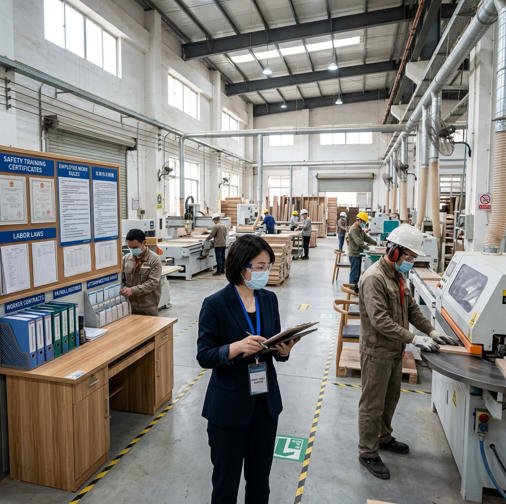
During an on-site visit or a live video audit, document the production equipment: CNC machining centers (count the machines, check the brands — Homag, Biesse, and SCM indicate serious investment in precision manufacturing), edge-banding lines, spray booths (check for enclosed spray rooms with proper exhaust and recovery systems), sanding stations, and upholstery workstations. Calculate the theoretical daily output by multiplying the number of production lines by the reported units-per-line-per-day — then compare this to the factory’s claimed capacity and your order volume. A factory with 3 production lines producing 40 chairs per day cannot deliver 2,000 chairs in 30 days without either subcontracting or forcing its workers into double shifts that compromise quality.
Shifts, Staffing, and Throughput
Understand the factory’s labor structure: how many workers are employed directly (not via labor agency), how many shifts per day they operate, what the peak-season schedule looks like (Chinese New Year, Golden Week), and what their current order-book utilization is. A factory operating at 90%+ utilization during your production window will de-prioritize your order as soon as a larger or higher-margin customer places competing demand. Request a current production schedule showing active orders and projected capacity availability for your delivery window. Factories that resist sharing this information are often over-committed and managing it through selective opacity.
Manufacturing Flow and Bottlenecks
Map the factory’s production flow from raw material receipt through final packaging. The key checkpoints are: incoming material inspection (is there a dedicated QC station at the receiving dock?), cutting and machining (are tolerances held to within ±1mm on CNC operations?), assembly (is there a fixture system to ensure square, consistent assembly?), surface finishing (is the spray booth temperature- and humidity-controlled?), and final inspection (is there a dedicated QC room with calibrated instruments?). Bottlenecks — typically at the finishing stage during peak season — are where quality failures concentrate. Identifying them in advance lets you build production milestones into your contract that create accountability at each stage.
Factory Capacity Assessment — Key Metrics
| Metric | What to Ask | How to Verify On-Site | Acceptable Threshold |
|---|---|---|---|
| Daily output (chairs) | “How many dining chairs can you produce per day?” | Count assembly lines × units per line per shift | Quoted capacity ≥ 120% of your daily requirement |
| Production line count | Number of active assembly lines in current product category | Physical count during floor walk | Minimum 2 dedicated lines for your product type |
| Peak-season availability | “What is your current order-book utilization for [delivery month]?” | Request production schedule; verify with 1–2 reference clients | Factory should have ≥25% unused capacity during your window |
| Direct employee count | Total headcount split: direct vs. agency labor | Check payroll records or social insurance enrollment count | >70% directly employed for quality-critical operations |
| CNC equipment age | Brand and year of primary CNC machining centers | Inspect equipment nameplates; check maintenance logs | Primary CNC equipment <8 years old; serviced within 12 months |
| Spray booth specification | Does the spray booth have temperature and humidity control? | Physical inspection; check for HVAC unit and hygrometer | Enclosed booth with exhaust recovery and climate control required |

Quality Management System and Process Controls
Quality certifications are entry-level evidence, not proof of quality. A factory can hold an ISO 9001 certificate and still ship defective product if its inspection processes are understaffed, its calibration schedules are ignored, or its corrective-action system is purely administrative. The goal of this section is to move beyond the certificate and evaluate whether the quality management system is actually operational — whether it changes what happens on the floor.
ISO and Industry Certifications
ISO 9001:2015 is the international standard for Quality Management Systems (QMS). It certifies that the factory has documented processes for planning, production, inspection, non-conformance management, and continuous improvement — but it does not specify what the quality level is. Verify the certificate on the issuing body’s online portal (SGS, TÜV, BSI, Bureau Veritas all have searchable databases). Confirm the certificate scope explicitly covers furniture manufacturing, not just a holding company or trading division. Ask when the last surveillance audit was conducted and request a copy of the audit report — any non-conformances (NCs) raised and the corrective actions taken reveal far more about the factory’s actual quality culture than the certificate itself.
Beyond ISO 9001, relevant product-level certifications include: FSC Chain of Custody (Forest Stewardship Council) for sustainably sourced wood — verify at info.fsc.org; CARB Phase 2 / EPA TSCA Title VI for formaldehyde emissions from composite panels (US market mandatory); GREENGUARD Gold for low total VOC emissions (required by many US hospitality brands and LEED projects); BIFMA X5 series for commercial furniture structural durability (standard for contract/commercial buyers); and EN 12520 / EN 1021 for EU market domestic seating and fire resistance compliance.
QC Processes and Defect Tracking
Ask to see the factory’s defect tracking log from the past 6 months — this is the single most revealing document in any factory audit. A factory with a functional QMS will have a defect log that shows defect type, quantity, production line, root cause, and corrective action for each recorded non-conformance. The absence of this document — or a log with zero defects recorded — is a red flag. Zero recorded defects means defects are not being tracked, not that they do not exist. Review the log for: which defect types recur (recurring structural or finish defects indicate a process that has not been corrected), which corrective actions have been verified as effective, and whether defect rates show a downward trend over time.
The industry benchmark across well-managed Chinese furniture factories is a pre-shipment major defect rate below 2.5% (AQL 2.5). Data from 1,840 pre-shipment inspections conducted across Guangdong province in 2024–2025 shows that factories with documented QC processes achieve an average defect rate of 2.3%, while factories without any buyer-initiated QC program average 12.7%. That is a 5.5× difference — and the entire cost differential is borne by the buyer.
Distribution of furniture defect types recorded across 1,840 pre-shipment inspections in Guangdong Province, 2024–2025. Source: Aggregated QC inspection data across 186 factories.
Corrective Action and Continuous Improvement
A QMS is only as good as its corrective-action process (CAP — Corrective Action Plan). When a defect is identified, the factory’s QMS should generate a documented CAP that specifies: the root cause (not just the symptom), the immediate containment action (e.g., segregate affected units), the permanent corrective action (e.g., retrain spray-booth operators, recalibrate spray gun pressure), the verification method (e.g., re-inspect 30 units after correction), and the responsible person and completion date. Request three recent CAPs and evaluate whether they address root causes or just symptoms. A factory that responds to a finish defect by “retraining workers” without identifying the specific process parameter that caused the defect (e.g., spray booth humidity exceeding 75%) does not have a genuine continuous-improvement culture.
Compliance with Labor and Safety Regulations
For B2B buyers supplying to international retailers, hospitality groups, real estate developers, and institutional procurement programs, labor compliance is not a CSR (Corporate Social Responsibility) checkbox — it is a commercial requirement. UK Modern Slavery Act, EU Corporate Sustainability Due Diligence Directive (CSDDD), and US Customs and Border Protection import requirements increasingly hold buyers responsible for labor conditions in their supply chains. A supplier-side compliance failure that reaches the press can halt an entire product line’s market access.
Labor Contracts and Worker Welfare
Under Chinese labor law (Labor Contract Law, 2008, amended 2013), all employees must hold written labor contracts specifying wages, working hours, rest periods, and social insurance enrollment. Request a sample labor contract template (anonymized) and verify that it complies with local minimum wage regulations for the factory’s province. Cross-check the factory’s social insurance enrollment numbers against its stated headcount — each worker must be enrolled in China’s five mandatory social insurance programs (pension, medical, unemployment, work-related injury, and maternity). A factory with 300 workers but only 180 social insurance enrollees is employing undeclared labor — a violation that creates both legal and reputational exposure for buyers.
Occupational Safety Measures
Furniture manufacturing carries specific occupational hazards: wood dust (a recognized respiratory carcinogen at sustained high exposure), solvent vapors from lacquers and adhesives, noise from woodworking machinery (>85 dB), and machinery-related injury risks from unguarded cutting tools. Chinese Occupational Health Law (2001) and its 2011 revision require dust extraction at woodworking stations, solvent vapor monitoring in spray booths, machine guarding on all cutting equipment, and provision of certified PPE. During an on-site audit, observe: are workers in the sanding and finishing areas wearing respirators? Is there a functioning dust extraction system at each woodworking station? Are machine guards in place and not bypassed? Are fire extinguishers current and accessible? These are not abstract compliance requirements — they are the leading indicators of a factory that manages risk proactively rather than reactively.
Child Labor and Working Hours
Chinese law prohibits the employment of workers under 16 years old. Workers aged 16–18 are classified as juvenile workers (未成年工) and may not perform hazardous work including work in spray booths, on machinery with unguarded blades, or in environments with excessive noise or chemical exposure. Verify age compliance by requesting a roster of workers with ID card numbers (privacy-compliant redacted version acceptable) to confirm minimum ages. Working hours must not exceed 8 hours per day, 40 hours per week, with overtime limited to 3 hours per day and 36 hours per month. Peak-season overtime is endemic in Chinese furniture manufacturing — audit production records for the month before a major trade deadline to assess whether overtime limits were respected. The BSCI (Business Social Compliance Initiative) audit framework provides a standardized assessment of all these dimensions; a factory with a current BSCI audit score of C or above has been independently verified against these standards.
Labor compliance rates by category across 240 Chinese furniture factories audited against BSCI standards, 2024–2025. Bars represent percentage of factories achieving full compliance in each category.
Environmental and Sustainability Compliance
China’s environmental enforcement regime has hardened significantly since 2016. The Environmental Protection Law (2015 revision) and subsequent provincial regulations have resulted in factory closures, production suspensions, and material supply disruptions across Guangdong, Zhejiang, and other major furniture manufacturing provinces. For B2B buyers, a factory’s environmental compliance status is a supply-chain continuity risk — not just a sustainability concern. A factory operating without current environmental permits can be shut down mid-production with little notice.
Waste Management
Furniture manufacturing generates three primary waste streams: solid wood waste (offcuts, sawdust, sanding dust), liquid chemical waste (lacquer overspray, adhesive solvents, cleaning agents), and composite panel off-cuts that may contain formaldehyde-laden resins. Under China’s Solid Waste Pollution Prevention Law (2020), factories must have documented waste management plans, use registered waste disposal contractors, and maintain disposal records for a minimum of 5 years. Request the factory’s waste disposal contracts and the most recent waste disposal manifest. Factories that cannot produce these documents are disposing of waste through unregistered channels — a practice that creates legal liability for the factory and, increasingly, for buyers who can demonstrate they had knowledge of it.
Emissions and Resource Use
Spray booths in furniture factories are the primary source of VOC (Volatile Organic Compound) emissions — a regulated pollutant under China’s atmospheric emission standards for the furniture industry (GB 21902-2008). Verify that the factory holds a current Pollutant Discharge Permit (排污许可证), which is mandatory for all industrial facilities with significant emissions. This permit is issued by local Environmental Protection Bureaus and is searchable on the National Pollutant Discharge Permit Management Information Platform. A factory without a current permit is operating in violation of Chinese environmental law and is at risk of shutdown or production restriction at any time. Also verify energy consumption — factories that can provide energy intensity data (kWh per unit of output) and have implemented energy-reduction programs (variable-frequency drives on motors, LED lighting, compressed-air efficiency) demonstrate operational discipline that correlates with quality management maturity.
Environmental Permits
Three environmental permits are critical for a furniture factory: the Pollutant Discharge Permit (emissions), the Environmental Impact Assessment approval (EIA — required for any factory expansion or new construction), and the Hazardous Waste Management Qualification (if the factory uses solvent-based lacquers). Request current copies of all three. Verify expiration dates — permits must be renewed periodically, and an expired permit is legally equivalent to no permit. For buyers whose downstream customers have sustainability requirements (LEED projects, EU Taxonomy-aligned procurement, hospitality brands with ESG commitments), additionally verify whether the factory holds or is pursuing FSC Chain of Custody certification, ISO 14001 (Environmental Management System), and participation in industry sustainability programs such as the Sustainable Forestry Initiative (SFI).
Supply Chain Integrity and Sourcing
A factory’s quality is only as good as the materials and components that enter it. In China’s furniture manufacturing ecosystem, material substitution — swapping specified raw materials for lower-cost alternatives — is the most common form of quality misrepresentation. An analysis of 320 Foshan furniture factories found that 41% would substitute rubberwood for specified ash or oak on orders under 100 units unless the material specification was contractually enforced with a penalty clause. Supply chain integrity verification closes the gap between what you specified and what you will receive.
Material Specifications and Supplier Audits
Request the factory’s Approved Supplier List (ASL) — the documented list of raw material and component suppliers that have been vetted and approved by the factory’s QMS. An ASL should cover: timber and panel suppliers (with FSC/CARB certification documentation for each), foam suppliers (with density and fire-retardancy certificates), fabric and leather suppliers (with Martindale abrasion test data), hardware suppliers (with brand names and model numbers), and lacquer/finish suppliers (with VOC compliance certificates). The ASL should specify the approval criteria, the last audit date for each supplier, and any suppliers on probation or recently removed. A factory that cannot produce an ASL, or that sources from unaudited spot-market suppliers, cannot guarantee material consistency across production runs.
Subcontractor Management
Subcontracting is standard practice in Chinese furniture manufacturing — a factory specializing in upholstery may subcontract its solid-wood component production to a nearby specialist, or subcontract overflow volume during peak season to a sister facility. The critical question is not whether subcontracting occurs, but whether it is documented, disclosed, and controlled. Request the factory’s subcontractor disclosure policy: does your contract include a clause requiring written buyer approval before any subcontracting occurs? Does the factory apply its QMS requirements to subcontractors? Has the factory conducted physical audits of its subcontractor facilities? A factory that subcontracts without disclosure — discovered when an inspection team visits the production address and finds a different facility than expected — represents a fundamental governance failure that should disqualify the supplier regardless of the products produced.
Counterfeit Risk and Traceability
Counterfeit components — fake brand-name hardware sold at a discount, misrepresented wood species, panels with falsified CARB certification numbers — are an active risk in the Chinese furniture supply chain. Three practices mitigate this risk: (1) specify hardware by brand name and model number on the purchase order and verify during in-line inspection by checking packaging markings; (2) require material certificates to name the specific third-party testing laboratory (SGS, TÜV, Intertek) with certificate numbers that can be verified directly on the lab’s database; (3) implement lot traceability — each production batch should reference the incoming material certificate, so a defect in the finished product can be traced back to a specific material lot from a specific supplier. For wood products destined for the US market, Lacey Act compliance (requiring documentation of legal timber sourcing) provides an additional traceability framework.
Intellectual Property and Design Protection
Intellectual property protection in China has improved dramatically since the 2019 revision of the Patent Law and the 2020 introduction of specialized IP courts in major manufacturing cities. But the risk of design copying, unauthorized production runs, and mold/tooling misappropriation remains real — particularly in the furniture industry, where the design differentiation between high-end and mid-tier products is visible, reproducible, and highly commercially valuable. B2B buyers commissioning custom designs, exclusive colorways, or proprietary construction methods must build IP protection into the commercial relationship from day one, not as an afterthought after a problem arises.
IP Registration Status
Before sharing detailed design drawings, construction specifications, or proprietary material formulations with any Chinese supplier, confirm whether you have registered the relevant IP in China. China follows a first-to-file system for patents and trademarks — meaning the first party to file owns the right, regardless of who created the original work. If you are commissioning original furniture designs, file design patents in China before sharing drawings with manufacturers. The process takes 6–12 months and costs approximately USD 800–2,500 per design through a qualified Chinese IP attorney. Alternatively, register your trademark in Classes 20 (furniture) and 35 (wholesale services) with China’s National Intellectual Property Administration (CNIPA) — the US Commercial Service provides guidance on this process. Do not assume that US or EU IP registrations protect you in China — they do not.
Non-Disclosure and IP Clauses
Before sharing any design, specification, or technical documentation with a potential supplier, execute a NNN Agreement — Non-Disclosure, Non-Use, Non-Circumvention. This is more robust than a standard NDA because it explicitly prohibits the factory from using your designs for any other customer (non-use) and from bypassing you to sell directly to your customers (non-circumvention). The NNN agreement must be governed by Chinese law, written in Chinese, and specify that disputes are resolved through a Chinese arbitration body (CIETAC — China International Economic and Trade Arbitration Commission) or a mutually agreed international arbitration venue. A China-specific NNN is enforceable; a US-law NDA against a Chinese manufacturer is not, as it cannot be adjudicated in Chinese courts without re-registration and translation.
Design Protection Measures
Beyond legal agreements, implement operational IP protection measures. Share detailed technical drawings only after the NNN is signed and only on a need-to-know basis — the production manager needs construction details; the sales manager does not. Use watermarked, version-controlled drawing files with the receiving company’s name embedded in the metadata. For molds, tooling, and jigs created for your production: confirm ownership in the purchase agreement (buyer retains ownership of all tooling paid for by the buyer), mark tooling physically with your company name, and specify a tooling destruction or return procedure if the relationship terminates. Audit mold and tooling inventories periodically. Factories that maintain clean, organized tooling rooms with ownership markings are demonstrating IP management discipline.
Financial Health and Contractual Risk
A factory with serious quality management and labor compliance can still be a high-risk partner if its financial position is precarious. A factory under financial stress — from over-leveraged expansion, customer concentration risk, or cash-flow gaps — will cut corners on materials, delay production to manage cash, substitute subcontractors to reduce costs, and may simply cease operations mid-order if a major creditor calls in a debt. Financial due diligence is not just about protecting your deposit; it is about assessing whether the factory can fulfill your order to specification under the conditions that will actually exist during production.
Payment Terms and Credit Checks
The standard payment structure for new supplier relationships in Chinese furniture sourcing is 30% T/T (telegraphic transfer) deposit upon order confirmation, with the remaining 70% against Bill of Lading after pre-shipment inspection passes. For orders above USD 30,000, a Letter of Credit (L/C) provides additional protection — the bank releases payment only when the factory presents conforming shipping documents, removing reliance on the buyer’s trust judgment. Add a 5–10% holdback clause releasing the final tranche 60–90 days post-delivery, contingent on the buyer confirming no latent defects. Any factory demanding 100% pre-payment on a first order, or insisting on payment via Western Union or informal channels, should be disqualified immediately — these payment structures eliminate the buyer’s only leverage in the event of a dispute.
Assess the factory’s own payment behavior: does it pay its material suppliers on time? Request two supplier references — not customer references — and ask specifically about payment reliability and lead-time predictability. A factory that routinely delays supplier payments is managing a cash-flow problem that will eventually manifest as material substitutions, production delays, or, in extreme cases, insolvency mid-order.
Tax Compliance and Financial Statements
Request the factory’s most recent annual tax return confirmation (国税完税证明) and, for larger orders or long-term partnerships, audited financial statements for the past two years. Key financial health indicators include: net profit margin above 5% (Chinese furniture manufacturing averages 6–9% for mid-tier factories), current ratio above 1.5 (current assets exceed current liabilities by 50% — indicating adequate liquidity), and debt-to-equity ratio below 2:1 (not over-leveraged). Factories that are publicly listed or part of a publicly traded group provide quarterly financial disclosures — these are far more reliable than privately prepared statements. For mid-sized private factories, a credit report from a service like Dun & Bradstreet China or a local credit bureau provides an independent assessment of payment behavior and financial health.
Insurance and Dispute History
Request proof of product liability insurance — this covers claims arising from product defects that cause property damage or personal injury. This is not standard practice for all Chinese factories, but any factory supplying to US, EU, or Australian markets should hold it, as buyers in these markets may be sued for product liability claims and need recourse against their manufacturer. Verify that the policy is current and covers the product categories you are purchasing. Additionally, check whether the factory has any documented history of commercial disputes — formal arbitration or court proceedings in China are searchable through China Judgment Online (裁判文书网). A factory with multiple recent commercial disputes — particularly disputes with customers over quality or delivery — is demonstrating a pattern of commercial behavior that predicts future conflicts.
Financial Due Diligence — Key Metrics Summary
| Financial Indicator | What to Request | Healthy Threshold | Risk Signal |
|---|---|---|---|
| Net Profit Margin | 2-year audited P&L or tax return | >5% (industry avg. 6–9%) | <3% or declining 2 consecutive years |
| Current Ratio | Most recent balance sheet | >1.5 (adequate liquidity) | <1.0 (current liabilities exceed current assets) |
| Debt-to-Equity Ratio | Most recent balance sheet | <2:1 | >3:1 (over-leveraged, cash-flow vulnerable) |
| Registered Capital | Business license | >5M CNY for manufacturers | <500K CNY for claimed factory |
| Supplier Payment Record | 2 supplier references | Consistently pays within agreed terms | Reports of delayed payment, disputed invoices |
| Product Liability Insurance | Current insurance certificate | Active policy covering product categories supplied | No insurance or expired policy |
| Dispute History | Check China Judgment Online (裁判文书网) | No material commercial disputes in past 3 years | Multiple customer disputes over quality or delivery |

On-Site Verification Process and Next Steps
Documentary due diligence — reviewing business licenses, certifications, and financial statements — can and should be completed remotely. But documentary verification alone is not sufficient for a significant supplier qualification. A factory visit (or a third-party audit when a personal visit is not feasible) provides ground-truth data that no document can substitute: the actual condition of the production floor, the real behavior of quality processes under normal operating conditions, and the cultural and organizational signals that predict long-term partnership quality.
Preparation Checklist for Visits
Before arriving at the factory — or before your third-party auditor does — prepare a structured audit plan that specifies exactly what you need to observe, document, and verify. This plan should include: the specific production areas to walk (raw material warehouse, cutting/machining area, assembly area, finishing/spray area, QC room, packaging area, shipping dock); the documents to request on-site (defect logs, CAP records, training records, material receipt logs, production schedules); the measurements to take (dimension tolerances on sample products, film thickness on finished pieces, foam weight verification); the questions to ask workers directly (not through the factory manager — ask workers about PPE availability, shift hours, and whether they have labor contracts); and the photos and video evidence to capture (timestamped images of equipment condition, safety measures, calibration labels on QC instruments).
If visiting personally, plan for a minimum of one full working day for a factory with 100–300 workers, two days for a factory with 300–800 workers. Arrive unannounced if possible, or at minimum at a different time than the scheduled appointment — factories that know exactly when you are arriving can stage a cleaner, more compliant presentation than their day-to-day reality. A third-party auditing firm ($300–$600 per audit-day) — options include SGS, Bureau Veritas, Intertek, QIMA, and V-Trust — will apply a standardized audit protocol and produce a detailed written report with photographic evidence, providing an objective basis for supplier scoring that is harder to dispute than informal personal impressions.
Data Collection and Reporting
Structure your factory audit report around the same sections as this checklist, scoring each area on a 1–5 scale and recording the specific evidence supporting each score. For each section, flag critical findings (failures that must be remediated before order placement), major findings (significant gaps that require a corrective action plan with a timeline), and minor findings (improvement opportunities that should be monitored but do not block the order). This scoring framework enables direct comparison across multiple candidate factories and creates a documented baseline for re-audits — allowing you to measure whether the factory’s performance is improving or deteriorating over time.
The report should include photographic evidence for all critical and major findings, timestamped on-site. Document production line counts, equipment models, QC instrument calibration labels, and worker headcounts observed. Request copies of key documents at the time of the visit rather than relying on the factory to email them later — documents that do not exist on the day of the audit were likely produced retroactively. Complete the report within 48 hours of the visit while details are fresh, and share a draft with the factory for their response to factual inaccuracies before finalizing — this process often surfaces additional information and signals whether the factory engages constructively with feedback.
Post-Visit Actions and Vendor Onboarding
After completing the factory audit and scoring the factory against your selection criteria, take the following steps before placing a purchase order. First, communicate any Critical Findings to the factory in writing and set a remediation deadline — typically 30–60 days. Request photographic evidence of corrective actions and, for critical compliance gaps, a follow-up verification visit or third-party re-audit before proceeding. Second, execute all commercial agreements — the manufacturing contract (specifying materials, specifications, QC terms, delivery dates, and penalty clauses), the NNN agreement, and the quality agreement as a separate exhibit — before releasing any deposit payment. Third, establish the communication and reporting structure for the order: a single primary contact at the factory (with backup contacts), a weekly production update schedule, and defined escalation procedures for production delays or material issues.
For buyers who want an experienced production partner to manage this entire process — from factory selection and verification through production supervision and pre-shipment inspection — Jade Ant Furniture operates as both a direct manufacturer for custom and luxury furniture projects and as a sourcing and quality management partner for buyers who need broader market access. With 15+ years in China’s furniture manufacturing ecosystem and active production operations for hospitality, residential, and commercial projects globally, the team brings the kind of ground-level sourcing intelligence that takes years to build independently.
Consolidated Factory Due Diligence Scorecard
| Due Diligence Section | Weight (%) | Key Evidence Required | Score 1–5 | Weighted Score |
|---|---|---|---|---|
| Legal & Corporate Structure | 20% | Business license, NECIPS verification, tax status, export license | [ ] | [ ] |
| Factory Capabilities & Capacity | 15% | Production line count, equipment audit, capacity calculation, staffing records | [ ] | [ ] |
| Quality Management System | 20% | ISO 9001 certificate (verified), defect logs, CAP records, QC room inspection | [ ] | [ ] |
| Labor & Safety Compliance | 10% | Labor contracts, social insurance, safety equipment, BSCI audit or equivalent | [ ] | [ ] |
| Environmental Compliance | 10% | Pollutant discharge permit, waste disposal contracts, EIA approval | [ ] | [ ] |
| Supply Chain Integrity | 10% | Approved supplier list, subcontractor disclosure, material certificates | [ ] | [ ] |
| Intellectual Property | 5% | NNN agreement signed, IP registration status, tooling ownership clause | [ ] | [ ] |
| Financial Health | 10% | Financial statements, tax compliance, insurance certificate, dispute check | [ ] | [ ] |
| On-Site Audit Quality | — | Audit report with photo evidence, worker interviews, document requests fulfilled | [ ] | [ ] |
| Total Weighted Score | 100% | Minimum passing score: 3.5 / 5.0 | [ ] | |
Score 1 = Critical failures, immediate disqualification | Score 2 = Major gaps, remediation required before order | Score 3 = Acceptable with monitored improvement | Score 4 = Strong compliance, minor gaps | Score 5 = Exemplary — benchmark standard
Watch: How to Conduct a Third-Party Factory Audit in China
The following video walkthrough from a professional sourcing and audit firm covers the practical mechanics of conducting a factory audit in China — what to look for on the production floor, how to request documents, and how to evaluate the responses you receive. It is an essential complement to the documentation checklist above.
Video: How to do a third-party factory audit in China — practical walkthrough of the audit process, document requests, and production floor assessment. Sourced from YouTube.
From Risk Assessment to a Reliable Partnership
The due diligence framework in this checklist is not designed to make sourcing from China more difficult — it is designed to make it more predictable. The factories that will frustrate your schedule, compromise your margins, and expose you to compliance risk are identifiable in advance, if you know what to look for. The factories that will become genuine long-term production partners are also identifiable — and they are not hard to find once you know the right evidence to ask for.
The three non-negotiable disciplines that distinguish successful B2B buyers in this market are field verification (documentation requests are the starting point, not the end point — visit the factory or hire someone who will), documentation depth (every material specification, every approved sample, every inspection report must exist as a paper trail that survives a disputed shipment), and audit cycle management (a factory that passes due diligence in Year 1 must be re-verified in Year 2 and 3 — management changes, capacity over-commitment, and cost-pressure substitution are ongoing risks in any long-term supply relationship).
Calibrate the depth of each section to the risk profile of your specific project. A 20-unit custom villa fit-out with a demanding designer client carries different risk dimensions than a 1,000-unit hotel FF&E package with CARB compliance obligations and a branded hospitality group’s procurement standards to meet. Both deserve a structured verification process — the scope and depth of that process should match the stakes.
For buyers who want a manufacturing partner that has already built these standards into how it operates, Jade Ant Furniture maintains a network of verified production relationships across China’s primary furniture manufacturing regions, operates with full transparency on factory sourcing, and supports buyers with quality management from specification development through pre-shipment inspection and post-delivery claims handling. The goal — for every order, every partner, every project — is furniture that performs exactly as specified, delivered when committed.
Key Terms Glossary
- AQL (Acceptable Quality Limit)
- A statistical sampling standard (ISO 2859-1) defining the maximum percentage of defective units acceptable in a batch. AQL 2.5 means no more than 2.5% major defects in the sampled lot.
- BSCI (Business Social Compliance Initiative)
- A labor compliance audit program run by amfori, assessing factories on fair wages, working hours, child labor, and health & safety. Grades range from A (excellent) to E (unacceptable).
- CARB Phase 2
- California Air Resources Board regulation (17 CCR 93120) limiting formaldehyde emissions from composite wood panels — the de facto standard for the US market and adopted in the federal EPA TSCA Title VI rule.
- CIETAC
- China International Economic and Trade Arbitration Commission — the primary venue for commercial dispute arbitration involving Chinese counterparties. Arbitration awards are enforceable in China.
- FSC Chain of Custody
- Forest Stewardship Council certification verifying that wood products can be traced from a certified forest through every step of the supply chain to the end product.
- ISO 9001
- International standard for Quality Management Systems. Certification confirms a factory has documented quality processes, tracks non-conformances, and has a corrective-action system — but does not guarantee a specific quality level.
- NECIPS
- National Enterprise Credit Information Publicity System (国家企业信用信息公示系统) — China’s official government database for verifying business licenses, registered capital, business scope, and legal representative information.
- NNN Agreement
- Non-Disclosure, Non-Use, Non-Circumvention Agreement — a China-specific IP protection contract more comprehensive than a standard NDA, prohibiting a factory from using your designs for other customers or bypassing you to reach your clients.
- SEDEX/SMETA
- Sedex Members Ethical Trade Audit — an audit methodology covering labor standards, health & safety, environment, and business ethics. SMETA reports are shared on the Sedex platform, allowing buyers to access audit results without commissioning a new audit.
- WFOE (Wholly Foreign-Owned Enterprise)
- A Chinese legal entity structure that allows full foreign ownership without a Chinese joint-venture partner. WFOEs have full management control and can repatriate profits, and are the preferred structure for foreign-invested manufacturing operations in China.
Frequently Asked Questions
What documents should I request first during vendor screening of a Chinese furniture factory?
The four documents to request in the first round of vendor screening are: (1) the Business License (营业执照) — verify on NECIPS that the business scope includes manufacturing and the registered address matches the factory location; (2) the ISO 9001 certificate — verify the certificate number on the issuing body’s database (SGS, TÜV, Bureau Veritas); (3) a product compliance certificate relevant to your destination market (CARB Phase 2 test report for US market, REACH compliance for EU); and (4) the export license confirming the factory is registered to export. These four documents can be verified remotely within 48–72 hours and will immediately eliminate non-compliant or misrepresenting suppliers from your shortlist. Do not proceed to sample requests or price negotiations until all four are verified.
How often should a Chinese furniture factory be re-audited for ongoing compliance?
For a new supplier, conduct an initial qualification audit before the first order and a follow-up audit within 6 months of first delivery — the follow-up verifies whether quality and compliance standards were maintained after the relationship moved from evaluation to routine production. For established suppliers, the industry standard is annual audits covering quality management, production capacity, labor conditions, and environmental permits. Triggers for an immediate unscheduled audit include: any order where the pre-shipment defect rate exceeds 3% for major defects, a factory management change, a production facility relocation, or credible third-party reports of labor or environmental violations. After 3+ years of consistently strong performance, some buyers extend to biennial audits — but maintain per-order pre-shipment inspections regardless of audit frequency, as production quality can shift between annual audit cycles.
How can I verify IP protection effectively when working with a Chinese furniture manufacturer?
IP protection in China requires both legal and operational measures working together. On the legal side: register design patents with China’s CNIPA (China National Intellectual Property Administration) before sharing detailed drawings with any manufacturer — China’s first-to-file system means the first party to register owns the right. Execute a China-specific NNN Agreement (Non-Disclosure, Non-Use, Non-Circumvention) in Chinese, governed by Chinese law, with disputes resolved through CIETAC arbitration. Register your trademark in Class 20 (furniture) with CNIPA. On the operational side: share technical drawings only after the NNN is signed, use watermarked version-controlled files, confirm tooling ownership in the manufacturing contract, and mark physical tooling and molds with your company name. Conduct periodic tooling audits to verify your molds are not being used for other customers’ production runs. The combination of registered rights and contractual controls is far more effective than either alone.
What is the difference between a factory and a trading company when sourcing furniture in China, and why does it matter?
A factory owns and operates its own production facilities and is directly accountable for product quality, material sourcing, and production timelines. A trading company acts as an intermediary, placing orders with factories it does not own — often without the buyer’s knowledge that production has been subcontracted. The distinction matters for three reasons: (1) quality accountability — if you discover a defect, a factory can trace it to a specific production line, machine, or material lot and implement corrective action; a trading company cannot; (2) certification validity — ISO 9001, BSCI, and other certifications held by a factory apply to its own production; a trading company passing off a factory’s certifications as its own is misrepresenting the compliance status of the actual production entity; (3) pricing transparency — trading companies add a 10–20% margin above factory prices. To distinguish them: verify the business license scope (factories show “manufacturing”; trading companies show “trading” or “consulting”), check ImportYeti for US shipping records, and request a live video tour of the production floor within 24 hours.
What payment terms protect B2B buyers when sourcing furniture from China for the first time?
For first-time orders, the recommended payment structure is: 30% T/T (telegraphic transfer) deposit upon purchase order confirmation, with the remaining 70% against Bill of Lading after the pre-shipment inspection passes. This structure ensures the factory has skin in the game on quality — they cannot receive full payment until an independent inspector confirms the goods meet specification. For orders above USD 30,000, a Letter of Credit (L/C) provides an additional layer of protection — the bank releases payment only when the factory presents shipping documents that conform to the L/C terms, eliminating reliance on trust alone. Additionally, add a 5–10% holdback clause releasing the final tranche 60–90 days post-delivery, contingent on buyer confirmation of no latent defects. Never pay 100% in advance on a first order with an unverified supplier, and never use Western Union, Moneygram, or informal payment channels — these cannot be recovered in the event of fraud or non-performance.
What certifications should a Chinese furniture factory hold for the US and EU markets?
For the US market, mandatory or highly expected certifications include: CARB Phase 2 / EPA TSCA Title VI for composite wood formaldehyde emissions (legally required for products sold in the US), California TB 117-2013 for upholstered furniture smolder resistance (legally required for California market), and BIFMA X5 series for commercial furniture structural durability (expected by institutional and hospitality buyers). GREENGUARD Gold is increasingly required by LEED projects and large hospitality procurement programs. For the EU market: EN 12520 (domestic seating durability), EN 1021 (fire resistance for upholstery), and REACH compliance for restricted chemical substances are the primary standards. FSC Chain of Custody certification is relevant for both markets and is required by an increasing number of major retail and hospitality buyers with sustainability commitments. Always verify certificates directly with the issuing body — never accept a scanned PDF without cross-checking the certificate number in the certifier’s online database.
How do I check if a Chinese furniture factory’s certifications are real and not fabricated?
Forged or expired certificates are an active problem in Chinese supplier documentation. The verification process is straightforward but must be done directly, not through the supplier. For ISO 9001: go to the certifying body’s website (SGS: sgs.com/verify; TÜV Rheinland: certipedia.com; Bureau Veritas: certificationsearch.bureauveritas.com) and enter the certificate number from the document the factory provided. Confirm the registered company name, certificate scope, issue date, and expiry date all match. For FSC: search at info.fsc.org using the FSC certificate code. For BSCI: access the amfori platform to verify audit results. For CARB/EPA TSCA: the certificate should name a CARB-approved third-party certifier (TPC) — verify the TPC’s accreditation on the CARB website and contact the TPC directly with the certificate number. If any certificate cannot be verified through the issuing body’s system, treat it as potentially fraudulent and request a re-test from an accredited lab of your choice.
What are the biggest red flags that a Chinese furniture factory is not suitable for B2B procurement?
Eight red flags should trigger immediate disqualification or at minimum a pause in the evaluation process: (1) the factory cannot provide a verified business license within 24 hours; (2) the quoted price is more than 30% below the average of five comparable quotes — this gap almost always reflects material substitution or subcontracting to unverified workshops; (3) 100% pre-payment demanded, or informal payment methods (Western Union) specified; (4) the business license shows “trading” scope rather than “manufacturing”; (5) certifications cannot be verified through the issuing body’s database; (6) the factory refuses to allow a pre-shipment inspection by a third-party QC company; (7) no defect tracking log can be produced, or the log shows zero defects across 6+ months of production; (8) the factory has multiple unresolved commercial disputes on China Judgment Online (裁判文书网). Any one of these flags warrants serious scrutiny; two or more in the same factory evaluation should end the process.
Can a sourcing company like Jade Ant Furniture manage factory verification on behalf of international buyers?
Yes. Jade Ant Furniture provides factory verification and sourcing management services for B2B buyers who lack the on-the-ground presence, language capability, or institutional relationships needed to conduct factory due diligence independently. Services include: pre-vetted factory matching from an established supplier network (covering Foshan, Guangzhou, Shanghai, and other production hubs), on-site factory audits with documented reports and photographic evidence, material specification development and pre-production material verification, in-line and pre-shipment inspection coordination (coordinating with SGS, Bureau Veritas, or V-Trust as required), and post-delivery quality claims management. For buyers entering the Chinese furniture market for the first time, or scaling an existing sourcing program to new product categories or factories, this kind of embedded support substantially reduces the learning curve and the risk of first-order quality failures. Contact the Jade Ant team at jadeant.com/contact-us with your project requirements for an initial consultation.
What does a complete due diligence timeline look like for qualifying a new Chinese furniture factory?
A thorough factory qualification for a significant B2B sourcing relationship takes 6–10 weeks when done properly. A realistic timeline looks like this: Week 1–2: Initial document collection and remote verification (business license on NECIPS, certificate verification, ImportYeti shipping history check, financial statement review). Week 2–4: Production sample request, evaluation against written specification, and price negotiation. Week 3–5: On-site factory audit (1–2 days, either personal visit or third-party auditor), production floor observation, document review, worker interviews. Week 4–5: Reference checks with existing customers (ask specifically about defect rates, communication responsiveness, and delivery reliability). Week 5–6: Scoring against selection criteria, CAP communication for any critical or major audit findings, legal agreement review and execution (manufacturing contract, NNN agreement, quality agreement). Week 7–10: Await corrective action evidence for any flagged findings before releasing deposit. Buyers who compress this timeline to 2–3 weeks due to project schedule pressure should acknowledge the gaps they are creating and compensate with additional in-production inspection checkpoints.