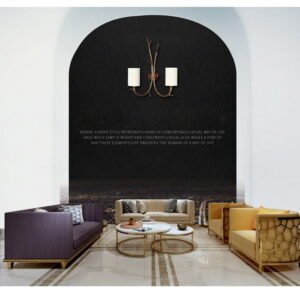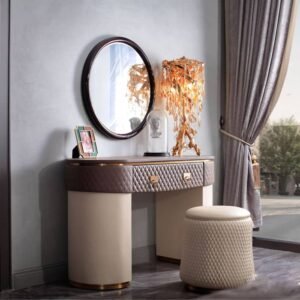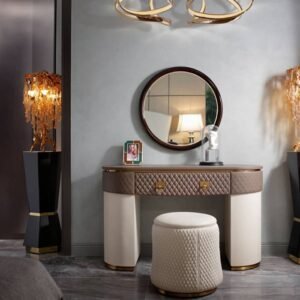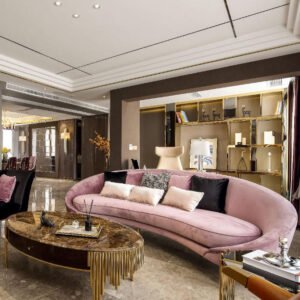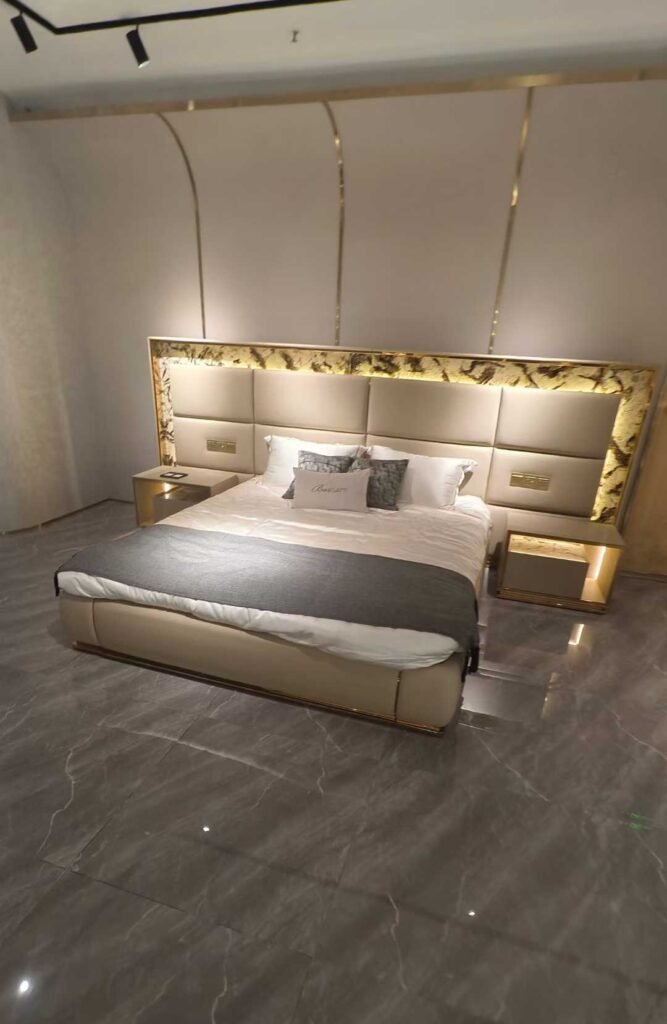
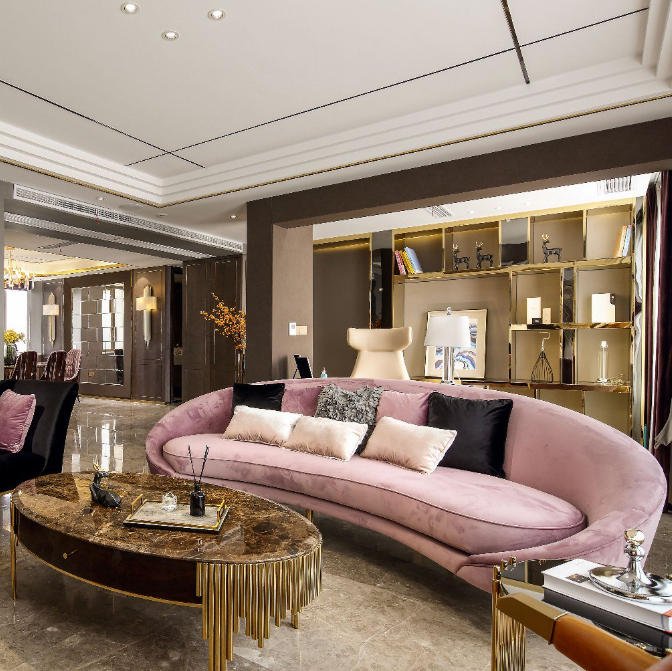
Two buyers, same hotel project, same budget line.
The first orders 120 guest room chairs from a curated luxury line. They arrive in eleven weeks and cost 380 USD each.
The second commissions a local workshop to build a single lobby bench in solid oak. It takes seven months and costs 6,400 USD.
Both are correct. The mistake is swapping them.

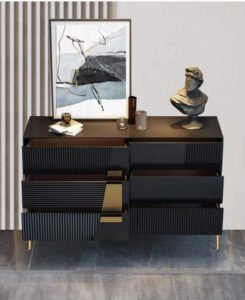
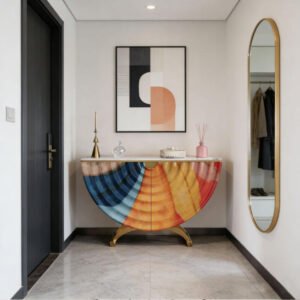
One room, two budgets. The marble and the joinery are fixed. The furniture is where the money can move.
I. The Choice Every High-End Buyer Faces
Affordable luxury furniture is a finished, catalogd piece from a curated line. It comes in set sizes, set materials and a set price.
Bespoke furniture is drawn for one room, built once, and never repeated.
The gap between them is not quality. A well-run curated line and a good bespoke workshop can use the same oak and the same foam.
The gap is control, time and money. Curated lines trade control for speed and price. Bespoke trades price for fit and exclusivity.
Most projects need both. A 90-key hotel that spends its whole furniture budget on bespoke pieces opens late. A villa that buys everything from a catalog looks like a showroom.
This guide compares the two routes on the four things that decide a project: budget, design control, lead time and risk. It is written for the people who sign the order: FF&E buyers, hotel operators, developers, villa owners, interior designers and private label brands.
The wider market is huge, and the top of it is thin. The global furniture market runs into hundreds of billions of dollars a year, yet only a small share of production is built to hotel or villa standard. That shortage is why the same drawing prices so differently across factories.
For background on how brand-grade ranges and made-to-order work differ in practice, this comparison of brand-grade versus custom-made furniture is a useful starting point.
Thesis: Affordable luxury wins on speed, scale and predictable cost. Bespoke wins on fit, identity and long-term value. The right answer is a deliberate mix, not a side.
II. Budget: What Each Route Costs Over Its Life
The sticker price is the easy part. The harder question is what the piece costs you in year eight.
The entry price
On the same chair specification, a curated line sets the baseline. A semi-custom version of that chair, with your fabric and one changed dimension, usually lands 35 to 45% higher. A full bespoke piece, drawn from scratch, lands 120 to 150% higher.

Index values from recent quotes for one lounge chair. Freight and duty excluded.
Why the bespoke premium is that large: labor share. In a bespoke commission, hand time is the biggest line in the quote.
The video below follows a sofa from bare plywood frame to finished cover. Those stages exist in a bespoke workshop too. The difference is that a workshop runs them once, for one piece.
https://www.youtube.com/watch?v=NO67VMy3guM
Typical cost structure of a one-off upholstered piece, from three recent workshop quotes.
Scale changes the maths
Curated lines get cheaper per unit as the order grows. Bespoke does not, at least not at first.
A curated chair at 40 units might cost 380 USD. At 240 units it can drop to 320 USD, because the factory already holds the frame, the pattern and the fabric in stock.
A bespoke chair at 40 units costs roughly the same per unit as at one. The tooling is amortized over 40 pieces, not 400. The saving only arrives on the second order, when the drawings and jigs already exist.
That is why hotel projects run curated lines in guest rooms. The cost curve rewards repetition.
It is also why the two routes are rarely compared on equal terms. A buyer who wants the full arithmetic, line by line, can use this cost and quality analysis as a template.
The number that matters: cost per year of use
Take two sofas. A curated line sofa at 4,200 USD, replaced after ten years. A bespoke sofa at 9,800 USD, reupholstered once at year twelve and kept for twenty years.
| Curated line | Bespoke | |
|---|---|---|
| Purchase price | 4,200 USD | 9,800 USD |
| Re-cover or repair | 0 | 1,800 USD at year 12 |
| Service life | 10 years | 20 years |
| Cost per year | 420 USD | 580 USD |
| Resale or salvage value | Low | 15–30% of cost in a strong market |
Bespoke costs more per year in a private home. It also holds resale value, and in a villa it supports the appraisal. Buyers who plan for a sale inside five years should weigh that carefully, and this checklist on resale value sets out what appraisers actually look at.
Industry insight: Curated lines are cheaper per year in commercial use, because replacement is fast and cheap. Bespoke is cheaper per decade in a private residence, because the piece never needs replacing at all.
III. Flexibility: Creative Control vs Curated Limits
Design control is the reason designers push for bespoke. It is also the reason projects run late.
What a curated line fixes
A curated piece fixes three things: size, material and finish. You choose from a list.
That is fine for most rooms. It becomes a problem in three situations:
- The wall is 3,400 mm and the longest sofa in the line is 2,900 mm.
- The ceiling is 4.2 m and the line’s tallest cabinet is 2,200 mm.
- The floor is a warm travertine and the line’s only stone top is cool grey.
In each case, the designer has to design around the furniture instead of the room. That is how a luxury space starts to look rented.
What bespoke actually buys
Bespoke buys three numbers: length, depth and height. It also buys the detail that makes a room feel authored, such as a fluted plinth that matches the joinery, or a 720 mm back height that clears a window sill.
It buys ergonomics too. A 6’4″ client with a bad back needs a 480 mm seat height and a firmer seat. No catalog holds that.
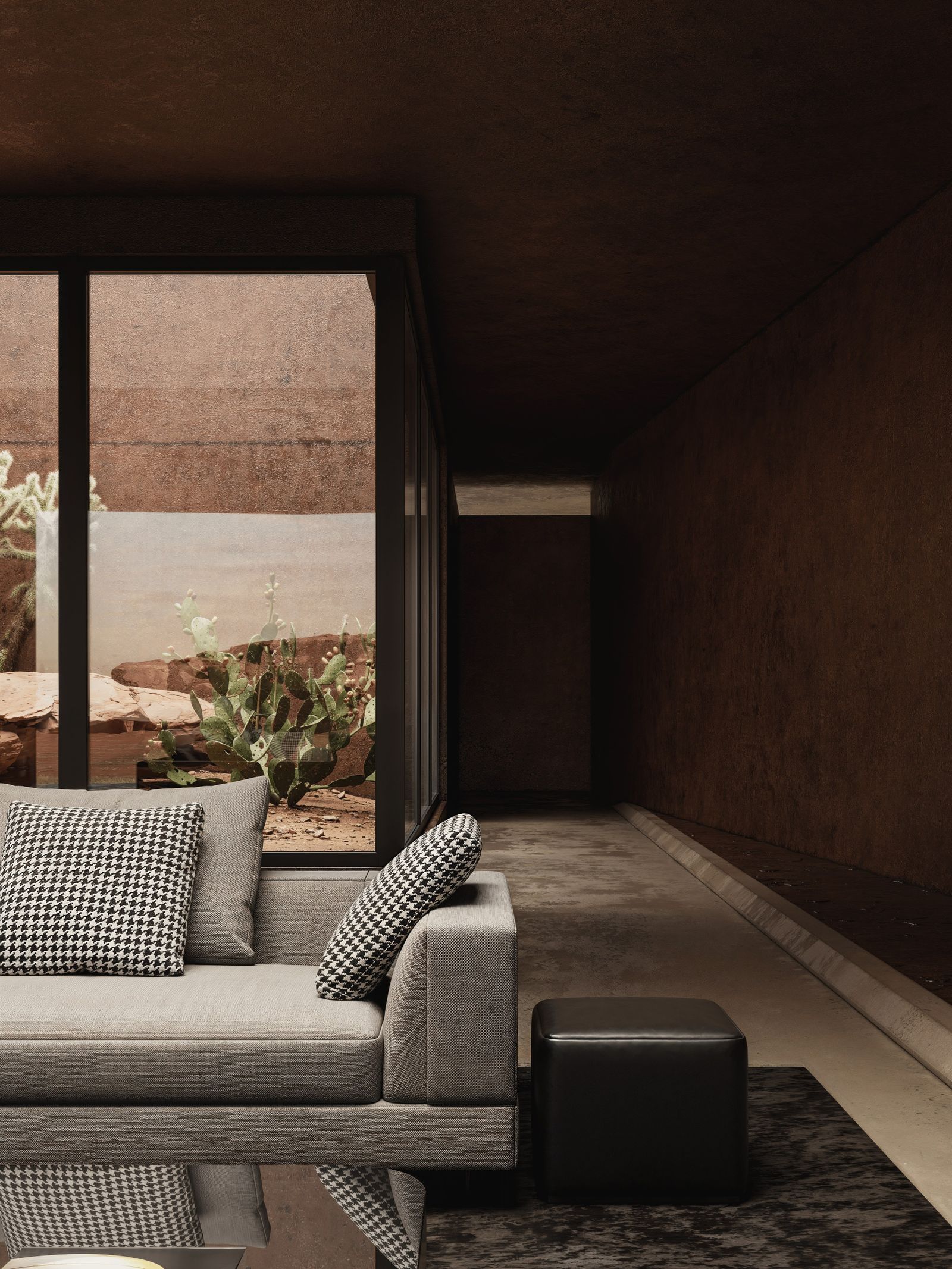
Bespoke work starts where the architecture stops. This room has no standard wall, so it needs no standard sofa.
The hybrid that most projects use
The workable model is a curated core with bespoke accents.
On a villa, that often means:
- Bespoke: the dining table, the main sofa, the bed, built-in joinery.
- Curated: side tables, dining chairs, lamps, occasional seating.
- Vintage or antique: one or two pieces that carry a story.
The ratio matters less than the logic. Put bespoke where the room is unusual. Put curated where the piece has to repeat.
Designers who brief a factory on this mix need drawings, not mood boards. The difference between a good and a bad custom order sits in the specification document, and most of it is written before production starts.
Upholstery is where most of that control lands. A custom frame is only as good as the cover that goes on it, and this guide to bespoke upholstery for interior fit-outs covers the seam, foam and fabric decisions that decide how a piece feels in year five.
For rooms where the fit is the whole point, the sequence in this guide to sourcing custom pieces that fit the room keeps a commission from drifting.
IV. Lead Times: What Speed Costs You
Time is the riskiest variable in furniture procurement. It is also the one buyers underestimate most often.
Door to door, including production, freight and site delivery. Add two to four weeks for customs in peak season.
A curated stock item moves in six weeks. A bespoke piece with a new prototype moves in thirty.
The thirty weeks break down in a way most buyers do not plan for:
- Drawing and approval: 3 to 5 weeks, often longer when three parties comment.
- Prototype or 1:1 sample: 4 to 6 weeks.
- Production: 10 to 14 weeks.
- Finishing and curing: 2 to 4 weeks. Oil and lacquer need time, not heat.
- Freight, customs and delivery: 4 to 8 weeks.
Every one of those stages can slip. The prototype is the usual culprit, because a designer’s drawing and a factory’s interpretation rarely match on the first pass.

A room like this takes a year from first drawing to final polish. Most of that year is approval, not craft.
What a delay actually costs
In a hotel contract, a late FF&E package can trigger liquidated damages. The common range is 0.5 to 1% of contract value per week, capped at 10%.
On a 2.4 million USD furniture package, four weeks late costs 48,000 to 96,000 USD. That is more than the bespoke premium on the lobby.
Liquidated damages are not the real cost either. A delayed opening costs room revenue, staff wages and marketing spend that has already been committed.
For projects with a fixed opening date, the FF&E timeline should be built backwards from handover, not forwards from the order.
V. Villas and Private Residences
A private client asks a different question. Not “how many can you deliver” but “has anyone else got one”.
Where bespoke earns its price
In a villa, the rooms that matter most are the ones a guest photographs: the dining room, the main living room, the principal bedroom.
Those are the rooms where bespoke pays. A 3.6-meter table in a single slab. A bed designed around a 2,000 mm mattress and a sloped ceiling. A library wall that follows the stair.
Bespoke also solves the environmental problem. A coastal villa needs stainless fittings and a finish that survives salt air. A mountain house needs timber that tolerates dry heat. Curated lines are built for average conditions.

A room like this has no catalog answer. The table, the chairs and the cabinetry were all drawn for the space.
Where curated wins
A 12-villa development is not twelve bespoke projects. It is a product.
For speculative villas, the goal is a fast sale at a strong price. Curated luxury delivers a complete, coherent interior in one order, with a predictable lead time and a warranty that survives the handover.
Buyers walk in and read the room in three seconds. Matched pieces from one collection read as designed. Twelve one-off pieces from twelve workshops read as a jumble, unless the designer is very good.
A workable split for a speculative villa:
- 35% curated: sofas, dining chairs, occasional pieces.
- 55% bespoke: joinery, beds, the main table.
- 10% vintage: one or two pieces that give the house a history.
Villa projects also fail in predictable ways. This list of procurement mistakes in luxury villas covers the ones that cost the most, including ordering furniture before the joinery is set out.
Materiality and longevity
Bespoke lets you choose the timber, the finish and the hardware. That control is worth money in a house that will be lived in for thirty years.
Curated lines restrict you to the maker’s palette. That is a limit, but it is also a form of quality control: the maker has already tested that combination in the field.
VI. Hotels and Commercial Projects
A hotel has two furniture problems in one building. The lobby must impress. The guest room must survive.
Guest rooms: standardization wins
A 120-key hotel needs 240 nightstands that meet the same wall, the same bed height and the same socket position. It needs them to be replaceable in year four without a new tooling cost.
Curated or semi-custom lines answer that. One specification, one supplier, one spare-parts list.
The numbers support it. A curated guest room package usually lands 30 to 45% below a bespoke equivalent, and it can be re-ordered in eight weeks instead of eight months.
That is why most operators put 65 to 75% of the furniture budget into repeatable, catalog-based pieces.

A public lounge is a stage set that has to survive 400 guests a day. Every piece here is specified for both jobs.
Public areas: bespoke builds the brand
The lobby, the bar, the signature suite and the restaurant are where a hotel becomes recognisable.
A bespoke reception desk that follows the arrival sequence. A banquette built around a column. A bar front in the same stone as the floor. None of these can be bought from a catalog, and all of them appear in the photography that sells the next 10,000 room nights.
Branded hotel groups solve this with a design language rather than one-off pieces. Independent hotels solve it with bespoke. Either way, the public area is where the signature spend belongs. Most of these specifications are still signed after seeing the frame and the foam in person, which is why buyers travel to events such as NeoCon each year.
The hospitality FF&E budget breakdown shows how that split usually lands: guest rooms dominate the count, public areas dominate the cost per square meter.
Supply chain efficiency
A curated catalog also simplifies procurement. One purchase order, one inspection, one container plan, one warranty contact.
Bespoke spreads that work across several workshops, several finish approvals and several delivery dates. On a project with a small procurement team, that overhead is real.
The operators who mix both routes well run them on one schedule. This FF&E coordination framework shows how to keep bespoke public-area pieces and catalog guest-room orders on the same handover date.
One more distinction is worth settling early: contract build versus residential build. A lounge chair built for a home and a lounge chair built for a lobby can look identical on day one, and this comparison of hospitality-grade and residential furniture explains where they separate.
Industry insight: Hotels do not choose curated furniture because it is cheaper. They choose it because a standardized room can be repaired, re-ordered and refitted without closing the floor.
VII. Risk: Where Each Route Breaks
Every route carries a failure mode. Knowing the failure mode is most of the risk management.
The quality gap in “affordable luxury”
The risk is real, and it is tactile. A guest who has sat in a 9,000 USD sofa will notice a 2,400 USD one, even if they cannot say why.
The usual giveaways: foam that bottoms out, a seat that creaks, a seam that wanders, a leather that feels like vinyl.
The fix is specification, not price. Ask for foam density, frame species, seam pitch and leather thickness in writing. Then check them on the sample.
The bespoke gamble
Bespoke fails in the gap between drawing and workshop.
Three common failures:
- The drawing shows a curve the workshop cannot bend in that timber.
- The finish sample was approved in daylight and produced under fluorescent light.
- The client approved a photo, not a physical sample.
A full-scale sample removes most of this risk. It costs 400 to 1,200 USD and saves the cost of a wrong production run.
Replacement risk
A curated piece can be re-ordered. A bespoke piece cannot, unless the drawings, the pattern and the fabric still exist.
Two rules protect you:
- Own the files. The drawing set, the material specification and the pattern belong to you, not only to the factory.
- Hold spares. Order 2% extra on high-traffic bespoke items, and store one full set of hardware.
Without those two, a single damaged banquette can hold a suite out of service for months.
VIII. Quality Assurance and Sourcing Standards
The checks differ by route. The goal is the same: proof, not promises.
For curated lines
Ask for the factory audit, the certification scope and two reference projects of similar size. Then inspect the first production batch, not the showroom sample.
Certificates matter, but the scope matters more. FSC covers timber sourcing. OEKO-TEX covers textile safety. UL GREENGUARD Gold covers low emissions, which counts in sealed guest rooms. Contract strength standards sit with BIFMA.
Ask for the certificate number and the product scope, not the logo. A certificate belongs to a factory and a product line, not to a brand.
Our own pre-shipment routine follows a written inspection checklist: dimensions against the approved drawing, finish against the retained sample, hardware cycle tests, and photos of every defect. A report without photos is not a report.
For bespoke work
Bespoke needs milestone approvals, because there is no catalog to fall back on.
Four gates:
- Drawing sign-off. Dimensioned, with tolerances and material callouts.
- Sample approval. A 1:1 corner, a finish panel, a hardware set.
- In-process check. Frame complete, before upholstery closes it.
- Final inspection. Before packing, in daylight, with the sample beside the piece.
Skip one gate and you are relying on goodwill.

A joint is either cut to the drawing or it is not. There is no middle setting, and no way to check it after upholstery.
The production side of that process is documented in this walkthrough of how custom luxury furniture is built, from frame joinery to the final finish check.
After handover, the same standard decides how long the piece lasts. A care plan costs little and adds years, and these care and restoration routines cover leather, oiled timber and stone in humid climates.
Sustainable sourcing
The comparison is not simple. Curated goods often travel further, but they are built in efficient batches with less waste per unit. Bespoke pieces are usually local, but a one-off uses more material per finished piece.
What matters in both cases is the same: certified timber, low-emission finishes, and a piece that will still be in service in twenty years. The sustainable FF&E options for hotels guide covers how those choices map to project credits.
One correction worth knowing: furniture does not earn a LEED credit by itself. It supports credits under materials and indoor environmental quality. The USGBC sets the rules, and the WELL Building Standard treats low-emission furniture as part of its air and light criteria.
IX. The Decision Flow: Three Questions, One Answer
Most projects do not need a long debate. They need three answers.
Step 1: What is the identity goal?
If the room must look like the brand, buy curated. If the room must look like nothing else, commission bespoke.
A hotel guest room is a product. A hotel lobby is a signature. A villa dining room is a portrait.
Step 2: When does the room open?
Work backwards from handover. Under 16 weeks, curated stock is the only safe route. Between 16 and 28 weeks, semi-custom fits. Over 30 weeks, bespoke is possible.
Step 3: Where does the budget actually sit?
Fix the CAPEX line before the design is signed off. A common and workable split:
| Project type | Curated | Semi-custom | Full bespoke |
|---|---|---|---|
| 120-key hotel | 70% | 20% | 10% |
| Boutique hotel, 30 keys | 55% | 25% | 20% |
| Speculative villa | 45% | 35% | 20% |
| Private villa, owner-occupied | 25% | 30% | 45% |
| Private label brand range | 0% | 60% | 40% |
Shares of furniture budget, excluding lighting, art and soft goods.
Apply the split to rooms, not to the whole project. A hotel can be 70% curated in the tower and 100% bespoke in the lobby, and both numbers can be right.
The sequence that avoids rework
Furniture decisions run in a fixed order:
- Fix the room dimensions and the joinery.
- Decide which pieces must be bespoke.
- Lock the curated catalog for everything else.
- Approve samples before any production slot is booked.
- Book inspection dates with the factory, not after.
Projects that reverse steps 2 and 3 usually end up designing around stock.
X. Conclusion
The comparison comes down to three trade-offs.
Money: curated lines cost less up front and less per year in commercial use. Bespoke costs more up front and holds value longer in a private residence.
Control: curated lines fix size, material and finish. Bespoke fixes nothing except your drawing.
Time: curated stock moves in six weeks. A new bespoke prototype can take thirty.
The balanced portfolio is not a compromise. It is the standard practice at the top of the market. Roughly 60 to 70% of the budget goes to pieces that must repeat, and 30 to 40% to the pieces that carry the identity of the project.
Jade Ant furniture runs both routes from one factory floor: curated ranges for the repeatable pieces, and a bespoke line for the drawings that cannot be bought. Brands that want their own range usually start with a signature private label collection. One sample process, one inspection standard, one delivery schedule.
Next step: Take your current furniture schedule and mark each line as repeat or signature. If more than 40% is marked signature, your timeline is probably already at risk. If less than 10% is, the rooms may read as rented.
Send us the schedule and we will price both routes against it. You can start that conversation here, or browse the current collections.
Glossary
| Term | Plain meaning |
|---|---|
| Curated line | A finished collection a maker holds in set sizes and finishes |
| Bespoke | A piece drawn for one room and built once |
| Semi-custom | A stock frame with your fabric, finish or one dimension changed |
| FF&E | Furniture, fixtures and equipment: everything supplied to a project that is not part of the building |
| Prototype | A first full-size build used to test the drawing before production |
| CAPEX | Capital expenditure: money spent on long-life assets at the start of a project |
| Liquidated damages | A fixed penalty a contract sets for late delivery |
| Lead time | Weeks from a signed purchase order to goods ready for site |
| Cost per year of use | Purchase price plus upkeep, divided by the years the piece stays in service |
Frequently Asked Questions
How do I know if my budget allows bespoke pieces?
Set the bespoke allowance at 10 to 20% of the furniture budget for a hotel, and 30 to 45% for an owner-occupied villa. Spend it on the rooms that carry the identity of the project. Everything that repeats should come from a curated line.
What is the lead time difference between affordable luxury and bespoke furniture?
Curated stock ships in about six weeks. Curated made-to-order runs 12 to 16 weeks. A new bespoke piece with a prototype takes 26 to 32 weeks. The prototype stage is where most of the extra time sits.
Can I mix affordable luxury and bespoke pieces in one room?
Yes, and most high-end rooms already do. Keep the visual language consistent: match the metal finish, the timber tone and the seat height. Let one or two bespoke pieces carry the room, and keep the rest quiet.
How do I check “affordable luxury” materials before a hotel bulk order?
Ask for foam density, frame species, leather thickness and seam pitch in writing. Then approve a production sample, not a showroom piece. Inspect the first batch before the balance payment, with photos of every defect.
What mistakes do designers make when commissioning bespoke furniture?
Three repeat: approving a photo instead of a physical sample, leaving tolerances out of the drawing, and ordering before the joinery is set out. Each one turns into a remake at the factory’s convenience, not yours.
Which rooms in a villa should always be bespoke?
The main dining table, the principal bed, the living room sofa and any built-in joinery. These are the pieces a buyer touches first and photographs most. Side tables, dining chairs and lamps can come from a curated line.
How do warranty terms differ between curated lines and custom makers?
Curated lines usually offer 5 to 10 years on frames and 1 to 3 years on upholstery, with a replacement or credit remedy. Bespoke makers typically warrant workmanship for 12 to 24 months, with structural terms written into the contract. Read the remedy, not the length.
What documentation should I give a maker for a bespoke piece?
Send a dimensioned drawing with tolerances, a material and finish schedule, a hardware list, and a reference photo of the joint and seam you expect. Add the room’s access route. A maker who asks for the lift dimensions is a maker who has delivered before.
Does bespoke furniture help a LEED or WELL rating?
Furniture does not earn a credit on its own. It supports credits for low-emission materials and indoor air quality. Choose low-VOC finishes, certified timber and documented content, and give the assessor the paperwork.
How do I replace damaged bespoke furniture in a hotel?
Keep the drawing set, the material specification and the pattern, and hold 2% spares on high-traffic pieces. Without those files, a single damaged banquette can take months to replace, because the factory has to rebuild the pattern first.