A cheap sofa looks right on delivery day. A good one looks right in year eight, after two hundred guests, three moves, and one renovation.
That gap is what buyers pay for. It is not a logo. It is the frame, the foam, the finish, and the discipline of the factory that made it.
This guide is written for the people who carry the risk: importers, designers, developers, hotel buyers, and private label owners. It covers what high-end modern furniture actually is, how to tell it apart from a look-alike, and how to buy it without losing a project to a late container.

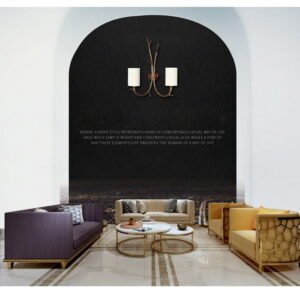
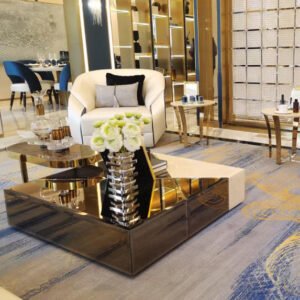
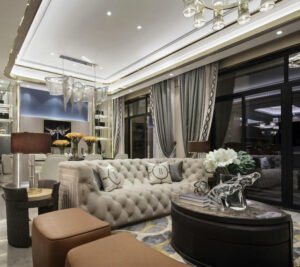
A modern luxury lounge. The calm look depends on proportion, not on decoration.
The Strategic Role of High-End Furniture in Premium Projects
High-end modern furniture is furniture built to a written specification, with materials and joints that hold their shape for a decade or more, in a design that does not depend on this year’s trend.
That is the whole definition. Everything else is detail.
From opulence to curated sophistication
Modern luxury moved away from gold leaf and heavy carving. Buyers now want quiet rooms with strong bones: a wide-plank floor, one sculptural chair, a stone table, and light that lands where it should.
The shift changed what “expensive” means. Ten years ago, a room looked expensive when it was full. Now a room looks expensive when every object in it is right, and there is less of everything.
That is harder to fake. A cheap copy of a baroque chair can look busy and pass. A cheap copy of a minimal chair cannot hide. Every joint is visible. Every millimetre of the silhouette is exposed.
Where form, function, and money meet
Three things decide whether a piece belongs in a premium project:
- Form. The shape holds up in a photograph and in a room.
- Function. It survives real use without service calls.
- Value. It still holds worth when the project is sold, refinanced, or rebranded.
Most suppliers can deliver one. Few deliver all three.
The real pain point: trend versus timeless
Designers feel this every season. A trend piece fills a page today and dates the room in three years. A timeless piece can look dull in a rendering.
The way out is a mix. Spend the budget on the pieces that carry the room, and keep the trend element small. A sculptural lamp or a coloured chair can carry a trend. A sofa, a dining table, and a bed should not.
If you want the longer argument on where the line sits, this breakdown of what separates luxury from premium pricing is a useful starting point.
| Buyer type | What they are really buying | Evidence that proves it |
|---|---|---|
| Villa owner | A home that feels personal and calm | Sample approvals, sight lines, comfort test |
| Interior designer | A supplier who protects the design intent | Drawing accuracy, finish match |
| Developer | Saleability and a clean handover | Staging result, defect list at handover |
| Hotel operator | Rate support and low maintenance cost | Contract test reports, lifecycle cost |
| Importer | Repeatable quality at a workable price | Batch consistency, packing standard |
| Private label owner | Exclusivity they can defend | Exclusivity clause, tool ownership |
Defining Style and Quality Markers for the Discerning Eye
True luxury shows in execution and intent. You can see both in ten minutes if you know where to look.
Marker 1: silhouette and proportion
A high-end piece has a clear line. Legs taper at the same rate. The seat height matches the table. The back angle matches the human spine.
Look at the gap between the arm and the seat. Look at the shadow line under the frame. On a good piece, those gaps are even on both sides. On a copy, one side is always 5 mm off.
Proportion is also a room problem. A 2.4 m sofa in a 3.2 m room leaves no air. The same sofa in a 5 m room looks underfed. Good suppliers help you check this before they cut wood.
Marker 2: handwork you can find
Mass production hides its shortcuts inside the piece. Handwork leaves traces you can check.
- Run a finger under the seat frame. Sharp staples mean speed, not care.
- Open the cushion zip. Loose foam crumbs mean cheap foam.
- Look at the piping. It should run straight and meet without a wobble.
- Check the seam allowance on the inside back. It should be trimmed.
None of these tests need tools. They need the willingness to look.
Marker 3: ergonomics and touch
Comfort is measurable. Seat height for a dining chair sits near 45 cm. Seat depth for a lounge chair sits between 55 and 60 cm. A sofa seat height near 42 cm suits most adults.
Touch matters too. Leather should warm under the hand, not stay cold and slick. Lacquer should feel smooth, not glassy. Bouclé should spring back when pressed.

Quilted leather shows every stitch line. There is nowhere for a rushed seam to hide.
| Marker | What to look for | How to test in five minutes |
|---|---|---|
| Silhouette | Even taper, level arms, straight shadow lines | Sight along the frame from one end |
| النجارة | Dowel, screw, and corner block at stress points | Press the arm down and listen for a creak |
| Upholstery | Straight piping, tight seams, no puckering | Run a hand across the seat front |
| Fill | Firm edge, slow recovery | Press the seat edge and count to five |
| Finish | Even sheen, sealed edges, no overspray | Look at the underside and the inside leg |
One more marker sits above all three: design intent. A good piece solves a problem. The arm is that height because a hand rests there. The back is that angle because a person leans back after dinner.
When a copy shortens the arm by 20 mm to save material, the intent disappears. The chair still looks like a chair. It stops feeling like one.
Design coverage is a useful reference here. Publications such as Wallpaper* show how the strongest pieces hold up across seasons, which is a better test than a single launch photo.
For a structured shortlist process, this selection criteria for high-value pieces turns the markers above into a scoring sheet.
Materiality: The Foundation of Longevity and Prestige
The material list decides how long the piece lasts and what it is worth in ten years.
Hardwood and veneer
Frames should be kiln-dried hardwood. Moisture content of 8% to 12% keeps the frame stable in most climates. A cheap frame uses softwood or plywood blocks, and it moves within two winters.
Veneer is where budgets hide. A 0.6 mm sliced veneer can be sanded and refinished. A 0.2 mm veneer cannot. Ask for the thickness in millimetres, not the word “veneer”.
Ask for FSC-certified timber if the project has a green target. It also tells you the mill tracks its supply, which usually means the material is consistent batch to batch.
Metal and alloy
Brushed brass, blackened steel, and aerospace-grade aluminium all carry a premium look. The finish is what separates them.
PVD stands for physical vapour deposition. It is a coating applied in a vacuum that bonds to the metal at a molecular level. It resists scratching and tarnish far better than electroplating, which sits on the surface and wears through at edges.
For a hotel lift lobby, PVD on brass is a practical choice. For a villa powder room, plated brass is fine.
Textiles and leather
Bouclé is a looped yarn fabric with a soft, nubbly surface. It photographs well and hides light wear. It also snags on jewellery and pet claws, so it suits bedrooms better than lobby sofas.
For leather, ask for top-grain or full-grain and the thickness in millimetres. Contract upholstery usually sits at 1.2 to 1.4 mm. Corrected-grain leather is sanded and stamped. It looks uniform and wears thin on arm caps.
For fabric in public areas, ask for the Martindale rub count. 30,000 cycles is the entry point for contract. Hotel lobby seating is safer at 40,000 and above.
Ask for معيار OEKO-TEX 100 on any textile that will sit close to skin. It confirms the fabric has been tested for harmful substances.

One needle, one seam. The stitch length tells you the machine setting and the operator’s habit.
| المواد | Where it earns its price | What goes wrong when it is cheap |
|---|---|---|
| Kiln-dried hardwood | Frames that stay square | Joints open, doors rub, seats creak |
| 0.6 mm sliced veneer | Refinishable surfaces | Sanding burns through to the core |
| PVD-coated brass | Handles and frames in public areas | Plating wears at edges within a year |
| جلد من الدرجة الأولى | Seating that develops patina | Surface cracks and peeling at arm caps |
| High-resilience foam | Seats that recover | Hollow seat after 18 months |

Where the money goes in a designer lounge chair, as a share of unit cost. Our model, based on quoted builds.
Stone, glass, and the surfaces people touch
A stone top is a statement and a risk. Marble etches when lemon juice sits on it. Quartzite resists more but costs more. Travertine needs filling and sealing.
Ask for the slab thickness and the edge profile. A 20 mm top with a laminated build-up looks thin and feels fragile. A 30 mm solid top with a hand-polished edge feels like a piece of architecture.
Glass behaves the same way. A 12 mm tempered top is fine for a side table. A dining table needs 15 mm and a frame that supports the full edge, not four points.
Every one of these surfaces needs a care plan at handover. This care and preservation plan sets out what to seal, how often, and what to avoid.
The Art of Finishing: Where Detail Meets Durability
A finish is not a colour. It is a system of sanding, sealing, and curing that decides how the surface behaves for years.
Coatings that last
- Matte lacquer hides fingerprints and reads soft. It shows scratches more than satin, so it suits low-touch surfaces.
- Open-pore finish leaves the grain tactile. It needs a maintenance coat every few years in dry climates.
- Powder coating on metal is baked on, not sprayed wet. It resists chipping and is the right choice for outdoor and contract frames.
Ask how many coats, and ask whether the factory sands between them. Three coats with sanding between is a different product from one heavy coat.
Hardware and hidden detail
Good hardware disappears. Soft-close hinges, concealed runners, and levelling feet are invisible in a photograph and obvious in daily use.
Smart technology is the new test. A charging pad inside a bedside table or a hidden cable channel in a desk should not change the outside of the piece. Ask to see the cut-out drawing before production. Retrofitting a cable route on site usually means drilling a finished surface.
Tolerances at scale
This is where a small workshop and a factory part ways. A one-off piece can be hand-fitted. A 100-room order cannot.
Ask for the tolerance in writing. Seat height within 5 mm. Fabric pattern centred within 3 mm. Veneer grain matched across a run of doors. Then ask how the factory checks it, and who signs the sheet.
In our experience at Jade Ant furniture, most finish complaints on large orders trace back to one batch of lacquer or one new spray operator, not to the design. A photo record at each gate catches both.
Approve the finish, not the photo
A phone photo cannot show sheen. Ask for a physical strike-off: a board finished in the exact system, in the exact colour, on the exact substrate. Sign it, date it, and keep one copy at the factory.
Then ask how the factory controls colour between batches. A serious supplier keeps a colour standard and checks each mix against it. A supplier without a standard matches by eye, and eyes differ between shifts.
This is the part of the process that a written furniture specification protects. If the sheen level, the substrate, and the number of coats are all written down, the argument about a dull batch becomes a measurement, not an opinion.
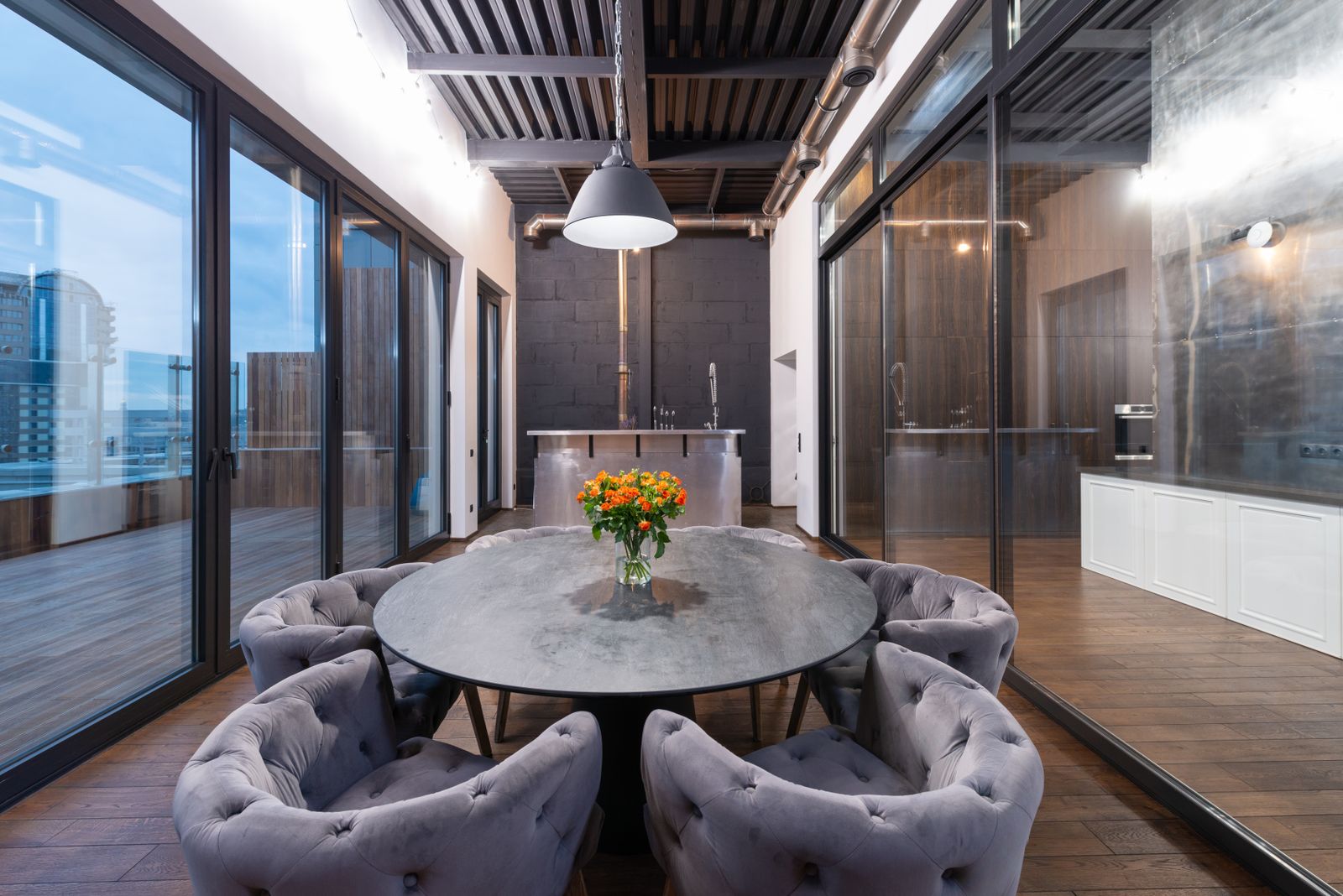
A stone top and eight tufted chairs. The finish on the table edge is what a guest touches first.
| Finish | Look | Wear behaviour | Best use |
|---|---|---|---|
| Matte lacquer | Soft, low sheen | Shows scratches, hides fingerprints | Bedrooms, dining rooms |
| Satin lacquer | Gentle reflection | Balanced, easy to repair | Living rooms, suites |
| Open pore | Visible grain, tactile | Needs periodic oiling | Feature tables, panelling |
| Powder coat | Even, fine texture | Chip resistant, colourfast | Metal frames, outdoor |
| PVD | Metallic, uniform | Scratch and tarnish resistant | Handles, public areas |
Application in Luxury Residential: Elevating the Private Villa
In a private estate, furniture has to do two jobs at once. It has to look like the owner, and it has to feel like home.
Statement zones
A villa needs two or three moments, not twenty. A sculptural chair at the entry. A stone table in the dining room. A low sofa that faces the view.
Spend the budget there. Fill the rest with quiet pieces that support the room. A villa that shouts in every corner feels like a showroom, and owners move out of showrooms.
Bespoke dimensions
Standard sizes rarely fit a villa. Ceilings run high, windows run wide, and the plan is often irregular.
Custom work solves this, but it adds risk. Confirm the lift size, the stair turn, and the door clearances before production. A three-metre table that cannot reach the dining room is a total loss.
This is the stage where villa furniture planning saves money. Designers who specify early avoid the expensive fix of rebuilding a piece on site.
A budget split that works for most villas is 60 / 30 / 10. Sixty per cent goes to the pieces the owner touches daily: sofa, dining table, bed, main armchair. Thirty per cent covers the supporting cast. Ten per cent stays for the one piece that makes the room memorable.
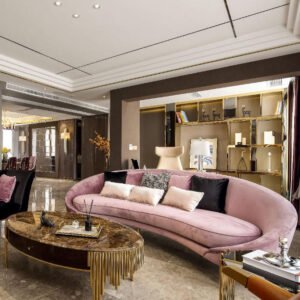
Bespoke upholstery carries the biggest share of that spend, and it is where fit matters most. A curved sofa in a bay window needs the frame drawn to the wall radius, not ordered from a size chart. Suppliers who build bespoke upholstery for fit-outs work from a template of the room, which removes the guesswork.
Comfort as psychology
A luxury home is a place where the body relaxes. That comes from softness underfoot, warm light at eye level, and seats that hold you at the right angle.
It also comes from texture. A room with one leather chair, one wool rug, and one stone table feels calmer than a room with five glossy surfaces. The eye needs somewhere to rest.

A foyer sets the price expectation for the whole house. Two good sofas do more than a marble inlay.
If the villa is part of a rental programme, this guide to hospitality-grade residential pieces explains where home specification stops and contract specification starts.
Application in Premium Commercial: Branding Through Interiority
In a commercial space, furniture is the brand made physical. A guest reads the chairs before they read the signage.
Lobby and reception
The lobby carries the first impression and the highest traffic. Two rules keep it working.
First, the seating must look sculptural and survive daily abuse. Second, the table must be heavy enough that nobody drags it across the floor.
A stone or solid timber table with a weighted base solves both. A glass table with a thin base looks lighter and needs replacing sooner.
Executive suites and boardrooms
Boardrooms need power and function in the same room. A 3.6 m table seats twelve. Each seat needs 70 cm of edge space, or shoulders touch.
Cable management should be designed into the table, not added under it. Ask for a flip-up box with power and data, and check the clearance under the top before you approve the drawing.
Boutique retail
Retail furniture guides the customer through the room. A low bench near the entrance slows people down. A high table at the back pulls them deeper.
The same logic applies to a car showroom or a private bank. Seating sets the pace of the visit.
For developers staging a sales suite, this look at common procurement mistakes in luxury villas covers the errors that cost the most and show up fastest.
Integration in Hospitality: The FF&E Challenge for Hotel Operators
Luxury hospitality asks for two things that usually fight each other. Five-star looks and industrial durability.
المفروشات والمعدات والأثاث means furniture, fixtures, and equipment. It is the loose and fixed inventory a hotel buys before opening, and it is usually the second largest line after construction.
Contract-grade specification
Contract furniture is built to standards that residential furniture never meets.
Upholstery must pass a fire test. In the US, CAL TB 117-2013 sets the baseline. In the UK and EU, BS 5852 is the reference. Composite wood must meet formaldehyde limits such as TSCA Title VI in the US.
Frames must survive drag tests, and finishes must survive cleaning chemicals. A finish that fades under a quat-based cleaner will look tired within a season.
Indoor air is the other half of compliance. Hotels seal their rooms, so emissions from foam, adhesive, and composite wood stay inside. Ask for GREENGUARD Gold on upholstery and case goods, and ask for the test report with the order number on it.
One narrative, many rooms
A hotel works when the lobby, the lounge, the corridor, and the suite feel like one story. That means shared materials and a repeated set of details.
Write the material palette once. Then hold every supplier to it. Colour drift between the lobby sofa and the suite bench is the most common visible failure in a new hotel.
Lifecycle cost
A hotel replaces lobby seating on a cycle. Cheap seating often lands on a four-year cycle. Contract-grade seating can run eight to ten years.
Do the maths before you buy. A USD 900 chair replaced every four years costs USD 225 per year. A USD 1,800 chair that lasts ten years costs USD 180 per year. The second chair is cheaper, and it looks better in year seven.
That only holds if the replacement exists. Jade Ant furniture keeps a component list for every hotel order, so a cushion or a leg can be matched three years later. A supplier without that record forces a full re-buy.

A lobby bar at night. The furniture carries the mood, and the mood carries the room rate.
| المواصفات | Residential grade | Contract grade |
|---|---|---|
| Upholstery fire test | Often none | CAL TB 117-2013 or BS 5852 |
| Fabric rub count | 15,000 to 20,000 cycles | 30,000 to 50,000 cycles |
| كثافة الرغوة | 25 to 28 kg/m³ | 35 to 40 kg/m³ |
| Frame test | None | Drag and impact test |
| Finish chemical resistance | Light household cleaners | Commercial disinfectants |
| Expected life | 5 to 7 years | 8 to 12 years |
Operators planning a full package can compare the hotel FF&E budget lines before the design is fixed. A single-source model also removes a layer of coordination, which is why many owners choose single-source project supply for mixed schemes.
Sourcing and Procurement Strategy for Professionals
The supply chain is where good designs fail. Most of the risk sits in three places: the factory, the calendar, and the paperwork.
Vetting the manufacturer
Ask for the production floor, not the showroom. Look at the cutting room, the foam store, and the finishing booth. A factory that only shows a display area is selling a catalogue.
Then ask four questions:
- Which machines do you own, and which do you subcontract?
- Who signs the final inspection, and can I see the form?
- What is your reject rate, and what happens to rejected units?
- Which client can I call about a project like mine?
The answers tell you more than any certificate. A factory that subcontracts the frames and the finishing is an assembly shop, not a manufacturer.
At Jade Ant furniture, a first project starts with a live walkthrough of the line and a written spec sheet, because both answer questions a catalogue cannot. Buyers who see the foam store and the spray booth tend to ask better questions on the next order.
That difference decides your price and your risk. A manufacturer rather than a trading company controls the output, so a spec change reaches the line in a day. A distributor sends it by email and hopes.
Owners with green building targets should also ask where the timber and foam come from. This overview of sustainable FF&E sourcing covers the documentation that actually counts at audit, rather than the labels that only look good on a website.
Managing the calendar
Furniture never arrives alone. It lands between the flooring, the lighting, and the final clean.
Work backwards from the handover date. Subtract installation, shipping, production, sample approval, and drawing approval. What is left is your real decision window, and it is usually shorter than the team expects.
This FF&E timeline from concept to handover maps the dependencies. Use it to set the order date, not to explain a delay later.
Private label and exclusivity
Brand owners want a piece that cannot be bought down the street. That requires a written exclusivity clause, a custom finish, and usually a custom frame.
Ask for three things: a signed exclusivity for your market and category, a mould or tool owned by you, and a label and packaging programme that hides the factory.
Here is the factory side of the story. The video runs through frame preparation, leather selection, and final inspection in a Foshan plant that builds for luxury interiors.
https://www.youtube.com/watch?v=8yBaCE34dVE
Watch how the frame is seasoned and how the leather is cut. Those two stages decide most of the finished quality.
A private label signature collection only works when the factory can hold a finish standard across runs. If the supplier also sells your design to other buyers, you have a sourcing problem, not a brand.
Some owners skip private label and buy a known brand instead. That is a valid route, and this comparison of brand-grade versus custom-made furniture sets out when the licence is worth the premium and when a custom frame is the better spend.
| المرحلة | What you approve | المدة المعتادة |
|---|---|---|
| Brief and budget | Scope, quantities, target cost | 1 to 2 weeks |
| Shop drawings | Dimensions, joints, hardware | 5 to 10 working days |
| Sample | Frame, foam, fabric, finish | 15 to 25 working days |
| Production | Batch schedule and QC plan | 8 to 16 weeks |
| Inspection | AQL report and photos | 2 to 3 days |
| Freight and install | Loading plan and site readiness | من 4 إلى 8 أسابيع |
The Economic Impact: Furniture as an Asset
Good furniture is not a sunk cost. It shows up in the numbers a buyer looks at.
Rate and yield
In hospitality, furniture supports the room rate. A suite with a proper desk, a reading chair, and good lighting can hold a higher rate than the same square metres with built-in furniture.
In residential lettings, furnished premium units rent faster and hold tenants longer. The furniture line is small compared with the vacancy cost of an empty month.
Here is a simple model for a small hotel. Take 60 rooms at an average rate of USD 210. If better furniture supports a 4% rate increase, the gain is USD 8.40 per room per night. At 70% occupancy over a year, that is about USD 128,000 in revenue.
The furniture premium for that upgrade might be USD 180,000 across the property. It pays back in under two years, and the asset keeps the higher rate afterwards.
The same logic works in serviced apartments. A tenant who stays twelve months instead of six cuts the turnover cost by half. Better furniture is one of the cheaper ways to earn that extra stay.
Staging and the first price conversation
A staged apartment sells a layout. A buyer who can see where the sofa sits and how the table fits stops negotiating about the plan and starts negotiating about the price.
Good staging also sets the price expectation. A room with two strong pieces reads as a finished home. A room with eight cheap pieces reads as a rental.
Developers who use proper furniture in the show unit usually recover the cost in the first negotiation. Those who hire cheap furniture often lose more than they saved.
The same pieces also do the work on the listing page. A staged room photographs better than an empty one, and better photos earn more clicks before the first viewing.
Resale and collectibles
Some pieces hold value. A chair from a known designer, produced in a signed edition, can resell years later. A mass-market sofa rarely resells at all.
An illustrative model from secondary market listings. The pattern matters more than the exact number.
إن secondary market for designer furniture is the place to test a claim. If a piece never appears there, it has no resale story.
A piece with a resale story also protects the owner in a down market. When a project is sold or refinanced, furniture with a name and a known edition can be valued. Anonymous pieces are written down to zero.
Future-Proofing Premium Projects
High-end modern furniture works when three things line up. The design has intent. The materials have integrity. The application matches the wear the piece will face.
Miss one, and the project pays for it later. A beautiful chair in a hotel lobby with residential foam is a service ticket. A tough chair with a clumsy silhouette is a room that never photographs well.
The market is also moving. Buyers now ask where the timber came from, whether the foam can be replaced, and whether the frame can be repaired instead of replaced. That is the shift toward sustainable luxury, and it rewards suppliers who build for repair.
The practical answer is simple. Buy fewer pieces, specify them properly, and keep them longer.
If you are planning a villa, a hotel, or a private label range, send your project brief and the Jade Ant furniture team will come back with a specification, a lead time, and a cost breakdown. You can also browse current collections to see how the frames and finishes are built.
Glossary
| المصطلح | Plain meaning |
|---|---|
| High-end modern furniture | Furniture built to a written spec, with durable materials and a design that lasts beyond a trend |
| PVD | A vacuum coating that bonds metal to a surface for scratch and tarnish resistance |
| Bouclé | A looped yarn fabric with a soft, textured surface |
| Open-pore finish | A finish that leaves the wood grain visible and tactile |
| المفروشات والمعدات والأثاث | Furniture, fixtures, and equipment bought for a project |
| Contract grade | Built and tested for commercial use, including fire and wear standards |
| COM | Customer’s own material, supplied by the buyer |
| ADR | Average daily rate, the average room revenue in a hotel |
| Patina | The soft change in surface that leather and metal develop with age |
| AQL | Acceptable quality limit, the sampling rule used to accept or reject a batch |
الأسئلة الشائعة
How do I tell luxury-style furniture from authentic high-end modern furniture?
Turn it over. Look at the frame joints, the underside of the seat, and the back panel. Real high-end pieces are finished on surfaces nobody sees. Copies are not. Then ask for the foam density and the veneer thickness in numbers. A supplier who can answer in numbers is building to a spec. A supplier who answers with adjectives is building to a price.
Which fabrics hold up best in a hotel lobby?
Look for a rub count of 40,000 cycles or more. Tight weaves in wool, polyester blends, and coated performance fabrics handle traffic well. Velvet and bouclé look rich but snag and show crushing. If you want a soft look, use bouclé on low-touch pieces and keep the high-traffic seating in a tight weave.
How do I keep a 100-room order consistent with the approved sample?
Freeze the sample and sign it. Photograph it under daylight. Then write the tolerance into the purchase order: seat height within 5 mm, pattern centred within 3 mm. Ask for a golden sample to stay at the factory, and check the first ten units against it before the run continues.
What is a realistic lead time for bespoke high-end furniture?
Plan on 15 to 25 working days for a sample, then 8 to 16 weeks for production. Add sea freight, customs, and installation. The sample stage is where most projects lose time, because design changes arrive late. Approve drawings before the sample starts, not after.
Is PVD better than plating for commercial furniture?
Yes, for high-touch surfaces. PVD bonds to the metal and resists scratching and tarnish. Plating sits on the surface and wears at edges, which is exactly where hands land. The cost difference is small compared with replacing hardware in a public area after two years.
Which materials are trending in luxury interiors right now?
Warm timber with visible grain, travertine and other pale stones, brushed metal in brass and bronze tones, and textured fabrics in wool and bouclé. The direction is tactile and quiet. Glossy surfaces and cold white rooms are fading. The trend favours materials that age well, which is good news for durability.
How do I get a minimal look without losing the premium feel?
Spend on material and proportion, not on decoration. A minimal room reads expensive when the stone is thick, the timber is solid, and the seams are tight. Add one sculptural piece and one soft texture. Do not fill the empty space with small objects.
What certifications should I ask for when sourcing internationally?
Ask for FSC chain of custody on timber, OEKO-TEX Standard 100 on textiles, and GREENGUARD Gold if indoor air quality matters. For hotels, add CAL TB 117-2013 or BS 5852 on upholstery. For green buildings, check the LEED certification requirements before you specify, because the credit language is specific.
Can high-end furniture include smart technology without looking technical?
Yes, if the technology is designed in. Put charging inside a drawer, route cables through a leg, and hide speakers behind fabric panels. The rule is simple: the outside of the piece should look the same with or without the technology. Ask for the cut-out drawing before production.
How do I handle delivery of oversized pieces?
Measure the route before you build. Check the lift, the stair turn, the door width, and the corridor. Ask for a white-glove team that carries, places, and removes packaging. For pieces over 3 m, plan a window entry or a site assembly. The cheapest time to solve this is at the drawing stage.