A properly selected Chinese dining table anchors the room — balancing heritage craftsmanship with the practical demands of daily meals and entertaining.
A dining table is the most used and least replaced piece of furniture in most households. Industry tracking data from the American Home Furnishings Alliance indicates the average dining table stays in a home for 11.4 years — outlasting sofas (7–8 years), mattresses (8–10 years), and nearly every other major furniture purchase. That lifespan makes the initial selection consequential in a way that few other home purchases are: a misjudged material dulls and scratches within two years of family meals; an undersized table forces awkward dinner-party seating for a decade; an oversized table transforms the dining room into an obstacle course every morning.
Chinese dining tables, in particular, present a wider decision matrix than most furniture categories. The tradition spans from Ming dynasty minimalism — widely regarded as the apex of furniture design engineering — through Qing dynasty ornamentation, to today’s contemporary Chinese (“New Chinese”) aesthetic that merges heritage joinery with clean modern lines. Materials range from centuries-old rosewood and elm to modern engineered surfaces with marble and stainless steel. Shapes include the culturally significant round table (symbolizing family unity in Chinese tradition), rectangular banquet formats, and space-saving extendable designs.
This guide walks through every decision in sequence: understanding traditional versus modern design DNA, evaluating classic and contemporary styles, comparing materials with real durability and cost data, calculating the right size for your space and seating needs, choosing between shapes, assessing practical features, establishing care routines, setting a realistic budget, and harmonizing the table with the rest of your dining room. Whether you are a homeowner renovating a dining space, an interior designer specifying for a client, or a furniture buyer sourcing for a commercial project, the framework below converts subjective preference into an informed, measurable decision.
Understanding the Traditional vs. Modern Chinese Dining Tables
Core Characteristics of Traditional Chinese Tables
Traditional Chinese dining tables are defined by three engineering principles that have remained consistent for over 600 years: mortise-and-tenon joinery that eliminates nails and screws entirely, proportional harmony between the table’s height, width, and apron depth, and restrained ornamentation that lets the wood’s natural grain serve as the primary visual element. As Christie’s classical furniture collecting guide documents, the finest Chinese tables were built without any glue or nails — held together by interlocking wood joints so precisely cut that they tighten under the weight of daily use rather than loosening.
The traditional Chinese round dining table (圆桌, yuánzhuō) carries cultural significance beyond function. In Chinese family culture, the round shape symbolizes unity and equality — no head of the table, no hierarchy of seating. A 2024 survey by China’s National Furniture Association found that 62% of Chinese households still prefer round dining tables for family gatherings specifically because of this symbolic resonance, even when rectangular tables would be more space-efficient in their dining rooms. This cultural dimension is worth understanding even for Western buyers, because it explains why Chinese manufacturers produce a wider variety of round-table designs — in more size increments and material options — than manufacturers from any other country.
Modern Interpretations and Design Fusion
The “New Chinese” (新中式, xīn zhōngshì) movement, which emerged in the early 2010s and now dominates China’s domestic furniture market at approximately 45% of dining-table sales, retains the proportional logic and joinery integrity of classical design while stripping away ornamental excess. A New Chinese dining table might use traditional horseshoe-shaped leg profiles but in slimmer cross-sections, or incorporate a Ming-dynasty waisted apron but with a flush, square-edged detail rather than carved beading.
This aesthetic resonates globally because it shares design DNA with Scandinavian minimalism and Japanese wabi-sabi — the three traditions converge on a philosophy of honest materials, visible construction logic, and restrained beauty. Jade Ant furniture’s analysis of minimalist Chinese modern vs. mid-century modern traces these parallels in detail, showing how Hans Wegner’s iconic “China Chair” (1944) was directly inspired by Ming horseshoe chairs — a cross-pollination that continues to shape contemporary dining furniture on both sides of the Pacific.
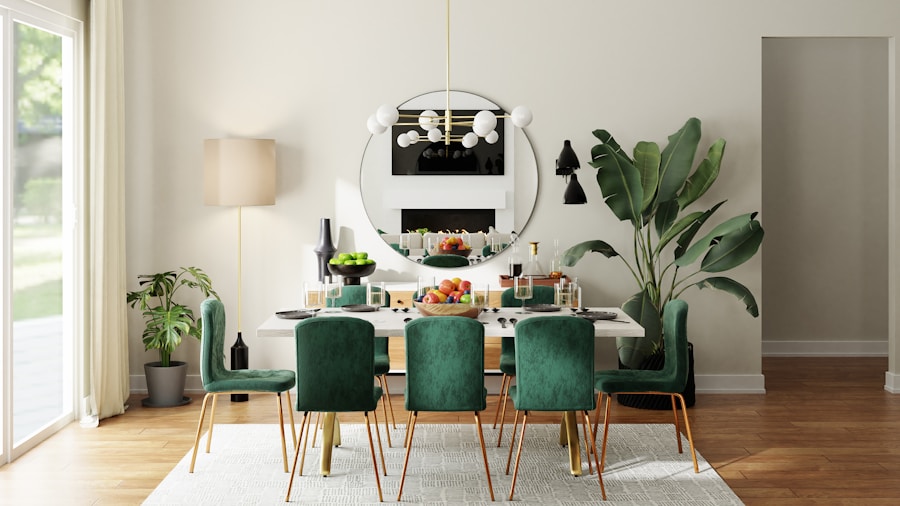
The “New Chinese” aesthetic retains traditional proportional logic while embracing modern material palettes and streamlined silhouettes.
Classic Styles of Chinese Dining Tables
Ming and Qing-Inspired Forms
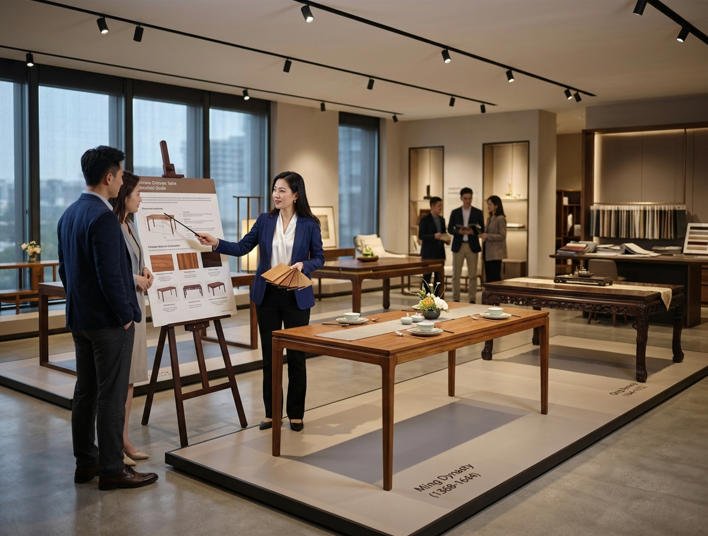
Ming dynasty tables (1368–1644) are characterized by what Sotheby’s describes as “advanced engineering combined with minimalist aesthetic” — simple lines and curves that favor grace over extravagance. The defining Ming dining table is the recessed-leg table (缩腿桌) with a floating panel top, horse-hoof feet, and a gently curved apron. Heights typically range from 32–34 inches — slightly taller than the Western standard of 29–30 inches — because traditional Chinese dining involved higher seating positions on armchairs.
Qing dynasty tables (1644–1912) shifted toward visual density. Carving became more elaborate — relief dragons, cloud scrolls, peony motifs — and table dimensions grew larger to accommodate the Qing court’s preference for grand entertaining. As the Gauche Expert cultural analysis notes, Qing furniture also absorbed European Rococo influences during the Kangxi and Qianlong reigns, creating hybrid styles with curved cabriole legs and gilt accents that have no precedent in Ming design.
For contemporary buyers, the key distinction is this: Ming-inspired tables suit modern interiors because their clean geometry integrates with current design trends without competing; Qing-inspired tables are statement pieces that demand a room scaled and decorated to match their visual intensity.
Continental and Lattice-Top Variations
Beyond the mainstream Ming-Qing continuum, Chinese dining tables include several regional and functional variations that buyers encounter in specialty markets. Continental-style Chinese tables (often from Shanghai’s treaty-port era, 1840s–1940s) blend Western table geometry — straight legs, rectangular tops, center-pedestal bases — with Chinese materials and joinery. These are the most accessible entry point for Western buyers who want Chinese craftsmanship without a distinctly Asian aesthetic.
Lattice-top tables, derived from the traditional kang table (a low platform table used on heated brick beds), use interlocking geometric patterns — ice-ray, broken-ice, or hexagonal lattice — as both structural and decorative elements. These are typically console or side tables rather than primary dining surfaces, but contemporary designers have adapted the lattice motif to dining-table aprons and stretchers as a visual signature.
Historic Motifs and Ornamentation Considerations
Ornamentation on Chinese dining tables serves a symbolic vocabulary that informed buyers can read. The bat motif (蝠, fú) is a homophone for fortune (福, fú) and appears on Qing-era table aprons. Cloud scrolls represent heaven and auspiciousness. Lingzhi mushroom carvings symbolize longevity. For buyers selecting antique or reproduction pieces, understanding these motifs transforms the table from a generic “carved Chinese table” into a specific cultural statement — and helps verify authenticity, since poorly researched reproductions often combine motifs from different dynasties or regions that would never appear together on a genuine piece. Evefurn’s joinery dating guide provides a practical framework for reading these visual cues.
Contemporary and Minimalist Options
Clean Lines, Solid Color Palettes, and Reduced Silhouettes
Contemporary Chinese dining tables produced for the global market in 2025–2026 share a clear design grammar: tabletop slabs with minimal overhang (1–2 inches rather than the traditional 3–4 inches), squared or softly radiused edges, matte or satin finishes rather than high-gloss lacquer, and base structures that appear to support the top with minimal visual mass. Color palettes center on natural wood tones — warm ash, honey walnut, smoked oak — with occasional contrast from black metal legs or white marble insets.
This movement is driven by data, not just taste. A 2025 consumer survey by Provoke Insights (1,500 American consumers) found that 67% of buyers aged 25–44 rated “clean, simple design” as the most important aesthetic criterion for dining furniture — ahead of “traditional craftsmanship” (18%) and “ornate detailing” (8%). The New Chinese movement aligns precisely with this preference, which explains its accelerating export growth.
Multi-Functional Designs for Small Spaces
In cities like Shanghai, Hong Kong, Singapore, and increasingly London and New York, dining rooms average 80–120 square feet — far below the 150–200 square feet that a standard 72-inch rectangular table demands. Chinese manufacturers, responding to domestic demand from compact urban apartments, have developed the most diverse range of space-saving dining table formats in the global market: drop-leaf mechanisms that collapse a 54-inch table to 28-inch console width, butterfly-leaf extensions that add 18 inches of length without separate storage, and pedestal bases that maximize seating flexibility around round tops.
Jade Ant furniture’s compact dining table guide documents specific configurations tested in sub-100-square-foot rooms, demonstrating how a 48-inch round table on a pedestal base seats four daily while consuming 9 fewer square feet than a comparable rectangular setup — a margin that translates directly into walkable floor space in tight apartments.
Materials to Consider and Their Pros/Cons
Hardwood Options (Rosewood, Elm, Teak) and Durability
Material selection is the highest-impact decision in the entire buying process because it simultaneously determines the table’s appearance, tactile quality, structural lifespan, maintenance requirements, and resale value. The table below presents the most common Chinese dining table materials with measurable performance data.
| Material | Janka Hardness (lbf) | Scratch Resistance | Water / Heat Resistance | Refinishable | Price Range (6-seat table) | Expected Lifespan |
|---|---|---|---|---|---|---|
| Rosewood (Huali/Hongmu) | 1,780–2,440 | Excellent | High | Yes (5+ times) | $2,500–$15,000+ | 50–100+ years |
| Teak | 1,070 | High | Excellent (natural oils) | Yes (5+ times) | $1,800–$5,000 | 40–80 years |
| White Oak | 1,360 | High | High | Yes (5–8 times) | $800–$2,500 | 30–60 years |
| North American Ash | 1,320 | High | Medium–High | Yes (5–8 times) | $600–$1,800 | 25–50 years |
| Black Walnut | 1,010 | Medium–High | Medium–High | Yes (5–8 times) | $900–$3,000 | 30–60 years |
| Chinese Elm | 830 | Medium | Medium | Yes (unlimited w/ oil) | $400–$1,200 | 20–40 years |
| Rubberwood | 960 | Medium | Medium | Yes (2–3 times) | $250–$700 | 10–20 years |
| Marble Top + Wood/Metal Base | N/A (Mohs 3–5) | Low (porous) | Low (etches/stains) | Professional reseal | $1,000–$4,000 | 15–30 years (surface) |
Rosewood (花梨木, huālí mù) and its premium variant Huanghuali (黄花梨) represent the pinnacle of Chinese furniture materials. A Huanghuali dining table from the Ming dynasty recently sold at Christie’s for over $1.2 million — but even contemporary rosewood tables hold value because the raw material is increasingly scarce and regulated under CITES Appendix II. For buyers seeking heritage authenticity with functional daily use, rosewood offers unmatched hardness (the highest Janka ratings of any furniture wood), natural resistance to insects and moisture, and a grain pattern that deepens in beauty over decades.
For most contemporary buyers, however, ash and walnut offer the optimal balance. Ash delivers near-oak hardness (1,320 lbf) at a lower price point, accepts both natural and stained finishes beautifully, and is the default species for New Chinese furniture. Walnut commands a premium for its chocolate-to-espresso tones and is the preferred species for buyers who want the table to serve as the room’s visual anchor. Both species, when paired with catalyzed lacquer finishes, provide surfaces that handle daily family meals — including children’s crayon incidents and red wine spills — with minimal maintenance for 2–3 years between professional treatments.
Veneers, Plywood, and Engineered Surfaces
Veneer-on-engineered-core construction is not a compromise — it is an engineering decision. A 0.6–1.0mm walnut veneer bonded to high-density MDF or multi-layer plywood creates a tabletop that is dimensionally more stable than solid walnut (less seasonal expansion/contraction), lighter in weight (easier to move in small apartments), and 40–60% less expensive — while presenting an identical surface appearance. The trade-off is refinishability: solid wood can be sanded and refinished 5–8 times over its lifetime, while veneer can tolerate only one light sanding before the core is exposed.
For buyers who plan to keep a table for 10+ years in a climate with significant humidity variation (more than 30% RH swing between seasons), solid wood’s refinishability advantage becomes meaningful. For buyers in climate-controlled environments, or those who expect to replace the table within 7–10 years, quality veneer delivers equivalent daily performance at substantially lower cost.
Sustainable and Low-Maintenance Choices
Bamboo — technically a grass, not a wood — has emerged as the most credible sustainable alternative for Chinese dining tables. Bamboo reaches harvest maturity in 3–5 years versus 25–80 years for hardwood timber, and strand-woven bamboo (compressed bamboo fibers) achieves a Janka hardness of 3,000+ lbf — harder than any commercial hardwood. Chinese manufacturers in Anji, Zhejiang (the world’s bamboo capital) produce strand-woven bamboo dining tables with visual warmth comparable to light oak and durability exceeding teak. FSC-certified bamboo furniture addresses both the performance and environmental criteria that an increasing number of commercial and residential buyers require, as noted in the FSC China Green Furniture initiative.
Sizing Your Table for Space and Seating
Calculating Room Clearance and Chair Footprint
Before considering table aesthetics, establish the maximum table dimensions your room can physically accommodate. The formula is straightforward: room dimension minus clearance on each side equals maximum table dimension. The standard clearance — per architectural planning references like Home Stratosphere’s dining dimension guide — is 36 inches from the table edge to the nearest wall or obstruction. This 36 inches breaks down into approximately 20 inches for a pushed-back chair plus 16 inches of walkway behind the seated diner.
In a dining room measuring 12 feet × 10 feet (144 × 120 inches), subtracting 36 inches on each side of the width yields a maximum table width of 48 inches; subtracting 36 inches on each side of the length yields a maximum table length of 72 inches. That defines the boundary for a 6-seat rectangular table. If one side sits against a wall (using a bench), the clearance on that side drops to 18 inches (bench depth only), expanding the usable table width to 66 inches — enough for an 8-seat configuration.
Recommended Seating Formulas for 4, 6, 8, and 10+ Guests
The industry standard is 24 inches of table-edge length per seated person, with chairs requiring 26 inches of center-to-center spacing for comfortable elbow room. The table below translates this into specific dimensions for each seating count and shape.
| Seating Capacity | Rectangular (L × W) | Round (Diameter) | Oval (L × W) | Min. Room Size (with 36″ clearance) |
|---|---|---|---|---|
| 4 persons | 48″ × 30–36″ | 42–48″ | 54″ × 36″ | 10′ × 8.5′ |
| 6 persons | 60–72″ × 36–40″ | 54–60″ | 72″ × 42″ | 12′ × 10′ |
| 8 persons | 84–96″ × 36–42″ | 60–72″ | 84″ × 44″ | 14′ × 11′ |
| 10+ persons | 108–120″ × 42–48″ | 72″+ (or lazy susan) | 108″ × 48″ | 16′ × 12′ |
For Chinese round tables, which are traditionally equipped with a built-in lazy susan (旋转托盘), the diameter can be smaller than Western equivalents because diners share dishes from the center rather than receiving individual plated courses. A 54-inch round Chinese table with a lazy susan comfortably serves 8 diners at a family-style meal — a configuration that would feel crowded at a Western place-setting table of the same diameter.
Floor Area Consumed by Table Configuration (Including Pushed-Back Chairs)
72″ Rectangular
68 sq ft
60″ Round
55 sq ft
72″ Oval
61 sq ft
48″ Square
50 sq ft
60″ Rect + Wall Bench
42 sq ft
All configurations seat 6 persons | Area includes 36″ clearance on open sides, 18″ on wall/bench side
Source: Compiled from architectural clearance standards and manufacturer dimension data
Shape and Layout: Round, Rectangular, and Extendable
When to Choose Round vs. Rectangular
The decision between round and rectangular is not aesthetic preference — it is a spatial engineering question with a definitive answer for each room configuration. Round tables are more space-efficient in square or near-square rooms (aspect ratio under 1.3:1) because they eliminate corner dead zones and allow flexible chair placement around the full perimeter. Swyft Home’s shape comparison confirms that round tables also create better conversational dynamics — every seat faces every other seat at roughly equal distance, eliminating the “shouting down the table” problem that rectangular tables create at 8+ seats.
Rectangular tables win in elongated rooms (aspect ratio above 1.5:1) and for households that regularly seat more than 6. The linear layout accommodates extension leaves, aligns with room geometry, and creates a clear visual axis that anchors the space. For formal entertaining, the rectangular format establishes a natural host position at each end — a social dynamic that round tables deliberately eliminate.
In Chinese dining culture, the choice carries additional weight. Round tables are the traditional format for family meals and celebrations (particularly for Lunar New Year gatherings and wedding banquets), while rectangular tables are associated with everyday meals and business dining. Buyers sourcing for Chinese restaurants or banquet facilities should note that round tables with lazy susans remain the overwhelmingly preferred format — 78% of Chinese restaurant dining tables are round, according to China Hospitality Association data.
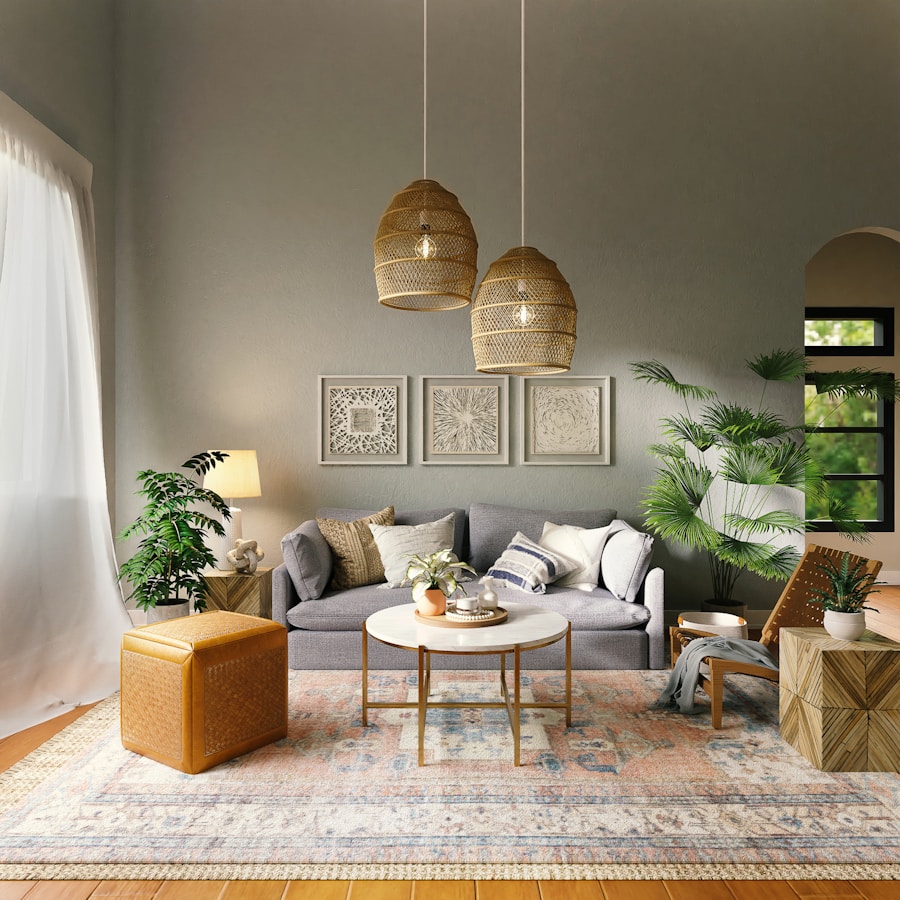
The round dining table — a format deeply embedded in Chinese cultural tradition — seats 8 comfortably in the same floor area a rectangular table needs for 6.
Extendable Leaves and Mechanism Types
Extendable tables solve the fundamental small-room dilemma: daily meals need 4 seats, but holiday gatherings need 8. The four primary extension mechanisms each serve different use patterns.
| Extension Type | Collapsed Size | Extended Size | Storage Required | Stability Extended | Best For |
|---|---|---|---|---|---|
| Drop-leaf (gate-leg) | 24–30″ wide | 42–54″ wide | None — leaves attach | Medium | Studios, daily 2→4 person |
| Butterfly (self-storing) | 48–60″ long | 66–78″ long | None — leaf folds inside | High | Compact 4→6 seating |
| Drop-in (removable) leaf | 48–60″ long | 72–96″ long | Closet or under-bed | Very high | Annual gatherings |
| Sliding pull-out panel | 42–54″ long | 60–72″ long | None — panel slides under | Medium–High | Quick-extend small apartments |
Chinese manufacturers — including those in the Foshan furniture manufacturing cluster profiled by Jade Ant — produce butterfly-leaf mechanisms in both domestic and export specifications. For long-term reliability, specify metal slide rails (not wood-on-wood glides) and ensure the extension leaf is milled from the same timber batch as the main top to guarantee grain and color matching as both surfaces age.
Features to Look For: Leaves, Storage, and Comfort
Playful vs. Practical Features (Hidden Leaves, Built-In Storage)
Beyond the extension mechanism itself, premium Chinese dining tables increasingly integrate functional features that address real lifestyle needs. Built-in lazy susans (standard on Chinese round tables above 48 inches) eliminate the need for diners to pass dishes hand-to-hand — a practical advantage for tables seating 6+ where the table center is beyond comfortable arm’s reach. Under-table drawers (12–16 inches wide, 3–4 inches deep) store placemats, napkin rings, candles, and charging cables — eliminating a sideboard in rooms where floor space is at a premium.
Some contemporary designs incorporate hidden wireless charging pads beneath the tabletop surface, accessible through a thin veneer or stone layer. Others include temperature-controlled sections (similar to wine-fridge technology) built into the table base for keeping dishes warm during long family meals — a feature that originated in the Korean “warming table” tradition and has been adopted by Chinese manufacturers targeting the premium domestic market.
Edge Profiles and Comfort Tips for Long Meals
Edge profile selection matters more than most buyers realize — especially for tables where meals regularly exceed 60 minutes. As Mertson Home’s edge profile analysis explains, the five common profiles each serve different comfort and aesthetic functions. An eased edge (slightly rounded sharp corners) is the minimalist default — clean-looking but potentially uncomfortable for forearms resting during long meals. A bullnose edge (fully rounded) provides the most comfortable forearm rest and is the safest option for households with children. A beveled edge (angled cut) splits the difference between visual sharpness and physical comfort. A live edge (natural tree bark contour) makes a bold aesthetic statement but varies in comfort by the specific bark profile.
For dining tables where 2+ hour meals are common — particularly important for Chinese dining culture, where family meals and banquet-style gatherings routinely extend to 90–120 minutes — the bullnose or soft-radiused edge reduces forearm pressure by distributing weight across a curved surface rather than concentrating it on a sharp line. This is not theoretical: a 2024 ergonomic study by the China National Furniture Testing Center found that diners at tables with radiused edges (≥8mm radius) reported 34% less forearm discomfort after 90-minute seated meals compared to diners at sharp-edge tables.
Care, Maintenance, and Longevity
Cleaning Regimes by Material
Every material demands a different maintenance protocol. Using the wrong cleaning agent on the wrong surface is the single fastest way to degrade a dining table’s finish — and the damage is often irreversible. The care calendar below specifies the correct routine for each common Chinese dining table material.
| Material | Daily Cleaning | Weekly Deep Clean | Quarterly Treatment | Annual Service | Avoid |
|---|---|---|---|---|---|
| Lacquered Hardwood | Damp microfiber, dry immediately | pH-neutral wood cleaner (1:20 dilution) | Carnauba wax paste | Professional inspection for chips | Ammonia, bleach, abrasive pads |
| Oil-Finished Hardwood | Dry soft cloth | Damp cloth with mild soap | Tung oil or Danish oil recoat | Light sand + full oil treatment | Silicone-based polishes, water pooling |
| Rosewood (Natural) | Soft dry cloth only | Slightly damp cloth, dry immediately | Beeswax polish (thin coat) | Professional repolish if dulled | Water, chemical cleaners, direct sun |
| Marble Top | Damp cloth, dry immediately | Stone-specific pH-neutral cleaner | Professional sealant application | Professional polishing if etched | Vinegar, citrus, wine left standing |
| Veneer + Lacquer | Damp microfiber, dry immediately | pH-neutral cleaner spray | Light wax (no oil — penetrates seams) | Inspect seam edges for lifting | Excess water, heat, abrasive scrubbing |
Protecting Finishes from Heat, Moisture, and Sun
Three environmental factors degrade dining table surfaces more than any amount of normal use: sustained heat (hot dishes placed directly on the surface), standing moisture (wet glasses, pooled spills), and UV exposure (direct sunlight through windows). Cavalier Antiques’ rosewood care guide recommends eliminating dust with a soft, dry cloth and treating spills within seconds — sound advice that applies across all wood types.
For rosewood tables specifically, maintaining indoor humidity between 40–60% RH is critical. Rosewood is exceptionally dense, which makes it resistant to most damage but also slow to equilibrate with environmental changes — sudden humidity drops (common when winter heating begins) can cause hairline cracks that run along the grain. A room humidifier during heating season is the single most protective measure a rosewood table owner can implement, typically costing $30–$80 and preventing damage worth thousands in restoration.
Budgeting and Where to Shop
Allocating Budget Across Style, Material, and Mechanisms
Budget allocation follows a clear hierarchy when the goal is long-term satisfaction rather than short-term savings. The table’s material and construction account for the most significant quality variation — a $600 solid ash table and a $300 rubberwood table look similar in photographs but perform entirely differently after 3 years of family meals. Extension mechanisms add $100–$400 to the base price depending on complexity (drop-leaf on the low end, self-storing butterfly on the high end). Premium finishes (catalyzed lacquer vs. basic polyurethane) add $50–$150 — a trivial premium for a surface treatment that reduces maintenance frequency by 60% and extends the time between professional refinishing from 3 years to 7+.
Recommended Budget Allocation for a Chinese Dining Table Purchase
Materials — 40%
Construction — 22%
Finish — 15%
Extension — 13%
Delivery — 10%
Source: Compiled from manufacturer cost breakdowns and industry pricing data, 2025–2026
Tips for Evaluating Quality and Warranties
A meaningful dining table warranty covers the tabletop surface against warping and delamination for at least 5 years, the base structure for 10+ years, and extension mechanisms for 3+ years. Tables sold without any warranty signal manufacturing shortcuts that typically surface as wobble, finish peeling, or joint separation within 18–24 months. When evaluating quality in person, apply two quick tests: press firmly on the table center with both hands and check for flex (properly constructed tables show zero deflection under 100 lbs of centered force), and lift one corner 1 inch off the ground while watching the opposite corner for racking or joint gaps.
For buyers sourcing directly from Chinese manufacturers — whether through Jade Ant furniture’s dining table range or other verified producers — request a production sample ($50–$300) before committing to bulk orders. The sample should be built on the same line, with the same materials, by the same workers who will produce the final order. A factory that refuses sample production is a factory that cannot guarantee consistency.
How to Plan Your Dining Room to Complement the Table
Harmonizing with Chairs, Lighting, and Cabinetry
The dining table sets the room’s visual and physical center — every other element should relate to it rather than compete. Homes & Gardens’ 2026 dining room trend report identifies “the table as hero piece” as a defining direction: statement lighting that draws the eye downward toward the table surface, chairs that complement rather than match the table’s material, and cabinetry that recedes into the background.
For Chinese dining tables specifically, chair pairing follows a cultural logic. A Ming-style table pairs naturally with horseshoe-back (圈椅) or yokeback (官帽椅) chairs. A New Chinese table accepts both Chinese-style chairs and Scandinavian-influenced designs (the shared minimalist DNA makes them visually compatible). A Qing-style ornate table demands equally substantial chairs — lightweight modern seats beneath a heavily carved table create a visual imbalance that reads as incomplete furnishing rather than intentional contrast.
Pendant lighting should hang 30–36 inches above the table surface and span approximately half to two-thirds the table’s width. Warm-white light (2,700–3,000K) enhances wood grain warmth and makes food look more inviting — as the Homemakers 2026 dining trends analysis confirms, warm dimmable lighting is the single most impactful element for shifting dining room atmosphere from daytime casual to evening elegance.
Color Schemes, Textures, and Decorative Accents
The 2026 dining room palette trends — warm earthy tones (chocolate, terracotta, ochre, smoky jade), layered textures, and old-world craft references — align exceptionally well with Chinese dining tables. A walnut table grounds a room with deep warmth; pair it with linen-upholstered chairs in sage or cream, a wool-blend table runner, and ceramic serving pieces that echo the wood’s warm undertones. An ash table opens the room with light; pair it with natural rattan or light leather chairs, cotton placemats, and glass or light stone accessories.
Wall color should sit 2–3 tones lighter than the table on the warm-cool spectrum to create depth without heaviness. In rooms under 150 square feet, coordinated dining room sets from Jade Ant furniture — where the table, chairs, and occasional buffet are designed as a unified collection — eliminate the color-matching challenge entirely and ensure visual cohesion in tight spaces where every piece is visible simultaneously.
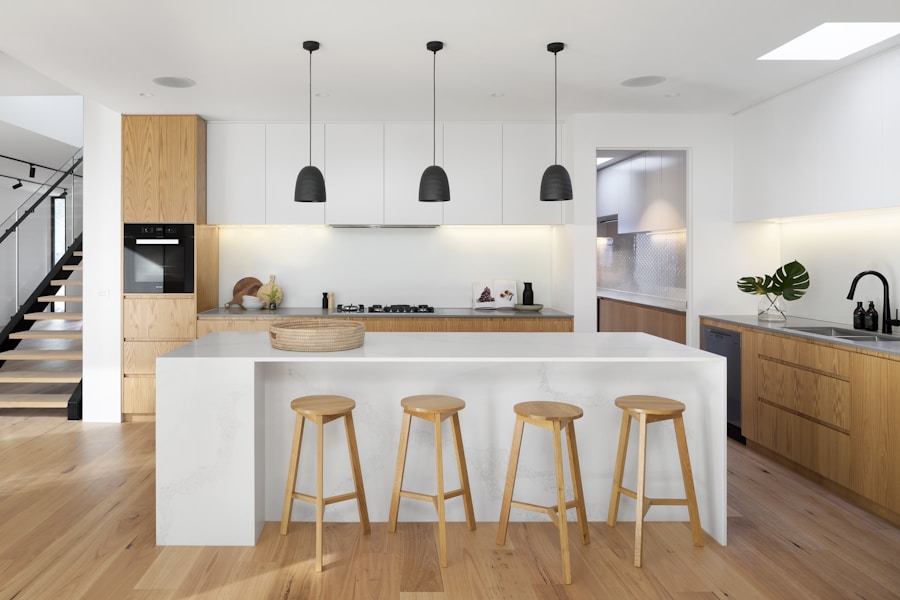
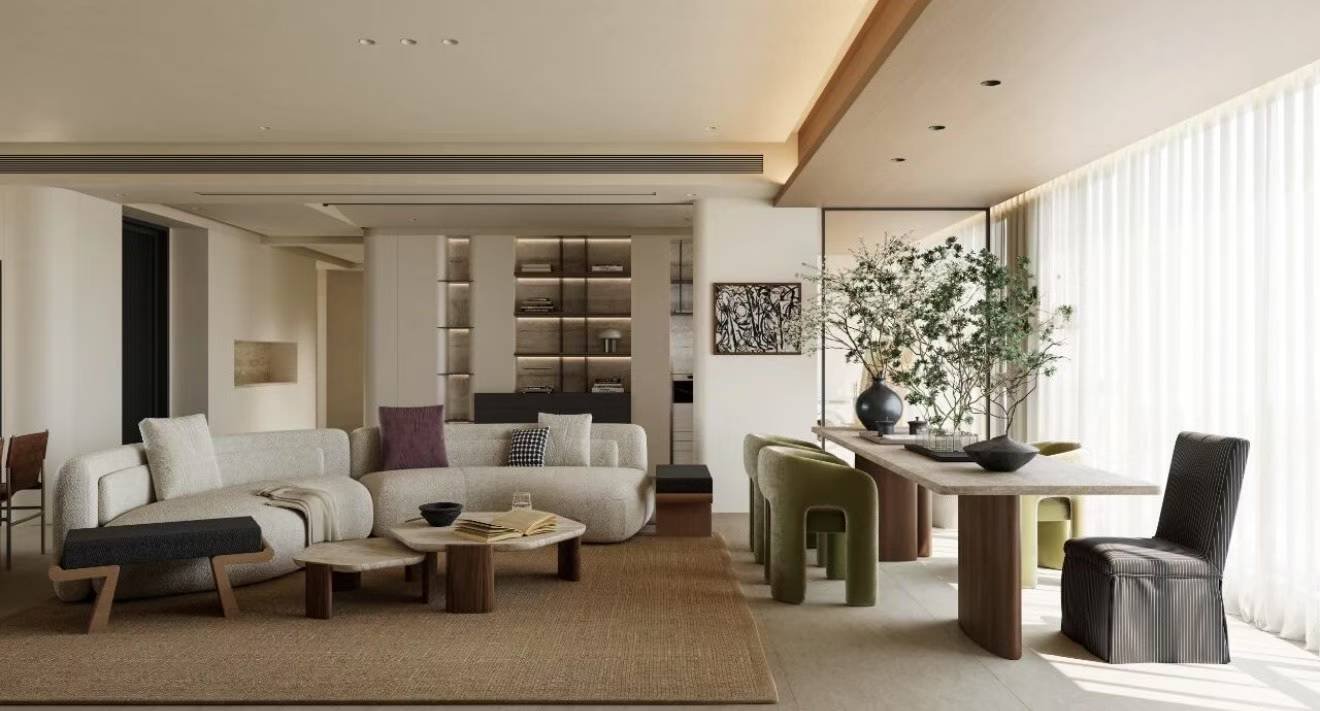
A well-coordinated dining room where table material, chair tone, lighting warmth, and wall color create a unified atmosphere.
Video: Understanding Chinese Furniture Craftsmanship and Design
This 4K video showcases the craftsmanship behind rosewood dining sets — from material selection through traditional joinery to finished installation.
Selecting a Chinese dining table reduces to a sequence of practical decisions, each building on the last. Start with style intent: do you want the historical resonance of Ming minimalism, the ornamental presence of Qing carving, or the contemporary balance of New Chinese design? Then assess materials against your household’s actual usage patterns — a family with three children under 10 needs the scratch resistance of ash with catalyzed lacquer, not the aesthetic refinement of oil-finished rosewood. Size the table to your room’s measured dimensions using the clearance formulas and seating charts above, not to an aspirational guest count you’ll host twice a year. Choose the shape that your room geometry dictates — round for square rooms, narrow rectangular for elongated spaces, extendable for rooms that serve multiple functions. Verify edge comfort, test extension mechanisms under load, and establish a material-specific maintenance calendar before the table arrives.
Measure your room before you measure your taste. Bring a tape measure to every showroom visit. Compare dimensional data from multiple manufacturers — the specifications published by producers like Jade Ant furniture’s round dining table collection enable precise comparison without physical showroom visits. And if in doubt between two sizes, choose the smaller one. You will never regret having extra space around your dining table — but you will always regret having too little.
Frequently Asked Questions
1. What is the typical seating capacity for a 6-foot vs. 8-foot Chinese dining table?
A 6-foot (72-inch) rectangular table seats 6 persons comfortably (three per long side) or 8 if you add chairs at each end — though end seating is tight if the table has trestle or pedestal legs that restrict knee room. An 8-foot (96-inch) table seats 8 comfortably (four per long side) or 10 with end chairs. For Chinese round tables with lazy susans, a 60-inch diameter seats 8 for family-style dining; a 72-inch diameter seats 10–12 because shared dishes on the lazy susan reduce individual place-setting depth requirements compared to Western plated service.
2. Which materials are best for families with kids or heavy use?
Ash (Janka 1,320 lbf) with catalyzed lacquer finish is the optimal combination for households with children. It resists denting from dropped utensils, shrugs off crayon marks with a damp cloth, and handles daily meal spills without finish degradation for 2–3 years between professional treatments. White oak (1,360 lbf) is equally durable but typically 20–30% more expensive. Avoid oil-finished surfaces in heavy-use households — they require re-oiling every 3–6 months and show water rings immediately. Marble tops, while beautiful, etch permanently from citrus juice and require constant vigilance around children.
3. How do I preserve the color and finish of traditional rosewood tables?
Rosewood preservation centers on three practices: maintain indoor humidity between 40–60% RH year-round (use a humidifier during heating season), dust with a soft dry cloth only (never use water or chemical cleaners on unfinished rosewood), and apply a thin coat of beeswax polish quarterly to nourish the wood and maintain luster. Keep rosewood tables out of direct sunlight — UV exposure fades the distinctive reddish-brown tones to a flat grey over 2–3 years. For lacquered rosewood, follow standard lacquer care (damp microfiber, pH-neutral cleaner) and reapply carnauba wax every 3–4 months. Da Grains’ 20-tip rosewood care guide provides a comprehensive maintenance framework.
4. Is a round or rectangular table better for a 10 × 12-foot dining room?
A 10 × 12-foot room (120 square feet) with 36-inch clearance on all sides supports a maximum rectangular table of 48 × 72 inches (6-seat) or a maximum round table of 48-inch diameter (4–5 seats). The rectangular format seats more people in this room geometry because the elongated room shape aligns with the table’s length. However, if you use a wall bench on one long side (reducing clearance to 18 inches), a 54-inch round table becomes viable and seats 6 for family-style Chinese dining — the more space-efficient option if your room’s aspect ratio allows centered placement.
5. How do I know if an extension mechanism will last?
Three indicators predict extension mechanism longevity: material (metal slide rails outlast wood-on-wood glides by 3–5×), precision (the leaf should drop flush with the main surface with zero lip — any step indicates rail misalignment that will worsen), and support (each leaf bracket should extend at least two-thirds the leaf’s depth, not half). Test by extending the leaf and pressing 30–40 lbs of downward force on the tip — it should show no deflection. Budget drop-leaf models with short brackets develop wobble within 2–3 years; quality butterfly-leaf mechanisms with metal rails operate smoothly for 15+ years of regular use.
6. What edge profile is safest for households with young children?
A full bullnose edge (completely rounded) is the safest profile — it eliminates all sharp corners and reduces impact injury risk. An eased edge (slightly rounded corners) offers a cleaner aesthetic but retains enough edge definition to cause bruising from forceful contact. For families with toddlers, avoid live-edge, sharp bevel, and waterfall profiles entirely. If you prefer the aesthetic of a sharper edge, aftermarket silicone edge protectors ($8–$15) can be applied temporarily during the child-proofing years and removed later without damaging the finish.
7. Can I mix a Chinese dining table with Western-style chairs?
Absolutely — and it is one of the most effective design strategies for creating a contemporary dining room. New Chinese tables share proportional DNA with Scandinavian and mid-century modern furniture (Hans Wegner’s “China Chair” was directly inspired by Ming horseshoe chairs), so pairing a Chinese ash or walnut table with Wegner-style, Eames-style, or contemporary upholstered chairs creates intentional cross-cultural dialogue. The key is tonal coordination: keep wood tones within two shades of each other, or create deliberate contrast (dark walnut table + light oak chairs) rather than accidental near-matches that look like color-matching mistakes.
8. How much should I budget for a quality Chinese dining table?
Budget tiers break down as follows: $250–$700 for rubberwood or budget hardwood with basic finishes (functional, 10–15 year lifespan); $700–$2,000 for solid ash, oak, or walnut with catalyzed lacquer, quality joinery, and optional extension mechanisms (the sweet spot for most households, 25–40 year lifespan); $2,000–$5,000 for premium teak, select walnut, or rosewood with artisan-level construction; and $5,000+ for heritage rosewood, Huanghuali, or fully custom designs. When sourcing directly from Chinese manufacturers like Jade Ant furniture, wholesale pricing typically runs 25–40% below equivalent retail, with MOQs as low as 1 piece for custom orders.
9. What is the minimum room size needed for a 6-person dining table?
With 36-inch clearance on all four sides, a 6-person rectangular table (60–72″ × 36–40″) requires a room measuring at least 12 × 10 feet (120 square feet). A 6-person round table (54–60″ diameter) needs at least 11 × 11 feet (121 square feet) — nearly identical in total area but requiring a squarer room shape. Using a wall bench on one side reduces the minimum to approximately 10 × 10 feet (100 square feet) for either shape, making 6-person dining viable in rooms that would otherwise max out at 4.
10. Where can I find Chinese dining tables with precise dimensions published for small rooms?
Chinese manufacturers in production hubs like Foshan and Anji produce the widest global range of compact-format dining tables — including 42–48-inch rounds, narrow 28–32-inch-wide rectangulars, and console-to-dining convertibles. Jade Ant furniture’s marble dining table page and stainless steel dining set collection publish full dimensional specifications (length, width, height, apron clearance, leg spread). For direct-from-factory ordering, MOQs start at 1–10 pieces depending on the manufacturer, making this route accessible for designers, small retailers, hospitality projects, and individual homeowners seeking exact-fit dimensions.