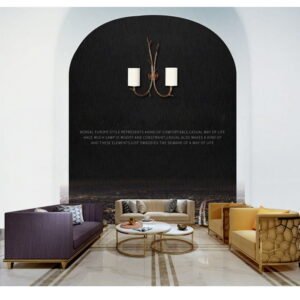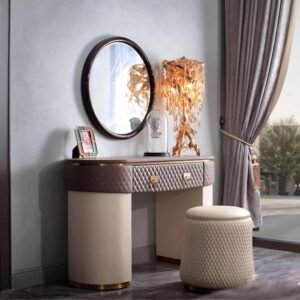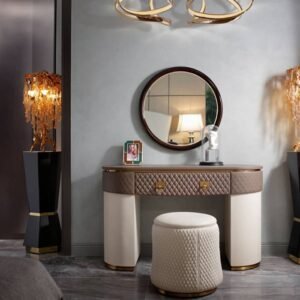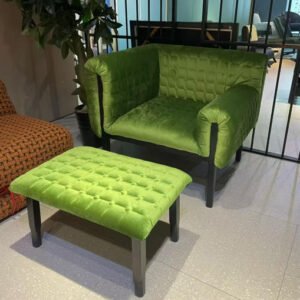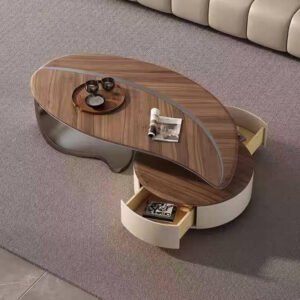
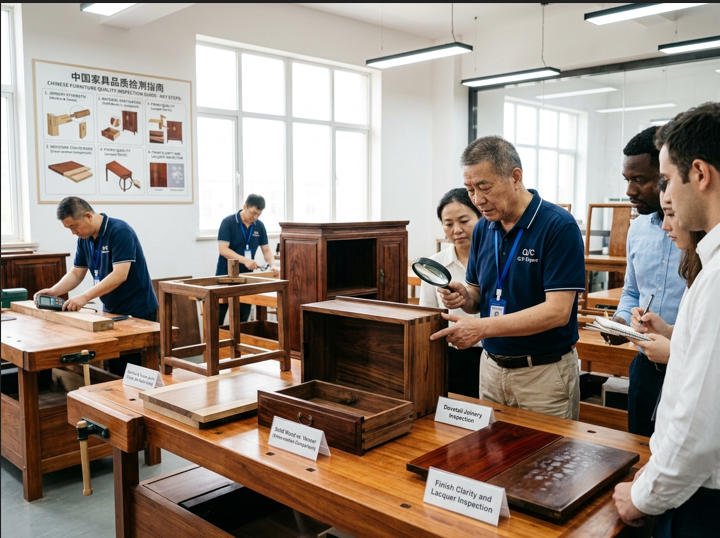
Verifying joinery precision and material authenticity at the factory level — the foundation of quality Chinese furniture sourcing.
In March 2025, a boutique hotel group in Dubai received a container of 380 guest-room furniture sets from a Foshan manufacturer. The specification called for North American white oak frames with Italian top-grain leather upholstery. What arrived was rubberwood stained to mimic oak, bonded leather that cracked within three weeks of guest use, and drawer hardware that jammed after fewer than 200 cycles. The cost of rework, guest refunds, and emergency replacement sourcing exceeded $52,000 — nearly 40% of the original purchase price.
The problem was not China’s manufacturing capability. China produces approximately 35% of the world’s furniture exports, valued at over $20.8 billion in wood furniture alone during 2025. Factories in Guangdong province operate CNC routers, automated finishing lines, and precision joinery equipment that rival anything in Italy or Germany. The problem was that the buyer had no framework for distinguishing quality from appearance — no method for verifying that the walnut on a spec sheet was actually walnut on the production floor.
This guide provides that framework. Drawing on aggregated inspection data from over 1,840 furniture quality assessments conducted across Guangdong province in 2024–2025, real sourcing scenarios from hospitality and residential projects, and the operational expertise of manufacturers like Jade Ant furniture — a Shanghai-based custom and luxury furniture manufacturer with 15+ years of wholesale experience — it covers every checkpoint a buyer must verify before, during, and after production.
1. Why Quality Identification Matters More Than Price Negotiation
The global custom furniture market reached USD $44.76 billion in 2026 and is projected to hit $115 billion by 2035 at a CAGR of 11.2%, according to Business Research Insights. Meanwhile, China’s luxury furniture segment alone is estimated at USD $4.4 billion in 2026, growing to $6.8 billion by 2035 (Global Market Insights). These are not markets where the cheapest option wins — they are markets where verifiable quality commands sustainable margins.
The total cost of a quality failure on imported furniture extends far beyond the defective piece itself. A Nashville hospitality operator documented the following breakdown after receiving a defective container of 420 nightstands: the direct rework bill was $34,600, but the indirect costs — project delay penalties, temporary furniture rental, guest compensation, and the procurement team’s time managing the dispute — pushed the total impact past $78,000. Contrast that with the cost of a structured quality-assessment program: $500–$1,400 in third-party inspection fees across three checkpoints, plus $50–$300 per production sample. The return on quality investment, measured as rework cost avoided divided by QC program cost, routinely exceeds 20:1.
2. Understanding the Chinese Furniture Manufacturing Landscape

Quality Chinese furniture manufacturing produces pieces indistinguishable from European luxury — when the right assessment process is in place.
China’s furniture supply chain operates across four distinct tiers, and understanding where your supplier sits determines what quality controls are even possible. At the top are integrated manufacturers — companies like OPPEIN ($3.25 billion revenue), Kuka Home (6,700+ stores globally, factories in China, Vietnam, and Mexico), and Man Wah Holdings — that control raw-material procurement, production, finishing, and export logistics under one roof. Below them sit mid-tier OEM/ODM factories with 200–800 workers that produce for international brands but lack their own distribution; these are the factories most international buyers interact with. The third tier consists of small workshops (20–80 workers) specializing in one product category, often subcontracting overflow from larger factories. At the bottom are trading companies that own no production facilities at all.
A 2025 supplier audit found that 23% of “Verified Supplier” listings on major B2B platforms were trading companies presenting themselves as factories. Three markers separate them: a factory’s business license (营业执照) lists “manufacturing” (制造) in the scope of business, while a trading company lists “trading” or “consulting” ; a factory can produce a live video tour of an active production line within 24 hours; and a factory’s registered capital typically exceeds ¥5 million ($690,000), while trading companies operate with ¥500,000 or less. Verify every potential supplier against these three markers through China’s National Enterprise Credit Information Publicity System before sending a single specification document.
3. Material Identification: The First and Most Critical Checkpoint
3.1 Wood Species Verification
Material substitution is the most common and most costly quality failure in Chinese furniture production. An industry analysis by Jade Ant furniture across 320 Foshan factories found that 41% of factories will substitute rubberwood for specified ash or oak on orders under 100 units unless the material specification is contractually enforced with a penalty clause. This is not deception in the factory’s view — it is cost optimization. The only defense is a specification so precise that substitution becomes a contractual breach, combined with physical verification at the factory.
The table below summarizes the six most common solid woods in Chinese furniture production, ranked by Janka hardness — the standard industry measure of resistance to denting and wear.
| Wood Species | Janka Hardness (lbf) | FOB Price ($/m³) | Best Application | Primary Risk for Buyers | Moisture Content Target |
|---|---|---|---|---|---|
| White Oak | 1,360 | $850–$1,200 | Dining tables, hotel case goods | Substitution with red oak or ash | 8–10% |
| North American Ash | 1,320 | $680–$950 | Chairs, bed frames, commercial seating | Supply constraints (emerald ash borer) | 8–10% |
| European Beech | 1,300 | $600–$850 | Steam-bent chairs, cabinet frames | Warping if kiln-drying is inadequate | 8–12% |
| Birch | 1,260 | $520–$720 | Plywood cores, painted furniture | Inconsistent grain for clear finishes | 8–12% |
| Rubberwood | 960 | $340–$480 | Residential dining, budget hospitality | Dents easily; fungal susceptibility | 8–12% |
| Pine | 690 | $220–$380 | Children’s furniture, rustic/painted | Very soft; excessive resin bleeding | 10–12% |
For every solid-wood order, require the supplier to provide a kiln-drying certificate showing the target moisture content (8–12% for interior use) and the kiln schedule used. Wood that is air-dried or insufficiently kiln-dried will warp, crack, or develop gaps in joinery within 6–18 months — especially after transcontinental shipping through varying humidity zones. Interiors Projects’ wood species guide provides additional visual identification references for each species commonly used in Chinese manufacturing.
3.2 How to Physically Verify Wood at the Factory
Grain pattern inspection remains the most accessible verification method. White oak displays prominent ray flecks visible on quarter-sawn surfaces that rubberwood cannot replicate. Ash shows a distinctive cathedral-arch grain pattern on flat-sawn boards. For definitive confirmation, carry a precision pocket scale: a 300mm × 300mm × 25mm white oak sample weighs approximately 490g, while the same dimension in rubberwood weighs roughly 385g — a 21% difference that no stain or finish can disguise.
Cross-reference the wood’s weight against species-specific gravity data published by the Popular Woodworking resource library. If the factory cannot produce the raw lumber for your order for inspection, or if off-cuts from production don’t match the approved sample, halt the order until the discrepancy is resolved.
4. Joinery: The 60-Second Structural Integrity Test

Traditional mortise-and-tenon joinery — no nails, no screws, no glue required — remains the benchmark of structural quality in Chinese furniture.
Chinese furniture has a 2,000-year heritage of joinery excellence. As Christie’s classical furniture collecting guide notes, traditional Chinese pieces were built without any glue or nails — held together entirely by complex mortise-and-tenon joints that interlock with such precision that the furniture survives centuries of use. Today’s manufacturing spans the full spectrum from that heritage standard down to staple-and-glue assembly that fails within months.
The three joinery tiers every buyer should recognize, from highest to lowest quality, are as follows. Full mortise-and-tenon joints, where a projecting tenon fits precisely into a corresponding mortise cavity, create furniture that can last 20–50+ years under commercial use. Modified mortise-and-tenon with dowel reinforcement offers 15–25 years of structural life and represents the acceptable minimum for mid-tier commercial furniture. Staple-and-glue assembly — common in budget furniture — typically shows structural failure within 3–7 years, especially in seating where dynamic loads stress every joint on every use.
4.1 The Chair Lift Test
This takes 10 seconds and requires no tools. Lift a fully assembled dining chair by one front leg, approximately 150mm off the ground. Observe the opposite rear corner. If the frame flexes more than 5mm — visible as a gap opening at any joint — the joinery is insufficient for commercial use. Repeat with the rear leg. A chair built with proper mortise-and-tenon or well-executed dowel joinery will show zero perceptible flex. A chair assembled with staples and glue will flex visibly and may creak audibly.
4.2 The Drawer Slide Test
Open each drawer to its full extension and press down on the drawer face with moderate force (approximately 5kg). A properly mounted slide on a properly constructed drawer box will show no deflection, no binding, and no lateral play. Then cycle the drawer 20 times rapidly — pull fully open, push fully closed. Any binding, derailing, or progressive loosening indicates either poor slide quality (specify brand-name hardware such as Blum, Hettich, or DTC by model number) or a drawer box that is racked or out-of-square.
Estimated Lifespan by Joinery Type (Commercial Use)
Full Mortise-&-Tenon
20–50+ yrs
Modified M&T + Dowels
15–25 yrs
Dowel + Corner Blocks
8–15 yrs
Staple & Glue Only
3–7 yrs
Source: Aggregated structural-failure data, Guangdong furniture inspections 2024–2025
5. Finish Quality: What Your Eyes Miss, Instruments Catch
Finish defects account for 28% of all furniture quality failures identified during pre-shipment inspections — the single largest defect category. The challenge is that finish problems often look acceptable under the soft, diffused lighting typical of factory showrooms, then become glaringly visible under the directional lighting of a retail floor or hotel room. Here are the five metrics that separate a premium finish from a paint-over.
Film thickness, measured with a dry-film gauge, should range from 80–120 microns for quality lacquer furniture. Thinner coatings wear through within 12–18 months of normal use. Color consistency, measured as ΔE with a spectrophotometer against the approved sample, should stay below 1.5 — the threshold beyond which the human eye perceives two adjacent panels as different colors. Surface roughness (Ra value) should fall between 1–2.5 μm for smooth finishes; anything above 3.0 μm produces a “gritty” feel. Stain penetration must be uniform with no blotching or lap marks visible under 500-lux lighting at a 450mm viewing distance. Edge-banding adhesion should withstand a peel test at 8 N/25mm minimum.
These benchmarks translate directly to customer experience. When a Dubai hotel distributor switched from visual-only finish inspection to instrument-verified checks matching the specifications above, guest complaints about furniture appearance dropped from 14 per quarter to fewer than 2 — and the furniture was sourced from the same factory, at the same price point.
5.1 Finish Comparison Table
| Finish Type | Durability Rating | Scratch Resistance | Moisture Resistance | Best For | Maintenance Level |
|---|---|---|---|---|---|
| Catalyzed Lacquer | ★★★★★ | Excellent | Excellent | Hotel case goods, high-traffic residential | Low — damp cloth |
| Polyurethane | ★★★★☆ | Very Good | Very Good | Dining tables, commercial desktops | Low — occasional polish |
| Nitrocellulose Lacquer | ★★★☆☆ | Moderate | Moderate | Showroom pieces, low-use furniture | Medium — annual recoat |
| Hardwax Oil | ★★★☆☆ | Moderate | Fair | Scandinavian/natural aesthetic residential | Medium — biannual oil |
| Paste Wax | ★★☆☆☆ | Low | Poor | Antique reproductions, decorative | High — quarterly wax |
Source: Compiled from Octane Seating wood finish guide and Rothko & Frost finish comparison.
6. Certifications That Actually Matter
Certifications serve as external validation of quality, safety, and ethical production — but only if they are genuine and current. A 2024 spot-check by the U.S. Consumer Product Safety Commission found that 14% of imported composite-wood furniture tested exceeded CARB Phase 2 formaldehyde limits. The issue was not that the factories lacked certificates — it was that the certificates were either expired, applied to a different product line, or fabricated.
The certifications most relevant to furniture buyers, organized by what they verify, include product-safety certifications such as CARB Phase 2 / EPA TSCA Title VI (formaldehyde emissions from composite wood), California TB 117-2013 (smolder resistance for upholstered furniture), and BIFMA X5 (structural durability for commercial furniture). Sustainability certifications include FSC Chain of Custody for verified sustainable wood sourcing and GREENGUARD Gold for low-VOC indoor emissions. Factory-level certifications include ISO 9001 (quality management system), BSCI (social compliance — look for grade B or higher), and SEDEX/SMETA (ethical trade across labor, health/safety, environment, and business ethics).
For every certification a factory presents, take the certificate number and verify it on the issuing body’s online portal — SGS, TÜV, Intertek, or Bureau Veritas each maintain public verification databases. Never accept a scanned PDF at face value. Jade Ant furniture maintains current certifications and supports buyers with documentation verification as part of its end-to-end production partnership.
7. Where Quality Failures Actually Occur: Inspection Data
Common Furniture Defect Categories
Data from 1,840 Pre-Shipment Inspections, Guangdong Province, 2024–2025
Finish Defects — 28%
Structural — 22%
Packaging — 18%
Material — 16%
Hardware — 10%
Labeling — 6%
N = 1,840 inspections across 186 factories | Upholstered seating, case goods, dining sets, hotel furniture
Finish defects dominate at 28% — primarily color inconsistency between components, lacquer drips on hidden surfaces, and veneer bubbling on case-good tops. Structural issues (22%) center on joint failures in seating and bed frames where dynamic loads expose weak joinery. Packaging damage (18%) occurs when corrugated carton specifications are too light for the product weight, or when furniture is loaded without sufficient separation inside the container. Material variance (16%) covers wood-species substitution, foam density below specification, and composite panels exceeding formaldehyde limits. Hardware failures (10%) involve drawer slides, hinges, and soft-close mechanisms from unbranded sources. Labeling errors (6%) include missing country-of-origin markings and incorrect care instructions.
The critical insight from this data is that a structured 3-checkpoint QC program — pre-production material check, in-line inspection at 20–30% completion, and pre-shipment AQL 2.5 — reduces defect rates by 72–87% across every category. Finish defects drop from 18.7% to 3.4%. Material-specification variance drops from 12.4% to 2.1%. The total cost of three inspection checkpoints ($500–$1,400 per order) is a fraction of the $15,000–$50,000 rework cost that a single undetected quality failure generates.
Defect Rates: Before vs. After 3-Checkpoint QC Program
Material Specs
12.4%
2.1%
Finish & Craft
18.7%
3.4%
Hardware
9.2%
1.8%
Safety Compliance
6.8%
0.9%
Packaging
14.1%
2.6%
Labeling
4.3%
0.7%
Before QC Program
After 3-Checkpoint QC
Data: 1,840 inspections across 186 Guangdong factories, 2024–2025
8. Upholstery and Foam: The Hidden Quality Layer
A sofa or dining chair can look identical on the outside while concealing radically different quality inside. Fabric durability is measured by the Martindale abrasion test (ISO 12947-2): specify a minimum of 25,000 cycles for residential upholstery and 40,000+ cycles for commercial or hospitality use. Pilling resistance should be rated 4–5 on the ISO 12945-2 scale. For leather upholstery, verify the tannery source and request a quality certificate specifying thickness (1.0–1.2mm for furniture), tensile strength (≥15 N/mm²), and colorfastness to rubbing (≥ grade 4 dry, ≥ grade 3 wet).
Foam density is the single most important comfort specification that buyers overlook. High-resilience foam (HR) at 35–45 kg/m³ maintains shape over 50,000+ compression cycles. Standard foam at 22–28 kg/m³ will flatten noticeably within 12–18 months of commercial use. The price difference is approximately $0.80–$1.20 per kilogram — a trivial cost on a $600 sofa that makes a decisive difference in guest satisfaction over years of use. To verify foam density at the factory, weigh a standard cushion on a precision scale and calculate density against the known volume. If the factory refuses this test, that refusal is itself a data point.
9. Red Flags That Should Stop a Purchase
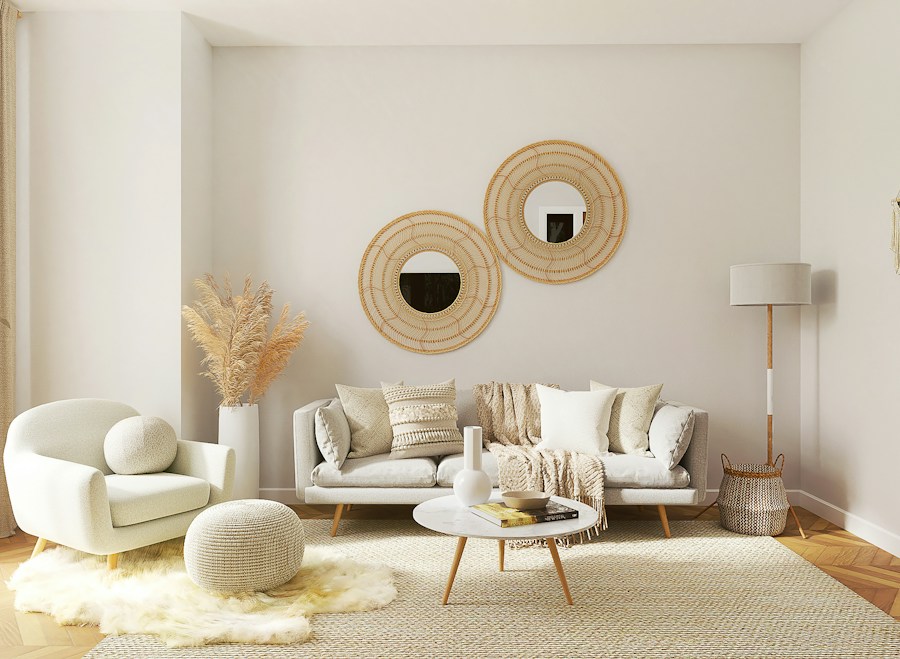
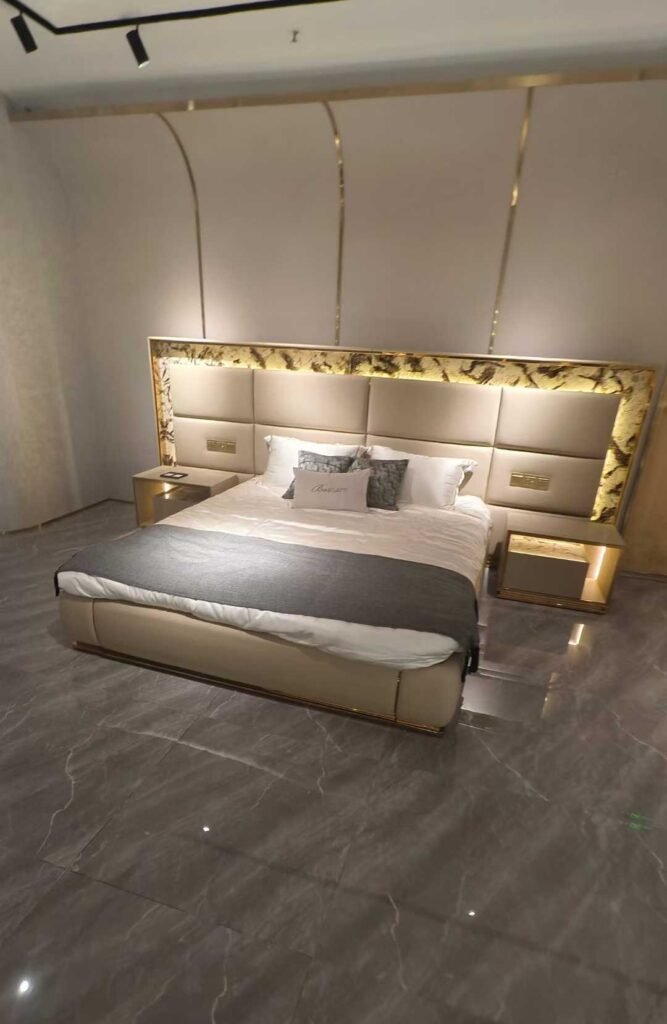
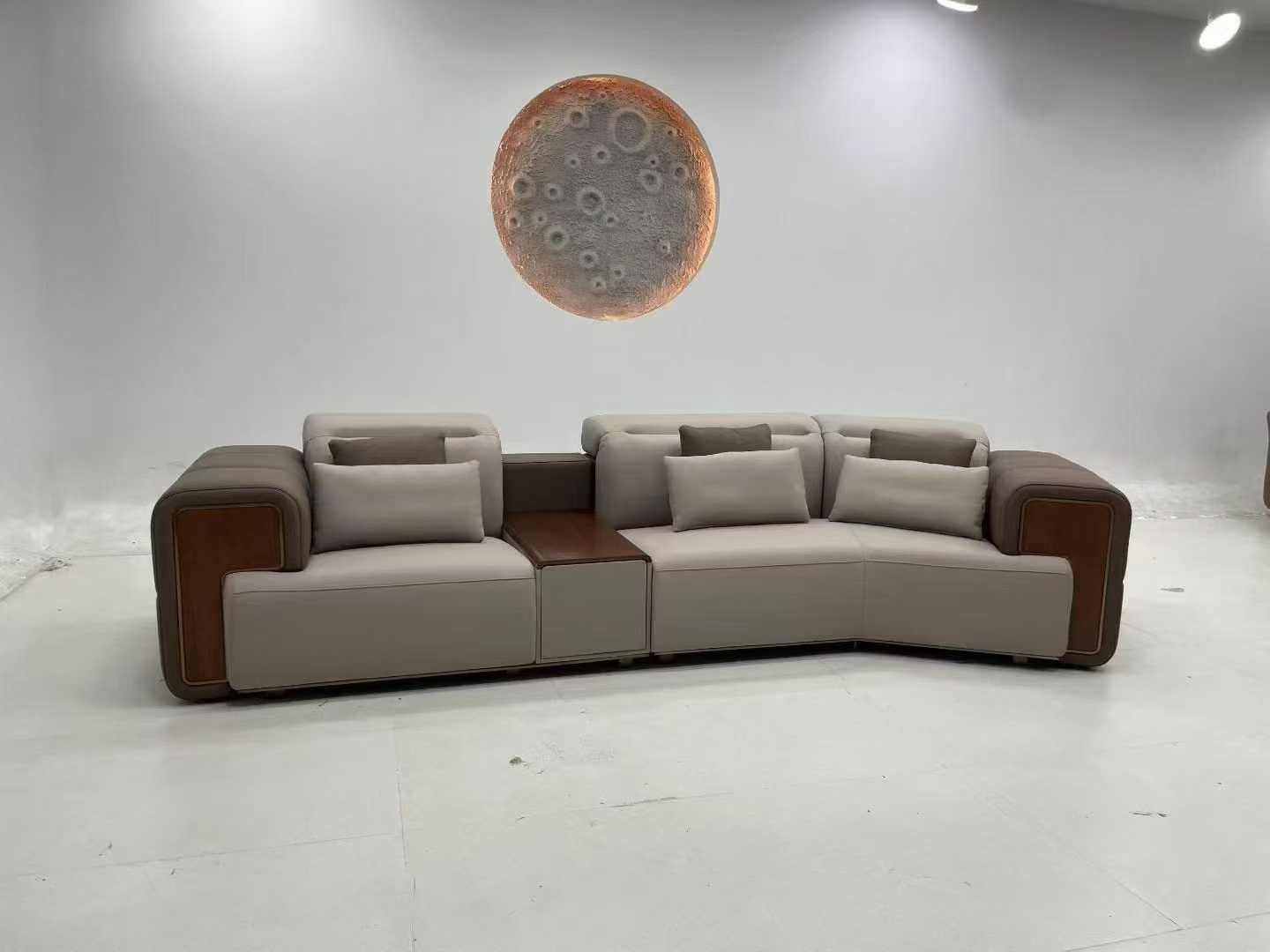
Hotel suite furniture where a single defective container can generate $50,000+ in rework and guest compensation costs.
Eight red flags should end — or at minimum pause — a supplier conversation. The supplier cannot provide a business license within 24 hours. Their quoted price is more than 30% below the five-quote average for the same specification. They insist on 100% pre-payment or refuse any form of escrow or Letter of Credit. The factory address on their B2B profile does not match the address on their business license. They cannot or will not provide a live video tour of the actual production line. Certifications (ISO, FSC, CARB) cannot be verified on the issuing body’s database. They refuse to allow pre-shipment inspection by a third-party QC company. And client references are unavailable or the contacts provided cannot be independently verified.
For additional due diligence, use ImportYeti to check actual U.S. shipping records — factories with real export history show consistent shipments under their own name, while trading companies often have no shipping history. The Jade Ant furniture factory directory also provides comparative data on verified manufacturers across Guangdong, helping buyers distinguish genuine production facilities from intermediaries.
10. The Production Sample: Your Pre-Commitment Insurance Policy
Never commit to a bulk order without a production sample — not a showroom sample, not a marketing photo, and not a specification sheet. A production sample ($50–$300 depending on complexity) is built on the same line, with the same materials, by the same workers who will produce your order. Evaluate it against every specification in your purchase agreement: wood species (verify by grain pattern and weight), finish color (measure with a spectrophotometer if ΔE precision matters), foam density (weigh a standard cushion and calculate against volume), hardware operation (cycle soft-close drawers 50 times), and joinery strength (apply the chair lift test).
Request 2–3 samples when possible. A single sample represents one moment on the production line; multiple samples reveal consistency or the lack of it. If sample #1 has a ΔE of 0.8 and sample #2 has a ΔE of 3.1 against the approved color swatch, the factory has a process-control problem that will replicate at scale. Jade Ant furniture’s bedroom collection provides an example of how sample evaluation is integrated into the production workflow — every custom order begins with a confirmed production sample before mass manufacturing proceeds.
11. Contract Protections That Actually Work
The quality specifications, sample approvals, and inspection protocols described above are only as strong as the contract that binds them. The six clauses that provide genuine protection are as follows. A detailed material specification listing wood species, foam density, hardware brand and model, fabric abrasion rating, and composite-panel certification requirements — attached as an appendix and signed by both parties. A finish-quality clause specifying film thickness, ΔE tolerance, and surface-roughness limits. An AQL inspection clause confirming that the buyer or their designated third-party inspector has the right to inspect at the factory prior to shipment, and that the lot will be rejected if it fails AQL 2.5 at General Inspection Level II. A defect-rate penalty clause stipulating that the factory pays 2× replacement cost for lots exceeding AQL 2.5. A 5–10% payment holdback released 60–90 days after delivery, conditional on the buyer confirming no latent defects. And a dispute-resolution clause specifying arbitration in a neutral venue (Hong Kong or Singapore under ICC rules) with governing law agreed in advance.
Without these terms in writing — not in WeChat messages, not in verbal agreements — a warranty is a marketing promise with no legal teeth.
12. Embedded Video: Furniture Quality Assessment in Practice
This video demonstrates practical techniques for identifying authentic materials and craftsmanship in Chinese furniture — skills applicable to both antique collecting and modern sourcing.
13. Building a Long-Term Quality Partnership
Consistency across production runs — the hallmark of a properly managed supplier relationship.
The most reliable quality outcomes come not from adversarial inspection-based relationships, but from genuine manufacturing partnerships where both parties invest in continuous improvement. This means reviewing defect reports after every shipment, identifying patterns, feeding those patterns back to the factory as process-improvement requirements, and tracking whether defect rates decrease over successive orders.
Factories that understand your quality expectations, have invested in meeting them, and trust the commercial relationship will maintain consistency across production runs. New, untested suppliers reset the quality learning curve with every order. The optimal strategy for most buyers is to develop 2–3 qualified suppliers for their core product categories — enough diversification to manage risk, but concentrated enough to build depth in each relationship. Jade Ant furniture’s living room collection demonstrates this partnership approach in action, supporting buyers from initial specification through production, inspection, and post-delivery follow-up as an integrated manufacturing partner rather than a transactional vendor.
When FSC China launched its Green Furniture for Sustainable Forests initiative in 2024, the first batch of 11 participating companies were all manufacturers with established long-term buyer relationships — precisely because the investment in FSC certification ($15,000–$40,000 for initial certification plus annual audits) only makes economic sense when a factory has buyers committed to multi-year procurement, not one-off orders.
14. Industry Outlook: Quality as Competitive Advantage in 2026
The Chinese furniture manufacturing landscape is bifurcating. On one side, a growing number of premium factories — many in Guangdong, some in Zhejiang and Sichuan — are investing in CNC automation, robotic finishing systems, AI-assisted quality control, and international certification. On the other, price-driven workshops continue to compete on cost alone, with predictable consequences for quality. For international buyers, this bifurcation is actually an opportunity: the premium tier now offers world-class manufacturing capability at prices still 30–50% below comparable European or American production, but only to buyers who know how to identify and verify that quality.
The data tells the story. China’s home furniture market is valued at USD $81.51 billion in 2026, growing at a CAGR of 2.86% to reach $93.86 billion by 2031. The custom furniture segment is growing even faster, valued at $44.76 billion globally with an 11.2% CAGR. Buyers who invest in quality identification — the specifications, inspections, samples, and contract protections outlined in this guide — will capture the value of this manufacturing ecosystem. Those who skip these steps will continue to pay the hidden tax of rework, returns, and reputation damage.
Frequently Asked Questions
1. What is the single most important thing to check when evaluating Chinese furniture quality?
Joinery. It determines structural lifespan more than any other factor. A dining chair with full mortise-and-tenon joints lasts 20–50+ years; the same chair with staple-and-glue assembly fails in 3–7 years. Use the chair lift test: lift by one front leg 150mm off the ground. If the frame flexes more than 5mm at the opposite corner, the joinery is inadequate for commercial use. No amount of beautiful finish can compensate for weak joinery.
2. How can I verify that a Chinese factory is using the correct wood species?
Three methods, in order of reliability: weigh a standard-dimension sample and compare against published specific-gravity data (white oak is 21% heavier than rubberwood at equal dimensions); inspect the grain pattern under consistent lighting (white oak shows distinctive ray flecks on quarter-sawn surfaces that rubberwood cannot replicate); and require a kiln-drying certificate from the lumber mill identifying the species, moisture content, and drying schedule. For high-value orders, independent laboratory testing (wood anatomy analysis) costs $50–$150 per sample and provides definitive identification.
3. What certifications should I insist on before placing an order?
At minimum: ISO 9001 (quality management system) for the factory, and CARB Phase 2 / EPA TSCA Title VI for any product containing composite wood panels (MDF, HDF, particleboard). For commercial or hospitality furniture, add BIFMA X5 (structural durability) and TB 117-2013 (fire safety for upholstered pieces). For sustainability-conscious buyers, FSC Chain of Custody and GREENGUARD Gold certify responsible sourcing and low indoor emissions. Always verify certificate numbers directly with the issuing body — never accept scanned PDFs without verification.
4. How much does a proper quality inspection program cost?
Third-party inspection rates in China range from $149 to $350 per man-day. A typical furniture order requires 3–4 inspection days across three checkpoints (pre-production material check, in-line inspection at 20–30% completion, and pre-shipment AQL 2.5). Total cost runs $500–$1,400 — compared to average rework costs of $15,000–$50,000 for an undetected quality failure on a container-load order. The return on investment routinely exceeds 20:1. Providers include AQI Service, SGS, Bureau Veritas, and V-Trust.
5. What does AQL 2.5 mean and is it strict enough for furniture?
AQL 2.5 at General Inspection Level II (per ISO 2859-1) means that for a randomly drawn sample, up to 2.5% major defects are the maximum acceptable rate before lot rejection. For a 500-unit lot, 50 units are randomly inspected; more than 3 major defects triggers rejection. AQL 2.5 is the industry baseline for quality furniture. For premium and luxury products, tighter tolerances of AQL 1.5 or AQL 1.0 are appropriate — these reduce the acceptable major-defect threshold and require larger sample sizes.
6. How do I distinguish a genuine factory from a trading company?
Check the business license scope (manufacturing vs. trading), verify registered capital exceeds ¥5 million on China’s NECIPS database, and request a live video tour of the active production line within 24 hours. Cross-reference with ImportYeti shipping records — genuine factories show consistent exports under their own name. Manufacturers like Jade Ant furniture welcome factory visits and provide transparent access to production facilities as standard practice.
7. What payment structure best protects the buyer?
The standard structure is 30% deposit via T/T upon order confirmation and 70% against Bill of Lading after goods pass pre-shipment inspection. For orders above $30,000, a Letter of Credit (1–3% bank fee) adds bank-verified payment protection. Include a 5–10% holdback clause that releases the final portion 60–90 days after delivery, conditional on no latent defects. Avoid any supplier demanding 100% pre-payment or accepting only Western Union transfers — both are red flags.
8. Can Jade Ant furniture help with quality assessment for orders from China?
Yes. Jade Ant furniture provides end-to-end quality-assessment support — from initial factory matching and specification development through in-process inspection, pre-shipment verification, and post-delivery support. With 15+ years of wholesale experience, 5,000+ designs produced, and MOQs as low as 1 piece per type, Jade Ant operates as an integrated production partner rather than a transactional supplier. Their quality assessment guide offers additional detail on their evaluation methodology.
9. How long should I expect quality furniture production to take in China?
Standard production timelines for custom furniture range from 30–60 days depending on design complexity and order scope. Add 18–35 days for sea freight (China to U.S. West Coast) or 25–45 days (China to Europe). Total door-to-door lead time is typically 8–14 weeks. Compressed timelines below 30 days for custom work should be treated with caution — rushed production correlates directly with elevated defect rates as factories skip curing times, QC checkpoints, and proper packaging preparation.
10. What finish type offers the best durability for hotel and commercial furniture?
Catalyzed lacquer provides the highest durability for commercial applications — excellent scratch resistance, moisture resistance, and a film thickness (80–120 microns) that withstands high-traffic use. Polyurethane is a strong second choice, particularly for dining tables and desktops. For residential settings with a natural aesthetic preference, hardwax oil offers good protection with a low-sheen appearance, though it requires biannual maintenance. Avoid paste wax on any commercial furniture — it provides minimal moisture protection and requires quarterly reapplication.