Master the art of blending contemporary, mid-century, and vintage furniture to create cohesive showroom displays, client proposals, and hotel fit-out designs. This professional guide equips you with proven mixing principles, sourcing strategies, and real-world room transformations to confidently present multi-style collections to your clients.
Why Style Mixing Matters for Your Business
The Commercial Opportunity in Eclectic Design
The data tells a clear story: the global interior design market was valued at USD 145.96 billion in 2025, and the fastest-growing segment within it is not minimalism or maximalism — it is personalisation. According to McKinsey, 71% of consumers expect personalised experiences from the brands they work with. In the interior design context, that expectation translates directly into client demand for spaces that feel unique, layered, and authentically theirs.
For furniture distributors, showrooms, and design professionals, this shift creates a specific commercial opportunity: clients who want curated, mixed-style spaces buy more than clients who want a single matching suite. A showroom floor that demonstrates how a 1960s walnut credenza sits confidently beside a contemporary linen sofa and a vintage brass floor lamp generates more conversation, more dwell time, and more cross-category sales than a floor arranged by product line.
The secondary market reinforces this. Online furniture resale has climbed to $34 billion and is forecast to reach $56 billion by 2030. The antiques market is growing at 15% annually. Millennial and Gen Z buyers — now the primary decision-makers in residential design — are actively rejecting “fast furniture” in favour of pieces with provenance, craft, and character. Interior designers and hotel fit-out specialists who cannot confidently source, style, and present mixed-era collections are already behind the curve.
What This Guide Solves for Your Business
Client hesitation about mixing styles is usually not aesthetic — it is anxiety about getting it wrong. When a client has invested $40,000 in a hotel room refurbishment, the fear of a result that looks “confused” or “jumbled” is entirely rational. Your job as a design professional is to remove that fear through demonstrated expertise: clear principles, compelling visual evidence, and confident recommendations.
This guide gives you the professional framework to do exactly that. It covers every layer of the mixed-style process — from understanding each style’s core vocabulary, to applying the proven mixing principles that prevent visual chaos, to managing sourcing logistics, showroom merchandising, client communication, and long-term business positioning. By the time you finish reading it, mixed-style design will not feel like an aesthetic gamble. It will feel like one of the most reliable tools in your commercial practice.
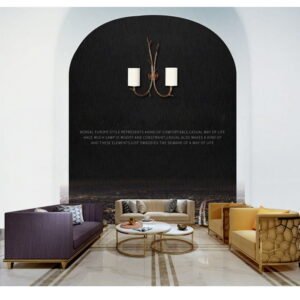
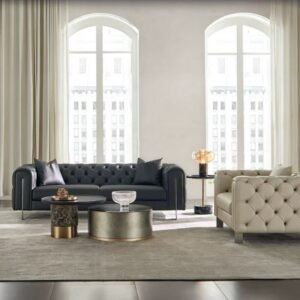
 Three eras, one coherent space: contemporary upholstery, mid-century casegoods, and vintage lighting united by a shared palette and material language — the foundation of professional style mixing.
Section 1: Understanding the Three Core Style Families
Contemporary Style: The Modern Foundation
Contemporary style — as distinct from “modern” (which refers to a specific 20th-century design movement) — describes the design sensibility of the present moment. In practical terms for furniture professionals in 2025, this means clean profiles, a preference for function over ornament, neutral anchoring palettes, and materials that lean toward natural textures rather than synthetic ones.
Contemporary furniture serves as the “glue” of mixed-style interiors for a specific reason: its restraint. A contemporary sofa does not make a strong historical claim. It does not announce an era or a school of thought. This neutrality allows it to sit comfortably alongside a 1950s Danish chair or a Victorian occasional table without either piece feeling contextually displaced.
From a sourcing and margin perspective, contemporary pieces from suppliers like CB2, Article, and West Elm offer predictable lead times, consistent quality, and clear wholesale pricing structures. For showrooms and distributors, contemporary pieces form the reliable backbone of a mixed-style inventory — the high-turnover, quick-to-replenish category that funds the more speculative vintage sourcing. Markup structures on contemporary trade pieces typically run 30–50% above wholesale cost, with margins compressible for volume and protected by the exclusivity of your curation rather than the rarity of the piece.
Key sourcing note: when selecting contemporary pieces specifically for mixed-style applications, prioritise those with honest material expression — solid wood legs rather than veneered MDF, natural fabric upholstery rather than synthetic blends, and metal accents in finishes that read as material (matte black, brushed brass, aged bronze) rather than coating. These details are what allow a contemporary piece to hold its own beside a vintage original.
Mid-Century Modern: The Bridge Between Eras
Mid-century modern (MCM) refers to the design movement that emerged roughly between 1945 and 1969, characterised by organic shapes, minimal ornamentation, an embrace of new materials (fibreglass, moulded plywood, new foams), and a philosophical commitment to the idea that well-designed objects should be accessible. Designers like Eames, Wegner, Jacobsen, Knoll, and Juhl defined the aesthetic vocabulary that continues to exert enormous influence on contemporary design — which is precisely why MCM pieces sit so naturally in mixed-era spaces.
Recognising authentic versus reproduction pieces is a core professional competency that directly affects both your sourcing costs and your client conversations. Authentic MCM pieces — original production examples from the 1940s–1960s — carry provenance value that reproductions do not, which justifies meaningfully different pricing. Key markers of authenticity include: manufacturer’s marks or labels underneath or behind the frame; construction methods consistent with the period (hand-tied webbing rather than sinuous springs in high-quality seating; solid teak or walnut with visible grain variation rather than uniform veneer); joinery that shows hand-finishing; and dimensions that are slightly non-standard by today’s automated-production norms.
High-quality reproductions from licensed manufacturers (Herman Miller continues to produce authorised Eames pieces; Fritz Hansen continues authorised Jacobsen production) occupy a legitimate market position and are priced accordingly. Generic unlicensed reproductions should be sourced and priced transparently — not presented as authentic originals.
Teak and walnut are the dominant timber species in MCM furniture, and both remain outstanding bridge materials when mixing eras. Their warm, grain-forward character reads as “quality” across design periods. A walnut MCM coffee table sits as naturally beside a contemporary linen sofa as it does beside a Victorian upholstered armchair — it is one of the few materials that is genuinely era-agnostic.
Vintage and Antique: Adding Character and Story
A professional definition: in the furniture trade, “vintage” typically refers to pieces from the 20th century that are at least 20 years old but not yet 100 years old. “Antique” refers to pieces that are 100 years or older. In practice, these definitions are applied loosely in client conversations — what matters commercially is the character, provenance, and condition of the piece, not the technical classification.
The emotional value proposition of vintage pieces is significant and increasingly relevant to your client base. The second-hand luxury goods market is forecast to grow from $44.7 billion in 2023 to $98.3 billion by 2031. Iconic mid-century examples — original 1970s sectional sofas, authenticated Knoll chairs, Danish teak case pieces — are commanding an average order value of $11,000 at the premium end of the market, according to Architectural Digest. Even non-designer vintage pieces carry a narrative that mass-produced furniture structurally cannot: they have already lived, and that history is visible in the material.
Condition assessment and restoration considerations are non-negotiable in professional vintage sourcing. A structural issue in a vintage chair — a compromised joint, a degraded spring system, a warped frame — must be factored into the acquisition price and restoration cost before any client margin is calculated. Build relationships with two or three trusted restoration specialists whose quality you know and whose turnaround times fit your project schedules. Vintage pieces that arrive in client spaces with unresolved structural issues damage your reputation in a way that no amount of aesthetic character can offset.
Section 2: The Five Professional Mixing Principles
Principle 1: The 60-30-10 Ratio System
The 60-30-10 rule is the most durable framework in professional interior design, and it applies with particular precision to mixed-style spaces. The principle: allocate 60% of the room’s visual weight to a dominant style or palette, 30% to a secondary style, and 10% to an accent that introduces contrast or surprise.
In a mixed-style context, this might look like: 60% contemporary (the sofa, the dining table, the floor covering), 30% mid-century (the occasional chairs, the sideboard, the pendant lighting), and 10% vintage (a pair of antique candlesticks, a reclaimed textile cushion, a single framed vintage print). The 10% accent category is where the personality lives — and it is also where the visual risk is contained. By limiting the most historically specific element to 10% of the room’s visual weight, you prevent any single era from dominating the narrative.
For showroom displays, this principle provides a direct merchandising framework. A vignette built on 60-30-10 reads as curated and intentional. A display without this structure reads as a warehouse. Train your floor team to understand this ratio so they can articulate it to clients: “We’ve built this space around a contemporary foundation with mid-century accents and a few vintage finds that give it its character.” That sentence communicates design expertise and gives the client a mental model for what they are looking at.
Principle 2: Establish a Cohesive Color Palette
Color is the fastest way to either unify or destroy a mixed-style space. The professional approach is not to match colors across eras — that is both impossible and aesthetically limiting — but to establish a palette of neutral anchors that every piece in the room shares, regardless of its era.
The most reliable neutral bridges across contemporary, MCM, and vintage styles are: natural wood tones (walnut, teak, oak, ash), warm whites and off-whites in upholstery, and metal finishes in brass, brushed gold, or matte black. These are not era-specific colours — they appear naturally in all three style families and create an implicit visual connection between disparate pieces.
Accent colours should be introduced through the 10% vintage layer and the soft furnishings: cushions, throws, artwork, ceramics. This allows seasonal updates to the palette without requiring inventory replacement. A showroom display that shifts its accent cushion colour from terracotta to sage green between seasons maintains its structural integrity while appearing refreshed.
For client proposals, always create a physical sample board before presenting a mixed-style scheme. A rendered image or mood board on screen does not convey the actual relationship between material textures and finishes. A physical board with actual fabric swatches, paint chips, wood samples, and metal finishes allows the client to make a confident decision rather than an imagined one.
Principle 3: Balance Scale and Proportion
Scale is the most technically demanding aspect of mixed-style design and the one most likely to produce the “something feels off” response that clients struggle to articulate. The issue is almost always proportion: a large, high-backed Victorian chair placed beside a low-slung contemporary sofa creates a visual tension that reads as mismatch rather than contrast.
The professional rule of thumb: pieces within the same visual grouping (a seating arrangement, a console and mirror pairing, a dining table and chairs) should share a dominant horizontal line. If your contemporary sofa has a seat height of 42cm and a back height of 75cm, the MCM chairs that sit alongside it should share at least one of those reference points — preferably the seat height, which determines the physical experience of sitting together.
Where scale variation is intentional — a tall vintage armoire beside a low contemporary credenza — it should be framed as architectural rather than furniture-based: the vertical contrast is treated as a compositional element rather than a functional grouping.
For showroom layouts, proportion guidelines translate directly into traffic flow. A display where all furniture sits at roughly the same visual height creates a flat, homogenous feel. Introducing one tall element (a vintage floor lamp, a standing mirror, an armoire) per vignette creates the vertical interest that draws the eye and encourages movement through the space.
Principle 4: Unify Through Materials and Finishes
Materials are the professional’s most powerful unifying tool in mixed-style design — more powerful than color, because material consistency operates below the conscious level of client perception. A room where every piece of furniture features exposed natural wood — regardless of whether that wood appears in a contemporary table leg, an MCM frame, or a vintage sideboard — feels cohesive in a way the client senses before they can explain why.
The materials that bridge all three style families most reliably are: natural hardwoods (walnut and teak lead; oak works well; avoid pine or soft timbers in premium contexts), leather in mid-range to full-grain grades, linen and natural-weave textiles, brass and gold-toned metals, and stone (marble and travertine). These materials appear authentically in design from every era between 1920 and the present day, which is why they create visual harmony across periods.
Avoid plastic-dominant contemporary pieces in mixed-style applications — they create a material dissonance that undermines the quality narrative of the vintage and MCM elements. The client who has invested in an authentic MCM Wegner chair does not want to look across the room at a polypropylene stacking chair, regardless of how cleverly it has been designed.
Principle 5: Create Intentional Focal Points
Every professional interior has a hierarchy: a piece that anchors the room, secondary pieces that support it, and tertiary elements that add detail. In a single-style room, this hierarchy is established by size and placement. In a mixed-style room, the hierarchy must also navigate era — which style leads, which supports, which accents.
The most effective approach is to designate one hero piece per room — the piece the room is “about” — and ensure it is your highest quality, most visually distinctive item, regardless of era. This might be an original Eames lounge chair in a contemporary living room, or a Victorian chesterfield in a mid-century-dominant space. The hero piece sets the design conversation; everything else responds to it.
For showrooms, designating hero pieces across style categories serves a dual commercial purpose: it highlights your highest-margin items (which should typically be your most visually striking), and it gives your sales team a clear narrative entry point for client conversations. “This room starts with this chair. Everything else is built around supporting what it says.”
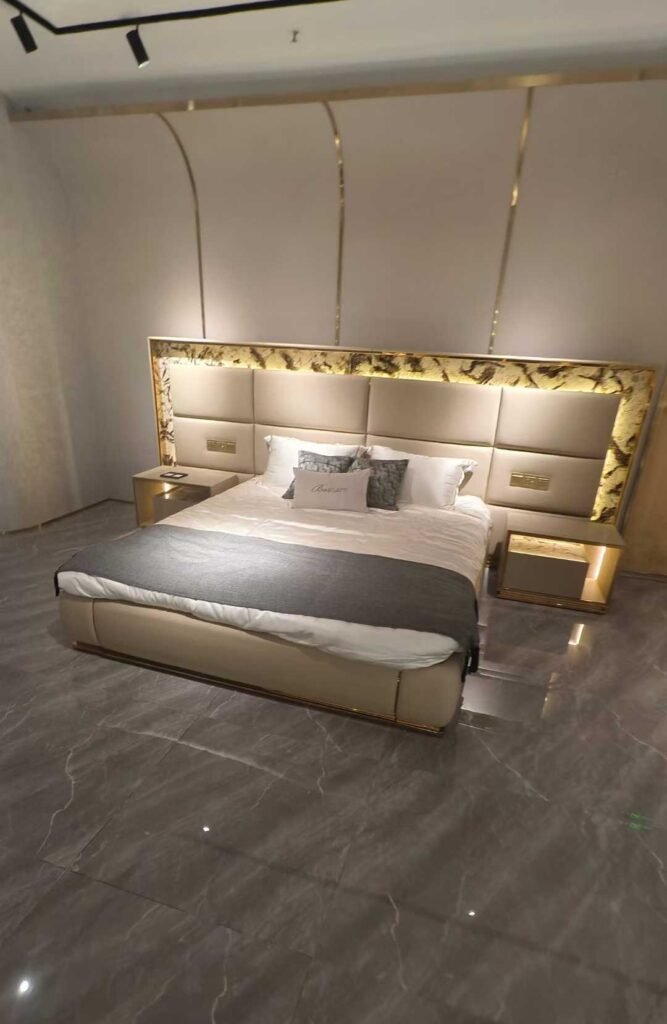
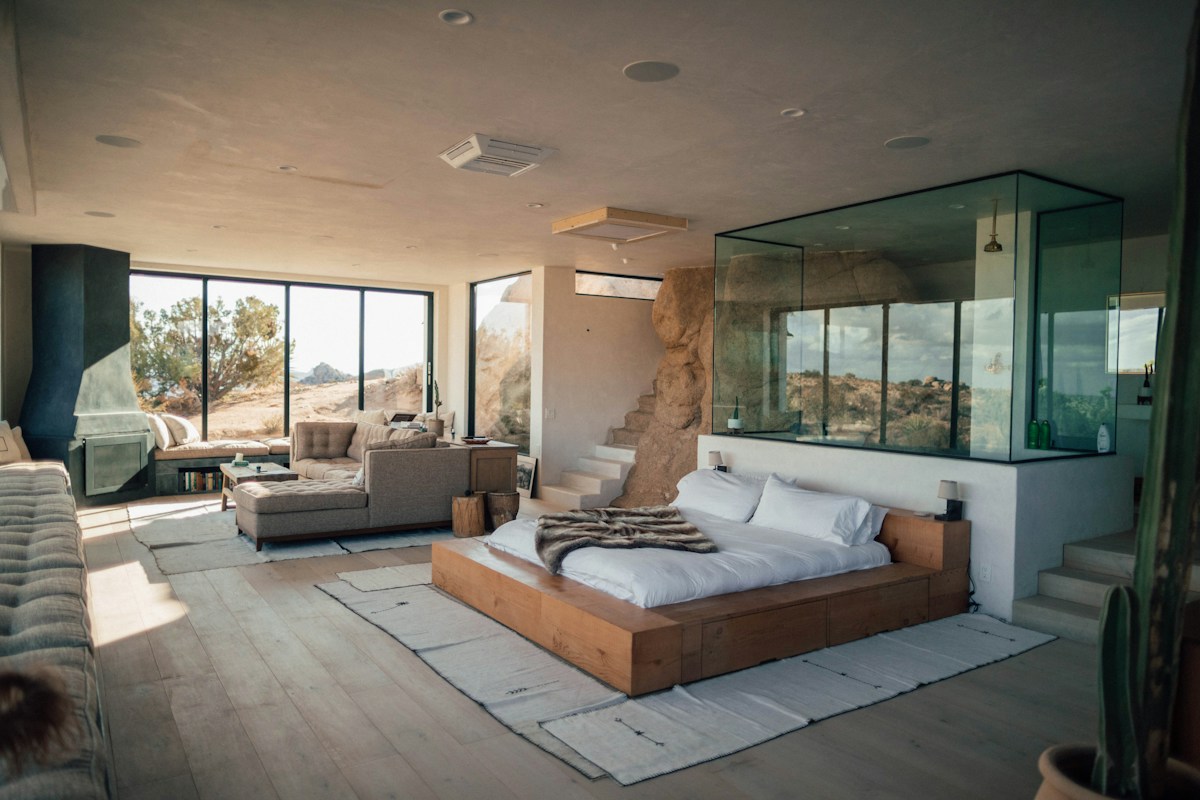
 A boutique hotel suite where the ratio is clear: contemporary bed and neutral walls (60%), Danish teak detailing (30%), vintage textile and lighting accents (10%) — coherence achieved through deliberate proportion, not matched sets.
Section 3: Before-and-After Room Transformations
Transformation 1: Contemporary Living Room + Mid-Century Seating + Vintage Accessories
The brief was a 45m² residential living room in a new-build apartment with no architectural character. The client had an existing contemporary sofa she wanted to keep, a blank budget of $18,000 for the remaining furniture and accessories, and a design goal she described as: “I want it to feel like I’ve collected these things over time, not bought a showroom.”
The initial challenge: the room had one dominant contemporary piece (a well-proportioned three-seater sofa in warm greige linen) and absolutely nothing else of note. Without intervention, any furniture added to support it would have produced either a matching-set monotony or a randomly assembled chaos.
The sourcing strategy applied the 60-30-10 principle rigorously: the contemporary sofa and a new contemporary coffee table (solid oak with a simple rectangular form) established the 60% foundation. A pair of restored 1960s Danish teak armchairs with new linen upholstery — sourced through an estate specialist — provided the 30% MCM layer. A single vintage rattan floor lamp, a vintage kilim runner, and a set of three graduated vintage ceramic vessels provided the 10% accent layer.
The material throughline was natural: warm wood tones across all three style families, linen in the sofa and the reupholstered chairs, brass in the lamp and the coffee table hardware. Color palette was warm neutrals with the kilim introducing a controlled terracotta accent.
The margin breakdown: the contemporary pieces carried a standard 40% markup on trade cost. The restored MCM chairs — acquired at $280 each plus $180 per chair in reupholstery — were presented to the client at $1,200 each, reflecting a curation and restoration premium that the client accepted readily because the design rationale had been clearly explained. The vintage accessories carried a 65–80% markup on acquisition cost, representing the sourcing expertise and curation judgment that identified these specific pieces as right for this specific space.
The client’s response at handover: “This looks like it took twenty years to build. How is that possible in six weeks?” That is the question you want your clients asking.
Transformation 2: Hotel Suite Blending All Three Styles
A 15-room boutique hotel in a renovated 1920s building presented a specific challenge: the property’s architectural bones were period — original cornicing, high ceilings, arched windows — but the owner’s brand positioning was decidedly contemporary. The brief called for a design that honoured the building without becoming a period pastiche, and that demonstrated enough personality to compete for the design-conscious travel market.
The solution was a structured inversion of the standard ratio: 60% contemporary foundation (beds, desks, bathroom vanity units, upholstered headboards in a neutral boucle), 30% vintage and period-appropriate antique (restored Victorian occasional chairs, original 1920s-1930s framed mirrors, period-correct brass light fittings), and 10% MCM accent (a single Scandinavian side table per room, a pair of MCM pendant lights in the corridor to bridge eras).
Durability requirements for the hospitality context required every upholstered piece to meet a minimum 35,000 Martindale rub count (see the specification section), all fabric to be fire-rated to EN 1021-1/2, and all lounge seating to be built on contract-grade frames. The vintage Victorian chairs — the most visually distinctive element in the scheme — were entirely reupholstered by a specialist in fire-rated velvet with a 40,000 Martindale rating, which eliminated any compliance risk while maintaining the period aesthetic.
For sourcing logistics across 15 rooms, the procurement was structured in three distinct phases: contemporary pieces placed first (longest lead time for the custom headboards), MCM accents placed second (shorter lead time, standardised selection), and vintage period pieces placed third (each sourced as individual items through a network of estate specialists, with 20% contingency pieces held in reserve for any that proved unsuitable on delivery). This phased approach prevented the single biggest logistics risk in mixed-style hotel procurement: the last-minute discovery that a key accent piece does not work in situ.
Transformation 3: Showroom Display — Retail-Ready Mixed-Style Vignette
A furniture showroom in a major city had a corner floor space of approximately 28m² that was producing below-average sales per square metre. The space had been arranged by product category — a sofa section, a coffee table section, a lighting section — with no design narrative connecting the pieces.
The redesign created a single cohesive living-room vignette using the 60-30-10 framework. The contemporary anchor: a three-seater sofa and a low console table in the same family. The MCM layer: two Danish-style armchairs and a pair of teak-and-brass pendant lights. The vintage accent: a single oversized vintage mirror above the console, two ceramic table lamps in earthy glazes, and a curated stack of three vintage design books.
The merchandising principle was deliberate aspiration: every element in the display was purchasable, but the display also worked as a design concept that clients could photograph and reference. An “as displayed” price card showed the total vignette value; individual piece labels allowed component sourcing. Within six weeks of the redesign, that corner of the showroom was generating 35% more revenue per square metre than the preceding quarter under the category-based arrangement. The most common sales pattern: clients buying a featured piece from each of the three style categories, rather than a single item.
Section 4: Practical Sourcing and Procurement Strategies
Building Your Contemporary Inventory
Contemporary pieces are your inventory backbone — the predictable, replenishable category that provides commercial stability. The key sourcing discipline is selectivity: not all contemporary furniture works in mixed-style applications. Choose pieces whose design vocabulary includes natural materials, honest construction, and proportions that can coexist with MCM and vintage elements.
When negotiating wholesale relationships with contemporary suppliers, volume commitments deliver the strongest pricing leverage. A distributor who can commit to quarterly minimum orders from a single contemporary supplier typically unlocks pricing tiers that improve blended project margins by 8–12 percentage points. For showrooms managing significant contemporary inventory, negotiating 30–45 day payment terms (rather than upfront or on-delivery payment) also improves working capital significantly on larger orders.
Trend forecasting for contemporary inventory requires monitoring both trade shows (Maison&Objet, Salone del Mobile, High Point Market) and platform-level trend data from sources like Pinterest’s annual trend report e WGSN’s home and interiors feed. Contemporary furniture that will work in mixed-style applications 18 months from now is often identifiable in emerging form and material trends today.
Developing Reliable Vintage and Antique Sourcing
Vintage sourcing is the highest-skill component of mixed-style procurement, and it is also the component that most directly differentiates your offering from competitors. Anyone can source contemporary. Only a professional with established relationships, market knowledge, and quality judgment can source the right vintage piece for a specific client brief.
Build your vintage sourcing network deliberately across at least three distinct channels: estate sale companies (who provide consistent volume of residential-clearance pieces, often at below-market acquisition costs); specialist auction houses (who provide quality, provenance documentation, and access to higher-value pieces); and international sourcing networks (particularly for Scandinavian MCM, which remains the most commercially versatile vintage category in mixed-style applications).
For condition assessment, develop a standard evaluation framework before any acquisition: structural integrity first (joints, frames, spring systems — a piece with structural issues requires restoration budgeting before purchase decision), surface condition second (refinishing teak or walnut is manageable; reupholstery is manageable; veneer damage on key surfaces requires more careful cost assessment), and aesthetic fit third (does this piece work in the specific style combinations your showroom or client base requires?).
The online vintage market has matured significantly. Platforms including 1stDibs, Chairish, and PAMONO provide access to authenticated vintage and MCM pieces with provenance documentation — useful for client-facing procurement where documentation supports premium pricing conversations.
Creating a Curated Inventory System
A mixed-style inventory without a systematic cataloguing framework becomes logistically unmanageable above approximately 80 distinct SKUs. The pieces that “work together” need to be findable at the moment a client conversation requires them — not after a 20-minute floor search.
Digital cataloguing should tag each piece with: style family (contemporary/MCM/vintage), material family (natural wood, leather, brass/metal, textile, stone), dominant color family, dimension category (lounge, accent, dining, bedroom, accessory), price tier, and — critically — “pairs well with” cross-references to other pieces in your inventory. This last tag is the commercial gold: when a salesperson can pull up a piece a client is interested in and immediately see three other pieces it works with across different style categories, average order value climbs.
Tracking pieces that sell well together provides data that should directly inform your sourcing strategy. If teak MCM sideboards consistently sell alongside contemporary linen sofas in your showroom, your sourcing priority is maintaining a consistent supply of both categories. If your vintage ceramic accessories consistently pair with contemporary dining tables, that combination becomes a signature vignette worth displaying permanently.
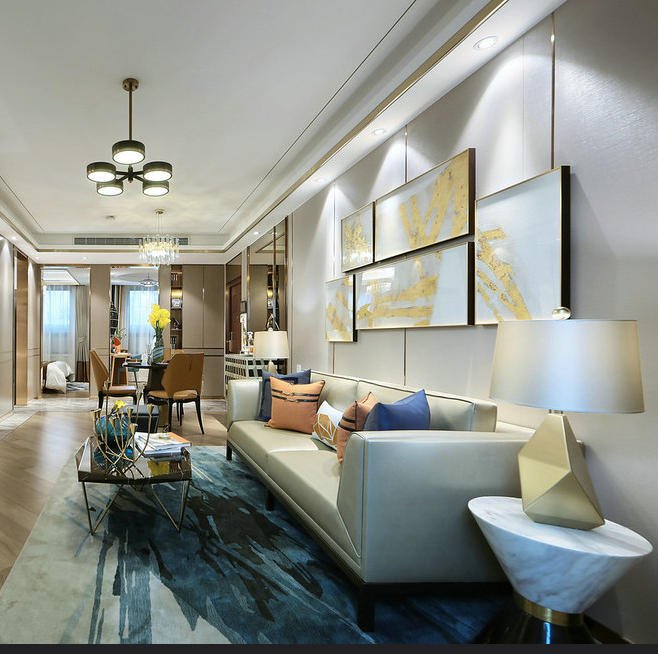
 A showroom vignette built on the 60-30-10 principle: contemporary upholstery anchors the space, MCM casegoods provide structural depth, and vintage accent pieces create the personality that makes clients photograph it before they purchase it.
Section 5: Communicating Mixed-Style Design to Your Clients
Creating Compelling Design Proposals
The single most common failure in mixed-style client proposals is presenting the furniture before presenting the concept. A client who sees a line-item quote with individual pieces listed by price has no framework for understanding why those specific pieces work together, which means the first question is always “why does this cost this much?” rather than “how do I make this happen?”
The professional proposal sequence reverses this order: present the concept (here is the space I am designing for you, and here is the story it tells), then present the palette (here are the colors, materials, and finishes that create unity across the pieces), then present the specific pieces (here is what each element contributes to the story), and finally present the pricing (here is the investment to make this happen). By the time the client reaches the price, they have been building enthusiasm for the result for several minutes — which is exactly the right state of mind for a pricing conversation.
Before-and-after imagery is your most powerful sales tool in this context. A photograph of the client’s current space beside a rendered image of the proposed scheme allows the client to make an emotional connection to the outcome before any logical evaluation of cost. If you do not have 3D rendering capability in-house, invest in it — tools like Houzz Pro’s 3D floor planning and SketchUp offer professional-quality visualisation at accessible price points that more than pay for themselves in proposal close rates.
Training Your Sales Team
A showroom floor team that cannot articulate the design rationale behind a mixed-style display is leaving money on the table. Clients who do not understand why a display works will not buy the concept — they will only buy individual pieces, which means they leave without the full combination and without the full spend.
Training should be specific and practical, not theoretical. Walk your team through each existing showroom vignette and have them explain, without notes, the design principle behind the piece selection, the material throughline that unifies it, and the 60-30-10 distribution. If they cannot do this confidently, they need more familiarity with the display, not more design education. The design principles are a communication tool — a language for talking to clients — not an academic exercise.
Develop specific language for the three most common client hesitations: “Will it look too busy?” (Answer: the 60-30-10 ratio is specifically designed to prevent that — the mixed pieces accent, they don’t compete), “Will the different pieces match?” (Answer: they are not supposed to match — they are supposed to belong together, and here’s the material thread that makes them belong), and “Is it worth spending more on vintage pieces?” (Answer: a well-sourced MCM chair in solid walnut with new upholstery will be in this client’s space in twenty years; the contemporary alternative will have been replaced twice by then).
Managing Client Expectations
Vintage sourcing timelines are the most common expectation gap in mixed-style projects. A client who has been shown a specific vintage piece in a showroom vignette and wants exactly that piece for their own space needs to understand that vintage items are one-of-a-kind — when it is gone, it is gone. Build a clear sourcing policy: for confirmed projects, sourcing for specific vintage elements begins on receipt of a deposit, and client-approved alternatives are pre-agreed before sourcing begins, so that if the first-choice piece is not available, the project does not stall.
Condition variation in vintage pieces is another expectation that must be managed proactively. A restored MCM chair that has been reupholstered is not the same as a brand-new production piece — there may be minor imperfections in the frame finish, subtle evidence of the original construction, or slight material aging that is visible on close inspection. Presenting this as a design quality — “this is what genuine craft from the 1960s looks like; you cannot replicate this in a factory today” — transforms a potential objection into a positive feature. But it only works if the client has been briefed honestly before the piece arrives.
Section 6: Showroom Display Strategy and Merchandising
Designing Mixed-Style Floor Displays
A showroom display that tells a design story is the most powerful sales tool a furniture business has — significantly more powerful than any digital marketing. When a client walks into a space that has been designed with the same principles you are proposing for their own home or hotel, and they feel immediately comfortable and inspired in it, the selling has already happened.
Every vignette should have a clear narrative that can be expressed in one sentence. “This is a working professional’s apartment at the end of the week — comfortable, considered, and unhurried.” “This is a boutique hotel suite that feels more like a design collector’s apartment than a generic room.” These narratives are not sales scripts — they are design briefs. And when your sales team can articulate them, clients connect emotionally to the space rather than evaluating it as a collection of furniture items.
Instagram-worthy moments in showroom displays are not vanity — they are marketing infrastructure. A display that clients photograph and share generates far more qualified traffic than most paid advertising. The key design elements that prompt photography: a single distinctive hero piece (an unusual vintage mirror, a statement MCM chair), strong natural or directed lighting, and a clear composition that reads well in a smartphone photograph. If your displays are not being photographed by floor visitors, they have not found their focal point yet.
Seasonal Updates and Trend Integration
The most commercially effective seasonal update strategy in a mixed-style showroom is to rotate only the 10% accent layer — the vintage and accessory elements — while keeping the 60% and 30% layers stable. This approach keeps the display feeling fresh and current without requiring significant new inventory investment or disrupting the established pieces that clients may be in the process of deciding on.
Seasonal accent rotations should be supported by a deliberately limited sourcing calendar: allocate specific budget and time for accent sourcing in advance of each quarter rather than ad hoc acquisition. This discipline prevents the “buying from enthusiasm rather than strategy” pattern that fills showrooms with beautiful individual pieces that do not work together.
New arrivals deserve specific marketing communications — a brief email to your trade client database, a post in your social media channels showing the new piece in situ within an existing vignette. The “new arrival within a familiar context” format performs consistently well because it shows clients how the new piece fits into a world they already trust.
Section 7: Overcoming Common Design Challenges
Challenge 1: Avoiding Visual Chaos When Mixing Styles
Visual chaos in mixed-style interiors has three consistent causes: too many focal points competing simultaneously (no clear hierarchy), too many accent colors without a unifying neutral (palette fragmentation), and scale mismatches that prevent the eye from reading the space as a coherent whole.
The simplest diagnostic: stand at the room’s primary entrance point and ask “where does my eye go first?” If the answer is “everywhere equally,” the space lacks hierarchy and needs editing. Remove pieces until one clear focal point emerges, then re-introduce supporting elements one at a time. The piece that goes back in last — the one that almost did not make the cut — is usually the one that was creating the chaos.
Negative space is not wasted space in mixed-style design. A table surface that is 60% empty allows the three objects on it to breathe and be seen individually. A table surface covered with twelve objects creates visual noise. The discipline of restraint — editing out pieces that are individually beautiful but collectively too much — is the mark of professional design confidence.
Challenge 2: Bridging Price Point Gaps
A mixed-style collection that includes one authentic MCM piece at $2,400, two contemporary pieces at $600 each, and a set of vintage accessories at $80 each has a significant price gradient. Presenting this gradient transparently to clients requires a clear value framework that anchors each piece’s price to its specific contribution.
The language that works: “The MCM chairs are the investment pieces in this scheme — they are authentic period furniture with the kind of structural quality that means you are still using them in twenty years. The contemporary pieces are the functional foundation — beautiful but replaceable if your taste evolves. The vintage accessories are the personality layer — individually affordable, collectively transformative.” This framing validates each price point without requiring any of them to compete with the others.
Tiered package options — a premium version with all original MCM pieces, a mid-range version mixing high-quality reproduction and vintage, and a budget-focused version using contemporary pieces with vintage accessories — make mixed-style design accessible across a wider client range while allowing you to demonstrate the value of investment in the premium tier.
Challenge 3: Sourcing Consistency Across Projects
The tension between the uniqueness of vintage sourcing and the consistency that professional project delivery requires is real and must be managed explicitly. The solution is not to abandon unique sourcing in favour of safer catalogue choices — that sacrifices the differentiation that drives premium pricing. The solution is to build contingency into every project brief.
For every vintage or MCM element in a project specification, identify a pre-approved alternative before sourcing begins. This alternative should be at a similar price point and aesthetic fit, approved by the client in advance as an acceptable second choice. When your first-choice piece is unavailable (which will happen), you have a project-approved alternative that moves the project forward rather than stalling it.
Challenge 4: Managing Inventory Risk
Vintage and MCM inventory carries different risk profiles than contemporary catalogue pieces: higher acquisition cost per piece, longer time-to-sell for highly specific items, and no reorder option when a sold piece needs replacement. Managing this risk requires data-informed purchasing rather than taste-led acquisition.
Track which vintage and MCM pieces sell within 60 days and which sit for more than 90 days. Pieces that consistently sell within 60 days define your productive category — buy more of them. Pieces that consistently sit for more than 90 days are either priced incorrectly, displayed ineffectively, or represent a style direction your specific client base does not respond to. Address each case separately before adding more inventory in that category.
Watch: How to Mix Vintage and Modern Furniture Like a Pro
This walkthrough covers the practical principles of mixing eras — from establishing a palette anchor to placing statement vintage pieces — with real room examples that translate directly into showroom and client proposal contexts.
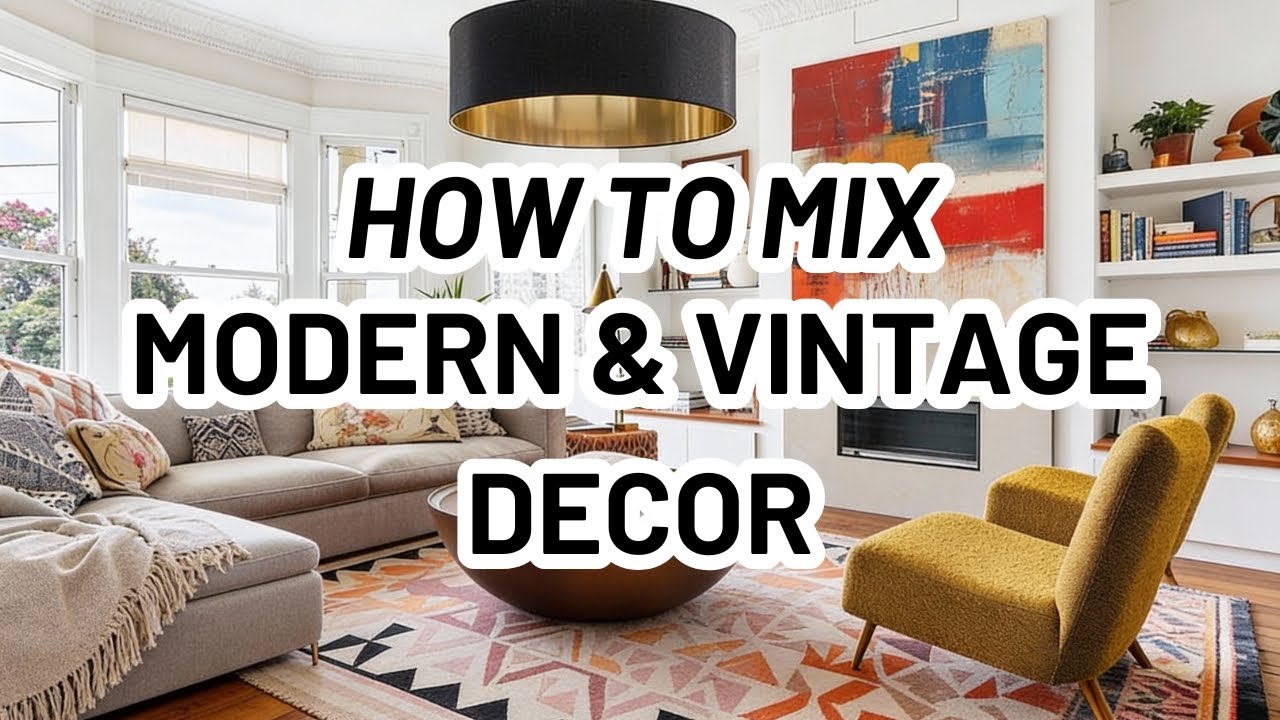
A practical visual guide to mixing vintage and modern furniture — covering focal points, material consistency, and the proportion principles that prevent mixed-style spaces from feeling chaotic.
Section 8: Professional Development and Industry Positioning
Becoming a Mixed-Style Authority
The design professionals who command the highest fees for mixed-style work are not necessarily those with the deepest theoretical knowledge. They are those who have documented their work most consistently and shared it most strategically. A case study published on your website, a before-and-after post on Instagram, a project feature in a trade publication — these are the evidence of expertise that prospective clients evaluate before they ever contact you.
Attending trade shows and design markets is non-negotiable for mixed-style specialists. Maison&Objet (Paris, biannual), Salone del Mobile (Milan, annual), and High Point Market (North Carolina, biannual) are the three tier-one events for furniture and design professionals. Beyond product discovery, these events provide market intelligence about where design direction is moving — which contemporary aesthetics are emerging, which vintage categories are gaining commercial traction, and which material stories are resonating with the most influential design voices. That intelligence is what allows you to source ahead of demand rather than catching up to it.
Marketing Your Mixed-Style Expertise
Before-and-after content is the highest-performing marketing format for design professionals across every platform, and mixed-style transformations produce particularly compelling material because the contrast is visually dramatic and the “how did you do that” question creates natural engagement.
For showrooms and distributors, before-and-after content should extend beyond individual room transformations to showroom floor evolutions: document a display vignette, redesign it using mixed-style principles, and publish the comparison with a brief explanation of the design decisions. This demonstrates both product knowledge and design capability — which is exactly the positioning that differentiates a design-forward showroom from a warehouse operation.
Móveis Jade Ant publishes collections specifically curated for design professionals and distributors building mixed-style inventories — pieces selected for their material compatibility with both MCM and vintage contexts, at trade pricing structures that support professional margins. Building a sourcing relationship with a supplier whose curation philosophy aligns with your own design positioning is a significant time-saving advantage in a market where the right piece is everything.
Pricing and Profitability Strategy
Mixed-style design commands a premium because it requires genuine expertise: the curation judgment to know which pieces work together, the sourcing network to find them, and the communication skill to present the combination persuasively. That expertise is worth charging for — as a design consultation fee, as a curation service fee, or as an elevated markup on curated pieces that could not be independently sourced by the client.
Design consultation fees for mixed-style projects typically run $150–$350 per hour for experienced practitioners, billed separately from product procurement. This structure has a secondary benefit: it changes the client’s perception of your role from “furniture seller” to “design advisor who also happens to have access to excellent furniture.” That positioning commands different respect — and different pricing — than the former.
Section 9: Technology and Tools for Mixed-Style Design
Digital Design Tools for Client Presentations
The technology stack for professional mixed-style presentations has become both more powerful and more accessible in the past three years. The key platforms for furniture professionals:
| Tool | Primary Use | Price Point | Melhor para |
|---|---|---|---|
| Houzz Pro | 3D floor planning + client proposals | From $149/month | Showrooms with active client acquisition |
| SketchUp | 3D modelling + rendering | From $119/year | Designers producing detailed visualisations |
| Planner 5D | Quick room planning + client collaboration | From $14.99/month | Fast proposal turnaround |
| Canva Pro | Mood boards + digital presentations | From $16.99/month | Marketing content and sample boards |
| Morpholio Board | Professional mood boarding + spec sheets | From $9.99/month | Design practices focused on curation |
For mixed-style proposals specifically, the most valuable digital capability is before-and-after rendering: the ability to show a client’s existing space transformed by the proposed scheme. This addresses the most common barrier to mixed-style purchase decisions — the client’s inability to visualise how disparate pieces will coexist in their specific space. A high-quality rendering removes that imaginative barrier and allows the decision to be made on enthusiasm rather than uncertainty.
Inventory Management Systems
For showrooms and distributors managing mixed-style inventory, the investment in a dedicated inventory management system pays for itself in reduced sourcing duplication and improved sales team effectiveness. The system needs to do one thing exceptionally: enable cross-style pairing. When a salesperson pulls up a piece a client is interested in, the system should immediately surface the three to five other pieces in current inventory that work best alongside it.
This cross-referencing capability requires deliberate data entry — tagging each piece with its compatible style families, material families, and price tier — but the commercial return is significant. Showrooms that implement systematic cross-referencing report 20–30% higher average transaction values within the first six months, because clients who would previously have bought a single piece buy two or three once the combination has been clearly demonstrated.
Marketing and Social Media Strategy
Mixed-style content performs strongly across all design-adjacent social platforms because it is inherently educational — it explains a design decision, not just showcases a result. The most effective content formats: before-and-after imagery (highest engagement, most shareable), short video walkthroughs of a vignette explaining the design rationale (builds expertise positioning), and “why these pieces work together” close-up posts (teaches the audience, builds community).
Instagram and Pinterest remain the primary platforms for furniture and interior design marketing, but LinkedIn is increasingly important for B2B positioning among design professionals, hospitality developers, and commercial interior architects. Thought leadership content published on LinkedIn — practical articles about sourcing challenges, pricing strategy, or client communication — reaches the professional buyer audience that delivers the highest-value projects.
Section 10: Future-Proofing Your Mixed-Style Business Model
Emerging Trends in Style Mixing
Sustainability is redefining the vintage market’s value proposition in ways that directly benefit design professionals who have built sourcing expertise. The circular economy argument for vintage and MCM furniture — well-made pieces that last decades rather than years, that carry embodied carbon from original manufacture rather than requiring new production — is now a mainstream client value, not a niche ethical position. Design professionals who can substantiate their vintage sourcing with genuine quality data (construction standards, material provenance, restoration quality) are meeting a client demand that will continue to grow.
The global influences trend in mixed-style interiors is accelerating: Japanese Wabi-Sabi aesthetic principles applied to Western MCM pieces, North African textile traditions introduced into Scandinavian-influenced contemporary schemes, Indian brass and craft objects alongside clean European contemporary furniture. For sourcing networks, this means expanding beyond domestic and European vintage channels into international sourcing relationships — which require deeper supplier relationship investment but deliver genuine competitive differentiation.
Technology integration into classic spaces — smart home devices, integrated AV, architectural lighting systems — creates a specific challenge for mixed-style design: how do you incorporate technology without it destroying the material integrity of a curated vintage or MCM space? The answer emerging from the most sophisticated hospitality and residential projects is concealment: technology that is fully functional but invisible, allowing the design integrity of the space to remain complete.
Adapting to Market Changes
Supply chain disruptions have permanently changed the risk calculus for contemporary furniture inventory. Extended lead times, cost volatility, and import disruptions are now permanent features of the global furniture market rather than exceptional circumstances. This structural shift actually advantages mixed-style specialists who maintain significant vintage and MCM inventory: these pieces are not affected by container shipping delays or tariff changes, because they already exist.
Building resilience through diversification means maintaining sourcing relationships across at least three distinct channels for each style category: no single supplier or sourcing network should represent more than 35% of any category’s supply. This diversification reduces concentration risk and ensures that a disruption to any single relationship does not halt project delivery.
Building a Scalable Curation System
The curation process — identifying pieces that work together, developing a coherent sourcing strategy, maintaining quality standards across categories — is the bottleneck in most mixed-style businesses when volume grows. The way to scale it is to systematise the judgment: create a written design brief for your showroom’s signature style (the specific combinations that define your aesthetic), develop a sourcing framework that prioritises pieces compatible with that brief, and train team members in the application of that framework so that curation decisions do not all require principal-level judgment.
For distributors and multi-location showrooms, building a signature aesthetic — a recognisable curation identity that clients associate specifically with your business — is one of the most powerful long-term brand assets available. Jade Ant Furniture’s trade collections are curated with this principle in mind: pieces selected for their cross-era compatibility, available to design professionals and distributors building a distinctive mixed-style inventory position.
Quick Reference: The Mixed-Style Design Glossary
| Term | Definition | Practical Application |
|---|---|---|
| 60-30-10 Ratio | Dominant style (60%), secondary style (30%), accent (10%) distribution | Apply to every room design to prevent visual chaos |
| MCM (Mid-Century Modern) | Design movement 1945–1969; clean lines, organic shapes, natural materials | The most commercially versatile vintage category for mixed-style applications |
| Vintage | Furniture at least 20 but fewer than 100 years old | The personality layer in mixed-style spaces; highest curation judgment required |
| Antique | Furniture 100 years or older | Reserved for specific period applications; requires authentication documentation |
| COM / COL | Customer’s Own Material / Leather; client-specified fabric applied to a manufacturer’s frame | Allows MCM frames to be reupholstered in materials that work within a contemporary palette |
| Martindale Rub Count | Fabric abrasion resistance measure; minimum 35,000 for hospitality applications | Always specify for hotel and commercial mixed-style applications |
| Visual Hierarchy | The arrangement of elements by importance (hero piece > secondary > accent) | The structure that prevents a multi-era space from feeling chaotic |
| Material Bridge | A material (walnut, brass, linen) that appears authentically in multiple design eras | The primary tool for creating visual unity across style families |
| Vignette | A styled grouping of furniture and accessories that tells a complete design story | The fundamental unit of showroom merchandising and client proposal imagery |
 A hotel corridor vignette: the vintage console provides architectural weight, the contemporary lighting maintains freshness, and the MCM-influenced seating bridges both eras — commercial mixed-style design where every decision is also a durability and maintenance decision.
Your Competitive Edge in Mixed-Style Design
Why This Expertise Matters Now
The interior design market is large, growing, and increasingly differentiated by curation rather than product access. In 2015, the competitive advantage in the furniture trade was supplier relationships — who had access to the best product at the best price. In 2025, the competitive advantage is design intelligence — the ability to present a complete visual concept that a client can live in emotionally before they have purchased a single piece.
Mixed-style design expertise is the most commercially powerful expression of that intelligence. It produces higher average order values (because clients buy across categories), stronger client loyalty (because the results are more distinctive than single-style schemes), and more compelling marketing content (because before-and-after transformations are inherently shareable). The design professionals and showrooms that build this capability consistently and document it rigorously are establishing a position that will be increasingly difficult for competitors to replicate.
Your Action Plan
Start this week: walk your showroom floor and identify one existing display that you can rework using the 60-30-10 principle. You do not need new inventory — you need a new arrangement of existing pieces with a clear ratio, a material throughline, and one designated hero piece. Document the before and after. Share it with your team, your trade clients, and your social audience. The response will tell you everything you need to know about the appetite for this kind of expertise in your market.
In the next 30 days: audit your inventory against the three style categories. How many pieces in each category do you currently hold? What are the gaps? Identify the two or three MCM or vintage pieces that, if you could source them, would transform your current strongest vignette. Begin building the sourcing relationship that would make those pieces available to you consistently.
In the next 90 days: build your first documented mixed-style case study. Take a client project — past, present, or proposed — and document the design rationale, the sourcing strategy, the specific pieces selected, and the result. Publish it. This single case study is worth more to your market positioning than any amount of general product marketing.
Ready to Transform Your Showroom Into a Mixed-Style Destination?
Start by auditing your current inventory for pieces that work together across styles. Create one showcase vignette this month using these principles, document the process, and watch how clients respond. Explore Jade Ant Furniture’s curated B2B collections — trade-priced pieces selected specifically for their cross-era compatibility — and build the mixed-style sourcing foundation your business needs to differentiate and grow.
Explore Jade Ant Furniture’s Trade Collections →
Perguntas frequentes
1. How do I know if pieces from different eras will actually work together in a specific client space?
Apply the 60-30-10 ratio and check for a material throughline before making any final sourcing decisions. If the pieces you are considering share at least one natural material in common — walnut wood tones, brass metal, linen or natural textile — they will harmonise in the space even if they come from different design periods. The most reliable test is a physical mock-up: arrange the actual pieces together (or high-quality photographs of them at scale) before presenting to the client. Digital rendering tools make this increasingly accessible — and a rendered combination that you can walk a client through creates far more confidence than a list of product names. If a specific piece creates conflict in every combination you try, the issue is usually scale, not style — a proportion adjustment will often resolve it.
2. What is the difference between eclectic mixing and clashing chaos, and how do I explain this to clients?
Eclectic mixing has an underlying structure that a trained eye can decode; chaos does not. The structure is the 60-30-10 ratio (clear dominance hierarchy), a defined palette of neutral anchors (material consistency), and one clear focal point per visual grouping (hierarchy). When all three are present, a space can include pieces from five different eras and read as intentionally curated. When any one of them is missing, the space reads as randomly assembled — even if the individual pieces are beautiful. To communicate this to clients, use before-and-after examples from your own showroom or portfolio. Show them a space where mixing worked, explain the three structural principles that made it work, and then show them a space (a competitor’s display or a publicly available image) where it did not. The visual comparison is worth ten minutes of verbal explanation.
3. How do I maintain a consistent supply of quality vintage and MCM pieces for my showroom?
Systematic relationship-building across multiple sourcing channels is the only reliable approach. Build a primary relationship with a reputable estate sale company who understands your quality requirements and will contact you before items go to general sale. Establish an auction house account with at least one specialist in MCM and 20th-century furniture. Register with two or three online platforms (1stDibs, Chairish) for access to authenticated pieces with provenance documentation. Attend at least two major antique markets or trade fairs annually. And maintain a client wish list — a documented record of specific pieces or categories that your most active clients are looking for. That wish list drives your sourcing priorities and ensures that what you source has a buyer.
4. What is the right markup strategy when mixing high-end contemporary with vintage pieces in a single project?
Price based on your curation expertise and the specific contribution each piece makes to the scheme, not on a uniform percentage above acquisition cost. A well-sourced and restored MCM chair that anchors a design scheme and is demonstrably not available elsewhere warrants a premium markup — typically 60–80% above your total cost including restoration. A contemporary sofa from a supplier whose trade pricing is known in the market warrants a more competitive markup — typically 30–45% above wholesale. The project-level margin is the metric that matters, not the per-piece markup. Create package pricing for complete vignettes or room schemes — this bundles your curation expertise into the pricing rather than making it a per-item calculation, which protects your margins and positions your design contribution as the value driver.
5. How do I handle client hesitation about investing in vintage pieces that might need restoration?
Reframe the conversation around durability and value, not condition. A solid walnut MCM chair from the 1960s that has been professionally reupholstered has already proven its structural longevity — the frame is 60 years old and still sound, which is more durable evidence than any new production guarantee. Bring the restoration cost into your transparent pricing rather than hiding it: “This chair is $1,100, which includes the restoration to the frame and the new upholstery in a commercial-grade linen — you are getting a structurally sound 1960s original for the price of a quality reproduction.” Provide before-and-after images from your restoration partner. Offer a post-restoration warranty that covers structural integrity for a defined period. These measures convert a condition concern into a quality conversation.
6. Do mixed-style design principles work in smaller spaces, or are they only effective in larger rooms?
Mixed-style design works particularly well in small spaces because it prevents the visual monotony that makes compact areas feel smaller than they are. The discipline required in small spaces is scale: every piece must earn its presence because there is no room for even one oversized or disproportionate element. Apply the 60-30-10 ratio more strictly — the 10% accent layer in a small space might be a single vintage object rather than a collection. Use the MCM layer to introduce visual interest through form rather than mass (a tapered leg, a distinctive silhouette) rather than through large statement pieces. And be rigorous about negative space: in a small room, what you leave out is as important as what you put in.
7. How do I train sales team members to confidently recommend mixed-style combinations to clients?
The most effective training is floor-based, not classroom-based. Walk each team member through every display vignette and require them to explain, in their own words: what the dominant style is, what the secondary style adds, what the accent layer contributes, and what the material throughline is. If they can explain it fluently, they can sell it. If they cannot, they need more time with the display before engaging clients on it. Supplement floor training with a printed style guide specific to your showroom — a document that describes each display’s design rationale in plain language, with photographs. This becomes the reference material for staff when they encounter a client question they cannot immediately answer.
8. Which materials and finishes work best when bridging contemporary, mid-century, and vintage styles?
Walnut and teak are the most universally effective natural wood bridges — they appear authentically in design from the 1930s through to today, and their warm, grain-forward character signals quality across all eras. Brass and warm gold-toned metals work across all three style families: they appear in contemporary fixtures, are central to MCM design vocabulary, and have been a premium finish in furniture since antiquity. Natural linen and wool textiles bridge styles because they are material-first rather than pattern-first — their texture reads as quality without making a strong period claim. Leather, particularly in mid- to full-grain grades in warm naturalistic tones, is similarly era-agnostic. What to avoid: plastic-dominant contemporary pieces (material mismatch with quality vintage), highly glossy lacquered finishes (clash with the material honesty of MCM and vintage), and color-matched furniture sets (they eliminate the visual tension that makes mixed-style design interesting).
9. How do I photograph mixed-style spaces effectively for proposals and marketing?
Shoot in natural light where possible, and schedule shoots for the time of day when the room’s natural light is at its best. Mixed-style spaces need photography that captures the material relationships between pieces — the way walnut tones echo from a MCM chair to a vintage sideboard to a contemporary table — which requires a camera position that shows multiple pieces in a single frame rather than individual product shots. Always photograph from three positions: a wide establishing shot that shows the complete vignette, a mid-distance shot that captures two or three pieces in relationship, and two or three close-up detail shots that show the specific material and finish interactions that make the combination work. The detail shots are often the most commercially effective — they teach the viewer something about design, which builds your expert positioning.
10. What is the best system for managing vintage inventory when some pieces are one-of-a-kind?
Digital cataloguing with availability status, condition notes, and cross-reference pairing tags is the minimum viable system. Each vintage piece should have a photograph, acquisition cost, restoration cost (if applicable), current asking price, condition grade, material tags, style family tag, and a “pairs well with” reference to other inventory pieces. When a piece sells, the inventory record should prompt you to check whether any other pieces in your “pairs well with” cross-reference list need to be repositioned in your display or repriced as individual pieces rather than a combination. Maintain a client wish list that records specific pieces or categories that active clients are seeking — this data should directly inform your next sourcing trip.
11. How do I position mixed-style design as a premium service that justifies higher consultation fees?
Document and communicate the expertise that goes into the service. A client brief that explains your sourcing process, your quality assessment framework, your design methodology, and the time invested in identifying pieces that work together converts design expertise from an assumed background activity into a visible, chargeable service. Publish case studies that show the before state, the design rationale (explaining each decision), and the after result. Develop a design consultation structure that includes a paid discovery session before any purchasing decisions — this positions you as a design advisor whose expertise exists independently of product sales, which is a fundamentally more valuable professional positioning than a showroom where advice is free and revenue depends only on what the client buys.
12. What should I recommend when a client wants a mixed-style space but has a limited budget?
Create three tiers of the same scheme: a premium version with authentic vintage and MCM pieces as the 30% layer and the 10% accent layer; a mid-range version using high-quality licensed reproductions as the MCM layer and genuine vintage accessories as the 10% accent; and a budget-focused version that uses contemporary pieces throughout with a single vintage statement piece as the hero. Present all three simultaneously, with visual representations of each tier. Most clients will choose the middle tier — which delivers the mixed-style aesthetic they want at a price point they can manage — but seeing the premium tier helps them understand the full value of what they are choosing. Focus the budget version’s investment on a single outstanding vintage piece: one excellent vintage mirror, lamp, or accent can transform an otherwise contemporary space for a fraction of the cost of a full mixed-style scheme.
Data references: US Interior Design Market Report, McKinsey personalization research, Second-Hand Furniture Market Report, Antiques Market Growth 2025, e Architectural Digest Vintage Chair Investment Guide. Design principles informed by trade expertise and ASID industry research.