Interior designers, showroom managers, and fit-out specialists face constant pressure to deliver high-end aesthetics for clients without inflating project costs. Budgets are tighter. Client expectations are higher. And the gap between the two is where your competitive advantage — or your margin loss — lives.
This comprehensive guide reveals proven strategies for sourcing premium furnishings at wholesale prices, mastering the art of mixing investment pieces with budget-friendly alternatives, and positioning your design solutions as luxury experiences that protect your profit margins. Every tactic here is built specifically for furniture distributors, agents, showroom owners, interior designers, and hotel fit-out specialists.

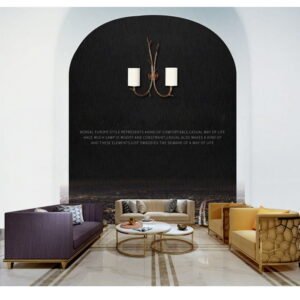
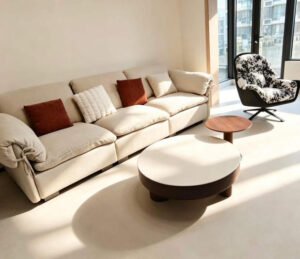
A well-curated living room where every piece earns its place — the result of strategic sourcing, not unlimited budget.
Why Budget-Conscious Luxury Is Your Competitive Advantage in B2B Design
The Market Shift: What Your Clients Actually Want
How Boutique Hotels and Corporate Spaces Are Redefining “Luxury” Around Experience, Not Price Tags
The definition of luxury has fundamentally shifted over the past decade. Where clients once equated luxury with recognisable brand labels and premium price tags, the dominant conversation in boutique hospitality and commercial design today centres on experience, atmosphere, and authenticity. A 40-room boutique hotel in Lisbon competes not by furnishing every room with Cassina, but by creating a cohesive narrative that guests photograph and share. A corporate headquarters in Singapore earns its reputation not by procuring the most expensive seating, but by delivering a space that communicates brand values the moment someone walks through the door.
According to DLR Group’s 2026 Hospitality Design Trends Report, the hospitality sector is increasingly prioritising immersive, experience-led design — spaces that create intentional, memorable moments for guests without necessarily requiring the highest FF&E (Furniture, Fixtures & Equipment — the procurement category covering all moveable furnishings in a project) spend per room. This shift is your opportunity as a distributor, showroom, or designer.
Why Interior Designers and Showroom Owners Who Master Budget Luxury Win More Contracts and Higher Retention Rates
When you can consistently deliver a space that looks like a $150,000 fit-out on a $60,000 budget, you don’t just close one project — you become the professional clients call first, refer most, and retain longest. The most profitable design businesses generate 40–60% of their revenue from repeat clients and referrals, according to industry surveys. That retention rate is built not on product access, but on strategic expertise.
Distributors and showrooms that position themselves as curation partners — not just product vendors — consistently command higher per-project fees and maintain stronger agent relationships than those competing purely on price per unit.
The Profit Opportunity for Distributors and Agents
How Mixing High-Low Furnishings Increases Your Project Margins Without Sacrificing Perceived Value
The high-low mixing strategy — selecting premium investment pieces for anchor positions while using cost-efficient alternatives for supporting roles — is one of the most reliable margin-protection tools available to B2B design professionals. Interior designers applying this framework typically apply 30–50% markups above trade cost, according to ASID industry benchmarks cited by Procurist. When your sourcing strategy is optimised, your margin opportunity grows at every tier.
Consider a hotel suite fit-out with a $12,000 FF&E budget per room. A purely premium approach might deliver four or five statement pieces. A strategic high-low approach delivers a complete, styled environment — bed frame, upholstered headboard, bespoke nightstands, accent chair, lighting, and textiles — while maintaining the same perceived value at 30% lower procurement cost. The designer captures the difference.
Building Client Loyalty Through Transparent, Strategic Sourcing That Exceeds Expectations
Clients who understand why you made specific sourcing choices — and see those choices validated in the finished space — become your most loyal advocates. Strategic transparency about sourcing is not a weakness; it is a positioning tool. Frame your budget decisions as deliberate curatorial choices, not compromises, and your clients will trust your expertise more deeply on every subsequent project.
Strategic Sourcing — Where Distributors Find Premium Furnishings at Wholesale Costs
Leveraging Direct Manufacturer Relationships
Negotiating Bulk Orders With Mid-Tier Manufacturers Who Offer Luxury Aesthetics at Distributor-Friendly Pricing
The most reliable way to access premium aesthetics at wholesale pricing is through direct relationships with manufacturers that operate below the radar of major retail brands. Mid-tier manufacturers — particularly those based in emerging production hubs — offer the same material quality, finish standards, and construction techniques as established luxury brands at 40–50% lower cost, simply because they haven’t invested in retail marketing infrastructure.
China-based manufacturers like Meuble Fourmi de Jade are built specifically for this sourcing model. With 15+ years of wholesale furniture manufacturing experience, Jade Ant supplies custom luxury furniture for hotels, villas, and commercial projects across bedroom, living room, dining room, and home office categories — with full customisation support (materials, colours, dimensions) and low MOQ flexibility that suits project-based ordering. For distributors and interior designers who need to bundle projects to meet volume thresholds, this operational flexibility is a significant advantage.
When approaching manufacturers directly, negotiate volume commitments in exchange for 20–35% discounts, and confirm quality control protocols, sample approval processes, and split-shipment flexibility upfront. Using a structured supplier checklist — covering certifications, lead-time verification, and third-party QC — protects your projects from costly surprises. Aurora Craft’s B2B Furniture Supplier Checklist provides a useful framework for structuring this vetting process.
Understanding MOQ Requirements and How to Bundle Projects to Meet Minimums Profitably
MOQ (Minimum Order Quantity — the smallest order a manufacturer will accept for a given product) is often cited as the primary obstacle to direct manufacturer relationships. In practice, it’s a logistics challenge, not a fundamental barrier. The solution is project bundling: coordinating the procurement timelines of multiple projects to combine orders. If Project A requires 20 dining chairs and Project B requires 15 identical chairs with a four-week lead time difference, ordering 35 units simultaneously typically unlocks price tiers that neither project could access independently — while reducing per-unit logistics costs.
Identifying Undervalued Suppliers and Emerging Brands
Scouting Regional and International Manufacturers Before They Become Mainstream (and Expensive)
The sourcing advantage in B2B design belongs to professionals who identify quality manufacturers 12–18 months before they enter mainstream retail channels. At that stage, prices are at their most competitive, partnership terms are most flexible, and the potential for exclusive regional agreements is highest. Monitor design publications, attend regional furniture markets in secondary cities, and follow emerging designers on social media to identify suppliers before they’re discovered by major retailers.
Building Exclusive Partnerships That Differentiate Your Showroom Offerings From Competitors
When you identify a manufacturer that meets your quality, aesthetic, and pricing criteria, negotiate exclusivity early. An exclusive regional supply agreement with a premium-quality emerging manufacturer creates a showroom offering that competitors simply cannot replicate — regardless of their budget. This is a structural competitive advantage that compounds over time as the manufacturer’s reputation grows.
Secondary Market and Overstock Sourcing for Showroom Inventory
Liquidation Channels, Factory Seconds, and Discontinued Lines That Maintain Quality While Reducing Cost
Liquidation channels, factory seconds, and discontinued manufacturer lines represent a significant sourcing opportunity that many distributors overlook due to perceived quality risk. In practice, factory seconds often involve minor cosmetic variations — slight colour inconsistencies, small surface imperfections — that are invisible in a styled room setting and command 30–60% discounts versus primary market pricing.
The key discipline is specificity: establish clear written specifications for acceptable variation before committing to bulk orders, and build relationships with 2–3 established liquidation suppliers so you can compare quality and pricing consistently.
Risk Management: Quality Control Protocols for Non-Traditional Sourcing Channels
Budget 5–10% of your procurement cost for potential returns or remediation when working with non-traditional channels. Inspect samples before committing. Document everything with photographs. Never source from unknown suppliers without verified references. The savings from secondary market sourcing are only real if the pieces arrive in condition that meets your project standards — the margin evaporates quickly if you’re managing client complaints and replacement logistics.

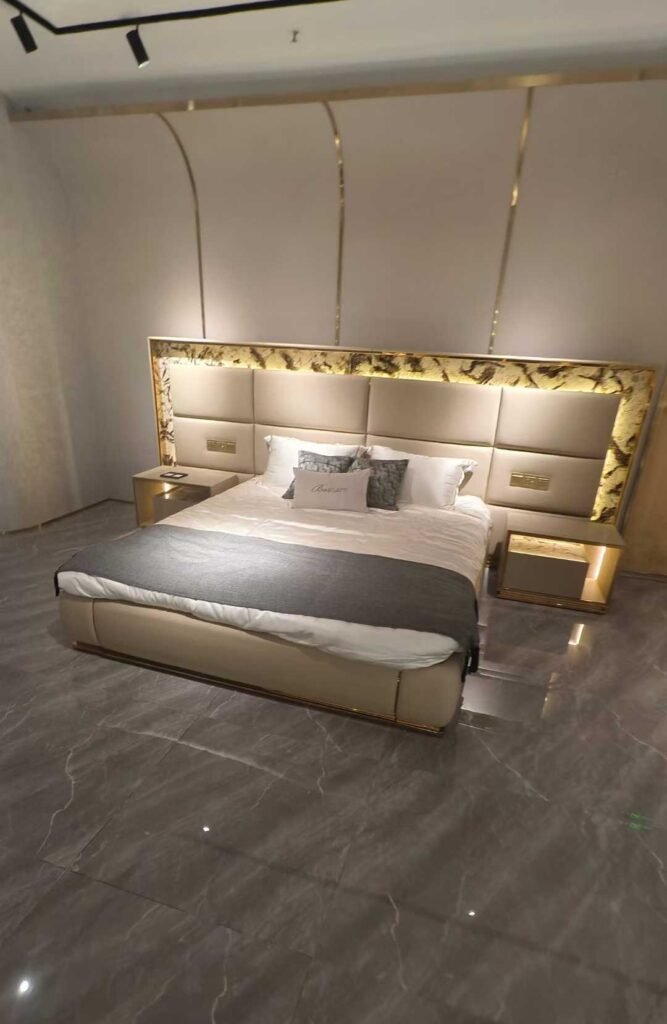
Luxury hotel bedroom achieved through strategic FF&E allocation — investment-grade upholstered headboard and custom nightstands anchor a room where supporting pieces are cost-efficiently sourced.
The Art of Mixing — Creating Cohesive Luxury Through Strategic Pairing
The Design Principle: Investment Pieces vs. Accent Furnishings
Which Categories Justify Premium Pricing and Which Can Be Budget-Friendly
The investment-vs-accent framework is built on a simple principle: spend where clients feel et photograph, save where they don’t. High-use, high-visibility pieces — statement sofas, custom bed frames, primary dining tables, principal lighting fixtures — justify premium procurement because their quality is immediately perceived through touch, proportion, and visual dominance. These are the pieces that define the room’s identity and the client’s confidence in your work.
Secondary pieces — accent chairs in low-traffic positions, side tables, decorative storage, artwork — can be sourced cost-efficiently without any reduction in perceived room quality, provided they share the same colour palette, material language, and finish family as the primary pieces.
| Furniture Category | Procurement Priority | Rationale |
|---|---|---|
| Statement sofa / sectional | Invest | Dominant visual anchor; daily tactile experience |
| Primary bed frame / headboard | Invest | Central visual focus of any bedroom; guest perception |
| Main dining table | Invest | Structural centrepiece; durability under daily use |
| Primary lighting (pendants, chandeliers) | Invest | Defines atmosphere; highly photographable |
| Accent chairs (secondary seating) | Balance | Visible but supporting role; quality finish required |
| Side tables / end tables | Save | Supporting role; finish alignment more important than build quality |
| Decorative storage / shelving | Save | Functional; contents and styling matter more than the piece |
| Cushions, throws, decorative objects | Save | High visual impact at low unit cost; refreshable seasonally |
How Interior Designers Use This Framework to Present Tiered Options to Clients Without Appearing Indecisive
Present the investment-vs-accent framework explicitly to clients as a strategic methodology, not as a budget workaround. When you can articulate why a specific piece deserves premium allocation and why another category is deliberately cost-efficient, you demonstrate curatorial expertise rather than cost constraint. Clients who understand the logic become co-investors in the strategy — not skeptics questioning your selections.
Color, Material, and Finish Strategies That Hide Budget Compromises
Selecting Finishes and Materials That Photograph Well and Feel Luxurious Despite Lower Price Points
Certain material finishes create a disproportionate perception of luxury relative to their actual cost. Brushed brass hardware, smoked glass, stone-effect laminates (high-pressure decorative surfaces that replicate the visual characteristics of natural stone), velvet upholstery, and matte lacquer finishes all test significantly above their price point in client perception surveys. When budget pieces share these finish languages with investment pieces, the price difference becomes visually invisible.
Critically, avoid shiny chrome, glossy white laminates, and visible MDF (Medium-Density Fibreboard — a cost-efficient manufactured wood product that signals budget positioning when exposed) edges — these materials read as budget choices in photographs and in person, undermining the entire project’s perceived value regardless of what premium pieces surround them.
Creating Visual Hierarchy So Budget Pieces Recede While Investment Pieces Command Attention
Visual hierarchy — the principle that some elements in a space should dominate visually while others recede — is the mechanism by which high-low mixing becomes invisible to clients. When a sculptural, bespoke sofa or a dramatic lighting installation commands the eye, the coffee table beneath it receives a fraction of the visual attention. Size, colour contrast, material finish, and lighting direction all determine which pieces lead and which pieces support. Master this sequence and you control perception regardless of procurement cost.
Building Collections That Tell a Cohesive Story Across Price Points
Styling Frameworks That Make Mixed-Price Furnishings Feel Intentional, Not Mismatched
Cohesion is achieved through restraint, not through uniformity of price. The most effective styling framework for mixed-price collections is the three-element rule: every room should share a consistent application of no more than three dominant colours, two primary materials, and one finish family across all pieces. When a $200 accent chair shares the same brushed brass hardware, the same warm off-white upholstery, and the same slender leg profile as the $2,000 sofa beside it, the price difference is indistinguishable to any client.
How Showroom Layouts Can Demonstrate These Combinations to Build Client Confidence
The most powerful selling tool for mixed-price collections is not a brochure or a quote — it is a complete, styled room setting in your showroom that demonstrates the principle live. Create three to four complete vignettes at different budget tiers using identical style directions, and place them adjacently so visitors can walk between them. Include discreet pricing cards that break down the total investment. When clients see that a $15,000 room setting and a $40,000 room setting can share the same visual language, their confidence in your methodology becomes the foundation for long-term partnership.
Procurement Tactics for Interior Designers and Fit-Out Specialists
Building a Curated Supplier Network That Scales With Your Projects
Vetting Suppliers for Reliability, Lead Times, and Quality Consistency Across Multiple Price Tiers
A reliable supplier network is built on verified performance, not on catalogue promises. For each furniture category, maintain relationships with two to three qualified suppliers at different price tiers. This gives you sourcing flexibility when project budgets vary, protects your projects from single-supplier delays, and provides competitive price benchmarks for every order. When vetting new suppliers, always request samples, verify lead-time commitments in writing, and ask for references from clients who have completed multiple repeat orders — not just first-time buyers.
Le Jade Ant furniture blog documents the full custom manufacturing process — from design confirmation to logistics — which reflects the transparency standards you should expect from any production partner in your network.
Negotiating Volume Discounts and Project-Based Pricing That Improve Your Project Profitability
Volume pricing — negotiated as a percentage discount applied to orders above a defined unit or dollar threshold — is the most direct lever for margin improvement in furniture procurement. Establish volume thresholds with your primary suppliers and work proactively to aggregate orders across projects to reach those tiers. Project-based pricing, where a supplier quotes a blended rate for a complete FF&E package, can deliver an additional 10–15% reduction versus line-item pricing, particularly for hotel fit-out projects where order diversity is high.
Managing Client Expectations Through Strategic Presentation
How to Frame Budget Selections as “Design-Forward Choices” Rather Than Compromises
Language matters more than price in client presentations. The moment you describe a selection as “more affordable” or “budget-friendly,” you’ve primed your client to perceive it as inferior. Instead, present cost-efficient choices using language that reflects design intent: “we’ve chosen a clean-lined, smoked-glass side table that draws the eye away from the supporting pieces and keeps the focal point on the sofa cluster.” The client hears curation. The budget is invisible.
Presenting Mood Boards and 3D Renderings That Showcase the Complete Vision Before Procurement
Professional renderings are one of the highest-leverage investments a design professional can make. A photorealistic 3D render that shows the complete furnished environment — before a single piece is ordered — allows clients to emotionally commit to the vision before they scrutinise individual product costs. Tools like Enscape (real-time rendering integrated directly into Revit and SketchUp), Lumion, et D5 Render deliver presentation-quality outputs that consistently reduce client revision cycles and accelerate procurement decisions. The rendering fee, charged separately as part of your design service, is a margin-protecting asset — not a cost.
Protecting Margins While Delivering Perceived Luxury
Pricing Strategies That Reflect Design Value Without Revealing True Product Costs
Separate your design fee from your product procurement pricing. When design expertise and product cost are bundled into a single line item, clients naturally focus on the product cost and begin questioning individual selections. When design fees are itemised separately — concept design, detailed specification, 3D presentation, project management, installation coordination — the value of your expertise becomes visible and defensible independent of what any individual piece costs. This structure protects your margins and prevents clients from going direct to suppliers.
Upselling Through Styling Services, Installation Expertise, and Project Management
Professional installation and final styling — positioning accessories, dressing beds, adjusting lighting — typically cost 5–10% of the total furnishing budget and elevate perceived project value by a disproportionate margin. Clients who see a professionally installed and styled space versus a standard installation understand immediately why the premium is justified. Offer these services as distinct, profitable add-ons, not as bundled necessities.
Decor Elevation Techniques That Maximise Impact Per Dollar Spent
Strategic Styling and Accessorising for Premium Appearance
High-Impact, Low-Cost Accessories That Transform Basic Furnishings
Accessories allocated at 10–20% of a project’s furnishing budget deliver some of the highest perceived-value returns in interior design. Oversized mirrors positioned opposite windows double natural light and create spatial depth that clients interpret as an indicator of high-end design. Large-format artwork anchors walls that would otherwise undermine an expensive sofa arrangement. Curated decorative objects — sculptural ceramics, architectural books, organic textures — signal that a space has been deliberately styled, not simply furnished.
When advising clients on accessory budgets, frame the investment this way: “A $3,000 accessory selection on a $25,000 room can increase the perceived value of that room to $35,000 — that’s a 40% uplift on perception for 12% additional spend.”
Sourcing Statement Pieces — Mirrors, Wall Art, Sculptural Objects — That Create Perceived Luxury
Statement accessories need not be expensive to be impactful. Scale and proportion matter more than price. A large-format mirror with a simple black powder-coated frame commands more presence than a small, ornate gilt mirror at triple the cost. A single oversized canvas in muted tones creates more luxury perception than a gallery wall of small, competing prints. Source statement accessories at scale — and use them sparingly.
The Psychology of Negative Space and Curation in Luxury Design
Negative space (the deliberately empty areas of a room — around and between furniture and objects — that create visual breathing room) is one of the most powerful and misunderstood tools in luxury interior design. Crowded spaces — regardless of the quality of individual pieces — read as budget environments because they signal that every inch of space needed to be filled. Luxury environments are characterised by restraint: fewer pieces, more intentional positioning, and deliberate empty space that allows each element to be seen completely. If your showroom or project budget forces you to choose between buying one more piece or leaving well-curated space, choose the space.
Lighting Design as a Luxury Multiplier
How Layered Lighting Elevates Even Modest Furnishings
Lighting is the single most cost-effective luxury multiplier available in interior design. A room furnished at mid-tier specifications but lit with a layered system — ambient lighting (the general fill light of the space), task lighting (focused light for functional activities), and accent lighting (directional light that highlights key features or objects) — consistently outperforms a premium-furnished room with flat overhead lighting in client perception assessments.
The mechanism is simple: directional accent lighting creates contrast and shadow that gives texture and depth to any surface. A $600 upholstered chair under a focused warm-toned wall washer reads as a $1,800 chair. This is not an aesthetic illusion — it is the correct application of design principles that luxury hospitality projects have used for decades.
Budget-Friendly Lighting Solutions That Deliver High-End Aesthetics for Hotels and Showrooms
LED strip lighting behind headboards and beneath furniture creates ambient glow effects associated with five-star hotel environments at a fraction of custom lighting installation costs. Dimmable warm-white fixtures (2700K–3000K colour temperature) applied consistently across a project replace the need for expensive custom luminaires in supporting positions. Reserve budget for primary pendant and chandelier lighting — the pieces that photograph and define first impressions — and optimise cost in secondary and tertiary positions.

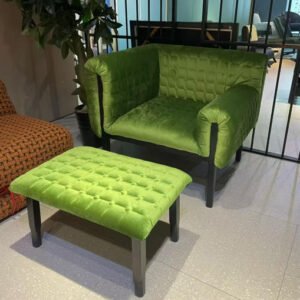
Hospitality-grade seating and lighting working in combination — the perceived luxury here comes as much from the layered lighting and material finish alignment as from the individual piece specifications.
Textile and Material Selection for Maximum Visual Impact
Choosing Fabrics and Textures That Signal Luxury Without Premium Price Tags
Certain fabric and material choices carry an inherent luxury signal that clients associate with high-end hospitality and residential design regardless of their unit cost. Velvet (woven fabric with a short, dense pile that creates both visual depth and tactile richness) is particularly powerful — it photographs beautifully, feels premium to the touch, and is available at accessible price points across the market. Bouclé (a looped, textured yarn fabric increasingly prominent in contemporary luxury interiors), linen-cotton blends, et faux leather with visible stitching detail all perform similarly — high perceived value relative to actual procurement cost.
Avoid polyester-dominant fabrics in visible upholstery positions. They reflect light flatly, age quickly, and communicate budget positioning to clients who work with premium interiors regularly.
Seasonal and Trend-Responsive Textile Strategies That Keep Showroom Displays Fresh
Textiles are the lowest-cost, highest-frequency opportunity to update showroom displays. Seasonal textile swaps — cushion covers, throws, table runners, area rugs — can transform the mood of a complete room setting for under $500, refreshing your showroom display quarterly without requiring new furniture investment. Track the Dezeen material and colour trend reporting to anticipate textile directions 6–12 months ahead of mainstream adoption, and brief your textile suppliers accordingly.
Showroom and Display Strategy — Selling the Vision, Not Just the Products
Merchandising Budget Pieces in Luxury Contexts
Room-Setting Displays That Demonstrate How Affordable Pieces Function in Premium Environments
The most effective showroom merchandising strategy for budget-luxury positioning is the complete room-setting display, structured at clearly defined investment tiers. Consider building four signature vignettes — a $5,000 composition, a $15,000 composition, a $30,000 composition, and a $50,000+ composition — using identical stylistic direction across all four. The visual consistency demonstrates your curatorial expertise. The price differentiation helps clients self-select their investment level with confidence rather than anxiety.
The critical execution detail: every vignette must be professionally photographed under controlled lighting conditions. These images become your primary B2B sales assets — shared with agents, used in presentations, and featured across your digital presence including the Meuble Fourmi de Jade partner network.
Creating “Aspirational Vignettes” That Justify Design Fees and Positioning
An aspirational vignette (a styled, complete room composition in a showroom that demonstrates the designer’s complete aesthetic vision, typically exceeding the average client budget, to establish the reference point from which all other tiers are positioned) serves as your positioning anchor. When a client sees what $50,000 looks like at its best, a $15,000 composition they might otherwise have perceived as basic suddenly looks like exceptional value. Always show your best work first.
Digital Presentation Tools for Remote Clients and Agents
3D Rendering and Visualisation Software That Sells the Complete Vision Before Procurement
For distributors and designers working with agents, remote clients, or hospitality operators across multiple geographies, digital presentation capability is no longer optional — it is a baseline expectation. Invest in rendering tools that integrate directly into your design workflow. Enscape and Lumion both offer real-time rendering within SketchUp environments, meaning a designer can present an updated room layout within minutes of a client’s feedback, not days later.
Le 2026 rendering tool review published by Chaos Blog identifies Enscape, V-Ray, D5 Render, Lumion, and Twinmotion as the five consistently leading platforms for interior design presentations — each with different integration strengths depending on your primary design software.
Virtual Showroom Capabilities That Help Agents and Designers Close Deals Faster
Virtual showroom environments — interactive 3D spaces that agents and clients can navigate independently — reduce the geographic barrier for distributor-agent relationships significantly. An agent based in Dubai reviewing a manufacturer’s new collection in a virtual showroom environment can specify, comment, and shortlist pieces without an in-person factory or showroom visit. This accelerates the specification cycle and increases the depth of the commercial relationship between distributors and their agent networks.
Building Confidence Through Transparent Communication
How to Discuss Budget Constraints With Clients Without Diminishing Perceived Value
Reframe the budget conversation entirely. Replace the phrase “with your budget, we can do…” with “given your investment parameters, we’re targeting…” The distinction signals that you are investing strategically within a defined frame — not compromising within a limitation. Provide clients with a structured breakdown of how their budget is allocated across categories (40% on primary furniture, 20% on lighting, 15% on textiles, 15% on accessories, 10% on installation and styling) so they understand the logic of your procurement decisions rather than evaluating individual prices in isolation.
Creating Design Narratives That Position Smart Sourcing as Intentional Strategy, Not Necessity
Every project should have a narrative — a brief, compelling story about what this space is, who it serves, and what it communicates. When your sourcing decisions are framed within that narrative, they become design choices, not cost-cutting measures. “We sourced the dining table from a Shenzhen manufacturer whose material quality matches European standards at 45% lower cost — which freed budget for the lighting installation that defines this room” is a narrative that builds client trust and positions your sourcing expertise as a value-add, not a workaround.
Project Management and Execution — Delivering Luxury Consistently
Quality Control Across Mixed-Price Sourcing
Inspection Protocols That Ensure Budget Pieces Meet Luxury Standards
Implement a standardised inspection checklist for every piece in your project procurement, regardless of source tier. This checklist should cover: finish quality and consistency, joint integrity and structural stability, hardware alignment and function, upholstery tension and seam quality, and packaging suitability for international transit. Budget pieces that pass this checklist are indistinguishable from premium pieces in a finished installation. Budget pieces that don’t pass — and are installed without remediation — become client complaints that cost you the relationship.
Managing Supplier Relationships to Maintain Consistency Across Repeat Projects
Supplier relationships in B2B furniture procurement compound over time. Manufacturers who have fulfilled two or three of your projects understand your quality standards, your communication preferences, and your lead-time requirements without needing to re-establish the baseline on every order. This relationship compounding is a competitive asset — it gives you faster turnaround, more flexible payment terms, and priority production scheduling on time-sensitive projects. Invest in maintaining your best supplier relationships with regular communication, prompt payment, and feedback on completed orders.
Installation and Styling as Profit Centres
How Professional Installation and Final Styling Justify Design Fees and Elevate Perceived Value
The installation and final styling phase is where projects are won or lost in client perception — and where the most significant margin opportunity exists for design professionals. A room where furniture is correctly positioned, art is hung at the right height, textiles are dressed professionally, and lighting is calibrated to the intended atmosphere looks fundamentally different from the same room assembled by a logistics team. Charge for this service as a discrete line item in your project fee structure — typically 5–10% of total project value — and deliver it with a level of craft that makes the fee completely self-evident.
Training Your Team to Execute the Luxury Vision During Final Project Phases
Your installation team is the final creative executor of every project your business delivers. Invest in training that covers correct furniture positioning principles, textile dressing techniques, lighting calibration, and the specific styling elements that differentiate a luxury installation from a standard one. The cost of this training is recovered on the first project where a professionally styled installation generates a client referral that wouldn’t have come from a standard delivery.
Documentation and Portfolio Building
Photography and Case Studies That Showcase Your Budget-Luxury Projects to Future Clients
Professional photography of completed projects is your most valuable marketing asset. A well-photographed room setting demonstrates your capability to prospective clients more convincingly than any brochure, rate card, or verbal description. For each completed project, invest in a half-day professional photography session. The images serve your website, your social media, your agent presentations, and your pitch decks for the next three to five years — delivering ongoing commercial value from a single session.
Structure case studies around the budget-luxury narrative: “Project brief: boutique hotel suite, $11,000 FF&E budget per room. Result: 4.8/5.0 guest satisfaction rating and a three-project repeat order.” These stories speak directly to the ROI concerns of hospitality operators and project managers.
The Budget-Luxury Procurement Framework
Use this table as your starting allocation guide for project-based FF&E procurement. Adjust percentages based on project type and client priorities.
| Budget Tier | Total FF&E Budget | Primary Furniture (%) | Lighting (%) | Textiles & Accessories (%) | Styling & Install (%) |
|---|---|---|---|---|---|
| Entry-Level Luxury | $5,000 – $15,000 | 55% | 20% | 15% | 10% |
| Mid-Range Luxury | $15,000 – $35,000 | 50% | 20% | 18% | 12% |
| Upper Mid-Range | $35,000 – $60,000 | 48% | 22% | 18% | 12% |
| Premium Luxury | $60,000 – $100,000 | 45% | 25% | 20% | 10% |
| Ultra-Luxury | $100,000+ | 40% | 25% | 22% | 13% |
Hotel reference point: Luxury hotels typically allocate $25,000–$50,000 per room for FF&E; mid-scale properties budget $8,000–$15,000 per room. (Source: HYSD Furniture FF&E Guide)
Supplier Evaluation Scorecard for B2B Furniture Procurement
| Evaluation Criteria | Weight | Key Verification Method |
|---|---|---|
| Lead-time reliability (on-time delivery rate) | 25% | References from 3+ completed projects |
| Quality consistency across repeat orders | 25% | Sample approval and third-party QC inspection |
| Customisation capability | 20% | Sample order for a bespoke specification |
| MOQ flexibility for project-based ordering | 15% | Written confirmation of split-shipment terms |
| Communication and responsiveness | 10% | Trial period across 2–3 enquiries |
| Logistics and trade process support | 5% | Review of customs documentation support |

A custom home office environment where every piece is specified to the brief — structured procurement and careful material selection create the perception of high investment regardless of actual cost allocation.
Technology and Tools That Streamline Budget-Luxury Design
Design Software and Visualisation Platforms
Tools That Help Designers and Showroom Managers Present Mixed-Price Concepts Effectively
The right rendering platform transforms your client presentation from a catalogue exercise into a creative experience. Enscape integrates directly into SketchUp and Revit, providing real-time rendering that allows designers to adjust lighting, materials, and furniture placement during client meetings. Lumion’s extensive material library and landscape integration make it particularly effective for hospitality and villa fit-out presentations. For teams working primarily in SketchUp, D5 Render provides photorealistic outputs with a significantly shorter learning curve than traditional rendering pipelines.
For inventory management and supplier relationship tracking, platforms like Fohlio (a specification and procurement management tool designed specifically for interior design firms and FF&E procurement) provide the operational backbone for managing complex, multi-supplier project environments. Fohlio’s FF&E procurement guide outlines best practices for specification management that are directly applicable to distributors managing large project portfolios.
Inventory Management Systems That Track Sourcing Options and Supplier Relationships
Centralise your supplier network in a structured CRM or inventory management system that records lead times, MOQ thresholds, pricing tiers, and quality ratings for each supplier relationship. This data becomes increasingly valuable over time — it allows your team to source accurately and quickly on new projects without repeating vetting processes, and it builds institutional knowledge that stays with your business regardless of individual staff changes.
Project Management and Client Communication Tools
Platforms That Streamline Procurement, Budgeting, and Timeline Management
Programa is a purpose-built interior design project management platform that integrates specification, procurement, and client communication into a single workflow. For distributors managing parallel projects with multiple clients, it provides the timeline visibility needed to coordinate supplier lead times, bundle orders for MOQ optimisation, and maintain accurate budget tracking across every project. The Programa FF&E procurement guide outlines the platform’s application to multi-tier sourcing environments specifically.
Transparency Tools That Build Client Trust Through Real-Time Project Visibility
Modern clients — particularly those managing hospitality or commercial developments — expect real-time visibility into procurement status. Platforms that provide shareable project dashboards, supplier confirmation tracking, and delivery milestone notifications eliminate the most common source of client anxiety in long-lead furniture projects: the unknown. When clients can see that their order has been confirmed, production is scheduled, and logistics are arranged, they focus their attention on design decisions rather than project management concerns. This reduces revision requests and client calls while strengthening your professional positioning.
Common Challenges and Solutions for B2B Design Professionals
Managing Client Expectations When Budget Is Limited
Communication Frameworks That Position Constraints as Creative Opportunities
The most effective communication framework for constrained-budget projects is the priority-tier brief: at the outset of every project, present clients with three categories — non-negotiables (the pieces that define the project’s identity and justify premium procurement), important-but-flexible (pieces where quality matters but aesthetic range is wide), and opportunistic (pieces where cost optimisation serves the project without compromise). This framework gives clients ownership of the strategic choices, reduces second-guessing throughout the project, and positions you as a strategic consultant rather than a product selector.
Presenting Phased Approaches That Deliver Immediate Luxury While Planning Future Upgrades
Phased delivery — where a project is executed across two or three investment cycles over 12–24 months — is one of the most effective retention tools in B2B design practice. Phase 1 delivers immediate, high-impact results (primary furniture, lighting, key textiles) that allow the client to begin using and experiencing the space. Phase 2, planned and budgeted at inception, completes the vision with secondary pieces and accessories. This approach generates recurring revenue and deepens the client relationship beyond a single transaction. Document the phased plan in writing — it becomes a commitment that motivates Phase 2 conversion.
Balancing Speed and Quality in Procurement
Strategies for Meeting Tight Timelines Without Compromising on the Luxury Aesthetic
Build a rapid-response sourcing library — a curated shortlist of in-stock or near-stock pieces across all major categories at multiple price tiers, sourced from suppliers with confirmed 2–4 week lead times. When a client presents a compressed timeline, your rapid-response library allows you to propose a complete, curated solution within 48 hours rather than spending days qualifying new suppliers. This capability is a commercial differentiator that clients and agents value highly — particularly in hospitality fit-out where project delays carry direct revenue costs.
Building Buffer Time Into Projects Without Inflating Costs
Standard practice in hotel and commercial fit-out procurement is to plan procurement 4–6 months ahead of the installation date, allowing buffer time for production delays, customs clearance, and logistics coordination without requiring expedited shipping fees. HYSD’s FF&E procurement guide recommends sourcing 3–5 potential suppliers per item category to maintain competitive pricing while protecting against single-supplier risk. Build this buffer into your project timeline as a standard deliverable — not as a contingency — and communicate it to clients as professional practice rather than caution.
Staying Competitive While Maintaining Margins
Positioning Your Design Expertise as the True Value Proposition, Not the Furnishings Themselves
The most profitable B2B design businesses compete on expertise, not on product access. Any client can access a furniture catalogue. Only a qualified design professional can curate that catalogue into a cohesive, luxury-performing environment within a defined budget and timeline. When your value proposition is clearly framed around curatorial expertise, project management capability, and sourcing relationships — not around product availability — you compete in a market where your primary competitors are other design professionals, not product platforms.
Building Recurring Revenue Through Maintenance, Refresh, and Upgrade Services
Structure your post-project service offering proactively. Propose a 12-month maintenance review — a site visit to assess textile condition, identify replacement needs, and propose seasonal refresh selections — as part of every project proposal. For hospitality clients, propose a 3-year FF&E refresh cycle aligned with their property management schedule. These recurring engagements generate predictable revenue, maintain your relationship with the client, and create a continuous pipeline of sourcing orders that benefits your supplier relationships through sustained volume.
Future-Proofing Your Budget-Luxury Strategy
Trend Forecasting and Staying Ahead of Market Shifts
Monitoring Design Trends to Source Pieces That Remain Relevant Longer
Furniture procurement decisions made today will define a client’s environment for 5–10 years. Sourcing pieces that align with enduring design directions — rather than short-cycle trend moments — protects both the client’s investment and your professional reputation. Monitor trend forecasting from sources including Dezeen et Architectural Digest to distinguish between trend cycles that will sustain 3–5 years and micro-trends that peak in 18 months. Source primarily within the former; use the latter selectively for accessories that can be refreshed at low cost.
Building Flexibility Into Designs So Clients Can Refresh Without Complete Overhauls
Design modularity (the principle of designing spaces so that individual components can be replaced or updated without requiring the complete environment to be re-procured) is increasingly valued by hospitality and corporate clients managing properties across long investment cycles. Specify primary furniture with neutral material profiles that accommodate varied textile and accessory directions. This means that a seasonal textile refresh — pillow covers, throws, accent rugs — transforms the room’s mood without touching any major procurement. Clients who can refresh at 15% of the original project cost every two years remain clients indefinitely.
Sustainability and Value Alignment
How Eco-Conscious Sourcing Appeals to Modern Clients and Justifies Premium Positioning
The global eco-friendly furniture market reached $55.1 billion in 2025 and is projected to grow to $103.7 billion by 2034 (Dataintelo, 2025). Across both hospitality and residential sectors, clients increasingly request evidence of sustainable sourcing practices — not as an ideological preference but as a reputational and compliance requirement. LEED-certified projects (Leadership in Energy and Environmental Design — the internationally recognised green building certification programme) saw a 34% increase since 2023, according to the U.S. Green Building Council’s 2025 Market Outlook.
Certified sustainable pieces typically cost 10–15% more than conventional alternatives but allow you to command higher design fees, access LEED-compliant project specifications, and position your business within a growing client segment that prioritises value alignment over lowest unit cost. Manufacturers like Meuble Fourmi de Jade incorporate environmentally responsible raw materials into their production process, providing partners with the sourcing transparency that sustainability-oriented clients and project certifications require.
Building Brand Reputation Through Responsible, Transparent Procurement Practices
Document your sustainability sourcing practices. Maintain records of material certifications, manufacturer environmental policies, and sustainable procurement decisions for every project. Present these records to clients proactively — not only in response to questions. When your brand is known for responsible sourcing, you attract clients who value the same things: long-term thinking, quality over quantity, and investment in partnerships rather than transactions. This client profile also tends to be the most loyal, the most profitable, and the most likely to generate referrals.
Building Long-Term Client Relationships
Creating Service Models That Generate Repeat Business and Referrals
The shift from project-to-project transactions to ongoing service relationships is the defining characteristic of the most successful distributors and design firms in the B2B furniture market. Structure your business around service tiers — Bronze (single-project procurement support), Silver (multi-project volume pricing with quarterly reviews), and Gold (dedicated account management, priority sourcing access, and seasonal refresh scheduling). Clients who enter at Bronze and experience your methodology at its best will migrate to higher tiers naturally — provided you create the pathway explicitly.
Positioning Yourself as a Trusted Partner, Not Just a One-Time Vendor
Trust in B2B relationships is built through consistent delivery, proactive communication, and honest counsel — including the willingness to tell a client when a budget is genuinely insufficient to achieve their stated objectives. The professionals who build the most durable B2B partnerships are those who have had difficult conversations transparently and used those conversations to find solutions that work for both sides. Your sourcing expertise, your manufacturer relationships, and your project management capability are the assets that make those solutions possible. Position them accordingly.

Boutique hotel lobby delivering five-star ambiance through curatorial precision — the curved sofa anchors the composition while supporting pieces are sourced cost-efficiently without compromising the visual narrative.
🎬 Watch: How to Create Luxury Interior Design Results on Any Budget

Interior design pricing strategy and high-low mixing framework explained for design professionals — practical frameworks for protecting margins while delivering luxury outcomes.
Luxury Is a Strategy, Not a Price Tag
The most successful distributors, agents, and interior designers understand that true luxury lies in curation, execution, and storytelling — not in price tags. By mastering strategic sourcing, thoughtful mixing, and expert styling, you transform budget constraints into competitive advantages. Your clients don’t need the most expensive pieces; they need confidence that their investment will deliver exceptional results.
The global contract furniture market continues to grow. The eco-friendly furniture market is doubling over the next decade. Boutique hospitality is accelerating. Corporate fit-out demand is expanding. All of these trends reward the design professional who has built the sourcing network, the presentation capability, and the client management methodology to deliver luxury outcomes at every investment level.
This guide provides the framework to deliver exactly that — profitably and consistently.
Ready to Build Your Budget-Luxury Supply Chain?
Partner with us to access exclusive wholesale networks, curated supplier relationships, and design frameworks that position you as the go-to expert for luxury projects at any budget level.
Schedule a free 30-minute consultation with our B2B design sourcing team today →
Or explore the full Jade Ant furniture product collection to see our custom living room, bedroom, dining room, and hotel furniture ranges available for trade partners, distributors, and project specifiers.
Frequently Asked Questions
1. How do I source furniture at wholesale prices without sacrificing quality for my showroom?
Build direct relationships with two to three mid-tier manufacturers per category rather than relying on single suppliers. Negotiate volume commitments in exchange for 20–35% discounts, and implement strict quality control protocols. Many distributors overlook regional manufacturers and emerging brands — including established China-based manufacturers like Jade Ant furniture — that offer luxury aesthetics at 40–50% below established brand pricing, before they become mainstream and expensive. The Aurora Craft B2B supplier checklist provides a solid framework for structuring your vetting process.
2. What’s the most effective way to mix high-end and budget pieces so clients don’t notice the difference?
Invest heavily in statement pieces — sofas, bed frames, dining tables, primary lighting — that anchor the room visually and physically. Use budget-friendly options for secondary pieces such as accent chairs, side tables, and storage. Unify everything through cohesive colour palettes, shared finish families, and professional styling. The mechanism is visual hierarchy: when a sculptural sofa or a dramatic chandelier commands attention, less expensive supporting pieces become invisible.
3. How can I present budget constraints to clients without diminishing the perceived value of my design?
Reframe budget as a design parameter, not a limitation. Present tiered options that demonstrate how smart sourcing delivers luxury experiences at different investment levels. Use language like “design-forward choices” and “strategic investment” rather than “affordable alternatives.” Most importantly, let your 3D renderings and final installations do the communicating — exceptional styling and execution prove value far more convincingly than verbal justifications.
4. What furniture categories should I never compromise on when working with limited budgets?
Prioritise comfort and durability in high-use, high-visibility pieces: sofas, beds, primary dining chairs, and principal lighting. These are touched, sat on, and photographed every day — their quality is immediately perceived. Secondary pieces like accent tables, shelving, and decorative storage can be sourced more cost-efficiently. Always compromise on quantity before quality: fewer, better pieces in a well-styled space outperform a crowded room of mid-tier selections every time.
5. How do I manage lead times and MOQ requirements when sourcing from multiple suppliers?
Bundle projects strategically to meet manufacturer minimums. If one project needs 20 dining chairs and another needs 15 of the same specification, coordinate timing to order 35 units simultaneously. Build relationships with suppliers — like Jade Ant furniture — who offer flexibility on split shipments and low MOQ orders for project-based buyers. Plan procurement 4–6 months ahead of installation and use project management platforms to track lead times across all suppliers simultaneously.
6. What’s the best strategy for building a showroom that demonstrates budget-luxury concepts?
Create three to four complete room-setting vignettes at different price points using identical stylistic direction. This visual comparison helps clients understand where their budget allocation goes and builds confidence in your methodology. Include a discreet price breakdown for each vignette. Use professional photography under controlled lighting for every setting, and refresh displays quarterly with seasonal textile updates to demonstrate ongoing trend relevance without requiring new furniture investment.
7. How can I use 3D rendering and visualisation to sell budget-luxury concepts to remote clients and agents?
Invest in real-time rendering tools — Enscape, Lumion, or D5 Render — that integrate with your design software. Create photorealistic presentations that show the complete furnished environment before procurement begins. Present multiple sourcing tiers within the same render so clients can see the visual impact of different budget allocations. For agents and remote clients, virtual walkthroughs build commitment to the vision and reduce revision cycles significantly, protecting your margins on every project.
8. What’s the most profitable way to structure design fees when working with budget-constrained projects?
Separate design fees from product procurement costs in every proposal. Charge design fees based on project scope, timeline, and complexity — not on furnishing costs. Offer tiered service packages: concept design only, detailed specification with 3D renderings, and full project management with installation and styling. Many clients will pay premium fees for exceptional design expertise even when furnishing budgets are modest — but only if your fee structure makes the value of that expertise visible and defensible.
9. How do I identify emerging suppliers before they become expensive and mainstream?
Monitor design publications including Dezeen et Architectural Digest, attend regional furniture markets in secondary production cities, and follow emerging manufacturers on social media 12–18 months ahead of mainstream adoption cycles. When you identify a quality supplier early, negotiate exclusive regional partnership terms before they enter major retail distribution. This creates structural competitive advantage that compounds over time as their reputation develops.
10. What quality control measures should I implement for non-traditional sourcing channels like liquidation or overstock?
Inspect samples before committing to bulk orders. Establish written specifications for acceptable variation in finish, colour, and structural integrity. Document everything with photographs for your records. Never source from unknown suppliers without verified references. Budget 5–10% of your non-traditional sourcing cost for potential returns or remediation. The savings from secondary-market sourcing are only real if the pieces arrive in condition that meets your quality standards and your clients’ expectations.
11. How can I use accessories and styling to maximise perceived luxury without increasing product costs?
Allocate 10–20% of your furnishing budget to statement accessories: large-scale mirrors, sculptural lighting, curated art, and high-impact textiles. Layer lighting across ambient, task, and accent positions to create contrast and depth that elevates any furniture specification. Apply negative space deliberately — a well-curated room with fewer, better-positioned pieces reads as more luxurious than a fully furnished space of equivalent total value. Professional final styling, charged as a separate service fee, typically delivers the highest visible ROI of any project phase.
12. What’s the best approach for managing client relationships when budget limitations require phased implementation?
Present phased approaches as intentional strategy, not compromise. Show how Phase 1 delivers immediate, high-impact results while Phase 2 — planned and budgeted at inception — completes the vision on a 6–12 month timeline. This approach improves client satisfaction because it allows adjustment based on actual space usage. Document the phased plan in writing at project inception. Build refresh and upgrade services into your ongoing business model — these generate recurring revenue and are the most reliable source of repeat business in B2B design practice.
13. How do I differentiate my showroom or design services in a saturated market?
Position yourself as a curation and execution expert — not a product vendor. Build your reputation around delivering exceptional results within defined investment parameters. Develop specific expertise in categories where you can command premium service fees: boutique hospitality, corporate headquarters, high-end residential. Offer value-adds that competitors don’t — space planning, project management, professional installation, and photography. Your portfolio of completed, well-documented projects is your most persuasive business development tool.
14. What role should sustainability play in my budget-luxury sourcing strategy?
A significant one. The global eco-friendly furniture market is projected to reach $103.7 billion by 2034, driven by hospitality operators, corporate clients, and LEED project requirements. Prioritise suppliers with transparent, environmentally responsible manufacturing practices. Certified sustainable pieces typically cost only 10–15% more than conventional alternatives but allow you to command higher design fees and access specifications that competitors without sustainability credentials cannot reach. Build this positioning into your brand narrative proactively.
15. How can I build recurring revenue and long-term relationships from budget-luxury projects?
Structure your business around ongoing services, not one-time transactions. Offer 12-month maintenance reviews, seasonal refresh subscriptions, and 3-year FF&E cycle planning for hospitality and corporate clients. Create a tiered partnership programme for repeat clients with preferential pricing and priority sourcing access. Document every completed project with professional photography and case studies that become referral tools. The most profitable B2B design businesses generate 40–60% of their revenue from repeat clients and referrals — and every sourcing decision you make either builds or erodes that relationship foundation.
Glossary of Key Terms
FF&E — Furniture, Fixtures & Equipment. The procurement category covering all moveable furnishings, light fittings, and equipment in a hospitality or commercial project. Not structurally attached to the building.
MOQ — Minimum Order Quantity. The smallest order volume a manufacturer will accept for a given product or finish. Varies by supplier and can often be negotiated through project bundling or relationship development.
High-Low Mixing — A design and procurement strategy that combines premium-specification investment pieces with cost-efficient supporting pieces within the same environment to maximise perceived value within a defined budget.
Visual Hierarchy — The intentional organisation of a room’s visual elements so that some pieces (investment pieces) draw the eye and dominate perception while others (supporting pieces) recede into the background.
Negative Space — Deliberately unoccupied areas of a room that create visual breathing room and are strongly associated with luxury design aesthetics. A key differentiator between luxury and budget environments.
Aspirational Vignette — A complete, styled room composition in a showroom or digital presentation that demonstrates the designer’s full aesthetic vision at a premium investment level, establishing the perceptual baseline from which all other budget tiers are positioned.
LEED — Leadership in Energy and Environmental Design. The internationally recognised green building certification programme administered by the U.S. Green Building Council. LEED-compliant specifications require verified sustainable material sourcing.
Design Modularity — A design principle where primary furniture is specified with neutral material and finish profiles that allow the room’s aesthetic to be refreshed through textile and accessory swaps without requiring major re-procurement.
Ambient / Task / Accent Lighting — The three layers of a comprehensive interior lighting design. Ambient: general fill light of the space. Task: focused light for functional activities. Accent: directional light that highlights specific features, objects, or surfaces to create contrast and depth.
Trade Discount — A pricing reduction applied to purchases made through verified trade channels (interior designers, architects, project managers) rather than retail. Typically 20–40% below retail pricing, creating the margin structure within which designers operate.