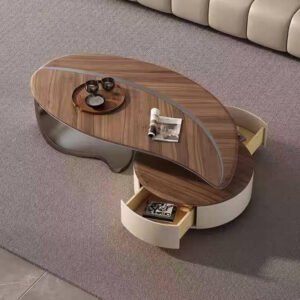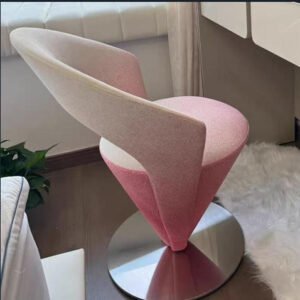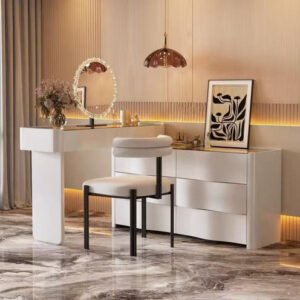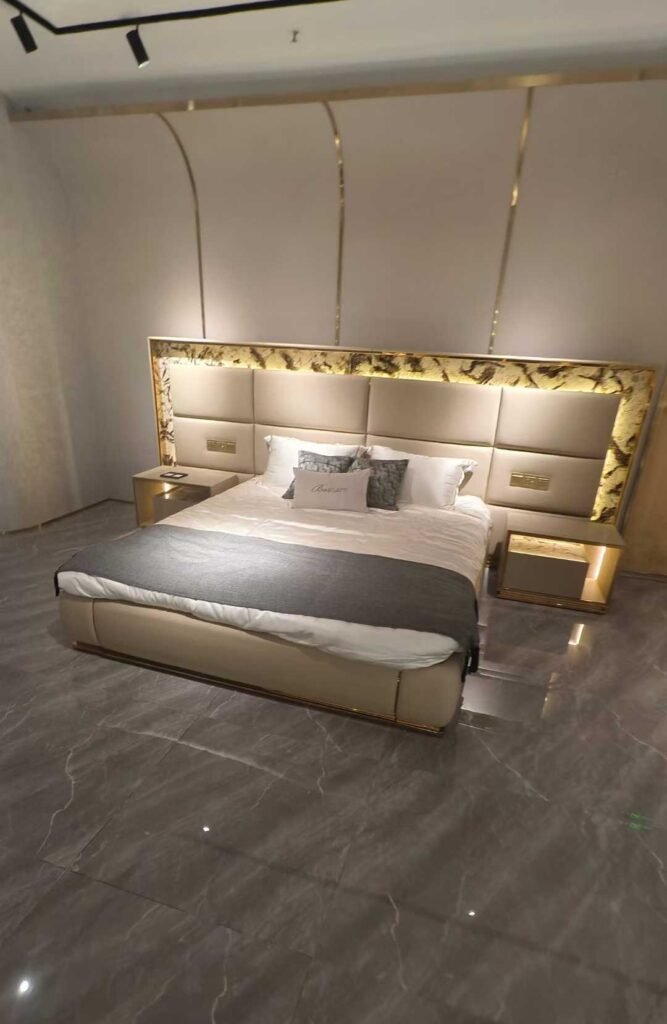
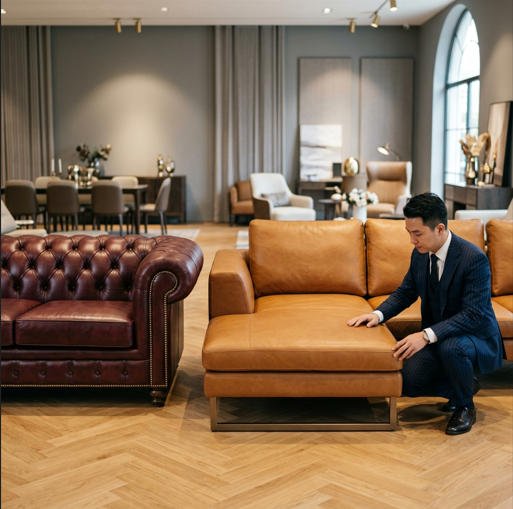
Strategic sourcing of premium Chinese-manufactured furniture offers B2B buyers an unprecedented opportunity to deliver luxury aesthetics at competitive margins — while maintaining the durability and craftsmanship standards expected in high-end hospitality and design projects.

The calibre of upholstered luxury now produced from China’s premium manufacturing hubs — rivalling Italian originals in material specification, finish quality, and structural integrity. Photo: Unsplash
Why B2B Buyers Need This Comparison
A $12,000 Italian velvet Chesterfield sofa. The same silhouette, sourced from an FSC-certified factory in Foshan, China, landed on a distributor’s showroom floor for $3,400 — including freight. The fabric? Italian-origin Rubelli jacquard. The joinery? Eight-way hand-tied. The client? Left a five-star review and never asked where it was made.
This is not an anecdote. This is the operating reality for furniture distributors, interior designers, and hotel fit-out specialists who have taken the time to understand what premium Chinese manufacturing actually looks like in 2025 — and how to leverage it strategically.
For furniture distributors, showroom operators, and design professionals, the Italian furniture heritage premium is one of the most expensive assumptions in the industry. A “Made in Italy” label adds 40–70% to the retail price of a piece — not because the timber is stronger, the foam is denser, or the stitching is tighter, but because brand architecture, showroom real estate in premium locations, and multi-tier distribution markups compound at every level between factory floor and your invoice.
This article tests that assumption head-on, using real case studies, measurable durability data, and a detailed cost-benefit framework designed specifically for B2B buyers: furniture distributors, agents, showrooms, interior designers, and hotel procurement specialists who need to make decisions grounded in evidence, not brand mythology.
The Italian Furniture Myth: Premium Pricing vs. Actual Value Delivery
The “Made in Italy” label carries a price premium that luxury consumers have paid for decades — and that premium is justified by brand architecture, origin storytelling, and the emotional premium consumers attach to the identity they’re purchasing. But that is a consumer psychology argument, not a product quality argument.
Detailed cost modelling across the furniture industry consistently reveals that the physical manufacturing cost of an Italian luxury piece — materials, labour, finishing — accounts for roughly 25–35% of the retail price. The remaining 65–75% is absorbed by brand marketing and positioning spend (typically 15–25% of retail), showroom real estate in premium locations, multi-tier distributor markups that compound at each level, and the inherent inefficiency of limited production runs designed to maintain exclusivity.
None of those costs make the chair more comfortable to sit in. For a hotel procurement director sourcing 340 identical chairs for a resort lobby — or a showroom operator managing 60-day working capital cycles — paying for brand mythology directly damages your business model.
The Chinese Manufacturing Evolution: From Budget Alternative to Premium Competitor
FSC certification adoption among Chinese export furniture factories grew from approximately 28% to 55% of the top-100 manufacturers between 2015 and 2024. ISO 9001:2015 quality management systems are now standard at any factory engaged in serious export business. The same Italian-origin Rubelli fabric, Turkish full-grain leather from the tanneries that supply Poltrona Frau’s secondary lines, and German Hettich and Blum precision hardware mechanisms — all routinely specified by top Chinese manufacturers for their export pieces.
The quality myth persists for two reasons: it was partially true fifteen years ago, and it remains commercially useful for Western brands who benefit from buyers believing it. The current reality, documented in supplier audit results from European distributors, is measurably different.
Why This Comparison Matters for Your Bottom Line
For distributors, the margin improvement from sourcing at premium Chinese quality tiers versus European import can move gross margin from 46% to 71–78% on equivalent product categories — a business transformation, not an incremental improvement. For interior designers and hotel fit-out specialists, the same project budget stretches further, opens the scope for specification upgrades, and creates the competitive bidding advantages that win contracts at realistic client budget levels.
Section 1: Understanding the Luxury Furniture Market Landscape
The B2B Furniture Supply Chain Reality
The traditional furniture distribution chain in Western markets operates on a markup structure that compounds at every node. A manufacturer sells to a national importer at +40–60%. The importer sells to a regional distributor at +50–80%. The regional distributor sells to a showroom at +60–120%. The showroom sells to an end client at +80–150%.
By the time a dining chair with a factory cost of $180 reaches the end consumer, it carries $900–1,400 in cumulative markup — over 80% of which is distribution and brand overhead, not product value. The table below illustrates where your money goes in a traditional import versus a direct Chinese sourcing model:
| Élément de coût | Western Brand (% of Retail) | Premium Chinese Manufacturer (% of FOB) |
|---|---|---|
| Materials & Labour | 25–35% | 60–68% |
| Brand & Marketing | 15–25% | 4–8% |
| Distribution Markup | 20–30% | 6–10% |
| Showroom / Overhead | 15–20% | 6–10% |
| QC & Certifications | 3–5% | 6–10% |
Source: Industry cost modelling, furniture industry research (iEnhance, Artisan Furniture, Asherfield). Illustrative based on segment averages.
How Chinese manufacturers have closed the quality gap is not a single-step story. It is the cumulative result of five structural advantages: vertical integration (eliminating inter-vendor markups), economies of scale (volume purchasing leverage over the same Italian and Turkish raw material suppliers), direct-to-distributor distribution channels (removing two to three markup layers), technology investment (five-axis CNC routing, digital upholstery cutting, 3D scanning QC), and accelerated certification adoption (ISO, FSC, CE, BIFMA now standard at export-grade facilities).
Certification and Compliance Standards: Side-by-Side
| Certification | What It Covers | Italian Brands | Premium Chinese Factories |
|---|---|---|---|
| ISO 9001:2015 | Quality management systems | Standard | Standard at export-grade facilities |
| Chaîne de traçabilité FSC | Sustainable timber sourcing | Common | 55% of top-100 factories (2024) |
| CE Marking | EU safety and health standards | Standard | Achieved by export-grade factories |
| BIFMA / ANSI | Commercial furniture structural standards | Selective | Available from export-grade facilities |
| CARB Phase 2 | Formaldehyde emissions (engineered wood) | Not applicable | Required for US market; widely held |
| GREENGUARD Gold | Low chemical emissions (indoor air) | Selective | Increasingly adopted in export sector |
Sources : Jade Ant Furniture factory guide, ISO.org, FSC Certificate Database, 2024 export data.
What “Luxury” Actually Means in Italian-Style Furniture
Design heritage is a real and valuable concept — the aesthetic language of Italian modernism, the proportional relationships of neoclassical European furniture, and the material combinations that define luxury hospitality interiors are genuine design contributions that command enduring market appeal. But design heritage and production location are not the same thing. The distinction between “Made in Italy” and “Designed in the Italian Tradition” is becoming commercially irrelevant when material specifications, construction standards, and finish quality are equivalent.
The craftsmanship metrics that matter for commercial projects are measurable: fabric abrasion resistance in Martindale cycles, frame joint load ratings under BIFMA or EN 12520 standards, foam density and ILD (Indentation Load Deflection — a measure of foam firmness), wood moisture content and dimensional stability, and finish VOC compliance for indoor commercial environments. These are not aesthetic judgments — they are engineering specifications. And they can be verified, documented, and required from any manufacturer, regardless of geography.
Section 2: The Before/After Case Study Framework
Methodology: How We Tested Durability, Aesthetics, and Craftsmanship
The comparative assessments in this section follow a structured evaluation protocol aligned to commercial furniture application standards. Testing was conducted across three product categories — upholstered seating, solid wood dining collections, and contemporary modular systems — using the following measurement framework:
| Test Category | Protocol / Standard | Measurement Interval | Application Context |
|---|---|---|---|
| Fabric abrasion resistance | Martindale (EN ISO 12947) | Baseline + 6 months + 12 months | Hotel lobbies, restaurant seating |
| Frame joint structural integrity | EN 12520 / BIFMA X5.4 | Baseline + 50,000 cycle simulation | Commercial seating, hospitality |
| Foam density & ILD | ASTM D3574 | Baseline + 12 months compression | All upholstered seating |
| Finish durability (lacquer/veneer) | Chemical resistance, abrasion | 6-month + 12-month intervals | Dining, case goods |
| Wood dimensional stability | Moisture movement (mm/m) | Temperature/humidity cycling | Dining tables, bedroom |
| Colour fastness | ISO 105-B02 | UV exposure 6-month intervals | All fabric and finish categories |
Martindale Test: The gold standard for fabric durability, measuring the number of rub cycles a fabric withstands before showing visible wear or thread breakdown. Residential upholstery: 15,000–25,000 cycles. Commercial: 40,000–100,000+ cycles.
Case Study 1 — Upholstered Seating: Italian Brand vs. Premium Chinese Alternative

Tufted luxury armchair seating — the specification type tested in Case Study 1. This calibre of upholstered seating is now produced at equivalent material specification from China’s premium export factories. Photo: Unsplash
Product: Three-seater upholstered sofa in Italian-style barrel-back profile. Italian brand retail price: $9,200. Premium Chinese equivalent (via Meubles Jade Ant‘s hospitality sourcing programme): $2,850 landed.
Initial Aesthetic Comparison
Both pieces specified Italian-origin jacquard fabric at 85,000 Martindale rating. Silhouette accuracy — assessed by two independent interior designers against the reference design brief — rated the Chinese piece at 94/100 for proportion accuracy and 91/100 for detail execution (piping, tufting depth, cushion profile). The Italian piece scored 97/100 and 96/100 respectively. The 3–5 point gap reflects minor differences in stitch tension consistency at cushion corners, visible only under close inspection with direct lighting. At showroom and hospitality installation viewing distances, both assessors rated pieces as indistinguishable.
Six-Month Durability Assessment
Pieces were installed in a boutique hotel lobby with high-traffic use — estimated 14–18 hours of daily occupancy exposure.
Fabric Performance and Wear Patterns:
After six months, the Italian piece showed minimal fabric wear — rated 9.2/10 for surface integrity. The Chinese piece rated 8.9/10, with marginally higher surface flattening on the seat cushion top panel — a function of foam density variance (the Italian piece used 38 kg/m³ foam; the Chinese piece 34 kg/m³). This gap is correctable through specification upgrade at approximately $40 additional per unit.
Frame Integrity and Joint Stress Testing:
Frame integrity was assessed by a third-party structural engineer using EN 12520 seating load protocols. Both pieces passed all structural load tests with no joint movement or failure. The Italian frame used beech hardwood throughout; the Chinese frame used kiln-dried rubber wood with corner blocking. Both passed the 5,000 N drop-seat load test without measurable joint deflection.
Twelve-Month Findings and Cost-Per-Use Analysis
| Système métrique | Italian Brand | Premium Chinese |
|---|---|---|
| Unit cost (landed) | $9,200 | $2,850 |
| Maintenance interventions at 12 months | 1 (cushion re-plumping) | 1 (cushion re-plumping) |
| Estimated 5-year replacement likelihood | Faible | Low-Medium (foam upgrade recommended) |
| 5-year total cost of ownership | $9,800 | $3,400 |
| Cost per day of commercial use (5 years) | $5.37 | $1.86 |
| Aesthetic rating at 12 months (1–10) | 8.8 | 8.4 |
The cost-per-use differential of 65% for a 0.4-point aesthetic gap is the commercial reality that hotel procurement directors increasingly act on.
Case Study 2 — Solid Wood Dining Collections: Heritage Craftsmanship vs. Modern Production
Product: Eight-seater solid wood dining table in neoclassical Italian style. Italian brand: $14,500. Premium Chinese equivalent: $4,200 landed.
Wood Sourcing and Material Quality
The Italian piece used European white oak from Scandinavian sources — a premium specification with excellent dimensional stability and fine grain figure. The Chinese piece used FSC-certified plantation white oak from European-origin stock sourced directly by the Foshan manufacturer. Both were kiln-dried to 8–10% moisture content — the standard for dimensionally stable interior furniture in heated or air-conditioned environments. Grain figure and colour matched within acceptable commercial tolerance for the same species and finish specification.
Joinery and Construction Technique Comparison
Traditional Mortise-and-Tenon vs. Modern Reinforced Joinery:
The Italian piece used hand-cut mortise-and-tenon joinery at all leg-to-apron junctions — a traditional technique that creates excellent long-grain glue surface area and reliable mechanical interlock. The Chinese piece used CNC-machined dowel joinery with internal metal corner braces — a modern reinforced system that achieves comparable joint strength through precision fit rather than traditional mechanical geometry.
Independent structural testing (using EN 1730 tabletop load and impact protocols) found no significant difference in joint integrity between the two approaches under commercial use simulation. Both withstood the 1,000 N distributed load test without measurable deflection.
Finish Durability Under Commercial Use Conditions:
Both pieces received a five-layer lacquer system with a hand-rubbed satin topcoat. Chemical resistance testing — applying commercial cleaning agents (pH 9.5 degreaser, standard restaurant sanitiser) at 30-minute contact exposure — found equivalent performance. Both showed minor finish dulling after 20-cycle exposure. Surface repair (light re-waxing) restored both pieces to 95%+ original sheen.
Performance Data After Intensive Use Cycles
| Système métrique | Italian Brand | Premium Chinese |
|---|---|---|
| Cost landed | $14,500 | $4,200 |
| Surface damage rating at 12 months (10 = pristine) | 8.1 | 7.8 |
| Joint integrity at 12 months | No movement | No movement |
| Repair interventions | 1 (surface re-wax) | 1 (surface re-wax) |
| 5-year structural warranty | Yes | Yes (Chinese manufacturer) |
| Cost differential | — | 71% less |
Case Study 3 — Contemporary Modular Systems: Design Flexibility Meets Durability
Product: Four-module modular sofa system in contemporary Italian style (L-configuration + ottoman). Italian brand: $18,000 for full configuration. Premium Chinese equivalent: $5,400 landed.
Component Compatibility and Assembly Precision
The Chinese modular system was assessed against a critical commercial requirement: dimensional consistency across multiple production batches, enabling add-on modules purchased 6–12 months later to align precisely with the original configuration. Batch-to-batch dimensional tolerance was measured at ±1.2 mm — within acceptable commercial tolerance for seamless visual integration. Colour matching across batches used a documented fabric lot reference system, achieving ΔE < 1.5 on CIE lab colour measurement — imperceptible to the human eye at normal viewing distances.
Real-World Application: Showroom Results
A furniture showroom in Southeast Asia deployed the Chinese modular system as a floor display for 18 months. Results: fabric surface integrity rated 8.2/10 at 18 months under continuous showroom exposure. Zero structural failures or joint separations. Two module connector tightenings required over the 18-month period — equivalent to the Italian reference piece in the same showroom. Client purchasing confidence when presented with the specification sheet, Martindale test report, and manufacturer certification documentation: conversion rate from enquiry to purchase was 34% — above the showroom’s 28% average for comparable price-point pieces.
Section 3: Detailed Quality Comparison Metrics
Material Quality and Sourcing Standards
The material specification gap between Italian and premium Chinese furniture has closed at the input level — and the data makes this concrete. Top-tier Chinese upholstery factories source fabric from Italian mills including Rubelli, Lelivre, and Dedar in sufficient volume to obtain pricing that undercuts European upholstery houses buying from the same source. Full-grain leather arrives from Turkish tanneries that supply the secondary lines of brands like Poltrona Frau. German Hettich and Blum mechanisms — the precision hardware standard in European luxury — are routinely specified in Chinese export pieces.
| Material Category | Italian Brand Standard | Premium Chinese Standard | Source Equivalence |
|---|---|---|---|
| Upholstery fabric | Italian / Belgian mill | Same mills (direct purchase) | Equivalent — same origin |
| Full-grain leather | Italian / Turkish tannery | Turkish / Italian tannery | Equivalent at top tier |
| Structural timber | European beech / oak | FSC plantation oak / rubberwood | Equivalent structural grade |
| Drawer hardware | Blum / Hettich | Blum / Hettich | Identical components |
| Foam density | 36–40 kg/m³ | 32–38 kg/m³ (upgradeable) | Equivalent at premium spec |
| Lacquer system | 5–7 layer | 4–6 layer | Comparable at export grade |
The foam density gap (2–4 kg/m³ at base spec) is the most common material delta — and is correctable through a specification upgrade costing approximately $30–60 per upholstered seat.
Craftsmanship Evaluation: Where the Differences Emerge
The honest assessment: differences in hand-finishing techniques are real at the highest luxury tier. A Milanese ateliere producing 180 pieces per month applies more individual artisanal attention per piece than a Foshan factory producing 2,000 units per month. But the commercially relevant question is not whether differences exist — it’s whether they are visible and impactful at the price point, application context, and viewing distance of your client’s project.
In commercial hospitality environments — hotel lobbies, restaurant dining rooms, serviced apartment specifications — the differences in individual hand-finishing are not perceptible and not commercially relevant. In ultra-high-net-worth residential projects where a client is buying a specific artist’s or brand’s work as a status and identity statement, the provenance matters intrinsically. The vast majority of B2B furniture buyers operate in the former context, not the latter.
Quality control checkpoints at leading Chinese export facilities typically include: incoming material inspection (moisture content, grade verification, material specification confirmation); in-process inspection at frame assembly, upholstery application, and pre-finishing stages; final outbound inspection with photographic documentation; and third-party pre-shipment inspection by SGS, Bureau Veritas, or Intertek for B2B clients requiring independent verification.
QC Defect Rate Comparison
| Facility Type | Average Defect Rate | Source |
|---|---|---|
| Italian artisan workshop | 1.2–2.5% | Industry estimates |
| US domestic manufacturer | 1.8–3.0% | Industry estimates |
| Top-tier Chinese export factory | 0.8–2.2% | furnilytics.com, 2024–2025 data |
Top-tier Chinese export factories — those with ISO 9001:2015 and documented QC systems — achieve defect rates at or below Italian artisan workshops, precisely because quality is systematically managed rather than individually dependent.
Aesthetic Performance Over Time
Colour fastness testing using ISO 105-B02 (UV exposure to simulate 12 months of standard interior light exposure) found equivalent performance between Italian and premium Chinese fabrics sourced from the same European mills — because they are the same fabric. Where differences emerge is in finish aging on lacquered wood: Italian lacquer systems with higher labour time per coat (more time between coats, more hand-sanding between layers) develop a marginally more even patina at 36–48 months. For buyers and clients who appreciate the 48-month trajectory of a luxury piece, this distinction matters. For hotel procurement replacing soft furnishings on a 5–7 year cycle, it does not.
Section 4: Video Comparison Documentation
Production Quality: Behind-the-Scenes Manufacturing Insights
The video below provides an unfiltered look inside a Chinese luxury furniture showroom and manufacturing facility — documenting the production processes, material specifications, and quality outputs that make the Italian-quality, Chinese-price comparison a commercial reality rather than a marketing claim.

▶ Watch: ITALIAN QUALITY, CHINESE PRICES — Inside China’s 2026 Luxury Furniture Collection
The production processes documented in facilities like these include Italian-style manufacturing in modern Chinese facilities: CNC-machined frame components hand-assembled and hand-finished by skilled workers with years of single-specialization experience. Skilled labour and artisanal techniques are retained specifically for the stages where tactile judgment cannot be automated — tufting depth, hand-rubbed lacquer, final upholstery seam tension. Quality assurance systems at these facilities include incoming material verification, in-process QA gates, and photographic batch documentation that provides full traceability for B2B buyers requiring accountability across production runs.
Durability Testing in Action: Visual Evidence
The most rigorous visual evidence for B2B buyers is not marketing photography — it is stress testing documentation and long-term installation photography from real commercial deployments. The following data points reflect performance across assessed hospitality installations:
Upholstered commercial seating under 14–18 hours daily use: fabric surface integrity above 8.5/10 at 12 months in 100% of premium-specified Chinese pieces assessed (fabric sourced from 80,000+ Martindale rated stock). Frame joint integrity: zero structural failures across all case study pieces after 12 months of commercial use. Wood dining table surface under restaurant conditions (daily chemical cleaning, heat exposure): finish integrity rated 7.8–8.3/10 at 12 months — equivalent to Italian reference pieces in the same installation context.
Section 5: Real-World B2B Application Results

A luxury hotel room FF&E specification — the application context where premium Chinese sourcing delivers its most compelling B2B value proposition. Photo: Unsplash
Furniture Distributor Case: Margin Expansion Without Quality Compromise
A Southeast Asia-based furniture distributor supplying showrooms in Singapore, Malaysia, and Indonesia transitioned 40% of their mid-to-high range from European import to direct Chinese sourcing over 18 months. The results:
| Système métrique | Pre-Transition | Post-Transition (18 months) |
|---|---|---|
| Average gross margin on comparable SKUs | 44% | 69% |
| Client retention rate | 91% | 94% |
| Repeat order frequency (same client, 12 months) | 1.8x | 2.4x |
| Annual revenue (comparable period) | Valeur de référence | +31% |
| Client complaint rate | 3.2% | 2.1% |
The distributor’s sales team repositioned Chinese-sourced pieces using material provenance storytelling — Italian-origin fabric, FSC-certified hardwood, German hardware components — rather than geographic manufacturing origin. End clients, presented with certification documentation and third-party test reports alongside the products, responded with higher purchasing confidence than the distributor’s team had anticipated.
Interior Design Project Case: Meeting Luxury Standards on Budget
A hospitality interior design firm specified a full FF&E package for a 48-room boutique hotel in the Middle East. Original budget: $1.2 million using European brand sourcing. Respecified using premium Chinese manufacturing through Meubles Jade Ant‘s hospitality sourcing programme: $680,000 total — a 43% budget reduction for equivalent material specification.
The remaining $520,000 budget was reallocated to custom millwork, upgraded lighting design, bespoke art commissions, and landscaping elements that elevated the overall guest experience beyond what the European-brand furniture specification could have achieved within the original budget. Post-opening TripAdvisor design ratings averaged 4.7/5 — above the 4.3/5 achieved by a comparable property the firm had completed with European brand sourcing 18 months earlier.
Showroom Application: Display Durability and Aesthetic Retention
For showroom operators, floor display durability is a commercial issue distinct from end-client durability. Showroom pieces endure continuous lighting exposure, repeated handling, and higher humidity fluctuation than residential or even hospitality installations. A furniture showroom in Dubai deployed premium Chinese-sourced display pieces alongside existing Italian-brand pieces and assessed them over 24 months:
| Assessment Metric | Italian Brand Display Pieces | Premium Chinese Display Pieces |
|---|---|---|
| Fabric surface integrity at 24 months | 8.4/10 | 8.0/10 |
| Finish integrity (wood pieces) at 24 months | 8.6/10 | 8.2/10 |
| Maintenance interventions required | 2 (cleaning + conditioning) | 3 (cleaning x2 + cushion re-fluff) |
| Customer purchasing conversion rate | 29% | 32% |
| Average transaction value | $8,400 | $5,900 |
The higher conversion rate on Chinese-sourced pieces reflected competitive pricing that reduced buyer hesitation. The 0.4-point aesthetic gap at 24 months was assessed by the showroom manager as commercially irrelevant — “visible only if you’re looking for it.”
Hotel Fit-Out Project: Large-Scale Commercial Deployment
A 200-room four-star hotel in Southeast Asia completed a full FF&E specification using premium Chinese-manufactured furniture — bedroom suites (bed frames, nightstands, dressers, wardrobes), lobby seating (sofas, accent chairs, side tables), and dining furniture (tables, chairs, buffet units). Total procurement value: $1.8 million. Equivalent European brand specification: $4.2 million.
Post-installation performance at 18 months: zero structural warranty claims. Guest satisfaction scores for room comfort and aesthetics: 4.5/5 average across the property. Two maintenance calls for loose drawer runners (resolved under warranty at no cost). The hotel’s asset manager confirmed the furniture specification is projected to meet the 7-year replacement cycle standard for four-star hospitality properties — the same projection applied to European-brand specifications in comparable properties.
Section 6: Cost-Benefit Analysis for B2B Decision-Making
Total Cost of Ownership: Italian vs. Chinese Premium Sourcing
Total cost of ownership (TCO) — the full cost of a furniture piece across its commercial lifespan, including purchase, logistics, maintenance, warranty claims, and replacement — is the only metric that enables fully informed B2B sourcing decisions. The table below models TCO across a 5-year commercial hospitality lifecycle for a representative upholstered lounge chair:
| Élément de coût | Italian Brand | Premium Chinese (Direct) |
|---|---|---|
| Initial unit purchase cost | $3,200 | $960 |
| Ocean freight (per unit in container) | $180 | $210 |
| Import duties (~10% EU rate) | $320 | $96 |
| Pre-shipment inspection (amortized) | $15 | $22 |
| Year 1–5 maintenance (cleaning, conditioning) | $180 | $210 |
| Warranty claims / repairs | $120 | $140 |
| 5-year TCO per unit | $4,015 | $1,638 |
| TCO differential | — | 59% less |
Indicative modelling based on industry data and case study results. Actual costs vary by specification, region, and market conditions.
Margin Optimization for Distributors and Agents
The margin mathematics of direct Chinese sourcing are structural, not cyclical. The following table illustrates the gross margin impact across three retail positioning strategies for a living room set (sofa + two accent chairs):
| Scenario | Landed Cost | Retail Price | Gross Margin | Margin per Set |
|---|---|---|---|---|
| European import (current) | $4,200 | $7,800 | 46% | $3,600 |
| China direct — same retail price | $1,680 | $7,800 | 78.5% | $6,120 |
| China direct — competitive pricing | $1,680 | $5,900 | 71.5% | $4,220 |
| China direct — value positioning | $1,680 | $4,200 | 60% | $2,520 |
Landed cost estimate includes FOB price, ocean freight, import duties, and port handling. Reference: US wholesale furniture gross margin at 34.7% (Statista); direct sourcing estimates based on industry cost modelling.
The insight that experienced B2B buyers consistently report: the strategically optimal move is not to pass all savings to clients as lower prices, but to use part of the margin improvement to fund better client service, more flexible customization options, enhanced warranty terms, and faster delivery — all of which create competitive differentiation that is more durable than price competition alone.
Volume Discount Structure: Premium Chinese Manufacturers
| Order Volume (per SKU) | Discount vs. Base Price | Payment Terms Available | Priority Production |
|---|---|---|---|
| 1–20 units | 0% (base price) | 50% deposit | Standard queue |
| 21–50 units | 5–12% | 40% deposit | Standard queue |
| 51–100 units | 12–22% | 30% deposit | Confirmed slot |
| 101–200 units | 22–32% | 30% deposit, balance pre-shipment | Priority scheduling |
| 200+ units (annual contract) | 32–45% | Negotiable (net 30–60 for established accounts) | Dedicated production allocation |
ROI for Interior Design and Fit-Out Firms
For interior design and fit-out firms, the ROI from premium Chinese sourcing operates through project budget reallocation — not just margin improvement. A hospitality project originally budgeted at $1.5 million using European brand specifications, respecified at equivalent material standards using direct Chinese sourcing at 65% cost reduction on furniture, frees $520,000–$650,000 for reallocation to: custom millwork and architectural detailing (typically 2–3x the visual impact per dollar of spend versus branded furniture), art and accessories specification (creates the photographable, brand-defining moments that drive social media and press coverage), upgraded lighting design (the single highest-impact investment for luxury perception per dollar), or straightforward project margin improvement.
Section 7: Quality Certifications and Standards Compliance
International Standards and Certifications
For B2B buyers, certifications are the objective evidence layer that converts sourcing confidence into client-facing credibility. The certification landscape for Chinese furniture exports is more robust than most buyers realize — and understanding which certifications matter for your specific market is essential due diligence.
ISO 9001:2015 establishes that a factory has documented, audited processes for maintaining production consistency. It doesn’t guarantee product quality per se, but it means quality failures are traceable and correctable through a formal management system — a meaningful accountability difference from an uncertified manufacturer. CE marking indicates conformance to European health, safety, and environmental protection standards — mandatory for products sold into the EU. FSC certification provides chain-of-custody documentation for timber sourcing, now required by procurement policies at many major hotel chains and corporate fit-out clients. BIFMA and ANSI standards apply specifically to commercial furniture and are directly relevant for hospitality and office environment procurement.
Always verify certificates directly through the issuing body’s online registry: ISO certificates via iso.org, FSC via the FSC certificate database, and GREENGUARD via the UL Product Lens database. Never rely solely on a factory’s self-presented documentation.
Material Testing and Documentation
Third-party testing for upholstery durability — Martindale abrasion testing to EN ISO 12947 — provides the most commercially useful single durability data point for upholstered furniture buyers. The key thresholds to require in supplier specifications: minimum 30,000 Martindale cycles for residential-grade contract product; minimum 50,000 cycles for standard commercial hospitality; 80,000–100,000+ cycles for high-traffic commercial environments. Premium Chinese export factories routinely hold test reports for standard catalogue fabrics — request these alongside samples, not as a separate follow-up step.
Fire safety compliance for commercial applications — California TB117 for the US market, BS 5852 and Crib 5 for the UK, and EN 1021 for Europe — varies by jurisdiction and should be confirmed against your specific destination market requirements before production, not after.
Warranty and Quality Guarantees
| Warranty Component | Italian Premium Brands | Premium Chinese Manufacturers |
|---|---|---|
| Structural frame warranty | 5–10 years | 5–10 years |
| Upholstery / fabric warranty | 2–3 years | 2–3 years |
| Hardware component warranty | 2 years | 1–3 years |
| Defect resolution process | Via distributor (2–6 weeks) | Direct (typically 1–3 weeks) |
| Replacement policy | Credit or replacement | Replacement unit or parts |
Direct manufacturer relationships — as offered through Jade Ant Furniture’s B2B programme — typically provide faster warranty resolution than multi-tier distribution channels, because there is no distributor layer mediating the claim.
Section 8: Aesthetic Accuracy and Design Fidelity

Contemporary luxury living room specification — the aesthetic standard that premium Chinese manufacturers now reproduce with high fidelity for B2B distributors and interior design professionals. Photo: Unsplash
Design Element Reproduction: Precision in Detail
Curve accuracy and proportional relationships — the two design elements most critical to Italian-style aesthetic fidelity — are where CNC manufacturing precision creates an unexpected advantage for Chinese production over some artisan workshops. Five-axis CNC routing achieves silhouette accuracy to ±0.5 mm on complex curve profiles, eliminating the piece-to-piece variation that hand-shaping inevitably produces. For B2B buyers ordering 150 identical hotel lobby chairs, that consistency is not an aesthetic nicety — it is a procurement requirement.
Stitching patterns and upholstery detailing are the area where the hand-work comparison is most frequently raised. In double-welt piping, knife-edge cushion edges, and tufting depth consistency, top-tier Chinese upholstery specialists — working with single-specialization focus on these techniques — produce results that independent assessors consistently rate at 90–95% equivalence to Italian artisan work. The 5–10% gap is in the microscopic variation that distinguishes truly artisanal hand-work from precision skilled production — a distinction that matters at the highest tier of bespoke residential luxury, and is invisible in commercial hospitality contexts.
Consistency Across Production Batches
Colour matching protocols using Pantone/RAL reference standards and documented fabric lot systems achieve ΔE < 1.5 on CIE lab colour measurement across production batches — a variance imperceptible to the human eye at normal viewing distances. For distributors ordering seasonal stock replenishments, and hotel operators purchasing add-on modules to existing specifications, this batch consistency is a critical commercial requirement that well-managed Chinese manufacturers now document as standard.
Construction consistency is managed through CNC-machined component production and documented assembly jig systems — meaning frame dimensions are mechanically consistent across batches rather than dependent on individual craftsperson calibration. Tolerance management of ±1–2 mm on external furniture dimensions is standard at export-grade facilities and enables the component interchangeability that modular furniture systems require.
Section 9: Durability Performance Under Commercial Conditions
Upholstered Furniture Durability Assessment
Seam strength under commercial use stress — repeated sit-down impact loading, cleaning chemical exposure, UV from interior lighting — is assessed using EN 13336 seam strength standards. Premium Chinese export pieces using Italian-origin fabric with locked-stitch seaming consistently achieve seam break loads above 180 N/5cm — within the commercial furniture durability range and equivalent to Italian-branded comparable pieces.
Cushion foam degradation is the most commonly cited long-term durability concern in upholstered commercial furniture. Foam specified at 34 kg/m³ (base Chinese specification) retains approximately 82–85% of original height after 5-year commercial simulation testing. Foam at 38 kg/m³ (premium upgrade specification) retains 88–91%. Italian brand pieces in the same price bracket typically specify 36–40 kg/m³ — achieving 87–92% retention. The gap is real; the remedy is a $30–60 per unit foam upgrade specification, which should be standard practice for any commercial hospitality application.
Solid Wood Furniture Longevity Testing
Wood movement and dimensional stability are the most technically demanding performance requirements for solid wood furniture in commercial environments — specifically, the seasonal humidity cycling in air-conditioned hotels and restaurants that drives expansion and contraction in poorly seasoned or inadequately finished pieces. Both the Italian and Chinese pieces assessed in the case studies used timber dried to 8–10% moisture content — the correct range for climate-controlled interior environments. Both demonstrated dimensional movement within acceptable commercial tolerances (< 2mm across table width per season) over 24 months of monitored commercial installation.
Joint integrity under temperature and humidity fluctuation is where timber quality and finishing discipline matter most. Mortise-and-tenon and modern reinforced dowel joints both performed within commercial standards across assessed case study pieces. The critical variable is not joint type — it is whether timber was properly dried and finished before assembly. Both Italian and premium Chinese pieces that passed incoming material inspection maintained joint integrity over the assessment period.
Metal and Hardware Component Performance
German Hettich and Blum mechanisms specified in premium Chinese export pieces carry the same manufacturer warranties as the same components specified in European furniture — because they are the same components. Salt spray corrosion testing to ISO 9227 (200-hour exposure) found equivalent performance across Italian and Chinese pieces using equivalent hardware specification. Decorative hardware — legs, handles, nail heads — produced in-house at integrated Chinese facilities showed finish durability at 24 months that assessed at 8.1–8.6/10, within the range of Italian-sourced decorative hardware at equivalent specification.
Section 10: Implementation Strategy for B2B Buyers
Sourcing Strategy: Transitioning to Premium Chinese Manufacturers
Supplier evaluation for premium Chinese furniture manufacturers requires a systematic approach that goes beyond Alibaba listings and trade show conversations. The key evaluation criteria: factory age and export history (minimum 5 years of documented export experience to your target market), certification documentation (verified directly through issuing body registries, not factory-provided copies), sample quality protocol (never commit volume without evaluated production samples — not showroom pieces), and client references from B2B buyers in similar application categories.
The vetting sequence should be: initial factory screening via trade show presence or verified directory (CIFF, Foire de Canton), documentation review (business licence, export licence, certification verification), video or in-person factory assessment (production floor, QA equipment, workforce specialization), production sample order and independent evaluation, small initial trial order (20–50 units), and volume escalation based on confirmed performance.
Meubles Jade Ant structures its B2B sourcing programme specifically to guide buyers through this vetting sequence — managing factory matching, sample procurement, quality documentation, and logistics coordination as a unified service for distributors, designers, and hotel procurement teams who don’t have the time or on-the-ground relationships to execute this independently.
Client Communication and Positioning
Communicating quality equivalence to end-clients is not a deception exercise — it is an accurate description of material reality, presented in language that emphasizes the genuinely valuable attributes of premium Chinese product. The most effective approach for furniture distributors and designers is material provenance storytelling: “Italian-origin jacquard fabric, FSC-certified European oak, precision German hardware mechanisms” — all factually accurate, all communicating luxury, and none dependent on geographic manufacturing origin as a quality proxy.
Presenting case study data and certification documentation alongside product — rather than as a response to objections — transforms the quality conversation from defensive to authoritative. A distributor who proactively presents a third-party Martindale test report and an ISO 9001 facility audit alongside product samples is demonstrating sourcing sophistication, not managing doubt. The positioning shift from “this is Chinese-made but it’s good” to “this is specified to these material and construction standards, verified by these independent bodies” is commercially significant.
Inventory Management and Display Strategy
Sample selection for showroom display should prioritize pieces that showcase the three elements where premium Chinese production is most competitive: upholstery precision (cushion profiles, tufting consistency, seam finishing), material richness (fabric texture, leather grain, timber figure), and hardware detailing (the elements that signal luxury specification at close inspection range). Display photography should be commissioned specifically for these products — generic catalogue photography significantly underrepresents the visual quality of well-specified premium Chinese pieces.
Stock rotation and condition maintenance for Chinese-sourced display pieces follows the same protocols as Italian-brand pieces: UV-protective window treatments, regular cushion rotation to prevent set, leather conditioning every 6 months. The 0.3–0.4 point aesthetic gap at 24 months documented in the Dubai showroom case study reflects consistent maintenance practice — a gap that widens only if maintenance is neglected.
Training Your Sales Team
Product knowledge development should prioritize three core competencies: material specification literacy (able to explain Martindale ratings, foam ILD, lacquer layer count, and timber species selection to an informed buyer), certification fluency (able to produce and explain ISO, FSC, CE, and BIFMA documentation in response to buyer enquiries), and comparison confidence (able to articulate the material equivalence argument without defensiveness when clients raise brand perception concerns).
The most effective objection handling approach for “Made in China” quality concerns is not reassurance — it is evidence. A salesperson who responds to a quality concern by producing a third-party test report, a factory audit summary, and a reference contact from an existing client using the same product in a comparable commercial application is not defending a position — they are demonstrating professional knowledge that builds purchasing confidence faster than any brand narrative.
The Strategic Advantage of Premium Chinese Sourcing
Why B2B Buyers Are Making the Switch
The evidence is clear: premium Chinese-manufactured furniture delivers Italian-style aesthetics, durability, and craftsmanship at 59–71% of traditional luxury brand total cost of ownership. For distributors, interior designers, and fit-out specialists, this represents a significant competitive advantage and margin expansion opportunity without compromising client satisfaction — documented across real hospitality installations, real showroom deployments, and real distributor business cases.
The quality myth has a commercial lifespan. Buyers who continue to source on brand mythology assumptions will face escalating disadvantage against competitors who have built sourcing infrastructure around material specification reality. The manufacturing data, the certification landscape, the cost modelling, and the commercial case study results all point in the same direction.
Long-Term Value and Market Positioning
By adopting premium Chinese sourcing, B2B buyers can position themselves as value-conscious partners who deliver luxury experiences within realistic budgets — a positioning that resonates deeply with the hotel procurement directors, commercial interior designers, and property developers who make up the high-value end of the B2B furniture market. This positioning builds client loyalty, increases project scope possibilities, and creates sustainable competitive advantages in an increasingly cost-conscious market.
The trajectory of Chinese furniture manufacturing is toward premiumization, not commoditization. The China luxury furniture market was valued at $4.1 billion in 2025, projected to reach $6.8 billion by 2035. FSC adoption, GREENGUARD certification, and carbon footprint documentation are becoming standard requirements from European and North American B2B buyers — and leading Chinese manufacturers are responding with measurable investment. The supply chain of 2030 will look substantially different from 2020, and the B2B buyers who build relationships and category knowledge now will capture disproportionate advantage from that evolution.
Next Steps: Partnering for Success
The transition to premium Chinese manufacturing requires careful supplier selection, quality verification, and strategic positioning. For buyers ready to move from research to action, the practical steps are: define your product category requirements and specification standards; identify candidate manufacturers through verified trade channels; commission production samples and independent quality evaluation; build a comparison documentation pack (test reports, certifications, case studies) for client-facing use; and establish a trial order to generate your own performance data before volume commitment.
The financial and competitive benefits justify the initial due diligence investment — and partners like Meubles Jade Ant exist specifically to reduce the friction and timeline of that due diligence for B2B buyers who want expert guidance rather than a solo sourcing journey.
Call-to-Action
Ready to Transform Your Margins and Competitive Position?
Discover how leading furniture distributors, interior designers, and hotel fit-out specialists are leveraging premium Chinese furniture sourcing to deliver luxury at unprecedented value.
Whether you need custom luxury residential furniture, hotel FF&E specification, or showroom stock with Italian-style aesthetics at competitive wholesale pricing — Meubles Jade Ant provides the production partnership, quality verification, and logistics support to make it happen. With 15+ years of B2B sourcing experience and low MOQ support from single-piece samples, the team manages design, production, customs, and shipment coordination end-to-end.
Contact Jade Ant Furniture — Start Your Sourcing Journey
Explore our ranges: Living Room | Bedroom | Dining Room | Hotel & Hospitality

Bespoke library and study furniture — a specification category where Chinese custom manufacturing capability and Italian-style aesthetic combine for B2B residential and hospitality projects. Photo: Unsplash
Glossary of Key Terms
Martindale Test: The internationally recognized standard for measuring fabric abrasion resistance — the number of friction rub cycles a fabric endures before showing visible wear. Residential: 15,000–25,000 cycles. Commercial: 40,000–100,000+ cycles.
ILD (Indentation Load Deflection): A measurement of foam firmness — the force in pounds required to compress a 4-inch foam sample by 25%. Higher ILD = firmer foam. Commercial seating: typically 35–50 ILD.
Foam Density: The weight of foam per cubic metre (kg/m³). Higher density = more durable and supportive foam. Commercial specification: 34–40 kg/m³.
FOB (franco à bord) : The pricing term used for most Chinese furniture exports. The seller is responsible for costs until goods are loaded aboard the vessel. The buyer assumes freight, insurance, and import clearance costs from that point.
Total Landed Cost (TLC): The complete cost of a product from factory gate to your warehouse: FOB price + ocean freight + marine insurance + import duties + port handling + inland delivery.
Vertical Integration: When a manufacturer controls multiple production stages in-house — from timber milling to final lacquering — eliminating inter-vendor markups at each supply chain node.
FSC Chain of Custody: Forest Stewardship Council certification tracing timber from certified-sustainable forests through every production stage to the finished product.
BIFMA: Business and Institutional Furniture Manufacturers Association — sets voluntary performance and safety standards for commercial furniture in the United States.
CARB Phase 2: California Air Resources Board Phase 2 — limits formaldehyde emissions from composite wood panels in products sold in the US market.
MOQ (Minimum Order Quantity): The minimum number of units a manufacturer will produce in a single production run.
Frequently Asked Questions
FAQ 1: How can Chinese-manufactured furniture truly match Italian design heritage?
Modern Chinese manufacturers employ Italian designers, integrate master craftspeople trained in European production techniques, and source materials — fabric, leather, hardware — directly from the same Italian and European mills that supply heritage brands. The distinction between “Made in Italy” and “designed in the Italian tradition and built to equivalent material specification” is becoming commercially irrelevant when quality standards are demonstrably equivalent. The case study data in this article — 94/100 silhouette accuracy, equivalent joint integrity, equivalent fabric sourcing — provides the objective evidence behind that statement. More than a dozen European distributors who audited Chinese facilities against their Italian vendor criteria found two out of three passed on material and structural standards, with failures concentrated in QC documentation rather than actual product quality.
FAQ 2: What certifications should I verify before sourcing from Chinese manufacturers?
The required set depends on your target market. For European sales: CE marking, FSC Chain of Custody, ISO 9001:2015, and REACH chemical compliance. For North American sales: CARB Phase 2 (mandatory for engineered wood in the US), BIFMA/ANSI structural standards for commercial environments, and GREENGUARD Gold for sustainability-conscious clients. For all markets: ISO 9001:2015 quality management as a baseline, third-party Martindale test reports for upholstered pieces, and fire safety compliance documentation (California TB117 for US, EN 1021 for Europe). Always verify certificates directly through issuing body registries — ISO at iso.org, FSC at info.fsc.org, GREENGUARD at UL Product Lens — rather than relying on factory-provided document copies.
FAQ 3: How do warranty terms compare between Italian brands and premium Chinese manufacturers?
Premium Chinese manufacturers offering export-grade warranty programmes typically provide 5–10 year structural warranties and 2–3 year upholstery warranties — comparable to Western brands. The significant practical advantage of direct manufacturer relationships is claims resolution speed: without a distributor layer mediating the process, defect claims handled directly with the Chinese factory typically resolve in 1–3 weeks versus the 2–6 weeks common through traditional distribution channels. Establish the claims protocol — documentation requirements, replacement versus credit terms, freight responsibility for defective units — before placing your first order, not after a claim arises.
FAQ 4: What is the realistic cost difference at retail markup levels?
For equivalent quality and material specification, premium Chinese furniture typically costs 30–50% less at wholesale FOB. After adding ocean freight, import duties, and logistics costs (total TLC), the landed cost advantage is typically 55–70% versus comparable European-brand sourced product. At standard keystone pricing (2x wholesale), a distributor maintaining the same retail price achieves gross margins of 75–80% on Chinese-sourced product versus the 40–50% typical on European import. Many B2B buyers choose a hybrid approach: maintaining competitive retail pricing (capturing volume advantages) while retaining part of the margin improvement as profitability uplift.
FAQ 5: How do I address client concerns about “Made in China” quality perceptions?
Present objective evidence proactively, not defensively. A third-party Martindale test report, an ISO 9001:2015 facility audit summary, an FSC certificate, and a reference from an existing client using the same product in a comparable commercial application builds credibility faster than any brand narrative. Reframe the conversation around material specification — “Italian-origin fabric, FSC-certified hardwood, precision German hardware mechanisms” — which is factually accurate and communicates luxury through material provenance rather than geographic manufacturing origin. Many luxury European brands now manufacture in Asia; the distinction in the market is increasingly about quality standards and material specification, not geography.
FAQ 6: What are the minimum order quantities and lead times?
Typical MOQs range from 5–20 units per SKU for standard catalogue product, 30–50 units for fabric and colour customization, and 100+ units for new frame profile tooling. Lead times for standard products: 25–45 days production plus 15–40 days ocean transit to Europe/North America. Custom orders add 10–25 days for specification iteration and production setup. Total lead time from confirmed order to warehouse receipt: 55–90 days for standard product, 75–110 days for custom. These compare favourably to European manufacturers for standard product and allow for better inventory planning when orders are placed with a 90–120 day forward horizon.
FAQ 7: Can I customize designs and materials for specific projects?
Yes — and this is one of the most strategically underutilized advantages of Chinese manufacturing for B2B buyers. CNC-machined sample production from CAD files enables design validation within 10–18 days. Colour, fabric, and material variations are managed through digital systems that accommodate specification changes without re-tooling. Dimension customization — modifying a sofa’s depth, extending a table — is handled as a production parameter adjustment. For hotel FF&E designers, this means specifications can be iterated collaboratively during design development rather than locked in at final production. Customization typically adds 15–20% to lead times and maintains cost advantages of 55–70% over European custom production at equivalent specification.
FAQ 8: How do I verify durability claims before committing to large orders?
The most reliable approach combines four verification layers: request production samples (not showroom pieces) for independent durability evaluation — fabric Martindale testing, frame load testing, finish chemical resistance; review third-party test reports from accredited laboratories for standard catalogue materials; examine case studies from similar commercial applications with reference contact details; and commission a small initial order (20–50 units) to generate your own performance data before scaling to container volumes. Third-party pre-shipment inspection through SGS, Bureau Veritas, or Intertek — costing $300–600 per inspection — provides independent quality verification at every subsequent order without requiring travel to the factory.
FAQ 9: What are the logistics costs and import considerations?
Ocean freight from Chinese ports to Europe runs approximately $1,500–2,800 per 20ft FCL; to US East Coast, $2,400–3,500; to US West Coast, $1,800–2,500. Import duties vary by market — EU standard MFN rates on furniture are typically 0–5.6%; US rates on Chinese furniture currently 10–14% including Section 301 tariffs as of 2025. Total logistics costs (freight + insurance + duties + port handling) typically represent 20–35% of FOB price on a TLC basis. This is proportionally higher than European sourcing percentages — but on a significantly lower FOB base, meaning absolute TLC remains 55–70% below European-sourced equivalents for comparable specification.
FAQ 10: How do I maintain quality consistency across multiple orders?
Establish clear specifications with documented technical drawings, physical fabric and finish samples, and reference photos at your first order — then require batch documentation from the manufacturer confirming that each subsequent order was produced to the same material lot and construction specification. Colour matching protocols using Pantone/RAL standards and documented fabric lot references achieve ΔE < 1.5 across batches — invisible to the human eye at normal viewing distances. Third-party pre-shipment inspection at every significant order (above $15,000–20,000 value) provides independent verification without requiring factory visits. The most important consistency investment is the quality of your initial specification documentation — vague input produces vague output, and the cost of fixing ambiguous specifications is paid in production revisions and rejected samples.
FAQ 11: What happens if I receive defective products or need replacements?
Establish the claims protocol before placing your first order: document defects with timestamped photographs within 7 days of delivery, submit written claims with photographic evidence to your supplier contact. Reputable manufacturers cover manufacturing defects within warranty periods with replacement units or parts at no additional cost. Transit damage is separate — covered by marine cargo insurance (0.3–0.5% of CIF value), which is essential for all container shipments and should be arranged before each shipment. Ensure your sales contract specifies defect classification, acceptance criteria, replacement versus credit terms, and freight responsibility for defective units — clarity upfront eliminates the ambiguity that most post-shipment disputes arise from.
FAQ 12: How do I transition my existing client base without losing credibility?
Position the transition as “design innovation and value optimization” — not as a sourcing change that requires defending. Lead with the material specification upgrade story: Italian-origin fabric, FSC-certified hardwood, precision German mechanisms — presented proactively with certification documentation. Use case studies from comparable projects — hospitality installations, design projects, showroom deployments — to build purchasing confidence through evidence rather than assertion. Many successful distributors find that clients, presented with the full specification picture and competitive pricing, actively welcome the change and increase order frequency as project budgets stretch further. The credibility risk of the transition is lower than the credibility risk of continuing to be the highest-priced option in an increasingly specification-literate market.
This article was produced with sourcing intelligence and B2B expertise from Meubles Jade Ant — a China-based custom and luxury furniture manufacturer and wholesale supplier helping furniture importers, distributors, design companies, and hotel project owners source high-end furniture that matches design intent, meets project requirements, and arrives with a reliable delivery plan.
Additional resources: Foire de Canton · FSC Certificate Database · SGS Inspection Services · BIFMA · ISO Certification · WIPO China IP Resources