Regional Furniture Hubs in China Explained:
Which City Makes What — and Why It Matters
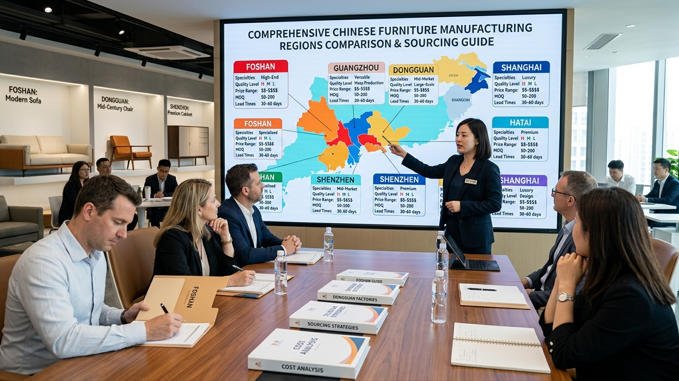
A comprehensive guide to China’s major furniture manufacturing centers, helping distributors, showroom owners, interior designers, and hotel fit-out specialists source the right products from the right regions at competitive prices.
China is not one furniture market — it is seven distinct manufacturing ecosystems, each with its own product DNA, quality tier, pricing logic, and supply chain personality. A distributor who books a flight to Foshan expecting to source premium solid wood pieces will leave empty-handed. An interior designer who visits Shanghai looking for affordable upholstered sofas in bulk will find the economics don’t work. Getting the right product from the right region is the single most impactful sourcing decision any B2B buyer can make.
China’s furniture sector generated an estimated USD $160.5 billion in domestic market value in 2025 and exported $67.81 billion worth of furniture — down 5.9% year-on-year due to global economic headwinds, but still representing roughly 34% of total global furniture production. That output comes from clusters scattered across the country, each optimized over decades for specific product types, materials, and market segments.
This guide breaks down each major hub — Foshan, Shanghai, Guangzhou, Jiangsu, Zhejiang, Sichuan, and Western China — with concrete data on what they produce, what they charge, how long they take, and how brands like Móveis Jade Ant operate within this ecosystem to deliver luxury custom furniture with the flexibility that B2B buyers actually need.
📖 Key Terms — Defined at First Use
- MOQ (Quantidade Mínima de Pedido)
- The smallest number of units a factory will accept per style per order. Factories with high fixed tooling costs set higher MOQs (e.g., 200 units) to cover setup expenses.
- FF&E (Furniture, Fixtures & Equipment)
- The complete interior package for hospitality and commercial projects — beds, chairs, desks, lamps, artwork — delivered as a turnkey installation package.
- OEM / ODM
- OEM = factory makes your design under your brand. ODM = factory provides existing design that you brand as yours. Both are common in Chinese furniture sourcing.
- Certificação FSC
- Forest Stewardship Council. Guarantees the wood in your furniture was harvested from responsibly managed forests. Required by many European retailers and eco-conscious hotel chains.
- BIFMA
- Business and Institutional Furniture Manufacturers Association. Sets US performance and safety standards for commercial furniture — structural load, durability, stability.
- CARB Fase 2
- California Air Resources Board standard limiting formaldehyde emissions from composite wood. Mandatory for furniture entering the US market containing MDF or particleboard.
- T/T (Telegraphic Transfer)
- Standard international wire payment. Most Chinese manufacturers require 30% T/T deposit upfront and 70% before shipment or against Bill of Lading.
- Prazo de entrega
- Total days from order confirmation to goods ready for shipment — includes material procurement, production, quality inspection, and packing. Does NOT include ocean transit.
Foshan — The Furniture Capital of Southern China
Mid-to-Premium · Upholstered · Volume ProductionWhy Foshan Dominates
Foshan’s story begins in 1977, when Longjiang Town’s Chenyong Woodworking Group reverse-engineered a sofa design from Hong Kong — producing China’s first modern upholstered sofa. What followed was a grass-roots manufacturing revolution. By the mid-1990s, the “front shop, back factory” model had crystallized: Lecong became the commercial sales and exhibition center, while Longjiang became the production engine. Today, this twin-town arrangement handles more furniture transactions than any other geography on earth.
The cost advantages are structural, not accidental. Over 90% of raw materials — foam, fabric, springs, hardware, wood panels — are sourced within Guangdong Province, often within a 60-minute drive. A factory can receive a new fabric swatch from a Foshan textile supplier and begin production within 48 hours. This compressed supply chain eliminates weeks of lead time that buyers from competing regions simply cannot match.
In 2025, an estimated 300 furniture companies collapsed in Foshan — roughly double the previous year’s failures — driven by excess capacity, price pressure from Vietnam, and rising US tariffs. The survivors are factories that invested in automation, proprietary branding, and export compliance. For B2B buyers, this consolidation is a quality filter: the remaining factories are leaner, more professional, and better equipped to meet international standards.
What Foshan Specializes In
- Upholstered sofas, sectionals & recliners (60%+ of China’s export volume)
- Fabric & leather beds with custom headboards
- Dining chairs with upholstered seats
- Hotel lobby seating and guestroom packages
- Mid-to-premium quality tiers ($300–$2,000 FOB per sofa)
- Smart furniture with integrated charging & IoT features
B2B Sourcing Advantages
- Lecong: world’s largest wholesale furniture market, 4M m² across 3,000+ dealers
- Longjiang: factory-direct pricing up to 50% below showroom quotes
- Rapid prototyping — fabric/material changes in 48–72 hours
- Port access via Nansha, Yantian, Shekou (28–35 days to US East Coast)
- Foshan ranked 30th in China’s Top 100 Industrial Clusters (2023)
- Live-stream B2B platforms now drive 20–50% of smaller factory sales
Key Districts: Lecong vs. Longjiang
Lecong District is the world’s wholesale epicenter for furniture. The “Ten-Mile Furniture Corridor” spans over 5 kilometers and four distinct market zones: Louvre Palace (high-end, pieces >10,000 CNY), Shunlian North (mid-high, minimum 7,000 CNY), Shunlian South (factory-direct, three-digit CNY pricing), and Royal Home (wholesale hotel furniture). Foot traffic is light on weekdays but surges on weekends, making scheduling your sourcing visit accordingly a practical tip that saves frustration.
Distrito de Shunde hosts design-forward manufacturers that have invested in original design (OBM — Own Brand Manufacturing). Companies here are driving Foshan’s shift from pure OEM contractor to brand owner, collaborating with international design studios and exhibiting at Salone del Mobile. This is where you find factories willing to co-develop exclusive lines for your showroom rather than simply copying competitor products.
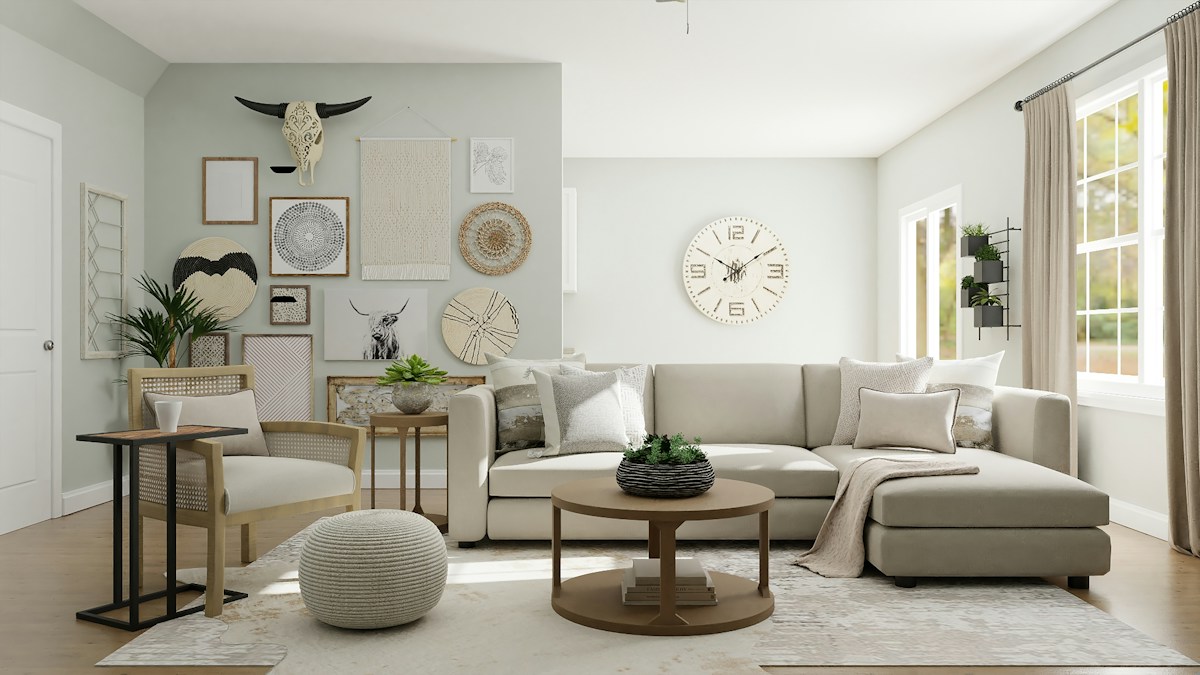
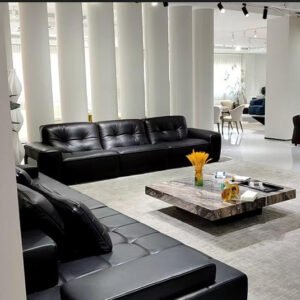
Premium upholstered seating of the type manufactured in Foshan’s Longjiang district — the global capital for sofa production. (Photo: Unsplash)
Logistics & Export Infrastructure
Foshan is not a coastal port city, but it benefits from exceptional logistics proximity. Container cargo moves efficiently to Guangzhou’s Porto de Nansha (40 minutes), Shenzhen’s Yantian Terminal (90 minutes), and Hong Kong (2 hours). These ports collectively provide daily sailings to North America, Europe, the Middle East, and Southeast Asia. Ocean freight rates from the Pearl River Delta to the US West Coast currently range from $2,500–$4,500 per 40-ft container (2025 market rates, sea freight). East Coast adds another $1,000–$2,000 depending on transshipment routing.
Marcas como Móveis Jade Ant, operating within the Foshan–Guangdong ecosystem, combine Foshan’s manufacturing depth with professional export support — handling customs declarations, logistics coordination, and quality control documentation, which are the hidden operational layers that determine whether an order arrives in perfect condition or causes expensive headaches.
Shanghai — Premium Design & High-End Manufacturing
Premium · Luxury · Design-Forward · International StandardsShanghai’s Position in the Luxury Furniture Market
Shanghai is China’s design capital — a city where international aesthetics converge with precision manufacturing. Furniture companies here compete not on volume but on design differentiation and international compliance. The China luxury furniture market was valued at USD $4.1 billion in 2025 e deve atingir $6.8 billion by 2035 (CAGR of approximately 5%), driven primarily by demand from ultra-high-net-worth residential buyers and international luxury hotel chains.
Shanghai manufacturers are the natural partners for interior designers working on flagship penthouse projects, boutique hotels targeting international guests, or showrooms positioning themselves as the premium alternative to mass-market chains. These factories understand concepts like material tolerance specifications, color matching across production batches, and finish consistency — details that mid-range factories in other regions often treat as optional.
Furniture Categories from Shanghai
- High-end residential furniture (Italian & Scandinavian aesthetics)
- Bespoke designer collaboration pieces
- Commercial furniture for luxury hotels (5-star FF&E packages)
- Architectural millwork and custom cabinetry
- Art-furniture hybrids for gallery-level showroom display
Quality Certifications Common in Shanghai
- ISO 9001:2015 (Quality Management System)
- CE Marking (EU market access)
- FSC Chain of Custody (responsible wood sourcing)
- GREENGUARD Gold (low chemical emissions, indoor air quality)
- EN 12520/12521 (European domestic furniture safety standards)
Manufacturing Districts
Pudong’s modern furniture clusters house manufacturers that emerged in parallel with Shanghai’s financial district development — factories designed from the ground up to serve international luxury buyers. Many have separate design studios, English-speaking project managers, and sophisticated quality assurance labs. Minhang District’s specialized production facilities include factories focused on sintered stone tabletops, lacquered case goods, and custom metal furniture frames — technical disciplines where attention to micron-level tolerances matters.
Pricing & MOQ for B2B Buyers
Expect Shanghai pricing to run 20–40% above equivalent Foshan products. A custom dining table that costs $450 FOB from a Foshan factory might be $580–$630 from a Shanghai premium manufacturer. The differential pays for stronger material consistency, better project management, and the peace of mind of knowing a 5-star hotel contract won’t be derailed by finish variations. MOQs are typically lower (20–100 units) because these factories serve niche design-driven buyers, not volume distributors. Some accept orders as small as 5–10 units for established client relationships.
Guangzhou — The Bridge Between Manufacturing and Trade
Mid-Range · Office & Contract · Trade Fair CapitalStrategic Role in Furniture Distribution
Guangzhou is where the industry meets itself. The Feira Internacional de Móveis da China (CIFF) — held bi-annually in March and September at the China Import and Export Fair Complex — is the world’s largest furniture trade event. With 850,000 square meters of exhibition space and over 380,000 professional visitors from 200+ countries, CIFF is the single most important sourcing and intelligence-gathering event in the global furniture calendar.
Guangzhou serves a dual role: it is both a manufacturing hub in its own right and a trade gateway that connects buyers to manufacturers across the entire Pearl River Delta. For distributors entering the Chinese market for the first time, Guangzhou — particularly during CIFF — offers the most efficient way to evaluate hundreds of suppliers in a single trip and establish relationships before committing to factory visits.
Key Markets & Trading Zones
- Yipin Furniture Market — comprehensive multi-category wholesale
- Longxi Furniture Market — specialist in mid-range residential pieces
- CIFF Complex — bi-annual trade fair campus (world’s largest)
- Pazhou Exhibition District — permanent showrooms for repeat buyers
Furniture Specializations
- Mid-range residential furniture (bedroom, living room, dining)
- Office furniture and ergonomic seating for commercial projects
- Contract furniture for hospitality chains (cost-effective tier)
- Whole-home furniture packages for residential developers
Around 70% of booths claiming to be “direct factories” at Guangzhou trade events are actually trading companies or middlemen, according to Canton Fair sourcing guides. The tell-tale signs: vague answers about production capacity, inability to show factory floor photos, and unwillingness to provide a factory audit appointment within 2 business days. Always request the factory’s Unified Social Credit Identifier (USCI) and verify it against China’s national business registry before proceeding.
Logistics Infrastructure
Guangzhou’s Baiyun International Airport is the cargo gateway for time-sensitive air freight shipments, while Porto de Nansha (Guangzhou’s deepwater terminal, 40 minutes from the city center) handles vast container volumes. For buyers sourcing across both Guangzhou and Foshan simultaneously — a common and efficient approach — consolidated container loading from both cities through a single freight forwarder can reduce per-unit logistics costs by 15–25%.
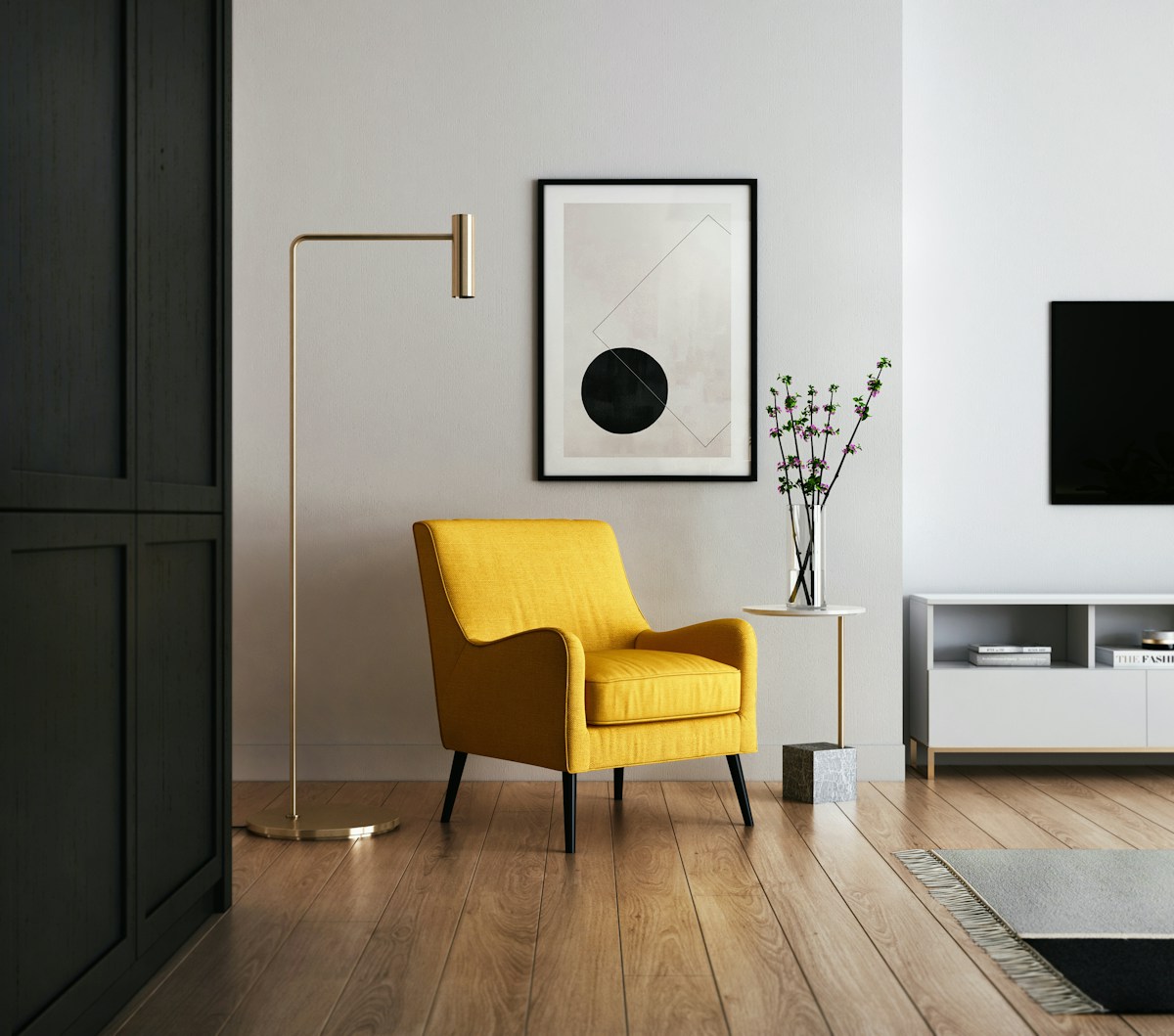
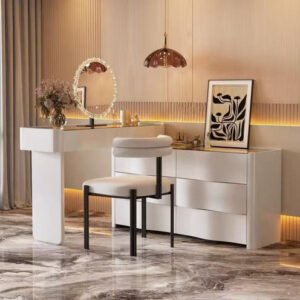
High-end dining furniture of the caliber produced by Shanghai’s premium manufacturers and Foshan’s design-forward factories. (Photo: Unsplash)
Jiangsu Province — Emerging Quality & Solid Wood Specialization
Solid Wood · Sustainability · Premium Domestic StandardsNanjing & Suzhou’s Growing Influence
Jiangsu Province — home to the historic cities of Nanjing and Suzhou — has built a reputation as China’s solid wood furniture center. Unlike the mass-production model of Foshan’s panel and upholstered furniture, Jiangsu factories focus on traditional joinery, solid wood construction, and premium finishing techniques. Ash, oak, walnut, and rubber wood are the dominant materials, often sourced from FSC-certified suppliers in Russia, North America, and Southeast Asia.
Suzhou, in particular, benefits from proximity to Shanghai — enabling easy access to the city’s international design community while maintaining the lower manufacturing costs of a second-tier city. Several Suzhou factories have invested in European CNC machinery (German-made Homag and Italian SCM equipment) that delivers European-grade precision at Chinese production costs.
Categorias de produtos
- Solid wood bedroom furniture (bed frames, wardrobes, dressers)
- Dining tables with traditional joinery or contemporary minimalist design
- Eco-certified furniture for LEED-compliant commercial projects
- Children’s solid wood furniture with non-toxic finishes
- Custom millwork for residential developers and hotel projects
Key Quality Advantages
- FSC Chain of Custody certification widely available
- CARB Phase 2 compliant production (formaldehyde emission control)
- Domestic China premium market demands shape high baseline quality
- Skilled wood craftsmen with 15–30 year specialization histories
- Strong quality assurance protocols (ISO 9001 standard)
For interior designers and hotel fit-out teams specifying FSC-certified solid wood furniture, Jiangsu offers a compelling combination: quality that rivals European production, pricing 35–50% below equivalent Italian or Scandinavian products, and the flexibility to accommodate custom dimensions and finishes. The 50–70 day lead time requires advance planning, but the result is furniture that passes rigorous hotel brand standards inspections — something that cheaper panel furniture from other regions routinely fails.
Zhejiang Province — Specialized Manufacturing Excellence
Metal · Outdoor · Industrial · Niche ExpertiseHangzhou & Jiaxing’s Niche Dominance
Zhejiang is China’s specialist province for furniture categories that require industrial engineering rather than traditional craftsmanship. Condado de Anji (part of Huzhou, bordering Zhejiang) produces an estimated 60% of the world’s office chairs and gaming chairs — a specialization so concentrated that global brands from Herman Miller competitors to Amazon private-label sellers source from here. Jiaxing leads in aluminum outdoor furniture manufacturing, with major producers like Jiaxing Mindo Outdoor Products serving European and North American resort and hospitality buyers.
Metal furniture from Zhejiang is characterized by precision welding, powder-coating technology that withstands salt-spray testing (a requirement for coastal resort applications), and modular design that allows flatpack shipping — significantly reducing container volumes and per-unit logistics costs versus bulky upholstered pieces.
Product Specializations
- Office & ergonomic gaming chairs (Anji — global market leader)
- Aluminum & wrought iron outdoor garden furniture (Jiaxing)
- Industrial-style metal frame dining tables & chairs
- Hotel pool deck furniture & commercial outdoor seating
- Custom metal bed frames with upholstered elements
Technology & Innovation
- Advanced robotic welding for structural consistency
- Powder coating lines with 500-hour salt-spray resistance testing
- Teak, PE rattan & olefin fabric outdoor collections
- Smaller batch production capabilities (40–120 units) for boutique buyers
- ISO 14001 environmental management certifications
Sichuan Province — Cost-Effective Mass Production Hub
Budget Tier · Volume · Panel Furniture · Domestic MarketChengdu’s Role in Budget-Friendly Manufacturing
Sichuan’s capital Chengdu — home to Móveis QuanU (annual revenue approximately $2.2 billion, making it China’s 4th largest furniture company by revenue) — represents China’s domestic market powerhouse. The Wuhou District furniture cluster in Chengdu is the engine of affordable panel furniture production, serving China’s vast middle-income housing market and the budget tier of commercial contract furniture.
For international B2B buyers focused on price-sensitive markets — student accommodations, budget hotel chains, rental apartment operators, or value-tier furniture retail — Sichuan offers production costs 20–35% below Foshan for equivalent panel furniture categories. The trade-off is higher MOQs (200–500 units per style to justify the logistics costs of inland transportation to coastal ports) and quality consistency that requires more rigorous third-party inspection management than coastal hubs.
Product Focus
- MDF and melamine panel furniture (bedroom, living, dining)
- Flatpack ready-to-assemble (RTA) furniture for volume retail
- Budget commercial contract furniture for hotels & serviced apartments
- Children’s furniture for mass-market retail distribution
Sourcing Considerations
- Add inland freight cost ($150–$300/container to Guangzhou ports)
- Allow 5–10 extra days for inland transport to coastal shipping
- Mandatory pre-shipment inspection (defect risk higher than coastal hubs)
- CARB Phase 2 compliance verification required for US-bound shipments
Yunnan & Western China — Specialized Materials & Artisanal Craftsmanship
Bamboo · Rattan · Artisanal · Eco-Certified · SpecialtyChina’s western provinces — Yunnan, Sichuan’s rural counties, Guizhou, and Guangxi — are home to a very different kind of furniture production. This is where traditional craft techniques meet natural materials to produce the kind of authentically handmade furniture that design-forward showrooms and boutique resort hotels are actively seeking. Bamboo, rattan, and natural fiber furniture from this region carry a natural storytelling premium that mass-produced factory furniture cannot replicate.
Unique Product Offerings
- Handwoven bamboo chairs and lounge pieces (each piece unique)
- Natural rattan dining sets with traditional Chinese motif weaving
- Bamboo composite furniture with eco-material certification
- Artisanal carved wooden accessories and accent furniture
- Traditional Chinese craft-style bedroom pieces for boutique hotels
Sustainability & Export
- Locally sourced bamboo (fastest-renewing natural building material)
- FSC and eco-certification available for export-focused producers
- Longer lead times: 60–90 days production + 35–45 days ocean freight
- Partnership model recommended: source through established trading agents
- Premium positioning (10–30% above Foshan pricing) justified by uniqueness
Biophilic design — incorporating natural materials to connect interior spaces with the natural world — is one of the fastest-growing trends in 2025 hospitality design. Boutique resort hotels in Bali, the Maldives, and Costa Rica are specifying bamboo and rattan furniture sourced from Western China, often procured through sourcing agents who understand the production nuances of artisanal workshops. The challenge: no two pieces are identical, which is a feature, not a bug, for premium positioning.
▶ Watch: Inside China’s Furniture Manufacturing Hubs
A real factory and market tour through Foshan — the world’s largest furniture manufacturing cluster — showing the scale, specialization, and trade infrastructure that B2B buyers need to understand before sourcing.

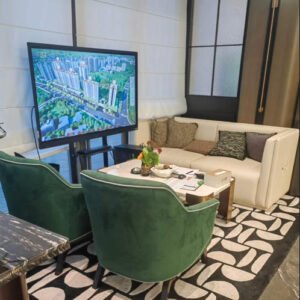
Hospitality-grade furniture of the type manufactured by Foshan’s hotel specialists and Shanghai’s premium design factories — built for 10+ years of daily guest use. (Photo: Unsplash)
Interactive Regional Comparison Guide
Use this framework to match your sourcing needs to the right Chinese manufacturing region. The quality tier, product specialization, pricing, and compliance profile of each hub directly determines your sourcing outcome.
Quality Tier Framework
🟢 Budget Tier
- Panel/MDF furniture dominant
- Price index: 100 (baseline)
- MOQ: 200–500 units
- Best for: volume retail, student housing
- Risk: requires active QC management
🔵 Mid-Range Tier
- Upholstered + wood composite dominant
- Price index: 130–160
- MOQ: 50–200 units
- Best for: distributors, showrooms, hotels
- Risk: finish consistency (manage via spec sheets)
🟡 Premium Tier
- Solid wood + luxury composite
- Price index: 180–220
- MOQ: 20–100 units
- Best for: luxury residential, design hotels
- Risk: higher unit cost (offset by lower defects)
🟣 Specialty / Artisanal Tier
- Bespoke, handcraft, designer collab
- Price index: 220–350+
- MOQ: 1–50 units
- Best for: boutique hotels, flagship showrooms
- Risk: longer lead times, higher unit cost
Master Regional Comparison Table
| Região | Melhores categorias de produtos | Nível de qualidade | Price Index | MOQ Range | Prazo de entrega | Key Certifications | Melhor para |
|---|---|---|---|---|---|---|---|
| Foshan, Guangdong | Upholstered furniture, sofas, hotel seating, beds | Mid–Premium | 130–165 | 50–200 unidades | 45–60 days | ISO 9001, BIFMA, ANSI, CARB P2 | Distributors, showrooms, hotel FF&E |
| Xangai | Luxury residential, bespoke designer, high-end hotel | Premium–Luxury | 180–220 | 20–100 units | 50-75 dias | ISO 9001, CE, FSC, GREENGUARD Gold | Luxury hotels, design showrooms, high-end residential |
| Guangzhou | Mid-range residential, office, contract furniture | Mid-Range | 125–155 | 100–300 units | 40–55 days | ISO 9001, BIFMA (office), CARB P2 | Commercial developers, office procurement, distributors |
| Jiangsu Province | Solid wood bedroom, eco-certified, custom millwork | Premium | 160–200 | 30–150 units | 50–70 days | FSC, CARB P2, ISO 9001, LEED-compliant | Eco-focused hotels, luxury residential, design firms |
| Zhejiang Province | Office chairs, outdoor/garden, metal industrial, gaming chairs | Mid–Premium | 140–180 | 40–120 units | 45 a 65 dias | ISO 9001, ISO 14001, EN outdoor standards | Outdoor hospitality, office procurement, boutique buyers |
| Sichuan (Chengdu) | Panel furniture, RTA, budget commercial contract | Budget | 100 (baseline) | 200–500 unidades | 40–60 days (+inland transit) | Basic ISO, CARB P2 (verify per factory) | Volume retail, student housing, budget hotel chains |
| Yunnan / Western China | Bamboo, rattan, artisanal craft, eco-natural | Especialidade | 150–200 (uniqueness premium) | 1–80 units | 60–90 days | FSC (select), eco-material certs | Boutique resorts, biophilic design projects, eco-hotels |
Sourcing by Product Category — Quick Matching Guide
| Categoria do produto | Primary Hub | Secondary Hub | Why This Region | Typical FOB Price Range |
|---|---|---|---|---|
| Upholstered sofas & sectionals | Foshan (Longjiang) | Guangzhou | 60%+ of China’s export volume; integrated fabric supply chain | $280–$1,800 per sofa FOB |
| Solid wood bedroom sets | Jiangsu (Suzhou/Nanjing) | Yunnan (artisanal) | Traditional joinery expertise, FSC-certified sourcing | $800–$3,500 per set FOB |
| Office & ergonomic chairs | Zhejiang (Anji) | Guangzhou | Global market leader in office seating production | $45–$380 per chair FOB |
| Outdoor / garden furniture | Zhejiang (Jiaxing) | Yunnan (bamboo/rattan) | Aluminum & powder coat technology; salt-spray resistance | $180–$1,200 per set FOB |
| High-end custom / bespoke pieces | Xangai | Foshan (Shunde design factories) | Design innovation, international compliance, low MOQ | $600–$8,000+ per piece FOB |
| Hotel FF&E packages (5-star) | Foshan / Guangdong | Xangai | Dedicated hotel furniture factories; fire compliance | $2,500–$12,000 per room FOB |
| Budget RTA / flatpack | Sichuan (Chengdu) | Guangzhou (lower-tier) | Lowest production cost; high-volume capabilities | $35–$280 per piece FOB |
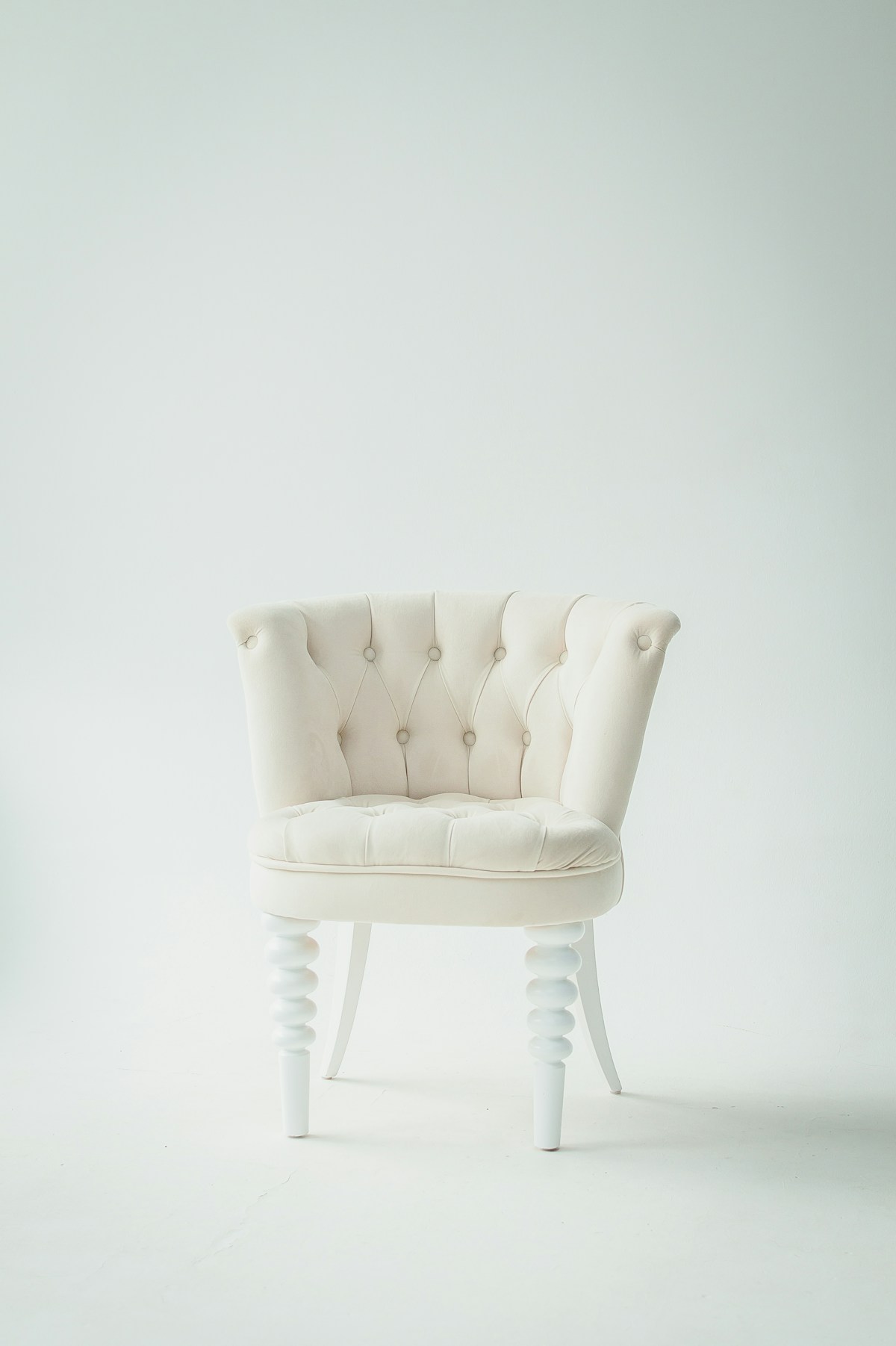
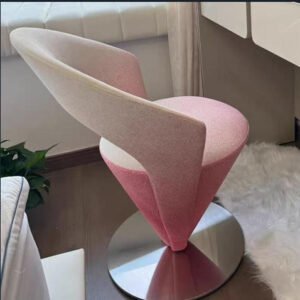
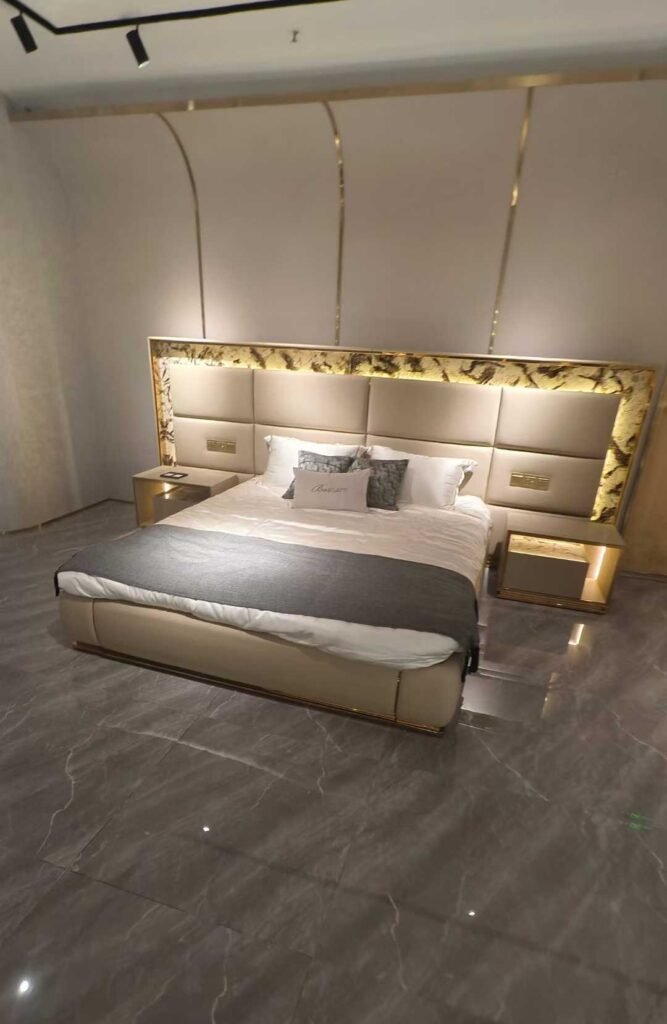
Precision-crafted upholstered furniture of this caliber is produced in Foshan’s Shunde design factories and Shanghai’s luxury manufacturing districts. (Photo: Unsplash)
Strategic Sourcing Strategies for B2B Buyers
The most sophisticated buyers don’t source from one city. They source from a portfolio of regional partners, each selected for its specific strength — a multi-hub approach that balances cost, quality, and specialization.
Multi-Hub Sourcing Approach
Consider the practical example of a hotel fit-out designer furnishing a 120-room 4-star property with a F&B restaurant and rooftop bar. A single-region sourcing strategy produces mediocre results: either everything comes from Foshan (great for guestroom upholstered pieces but suboptimal for outdoor terrace furniture) or everything comes from Shanghai (impeccable quality but budget-busting pricing for standard guestroom furniture).
The optimal approach: guestroom upholstered furniture and fabric headboards from Foshan (mid-premium quality, 45-day lead time, 20–30% cost advantage over Shanghai), F&B dining chairs and solid wood tables from Jiangsu (FSC-certified, durable, premium finish), and rooftop terrace furniture from Zhejiang (aluminum construction, salt-spray resistant, modular flatpack shipping). All three shipments can be consolidated through a single freight forwarder for one container booking, eliminating logistical complexity.
This is the approach that Móveis Jade Ant guides its B2B clients toward — leveraging deep knowledge of China’s regional specializations to source the right product from the right hub, rather than defaulting to a single city simply because it’s the most famous.
Relationship Building Strategies
- CIFF Guangzhou (March/September): largest trade fair — attend before factory visits
- Canton Fair: strong for general merchandise + hospitality buyers
- Factory visits: essential before first large order (3-day Foshan itinerary recommended)
- WeChat: standard communication channel — build relationships with factory WeChat accounts
- Translator / sourcing agent: mandatory for non-Chinese speakers ($50–$150/day)
Negotiation Tactics by Region
- Foshan: volume commitments yield 8–15% discounts; offer 60-day lead time for price reductions
- Shanghai: emphasize long-term relationship; price reductions rare but exclusivity is negotiable
- Jiangsu: FSC certification maintenance costs — don’t negotiate below break-even
- Sichuan: volume discounts strongest here (15–25% for 500+ units)
- All regions: 30% T/T deposit is standard — never pay 100% upfront with new suppliers
Quality Control & Compliance Management
Third-party inspection is not optional — it is the single most cost-effective investment in your China sourcing program. A pre-shipment inspection from SGS, Bureau Veritas, or TESTCOO costs $250–$600 per inspection day and covers defect classification, dimensional verification, material conformance, and packaging assessment. When a shipment fails inspection and you catch it before it leaves China, the correction cost is typically $500–$2,000. When the same defect reaches your warehouse after 30+ days at sea, the correction cost is $5,000–$50,000 in returns, rework, and lost customer goodwill.
For certification compliance, verify certificate authenticity directly with the issuing body — FSC certificate search is free and publicly accessible. GREENGUARD Gold certificates are verifiable through UL’s database. CARB compliance certificates are verified through the California Air Resources Board. Certificates cannot be taken on faith in the Chinese furniture industry.
Logistics Optimization
For buyers sourcing from multiple regions simultaneously, cargo consolidation is the highest-impact logistics optimization available. A consolidation hub — typically a bonded warehouse in Guangzhou, Shenzhen, or Shanghai — collects shipments from multiple factories, performs final quality inspection, and loads a single container for international export. This eliminates the cost of shipping multiple small LCL (Less-than-Container Load) shipments and reduces per-unit logistics cost by 18–30% versus individual shipments.
Common Challenges & Solutions for B2B Sourcing
Every experienced B2B buyer has a collection of “China sourcing horror stories.” The good news: virtually every common problem has a known prevention protocol.
| Challenge | Root Cause | Prevention Protocol | Recovery Strategy |
|---|---|---|---|
| Quality Inconsistency Between Orders | Factory switches materials post-sample approval; subcontracts production to cheaper workshops | Pre-production inspection at material stage; lock material specs in purchase order contract; visit factory during production | Claim compensation via inspection report; require rework or replacement before payment release |
| Longer Than Agreed Lead Times | Factory overcommitted; raw material shortages; CNY holiday disruption | Build 15-day buffer into all project timelines; confirm production start date in writing; deposit triggers production slot booking | Establish penalty clauses in purchase order (e.g., 0.5% per day delay, max 5%); escalate through sourcing agent |
| Communication Misunderstandings | Technical specs lost in translation; verbal changes not documented | All specs in written Chinese AND English; use annotated technical drawings (dimensions, materials, colors in RAL/Pantone codes) | Translation professional to re-confirm specifications before production begins |
| MOQ Too High for Initial Orders | Factory optimizes for production run efficiency | Use trading companies for first orders (more flexible); consolidate orders with other buyers via sourcing agent; offer longer lead time in exchange for lower MOQ | Partner with brands like Móveis Jade Ant that specialize in lower-MOQ bespoke orders |
| IP / Design Protection | Factory sells your design to competitors; design copied and sold in Lecong markets | NDA and non-compete clauses in Chinese (legally enforceable in China); register design in China via CNIPA; share complete specs only after deposit received | Register copyright of original designs proactively; pursue CNIPA takedown notices for flagrant copying |
Future Trends in China’s Furniture Manufacturing Hubs
The regional landscape is not static. Four macro-trends are actively reshaping which hubs gain influence and which face consolidation pressure through 2028.
Sustainability & Eco-Friendly Production
The Chinese government’s Carbon Neutrality by 2060 commitment is driving real change in furniture manufacturing. New national standards (GB 18584-2024) have updated hazardous substance limits across all furniture categories, effectively raising the quality floor for the entire industry. In Jiangsu, FSC-certified material sourcing has expanded from a niche premium to a baseline expectation for export-focused factories. Foshan’s larger manufacturers are now investing in solar-powered production facilities and water-based coating systems that reduce VOC emissions by 60–80% versus solvent-based predecessors.
Digital Transformation & Industry 4.0
Smart manufacturing is advancing fastest in Foshan and the Pearl River Delta. Lin’s Furniture’s “1+1+N” modular production model — where components are standardized and assembled on-demand using AI-driven order management — has reduced delivery cycles from 60 days to 7 days for standardized product configurations. Digital twin modeling allows factories to simulate production runs before committing to tooling, reducing development costs for custom orders. AI-powered visual inspection systems now detect surface defects at 0.3mm resolution — a level of consistency impossible with manual inspection alone.
For B2B buyers, these developments translate to practical benefits: faster sample production, more reliable quality consistency, and real-time production visibility through factory digital dashboards that leading manufacturers are now making available to their major international clients.
Post-Pandemic Supply Chain Adjustments
The 2020–2022 supply chain crisis accelerated a structural shift: international buyers who previously sourced exclusively from China are now pursuing dual-sourcing strategies, maintaining a China primary supplier for cost and scale while establishing a Vietnam or Malaysia secondary supplier for supply chain resilience. Vietnam’s furniture export value to the US reached $9.4 billion in 2024, driven partly by buyers diversifying away from China-only exposure.
The smart response for B2B buyers is not to abandon China — where the depth of specialization, supplier density, and logistics infrastructure remains unmatched — but to treat regional diversification within China itself as a risk management strategy. Sourcing upholstered pieces from Foshan while maintaining a Jiangsu solid-wood relationship and a Zhejiang outdoor furniture partnership creates supply chain resilience without sacrificing the cost or quality advantages of Chinese manufacturing.
Practical Tools for Regional Sourcing Decisions
Supplier Vetting Checklist
Use this checklist before committing to any new Chinese furniture supplier, regardless of region:
Sample Sourcing Timeline & Milestones
Weeks 1–2: Research & Shortlisting
Identify 8–12 candidate suppliers via CIFF, Canton Fair contacts, or B2B platforms. Verify USCI for all candidates. Send RFQ (Request for Quotation) with technical specification sheet.
Weeks 3–4: Quotation Review & Sample Request
Evaluate quotations on price, lead time, certifications, and responsiveness. Shortlist to 3 suppliers. Order samples from each ($50–$500 + shipping). Do NOT select a supplier without receiving a physical sample.
Weeks 5–7: Sample Evaluation & Factory Audit
Evaluate sample quality against specification. If possible, visit factory in person (3-day Foshan or Guangzhou trip covers 4–6 factories efficiently). Alternatively, commission a factory audit through SGS or Bureau Veritas ($300–$600).
Weeks 8–9: Contract Negotiation & Pilot Order Placement
Negotiate final pricing, payment terms, and delivery window. Place pilot order (50–100% of MOQ) with clear quality specifications in Chinese and English. Pay 30% T/T deposit to trigger production slot.
Weeks 10–14: Production Monitoring & Pre-Shipment Inspection
Request mid-production update photos. Commission pre-shipment inspection when 80%+ of order is complete. Review inspection report before releasing final payment (70% balance). Book container space at least 4 weeks before ready date.
Weeks 15–20: Ocean Transit & Customs Clearance
Ocean transit: 28–40 days from Pearl River Delta to US/EU ports. Arrange customs broker 2 weeks before estimated arrival. Prepare HS codes, commercial invoice, packing list, Bill of Lading, and certification documentation for customs entry.
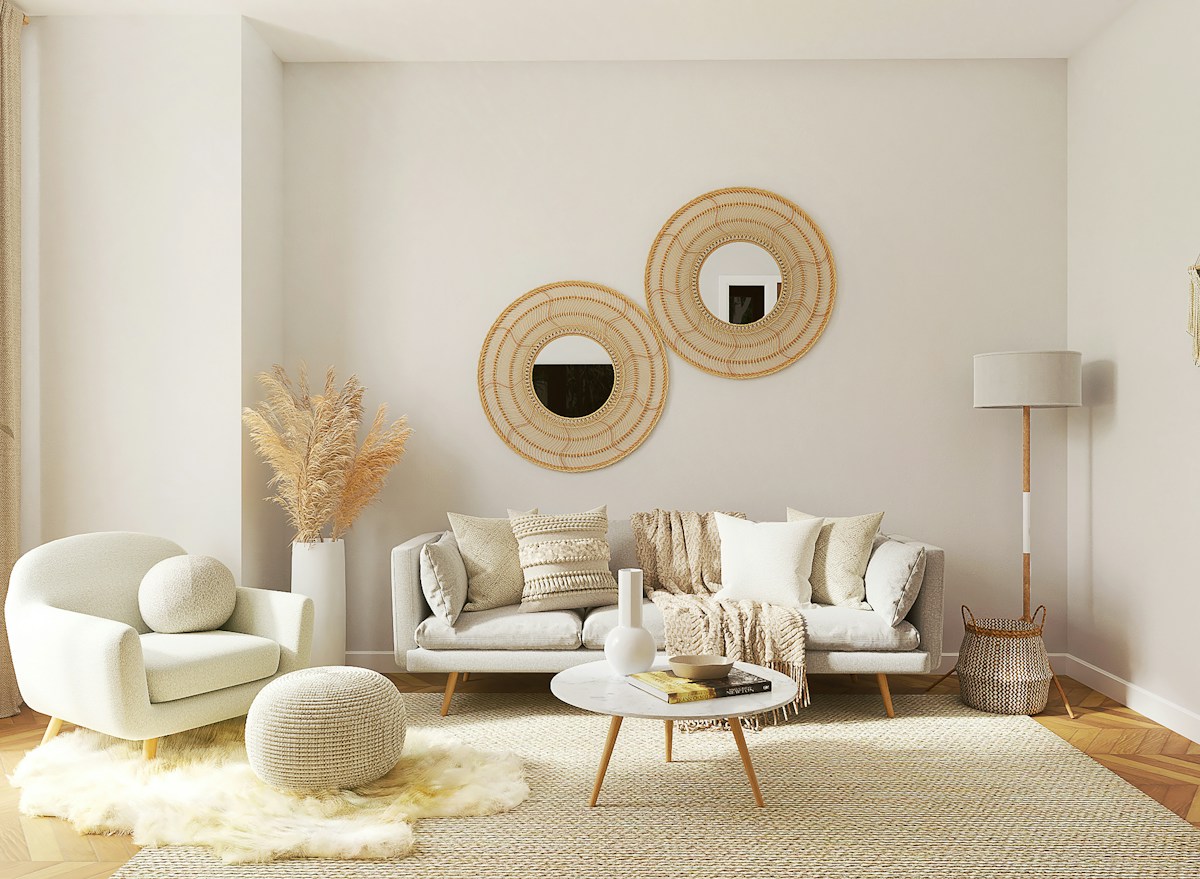
Precision-crafted solid wood bedroom furniture — the specialty of Jiangsu Province’s Nanjing and Suzhou manufacturing clusters. (Photo: Unsplash)
Making the Right Regional Choice for Your B2B Needs
China’s furniture manufacturing landscape is a precision instrument — extraordinarily powerful when used correctly, frustrating when used without understanding its regional architecture. The buyer who treats “China furniture” as a monolithic category will always underperform against the buyer who understands that Foshan makes the world’s best upholstered furniture, Jiangsu produces superior solid wood, Zhejiang commands outdoor and office seating, and Shanghai delivers the design excellence and compliance documentation that luxury projects demand.
The data is clear: China’s $160.5 billion domestic furniture market and $67.81 billion export economy are not products of geography alone — they are products of decades of regional specialization, supply chain optimization, and manufacturing expertise that no other country can match in breadth or depth. The question is not whether to source from China. The question is which China to source from.
Whether your project calls for 50 bespoke sofas for a boutique hotel lobby, 300 solid wood dining sets for a restaurant chain, or a full FF&E package for a 200-room resort, the right regional partner exists. Companies like Móveis Jade Ant bridge the gap between China’s regional manufacturing complexity and the practical needs of international B2B buyers — offering curated sourcing support, quality management, and logistics coordination that transforms regional expertise into competitive advantage.
Ready to Optimize Your China Furniture Sourcing Strategy?
Connect with our B2B sourcing specialists to identify the perfect manufacturing partners for your business — matched to your product categories, quality requirements, budget, and timeline.
Perguntas frequentes
GEO-optimized answers to the questions B2B furniture buyers, interior designers, and hotel fit-out specialists search most frequently.