Affordable Luxury Furniture: A Procurement Framework for Premium Projects
Affordable luxury furniture is furniture built to a verified premium specification without the full cost of a heritage label. It helps professional buyers control material quality, design and landed cost at the same time. The goal is not the lowest quote. The goal is furniture that fits the project, performs in daily use and stays consistent across repeat orders.
For importers, designers, developers and FF&E buyers, this approach solves a common problem. The project needs a high-end result, but the budget cannot support a famous brand name on every piece. A specification-led buying model closes that gap. It shifts spending toward materials, construction and finish control.

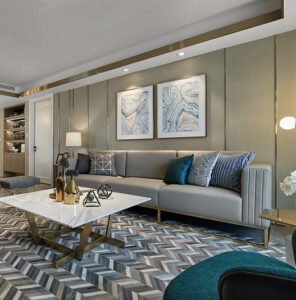
Affordable luxury places the budget into proportion, materials and construction rather than a visible label.
I. Redefining the Value Proposition of “Affordable Luxury”
“Affordable” does not mean “budget” in the premium sector. Budget furniture starts with a target price and removes features until the product fits. Affordable luxury starts with the required performance and removes costs that do not improve the piece.
Those costs may include retail showrooms, layered distribution, licensing fees and large advertising programs. Material integrity and skilled labor should stay in the specification.
A professional buyer should judge value through three questions:
- Does the piece meet the visual standard of the project?
- Can it survive the expected level of use?
- Can the supplier reproduce it with the same materials and finish?
This model works for a private villa, a hotel floor or a private label collection. The scale changes, but the buying logic stays the same.
| Buyer priority | Weak buying method | Stronger affordable luxury method |
|---|---|---|
| Appearance | Approve a product photo | Review dimensions, materials and finish samples |
| Durability | Trust the word “premium” | Request construction details and test reports |
| Cost control | Compare factory prices only | Compare total landed cost and service life |
| Design control | Accept fixed catalog options | Agree on dimensions, finishes and tolerances |
| Repeat orders | Assume the next batch will match | Retain approved samples and batch records |
FF&E means furniture, fixtures and equipment. In a hotel project, it includes beds, chairs, tables, decorative lighting and other movable items. Each item needs a clear use case before the buyer discusses price.
II. The Anatomy of Affordable Luxury: Materials and Engineering
True luxury starts with honest materials and precise construction. A beautiful photograph cannot show weak joints, unstable timber or poor seat support. Buyers need documents and physical samples.
Specify the material, not just its appearance
Kiln-dried hardwood is wood dried in a controlled chamber to reduce moisture. Lower and stable moisture helps reduce later movement. The target should match the destination climate rather than follow one universal number.
Walnut, white oak, ash and teak can support premium designs. The species alone does not prove quality. Buyers should also check moisture records, joint design, grain selection and finishing.
Leather needs the same care. Top-grain leather comes from the upper layer of the hide. Full-grain leather keeps the natural surface. Other top-grain leather may receive light surface correction. “Genuine leather” is not a useful grade description for a premium specification.
Architectural metals also need clear names. Specify solid brass, stainless steel or aluminum where appropriate. State the surface treatment, thickness and color reference. “Gold metal” does not tell the factory enough.

Velvet, stone and metal can create a premium interior. The specification must still define what sits beneath each surface.
Understand the difference between veneer and imitation finishes
Veneer is a thin slice of real wood bonded to a stable core. High-end veneer can be an excellent choice. It allows book-matched grain and can reduce movement across wide panels.
Mass-market printed foil is different. It copies the appearance of wood without using a real wood surface. Buyers should not reject veneer simply because it is veneer. They should reject unclear material descriptions.
| Componente | What to specify | Evidence to request | Problem it helps prevent |
|---|---|---|---|
| Timber frame | Species, moisture target and joint method | Material record and frame photos | Warping, loose joints and cracking |
| Couro | Hide grade, thickness, finish and origin | Hide sample and supplier details | Peeling, color variation and early wear |
| Metal | Base metal, thickness and coating | Finish sample and coating process | Chipping, corrosion and color mismatch |
| Wood veneer | Species, cut, core and matching method | Veneer layup sample | Delamination and uneven grain |
| Upholstery | Foam density, suspension and fabric performance | Cut sample and test documents | Seat sagging and fabric failure |
Engineering should support the design without adding visible bulk. A slim table may need a concealed steel support. A wide headboard may need wall fixings rated for its weight. A curved sofa may need several frame sections that align within an agreed tolerance.
A tolerance is the allowed difference from the target dimension. For example, a ±3 mm tolerance on seat height gives production and inspection teams a shared pass/fail rule.
This FF&E furniture specification framework shows how buyers can turn these decisions into written requirements.
III. Craftsmanship vs. Mass Production: The Human Element
Affordable luxury does not require every task to be done by hand. It requires skilled judgment at the points where hands and eyes produce a better result.
Bench-made construction means a skilled worker builds or assembles the piece at a workbench rather than relying only on an automated line. Hand-stitched detailing can improve selected seams, rolled edges and decorative work. Machines can still handle repeatable cutting and drilling.
The best model combines both:
- CNC equipment cuts repeated parts to the same dimensions. CNC means computer numerical control.
- Skilled workers fit joints and inspect grain direction.
- Upholsterers control fabric tension around curves and corners.
- Finishers sand between coats and inspect the surface under suitable light.
- Inspectors compare the finished item with the approved sample.
A factory tour alone does not prove these controls. A tour shows selected workstations on one day. A better review follows one item from raw material to packing.
Quality control for hotel and FF&E orders
A hotel order needs checkpoints before the final inspection. Problems become expensive after hundreds of items reach the finishing stage.
| Production gate | Buyer checkpoint |
|---|---|
| Material arrival | Confirm species, fabric batch, foam and hardware |
| Frame completion | Check dimensions, joint strength and alignment |
| Pre-upholstery | Approve frame photos before the fabric hides them |
| Finish approval | Compare color and sheen with the signed sample |
| Pre-shipment inspection | Check function, appearance, labels and carton marks |
| Packing review | Confirm corner protection, moisture control and crate strength |
The following video shows how sofa frames, springs, fillings and upholstery come together. Use it as a prompt for factory questions, not as proof of another supplier’s process.
www.youtube.com/watch?v=-6jB5XSXJDY
IV. Strategic Sourcing for Importers and Private Label Brands
For brand owners, affordable luxury is a scalable business model. It depends on a manufacturing partner that can protect the design while supporting repeat production.
OEM means original equipment manufacturer. In furniture, the factory builds the buyer’s design to the buyer’s specification. ODM means original design manufacturer. The factory provides a base design, and the buyer adapts or brands it.
| Sourcing route | Design control | Development work | Best use |
|---|---|---|---|
| OEM | Alto | Drawings, tooling and prototypes | A proprietary private label collection |
| ODM | Médio | Finish, fabric and detail changes | Faster range development |
| Bespoke project | Muito alto | Room-specific engineering | Villas, hotels and architectural constraints |
| Catalog purchase | Baixo | Product selection | Short lead times and simple repeat orders |
COGS means cost of goods sold. It includes the direct cost of producing or buying the products sold. Buyers should not confuse a lower COGS figure with better value if defects, freight damage or replacement rates rise.
Brand exclusivity needs more than a logo. A private label collection can use exclusive dimensions, a controlled material palette, custom hardware and documented packaging. The agreement should also state who owns the drawings, molds and patterns.
Use prototypes to protect design fidelity
A prototype is the first physical version of a design. A golden sample is the final approved reference for production.
A practical sampling process includes:
- Submit drawings, quantities, materials and target uses.
- Review the factory’s technical questions before sampling.
- Test the prototype for comfort, size and function.
- Record every approved change.
- Sign, seal and retain the golden sample.
- Use that sample during production and inspection.
This private label collection development guide explains how a coherent material palette can support a distinct brand range.
V. Solving the Designer’s Dilemma: Balancing Budget and Vision
Interior designers often need to protect a visual concept after the budget changes. The answer is not a uniform price reduction. That approach can weaken every important piece.
The high-low strategy places more money into items that carry the design. It uses simpler specifications for supporting items.
Statement pieces may include a sculptural lobby sofa, a large stone dining table or a custom headboard. Foundational luxury includes the seats, beds and tables used every day. Supporting pieces may include side tables, ottomans and secondary casegoods.
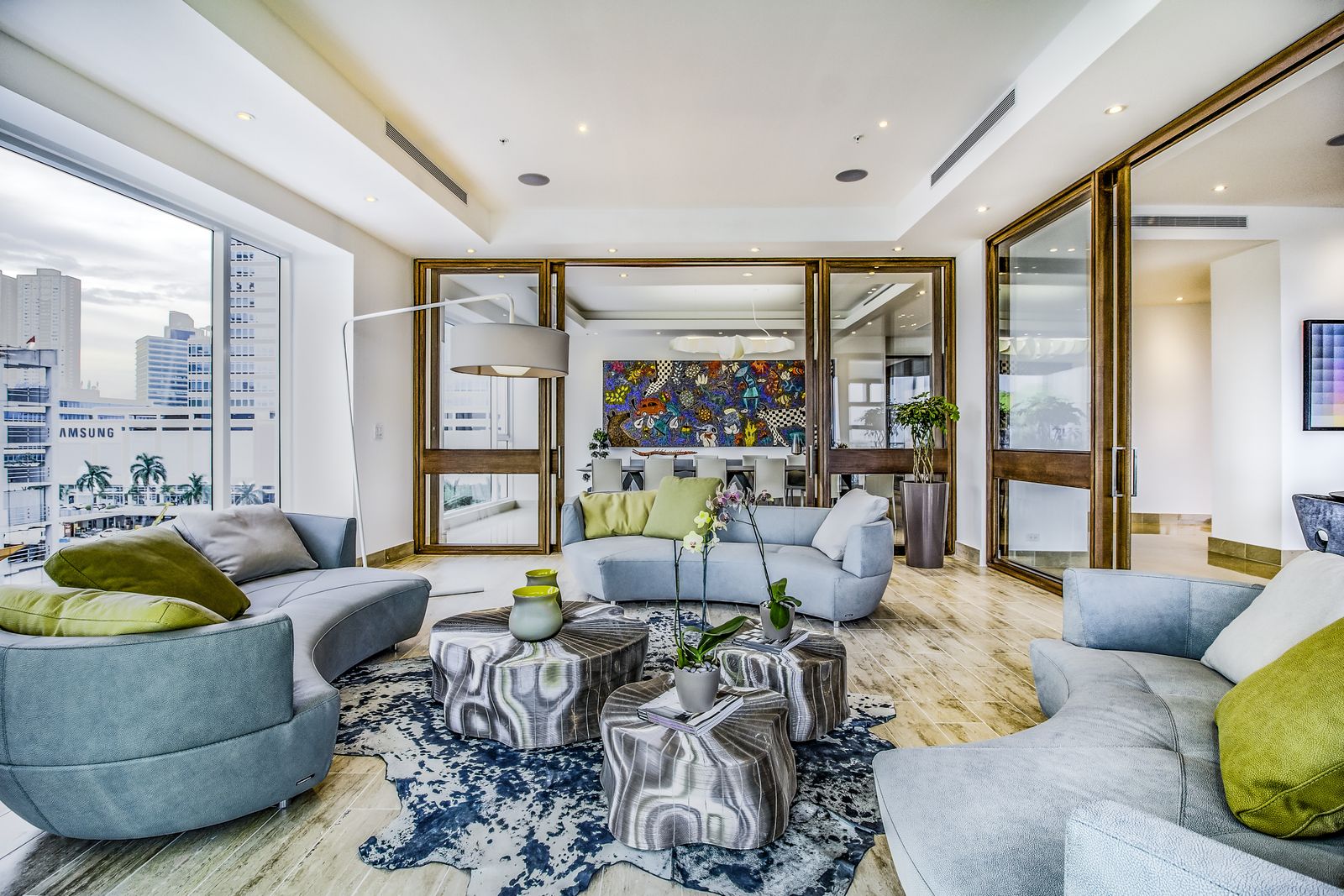
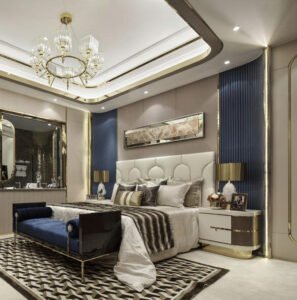
The curved seating and stone tables carry this room. Supporting pieces can stay quieter without weakening the design.

This 35/45/20 split is a planning example, not an industry average. Adjust it to the room, traffic level and design brief.
Keep categories visually consistent
Consistency does not require every item to come from one collection. It requires shared rules.
Create a master finish schedule with approved timber tones, metal samples, fabric references and stone selections. Give each sample a project code. Use that code on drawings, purchase orders and cartons.
Buyers should also approve related items together. A walnut bedside table can look different under hotel lighting than it did under factory lighting. A fabric can shift beside a warm stone floor. A physical sample room reveals these conflicts before bulk production.
Lead time improves when the team freezes key decisions early. Late changes to fabric, dimensions or electrical features can restart sampling. For phased projects, buyers can separate early architectural items from later decorative pieces.
VI. Scaling Luxury for Developers and Hotel Operators
Large projects need a consistent guest experience and a controlled replacement cycle. Affordable luxury supports both when buyers specify for actual use.
A restaurant chair faces different stress from a villa occasional chair. A lobby sofa needs cleanable upholstery and replaceable cushions. A guestroom casegood needs hardware that housekeeping staff can operate thousands of times.
Match documentation to the product and market
BIFMA develops commercial furniture performance standards. ANSI/BIFMA X5.4 covers public and lounge seating. Buyers can use the official BIFMA standards descriptions to identify the relevant product category.
Fire requirements vary by country, building use and local code. California Technical Bulletin 117-2013 tests the smolder resistance of upholstered furniture component assemblies. It does not measure every open-flame scenario. Buyers should review the California TB 117-2013 test scope and confirm project requirements with the local authority and testing laboratory.
| Requirement | What it addresses | What buyers should request |
|---|---|---|
| Structural performance | Strength, stability and durability | Test report for the relevant product standard |
| Upholstery fire behavior | A defined ignition or flame scenario | Report matching the final materials and market |
| Fabric abrasion | Resistance to surface wear | Test method, result and fabric reference |
| FSC timber | Responsible forest-based supply chains | Certificate scope, code and sales documents |
| Repairability | Ability to replace worn parts | Spare parts list and replacement method |
FSC means Forest Stewardship Council. Its certification supports responsible sourcing claims. It does not certify structural strength or product lifespan.
Measure ROI beyond the purchase price
ROI means return on investment. Furniture ROI can include longer service life, fewer room closures, lower replacement labor and a design that stays relevant through future renovations.
Illustrative model only. The calculation assumes purchase prices of $650, $1,050 and $2,600, with service lives of four, eight and twelve years. It excludes freight, repairs, resale value and downtime.
This model shows why unit price should not lead the meeting. A lower purchase price can produce a higher yearly cost if replacement comes early. Buyers should test the model with their own maintenance and occupancy records.
Bulk procurement can still feel boutique. Standardize the hidden construction across rooms, then vary selected fabrics, finishes and proportions. Approve a mock-up room before production. Keep spare fabric, hardware and touch-up materials with the operating team.
VII. The Role of Customization and Bespoke Integration
Customization allows furniture to serve the architecture rather than fight it. A standard cabinet may block a curtain track. A standard sofa may be too deep for a narrow lounge. A made-to-measure piece solves these constraints before installation.
Useful custom options include:
- Width, depth, height and seat firmness
- Fabric, leather and customer-supplied material
- Timber species, stain and surface sheen
- Stone selection and edge profile
- Metal finish and hardware design
- Power access, lighting or cable management
- Removable covers and replaceable components
Custom does not need to mean unlimited choice. Too many open decisions slow the project. A controlled options menu gives buyers flexibility while keeping materials and production stable.

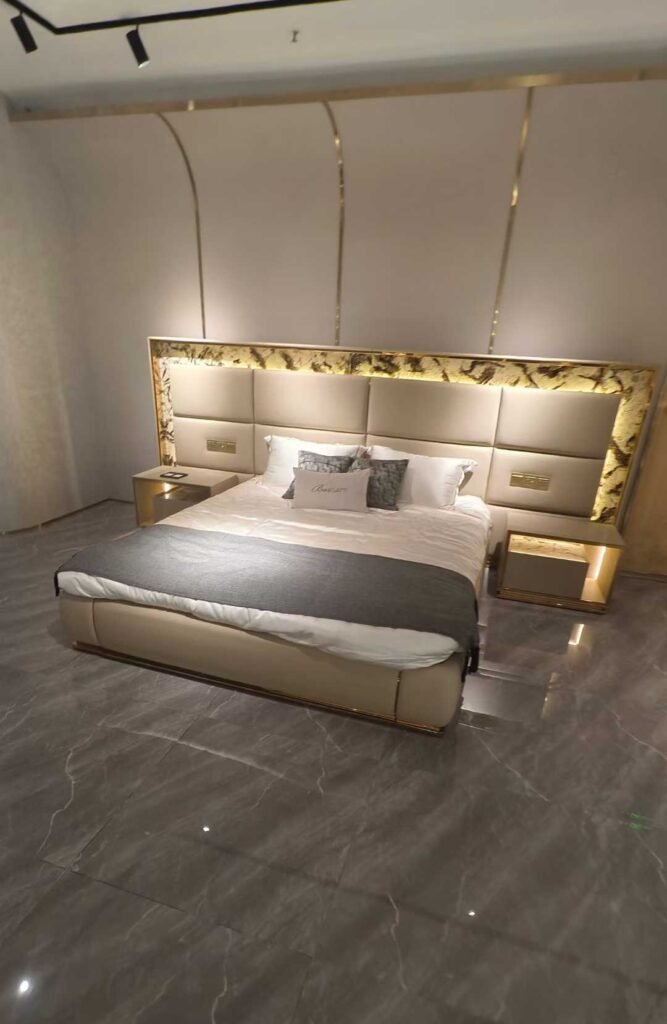
A tailored headboard can set the room’s proportions and connect the fabric, timber and lighting palette.
Build a shared technical workflow
A shop drawing is the detailed production drawing for one item. A BOM is a bill of materials. It lists every part and material used in the piece.
- The architect provides room dimensions and design intent.
- The designer defines proportions, comfort and finishes.
- The manufacturer checks structure, materials and production limits.
- The engineer resolves fixings, load paths and integrated services.
- The buyer approves cost, samples and the delivery plan.
- All parties use the same revision number after each change.
Jade Ant furniture follows this drawing-led approach for project work. Its custom furniture production workflow explains how shop drawings, samples and inspections connect.
VIII. Sustainability as the New Luxury Standard
Premium buyers now ask where materials come from and what happens when a component wears out. A sustainability claim needs evidence at the product and order level.
A circular economy keeps products and materials in use for longer. In furniture, this can mean replaceable cushions, bolted joints, standard hardware and frames that can be refinished.
Slow furniture takes the same view. It favors durable construction, repair and timeless proportions over frequent replacement. Longevity is not automatic, so buyers still need suitable tests and maintenance.
Use certifications for their actual purpose
O FSC chain-of-custody model tracks forest-based materials through the supply chain. Buyers should check the certificate holder, scope, validity and claim on sales documents.
LEED means Leadership in Energy and Environmental Design. It is a building rating system, not a certification for an individual sofa. Furniture documentation can support a project’s LEED work. The USGBC LEED program explains the wider building framework.
VOCs are volatile organic compounds. These chemicals can be released from some coatings, adhesives and other materials. Low-VOC specifications should name the required test or emissions program rather than rely on a general “eco-friendly” claim.
| Sustainability goal | Practical specification | Verificação |
|---|---|---|
| Responsible timber | Certified wood matched to the order | Certificate and transaction documents |
| Healthier interiors | Tested low-emission products | Product-level emissions certificate |
| Longer use | Replaceable wear components | Spare parts and disassembly details |
| Less waste | Accurate cutting and right-sized packaging | Material plan and packing review |
| Easier repair | Refinishable surfaces and standard fittings | Maintenance and repair instructions |
UL GREENGUARD Certification addresses chemical emissions for covered products. Buyers should confirm that the certificate matches the actual product, production site and validity period.
IX. Procurement Risk Mitigation for Global Buyers
International sourcing adds factory, freight, currency and customs risk. A low factory quote cannot offset a missed opening date or a damaged shipment.
Vet the manufacturer before discussing volume
Request the legal company name, production address, export history and relevant audit reports. Ask for references from similar order sizes. Review whether the factory performs the critical work itself or subcontracts it.
Ethical labor review should cover working conditions, worker safety and responsible recruitment. A certificate on the wall is not enough. Check the audit date, scope, corrective actions and legal entity.
Use independent inspections when the order value or project risk justifies them. Give the inspector the approved drawings, sample references and defect rules before the visit.
Protect the product during delivery
White-glove delivery usually includes controlled handling, placement, unpacking and packaging removal. The exact scope varies, so the contract should list every included service.
For oversized pieces, measure doors, lifts, corridors and stair turns using the packed dimensions. Stone, glass and high-gloss finishes may need custom crates, moisture barriers and shock protection.
Incoterms are standard trade terms that divide costs and responsibilities between buyer and seller. The ICC guide to Incoterms rules provides the official framework. Buyers should name the rule, place and version in the contract.
This international furniture import roadmap covers the packing and shipping steps that protect high-value pieces.
Calculate landed cost and currency exposure
Landed cost is the full cost of getting the product to its destination. It can include the factory price, inspection, packing, freight, insurance, duty, customs brokerage, storage and final delivery.
Landed cost = product cost + inspection + packing + freight + insurance + duty + customs + delivery
Use the correct product classification with a customs broker. Confirm tariff assumptions before approving the project budget. Add a currency buffer or use a suitable forward contract through a qualified finance provider when the order size justifies it.
X. The Future of Premium Living and Procurement
Affordable luxury furniture gives professional buyers a practical balance between quality, design and value. It does not remove the need for premium materials or skilled work. It removes costs that do not improve the finished piece.
The framework is clear. Define the use case. Specify the materials. Approve physical samples. Test the relevant performance points. Control production through documented checkpoints. Calculate the full landed cost. Plan for repair before the furniture reaches the site.
Luxury procurement is moving toward greater transparency. Buyers want to know what sits beneath the finish, who made the piece and how the next order will match the first.
The next step is to replace a label-led shortlist with a specification-led one. Jade Ant furniture can review your drawings, room schedule, quantities and target budget before production begins. Discuss your furniture project with the team and invest in craftsmanship that serves the project rather than a label.
Glossário de termos-chave
| Termo | Plain-English definition |
|---|---|
| Affordable luxury | Premium design, materials and construction without the full cost of a heritage brand |
| FF&E | Furniture, fixtures and equipment used to furnish a property |
| OEM | A factory produces the buyer’s design and specification |
| ODM | A factory provides a base design that the buyer adapts or brands |
| COGS | The direct cost of producing or purchasing goods sold |
| Golden sample | The signed physical reference used to judge bulk production |
| Tolerance | The allowed variation from a target dimension |
| Landed cost | The full cost of delivering a product to its destination |
| Circular economy | A model that keeps products and materials in use for longer |
| Low-VOC | A claim tied to lower emissions of specified volatile organic compounds |
| Entrega com tratamento especial | A defined service covering careful delivery, placement and unpacking |
| High-low strategy | Concentrating spend on key pieces while simplifying supporting items |
Perguntas frequentes
1. How does affordable luxury differ from mid-market furniture in longevity?
Affordable luxury should use stronger material specifications, better construction and clearer inspection rules. Mid-market furniture often focuses on appearance and a target retail price. Actual longevity depends on use and maintenance, so buyers should compare test reports, repair options and expected service conditions rather than category names alone.
2. Which certifications help verify sustainable luxury woods?
FSC chain-of-custody documentation is a common starting point. Check the certificate code, legal entity, product scope and validity. The claim should also appear on the relevant sales documents. FSC verifies the forest-based supply chain; it does not prove joinery quality or furniture lifespan.
3. Can affordable luxury furniture meet hotel fire and safety codes?
Yes, when the final product is built and tested for the required market and use. The buyer must identify the local code before production. Test reports should match the actual fabric, filling, barrier and construction. A report for a different material combination may not be enough.
4. How can I verify artisanal craftsmanship instead of machine imitation?
Ask for production photos and videos at frame, upholstery and finishing stages. Review the physical sample for seam control, joint fit, grain matching and finish consistency. Skilled work should solve visible and structural details. Handwork alone is not proof of quality if the dimensions or materials are wrong.
5. What lead time should I expect for customized affordable luxury pieces?
A first custom international order may require a planning range of 16–24 weeks from design development to delivery. Sampling, material availability, order size, freight and customs can change the schedule. Repeat orders may be faster after approvals are complete. Always use a written project schedule with approval dates and a delivery buffer.
6. How can I maintain color and finish consistency across a large villa project?
Approve physical control samples under the intended lighting. Assign project codes to every timber, metal, fabric and stone reference. Keep a signed golden sample at the factory. Record dye lots and finish batches, then inspect related pieces together before shipment.
7. How does affordable luxury pricing reflect materials rather than brand marketing?
A specification-led quote separates materials, labor, hardware, finishing, packaging and setup work. This makes cost changes easier to review. Heritage-brand pricing can also include design heritage, distribution, retail space and marketing. Buyers should compare products with the same dimensions and performance requirements before judging the gap.
8. How should high-end finishes be maintained in busy environments?
Follow the finish supplier’s care instructions. Use pH-neutral cleaning methods where approved, soft cloths and prompt spill removal. Keep ammonia and abrasive pads away from lacquer unless the manufacturer approves them. Aniline leather needs suitable leather care and fast blotting because its open surface can absorb spills more readily.
9. How can I import oversized luxury pieces without transit damage?
Check the packed dimensions against every access point. Use suitable crates, corner protection and moisture control. Insure the shipment and document its condition before sealing and on arrival. Coordinate delivery equipment and installation labor before the truck reaches the site.
10. Can a manufacturer modify existing designs for a private label collection?
Yes, if the supplier offers OEM or controlled ODM development. Common changes include dimensions, fabrics, finishes, hardware and branded details. Use written ownership and confidentiality agreements for proprietary work. A hotel chain can also standardize hidden construction while changing visible finishes to create a unique look at scale.