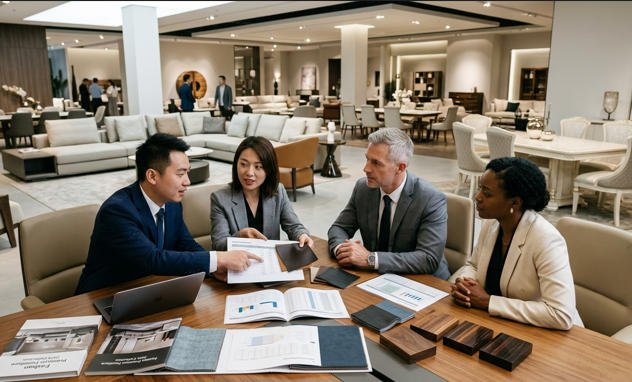
Um guia completo para compreender a excelência global na fabricação e no abastecimento de móveis em Foshan — para distribuidores, designers e operadores de showrooms
Introdução
Entre em qualquer showroom de móveis de luxo em Dubai, folheie o catálogo de um designer especializado em hotéis de Milão ou passeie pelo depósito de um distribuidor em Los Angeles — e é bem provável que uma parte significativa do que você vir tenha sido produzida em uma única cidade no Delta do Rio das Pérolas, no sul da China. Essa cidade é Foshan.
Foshan não é apenas um polo industrial. É a espinha dorsal operacional da cadeia de suprimentos global de móveis. Com um valor de produção industrial que ultrapassa 1 trilhão de yuans chineses, mais de 9.000 empresas do setor manufatureiro, mais 20.000 empresas do setor de comércio de móveis, e um conjunto de espaços de exposição que se estende por mais de 4 milhões de metros quadrados, só o distrito de Shunde, em Foshan, é responsável por aproximadamente 39% do volume global de produção de móveis — um número que nenhum concorrente, em nenhum continente, chegou nem perto de igualar.
Para distribuidores de móveis que estão adquirindo seu próximo contêiner, designers de interiores que estão definindo um projeto personalizado para o setor de hospitalidade ou operadores de showrooms que estão montando um portfólio de produtos competitivo, entender Foshan não é opcional — é um imperativo comercial. Este guia revela todos os aspectos desse ecossistema: sua história, infraestrutura de fabricação, capacidades de design, credenciais de sustentabilidade, mecanismos logísticos, estruturas de custos e a jornada real de aquisição, desde a primeira consulta até o desembaraço aduaneiro.
1. Os fundamentos históricos da indústria moveleira de Foshan
Do artesanato em cerâmica à excelência na fabricação de móveis
A evolução do patrimônio industrial de Foshan
A identidade de Foshan como cidade industrial antecede a era moderna em séculos. Muito antes de a primeira fábrica de móveis abrir suas portas, a cidade já era famosa em toda a China por seus fornos de cerâmica, oficinas de fundição de metais e tradições de tecelagem de seda. Não se tratava de indústrias artesanais — eram ofícios sofisticados e tecnicamente exigentes, que demandavam precisão na marcenaria, conhecimento dos materiais e habilidade artística decorativa. Quando a indústria moveleira começou a surgir no início da era das reformas, na década de 1980, ela não surgiu do nada. Ela surgiu em uma cidade cuja força de trabalho já possuía a destreza, a atenção à qualidade dos materiais e a disciplina de produção que os móveis finos exigem.
Como as habilidades tradicionais se transformaram em produção moderna
A transferência de habilidades foi gradual, mas lógica. Os entalhadores de madeira, que antes produziam móveis cerimoniais para trupes de ópera cantonesa, adaptaram suas técnicas aos mercados residencial e de exportação. Os fundidores de metal passaram a se dedicar a ferragens e componentes de estruturas. Os artesãos de cerâmica encontraram novas aplicações para acabamentos de superfície e incrustações decorativas. Essa evolução orgânica fez com que, quando os compradores internacionais começaram a aparecer em Guangdong no final da década de 1980 e início da década de 1990, os fabricantes de Foshan não estivessem partindo do zero — eles estavam aprimorando e ampliando capacidades que já estavam profundamente enraizadas na cultura local.
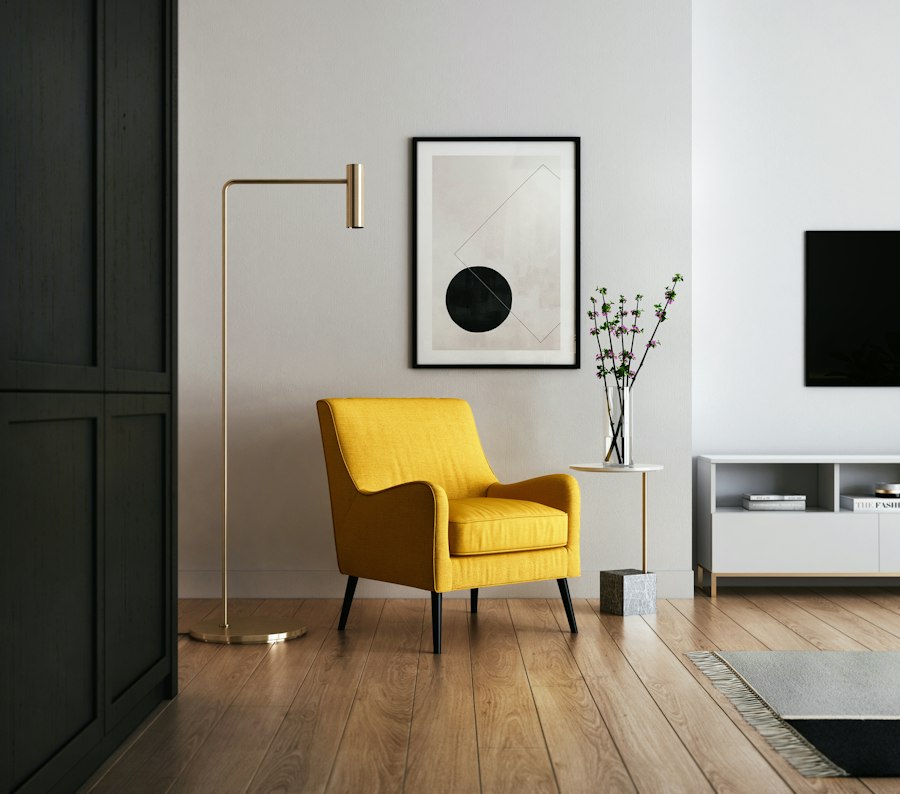
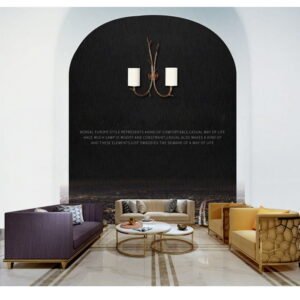
Móveis estofados de luxo para sala de estar — a excelência do trabalho artesanal exportado de Foshan para mercados em todo o mundo.
A trajetória de crescimento: conquistando uma participação no mercado global de 39%
Principais marcos no desenvolvimento da indústria moveleira de Foshan
A Cidade do Móvel de Lecong — hoje uma área comercial de cinco quilômetros que se estende ao longo da Avenida Foshan — surgiu no início da década de 1980 como um modesto conjunto de barracas de comércio. Em meados da década de 1990, já havia se transformado em um centro atacadista reconhecido nacionalmente, atraindo compradores de toda a China. No início dos anos 2000, pedidos de exportação da Europa, dos Estados Unidos e do Sudeste Asiático começaram a chegar em volume significativo. A década de 2010 testemunhou o surgimento de fabricantes voltados para o design, que competiam não apenas em preço, mas também em sofisticação estética, inovação de materiais e capacidade de personalização. Hoje, cinco complexos de showrooms emblemáticos — incluindo o Louvre Palace (que se concentra em marcas de luxo com produtos que geralmente custam mais de ¥10.000) e o Shunlian Norte e Sul — formam um ecossistema comercial permanente que funciona o ano todo, não apenas durante as temporadas de feiras comerciais.
Fatores econômicos que aceleraram a expansão do mercado
Três forças macroeconômicas convergiram para tornar o crescimento de Foshan quase inevitável. Em primeiro lugar, a adesão da China à Organização Mundial do Comércio, em 2001, abriu canais de exportação que valorizaram as vantagens de escala já existentes em Foshan. Em segundo lugar, a rápida urbanização da China nas décadas de 2000 e 2010 gerou uma enorme demanda interna que financiou a modernização das fábricas e a expansão da força de trabalho. Em terceiro lugar, a localização de Foshan na Grande Baía — próxima a Guangzhou, a 40 minutos de Shenzhen e com fácil acesso à infraestrutura financeira de Hong Kong — proporcionou à cidade acesso a capital, logística e redes de negócios internacionais que as cidades industriais do interior não podiam igualar.
Compreendendo o posicionamento competitivo de Foshan no mercado global
Análise de participação de mercado e liderança no setor
Participação na produção global de móveis por região (estimativa, 2024)
Fontes: Associação de Móveis de Guangdong, estimativas do setor, 2024. Os números são aproximados e têm caráter meramente ilustrativo.
Por que os compradores internacionais escolhem os fabricantes de Foshan
A resposta não é simplesmente “mão de obra barata” — essa narrativa já está ultrapassada há duas décadas. Os compradores B2B de hoje escolhem Foshan porque a cidade oferece algo que nenhuma outra região industrial consegue igualar: integralidade concentrada e competitiva. Em um raio de 30 quilômetros, um comprador pode comparar sofás estofados em 20 faixas de preço diferentes, especificar estruturas personalizadas de madeira maciça de acordo com desenhos arquitetônicos, adquirir ferragens e tecidos combinados na mesma tarde e providenciar o carregamento de contêineres por meio de um agente de carga experiente — tudo isso sem sair do bairro. Para um distribuidor que busca construir uma linha de produtos coerente ou um designer de hotelaria que está equipando um hotel de 200 quartos, essa eficiência tem um valor comercial real que transcende o custo unitário.
2. O ecossistema da indústria: estrutura e escala
Visão geral da infraestrutura de fabricação de móveis de Foshan
Pólos fabris e zonas industriais
O melhor modelo mental para o ecossistema moveleiro de Foshan não é um único distrito industrial, mas uma federação de cidades especializadas, cada uma com um papel distinto. Cidade de Lecong, a capital comercial e dos showrooms, abriga mais de 3.000 revendedores nacionais e internacionais em mais de 2 milhões de metros quadrados de área útil — a maior zona de comércio de móveis do mundo. Cidade de Longjiang, separada de Lecong por um rio estreito, é onde ocorre a produção propriamente dita: os preços na saída da fábrica costumam ficar entre 40 e 50% abaixo dos preços praticados nas lojas de Lecong, e os compradores que mantêm relações diretas com a fábrica obtêm vantagens significativas em termos de margem de lucro. Distrito de Shunde no total, conta com mais de 30.000 empresas do setor de móveis, abrangendo tanto a vertente de fabricação quanto a de comercialização desse ecossistema.
A concentração das capacidades produtivas em distritos-chave
O que torna essa concentração estrategicamente vantajosa para compradores B2B é o nível de especialização em cada zona. Acessórios de ferragens, extrusões de alumínio, fornecedores de espuma, atacadistas de tecidos, especialistas em vernizes e tintas, materiais de embalagem — todos estão integrados no mesmo cluster. Um fabricante de móveis em Longjiang pode adquirir todos os componentes para uma cadeira de jantar de luxo sem que nenhuma matéria-prima precise percorrer mais de 20 quilômetros. Essa densidade da cadeia de suprimentos reduz os prazos de entrega, diminui os danos causados pelo transporte e permite a negociação de preços em toda a estrutura de custos, de uma forma que bases de fabricação geograficamente dispersas não conseguem oferecer.

Móveis estofados de alto padrão fabricados no distrito de Longjiang, em Foshan — o tipo de especificação de qualidade que hoje é padrão entre os principais fabricantes exportadores do mundo.
Tipos de fabricantes e áreas de especialização
Produtores industriais de grande porte x fabricantes de pequeno porte
O setor manufatureiro de Foshan abrange uma enorme variedade de escalas e características. Em um extremo, estão os grandes produtores industriais — fábricas com 10.000 a 50.000 metros quadrados de área de produção, centenas de máquinas CNC, laboratórios dedicados ao controle de qualidade e capacidade para atender a pedidos de contêineres em ciclos de produção padronizados de 30 dias. Esses fabricantes atendem redes globais de varejo, programas de aquisição de móveis para hotéis e distribuidores de grande volume. Seu ponto forte é a consistência, a rapidez e a competitividade de preços em grande escala. Sua limitação é a rigidez: pedidos altamente personalizados ou de baixo volume muitas vezes ficam fora de seu ponto ideal de operação.
No outro extremo estão os fabricantes boutique — oficinas de 2.000 a 5.000 metros quadrados, com equipes de artesãos experientes que trabalham a partir de desenhos técnicos detalhados, produzem acabamentos personalizados indisponíveis em qualquer catálogo e tratam cada relacionamento com o cliente como uma parceria de design, em vez de uma transação em massa. Esses estúdios são os parceiros preferidos de designers de interiores que planejam projetos exclusivos para o setor de hospitalidade, incorporadoras residenciais de alto padrão ou operadores de showrooms que buscam construir uma identidade diferenciada para seus produtos. Os custos unitários são mais elevados, mas a fidelidade do design e o processo colaborativo agregam um valor que um pedido feito por catálogo não consegue oferecer.
Categorias de especialização: Móveis estofados, móveis de madeira, móveis de metal e sistemas modulares
Entre a população ocupada no setor manufatureiro de Foshan, especializações claras em produtos surgiram ao longo de décadas de concorrência. Móveis estofados — sofás, cadeiras, camas e pufes — são a categoria na qual os produtores exportadores de Foshan têm maior domínio global, representando uma parcela desproporcional do volume de exportação da cidade. Móveis de madeira maciça, desde mesas de jantar neoclássicas até conjuntos de quarto no estilo americano, ocupam um segmento premium onde o artesanato em marcenaria e o fornecimento de madeira são os principais diferenciais. Móveis de metal e híbridos — incluindo assentos para o setor de hospitalidade, coleções para áreas externas e estruturas minimalistas contemporâneas — cresceram rapidamente com o aumento dos projetos comerciais e hoteleiros. Móveis de sistema modular, incluindo soluções de guarda-roupas e armazenamento, se beneficiam da proximidade de Foshan ao polo de fabricação de cozinhas e armários de Guangzhou.
Integração da cadeia de suprimentos e fabricação vertical
Abastecimento de matérias-primas e redes de fornecedores locais
Uma das vantagens menos discutidas, mas de maior importância comercial, do ecossistema de Foshan é a integração de matérias-primas. Madeiras de lei importadas — teca, carvalho, nogueira, borracha — passam por pátios de madeira especializados em Shunde. Painéis de engenharia nacionais (MDF, compensado, aglomerado que atendem às normas CARB Fase 2 e de formaldeído E0/E1) são produzidos dentro da cadeia de suprimentos da Grande Baía. Espumas, tecidos, couros e revestimentos sintéticos estão disponíveis em mercados atacadistas especializados a menos de 30 minutos de carro. Essa proximidade significa que um fabricante que receba um pedido personalizado de um comprador do exterior pode passar da cotação de materiais à produção de amostras em dias, em vez de semanas.
Capacidades de produção interna e sistemas de controle de qualidade
Os principais fabricantes de Foshan têm investido pesadamente na integração vertical — a prática de controlar várias etapas de produção em uma única instalação, em vez de terceirizar para subcontratados. Uma fábrica verticalmente integrada pode operar, sob o mesmo teto, seu próprio forno de secagem de madeira, oficina de fabricação de estruturas, linha de corte de espuma, sala de estofamento, cabines de acabamento e envernizamento e área de inspeção final. Essa estrutura elimina a variabilidade de qualidade associada à subcontratação e confere à fábrica responsabilidade direta por todas as etapas do ciclo de vida do produto. Para compradores B2B que fazem pedidos de alto valor, nos quais a consistência é imprescindível — pense em pacotes de móveis para hotéis de 150 quartos ou programas anuais de reabastecimento para um distribuidor nacional —, a integração vertical é um importante indicador de qualidade que vale a pena verificar durante a avaliação da fábrica.
| Tipo de fabricante | Tamanho da fábrica | MOQ típico | Prazo de entrega | Personalização | Melhor para |
|---|---|---|---|---|---|
| Grande Produtor Industrial | 10.000–50.000 m² | 200–500 unidades/SKU | 30 a 45 dias | Limitada (catálogo padrão) | Distribuidores de grande volume, redes de varejo |
| Fábrica OEM/ODM de médio porte | 3.000–10.000 m² | 50-200 unidades/SKU | 35 a 55 dias | Moderado (material e cor) | Distribuidores, operadores de showrooms |
| Fabricante de design exclusivo | 1.000–5.000 m² | 10–50 unidades/SKU | 45 a 75 dias | Alto (design personalizado) | Designers de interiores, projetos para o setor de hospitalidade |
| Especialista em nichos | 500–3.000 m² | 1–30 unidades/SKU | 30 a 60 dias | Muito alto (totalmente personalizado) | Empreendedores imobiliários especializados em residências de alto padrão e vilas |
Tabela 1: Tipos de fabricantes de Foshan — Matriz de escala, quantidade mínima de pedido (MOQ) e adequação ao comprador
3. Por dentro da fábrica: habilidade artesanal e processos de produção
Fabricação de móveis de madeira: técnicas tradicionais aliadas à tecnologia moderna
Seleção, tratamento e padrões de qualidade da madeira
A qualidade de uma peça de mobiliário de madeira é determinada muito antes do corte da primeira junta — ela começa no pátio de madeira. Fabricantes conceituados de Foshan se abastecem junto a importadores certificados que fornecem madeiras de lei secas em estufa com teor de umidade mantido entre 8–12%, a faixa ideal para a estabilidade dimensional em ambientes internos aquecidos ou com ar-condicionado. FSC (Forest Stewardship Council)- A madeira certificada é agora um requisito básico para os compradores que exportam para os mercados europeus, e os principais fabricantes possuem certificados de Cadeia de Custódia do FSC que rastreiam a origem da madeira em todas as etapas da produção.
Além da seleção das espécies, é no processo de tratamento que ocorre uma diferenciação significativa em termos de qualidade. Fabricantes de alto padrão utilizam fornos de secagem em múltiplas etapas, em vez da secagem ao ar livre, eliminando as variações de umidade que causam empenamento e falhas nas juntas durante o transporte ou em destinos com variações climáticas. A preparação da superfície — lixamento com grãos sucessivos, aplicação de massa para madeira onde necessário e uso de sistemas de verniz em várias camadas — aumenta tanto o custo de mão de obra quanto a durabilidade. Uma peça com acabamento em cinco camadas de verniz, produzida por um fabricante renomado de Foshan, durará décadas a mais do que um produto concorrente com apenas uma camada, em condições reais de uso.
Processos de marcenaria, montagem e acabamento
A marcenaria tradicional chinesa — encaixes de mortise e tenon, em cauda de andorinha e em caixa — continua sendo a base estrutural dos móveis de madeira de alta qualidade de Foshan. As fábricas contemporâneas combinam essas técnicas com o corte de precisão por CNC para atingir tolerâncias inferiores a 0,1 mm em perfis complexos de juntas, o que significa que as peças montadas apresentam a precisão dimensional necessária para sistemas modulares e formatos de exportação em embalagens planas. O acabamento manual — incluindo entalhes decorativos, trabalhos de incrustação e a aplicação artesanal de acabamentos envelhecidos ou desgastados — ainda é realizado por trabalhadores qualificados, especialmente em fabricantes especializados que atendem aos mercados de design neoclássico europeu e provincial francês.
Produção de móveis estofados: da estrutura ao produto final
Construção de Estruturas e Engenharia Estrutural
A estrutura interna de um sofá de luxo ou de uma cama estofada é onde, com mais frequência, se economiza na fabricação — e onde compradores experientes sabem que devem verificar em primeiro lugar. Fabricantes de qualidade de Foshan utilizam estruturas de madeira de lei seca em estufa (geralmente madeira de seringueira ou álamo), reforçadas nos pontos de tensão com travessas nos cantos e suportes metálicos. A BIFMA (Associação dos Fabricantes de Móveis para Empresas e Instituições) As normas estruturais exigem que as estruturas dos assentos suportem, no mínimo, 250 libras de ciclos de carga concentrada — um teste que revela a deficiência na construção das travessas em questão de semanas. Os fabricantes que atendem aos setores comercial e de hospitalidade costumam projetar seus produtos de acordo com essas normas, mesmo quando os compradores não o solicitam explicitamente, pois reclamações repetidas de garantia prejudicam as relações de longo prazo.
Seleção de tecidos, corte e aplicação em estofados
Os fabricantes de estofados de Foshan atuam em toda a gama de materiais de revestimento: tecidos de alto desempenho com classificação para mais de 100.000 ciclos de abrasão Martindale para uso comercial, couros de grão integral e de grão corrigido provenientes de curtumes certificados na Itália e na América do Sul, além de um amplo catálogo de designs de tecidos exclusivos desenvolvidos por equipes de design internas. O corte de tecidos assistido por computador (CAD/CAM nesting) minimiza o desperdício e mantém a precisão do corte em produções de alto volume — um detalhe importante quando um comprador especifica 200 cadeiras idênticas para o salão de festas de um hotel. A aplicação manual do estofamento, especialmente para formas curvas complexas e tufagem em canaletas, continua sendo um ofício especializado que exige anos de aprendizado, e a qualidade desse trabalho manual é um dos indicadores mais claros que diferenciam os fabricantes de produtos premium dos de commodities.
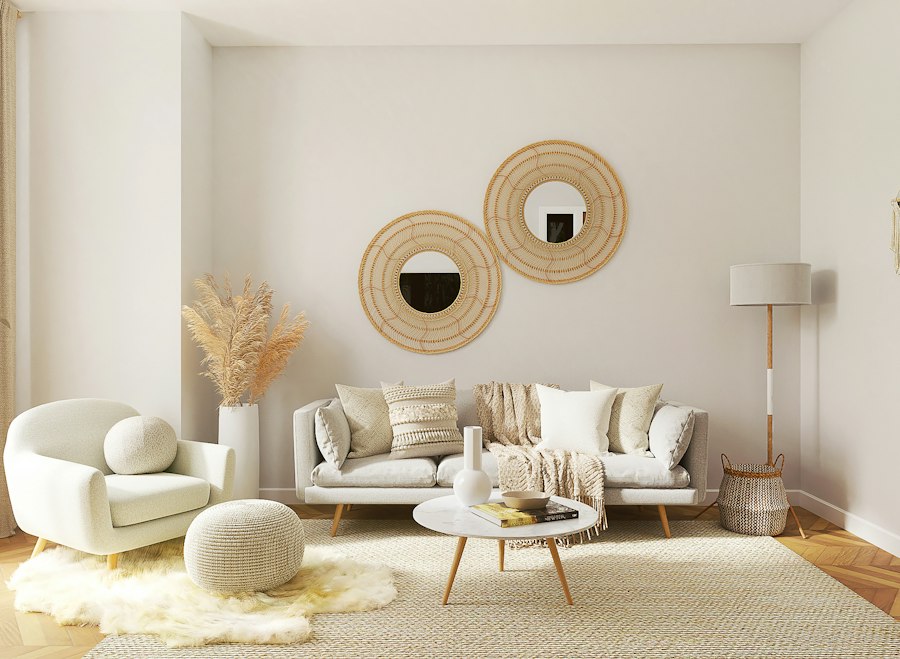
Um conjunto de jantar de luxo que combina superfícies de mármore, bases metálicas soldadas com precisão e estofamento costurado à mão — representativo da capacidade de fabricação com diversos materiais de Foshan.
Fabricação de móveis de metal e híbridos
Soldagem, acabamento e testes de durabilidade
Os móveis de metal de Foshan — sejam peças para área externa em aço com revestimento em pó, mesinhas laterais em aço inoxidável escovado ou molduras decorativas com incrustações de latão — passam por um rigoroso processo de fabricação. A soldagem TIG (soldagem com gás inerte e tungstênio: um método de soldagem de precisão que produz juntas limpas e de alta resistência, sem respingos visíveis) é padrão para juntas visíveis em peças premium. Após a soldagem, o esmerilhamento e o polimento conferem às superfícies a qualidade de acabamento especificada antes do revestimento em pó ou da galvanoplastia. O teste de névoa salina (exposição das peças acabadas a um ambiente de névoa salina por 200 a 500 horas para simular anos de exposição à umidade) é um protocolo comum de durabilidade para móveis de exterior e de banheiro destinados à exportação.
Integração de materiais em projetos contemporâneos
A tendência de design de móveis de maior relevância comercial da última década — a combinação de materiais contrastantes em uma única peça — se alinha diretamente aos pontos fortes da indústria de Foshan. Uma mesa de jantar com tampo de pedra sinterizada, faixa de incrustação em latão maciço e base de aço com revestimento em pó requer três competências distintas de fabricação. Dentro do polo industrial de Foshan, um fabricante por projeto pode adquirir cada componente de especialistas no mesmo distrito, montar e verificar a qualidade da peça finalizada internamente e exportá-la como um único SKU. Essa capacidade de trabalhar com múltiplos materiais é particularmente valorizada por incorporadoras residenciais de luxo, designers de hotéis e pelo crescente segmento de varejo de “luxo contemporâneo”.
Protocolos de garantia de qualidade e testes
Normas de ensaio de materiais e de durabilidade
Fabricantes confiáveis de Foshan realizam testes internos ou por meio de terceiros para toda a gama de normas internacionais de durabilidade. Seguem-se os testes de fadiga da estrutura do sofá EN 12520 (resistência e durabilidade de assentos para uso doméstico) e as normas EN 12521 (mesas domésticas). Os testes de conforto e durabilidade dos colchões seguem as normas da ISPA. A resistência de aderência do folheado de madeira, a densidade da espuma e o ILD (Indentation Load Deflection — uma medida da firmeza da espuma), bem como a solidez da cor do tecido, estão entre os testes de rotina realizados em amostras de produção. Compradores B2B devem solicitar relatórios de teste para cada categoria de produto — não apenas certificados de conformidade, mas folhas de dados de teste reais que mostrem os resultados medidos em comparação com os limites estabelecidos pelas normas.
Conformidade com as certificações internacionais de segurança e meio ambiente
A conformidade ambiental tornou-se um verdadeiro diferencial no mercado de exportação de Foshan, e não apenas um mero trâmite burocrático. Os regulamentos REACH da UE (Registro, Avaliação, Autorização e Restrição de Produtos Químicos) limitam a presença de substâncias perigosas em acabamentos de móveis e materiais de estofamento a limites definidos. A norma Fase 2 do CARB (Conselho de Recursos Atmosféricos da Califórnia) limita as emissões de formaldeído provenientes de painéis de madeira composta — uma certificação essencial para qualquer fabricante que exporte para os Estados Unidos. Os compradores que exportam para a UE, o Reino Unido ou os EUA devem exigir tanto as declarações de conformidade com o REACH quanto as certificações da Fase 2 da CARB como documentação pré-pedido obrigatória.
4. Inovação em design e capacidade de personalização
Como os fabricantes de Foshan abordam o design e o desenvolvimento
Equipes internas de design e recursos de modelagem CAD/3D
A imagem de Foshan como um mero centro de produção de réplicas está cerca de uma década atrasada em relação à realidade. Atualmente, os principais fabricantes contam com equipes internas de design compostas por 5 a 30 designers, muitos deles com formação internacional ou experiência em mercados estrangeiros, que desenvolvem coleções originais para lançamentos em feiras comerciais e respondem às solicitações dos clientes com propostas de design, em vez de simples seleções de catálogo. AutoCAD e ferramentas de modelagem 3D programas como o SolidWorks e o Rhinoceros são padrão nesses estúdios, permitindo a criação de desenhos técnicos de produção e visualizações fotorrealistas para os clientes antes mesmo de se cortar um único pedaço de madeira.
Análise de tendências e estratégias de design orientadas para o mercado
Os principais fabricantes de Foshan acompanham as tendências internacionais de design com notável sofisticação. A participação na Salone del Mobile, em Milão, a Maison et Objet em Paris e a Feira Internacional de Móveis da China (CIFF) em Guangzhou fornecem informações sobre design que alimentam diretamente os ciclos de desenvolvimento de novas coleções. Os principais fabricantes costumam lançar duas coleções por ano em um ciclo de desenvolvimento acelerado de 90 dias — uma agilidade que permite que distribuidores e operadores de showrooms mantenham seu portfólio de produtos atualizado, sem precisar esperar 18 meses pelos ciclos de design à comercialização, mais comuns na indústria europeia.
Serviços de personalização para clientes B2B
Soluções de design personalizadas para distribuidores e designers
Para distribuidores que buscam criar uma identidade própria para seus produtos — ou designers de interiores que especificam uma coleção personalizada para um ambiente hoteleiro de marca —, as capacidades de personalização de Foshan estão entre as mais avançadas comercialmente do mundo. Um comprador pode entrar em contato com os fabricantes apresentando imagens de referência, moodboards, desenhos arquitetônicos ou amostras físicas e receber, em 5 a 10 dias úteis, um orçamento detalhado que abrange a engenharia de projeto, a produção de amostras e os preços para pedidos em grande volume. As modificações personalizadas variam de simples (substituição de tecido, mudança no acabamento das pernas, ajuste de dimensões dentro dos limites estruturais) a abrangentes (design totalmente novo, desenvolvido desde o briefing do conceito até o desenho pronto para produção pela equipe de design do fabricante).
Fabricantes como Móveis Jade Ant construíram sua proposta de valor B2B especificamente em torno dessa capacidade de personalização — oferecendo aos clientes um gerenciamento de projetos, desde o projeto até a entrega, que abrange desenhos técnicos, aprovação de amostras, monitoramento da produção e coordenação logística como um serviço integrado, em vez de exigir que os compradores gerenciem cada etapa separadamente.
Flexibilidade de lotes e estruturas de quantidade mínima de pedido
As estruturas de MOQ em Foshan são mais flexíveis do que os compradores de primeira viagem costumam supor. Grandes fabricantes industriais geralmente estabelecem pedidos mínimos de 100 a 500 unidades por SKU para justificar os custos de configuração da linha de produção. Fábricas OEM de médio porte costumam negociar em faixas de 50 a 100 unidades. Fabricantes boutique e de nicho — incluindo alguns dos estúdios mais inovadores em design em Longjiang — aceitam pedidos de 10 a 30 unidades para peças personalizadas complexas, especialmente quando o comprador demonstra um histórico de pedidos recorrentes. A chave para negociar MOQs mais baixos não é simplesmente contestar a posição declarada do fornecedor, mas demonstrar a lógica comercial: um cronograma confirmado de relacionamento com pedidos repetidos, flexibilidade no prazo de entrega ou disposição para aceitar uma taxa de produção de amostra que seja creditada no primeiro pedido em grande quantidade.
Integração da tecnologia no projeto e na produção
Amostragem digital e prototipagem virtual
A prototipagem virtual mudou significativamente o processo de aprovação de amostras para compradores internacionais. Em vez de esperar de 3 a 4 semanas e pagar $200–$800 em custos de envio de amostras para cada iteração do projeto, os compradores agora podem analisar renderizações 3D fotorrealistas de peças personalizadas — com representação precisa de materiais, texturas e proporções — em um prazo de 48 a 72 horas após o envio do briefing de design. Os principais fabricantes de Foshan utilizam softwares profissionais de renderização (KeyShot, V-Ray, Lumion) para produzir imagens que, segundo designers de interiores experientes, são indistinguíveis de fotografias em termos de qualidade final. Amostras físicas ainda são essenciais para a avaliação tátil dos materiais e para a aprovação final, mas a amostragem digital elimina a maior parte das idas e vindas que antes tornavam o processo de aquisição de produtos personalizados lento e caro.
Ferramentas de automação e fabricação de precisão
Fresadoras CNC (Controle Numérico Computadorizado), linhas automatizadas de corte de painéis, cabines de pintura robotizadas e câmeras de inspeção de qualidade assistidas por IA estão se tornando cada vez mais comuns nas maiores fábricas de Foshan. Os centros de fresagem CNC podem executar programas complexos de entalhe e corte de perfis com precisão submilimétrica, a velocidades de produção que o entalhe manual não consegue alcançar. As cabines de pintura automatizadas mantêm a espessura do revestimento e a consistência da viscosidade ao longo de toda a produção — eliminando a variação de cor entre as peças, característica das operações de pintura manual. Esses investimentos em tecnologia representam uma mudança fundamental da competitividade baseada no custo da mão de obra para a competitividade baseada nos processos: o objetivo não é mão de obra mais barata, mas uma produção mais confiável.
🎬 Aquisição B2B de móveis em Foshan: por dentro do maior mercado de móveis do mundo
Assista a este tour completo pelo Showroom de Móveis Da Fu, em Foshan — um dos maiores centros de abastecimento de móveis do mundo — para compreender a escala, a variedade e a dinâmica de abastecimento B2B que fazem desta cidade a líder global na fabricação de móveis.
5. Padrões de sustentabilidade e fabricação ética
Responsabilidade ambiental na produção de móveis em Foshan
Abastecimento sustentável de materiais e certificação FSC
Há uma década, as certificações de sustentabilidade eram, para a maioria dos fabricantes de Foshan, um mero cumprimento de formalidades — algo incluído na documentação de exportação porque os compradores exigiam, e não porque as fábricas tivessem mudado fundamentalmente a forma como obtinham seus materiais. Essa dinâmica mudou significativamente. O Regulamento da UE sobre Madeira e seu sucessor, o Regulamento da UE sobre Desmatamento (EUDR), agora estabelecem responsabilidade legal para importadores que não possam comprovar a origem legal da madeira, o que transformou a certificação da Cadeia de Custódia do FSC de um diferencial de mercado em um requisito de entrada no mercado para compradores europeus. Os principais fabricantes de Foshan responderam estabelecendo relações de fornecimento de longo prazo com importadores de madeira certificados e mantendo os sistemas de documentação necessários para rastrear cada lote de madeira até sua fonte certificada.
Programas de redução e reciclagem de resíduos
Fabricantes inovadores implementaram sistemas de gestão de resíduos em ciclo fechado que convertem os resíduos de produção em produtos comerciais ou fontes de energia. Sobras de madeira e serragem são coletadas e vendidas a fabricantes de aglomerado ou usinas de energia de biomassa, em vez de serem descartadas em aterros sanitários. Resíduos de corte de tecido — gerados em volumes significativos pelas operações de estofamento — são enfardados e vendidos a processadores de fibras recicladas. Lacas à base de água e sistemas de acabamento com baixo teor de COV (Compostos Orgânicos Voláteis) têm substituído progressivamente as alternativas à base de solventes em operações de exportação orientadas pela conformidade ambiental, reduzindo tanto as emissões atmosféricas na fábrica quanto a carga química dos produtos acabados importados para mercados com regulamentações de segurança química para o consumidor.
Normas Trabalhistas e Bem-estar dos Trabalhadores
Práticas salariais justas e condições de trabalho
A força de trabalho da indústria moveleira de Foshan recebe salários que se comparam favoravelmente à média do setor manufatureiro chinês. Estofadores qualificados, operadores de máquinas CNC e artesãos de acabamento recebem salários mensais de ¥6.000 a ¥12.000 (aproximadamente US$ $830 a $1.650 em 2024) em fábricas estabelecidas — significativamente acima dos níveis do salário mínimo nacional da China e complementados pelas contribuições para a previdência social pagas pelo empregador, conforme exigido pela legislação trabalhista chinesa. Dormitórios e refeitórios nas fábricas são padrão em grandes produtores que atendem aos mercados internacionais de exportação, uma vez que essas instalações são minuciosamente avaliadas durante as auditorias realizadas por agentes de compras internacionais e empresas de inspeção independentes.
Auditorias de terceiros e documentação de conformidade
Os compradores que atuam nos mercados de varejo da UE, do Reino Unido, dos Estados Unidos ou da Austrália devem exigir que os fabricantes apresentem relatórios de auditoria de conformidade social elaborados por auditores independentes reconhecidos — BSCI (Business Social Compliance Initiative), SEDEX/SMETA ou estruturas equivalentes. Essas auditorias avaliam jornadas de trabalho, documentação salarial, protocolos de saúde e segurança, medidas de prevenção ao trabalho infantil e sistemas de gestão. Fábricas que fornecem para grandes redes varejistas internacionais geralmente mantêm relatórios de auditoria atualizados como documentação padrão. Para compradores que trabalham com fabricantes menores, encomendar uma auditoria independente (normalmente entre US$ $400 e US$ $800) é um investimento proporcional em relação ao risco à reputação e à cadeia de suprimentos decorrente do abastecimento de uma fábrica com problemas não divulgados de conformidade trabalhista.
Certificações de fabricação sustentável e práticas ecológicas
ISO 14001 e Sistemas de Gestão Ambiental
ISO 14001 A certificação (Sistemas de Gestão Ambiental) é a referência internacional para demonstrar uma gestão ambiental sistemática no setor de manufatura. Ela não estabelece metas específicas de desempenho, mas exige que o fabricante defina objetivos ambientais mensuráveis, monitore o desempenho em relação a esses objetivos e melhore continuamente a gestão de seu impacto ambiental. Para compradores B2B, a certificação ISO 14001 emitida por um organismo de certificação credenciado é um sinal significativo de compromisso ambiental — não uma prova de perfeição, mas evidência de um sistema de gestão organizado, em vez de respostas pontuais de conformidade.
Iniciativas de redução da pegada de carbono
Um número crescente de fabricantes de Foshan voltados para a exportação está se empenhando na medição e redução da pegada de carbono em resposta direta às exigências dos compradores, particularmente de clientes europeus e escandinavos, cujos próprios compromissos de sustentabilidade exigem a divulgação das emissões da cadeia de suprimentos. As iniciativas incluem a instalação de painéis solares nos telhados das fábricas (várias fábricas em Longjiang instalaram sistemas com capacidade de 1 a 3 MW que reduzem significativamente a dependência da rede elétrica), a substituição da iluminação por LED nas áreas de produção e armazenamento e a adoção de equipamentos elétricos de manuseio de materiais em substituição às empilhadeiras a diesel. Essas não são medidas meramente simbólicas — elas representam investimentos reais em ativos fixos com resultados mensuráveis em termos de emissões.
6. Logística, remessas e gestão da cadeia de suprimentos
Infraestrutura de exportação e instalações portuárias
Proximidade dos principais centros de transporte marítimo e redes logísticas
A localização logística de Foshan é uma de suas vantagens estratégicas mais subestimadas. A cidade está localizada a uma distância que permite o transporte direto por caminhão até quatro importantes opções portuárias: Porto de Nansha (Guangzhou, a cerca de 50 km), um porto de águas profundas que movimenta um volume significativo de contêineres; Porto de Yantian e Porto de Shekou (Shenzhen, a aproximadamente 80–100 km), um dos terminais de exportação mais movimentados da China; e Terminais de Contêineres de Hong Kong (aproximadamente 120 km), oferecendo maior flexibilidade de roteamento para os compradores com preferências específicas quanto às companhias marítimas ou rotas. Esse acesso a vários portos significa que os compradores nunca ficam dependentes de um único ponto de entrada e podem otimizar o roteamento com base nos horários das companhias marítimas, nas diferenças nas taxas de frete ou nas vantagens de trânsito específicas de cada destino.
Padrões de conteinerização e processos eficientes de carregamento
Os fabricantes consolidados de Foshan têm décadas de experiência na otimização do carregamento de contêineres — uma habilidade que afeta significativamente o custo final por unidade. Equipes profissionais de embalagem utilizam embalagens de poliestireno e papelão ondulado cortadas sob medida, projetadas antecipadamente para cada SKU, o que maximiza a utilização do contêiner e, ao mesmo tempo, minimiza o risco de danos. Um contêiner de 20 pés bem organizado (volume interno de aproximadamente 33 metros cúbicos), carregado por uma equipe experiente de frete de Foshan, atingirá consistentemente índices de preenchimento de 90 a 95%. Os compradores que comparam cotações entre fabricantes devem sempre comparar a estimativa de CBM (metro cúbico) por unidade, pois variações significativas na densidade de embalagem se traduzem diretamente em diferenças nos custos de frete que podem exceder as diferenças de preço unitário entre fabricantes concorrentes.
Opções de envio e gerenciamento de prazos
Transporte marítimo x transporte aéreo: análise de custo-benefício
Custos aproximados de frete de Foshan para os principais mercados (taxas de referência de 2025)
FCL = Carga de Contêiner Completo (20 pés). As tarifas são valores aproximados com base em referências de mercado de 2025. As tarifas reais variam de acordo com a companhia marítima, a época do ano e as sobretaxas. Fonte: Freightos, Shapiro, relatórios do setor.
O transporte marítimo continua sendo o meio de transporte preferido por ampla maioria para o transporte de móveis, devido à relação entre volume e valor. Um contêiner de 20 pés transportando $30.000 em móveis, com frete marítimo de $2.000, representa um custo logístico de 6,7% — um acréscimo administrável ao custo total de importação. A mesma remessa por via aérea, mesmo com uma média modesta de $8 por kg para móveis com peso médio de 10 kg por CBM, custaria aproximadamente $24.000 — reduzindo a margem do pedido a quase zero. O frete aéreo é reservado para peças de reposição urgentes, amostras ou pequenas remessas de valor extremamente alto, nas quais o custo em tempo do frete marítimo excede o sobrepreço do frete aéreo.
Prazos de entrega, programação da produção e garantias de entrega
Planejamento realista do cronograma para um pedido padrão de móveis de Foshan, desde a ordem de compra até o porto de destino: a produção leva de 30 a 60 dias, dependendo da complexidade do produto e da carga de trabalho da fábrica no momento do pedido; o transporte rodoviário pelo interior até o porto leva de 1 a 3 dias; o processamento no porto e o carregamento do contêiner levam de 3 a 7 dias; o transporte marítimo varia de 15 a 35 dias para a Costa Oeste dos EUA, de 25 a 40 dias para a Costa Leste dos EUA e a Europa, e de 12 a 18 dias para a Austrália e o Sudeste Asiático; o desembaraço aduaneiro no destino leva de 3 a 14 dias. Prazo total realista: 8 a 18 semanas desde o pedido de compra até o recebimento no armazém. Incorporar essa linha do tempo ao planejamento de estoque — em vez de tratá-la como uma única data estimada — é a disciplina que diferencia os importadores de móveis experientes daqueles que ficam sem estoque no meio da temporada.
Desembaraço aduaneiro e apoio à documentação
Certificados de Origem e Documentação de Conformidade
Um pacote completo de documentação de exportação fornecido por um fabricante profissional de Foshan inclui a fatura comercial (detalhada por SKU com códigos HS), a lista de embalagem (com pesos brutos/limos e dimensões por caixa), conhecimento de embarque (emitido pela companhia marítima), certificado de origem (necessário para alíquotas tarifárias preferenciais nos termos dos acordos comerciais aplicáveis), certificados de conformidade do produto (FSC, CARB Fase 2, REACH, testes de retardância ao fogo, conforme aplicável) e fichas de dados de segurança (FDS) para todos os componentes químicos. Fabricantes experientes contam com equipes dedicadas à documentação de exportação, capazes de produzir esse pacote completo em até 48 horas após o carregamento do contêiner — uma capacidade burocrática que os compradores só apreciam plenamente na primeira vez em que enfrentam uma retenção alfandegária causada por documentação incompleta.
Orientação sobre tarifas e assistência em regulamentos de importação
Os códigos HS de móveis para importações nos EUA (principalmente o Capítulo 94) têm alíquotas tarifárias básicas de 0 a 5,5%, com tarifas adicionais da Seção 301 sobre produtos chineses que variam de 7,5% a 25%, dependendo da categoria do produto — um fator que alterou significativamente os cálculos de abastecimento para alguns compradores norte-americanos e levou outros a optar pelo Vietnã como origem alternativa. Trabalhar com um agente de carga experiente, especializado em importações de móveis da China, é essencial para uma modelagem precisa do custo total de importação. A diferença entre uma classificação correta e incorreta do código HS em um pedido de móveis de $50.000 pode representar milhares de dólares em economia de impostos ou multas.
7. Eficiência de custos e estratégias de preços
Compreendendo as vantagens de custo de Foshan
Economia do Trabalho e Eficiência Produtiva
A vantagem de Foshan em termos de custo de mão de obra em relação ao setor manufatureiro ocidental diminuiu na última década, à medida que os salários na China aumentaram, mas a diferença em relação a outras regiões manufatureiras continua sendo significativa. No FOB (Free on Board) no portão da fábrica, os móveis de Foshan custam normalmente 60–90% a menos do que produtos equivalentes fabricados nos EUA ou na Europa, e de 20 a 40% a menos do que produtos comparáveis do setor de móveis em desenvolvimento do Vietnã — que compensa com custos mais baixos de matéria-prima, mas carece da integração da cadeia de suprimentos de Foshan, de suas capacidades de design e de seu ecossistema de fornecimento de ferragens e tecidos. Essas diferenças permanecem mesmo após a contabilização do frete marítimo, dos impostos de importação e dos custos de inspeção de qualidade.
Economias de escala e benefícios da produção em grande escala
A economia estrutural do polo industrial de Foshan gera vantagens de custo que a eficiência individual das fábricas não consegue explicar totalmente. Quando fornecedores de matéria-prima, fabricantes de componentes e produtores de produtos acabados estão todos a menos de 30 quilômetros uns dos outros, toda a cadeia de suprimentos opera com estoques de segurança reduzidos, ciclos de reabastecimento mais rápidos e custos de transporte entre fornecedores mais baixos. Essa eficiência sistêmica se traduz nos preços unitários competitivos que Foshan oferece em grande escala — e explica por que um fabricante de Foshan que produz 500 cadeiras de jantar idênticas pode oferecer um preço mais baixo do que um concorrente vietnamita que produz 100 unidades da mesma cadeira, mesmo que os salários por hora no Vietnã sejam ligeiramente mais baixos.
Modelos de preços para diferentes volumes de pedidos
Estruturas de descontos com base no volume
| Volume de pedidos | Desconto típico x Preço de amostra | Condições de pagamento disponíveis | Produção Prioritária |
|---|---|---|---|
| 1–10 unidades (amostra/teste) | 0% (preço de amostra) | 100% avançado | Fila padrão |
| 10–50 unidades | 5–12% | Depósito 50%, saldo pré-embarque | Fila padrão |
| 50–200 unidades | 12–22% | 30–50%: depósito, saldo antes do embarque | Vaga confirmada |
| 200–500 unidades | 22–32% | Depósito 30%, carta de crédito ou saldo antes do embarque | Agendamento prioritário |
| Mais de 500 unidades (contrato anual) | 32–45% | Negociável (30 a 60 dias a prazo para contas regulares) | Alocação de linha dedicada |
Tabela 2: Estrutura de preços com base no volume dos móveis de Foshan (faixas indicativas)
Cálculo transparente de custos e prevenção de taxas ocultas
As surpresas de preço na aquisição de móveis quase sempre têm origem em uma dessas três fontes: custos de embalagem não divulgados (caixas de papelão, espuma, protetores de canto e taxas de palete às vezes são cotados separadamente), cobranças por amostras que não são explicitamente reembolsáveis em pedidos em grande quantidade e frete terrestre até o porto cotado como um acréscimo, em vez de estar incluído no preço FOB. Estabelecer, na fase de solicitação de cotação (RFQ), que todas as cotações devem ser apresentadas como preços FOB com tudo incluído — incluindo embalagem e transporte terrestre até um porto específico — elimina essas surpresas. Solicite uma discriminação detalhada dos custos que separe materiais, mão de obra, despesas gerais, embalagem e frete terrestre. Fabricantes que se sentem à vontade com a transparência nos custos são quase sempre parceiros comercialmente mais confiáveis do que aqueles que evitam responder a perguntas detalhadas sobre a estrutura de custos.
Retorno sobre o investimento (ROI) para compradores B2B: margens e rentabilidade
Análise comparativa de custos: Foshan x outras regiões industriais
Comparação indicativa de custo total de importação: cadeira de jantar de luxo (em dólares americanos, entregue na Costa Leste dos EUA)
Estimativas ilustrativas que incluem custo de fabricação, frete, impostos (nas alíquotas aplicáveis) e custos de controle de qualidade. Os custos reais variam de acordo com as especificações, o volume e as condições de mercado. O Vietnã e o Sudeste Asiático não estão sujeitos às tarifas da Seção 301 dos EUA.
Maximizando as margens de lucro por meio do abastecimento estratégico
As estratégias mais eficazes de otimização de margem para compradores B2B que adquirem produtos de Foshan são a consolidação, o momento certo e o investimento no relacionamento — nessa ordem. A consolidação de várias SKUs em um único fornecedor permite acessar os níveis de preços por volume apresentados na Tabela 2 acima. Fazer pedidos durante os períodos de baixa demanda de produção em Foshan (normalmente de fevereiro a março, após o Ano Novo Chinês, e de agosto a setembro) costuma resultar em preços mais vantajosos e prazos de produção mais rápidos do que nos períodos de alta demanda em torno da temporada da Feira de Cantão. Além disso, investir em um relacionamento de longo prazo com o fabricante — fornecendo previsões contínuas, pagando em dia e oferecendo feedback sobre o design — gera consistentemente preços unitários 10–20% mais baixos do que aqueles obtidos por um comprador ocasional na primeira transação para o mesmo produto, pois os fabricantes incorporam o risco do relacionamento em suas cotações.
8. Como navegar pela experiência de sourcing: um guia passo a passo
Encontrando o parceiro de fabricação certo
Listas de fabricantes, feiras comerciais e redes do setor
Os principais canais de divulgação para os fabricantes de Foshan são os Feira de Cantão (realizada em Guangzhou todo mês de abril e outubro — uma das maiores feiras comerciais do mundo, com forte presença do setor de móveis), a Feira Internacional de Móveis da China (CIFF) em Guangzhou, e a própria Lecong Furniture City, que funciona como um espaço permanente de feiras comerciais ao longo do ano. Diretórios on-line, incluindo o Made-in-China.com, o Alibaba Global (apenas para uma triagem inicial — nunca para a avaliação final) e plataformas próprias mantidas por associações do setor, servem como ponto de partida. No entanto, as indicações mais confiáveis ainda vêm por meio de recomendações de colegas dentro das redes do setor — associações comerciais, grupos de distribuidores e conexões estabelecidas por meio de agentes de frete ou agentes de sourcing em comum, que mantêm relações verificadas com os fabricantes.
Avaliação de fabricantes: sinais de alerta e indicadores de qualidade
Dados do setor da Feira de Cantão de 2026 sugerem que até 70% dos estandes que se apresentam como “direto da fábrica” são, na verdade, empresas comerciais — intermediários que acrescentam uma margem de lucro sem assumir a responsabilidade pela fabricação. As principais etapas de verificação incluem solicitar uma cópia da licença comercial e da licença de exportação do fabricante (ambas verificáveis nos registros do governo chinês), pedir o endereço real da fábrica e cruzá-lo com imagens de satélite, solicitar vídeos de produção que mostrem as capacidades específicas da fábrica (e não imagens genéricas da fábrica), e examinar a profundidade da documentação de controle de qualidade do fabricante — uma empresa comercial terá dificuldade em apresentar relatórios de testes de materiais, registros de ferramentas ou fotos da produção no chão de fábrica.
Comunicação inicial e elaboração das especificações
Processo e documentação para Solicitação de Cotação (RFQ)
Uma RFQ (Solicitação de Cotação — documento formal que solicita preços a um fornecedor com base em especificações definidas) bem estruturada, enviada a um fabricante de Foshan, deve incluir: imagens de referência do produto ou desenhos técnicos, dimensões e tolerâncias exigidas, especificações de materiais (espécie de madeira, tipo e qualidade do tecido, densidade da espuma, tipo de acabamento), requisitos de embalagem, certificações de conformidade exigidas, quantidade prevista e cronograma de entrega, além da preferência de porto FOB. Quanto mais específica for a RFQ, mais diretamente comparáveis serão as respostas — e menores serão as chances de um fornecedor apresentar uma cotação competitiva com especificações inferiores para, posteriormente, substituir materiais durante a produção.
Especificações técnicas, desenhos e aprovação de amostras
Para pedidos personalizados ou semipersonalizados, a aprovação da amostra física é o ponto de verificação de qualidade mais importante em todo o processo de aquisição. Nunca dispense a etapa de aprovação da amostra para economizar tempo ou custos com amostras. Uma amostra de produção — confeccionada com os mesmos materiais, acabamentos e métodos de fabricação que serão utilizados na produção em massa — é o único indicador confiável do que você receberá em seu contêiner. Reserve um orçamento de $150 a $600 por peça de amostra (dependendo da complexidade) e preveja de 2 a 4 semanas para produção e envio. Avalie as amostras com base em uma lista de verificação de controle de qualidade por escrito — e não de forma subjetiva — e documente por escrito quaisquer modificações necessárias antes de aprovar o pedido em grande escala.
Planejamento da Produção e Gestão de Pedidos
Negociação de contratos e condições de pagamento
Um contrato de fornecimento de móveis com um fabricante de Foshan deve definir explicitamente: especificações do produto (com base em amostras aprovadas e desenhos técnicos), preço unitário e valor total do pedido, cronograma de pagamentos, data de início da produção, data de conclusão, porto de embarque, normas de embalagem, critérios de aceitação de qualidade, procedimento de resolução de defeitos e cláusulas de penalidade em caso de descumprimento das metas de entrega. As condições padrão de pagamento para novos relacionamentos são um adiantamento de 30–50% contra a ordem de compra, com o saldo a ser pago antes do carregamento do contêiner. Relacionamentos já estabelecidos podem negociar um adiantamento de 30%, com o saldo a ser pago contra os documentos do conhecimento de embarque — efetivamente estendendo o crédito até o momento do embarque. Acordos de Carta de Crédito (L/C) são adequados para pedidos de grande porte ($50.000+), nos quais uma garantia de pagamento bancária independente oferece segurança tanto para o comprador quanto para o vendedor.
Monitoramento da produção e pontos de verificação de qualidade
Para pedidos acima de $15.000–$20.000, o monitoramento profissional da produção é um investimento proporcional. Isso envolve um agente de compras local de confiança ou uma empresa de inspeção terceirizada realizando visitas de verificação em três etapas da produção: confirmação de materiais (verificar se os materiais que entram na produção correspondem às especificações aprovadas), inspeção no meio da produção (avaliar a estrutura da armação, a qualidade da marcenaria e a espuma antes que o estofamento cubra tudo) e inspeção pré-embarque (avaliação das peças acabadas em relação à lista de verificação de controle de qualidade antes do carregamento do contêiner). Fabricantes que operam de acordo com um padrão profissional internacional acolhem essas inspeções; aqueles que resistem ou obstruem as visitas de inspeção estão sinalizando um problema.
Inspeção pré-embarque e coordenação de entrega
Inspeções de qualidade por terceiros e resolução de defeitos
Empresas de inspeção independentes — SGS, a Bureau Veritas, a Intertek e a Asia Quality Focus estão entre as empresas consolidadas na região de Foshan — realizam inspeções pré-embarque com base na lista de verificação de qualidade do comprador, utilizando tamanhos de amostra estatisticamente válidos, calculados a partir da quantidade total do pedido. Um defeito detectado na inspeção pré-embarque tem soluções: o fabricante pode retrabalhar peças abaixo do padrão, substituir unidades com defeito ou aceitar uma redução de preço negociada em vez da correção. Um defeito descoberto após o contêiner ter passado pela alfândega tem apenas soluções caras e prejudiciais ao relacionamento comercial. A economia da inspeção pré-embarque é simples: uma inspeção que abrange 200 peças custa aproximadamente $250–$400; uma solicitação de retrabalho ou substituição em uma remessa rejeitada pode custar de 10 a 50 vezes esse valor.
Coordenação logística final e desembaraço aduaneiro
Após a aprovação da inspeção pré-embarque, o processo logístico passa para a confirmação do transporte rodoviário, a reserva do contêiner junto à companhia marítima, o seguro de carga (sempre contrate um seguro marítimo para remessas em contêineres — os prêmios geralmente variam entre 0,3 e 0,81 TP3T do valor da carga), a preparação da documentação e a supervisão do carregamento do contêiner. No porto de destino, um despachante aduaneiro familiarizado com importações de móveis deve ser contratado pelo menos duas semanas antes da data prevista de chegada do contêiner para apresentar antecipadamente os documentos de desembaraço aduaneiro, confirmar a classificação do código HS e agendar qualquer inspeção física necessária. Remessas bem gerenciadas provenientes de Foshan passam pelo desembaraço aduaneiro e são entregues no depósito do comprador dentro de 5 a 10 dias após a chegada do contêiner ao porto.
9. Histórias de sucesso reais: perfis de fabricantes
Perfil 1 — Produtor industrial em grande escala: Complexo Produtivo de Longjiang
Visão geral da empresa: Uma fabricante verticalmente integrada, com instalações de 28.000 m² na cidade de Longjiang, que opera 45 centros de fresagem CNC, uma linha dedicada à fabricação de espuma, 12 cabines de pintura automatizadas e um departamento de estofamento com 150 funcionários. Capacidade de produção mensal: 3.500 a 5.000 unidades de sofás estofados e 8.000 a 12.000 unidades de cadeiras de jantar. Certificado pelas normas ISO 9001, ISO 14001, Cadeia de Custódia do FSC e CARB Fase 2. Atende a 34 países, incluindo grandes redes de varejo no Reino Unido, na Alemanha e na Austrália.
Capacidade de produção: Pode atender a pedidos de contêineres de 100 a 800 unidades em um ciclo de produção de 35 a 45 dias, mediante ordem de compra confirmada. Oferece amostras digitais em até 72 horas após o recebimento do briefing e amostras físicas em 18 a 22 dias.
— Gerente de Exportação, Fabricante de Longjiang (nome ocultado a pedido da empresa)
Perfil 2 — Fabricante boutique com foco em design: Lecong Design Studio
Visão geral da empresa: Um estúdio de 3.200 m² com foco em design, localizado em Shunde, fundado por dois designers de móveis com formação internacional, que conta com 8 designers internos e 45 artesãos de produção. Especializado em móveis residenciais contemporâneos de luxo, com foco na estética minimalista italiana e no wabi-sabi japonês, adaptados para os mercados internacionais. Quantidade mínima de pedido (MOQ) de 5 a 20 unidades por SKU. Prazo de produção: 45 a 70 dias para peças personalizadas.
Filosofia de design: Os briefings dos clientes são tratados como projetos de design colaborativos. O estúdio fornece propostas com renderizações em até 5 dias úteis, maquetes físicas dos principais pontos de detalhamento em até 12 dias e amostras de produção completas em até 25 dias. As seleções de materiais são apresentadas na forma de painéis com curadoria, em vez de listas de componentes.
— Cofundador, Design Studio (anonimizado)
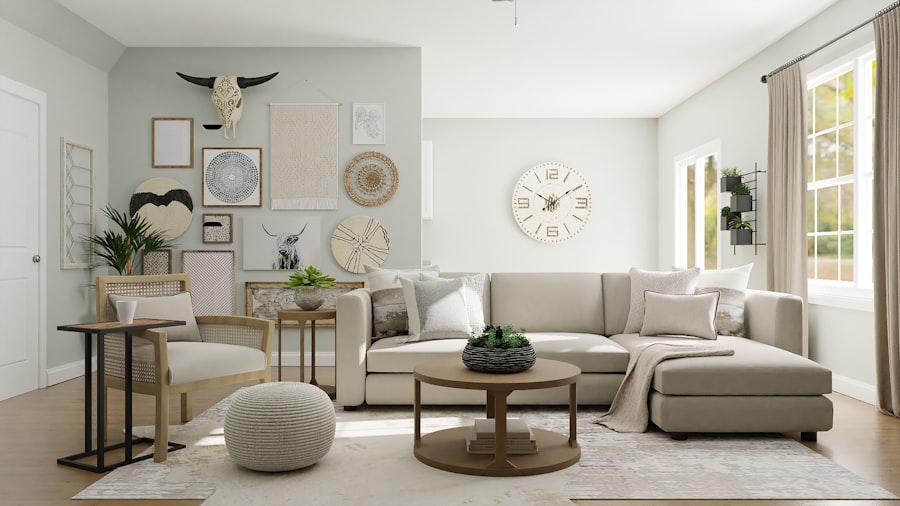
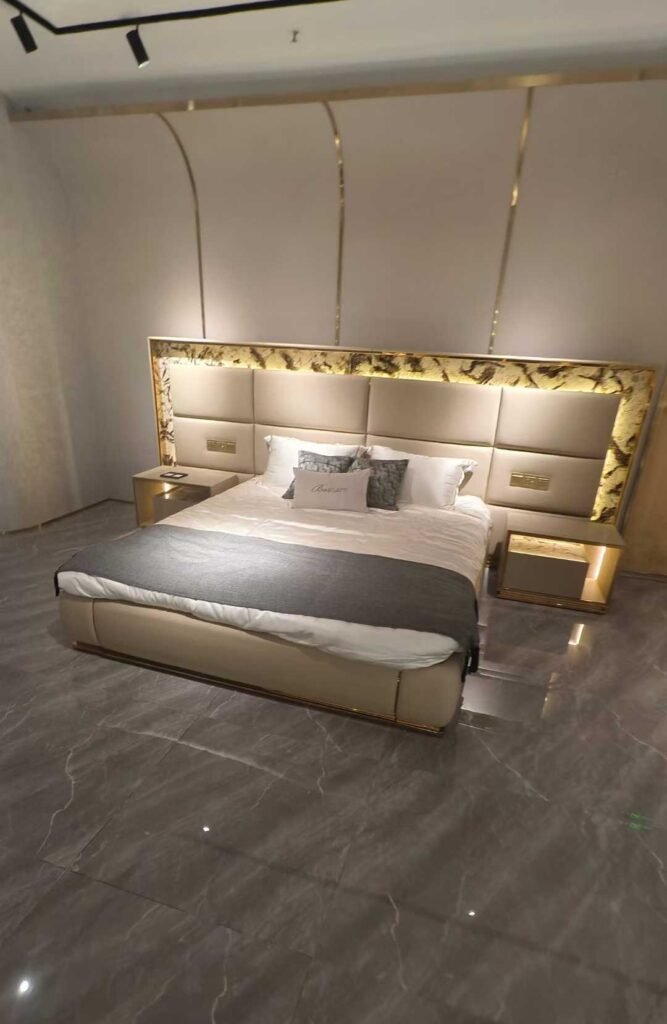
Uma suíte de luxo contemporânea — o tipo de projeto personalizado para o setor hoteleiro que costuma ser executado pelos fabricantes boutique de Foshan, especializados em design, para designers de interiores internacionais.
Perfil 3 — Pioneira na fabricação sustentável: Green Factory Shunde
Visão geral da empresa: Uma empresa de médio porte, com 6.500 m², que, em 2019, realizou uma reorientação estratégica deliberada para construir todo o seu modelo de negócios com base em critérios de sustentabilidade. Atualmente, possui certificações FSC, ISO 14001 e documentação de conformidade com o REACH para todas as linhas de produtos, certificação CARB Fase 2 e um relatório de pegada de carbono verificado por terceiros, atualizado anualmente. Instalou um sistema de energia solar no telhado com capacidade de 1,8 MW, que cobre 67% das necessidades de eletricidade para produção. Fornece para compradores na Alemanha, na Escandinávia e na Austrália, cujos próprios compromissos de sustentabilidade exigem dados ambientais verificados da cadeia de suprimentos.
— Gerente Geral (anonimizado)
Perfil 4 — Produtor especializado em nicho: Estúdio de móveis para o setor de hospitalidade
Visão geral da empresa: Uma empresa especializada em mobiliário para o setor de hospitalidade de nível contratual (quartos de hotel, assentos para restaurantes, ambientes de clubes), com uma área de 2.800 m² e um portfólio de mais de 400 projetos em 28 países no Oriente Médio, Sudeste Asiático e Europa. Projetos em conformidade com as normas BIFMA, EN 12520 e BS 7177 (resistência ao fogo para móveis estofados) como prática padrão, fornecendo documentação completa de testes com cada especificação de projeto. A quantidade mínima de pedido (MOQ) é de 20 unidades para assentos para o setor de hospitalidade, sem MOQ para pacotes completos de quartos.
— Diretor de Desenvolvimento de Negócios (anonimizado)
10. Desafios, soluções e perspectivas futuras
Desafios comuns para compradores internacionais
Barreiras de comunicação e considerações linguísticas
A língua é o desafio mais constantemente subestimado na aquisição de móveis em Foshan. As especificações técnicas de móveis envolvem terminologia precisa sobre materiais, conceitos de engenharia estrutural e referências a padrões de qualidade que exigem verdadeira especialização bilíngue — e não apenas um inglês funcional para conversação. Um sofá descrito em uma ordem de compra como tendo “espuma de alta densidade” deixa uma margem de interpretação de 20 kg/m³ a 45 kg/m³, o que se traduz em produtos que parecem completamente diferentes para o usuário final. Trabalhar com um agente de aquisição bilíngue ou solicitar que as especificações críticas sejam confirmadas por escrito tanto em inglês quanto em mandarim, com a equipe de controle de qualidade do fabricante aprovando a versão em chinês, elimina a maioria dos problemas de desvio de produção que os compradores atribuem a “questões de qualidade”, mas que, na verdade, são falhas de comunicação nas especificações.
Consistência no controle de qualidade e resolução de disputas
A consistência da qualidade em grandes lotes de produção — manter a mesma cor do acabamento, densidade da espuma e tensão do estofamento em 300 peças idênticas — é o desafio de qualidade que distingue o fornecimento profissional do amador. A causa principal da maioria das inconsistências de qualidade não é a desonestidade do fabricante, mas a ausência de critérios de aceitação claramente documentados e acordados no momento da realização do pedido. Um protocolo de controle de qualidade que especifique a tolerância de cor dentro de um intervalo delta-E definido, a densidade da espuma com uma variação de ±2 kg/m³ em relação à especificação aprovada e tolerâncias de folga nas juntas de no máximo 0,5 mm proporciona tanto ao fabricante quanto ao comprador uma linguagem comum para a resolução de disputas. Sem esses critérios por escrito, as disputas tornam-se subjetivas — e disputas subjetivas raramente são resolvidas de forma rápida ou satisfatória.
Estratégias de mitigação de riscos
Construção de relacionamentos de longo prazo versus aquisição transacional
Os dados fornecidos por compradores que atuam com sucesso em Foshan há mais de 5 anos apontam consistentemente para a mesma conclusão: parcerias de fabricação de longo prazo superam o abastecimento pontual em todos os indicadores relevantes — preço, consistência da qualidade, agilidade no atendimento e segurança no fornecimento. Um fabricante que conhece o seu negócio, compreende seus padrões de qualidade, ajustou seus processos de produção às suas especificações e valoriza o fluxo de receita de longo prazo da sua conta dedicará seus melhores funcionários, seus materiais mais confiáveis e a atenção de sua equipe de controle de qualidade mais experiente aos seus pedidos. Esse valor agregado do relacionamento é impossível de ser capturado em uma planilha de comparação de custos por unidade, mas é muito real na qualidade do que chega ao seu depósito.
Diversificação de fornecedores e parceiros de fabricação alternativos
As interrupções na cadeia de suprimentos causadas pela COVID-19 entre 2020 e 2022 demonstraram o risco comercial da dependência de um único fornecedor para qualquer linha de produtos de alto volume. Compradores B2B experientes que operam em grande escala agora mantêm de 2 a 3 relações com fabricantes qualificados para seus principais SKUs — não necessariamente dividindo o volume igualmente, mas contando com fontes alternativas avaliadas e com relações já estabelecidas, capazes de aumentar a capacidade em curto prazo quando um fornecedor principal enfrenta atrasos na produção, falhas de qualidade ou restrições de capacidade. Construir relações de backup custa dinheiro (aprovações de amostras, visitas de auditoria, tempo dedicado ao gerenciamento do relacionamento), mas o custo é insignificante em comparação com o custo de uma falta de estoque no pico da demanda.
O futuro da indústria moveleira de Foshan
Avanços tecnológicos e integração com a Indústria 4.0
Os principais fabricantes de Foshan estão investindo ativamente em recursos da Indústria 4.0 — a integração entre automação digital, conectividade de dados e sistemas de manufatura inteligentes. Veículos guiados automaticamente (AGVs) estão substituindo os carrinhos manuais para o transporte de componentes entre as estações de produção nas maiores fábricas. Sistemas de inspeção visual de qualidade assistidos por IA — câmeras instaladas em pontos de verificação da linha de produção que comparam peças montadas com imagens de referência e sinalizam desvios em tempo real — estão sendo testados por vários grandes fabricantes. Sistemas de ERP (Planejamento de Recursos Empresariais) que conectam gestão de pedidos, programação de produção, estoque e documentação de qualidade estão se tornando padrão, e não mais uma exceção. Esses investimentos não são meramente cosméticos: representam uma mudança estrutural da competitividade baseada no custo de mão de obra para a competitividade baseada na eficiência de processos, o que sustentará as vantagens de preço de Foshan mesmo com o aumento contínuo dos salários na China.
Tendências de mercado e oportunidades emergentes para compradores B2B
Três tendências de mercado estão criando oportunidades específicas para compradores B2B com relações de fornecimento já estabelecidas em Foshan. Em primeiro lugar, o crescimento das coleções de móveis de marca — nas quais os distribuidores desenvolvem designs próprios, fabricados exclusivamente em Foshan e vendidos sob sua própria identidade de marca — está gerando uma melhoria significativa nas margens para os compradores dispostos a investir no desenvolvimento de design. Em segundo lugar, a expansão do mercado hoteleiro do Oriente Médio (impulsionada pela “Visão 2030” da Arábia Saudita e pelo crescimento do turismo nos Emirados Árabes Unidos) está criando uma forte demanda por móveis de luxo para projetos, que os especialistas em hotelaria de Foshan estão bem posicionados para atender. Em terceiro lugar, a tendência de “móveis circulares” orientada pela sustentabilidade nos mercados comerciais europeus — caracterizada por designs projetados para desmontagem e substituição de componentes, em vez de substituição total — aproveita as capacidades de fabricação modular de Foshan e cria uma nova categoria de produtos a ser desenvolvida por distribuidores com visão de futuro.
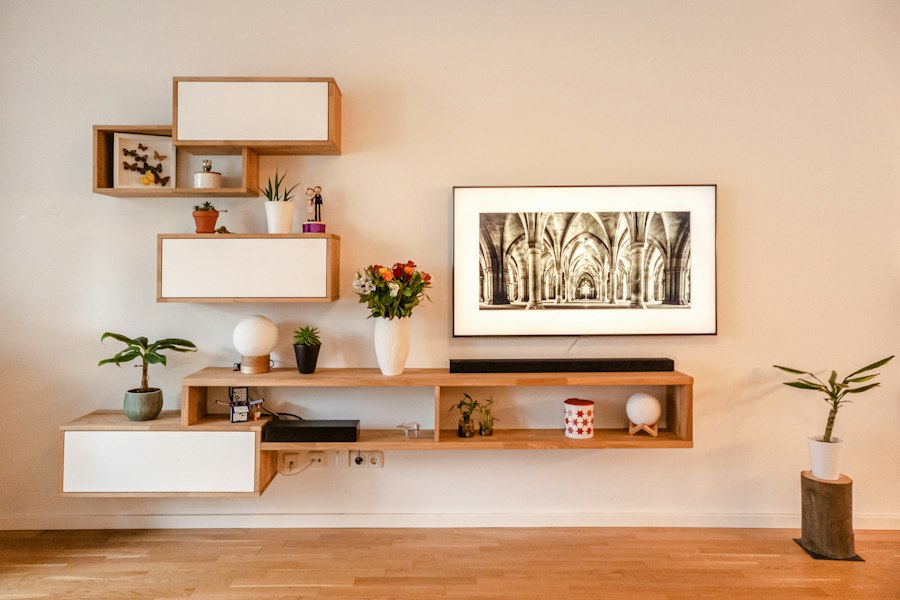
Especificações para móveis de lobby em hotéis de luxo — um segmento em crescimento no qual os fabricantes de Foshan, especializados em produtos para o setor de hospitalidade, estão conquistando projetos de alto valor no Oriente Médio, no Sudeste Asiático e na Europa.
📖 Glossário de termos-chave
- FOB (Livre a bordo)
- Condição de remessa em que o preço do vendedor inclui a entrega no porto de exportação designado e o carregamento no navio. A partir desse ponto, o comprador assume o risco e os custos de frete.
- MOQ (Quantidade Mínima de Pedido)
- A menor quantidade que um fabricante aceita em uma única série de produção. Varia bastante de acordo com o tipo de fábrica e a complexidade do produto.
- CBM (metro cúbico)
- A unidade utilizada para medir o volume de móveis para transporte. Um contêiner de 20 pés comporta aproximadamente 25 a 28 CBM de móveis embalados.
- RFQ (Solicitação de Cotação)
- Um documento formal enviado a um fornecedor solicitando cotação de preços com base em especificações definidas do produto.
- FSC (Forest Stewardship Council)
- Uma organização internacional sem fins lucrativos que certifica o manejo florestal responsável e o rastreamento da cadeia de custódia de produtos madeireiros.
- CARB Fase 2
- Norma do Conselho de Recursos Atmosféricos da Califórnia (CARB) que limita as emissões de formaldeído provenientes de painéis de madeira composta — a norma de fato para móveis vendidos no mercado dos EUA.
- REACH
- Regulamentação da União Europeia que restringe o uso de substâncias químicas perigosas em produtos comercializados no mercado europeu, incluindo acabamentos para móveis e materiais de estofamento.
- Soldagem TIG
- Soldagem com gás inerte de tungstênio (TIG) — um método de soldagem de precisão que produz juntas metálicas limpas e de alta resistência, com perfil de solda visível mínimo.
- Índice de Martindale (abrasão)
- Uma medida da durabilidade do tecido: o número de ciclos de atrito que um tecido pode suportar antes de apresentar desgaste visível. Uso residencial: 15.000–25.000; uso comercial: 50.000–100.000+.
- L/C (Carta de Crédito)
- Uma garantia de pagamento emitida por um banco que assegura que o vendedor receba o pagamento quando as condições definidas contratualmente (normalmente, a apresentação do documento de embarque) forem cumpridas.
Perguntas frequentes
As perguntas frequentes a seguir abordam as dúvidas mais comuns de distribuidores de móveis, designers de interiores, designers de hotéis e operadores de showrooms que estão explorando o mercado de Foshan pela primeira vez ou buscando ampliar relações já estabelecidas.
Por que Foshan continua sendo a escolha estratégica para o abastecimento de móveis no segmento B2B
Após examinar todas as dimensões do ecossistema de fabricação de móveis de Foshan — desde as bases históricas do artesanato que formaram a força de trabalho, passando pelos investimentos em tecnologia que estão remodelando a economia da produção, até as credenciais de sustentabilidade que estão abrindo ou fechando portas em mercados regulamentados —, a conclusão para os compradores B2B é clara e consistente: Foshan não é uma opção padrão; é uma escolha estratégica que, quando feita com a preparação adequada e a seleção correta de parceiros, proporciona uma vantagem competitiva que nenhuma outra região industrial consegue reproduzir atualmente.
O número referente à participação no mercado global do 39% não é uma alegação de marketing — é o resultado aritmético de 40 anos de investimento industrial concentrado, integração da cadeia de suprimentos, desenvolvimento da força de trabalho e aprimoramento competitivo. Para os distribuidores, isso se traduz em uma estrutura de custos que permite preços competitivos no mercado com margens significativas. Para designers de interiores e operadores de showrooms, isso se traduz em capacidade de personalização e agilidade no design, transformando uma especificação de mobiliário em uma assinatura de estilo. Para equipes de compras do setor hoteleiro e de hospitalidade, isso se traduz em qualidade de nível contratual a um preço que torna os interiores de luxo economicamente viáveis.
Os compradores que extrairão o máximo valor do ecossistema de Foshan nos próximos anos são aqueles que tratam as relações com os fabricantes como parcerias de longo prazo, investem na clareza das especificações e na disciplina da documentação, mantêm-se atualizados com os requisitos de conformidade em constante evolução em seus mercados-alvo e aprofundam continuamente seu conhecimento técnico sobre como realmente se parece e se sente a fabricação de móveis de qualidade em cada etapa da produção. Esse conhecimento — adquirido por meio de visitas às fábricas, avaliação de amostras e conversas sinceras com os fabricantes — é o ativo inimitável que distingue os profissionais de sourcing dos amadores da área.
Móveis Jade Ant foi criada precisamente para fazer a ponte entre compradores internacionais do setor B2B e os fabricantes mais qualificados de Foshan — cuidando do desenvolvimento de projetos, da documentação de especificações, do monitoramento da produção e da coordenação logística como um serviço integrado para distribuidores, designers e operadores de showrooms que desejam aproveitar as vantagens de Foshan sem ter que lidar sozinhos com suas complexidades. Saiba mais sobre como trabalhamos →
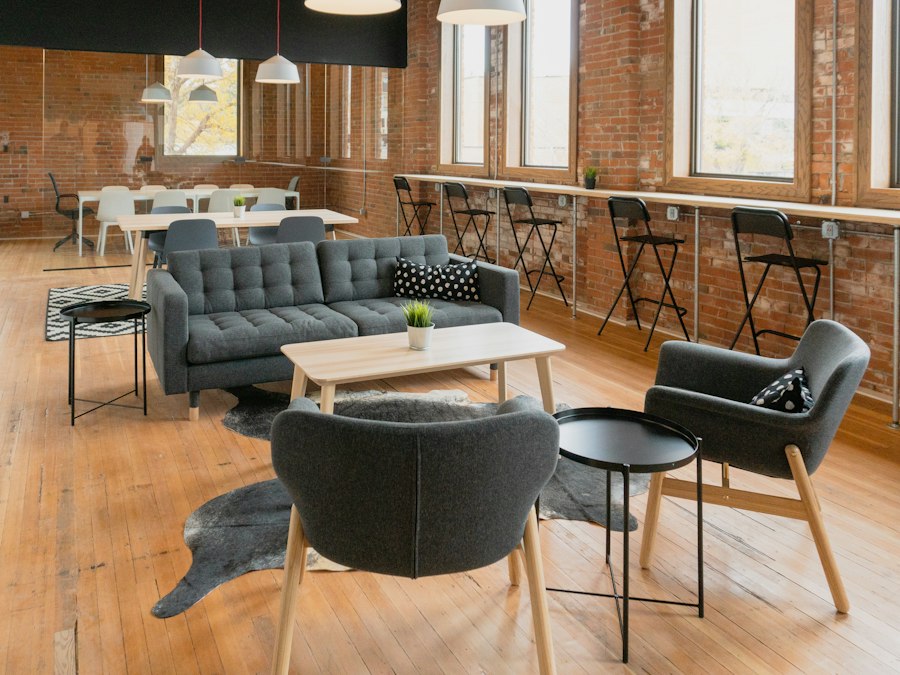
Um espaço residencial de luxo decorado com peças feitas sob medida — o destino final no mercado para os melhores móveis personalizados produzidos pelos fabricantes especializados de Foshan.
Pronto para explorar as oportunidades no setor de fabricação de móveis em Foshan?
Agende uma consulta com nossos especialistas em sourcing em Móveis Jade Ant para identificar o parceiro de fabricação ideal para as necessidades da sua empresa. Seja você um distribuidor em busca de preços competitivos, um designer que precisa de soluções personalizadas ou um operador de showroom montando seu estoque, nós o colocamos em contato com fabricantes de Foshan cuidadosamente selecionados que atendem às suas especificações, orçamento e prazo.
- Acesse diretórios exclusivos de fabricantes e redes de fornecedores verificadas
- Organize visitas virtuais ou presenciais a fábricas com os principais fabricantes
- Receba recomendações personalizadas com base nas suas necessidades em relação aos produtos
- Negociar condições favoráveis e descontos por volume
- Gerenciar os processos de logística, conformidade e garantia de qualidade