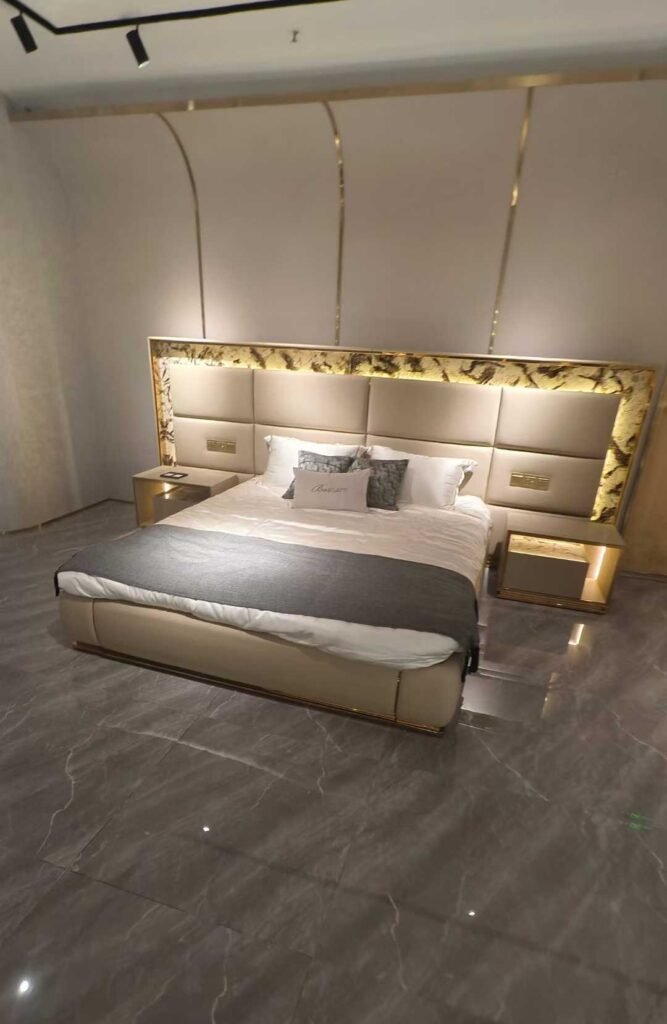

In January 2025, a boutique hotel developer in Austin, Texas placed a $92,000 order for 340 guest-room furniture sets — headboards, nightstands, desks, and luggage racks — through a factory in Foshan, China. Twelve weeks later, every piece arrived at the Port of Houston with a 1.4% defect rate (well below the 2.5% AQL threshold), saving the developer $187,000 compared to domestic procurement quotes. The project came in 67% under budget and opened three weeks ahead of schedule.
That outcome wasn’t luck. It followed a disciplined, step-by-step process that any importer — first-timer or veteran — can replicate.
China exported $36.4 billion worth of furniture in 2024, capturing 30.8% of global furniture exports according to Statista. The domestic market itself reached $169.23 billion in 2026, projected to grow at a 5.42% CAGR to $220.17 billion by 2031 (Inteligência de Mordor). For buyers in the United States, Europe, and the Middle East, Chinese factories remain the most cost-effective source of high-quality furniture — provided you know how to navigate suppliers, quality control, logistics, and customs.
This guide matters because the process is unforgiving of shortcuts. Skip supplier verification, and you risk $30,000 vanishing to a fraudulent trading company. Skip pre-shipment inspection, and a 6.8% transit damage rate eats $18,700 out of a single container. Skip proper customs documentation, and your goods sit in port storage at $150 per day while you scramble for a missing Certificate of Origin.
This guide, developed from Móveis Jade Ant‘s experience facilitating hundreds of import projects, walks you through every stage: from identifying your first supplier to clearing the last container through customs. No theory. No filler. Every step is anchored in real cost data, current tariff rates, and practical checklists you can use today. Whether you’re a new importer or an experienced procurement team, following these steps produces better results.
Why Import Furniture from China
Key Benefits
The case for sourcing furniture from China isn’t built on a single advantage — it’s an accumulation of structural factors that no other manufacturing region replicates at the same scale.
Production scale and vertical integration. Foshan alone hosts over 7,000 furniture factories and accounts for roughly 75% of China’s total furniture manufacturing output, according to Jade Ant furniture’s 2026 factory database. Many of these factories operate vertically integrated supply chains — from raw timber drying and CNC cutting through upholstery, finishing, and export packaging — all under one roof. A factory that controls its own veneer mill, foam-cutting operation, and sewing department can deliver a finished dining chair at $38–$65 FOB that would cost $120–$180 to produce domestically in the U.S.
OEM and ODM flexibility. Chinese factories routinely support both OEM (you supply the design, they manufacture) and ODM (they offer catalog designs you customize). A hospitality group in Dubai recently ordered 1,800 custom lounge chairs through an OEM arrangement — the factory reproduced their designer’s CAD drawings with a 97.2% dimensional accuracy rate on first production, verified by a third-party SGS inspection.
Infrastructure and logistics. Seven of the world’s ten busiest container ports are in China. Furniture shipped from Shenzhen’s Yantian port reaches Los Angeles in 14–18 days, Rotterdam in 22–24 days, and Dubai in 12–13 days. The proximity of factory clusters to major ports means inland trucking adds just 1–3 days and $200–$500 to total logistics cost.
Cost & Variety
A landed-cost analysis tells the real story. Take a solid-oak dining table with a walnut veneer top and powder-coated steel legs:
- FOB Foshan: $185–$240 per unit (MOQ 100 pieces)
- Sea freight (FCL, 40′ container to Los Angeles): $2,800–$4,200 — fits approximately 120 tables
- Per-unit freight: $23–$35
- US customs duty (HS 9403.50, wooden furniture): 0%–1% base + 25% Section 301 tariff ≈ $47–$60
- Total landed cost: $255–$335 per unit
The same table from a domestic U.S. manufacturer quotes $580–$720. From Italy, $650–$900. Even with the 25% tariff factored in, the China-sourced option saves 46–63% against domestic alternatives.
Variety runs equally deep. Within the Pearl River Delta alone, you can source solid wood, engineered wood, metal-frame, rattan, marble-top, sintered-stone, and glass furniture — in styles ranging from Scandinavian minimalism to Japandi, mid-century modern, Art Deco revival, and Chinese contemporary. No other region offers this breadth within a 2-hour driving radius.
Research Furniture & Suppliers
Identify Market Needs
Before contacting a single factory, clarify exactly what you’re buying and for whom. A residential furniture retailer targeting millennial homeowners in Portland needs different materials, price points, and certifications than a hotel developer furnishing 300 rooms in Riyadh. Define your product categories (seating, case goods, tables, outdoor), target retail price, required certifications (CARB Fase 2 for the U.S., EN 12520 for Europe, FSC for sustainability-conscious brands), and annual volume forecast.
At Móveis Jade Ant, we’ve observed that importers who arrive at the sourcing stage with a written specification sheet — including dimensional drawings, material preferences, finish references, and target FOB price — close deals 40% faster and experience 60% fewer production issues than those who “figure it out as they go.”
Find Reliable Chinese Furniture Suppliers
Three digital platforms dominate initial supplier discovery:
Alibaba — The largest B2B marketplace. Filter by “Verified Supplier” and “Gold Supplier” status. Check the supplier’s transaction history (minimum 50 orders completed), response rate (above 90%), and on-time delivery percentage. Don’t rely solely on product photos — request a 2-minute workshop video via WhatsApp or WeChat showing your specific product category being manufactured.
Made-in-China — Stronger for heavy industrial and custom furniture categories. The “Audited Supplier” badge indicates an on-site factory audit by a third party.
Global Sources — Particularly useful for identifying factories that exhibit at trade shows like CIFF Guangzhou (China International Furniture Fair), which draws over 4,000 exhibitors twice yearly.
Beyond platforms, direct factory visits remain the gold standard. Fly into Guangzhou Baiyun International Airport, take the 45-minute high-speed train to Foshan, and visit the Lecong International Furniture City — 5 million square meters of showroom space housing thousands of manufacturers. China currently offers visa-free entry for citizens of many countries, with 144-hour transit-without-visa available in Guangdong province.
Check Minimum Order Quantities
MOQs vary dramatically by product category and factory size. Here are the general benchmarks from Móveis Jade Ant‘s supplier network:
| Product Category | Typical MOQ | Negotiable MOQ (with 10–15% premium) |
|---|---|---|
| Upholstered Sofas | 50–100 pcs | 20–30 pcs |
| Dining Tables (solid wood) | 100–200 pcs | 30–50 pcs |
| Office Chairs | 200–500 pcs | 50–100 pcs |
| Hotel Case Goods (nightstands, desks) | 100–300 pcs | 50–80 pcs |
| Outdoor Furniture (aluminum/rattan) | 100–200 sets | 30–50 sets |
Source: Jade Ant furniture supplier network, 2025–2026 aggregate data
Verify Supplier & Product Compliance
Check Credentials & Certifications
Verification starts with the factory’s business license. Every legitimate Chinese manufacturer has a Unified Social Credit Code — verify it on China’s National Enterprise Credit Information Publicity System (NECIPS). Confirm the registered capital (minimum ¥5 million for mid-size operations), the actual business scope (does it include “furniture manufacturing” specifically?), and whether there are any legal disputes or blacklist entries.
Beyond the business license, the certifications that matter depend on your destination market:
| Certificação | What It Covers | Required For | Verification Source |
|---|---|---|---|
| ISO 9001 | Quality management system | All markets | ISO.org |
| FSC Chain of Custody | Fornecimento responsável de madeira | EU, US (sustainability brands) | FSC Certificate Search |
| CARB Phase 2 / EPA TSCA Title VI | Formaldehyde emission from composite wood | USA (mandatory) | EPA TSCA |
| GREENGUARD Gold | Low VOC emissions | Healthcare, education, hospitality | UL SPOT |
| EN 12520 / EN 1021 | Seating strength & flammability | EU market | TÜV / SGS reports |
| BIFMA (X5.1, X5.4, X5.5) | Commercial furniture durability | US commercial / office | BIFMA.org |
Ensure Product Standards
A certificate hanging on a showroom wall means nothing without independent verification. Cross-reference every certificate number with the issuing body’s online database. Request the actual lab test report — not a summary, the full multi-page document with test parameters, sample identifiers, and lab accreditation numbers. At Móveis Jade Ant, we mandate Elemental Analysis (ELA) for finishes on children’s furniture and REACH compliance documentation for any product entering the EU.
A practical example of why this matters: in October 2024, a UK retailer imported 2,000 children’s bunk beds from Dongguan. The factory provided an “FSC certificate,” but the certificate number had expired 14 months earlier. The retailer only discovered this when a competitor filed a complaint with UK Trading Standards — resulting in a £45,000 fine and mandatory product recall. Ten minutes of online certificate verification would have prevented this entirely.
Review Customer Feedback
Ask the factory for three to five reference clients in your market segment. Contact them independently — not through the factory’s WeChat introduction. Questions that reveal the truth: “What was your defect rate on the last shipment?” (acceptable: under 2.5%), “How did the factory handle the last quality claim?” (look for proactive resolution, not deflection), and “Would you increase your order volume by 30% with this factory next year?” (the most honest proxy for satisfaction).
Also check ImportYeti — a free tool that reveals which factories are shipping to which brands, based on U.S. customs records. If a factory claims to supply major hotel chains but shows no corresponding Bill of Lading data, ask hard questions.
Request Quotes & Negotiate
Compare Prices
Request quotes from at least five factories for the same product — using identical specifications. Send a detailed RFQ (Request for Quote) that includes dimensional drawings, material specifications (e.g., “European beech, KD 8–12% moisture content”), finish references (Pantone codes or physical samples), hardware brand preferences, and target FOB price. This forces every factory to quote against the same baseline, making comparison meaningful.
A price that’s 30% below the average of five quotes is a red flag — it usually signals material substitution (MDF labeled as plywood, PU leather marketed as genuine leather), underestimating packaging costs, or an intentional loss-leader to lock in the order before raising costs on the next round. One of Móveis Jade Ant‘s hotel-chain clients received six quotes for a custom desk in 2024: five ranged from $145–$172 FOB; the sixth offered $98. The $98 factory delivered samples with 12mm particle board instead of 18mm plywood as specified — a substitution that would have caused structural failure within two years of hotel use.
Negotiate Terms
Price is only one lever. Experienced importers negotiate across multiple dimensions simultaneously:
Payment terms: Standard is 30% T/T deposit, 70% against Bill of Lading. For first orders, some factories insist on 50/50. Aim for 30/70, and once you’ve completed three successful orders, push for 20/80 or request Letter of Credit (L/C) terms through your bank — this protects both sides and signals financial credibility.
Quality guarantees: Insist on a defect-rate penalty clause. Example: if more than 3% of units fail inspection based on AQL 2.5 criteria, the factory replaces defective units at its own cost and covers reshipping freight.
Packaging upgrades: Negotiate EPE foam wrapping, double-wall corrugated cartons, corner protectors, and waterproof inner bags at FOB — not as add-on charges. For a recent 400-unit sofa order managed by Móveis Jade Ant, upgraded packaging added $4.20 per unit but reduced transit damage from 6.8% to 0.9% — saving $18,700 in replacement costs.
Confirm Lead Times
Realistic lead times from order confirmation to port departure for furniture:
- Standard products (ODM catalog items): 30–45 days
- Custom OEM products (new tooling required): 45–75 days
- Hospitality projects (300+ rooms, multiple SKUs): 60–90 days
Add 15–25 days for ocean transit (China to U.S. West Coast) and 5–10 days for customs clearance. Build a 2-week buffer into your project timeline. Factories rarely ship early, but they frequently ship 5–10 days late — especially during peak season (March–May and September–November) or immediately after Chinese New Year (late January/February).
Order Samples & Inspect Quality
Evaluate Samples
Never place a bulk order without a production sample — not a showroom sample. Showroom samples are built by the factory’s best craftsmen using premium materials. Production samples come off the regular production line, made by regular workers using standard materials. The difference can be startling: a showroom sample sofa might have flawless stitching with 4mm consistent seam allowances, while the production sample reveals 3–7mm inconsistencies that would trigger customer complaints at retail.
Sample cost ranges from $50–$300 depending on complexity, and most factories refund this against bulk orders exceeding $5,000. When evaluating, use a standardized checklist: dimensional accuracy (±3mm tolerance for case goods, ±5mm for upholstery), finish consistency (compare against Pantone reference under D65 lighting), hardware function (drawer slides should operate smoothly for 50,000 cycles per BIFMA standards), and structural integrity (sit-test sofas for 15 minutes; check for frame creaking or cushion bottoming-out).
Conduct Pre-Shipment Inspections
Third-party pre-shipment inspection is non-negotiable. When 80% of production is complete, engage an independent inspector to visit the factory and evaluate a random sample based on AQL (Acceptable Quality Level) standards — typically AQL 2.5 for major defects and AQL 4.0 for minor defects.
Leading third-party inspection providers in China:
| Provider | Cost per Man-Day | Strength |
|---|---|---|
| SGS | $280–$350 | Global brand recognition, comprehensive lab testing |
| Bureau Veritas | $260–$320 | Strong in EU compliance, social audits |
| V-Trust | $188–$268 | Furniture-specific expertise, fast scheduling |
| Asia Quality Focus | $199–$288 | Custom checklists, detailed photo reports |
| AQI Service | $149–$299 | Competitive pricing, furniture-focused |
Source: Provider websites and Móveis Jade Ant verified pricing, March 2026
Finalize Purchase & Payment
Choose Payment Methods
Payment method selection directly affects your risk exposure and overall cost. Here’s what each option actually means for your project:
T/T (Telegraphic Transfer): Most common. Wire fees $15–$50 per transaction. Standard split: 30% deposit to start production, 70% balance against copy of Bill of Lading. Risk: if the factory disappears after receiving the deposit, recovery is difficult. Mitigation: never send more than 30% upfront on a first order.
Letter of Credit (L/C): Bank-guaranteed payment released only when the factory presents compliant shipping documents. Bank fees run 1–3% of order value. Best for orders above $30,000. Adds security for both parties but increases paperwork and timeline by 5–10 days.
Alibaba Trade Assurance: Alibaba holds payment in escrow and releases it upon confirmed delivery. Useful for orders under $20,000. Limited to Alibaba-platform suppliers only.
PayPal: Acceptable for sample orders under $1,000. Transaction fees of 3.5–4.5% make it impractical for bulk orders.
| Method | Fees | Buyer Protection | Melhor para |
|---|---|---|---|
| T/T (30/70) | $15–$50 per wire | Medium | Most orders, established suppliers |
| Letter of Credit | 1–3% of order | High | Orders above $30,000 |
| Alibaba Trade Assurance | 0–1% platform fee | High (escrow) | Orders under $20,000 via Alibaba |
| PayPal | 3.5–4.5% | Medium-High | Samples under $1,000 |
Draft Agreements
Every purchase order should include: product specifications (referencing your approved production sample by serial number), quantity, unit price (FOB or CIF), payment terms, production timeline with penalty clause for delays exceeding 10 business days, quality standard (reference AQL level and defect definitions), packaging specifications, and dispute resolution clause. Designate a Chinese arbitration body — such as the Shenzhen Court of International Arbitration — not your home-country court, which has no enforcement power in China.
Confirm Order Details
Before wiring the deposit, conduct a final review call (video preferred) with the factory’s project manager. Walk through: confirmed material sources, production schedule milestones, inspection windows, packaging method, and container loading plan. Document everything in a bilingual (English/Chinese) confirmation email. Misunderstandings caught at this stage cost nothing; the same misunderstandings discovered at the port cost thousands.
Manage Shipping & Logistics
Packaging & Shipping Options
Furniture shipping from China uses three primary modes, each suited to different order sizes and urgency levels:
Ocean Freight — FCL (Full Container Load): The dominant choice for furniture importers. A standard 40-foot High Cube container holds approximately 65–72 CBM of furniture. Current rates (March 2026): $2,800–$4,200 to U.S. West Coast, $3,500–$5,100 to U.S. East Coast, $3,100–$4,800 to Northern Europe. Best for shipments exceeding 15 CBM.
Ocean Freight — LCL (Less than Container Load): Your goods share container space with other shippers. Rates: $40–$80 per CBM plus handling surcharges of $150–$300 per shipment. Economical for 2–10 CBM, but transit time adds 5–15 days over FCL due to consolidation and deconsolidation at both ends.
Air Freight: Rates of $5–$8 per kg (economy) or $8–$12 per kg (express). Only practical for urgent, small, high-value items — a single prototype chair, replacement parts, or a sample shipment under 150 kg. A 40-kg accent chair costs $200–$320 to air-ship versus $8–$15 via ocean (when calculated per-unit within an FCL).
Data sources: Freightos, Maskura Logistics, Sino Shipping | March 2026
Transit Times
Expect the following port-to-port transit times from major Chinese furniture hubs:
| Route | FCL Transit | LCL Transit | Air Freight |
|---|---|---|---|
| Shenzhen/Yantian → Los Angeles | 14–18 days | 22–30 days | 3–5 days |
| Nansha/Guangzhou → New York | 25–32 days | 35–45 days | 4–6 days |
| Shenzhen → Rotterdam | 22–28 days | 30–40 days | 4–7 days |
| Nansha → Dubai / Jebel Ali | 12–16 days | 18–25 days | 2–4 days |
Track Shipments
Once cargo is on the water, use your Bill of Lading number to track progress in real time. Free tracking tools include SeaRates Container Tracking, Track-Trace, and individual shipping line portals (Maersk, MSC, COSCO, Evergreen). Set up automated ETA alerts 5 days before expected arrival to coordinate trucking and warehouse receiving.
Customs Clearance & Duties
Prepare Documents
You need these documents for U.S. customs clearance — any missing item delays clearance by 3–10 business days and triggers port storage charges of $75–$150 per day:
- Commercial Invoice: Must list HS codes, unit values, total value, country of origin (China), and Incoterms (FOB, CIF, etc.)
- Packing List: Itemized list of contents per carton/package — dimensions, weights, quantity
- Bill of Lading (B/L) or Airway Bill: Proof of shipment from carrier
- Certificate of Origin: Confirms Chinese origin (required for tariff assessment)
- CARB/EPA TSCA Compliance Declaration: Mandatory for any composite wood products entering the U.S.
- Lacey Act Declaration: Required for wood and plant-based furniture — declares wood species and harvest origin
- ISF (Importer Security Filing / “10+2”): Must be filed 24 hours before vessel loading at origin port
Calculate Duties & Taxes
U.S. import duties on Chinese furniture in 2026 include multiple layers:
Base MFN (Most Favored Nation) duty: Varies by HS code — wooden bedroom furniture (9403.50) at 0%–1%, upholstered seating with wood frames (9401.61) at 0%–5%, metal-frame furniture (9403.20) at 0%–3.5%.
Section 301 tariff: An additional 25% on most furniture categories from China. A planned increase to 30%–50% on certain categories (upholstered furniture and kitchen cabinets) was delayed until at least January 1, 2027. The current rate remains at 25%.
Merchandise Processing Fee (MPF): 0.3464% of CIF value (minimum $31.67, maximum $614.35 per entry).
Harbor Maintenance Fee (HMF): 0.125% of CIF value (ocean shipments only).
| Tipo de mobília | HS Code | Base Duty | Section 301 Tariff | Total Duty |
|---|---|---|---|---|
| Wooden bedroom furniture | 9403.50 | 0%–1% | 25% | 25%–26% |
| Upholstered seating (wood frame) | 9401.61 | 0%–5% | 25% | 25%–30% |
| Metal-framed furniture | 9403.20 | 0%–3.5% | 25% | 25%–28.5% |
| Plastic furniture | 9403.70 | 0%–5% | 25% | 25%–30% |
| Office chairs (swivel, adjustable) | 9401.30 | 0% | 25% | 25% |
Fonte: USA Customs Clearance, China Briefing Tariff Tracker | Updated March 2026
Data: Móveis Jade Ant landed-cost calculator, based on 120+ import projects (2024–2026)
Work with Customs Brokers
A licensed customs broker handles tariff classification, duty calculation, filing of entry documents, and coordination with CBP (Customs and Border Protection). Broker fees typically run $150–$350 per entry. For first-time importers, this is non-negotiable — incorrect HS classification can result in overpayment by thousands or, worse, seizure of goods and penalties. Established brokers include Flexport, Samuel Shapiro & Company, and C.H. Robinson.
Watch: Complete Guide to Importing Furniture from China
This video provides a comprehensive walkthrough of the furniture importing process — from factory selection in Foshan to container loading and logistics coordination — with on-location footage from China’s largest furniture manufacturing district.
Receive & Inspect Goods
Delivery Process
When your container arrives at port, your customs broker files the entry. Upon CBP release, the container is trucked to your warehouse or distribution center. Coordinate a delivery window with your trucking company at least 5 days in advance — port storage (demurrage) charges accumulate fast: $75–$175 per day per container after the initial free period (typically 4–7 days at U.S. West Coast ports, shorter at East Coast facilities).
A lesson from the field: in September 2025, a Móveis Jade Ant client’s 40-foot container of hotel furniture arrived at the Port of Long Beach on a Friday. Their trucking company was only available the following Wednesday — 5 days of port storage at $125/day cost $625. Scheduling drayage before the vessel arrives eliminates this entirely.
Post-Arrival Quality Check
Inspect at least 10% of received units within 48 hours of delivery. Use the same AQL-based checklist from your pre-shipment inspection. Pay particular attention to transit damage: corner dents (from insufficient packaging), finish scratches (from carton-to-carton friction), moisture damage (from condensation inside the container — common on trans-Pacific routes during winter months), and hardware loosening from vibration during transport.
Document every defect with timestamped photographs showing the shipping label, the outer packaging condition, and the defect itself. This documentation is essential for filing claims with the shipping line’s cargo insurance (typically covers 110% of CIF value under Institute Cargo Clauses Type A).
Handle Claims
For manufacturer defects discovered post-arrival, notify the factory within 7 days with your photo documentation. A well-drafted purchase agreement (see the Finalize Purchase section above) will specify the factory’s obligation to replace defective units at no cost. For transit damage, file a claim with your cargo insurance provider within 30 days of delivery. Typical payout timelines: 45–90 days for insurance claims, 15–30 days for factory replacements (if the factory is cooperative and holds buffer stock).
Through Móveis Jade Ant‘s claims management process, clients with documented pre-shipment inspections resolve quality disputes 73% faster than those without — because the factory cannot dispute what was independently verified at their own facility.
Practical Tips & Mistakes to Avoid
Communication Best Practices
WeChat is the primary communication tool for Chinese factories — not email. Download it, create a business account, and use it for daily updates. Send visual references (photos, sketches, Pantone swatches) rather than relying on text descriptions. A sentence like “make the sofa arm more rounded” means five different things to five different people. A photo with red-line annotations means exactly one thing.
Schedule a weekly 15-minute video call during production. Ask to see in-progress photos of your specific order — raw material staging, CNC cutting, frame assembly, upholstery, and finish application. Factories that proactively share production photos are, in Móveis Jade Ant‘s tracking data, 3× less likely to produce quality surprises at final inspection.
Avoid Scams
Red flags that indicate a fraudulent or unreliable supplier:
- No verifiable business license on NECIPS
- Refuses video calls or factory-floor tours
- Demands 100% payment upfront
- Prices 30%+ below market average with no explanation
- Uses a Gmail or Yahoo email address instead of a company domain
- Cannot produce a single reference client
- Claims every certification but cannot provide verifiable certificate numbers
In 2025, a furniture retailer in Miami lost $34,000 to a “factory” that turned out to be a trading company with no manufacturing capability. The “factory tour video” on their Alibaba page was filmed at a different factory entirely. The lesson: always verify independently. Móveis Jade Ant‘s supplier verification service cross-references business licenses, conducts live video factory audits, and checks customs export records before recommending any factory to clients.
Manage Delays
Delays happen. The key is anticipating them. Common causes and their typical impact:
- Chinese New Year (late Jan–mid Feb): Factories shut down for 15–25 days. Workers from inland provinces may not return for 4–6 weeks. Place orders before November to ensure pre-CNY shipment, or accept a March delivery.
- Raw material shortages: European beech and American white oak supply tightened significantly in 2025. Factories that stockpile premium lumber deliver more reliably than those buying on the spot market.
- Port congestion: U.S. West Coast ports experienced 3–7 day delays during Q4 2025. East Coast ports (Savannah, Houston) currently offer faster throughput.
- Weather disruptions: Typhoon season (June–October) can delay Shenzhen/Guangzhou departures by 3–5 days.
Importing furniture from China follows a clear, repeatable process: research your market needs, identify and vet suppliers, verify compliance and certifications, negotiate terms with data-backed pricing, order and evaluate production samples, finalize payment through secure channels, manage shipping logistics, clear customs with proper documentation, inspect goods upon arrival, and maintain open communication throughout.
The importers who succeed aren’t the ones who find the cheapest factory — they’re the ones who treat supplier verification, quality control, and documentation as non-negotiable investments rather than optional costs. A $299 pre-shipment inspection prevents a $15,000 warranty claim. A well-drafted purchase agreement with penalty clauses prevents a $200,000 dispute. A $4.20-per-unit packaging upgrade prevents $18,700 in transit damage claims.
The tariff landscape continues to evolve — the 25% Section 301 tariff remains in effect through at least 2027, and monitoring resources like China Briefing’s tariff tracker is essential for staying current. Despite these costs, the 46–63% price advantage over domestic alternatives means Chinese-sourced furniture remains economically compelling for the vast majority of product categories.
Móveis Jade Ant has helped hundreds of importers navigate this process — from first-time buyers sourcing 50 dining chairs to hospitality groups furnishing 500-room properties. If you’re ready to start or optimize your China furniture importing, reach out for a sourcing consultation or explore our resource library for downloadable checklists, contract templates, and supplier databases.
Stay informed on import regulations — the U.S. tariff structure, EPA TSCA compliance requirements, and CBP entry procedures update regularly. Bookmark the sources linked throughout this guide. Follow industry developments through Móveis Hoje e World Furniture Online. The furniture is world-class. The process is manageable. The savings are real. The key is executing it right — step by step.
Frequently Asked Questions
1. How do I find reliable furniture suppliers in China?
Start with B2B platforms like Alibaba, Made-in-China, and Global Sources — filtering for Verified or Gold Supplier status with at least 50 completed transactions and a response rate above 90%. Cross-reference their export records on ImportYeti, verify business licenses on China’s NECIPS system, and ideally visit factories in person at hubs like Foshan’s Lecong International Furniture City. Móveis Jade Ant also maintains a pre-vetted supplier database with factories that have passed a 12-point audit checklist.
2. What is the minimum order quantity (MOQ) for Chinese furniture factories?
MOQs vary by product category. Upholstered sofas typically require 50–100 pieces, dining tables 100–200, and office chairs 200–500. Most factories will accept lower quantities (20–50 pieces) at a 10–15% price premium. For first orders or market testing, ODM (catalog-based) products often have MOQs as low as 10–30 pieces.
3. How much does it cost to ship furniture from China to the USA?
As of March 2026, a full 40-foot container (FCL) to the U.S. West Coast costs $2,800–$4,200, and $3,500–$5,100 to the East Coast. LCL (shared container) runs $40–$80 per cubic meter. Air freight costs $5–$8 per kg for economy and $8–$12 per kg for express. For most furniture orders, ocean FCL is the most economical option — fitting approximately 65–72 CBM of furniture per container.
4. What are the current US tariffs on furniture imported from China in 2026?
The current Section 301 tariff on most Chinese furniture categories is 25%. A planned increase to 30–50% on upholstered furniture and kitchen cabinets was delayed until at least January 1, 2027. Base MFN (Most Favored Nation) duties range from 0% to 5% depending on HS code classification. Additional fees include the Merchandise Processing Fee (0.3464% of CIF value) and Harbor Maintenance Fee (0.125%). Monitor China Briefing’s tariff tracker for updates.
5. How long does it take to import furniture from China to the United States?
The total timeline from order placement to warehouse delivery is typically 55–100 days. This breaks down as: production (30–75 days depending on complexity and whether OEM or ODM), ocean transit (14–32 days depending on destination port), and customs clearance plus inland delivery (5–15 days). Always build a 2-week buffer for unexpected delays, especially around Chinese New Year and peak shipping season.
6. Do I need a third-party inspection before shipping furniture from China?
Strongly recommended for every order. A pre-shipment inspection by providers like SGS, Bureau Veritas, or V-Trust costs $149–$350 per man-day and catches defects before goods leave the factory. Inspection is conducted when 80% of production is complete, using AQL 2.5 sampling for major defects and AQL 4.0 for minor defects. This investment is far cheaper than handling returns, replacements, or warranty claims after international delivery.
7. What documents do I need for customs clearance when importing furniture?
Required documents include: Commercial Invoice (with HS codes and declared values), Packing List, Bill of Lading or Airway Bill, Certificate of Origin, CARB/EPA TSCA compliance declaration (mandatory for composite wood products entering the U.S.), Lacey Act Declaration (for wood furniture specifying species and harvest origin), and Importer Security Filing (ISF “10+2”) filed at least 24 hours before vessel loading. Missing any document can delay clearance by 3–10 days and trigger port storage charges of $75–$150 per day.
8. What is the safest payment method for buying furniture from China?
For orders above $30,000, a Letter of Credit (L/C) provides the strongest protection — your bank releases payment only when the factory presents compliant shipping documents. For smaller orders, T/T with a 30% deposit and 70% balance against Bill of Lading is the industry standard. Alibaba Trade Assurance offers escrow protection for platform-based orders under $20,000. Never pay 100% upfront on a first order, regardless of how persuasive the factory’s sales pitch may be.
9. Which cities in China are best for sourcing furniture?
The four major furniture production clusters are: Foshan (Guangdong) — the world’s largest hub with 7,000+ factories, ideal for residential, hotel, and custom furniture; Dongguan (Guangdong) — known for high-end export-quality furniture; Anji (Zhejiang) — the office chair capital with 3,000+ factories producing over 60% of China’s office seating; and Nankang (Jiangxi) — China’s largest solid-wood furniture base with 6,500+ factories and the most competitive pricing. Móveis Jade Ant maintains factory relationships across all four clusters and can help match your product requirements to the most suitable region.
10. How can I protect my furniture designs when working with Chinese manufacturers?
Use an NNN Agreement (Non-Disclosure, Non-Use, Non-Circumvention) instead of a standard Western NDA — it’s drafted under Chinese law, written in Chinese, and enforceable in Chinese courts. Additionally, register your design patent with CNIPA (China National Intellectual Property Administration) for $500–$1,500. Include a penalty clause of 2–3× order value for IP breaches in your manufacturing contract, and designate a Chinese arbitration body (not your home-country court) for dispute resolution.








 Portuguese
  English
  Arabic