What Top Hospitality Furniture Manufacturers Offer Today: A Strategic Guide for Hotel Buyers, Designers & Distributors
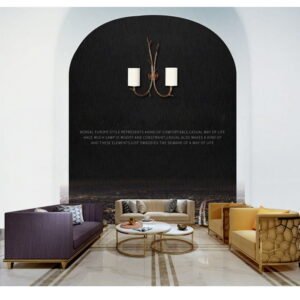
 A five-star lobby experience begins with furniture that commands attention before a guest says a word.
The global Hotel Furniture, Fixtures & Equipment (FF&E) market was valued at $63,1 bilhões em 2025 e deve atingir $107,9 bilhões até 2033 (Grand View Research). That number tells you one thing clearly: the hospitality industry is not cutting corners on interiors. Guests are paying more, expecting more, and reviewing more publicly than ever before.
For FF&E buyers, hotel developers, interior designers, importers, and private label brands, the real challenge is not finding a furniture supplier. It’s finding the certo manufacturing partner — one who can deliver durability that survives a decade of daily use, design that elevates your brand, and supply chain reliability that doesn’t derail your opening timeline.
This guide breaks down exactly what elite hospitality furniture manufacturers offer today, what red flags to avoid, and how to evaluate partners before signing a purchase order.
1. Why Your Manufacturing Partner Is a Strategic Decision, Not Just a Vendor Choice
Hotels that renovate their interiors see an average 30% increase in guest satisfaction scores, which translates directly into stronger review ratings, higher RevPAR (Revenue Per Available Room), and improved repeat booking rates (SNS Insider, 2026).
That cause-and-effect chain means your furniture vendor is not a commodity. The wrong choice — a manufacturer who delivers frames that wobble after six months or upholstery that pills within a year — shows up in your TripAdvisor reviews, not in their invoice.
Three things make a manufacturing partnership genuinely strategic:
Brand alignment means the pieces produced must match your property’s visual identity precisely — not close enough, but exactly. A boutique resort in Bali and a business hotel in Frankfurt require completely different material stories, and the best manufacturers understand that from the first consultation call.
Lifecycle cost management is the real financial lever. A chair that costs $180 and gets replaced every two years is more expensive than a $420 chair that lasts eight. When you’re furnishing 200 guest rooms, that math compounds fast.
Supply chain predictability is what actually protects your opening date. Manufacturers with multi-region production hubs, in-house logistics teams, and real-time project tracking portals are the ones who can look you in the eye at week 10 and say, “It’s on the water.”
2. The Complete Hospitality Furniture Category Map
Understanding the full scope of what a premium manufacturer should cover is the starting point for any serious FF&E conversation. Below is a breakdown of every major category, mapped to the specific buyer challenges each one addresses.
| Espaço | Key Furniture Items | Buyer Priority |
|---|---|---|
| Lobby & Public Areas | Sofas, lounge chairs, reception desks, ottomans | Brand first impression, high-traffic durability |
| Guest Rooms | Beds, nightstands, desks, dressers, upholstered chairs | Comfort, ergonomics, easy maintenance |
| Dining & Restaurant | Tables, dining chairs, banquettes, bar stools | Stackability, cleanability, volume pricing |
| Outdoor & Poolside | Loungers, dining sets, modular sofas, sunbeds | UV resistance, weather durability, rust-proof hardware |
| Meeting & Event | Conference tables, stackable chairs, modular partitions | Flexibility, fast reconfiguration, AV integration |
| Spa & Wellness | Treatment beds, relaxation seating, changing room units | Softness, hygiene compliance, waterproof fabrics |
| Executive Suites & Villas | Statement beds, custom living sets, bar carts | Bespoke design, premium material selection |
| Back-of-House | Staff seating, utility carts, admin furniture | Utility-grade pricing, ergonomic compliance |
| Contract Modular Systems | Reconfigurable seating and room systems | Scalability, phased purchasing, brand consistency |
| Custom & Bespoke Collections | Unique silhouettes, exclusive finishes | Private label differentiation, IP exclusivity |
Informações sobre o setor: The fastest-growing segment in 2026 is contract-grade modular systems. Chain operators and developers are standardizing modular room configurations that allow furniture to be reconfigured between room types — cutting renovation costs by up to 25% while maintaining visual consistency across properties.
3. Quality Signals That Separate Premium from Ordinary
This is where most buyers get burned. A manufacturer’s marketing materials all say the same things: “high quality,” “durable materials,” “competitive price.” Here’s how to read through that noise.
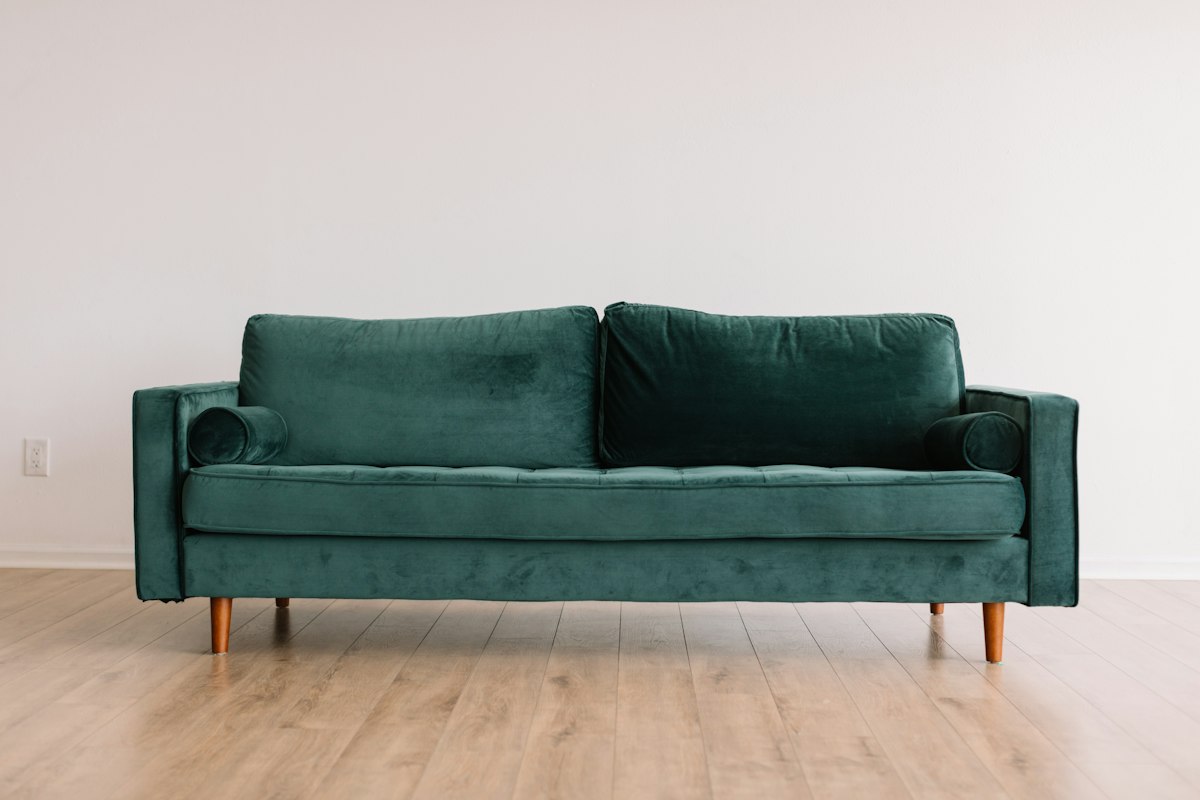 Kiln-dried hardwood frames with mortise-and-tenon joints: visible proof of engineering commitment.
Construção em estrutura
Kiln-dried hardwood — oak, ash, beech — is the industry benchmark for seating frames. Kiln-drying removes moisture to below 8%, which prevents warping, cracking, and joint failure as the wood acclimates to your property’s climate. Traditional joinery using mortise-and-tenon joints can support 50–100 years of structural integrity, compared to 5–15 years for fastener-dependent construction (Boston Mills, 2026).
Engineered wood cores (MDF, plywood) are acceptable for casegoods like wardrobes and nightstands, but should never be the primary structural material in high-traffic seating.
Upholstery Standards
The Martindale Rub Test (EN ISO 12947) measures how many cycles of abrasion a fabric withstands before showing wear. For hotel guest rooms, the minimum acceptable rating is 30,000 double rubs. Lobbies and public seating should target 50,000+.
Performance fabrics by brands like Crypton and Revolution Health are worth specifying when humidity, staining, or heavy soiling are concerns — they’re engineered to repel liquids, resist bacteria, and survive industrial laundering cycles.
Certifications That Mean Something
| Certificação | What It Confirms | Why You Need It |
|---|---|---|
| BIFMA X5.1 | Seating durability and stability | Industry safety standard for commercial use |
| EN 15372 | European non-domestic furniture strength | Required for EU hotel project compliance |
| ISO 9001 | Quality management system | Consistent production processes |
| GREENGUARD Gold | Baixas emissões químicas | Protects indoor air quality for guests |
| FSC | Certified sustainable wood sourcing | LEED credits, brand sustainability story |
| Norma OEKO-TEX 100 | Textile chemical safety | Ensures fabrics are free from harmful substances |
Warranty as a Quality Proxy
A manufacturer offering a 5–10 year structural warranty on seating is signaling genuine confidence in their engineering. A supplier who offers 12 months is telling you exactly how long they expect their furniture to hold.
Modular and Replaceable Components
The most forward-thinking manufacturers design guest room furniture so individual components — seat cushions, drawer fronts, leg assemblies — can be replaced without removing the entire piece. One European hotel group reported saving $340,000 per renovation cycle by replacing cushions and drawer panels rather than full casegoods units.
4. Design Excellence: The Silent Driver of Guest Experience
Great hospitality furniture design is not about aesthetics alone. It’s about engineering an emotional response the moment a guest walks through the door.
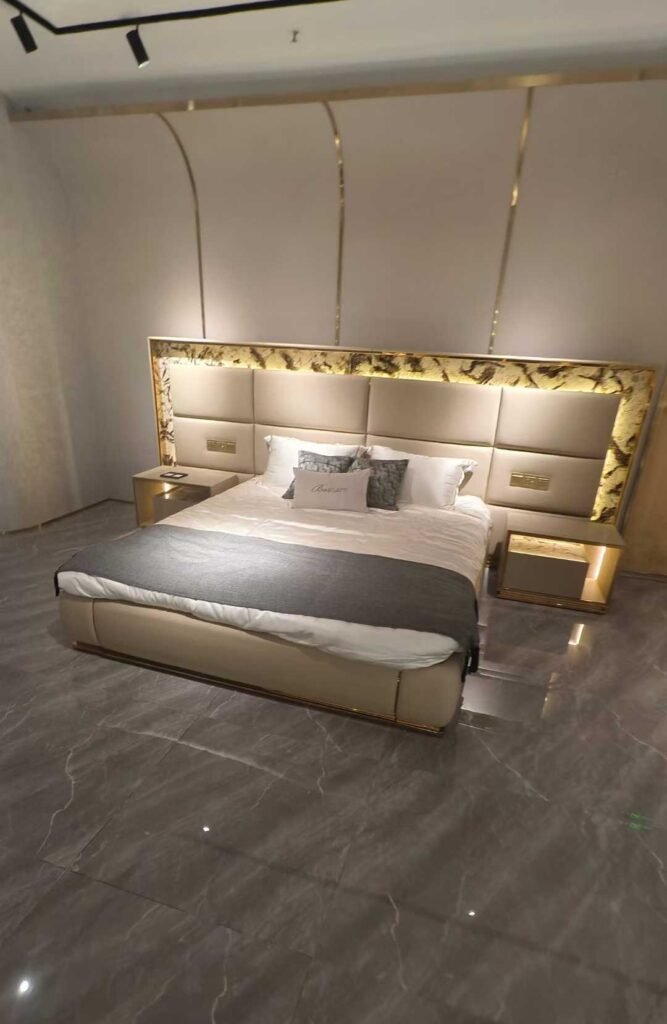
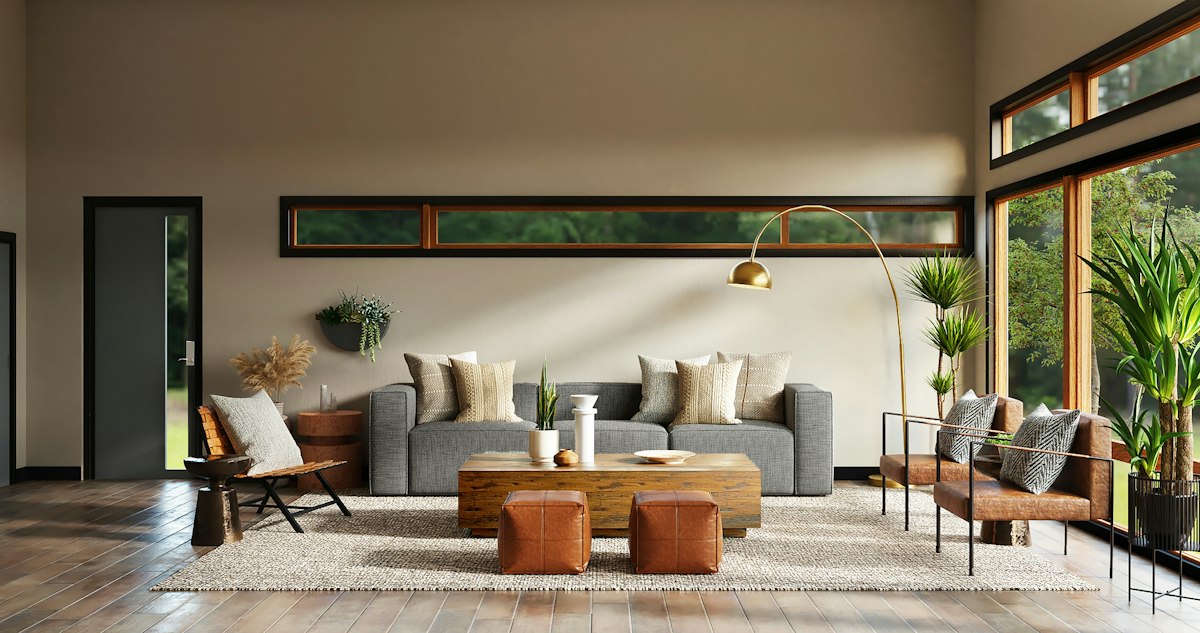 A carefully composed guest room communicates brand personality before a guest even touches a surface.
First Impressions Are Measurable
Guests form their first impression of a hotel lobby within seven seconds of entering. The furniture’s scale, material warmth, and spatial arrangement are the primary inputs in that snap judgment. A sofa that sits too low, a reception desk that feels institutional, or lounge chairs placed at awkward angles all register subconsciously — and show up in review scores.
Ergonomics Is Not Optional
Science-backed seating design matters more as health-conscious travel grows. Seat height, back angle, lumbar support, and armrest positioning all affect guest comfort during extended stays. Top manufacturers now employ ergonomics consultants at the design stage, not as an afterthought.
Color Psychology in Practice
- Warm neutrals (sand, taupe, warm white) create a sense of spaciousness and calm — ideal for guest rooms and spa areas.
- Deep blues and greens signal luxury and stability — well-suited to executive lounges and fine dining spaces.
- Earthy terracottas and natural woods evoke warmth and local character — effective for destination properties and boutique hotels.
Scalability Across Properties
For chain operators furnishing 20 or 50 properties, design language consistency is a critical brand asset. The best manufacturers build “design families” — modular collections with shared proportions, finishes, and upholstery palettes that can be deployed across properties while still allowing location-specific customization in secondary pieces.
Instagram-Worthy Moments
A statement lobby chair or a sculptural headboard does double duty as a marketing asset. When guests photograph and post your interiors, they’re doing your brand marketing for free. The most effective hospitality furniture manufacturers understand this and offer hero pieces designed explicitly to be photographed.
5. Advanced Manufacturing Capabilities: What Top Factories Actually Deliver
The gap between a mid-tier and elite manufacturer is most visible on the factory floor, not in the product catalog.
CNC Precision Cutting
Computer Numerical Control (CNC) machines — essentially robotic cutting and routing systems guided by digital design files — eliminate human measurement error in wood and metal cutting. CNC-produced components achieve tolerances within ±0.1mm, which is the difference between a drawer that glides smoothly and one that sticks after six months of temperature cycling.
3D Prototyping
Before a single piece of production timber is cut, leading manufacturers produce full-scale 3D printed or CNC-routed physical prototypes. This catches design issues — a headboard that reads well on screen but feels oversized in the actual room — before they cost you a 300-unit production run.
In-House Multi-Discipline Workshops
The distinction between a manufacturer and an assembler matters enormously for quality control. In-house metal fabrication, wood joinery, upholstery, lacquer finishing, and hardware fitting — all under one roof — means every junction point between materials is monitored by a single quality team, not scattered across a network of subcontractors.
BIM/CAD Integration
Modern FF&E specification increasingly happens inside Building Information Modeling (BIM) software like Autodesk Revit. Manufacturers who supply 3D BIM objects, Revit families, and CAD drawings eliminate a costly translation step between design intent and procurement — and reduce the risk of spec errors that cause expensive field modifications.
Just-in-Time Delivery and White-Glove Installation
JIT delivery (Just-in-Time — a logistics model where materials arrive exactly when needed, reducing storage costs) combined with on-site installation management means your property opening timeline isn’t held hostage to a container stuck in a warehouse. The best partners offer both.
6. Sustainability and Ethical Production: Now a Competitive Requirement
Sustainable sourcing has moved from “nice to have” to a genuine procurement requirement for major hotel brands, institutional investors, and government-tendered hospitality projects.
According to Jade Ant’s own hospitality sustainability guide, more than 58% of new hotel furniture orders now prioritize eco-friendly materials, including recycled wood and FSC-certified timber. The LEED v5 rating system rewards hotels for sourcing furniture that meets FSC certification, carries Environmental Product Declarations (EPDs), and uses low-emitting materials.
What to Look For
- FSC Certification (Forest Stewardship Council): Confirms that all wood originates from responsibly managed forests. Non-negotiable for projects targeting LEED or BREEAM credits.
- OEKO-TEX Standard 100: Confirms all textiles — including foam backing and thread — are free from harmful chemical substances. Critical for children’s areas, spa spaces, and any property marketing wellness.
- Low-VOC Finishes: VOCs (Volatile Organic Compounds) are chemicals released by paints and lacquers that affect indoor air quality. Low-VOC formulations protect guests and comply with increasingly strict building codes in the EU and North America.
- Cradle to Cradle (C2C) Design: Products designed for eventual disassembly and material recovery — relevant for developers with long-term ESG reporting obligations.
The ROI of Sustainable Sourcing
Beyond compliance, sustainable furniture directly supports premium pricing. A study by Booking.com found that 70% of travelers actively seek eco-friendly accommodation, and properties that credibly communicate sustainability commitments consistently command a price premium of 8–12% over comparable non-certified alternatives.
7. Private Label and Co-Branding Opportunities for Distributors and Designers
For furniture importers, distributors, and interior design firms, private label manufacturing is one of the most effective differentiation strategies available.
“Smart retailers and designers don’t sell furniture. They sell a curated product story that their clients can’t find anywhere else.”
How It Works
White-label manufacturing means a factory produces finished goods to your specifications — dimensions, materials, finishes, hardware, upholstery — and ships them under your brand identity. Your catalog, your labels, your trade relationships. The factory stays behind the curtain.
What Top Manufacturers Offer
| Service | Detalhes |
|---|---|
| Full CAD/CAM customization | Your dimensions, your silhouettes, your proprietary design |
| IP protection and NDA | Exclusive design ownership, restricted production for your account only |
| Branded packaging | Custom boxes, care card inserts, hang tags in your brand language |
| Exclusivity agreements | Geographic or channel exclusivity preventing the same design being sold to your competitors |
| Joint Design Development (JDD) | Co-development programs where the manufacturer’s design team works to your brief |
| Minimum Order Flexibility | Premium partners start from as low as 20–50 units per SKU depending on complexity |
For Importers and Distributors: Private label converts a transactional supplier relationship into a defensible business asset. Once your product line is designed, tooled, and approved, it’s yours — and your competition can’t simply order the same thing from the same factory.
Explore how Jade Ant Furniture supports private label brands and custom branding programs
8. Global Supply Chain Resilience: Protecting Your Project Timeline
The 2020–2023 supply chain disruptions taught the hospitality industry a hard lesson: a single-source, single-port manufacturing dependency is a project risk, not a cost optimization.
 Global supply chain agility is what separates a manufacturer from a strategic partner.
The Real Lead Time Landscape
According to FF&E procurement data from FBM Sourcing (2026), realistic lead times by category look like this:
| Furniture Category | Overseas Custom (weeks) | Domestic Stock (weeks) |
|---|---|---|
| Custom upholstered seating | 16–24 | 4–8 |
| Casegoods (custom) | 14–20 | 3–6 |
| Outdoor/poolside | 12–18 | 4–8 |
| Modular systems (standard) | 8–12 | 2–4 |
| Bespoke statement pieces | 20–30 | N/A |
The difference between a 70-day project and a 120-day project often comes down to whether the manufacturer can run sampling, production, and quality inspection in parallel — rather than sequentially.
What Resilience Looks Like in Practice
- Multi-region production hubs that can shift volume between Asia and Europe when port congestion hits
- Buffer stock programs for high-velocity SKUs (standard dining chairs, bedroom casegoods)
- Container consolidation services that prevent your 40-foot container sitting half-empty while you wait for a single delayed piece
- Real-time order tracking portals so you’re not sending weekly status emails to a factory contact who responds in three days
Duty Optimization
For importers sourcing from Asia, the difference between HS codes can represent a 5–15% cost variance on finished furniture. Manufacturers with in-house trade compliance teams can advise on country-of-origin declarations, material documentation for duty drawback programs, and customs paperwork that prevents clearance delays at destination ports.
9. Case Studies: What Premium Manufacturing Partnerships Actually Deliver
Case Study 1: Modular Systems Cut Room Turnover by 30%
A luxury resort chain operating across Southeast Asia switched from traditional fixed casegood configurations to a modular guest room system — beds, wardrobes, and desk units designed to be repositioned and reconfigured between room types. The result: housekeeping-led reconfiguration between suite categories dropped from 4 hours to under 2.8 hours, a 30% reduction in room turnover time. The modular system also reduced renovation material waste by 40% when rooms were refreshed at the 7-year mark.
Case Study 2: 40% Higher Guest Satisfaction Post-Redesign
A boutique developer in Southern Europe undertook a full FF&E replacement across a 60-room property, partnering with a manufacturer who provided full CAD documentation, material samples, and a physical mock-up room before production started. The result: the project opened on schedule, and post-renovation guest satisfaction scores (measured via Revinate) increased by 40% within the first three booking quarters. The property subsequently raised its average nightly rate by $45 — representing an annual revenue uplift of approximately $985,000.
Case Study 3: International Award for Custom Lobby Installation
A London-based interior design firm working on a destination resort commissioned a bespoke curved reception desk and sculptural lounge system. The manufacturer’s 3D prototyping team produced a full-scale physical mock-up from the BIM drawings within four weeks. Final production used FSC-certified walnut veneer with hand-applied lacquer in a custom colorway. The project won a Best Lobby Design category at the International Hotel & Property Awards — and the design firm has since made that manufacturer their exclusive production partner.
10. How to Evaluate and Select the Right Manufacturing Partner
This is the checklist that separates an informed buyer from an expensive mistake.
Pre-Qualification Checklist
| Critério de avaliação | What to Ask / Look For |
|---|---|
| Certificações | ISO 9001, BIFMA, FSC, OEKO-TEX, GREENGUARD — request actual certificates, not logos |
| Factory transparency | Will they facilitate a physical or virtual factory tour? If no, ask why. |
| Minimum Order Quantity | Do MOQs work for your project scale? Flexible partners start from 20–50 units. |
| Lead time guarantees | Are lead times written into the contract with penalty provisions? |
| Sample policy | Do they offer pre-production samples before committing to full production? |
| Warranty terms | What’s covered, for how long, and who bears cost of remediation? |
| After-sales support | Can they supply replacement parts, re-upholstery services, or on-site repair? |
| BIM/CAD capability | Can they supply Revit families, CAD drawings, and 3D BIM objects? |
| Customization depth | Dimensions, finishes, upholstery, hardware — full specification control? |
| Reference projects | Can they provide documented case studies or verifiable client references? |
Red Flags That Should End the Conversation
- No physical factory — only a trading company reselling production from unnamed third parties
- Vague or verbal material specifications without written documentation
- Warranty shorter than 24 months on seating frames
- Unable to produce material traceability documentation (e.g., FSC chain-of-custody certificates)
- Identical product images appearing across multiple unrelated supplier websites
Three Questions That Reveal Everything
- Can you scale from a 50-room prototype to a 500-room rollout using the same production line?
- Can you produce and ship a physical sample room mock-up before I approve production?
- If a key material (e.g., a specific leather hide) becomes unavailable mid-production, what is your documented substitution protocol?
🎬 Video: Understanding FF&E Procurement for Hotel Projects

This video breaks down the full FF&E procurement lifecycle — from concept brief to installation punch list — specifically for hotel developers and interior designers managing large-scale hospitality projects.
📊 How the Market Is Moving: 2026 Landscape at a Glance
The following chart illustrates projected growth across key hospitality furniture segments:
| Market Segment | 2025 Value (USD) | 2033 Projected (USD) | CAGR |
|---|---|---|---|
| Global Hotel FF&E Market | $63.1 Billion | $107.9 Billion | ~7.1% |
| Luxury Furniture (Global) | $28.5 Billion | $44.98 Billion | ~5.9% |
| Luxury Hotel Furniture (Specific) | $8.34 Billion | ~$14 Billion | ~6.6% |
| Sustainable/Eco FF&E (Share) | ~18% of orders | ~34% of orders | Growing |
Sources: Grand View Research, Straits Research, Fortune Business Insights, Jade Ant Industry Data (2026)
The takeaway for buyers: manufacturers who cannot credibly demonstrate sustainability credentials, customization depth, and digital integration (BIM/CAD) are already losing market position to those who can. The supply side is consolidating around fewer, more capable partners — which means your choice of manufacturer is also a competitive decision.
The Jade Ant Furniture Advantage: 15+ Years in Luxury Hospitality Production
Móveis Jade Ant has spent more than 15 years working specifically with the clients who need this guide most — FF&E buyers, hotel developers, importers, interior designers, and private label brands building product lines that carry real market differentiation.
Their production scope covers the full hospitality environment: guest rooms, lobbies, dining spaces, outdoor areas, executive suites, and spa environments. Custom sizing, proprietary finish development, white-label branding, BIM file delivery, and flexible MOQs starting at a single piece per type are all standard parts of the workflow.
For buyers who want to see the manufacturing capability behind the catalog, Jade Ant’s hotel furniture sourcing guide is a practical starting point.
📖 Glossary: Key Terms for FF&E Buyers
| Term | Plain-Language Definition |
|---|---|
| FF&E | Furniture, Fixtures & Equipment — all moveable items in a hospitality property that are not part of the building structure |
| Martindale Rub Test | An international standard (EN ISO 12947) that measures how many abrasion cycles a fabric can withstand before showing wear |
| Kiln-Dried Hardwood | Wood that has been oven-dried to remove moisture below 8%, preventing warping and joint failure in finished furniture |
| Mortise and Tenon | A traditional interlocking wood joint — one piece has a hole (mortise), the other has a matching protrusion (tenon) — known for 50–100 year structural integrity |
| BIFMA | Business and Institutional Furniture Manufacturer’s Association — U.S.-based body that sets safety and durability standards for commercial furniture |
| CNC Machining | Computer Numerical Control — robotic cutting and routing guided by digital design files, achieving tolerances within ±0.1mm |
| BIM | Building Information Modeling — digital 3D modeling of a building and all its components, including furniture |
| RevPAR | Revenue Per Available Room — a key hotel performance metric that links guest experience quality directly to financial return |
| VOC | Volatile Organic Compound — chemicals in paints and lacquers that can off-gas into indoor air; low-VOC finishes minimize this risk |
| JIT Delivery | Just-in-Time — a logistics model where goods arrive exactly when needed, reducing storage costs and project risk |
| MOQ | Minimum Order Quantity — the smallest batch a manufacturer will produce; lower MOQs allow more flexibility for boutique and custom projects |
| Wyzenbeek Test | The U.S. equivalent of the Martindale Rub Test, measuring fabric abrasion resistance using a different mechanical method |
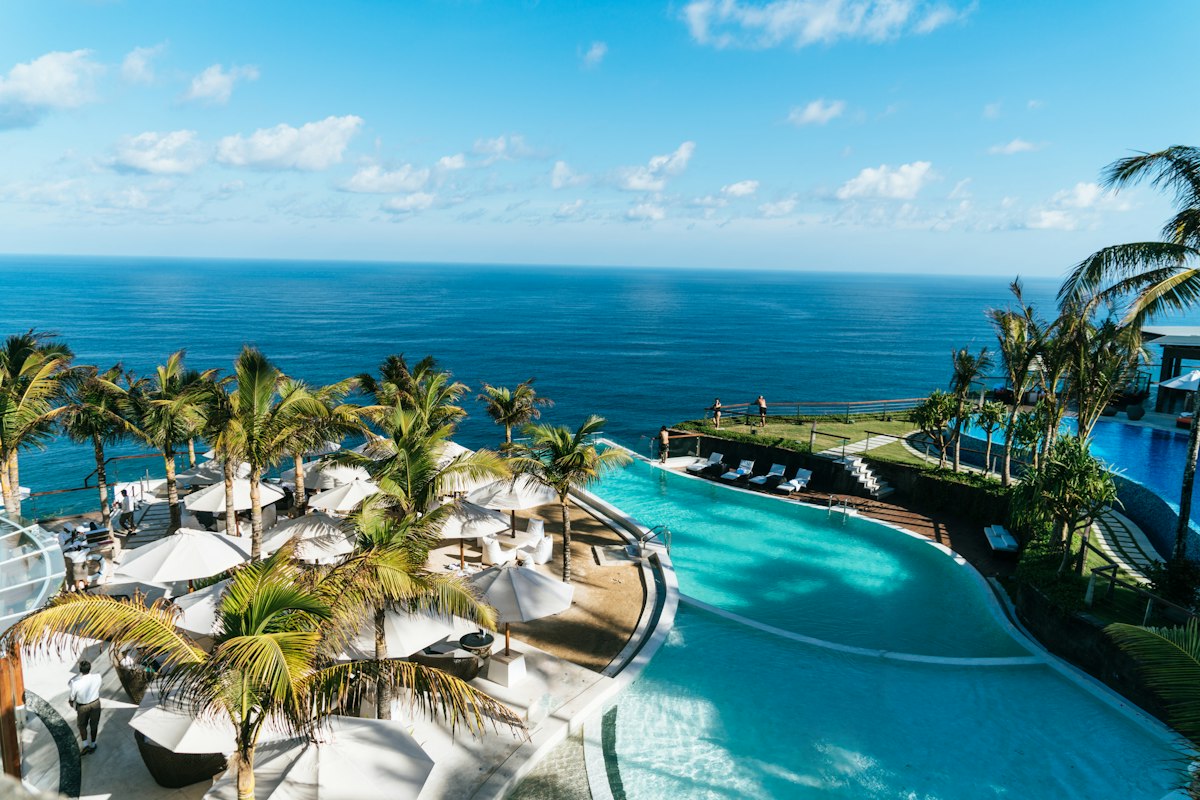 Outdoor hospitality furniture must balance aesthetic refinement with UV stability, rust-proof hardware, and performance fabric durability.
Perguntas frequentes (FAQs)
1. How do I ensure the furniture I source will last 10+ years in a high-traffic hotel?
Specify BIFMA-certified frames built from kiln-dried hardwood using mortise-and-tenon joinery. For upholstery, require a minimum 30,000 Martindale rub count in guest rooms and 50,000+ in public areas. Request documented warranty terms — any structural warranty shorter than 5 years on seating is a reliable signal of lower-grade construction.
2. What is the difference between residential and contract-grade hospitality furniture?
Contract-grade furniture is purpose-built for commercial use. It uses reinforced hardwood frames (not particleboard), high-density foam seats rated for 100,000+ compression cycles, commercial-grade hardware mechanisms (soft-close hinges rated to 80,000 open-close cycles), and performance fabrics that survive industrial laundering. Residential furniture is engineered for intermittent use by a household — it will fail rapidly in a hotel environment.
3. Can I get fully custom designs that align with my brand’s unique aesthetic?
Yes — top-tier manufacturers offer full CAD/CAM customization covering dimensions, silhouettes, proprietary finishes, material selection, and hardware specification. The process typically includes a design brief, CAD drawing approval, physical prototype production, and a mock-up room review before production commences.
4. How do I minimize lead times for large-scale FF&E projects?
The most effective approach is to lock specifications (what the industry calls “spec lock”) before production begins — every design change after production starts adds weeks. Work with manufacturers who run sampling and material sourcing in parallel with design finalization, and who can consolidate shipping zones to deliver by area rather than all-at-once.
5. Are sustainable materials as durable as conventional ones?
In most categories, yes. FSC-certified hardwoods perform identically to non-certified equivalents — the certification covers sourcing, not material properties. Recycled aluminum for outdoor frames is equal in strength to virgin aluminum. Performance eco-fabrics like Repreve (made from recycled plastic bottles) meet or exceed 50,000 Martindale standards. The durability gap, where it exists, is typically in lower-grade recycled composites — which premium manufacturers avoid.
6. Can I launch my own private label furniture line through an established manufacturer?
Absolutely. The standard structure includes a signed NDA covering all design files, a production exclusivity clause preventing the manufacturer from selling your designs to other buyers, and branding integration covering packaging, labeling, care documentation, and catalog assets. Minimum order quantities for private label programs at leading manufacturers typically start from 20–50 units per SKU depending on design complexity.
7. What certifications should I expect from a premium hospitality furniture manufacturer?
At minimum: ISO 9001 (quality management), BIFMA X5.1 (commercial seating durability), FSC (wood sourcing), and OEKO-TEX Standard 100 (textile safety). For projects in the EU, EN 15372 compliance is standard. For LEED-targeting projects, GREENGUARD Gold certification for low chemical emissions is increasingly required by major hotel brands.
8. How do you handle quality control across large, multi-container orders?
The industry standard among premium manufacturers is a three-stage QC process: in-process inspection during production (checking joints, foam density, upholstery seams), pre-shipment inspection of finished goods against a written specification checklist, and independent third-party inspection (companies like SGS or Bureau Veritas) for orders above a defined value threshold. Request that QC reports with photographic documentation are included in the production dossier.
9. Can you supply furniture for both indoor and outdoor luxury spaces within a single project?
Yes — manufacturers with in-house metal fabrication and upholstery workshops can produce both simultaneously. For outdoor pieces, specify powder-coated aluminum or marine-grade stainless steel frames, UV-stabilized synthetic wicker, and solution-dyed acrylic fabrics (like Sunbrella) rated for 5+ years of continuous outdoor exposure without color fade.
10. What happens if a piece gets damaged during the operating period?
Top manufacturers design for repairability. Modular component design means a cracked drawer front or worn seat cushion can be replaced individually, without pulling the entire casegood. Reputable partners maintain a spare parts inventory for a minimum of 7–10 years post-delivery and offer re-upholstery services for seating that remains structurally sound.
11. How do you protect design confidentiality when developing custom or private label pieces?
Standard practice includes a signed Non-Disclosure Agreement before any design information is shared, restricted access to design files within the manufacturer’s organization (typically limited to the production team assigned to your account), and IP protection clauses written into the purchase agreement that establish your ownership of all commissioned designs.
12. Can you integrate furniture specifications directly into our BIM or AutoCAD models?
Yes — manufacturers with a technical design team can provide 3D BIM objects formatted for Autodesk Revit (including Revit families at LOD 300–400), AutoCAD 2D plan and elevation drawings, and SketchUp or 3D PDF files for design presentations. This integration eliminates manual re-entry of specifications and reduces the risk of dimensional errors between design intent and procurement.
13. What is the typical MOQ for custom or private label hospitality furniture?
MOQs vary by product complexity and manufacturing setup cost. For standard custom programs (modifications to existing product families), leading manufacturers work from as low as 20 units per SKU. For fully bespoke designs requiring new tooling, molds, or proprietary hardware, MOQs typically start from 50–100 units to amortize the setup investment. Some partners — including Móveis Jade Ant — offer single-piece sampling with no commitment before approving full production.
14. How does modular furniture design reduce the total cost of ownership over time?
Modular design reduces TCO (Total Cost of Ownership — the full financial cost of owning and operating an asset over its entire lifespan) through three mechanisms: component-level replacement instead of full-unit disposal, faster room reconfiguration without specialized contractors, and standardized spare part inventories that reduce procurement complexity at the 5–7 year refresh cycle.
15. Do you support turnkey FF&E packages for entire properties?
Yes — turnkey FF&E means the manufacturer or their coordinating partner handles everything from the initial furniture specification through production, international logistics, customs clearance, site delivery, and installation. This model is particularly well-suited to developers and hotel operators who want a single accountable partner for the entire furniture scope, rather than managing a network of individual suppliers across multiple categories.
The hospitality furniture decision is not made in a catalog. It’s made in a factory tour, a sample room, a contract clause about warranty terms and design exclusivity, and in the first guest review after opening.
Elite manufacturers are the ones who bring all of that together — engineering rigor, design capability, supply chain resilience, sustainability credentials, and the commercial flexibility to work with importers, distributors, designers, and developers on their specific terms.
If you are building or refurbishing a luxury property, launching a private label furniture line, or sourcing FF&E for a multi-property rollout, the partner you choose today will be visible in every guest photograph, every satisfaction survey, and every renovation cost statement for the next decade.
Explore the full range of luxury hospitality and custom furniture solutions at Jade Ant Furniture — from hotel room casegoods to bespoke lobby statement pieces, built for the clients who understand that furniture is never just furniture.
External references used in this guide:
- Grand View Research — Hotel FF&E Market Report
- Fortune Business Insights — Luxury Furniture Market
- BIFMA Standards Overview
- Sustainable Hotel FF&E: Eco-Friendly Design Guide — Jade Ant
- 5 Key Factors When Choosing Hotel Furniture Manufacturers — Jade Ant
- Top Hotel Furniture Design Trends 2026 — Jade Ant
- FBM Sourcing — FF&E Lead Times and Order Sequencing
- Boston Mills — Furniture Joinery and Longevity
- Loomlan — Contract Grade Furniture Sourcing Guide
- MingSun — Best Hotel Furniture Materials and Martindale Standards