
شراء أثاث الحدائق من الصين: الدليل الشامل
Materials · Manufacturers · Certifications · Quality Control · Landed Costs · Sustainability
Why China Dominates Outdoor Furniture Exports
Walk around any hotel pool deck in Dubai, a resort patio in Florida, or a rooftop bar in Amsterdam, and there is a high chance the furniture beneath you originated in a factory in Guangdong or Zhejiang Province. China has spent three decades building the world’s most complete outdoor furniture supply chain — from raw aluminum extrusions and PE rattan weaving to powder-coating lines, cushion cutting, and full-container export packing. The result is a manufacturing ecosystem that is genuinely difficult to replicate elsewhere at the same price-to-quality ratio.
The global outdoor furniture market reached USD 23.86 billion in 2025 and is forecast to expand to USD 25.30 billion in 2026, growing at a compound annual rate of 5 % through 2032 according to Market Data Forecast. China supplies the lion’s share of that volume. Chinese furniture exports across all categories reached ¥677 billion in 2024, and outdoor furniture — spanning aluminum dining sets, lounge sofas, sun loungers, and commercial contract pieces — represents one of the highest-growth sub-segments within that figure.
Yet for buyers — whether a boutique hotel group ordering 200 pool loungers, an e-commerce retailer building a patio furniture brand, or an interior designer sourcing statement pieces for a private villa — the process of actually procuring from Chinese manufacturers is full of hidden complexity. Material substitution, inconsistent powder-coat thickness, certification gaps, and unfamiliar logistics terms routinely inflate landed costs and erode margins. This guide cuts through that complexity with real numbers, concrete checklists, and the kind of operational insight that only comes from working directly inside the supply chain.
Outdoor Furniture Materials: What Every Buyer Must Understand
Material selection is the single most consequential decision in outdoor furniture sourcing. It determines durability, maintenance requirements, weight, shipping cost, and price point. The four dominant materials used by Chinese outdoor furniture factories each have distinct trade-offs that buyers need to evaluate before writing a purchase order.
Aluminum — The Industry Workhorse
Cast or extruded aluminumA lightweight, naturally rust-resistant metal. Outdoor furniture uses either extruded aluminum (profiles formed through a die, used for frames) or cast aluminum (poured into moulds, used for decorative pieces). Density approx. 2.7 g/cm³ vs. 7.8 g/cm³ for steel. frames dominate the mid-to-premium commercial segment. Aluminum does not rust, weighs roughly one-third of steel, and holds powder coating exceptionally well. A quality powder-coated aluminum frame carries a minimum 10-year warranty from leading factories when coated to AAMA 2604/2605 or QUALICOAT Class 3 standards. The coating thickness should be no less than 60–80 microns for genuine weather resistance; thinner coatings (under 50 microns) are a common cost-cutting measure that buyers cannot detect visually before delivery.
PE Rattan (Polyethylene Wicker) — Style Meets Durability
PE rattanPolyethylene wicker: a synthetic strand woven over a metal frame to mimic the look of natural rattan. Unlike natural rattan, PE rattan does not absorb moisture, fade rapidly, or crack in UV exposure. HDPE (high-density PE) is superior to LDPE for outdoor use., often called all-weather wicker, is the most visually popular material in the global outdoor segment. It is woven by hand or machine over aluminum or steel frames. HDPE (high-density polyethylene) rattan is the commercial-grade standard and resists UV fading significantly better than standard PE. A simple buyer test: ask for the density specification. HDPE rattan should have a strand density of at least 1.4 g/cm³. Any supplier unwilling to share this specification is a red flag.
Teak and Hardwood — Premium but Regulated
Genuine teak from Myanmar or Indonesia carries inherent oil content that resists moisture and insects for decades. However, legitimate teak now requires an FSC Chain of Custody certificateForest Stewardship Council Chain of Custody (FSC CoC): a certification that tracks wood from the certified forest through every stage of processing and manufacturing. Without it, there is no legal guarantee the wood was harvested sustainably. Mandatory for EU Timber Regulation compliance and increasingly required by US corporate buyers. — without which it cannot legally enter the EU under the EU Timber Regulation. Chinese factories increasingly substitute teak with plantation teak (often grown in Brazil or Indonesia), which is legally certified but has lower natural oil content and requires annual teak oil treatment. Always ask for the species botanical name and the FSC certificate number, which you can verify at info.fsc.org.
Composite / Recycled Materials — The Sustainable Frontier
Recycled aluminum, GRS-certified recycled PE rattan, and WPC (wood-plastic composite) decking boards are growing rapidly as hotel procurement teams face ESGEnvironmental, Social, and Governance criteria used by investors and procurement teams to evaluate corporate sustainability practices. For furniture buyers, ESG compliance often means requiring FSC, BSCI, or SMETA audit documentation from suppliers. mandates. The eco-friendly furniture market globally is projected to grow from USD 2.52 billion in 2025 to USD 4.94 billion by 2033 at a CAGR of 9 % (Grand View Research). Factories that hold GRS (Global Recycled Standard) certificates can verify their recycled content claims — always request the GRS transaction certificates for each production run, not just the factory’s overall certification.
| المواد | Weather Resistance | Typical FOB Range (chair) | Weight (kg/chair) | Maintenance Level | Certifications to Request | Warranty (frame) |
|---|---|---|---|---|---|---|
| Cast Aluminum | ممتاز | $65–$180 | 5–9 kg | منخفض | ISO 9001, AAMA 2605, BSCI | 10–15 years |
| Extruded Aluminum | ممتاز | $45–$130 | 3–7 kg | منخفض | ISO 9001, QUALICOAT, BSCI | 10 years |
| HDPE PE Rattan | Very Good | $35–$95 | 4–8 kg | منخفض | ISO 9001, BSCI, GRS (if recycled) | 5 years (weave) |
| Standard PE Rattan | معتدل | $20–$55 | 3–6 kg | متوسط | ISO 9001, BSCI | 2–3 years (weave) |
| Certified Teak | ممتاز | $120–$350 | 7–14 kg | متوسط | FSC CoC, ISO 9001 | 5 years (structure) |
| WPC Composite | Very Good | $50–$120 | 6–10 kg | منخفض | ISO 9001, REACH, FSC (if wood-based) | 5–10 years |
| Steel (powder-coated) | معتدل | $25–$75 | 7–14 kg | متوسط | ISO 9001, BSCI | 3–5 years |
| Natural Rattan | Poor (outdoor) | $30–$80 | 2–5 kg | عالية | FSC CoC if certified | 1–2 years |
Sources: Industry price ranges compiled from Made-in-China.com wholesale listings, factory price sheets, and procurement reports. FOB prices are 2025 reference ranges for MOQ 50–200 units and will vary by specification.

China’s Outdoor Furniture Manufacturing Regions: A Practical Map
Understanding where furniture is made in China is as important as what it is made from. Different provinces specialize in specific materials, price tiers, and export markets. Buying aluminum commercial furniture from a region specializing in solid-wood dining sets adds cost and complexity — and vice versa.
Guangdong Province — The Commercial and Hotel Segment Hub
Guangdong, anchored by فوشان (particularly the Lecong and Longjiang townships), is the world’s largest single concentration of furniture manufacturing. The province accounts for roughly 35–40 % of China’s total furniture export value. Foshan alone handles an estimated 75 % of China’s furniture production across all categories. For outdoor furniture specifically, Foshan’s ecosystem excels in mid-to-high-end aluminum and PE rattan sets destined for European and North American retail and hospitality channels. The Lecong furniture city complex houses over 5,000 showrooms across multiple buildings — an overwhelming experience for first-time buyers, but an invaluable discovery resource when approached methodically.
Dongguan, 60 km east of Guangzhou, is the preferred sourcing ground for high-end contract and hotel outdoor furniture. Dongguan factories typically require higher MOQs (100–300 units per SKU) but offer superior finishing quality, tighter tolerances, and stronger compliance documentation. Many of the outdoor furniture pieces you will encounter at four- and five-star hotel properties across Asia-Pacific trace back to Dongguan production lines.
Zhejiang Province — Competitive Mid-Market Volume
Anji County in Zhejiang is globally recognized for its bamboo and rattan furniture concentration, supplying over 60 % of the world’s bamboo-based furniture. For buyers sourcing PE rattan furniture at competitive price points, Anji’s manufacturing ecosystem offers reliable quality at FOB prices that typically undercut Guangdong factories by 15–25 % for equivalent specifications. Haining, also in Zhejiang, specializes in leather and fabric upholstered outdoor sofas and lounge sets.
Fujian Province — Solid Wood Outdoor Furniture
Fujian is the primary base for teak, acacia, and solid pine outdoor furniture — dining tables, benches, and plantation-wood adirondack chairs. With over 3,000 furniture enterprises concentrated around Putian and Zhangzhou, Fujian has the deepest supply chain for certified solid-wood outdoor pieces. EU timber regulation compliance is well understood by experienced Fujian exporters, making the province the preferred origin for EU-bound solid-wood outdoor orders.
Source: Industry estimates based on WITS trade data, LinkedIn manufacturing reports, and factory distribution data from CIFF manufacturing region analysis. Figures are approximate and reflect outdoor-specific production, not total furniture output.
Certifications That Actually Protect Your Business
The certification landscape for Chinese outdoor furniture can feel like alphabet soup — BSCI, FSC, ISO, REACH, GREENGUARD, GRS. Not all certifications carry equal weight, and some are genuinely critical for market access while others are marketing tools. Below is a buyer-focused breakdown of what matters, when it matters, and how to verify it.
| التصديق | What It Covers | Required For | How to Verify | الأولوية |
|---|---|---|---|---|
| ISO 9001 | Quality management system; confirms consistent production processes | All commercial buyers | Check issuing body (Bureau Veritas, SGS, TÜV); confirm not expired | أساسي |
| BSCI / amfori | Social compliance audit — labor rights, wages, working hours, child labor | EU retail chains; large hospitality groups | Search factory name at amfori.org | Essential (EU) |
| FSC CoC | Forest Stewardship Council: confirms legal, traceable timber sourcing | All wood-containing outdoor furniture for EU / US eco buyers | Verify certificate number at info.fsc.org | Essential (wood) |
| REACH (EU) | Restricts hazardous chemicals (SVHCs) in articles sold in the EU — including coatings and textiles | Any furniture entering the European Union | Request test report from accredited lab (SGS, Intertek, Eurofins) | Essential (EU) |
| GRS (Global Recycled Standard) | Verifies recycled content claims in materials like recycled PE rattan, recycled aluminum | Eco-positioned brands; hotel procurement ESG requirements | Request GRS transaction certificate per production batch | Recommended |
| GREENGUARD Gold | Low chemical emissions — relevant for cushion foams and fabric treatments | Healthcare facilities, children’s environments, LEED projects | Search product database at UL GREENGUARD | Situational |
| EN 581 (Europe) | Structural and mechanical safety standard for outdoor seating and tables | EU retail; contract hospitality projects in Europe | Request test report referencing EN 581-1/-2/-3 | Recommended (EU) |
| BIFMA X5.6 | US commercial furniture performance and safety standard for outdoor seating | US commercial and hospitality projects | Request test report from BIFMA-accredited lab | Situational (US commercial) |
Real Cost Breakdown: FOB to Landed for a 100-Piece Chair Order
One of the most common mistakes first-time buyers make is evaluating Chinese outdoor furniture on FOB priceFree On Board (FOB): the seller’s price includes goods + loading onto the ship at the origin port. The buyer pays all costs from that point — ocean freight, destination port fees, import duties, local delivery, and insurance. FOB is the most common Incoterm in Chinese furniture exports. alone. The التكلفة الشاملة — what the furniture actually costs when it arrives at your warehouse — can be 55–75 % above the FOB price depending on your destination country, current tariff environment, and logistics configuration.
The example below uses a real-world scenario: a US-based hotel group ordering 100 powder-coated aluminum dining chairs (HDPE rattan seat, commercial grade, FOB Guangzhou) in a 20-foot container. All figures are 2025 reference data.
| عنصر التكلفة | لكل وحدة (بالدولار الأمريكي) | Total (USD) | % من FOB | ملاحظات |
|---|---|---|---|---|
| FOB Unit Price | $95.00 | $9,500 | 100% | Factory gate + port loading, Guangzhou |
| الشحن البحري (حاوية كاملة 20 قدمًا) | $20.00 | $2,000 | 21% | Guangzhou → US West Coast (2025 avg.) |
| Marine Insurance | $0.95 | $95 | 1% | 0.35% of CIF value |
| US MFN Import Duty | $3.33 | $333 | 3.5% | HS 9401.71 — aluminum outdoor seating, 3.5% MFN |
| Section 301 Tariff (US–China) | $23.75 | $2,375 | 25% | 25% additional on China-origin goods; rising to 30% Jan 2027 |
| Customs Broker + ISF Filing | $4.50 | $450 | 4.7% | Typical broker fee $350–$600 per shipment |
| Drayage + Destination Handling | $8.00 | $800 | 8.4% | Port to warehouse, US West Coast |
| التكلفة الإجمالية عند الاستلام | $155.53 | $15,553 | 164% | 64% above FOB price |
The key takeaway from this table: US Section 301 tariffs alone add 25 % on top of the FOB price for China-origin outdoor furniture in 2025 — a figure that rises to 30 % from January 2027. EU buyers face a more favorable environment, with MFN duties of 0–5.6 % on most aluminum outdoor furniture categories and no equivalent punitive tariff layer. For precise HS code tariff lookups, use the USITC Harmonized Tariff Schedule database.
Note: Figures based on 2025 reference rates. Section 301 tariff applies to China-origin goods only. EU buyers face a significantly lower total duty burden (MFN 0–5.6%, no Section 301 equivalent). Always verify current rates at hts.usitc.gov.
Quality Control: The Three Inspections That Prevent Expensive Mistakes
A veteran furniture buyer once described quality control in Chinese manufacturing as “trust, but verify — and then verify again.” That instinct is correct. Industry surveys suggest that 62 % of quality disputes in furniture importing stem from material substitution — the factory delivering a lower-grade material than specified, confident that most buyers will not discover the discrepancy until the container arrives 10,000 km away. A structured three-stage inspection protocol is the most effective counter-measure.
Stage 1 — Pre-Production Inspection (PPI)
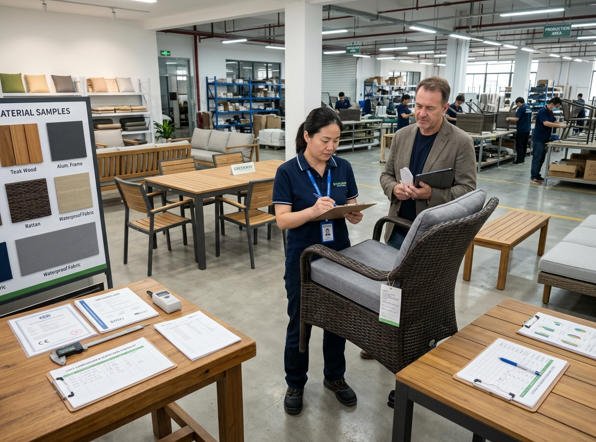
Conducted before production begins, a PPI verifies that the factory has received the correct raw materials — specifically: the correct alloy grade for aluminum frames, the correct HDPE rattan strand density, the correct fabric specification for cushion covers, and the correct foam density for cushion cores. A third-party inspector (QIMA, SGS, or Bureau Veritas) should be on-site at this stage to sign off a Pre-Production Sample (PPS)A signed, sealed physical sample agreed between buyer and factory before bulk production begins. The PPS becomes the legal quality reference point for the entire order. Any deviation from the PPS is a contractual breach. Always have at least one signed PPS retained by the buyer., which becomes the contractual quality reference for the entire run.
Stage 2 — During Production Inspection (DUPRO)
Carried out when approximately 30–40 % of the order is complete, a DUPRO inspection catches production defects early enough to allow correction before the entire run is finished. Key checks at this stage include powder-coat thickness measurement (minimum 60 microns, verified with a digital gauge), weld quality on frame joints, rattan weave tension uniformity, and seam quality on cushion covers. DUPRO inspections cost approximately $280–$420 per man-day through established third-party providers — a cost that is trivial against the alternative of an entire rejected container.
Stage 3 — Pre-Shipment Inspection (PSI)
Conducted when 100 % of production is complete and goods are packed, a PSI uses an AQL sampling planAcceptable Quality Limit (AQL): a statistical method for sampling a batch to determine whether the whole batch meets quality standards. AQL 2.5 means that across a random sample, a maximum 2.5% defect rate is acceptable. Most commercial outdoor furniture buyers specify AQL 2.5 for major defects (structural/functional) and AQL 4.0 for minor defects (cosmetic). — typically AQL 2.5 for major defects — to accept or reject the shipment. A PSI report from a recognized third-party firm is also useful documentation if a quality dispute arises after delivery. For orders placing through bulk factory ordering channels, requesting that the supplier coordinate third-party PSI access is a standard contractual clause.
Minor defects (light cosmetic scratches, minor color variation): AQL 4.0 — acceptable up to 4% of sampled units.
Critical defects (safety hazard — sharp edges, unstable joints): AQL 0 (zero tolerance).
Source: YouTube — “Inside China’s Largest Furniture Market | Foshan Furniture Sourcing Guide”. This video gives buyers a realistic visual reference for what a Guangdong factory-showroom ecosystem looks like before making their first sourcing trip.
Sustainability in Chinese Outdoor Furniture: Beyond the Marketing Brochure
Sustainability has moved from a buyer preference to a procurement requirement in the hotel and large-scale retail segments. The EU’s Corporate Sustainability Due Diligence Directive (CSDDDEU Corporate Sustainability Due Diligence Directive: requires large companies to identify and address human rights and environmental impacts throughout their supply chains, including their Chinese manufacturing partners. Phased implementation from 2027 onward. Affects any company with significant EU operations.) begins phased enforcement from 2027, while major US hotel groups increasingly require SMETA social audits from furniture suppliers as a condition of approved vendor status.
The eco-friendly outdoor furniture market is growing fast — projected at a CAGR of 9 % from 2025 to 2033 globally. Chinese manufacturers are responding. FSC China has certified over 800 furniture manufacturers as of 2025, and the FSC Green Furniture for Sustainable Forests initiative launched a first cohort of 11 leading manufacturers. Water-based lacquers are replacing solvent-based coatings in Guangdong’s more progressive factories, reducing volatile organic compound (VOC) emissions by up to 70 %.
For buyers making genuine sustainability commitments rather than just checking a compliance box, the practical checklist looks like this: verify FSC CoC certificate numbers independently, request GRS transaction certificates per production batch (not just the factory’s annual GRS scope certificate), ask whether the factory’s powder-coating line uses RoHS-compliantRestriction of Hazardous Substances (RoHS): an EU directive restricting the use of specific hazardous materials in electrical and electronic equipment. China’s GB 26572-2025 introduces a mandatory national RoHS standard effective August 2027, aligning closely with the EU directive. Relevant to outdoor furniture with electronic components (lighting, charging stations). coatings, and conduct an SMETA auditSedex Members Ethical Trade Audit: a widely recognized social compliance audit covering labor practices, health & safety, environment, and business ethics. Two-pillar (labor + H&S) or four-pillar versions available. Required by major UK retailers and growing numbers of US hospitality procurement teams. through Sedex before approving any new supplier for commercial-scale orders.
Pre-Order Checklist: 15 Steps Before You Place a Bulk Outdoor Furniture Order
The following checklist distills the operational experience of multiple sourcing rounds across Guangdong, Zhejiang, and Fujian. Each step has a specific action and a reason — not just a generic reminder to “check quality.” For a comprehensive walkthrough of the full China furniture sourcing process including logistics, see the US importer checklist at Jade Ant.
- Define your product specification in writing — material grade, dimensions (±2 mm tolerance), finish color with RAL code, fabric composition, cushion foam density (minimum 28 kg/m³ for commercial outdoor).
- Confirm HS code for your destination market and calculate full landed cost before committing to FOB price negotiations.
- Verify the supplier’s business license (营业执照) through China’s national enterprise database — confirm legal name, registration status, and registered address match factory documents.
- Request ISO 9001 certificate, BSCI audit report (or equivalent), and any relevant material certifications (FSC, GRS, REACH test report). Cross-verify certificate numbers independently.
- Obtain a minimum of two buyer references from clients who placed orders in the same product category within the last 18 months. Contact references directly.
- Order a counter sample (CS) before signing any purchase order — a CS is not a commitment to buy; it is a quality baseline reference.
- Sign a Pre-Production Sample (PPS) agreement with the factory — the PPS becomes the legal quality standard for the entire order. Retain a signed, sealed sample at your location.
- Specify AQL levels in the purchase order: 1.5 for major defects, 4.0 for minor, 0 for critical (sharp edges, unstable joints).
- Schedule a DUPRO inspection for when 30–40 % of production is complete. Book through QIMA, SGS, or Bureau Veritas — not through the factory.
- Confirm powder-coat thickness specification in the PO: minimum 60 microns for standard commercial, 80 microns for coastal/high-humidity environments.
- Use FOB Incoterms — not EXW — to retain shipping control. For first orders with a new factory, avoid CIF unless you have an established freight agent relationship.
- Arrange marine cargo insurance for a minimum of 110 % of CIF value. Verify that outdoor furniture damage (moisture ingress, crushing) is explicitly covered.
- File an ISF (Importer Security Filing) at least 24 hours before vessel departure for US-bound shipments. Your customs broker handles this — confirm the timeline.
- Conduct a pre-shipment inspection (PSI) before the final balance payment is released. Hold 30 % of the payment until PSI pass.
- Confirm ISPM-15 fumigation treatment of all wooden packaging materials — your container will be rejected at port without it.
Choosing Your Sourcing Channel: Factory Direct vs. Trading Company vs. Sourcing Agent
No single sourcing channel is right for every buyer. The decision depends on order volume, product complexity, timeline, and how much on-the-ground support the buyer needs. The chart below summarizes how outdoor furniture buyers are currently distributing their sourcing activity across channels.
Source: Compiled from industry procurement surveys, Reddit r/china__furniture sourcing discussions, and direct supplier questionnaire data. Figures reflect primary channel usage; most buyers use multiple channels simultaneously.
Direct factory sourcing delivers the lowest unit price and the most control over specification and quality — but demands time investment in supplier qualification and on-the-ground verification. It is the right choice for buyers with repeat order volumes above 100 units per SKU and the ability to manage a direct supplier relationship.
Trading companies add a 10–25 % margin above factory prices but reduce the administrative burden of managing multiple factory relationships. They are useful when you need to consolidate outdoor, indoor, and ancillary furniture into a single shipment. The key risk is that a trading company’s QC capability is entirely dependent on their own inspection team — which the buyer cannot audit independently.
Sourcing agents charge a service fee (typically 5–10 % of FOB value or a fixed monthly retainer) and act as the buyer’s representative on the ground in China. They conduct factory audits, coordinate inspections, manage sample shipping, and handle day-to-day supplier communication in Mandarin. For buyers placing their first significant outdoor furniture order in China, a qualified sourcing agent significantly reduces the risk of costly mistakes. This comparison of marketplace vs. factory direct sourcing from Jade Ant’s resource library provides additional context on how the channel choice affects total cost and risk.
Ready to Source Outdoor Furniture from China?
Jade Ant Furniture specializes in custom and contract-grade outdoor furniture for hotels, villas, and retail brands — with in-house design, QC coordination, and direct factory pricing. Explore their full outdoor furniture offering and get a sourcing consultation.
Visit Jade Ant Furniture →Glossary: Key Terms for Outdoor Furniture Buyers
- FOB (تسليم على متن السفينة)
- Seller’s price includes all costs up to loading on the vessel at origin port. Buyer pays ocean freight, insurance, duties, and local delivery from that point.
- HDPE Rattan
- High-Density Polyethylene synthetic wicker — the commercial-grade standard for outdoor PE rattan furniture. Resists UV fading and moisture better than standard LDPE rattan.
- Powder Coating
- A dry paint applied electrostatically and cured under heat to form a hard, weather-resistant layer on metal frames. Measured in microns — minimum 60 µm for outdoor commercial use.
- BSCI / amfori
- Business Social Compliance Initiative: an industry-driven programme for companies that want to improve working conditions in their supply chain. Mandatory for many EU retail and hospitality procurement programs.
- AQL (حد الجودة المقبول)
- Statistical sampling standard for quality inspections. AQL 2.5 means the lot is accepted if no more than 2.5% of the sampled units contain major defects.
- FSC CoC
- Forest Stewardship Council Chain of Custody: certifies that wood-containing products can be traced back through every manufacturing step to a certified sustainable forest.
- ريتش
- EU regulation requiring manufacturers to identify and manage chemical risks. For furniture, it restricts specific hazardous substances (SVHCs) in surface coatings, foams, and textiles.
- ISPM-15
- International Standard for Phytosanitary Measures No. 15: requires wooden pallets and packaging to be heat-treated or fumigated to prevent the spread of plant pests. Non-compliant packaging is rejected at most ports.
- MOQ (الحد الأدنى لكمية الطلب)
- The smallest order a factory will accept. Outdoor furniture MOQs in China typically range from 20 units (catalog items, trading company) to 200 units (custom OEM from a direct factory).
- التعريفة الجمركية بموجب المادة 301
- US punitive tariff applied to China-origin goods under Section 301 of the Trade Act of 1974. Currently 25% on most outdoor furniture categories, rising to 30% from January 2027.
الأسئلة الشائعة
Sourcing Smart in a Complex Market
China’s outdoor furniture manufacturing ecosystem offers a combination of material depth, manufacturing scale, and price competitiveness that is genuinely unmatched anywhere in the world in 2025. But accessing that value consistently — across multiple orders, multiple SKUs, and evolving compliance requirements — demands a structured approach that goes well beyond browsing Alibaba listings or walking a trade show floor.
The buyers who achieve the best outcomes share common practices: they define specifications precisely before engaging suppliers, they verify certifications independently, they invest in pre-production and during-production inspections rather than hoping for the best, and they calculate landed cost — not FOB price — as their commercial baseline. They also build long-term supplier relationships rather than re-tendering every order, which is what ultimately unlocks the lower MOQs, priority production slots, and early access to new material innovations that characterize the best Chinese manufacturing partnerships.
Whether you are furnishing a 200-room resort pool deck, building a branded patio furniture line, or specifying outdoor pieces for a private villa project, the framework in this guide gives you the operational foundation to source with confidence. For buyers who want experienced hands-on support — from factory matching to QC coordination to direct shipping — the team at مفروشات النمل اليشم has been doing exactly this for over 15 years, and their resource library covers everything from comparing manufacturer certifications إلى placing bulk factory orders with confidence.