Brand-Grade vs Custom-Made Luxury Furniture: How to Choose the Right Path for Your Project

For FF&E buyers, developers, hotel operators, interior designers, architects, villa owners, importers and private label owners.
The short answer: Choose brand-grade furniture when you need speed, repeatable quality and a name your clients recognize. Choose custom-made furniture when the space is unusual, the client wants something no one else owns, or your own brand needs a signature piece. Most strong projects use both.
I. Introduction
The dilemma. You are standing in front of a floor plan. The lobby needs 14 lounge chairs. The penthouse needs a 4.2-meter dining table that must fit a curved wall. The opening date is fixed.
A catalog piece will arrive sooner and look the same in every room. A commissioned piece will fit the wall perfectly, but it takes longer and needs more of your attention. That is the trade-off between standardized excellence et tailored artistry.
Who this guide is for. Different buyers feel this trade-off in different ways:
- FF&E buyers worry about delivery dates and room-to-room consistency. (FF&E means furniture, fixtures and equipment: the movable items in a hotel or villa that are not part of the building.)
- Developers worry about budget, resale value and the story told to buyers.
- Private label owners worry about margin and a look that competitors cannot copy.
Two terms, defined.
Brand-grade luxury furniture: Pieces from an established luxury label with fixed designs, set finishes and a proven production line. Think of the big Italian and French houses.
Custom-made luxury furniture: Pieces built to your drawings, sizes, materials and finishes. Some people say “bespoke” for work designed from zero. This custom and bespoke explainer separates the two: custom modifies an existing design, while bespoke is original from concept to creation.
Thesis. For high-end procurers and design professionals, the choice between brand-grade and custom-made furniture is a strategic balance between scalable consistency et bespoke exclusivity. The best path depends on three things: your lead time, your brand equity goals and how tightly the furniture must fit the architecture.
The luxury market is large enough that you have real choices. Business Research Insights values the global high-end furniture market at about $38.2 billion in 2026. More suppliers are chasing your projects, so a clear decision process matters.
II. Defining Brand-Grade Luxury: Scalability and Prestige
Brand-grade furniture gives you a vetted standard of quality and instant market recognition. You are buying a track record as much as a chair.
Proven Design Language. A well-known collection has already been tested in hundreds of rooms. The proportions work. The seat height is right. The finish has aged well.
That matters most on large jobs. If you need 120 identical guest chairs, a proven design lowers the chance of surprises in room 87.
Quality Assurance. Established houses run structured factories with written test routines. Their contract divisions also understand hotel-style delivery, such as phased shipments and room-by-room labeling. See, for example, the B&B Italia contract division, which is built for hospitality and commercial orders.
For commercial use, ask for performance proof. The BIFMA standards set recognized strength and durability tests for contract furniture.
Brand Equity. A familiar label does quiet work in sales rooms. A buyer who sees a recognized name on a penthouse sofa feels more certain about the whole apartment.
Industry insight: In branded residences, the furniture label often appears in the marketing brochure before a single sofa is delivered. That is why developers sometimes pay a premium for a name even when a similar shape could be made elsewhere.
For a closer look at how seven major luxury houses differ on lead time, customization and project support, see this guide to Italian and French luxury houses compared.
III. Defining Custom-Made Luxury: The Pinnacle of Exclusivity
Custom-made furniture solves two problems: awkward spaces and the wish for a unique identity.
Architectural Integration. Rooms are rarely square. A curved terrace door, a sloped ceiling or a column in the middle of a lobby can make a standard sofa useless.
A custom maker builds to your drawings. The piece fits to the millimeter and looks like part of the building.
Material Sovereignty. This means you control every material decision. You choose the veneer flitch, the stone slab, the leather hide or the textile mill. (A veneer flitch is a bundle of consecutive wood slices cut from one log, so the grain matches across pieces.)
With brand-grade furniture, you pick from the house palette. With custom work, you can bring in a rare marble or a hand-woven fabric and ask the maker to build around it.
Artistic Singularism. For ultra-high-net-worth (UHNW) clients, “no one else has this” is the product. UHNW usually means people with more than $30 million in investable assets.
A hand-carved table with a one-of-a-kind inlay cannot be matched by a neighbor. That exclusivity is hard to buy through any catalog.
One caution. Custom does not mean careless. Reliable custom work still follows a process: shop drawings, finish samples, a prototype, then production. A manufacturer such as Jade Ant furniture builds this sequence into custom furniture projects, so the unusual piece is still checked before it ships.
IV. Comparative Analysis: Customization and Flexibility
Flexibility is the biggest difference when your plans are complicated.
Brand-Grade: limited to modular options or fixed finishes. You can usually change the fabric, the leather, the metal finish or the combination of modules. You usually cannot change the frame, the proportions or the construction.
Custom-Made: total flexibility in ergonomics, scale and aesthetic. You can lower a seat for an elderly client, lengthen a bench to fit a window bay, or change a leg profile to match a door handle.
The “Hybrid” Approach. Some houses now offer semi-customization, where you adjust size, finish or configuration within an existing design. Many contract programs work this way. For example, Poltrona Frau’s Custom Interiors division handles non-standard dimensions and special materials for hotels and other large projects.
| Flexibility factor | Brand-grade | Semi-custom | Custom-made |
|---|---|---|---|
| Change fabric or finish | Yes, from set range | Yes, wider range | Yes, any approved material |
| Change dimensions | Rarely | Within limits | Fully |
| Change construction or details | No | Limité | Yes |
| Own the design | No | Sometimes | Yes, if agreed in contract |
| Best for | Standard rooms | Slightly unusual rooms | Unusual rooms, signature pieces |
Rule of thumb: If you only need a different color, stay with brand-grade. If you need a different shape, move toward semi-custom or custom.
V. Comparative Analysis: Lead Times and Supply Chain Logistics
Project timelines often decide the buying method, even before taste does.
Brand-Grade: faster turnaround. Established houses run optimized lines and often hold materials or semi-finished parts in stock. Standard items from major Italian brands commonly take around 10 to 16 weeks to reach the origin port.
Custom-Made: longer lead times. Custom pieces add drawing review, sampling, prototyping and hand work. Even custom commissions from major brands often run 16 to 24 weeks to the origin port. Smaller makers vary widely, so ask for a written schedule.
Ranges are indicative and exclude ocean freight, customs and installation. Always get a written schedule for your own order.
| Stage | Brand-grade | Custom-made |
|---|---|---|
| Drawings and approval | Often already done | 1 to 3 weeks |
| Samples and prototype | Usually skipped for standard items | 2 to 5 weeks |
| Production | Set slot | Depends on materials and hand work |
| Shipping and customs | Same for both | Same for both |
Risk Management. Clients often hear “6 months” and assume “6 months to the day.” Be clear from the start.
- Promise a delivery window, not a single date.
- Show the client where the schedule can slip: fabric from overseas, stone cutting, or final finish approval.
- Add a buffer for ocean freight and on-site installation.
- For key items, order samples early so approval does not become the bottleneck.
You can read the ICC Incoterms rules to see who owns the risk at each stage of shipping.
VI. Evaluating Craftsmanship: Consistency vs. Artistry
Both options are “high quality,” but the quality is of a different kind.
Brand-Grade: industrial precision and repeatable perfection. The second chair is the same as the first. The hundredth is the same as the second. That is consistency, and it is what hotels need across many rooms.
Custom-Made: hand-finished details and soul. A master upholsterer or woodworker leaves small, human signs of skill: a hand-rubbed edge, a book-matched grain, a carved detail. Each piece has character.
The two are not rivals. Consistency protects operations. Artistry lifts the story.
Durability Standards. Compare apples to apples here.
| Check | Brand-grade | Custom-made |
|---|---|---|
| Commercial test reports | Often available for core lines | Ask for tests on the actual build |
| Fire and chemical compliance | Usually documented by market | Must be confirmed per project |
| Batch consistency | Strong, built into the process | Depends on the maker; use a golden sample |
| Repairability | Parts and fabrics often kept | Plan spare parts at order time |
A golden sample is a signed-off physical piece that later production must match. With custom work, it is your best tool for consistency. For a field-tested inspection routine, use this pre-shipment inspection checklist.
Industry insight: A residential bespoke chair and a hotel lobby chair face very different lives. A hotel chair may be used dozens of times a day. If you commission a beautiful piece for a commercial space, ask the maker to test or reinforce it for contract use.
For an independent check before shipment, many importers hire inspectors such as QIMA, who work for the buyer rather than the factory.
VII. Service, Warranty, and After-Sales Support
Long-term care matters most for developers and hotel operators. Furniture is an asset that has to stay in good shape for years.
Brand-Grade: established warranties and global service. Big houses publish warranty terms and usually offer service through a dealer network. That is helpful when a hotel group has properties in several countries.
Check the details, though. Ask for the warranty in writing, what it covers (frame, mechanism, finish) and who pays for freight on a claim.
Custom-Made: a direct relationship with the maker. You talk to the person who built it. That can speed up repairs and allows tailored care plans, such as a yearly touch-up visit.
The risk is continuity. A small workshop can close, change owners or lose a key craftsperson. Reduce this risk by asking for drawings, finish recipes and a spare parts kit at handover.
Ease of Replacement. This is the hidden difference.
- Brand-grade: You can usually reorder the same model, even years later.
- Custom-made: Replacing one broken piece means repeating a build. A new batch may not match the original finish.
| After-sales item | Brand-grade | Custom-made |
|---|---|---|
| Warranty document | Standard, published | Negotiated per project |
| Spare parts | Often available | Order extras upfront |
| Matching finish later | Easier | Needs finish records and a retained sample |
| Contact person | Dealer or service team | The maker directly |
Practical tip: On any custom order, add 5% to 10% extra of fragile or wear-prone parts, such as drawer runners, hinges and fabric yardage. It costs less to make them now than to restart production later.
VIII. Strategic Selection for Private Labels and Brand Owners
If you are launching your own label, this choice shapes your positioning and your margin.
White-Labeling Brand-Grade: speed to market and lower R&D costs. One clear point: you cannot put your own label on a protected luxury house’s design. In private label, “brand-grade” means taking a manufacturer’s proven catalog design and adapting it. This is often called ODM (original design manufacturer): the factory’s design, changed and branded for you.
You can launch faster because the design work is already done. Typical changes are fabric, leg finish, size and logo.
Developing Custom Lines: unique IP and higher perceived value. With OEM (original equipment manufacturer), the factory builds your design. You own the design identity, which competitors cannot catalog-match. The cost is higher: more samples, more time and more oversight.
Margin Analysis. Gross margin is the share of the selling price you keep after paying for the product.
Landed cost means the full cost to get the piece to your warehouse, including freight, duty and packaging.
Here is an illustrative example with made-up numbers:
| Line | Landed cost | Retail price | Gross margin |
|---|---|---|---|
| Adapted catalog design (ODM) | $1,200 | $3,000 | 60% |
| Fully custom design (OEM) | $1,800 | $5,400 | 66.7% |
The custom line costs more upfront, but the exclusive design can support a higher price. It only pays off if your clients are willing to pay for exclusivity.
Industry insight: Many private label owners start with ODM to test the market, then commission a few custom hero pieces once demand is proven. That keeps cash tied up in R&D to a minimum.
For the full roadmap, from design protection to branded packaging, read this private label guide for furniture brands.
IX. Decision Matrix: Choosing the Best Fit for Your Project
Use a simple scoring method to match the route to your goals.
The “Efficiency Path”: choose brand-grade. Pick this when the schedule is tight, the volume is large and standard luxury is enough. Good examples are a 200-room hotel opening on a fixed date, or a developer fitting out many identical apartments.
The “Exclusivity Path”: choose custom-made. Pick this when the architecture is unique, the client is UHNW, or your brand needs a signature piece. Good examples are a curved-wall villa library or a flagship lobby.
The “Balanced Path”: use both. Buy proven brand-grade pieces for the main volume, and commission custom pieces only where they add the most value.
| Your project goal | Efficiency (brand-grade) | Exclusivity (custom-made) | Balanced (mixed) |
|---|---|---|---|
| Tight deadline | Best | Risky | Bien |
| Large volume, many rooms | Best | Costly | Bien |
| Unusual room dimensions | Weak | Best | Bien |
| One-of-a-kind identity | Weak | Best | Bien |
| Controlled budget | Bien | Variable | Best |
| Easy replacement later | Best | Needs planning | Bien |
This split is a starting example, not an industry rule. Adjust it for your site, client and calendar.
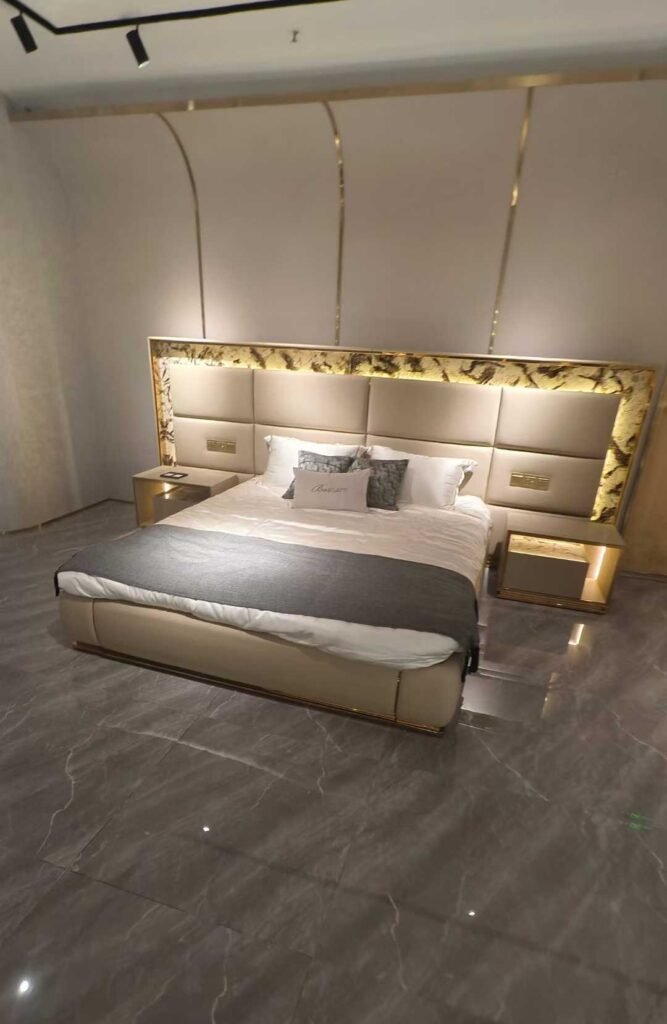
A balanced room often looks like this: a custom headboard and bench that match the brand story, with standard, proven nightstands that arrive on time. For mixed hotel packages, you can browse a hotel furniture collection to see how loose and fixed pieces can be coordinated.
Quick decision steps:
- List every piece in the room schedule.
- Mark each as “must fit exactly,” “must match everywhere,” or “must be unique.”
- Send “must match everywhere” items to brand-grade.
- Send “must fit exactly” and “must be unique” items to custom.
- Check the final list against the opening date and add buffer time.
To see how trends in specification are shifting for hospitality, read this overview of hotel furniture trends.
X. The trade-offs in short.
| Brand-grade | Custom-made | |
|---|---|---|
| Strength | Speed, consistency, name value | Fit, exclusivity, material choice |
| Weakness | Limited changes | Longer, more oversight |
| Best proof of quality | Published tests and warranty | Golden sample and inspection |
Our recommendation. Start with the end-user experience and the project’s return on investment. Ask: what will the guest, the owner or the buyer actually notice? Spend your custom budget there. Use brand-grade pieces everywhere else.
Two ways to learn more. If you source in volume from overseas, this guide to importing high-end furniture explains the full process. To compare manufacturers on scale, customization and QC, see how Chinese contract furniture brands compared on practical criteria.
Closing thought. Precision protects the schedule. Passion makes the room memorable. The best luxury interiors use both.
If you are weighing a custom piece, a private label line or a mixed package, send your drawings to the team. You can also read about Jade Ant’s factory background before you ask for a quote. A clear brief gets you a better first answer.
Watch: Two Short Videos on Quality and Custom Furniture
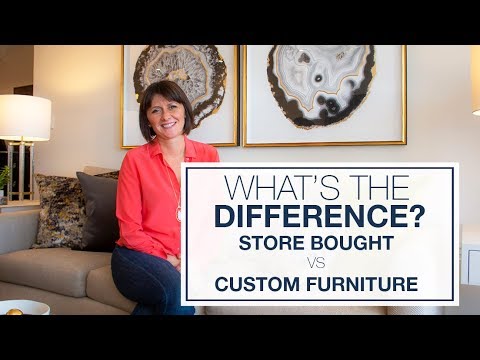
Watch: a designer explains the differences between store-bought and custom furniture.

Watch: how materials, construction and finish separate the furniture quality tiers.
Glossary of Key Terms
Quick-reference definitions for terms used in this guide.
| Term | Plain-English meaning | Example |
|---|---|---|
| Brand-grade | Furniture from an established luxury label with fixed designs | A leather lounge chair from a major Italian house |
| Custom-made | Built to your drawings and specification | A walnut sideboard cut to fit an alcove |
| Bespoke | Original design made from zero for one client | A carved table that exists only in one villa |
| Semi-custom | Changes to size or finish within an existing design | A sofa made 20 cm longer |
| FF&E | Movable furniture and equipment in a project | Beds, chairs, lamps |
| UHNW | Ultra-high-net-worth individual | A client with $30 million or more in investable assets |
| ODM | Factory’s design, adapted and branded for you | A catalog bed with your fabric and logo |
| OEM | Factory builds your own design | Your original chair, produced under your label |
| Golden sample | Signed-off piece that production must match | A signed armchair stored at the factory |
| Veneer flitch | Consecutive wood slices from one log | Grain that matches across five bedheads |
| Landed cost | Full cost delivered to your warehouse | Product, freight, duty and packing |
| Lead time | Time from confirmed order to ready or delivered goods | 16 to 24 weeks to origin port |
| FSC | Forest Stewardship Council wood certification | Chain-of-custody proof on a table |
Frequently Asked Questions
1. How do I verify the authenticity of materials in custom-made luxury furniture?
Ask for material specifications in writing, with species, grade and origin. For wood, request a cross-section photo and the supplier invoice. For responsibly sourced timber, ask for FSC chain-of-custody numbers and check them with the issuing body. Weigh a sample piece against the spec as well, since a sudden weight drop often means a hidden substitution.
2. What are the typical lead time differences between a European luxury brand and a bespoke workshop?
Standard pieces from major Italian brands often run 10 to 16 weeks to the origin port, while their custom commissions run 16 to 24 weeks. A bespoke workshop depends on its size, material supply and workload, so get a written milestone schedule. Add ocean freight, customs and installation on top of either figure.
3. For hotel FF&E, is brand-grade furniture more durable than custom-made pieces?
Not automatically. Brand-grade lines often come with commercial test reports, which makes proof easier. A custom piece can be just as durable if it is built for contract use and tested. Ask for strength, fabric-wear and fire documents for the exact construction you are buying.
4. How can I protect my intellectual property when commissioning custom designs for a private label?
Sign a confidentiality and non-circumvention agreement before sharing drawings. Put in writing that tooling, patterns and custom hardware belong to you. Register your design in the country where it will be made, if possible. Have a lawyer who knows local manufacturing contracts review the terms; this is general information, not legal advice.
5. Which option provides a better Return on Investment (ROI) for luxury villa flips?
It depends on what buyers will notice. Brand-grade pieces in main rooms can support price with a recognized name and a quick schedule, which protects carrying costs. Spend the custom budget on a few high-impact items, such as a statement dining table or entry console, rather than on everything.
6. How do I handle quality control for custom pieces produced overseas?
Approve drawings, finish samples and a prototype before mass production. Keep a signed golden sample and request photos at milestones. Book an independent pre-shipment inspection with a firm such as QIMA, and use a written defect classification. The pre-shipment inspection checklist above shows what to include.
7. Can brand-grade furniture be modified to fit specific architectural constraints?
Sometimes. Many houses allow changes in fabric, finish and module layout, and some contract programs allow size changes. Structural changes are rare. If the piece must follow a curved or sloped wall, ask early whether a semi-custom route exists or whether a custom maker is the better choice.
8. What are the shipping and logistics risks associated with oversized custom-made furniture?
The main risks are damage in transit, pieces that do not fit through doors or lifts, and customs delays. Measure the delivery path before you finalize size. Ask for export-grade crating, corner protection and moisture barriers, and agree who carries risk at each stage using standard trade terms.
9. How do warranties differ between a global luxury brand and an independent artisan?
A global brand usually publishes standard terms and offers service through a dealer network. An independent artisan negotiates terms with you and supports you directly. In both cases, get it in writing: coverage for frame, mechanism and finish, the claim process and who pays for freight.
10. In a large-scale development, what percentage of furniture should be custom vs. brand-grade?
There is no fixed rule. A common starting point is a majority of brand-grade or standardized pieces for volume and consistency, with a smaller share of custom pieces where fit or identity matters most. The 60/30/10 split in the chart above is only an example. Adjust it for your deadline, budget and design brief.
11. How do I communicate technical specifications to custom makers to avoid production errors?
Use dimensioned drawings, material codes and finish references rather than descriptions like “dark walnut.” Add photos, color cards and a version number for every drawing. Ask the maker to summarize the spec back to you in their own words before production starts.
12. Which option is more sustainable: mass-produced luxury or artisanal custom-made?
Neither is better by default. Sustainability depends on materials, durability and waste. Long-lasting, repairable pieces with certified timber are usually the greener choice, whichever route you pick. Ask for certificates and check that they cover your actual product, not just the factory.
Planning a villa, hotel or private label collection? Meuble Fourmi de Jade welcomes briefs from importers, designers and developers.