
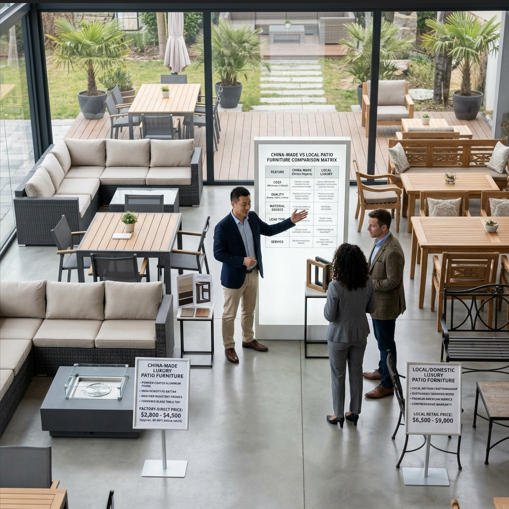

Outdoor Furniture Buyer’s Guide 2025
China vs. Local Patio Furniture:
Pros, Cons & Value for Your Outdoor Space
A no-nonsense comparison for furniture dealers, showrooms, interior designers, and hotel renovation buyers — grounded in real cost data, material science, and industry sourcing experience.
Request a Trade QuoteIntroduction
The Question Every Outdoor Buyer Eventually Has to Answer
You’re specifying outdoor furniture for a 200-room resort terrace, a high-end residential showroom, or a private villa renovation. Your two options sit side by side: a Chinese-manufactured aluminum dining set at $320 landed, and a locally produced equivalent at $890. Same aesthetic. Very different everything else. So which one actually delivers better value?
That question — “China-made or local?” — has no single right answer. A hotel group that furnished 200 sun loungers with the cheapest Chinese option they could find reported replacing 40% of them within 18 months due to frame corrosion and fabric fade, at a total replacement cost roughly 2.3 times the original purchase price. Meanwhile, hospitality buyers who took the time to verify material grades and certifications from verified Chinese manufacturers reported their units still performing after five-plus years in coastal environments. The variable isn’t geography — it’s specification.
On the other side, a boutique showroom in New England working with a local teak furniture maker paid a 60% premium over Chinese equivalents but eliminated import logistics complexity, cut lead times from 10 weeks to 3 weeks, and offered their retail clients a compelling “made locally, lasts forever” value narrative that justified the price point. Both decisions were correct — for their specific context.
This guide is structured for the professionals who need to make this decision with real data: furniture dealers and agents sourcing for client projects, showrooms managing inventory depth, interior designers specifying for residential and commercial clients, and hotel renovation designers working under timeline and budget pressure. We cover cost, materials, quality signals, environmental considerations, and a concrete buying strategy — without the vague platitudes that dominate most “comparison” content in this category.
Space and climate requirements · upfront vs. total cost of ownership · material lifespan by climate · import logistics and tariff exposure · sustainability certifications · warranty and after-sales realities · a step-by-step buying strategy for trade buyers.
Section 1
Overview of the Market and the Debate
What Constitutes China-Made vs. Locally Sourced Patio Furniture
“China-made” in the context of outdoor furniture means a product manufactured in a Chinese factory — typically in Guangdong, Fujian, or Zhejiang provinces — and imported via ocean freight. This can range from mass-produced, no-brand commodity items sold on Amazon to fully customized, OEM (Original Equipment Manufacturer) products ordered in bulk by a European luxury brand and retailed at 3–5× their FOB (Free on Board) price. The label “Made in China” tells you the country of manufacture. It tells you nothing, by itself, about material grade, construction quality, or the sophistication of the manufacturer.
“Locally sourced” typically means furniture manufactured domestically — within the buyer’s country or region — by a local brand, craftsman, or contract manufacturer. This covers everything from a small workshop producing hand-welded aluminum pieces in 4-week runs to a regional factory with a showroom floor and a catalog of standard designs with 8–12 week custom lead times.
Key Decision Factors for Dealers and Designers
When trade buyers and designers evaluate outdoor furniture sourcing, five factors consistently dominate the decision: price and total landed cost, material durability in the specific installation climate, project timeline and lead time, after-sales support and warranty reliability, and increasingly, environmental and ethical sourcing credentials. The challenge is that China-made and locally sourced products each carry structural advantages and structural weaknesses across these five dimensions — and those advantages are not evenly distributed across buyer contexts.
A hotel designer specifying poolside loungers for a coastal property in the UAE is operating in a completely different context from a furniture showroom in Minnesota deciding what to carry on their floor. The right choice differs. What should not differ is the rigor of evaluation.
Current Market Trends and Consumer Priorities
The global outdoor furniture market was valued at USD 56 billion in 2025 and is projected to reach USD 92 billion by 2034, growing at 5.74% annually. Asia Pacific — led by China — holds a 45.49% market share as both a producer and a growing consumer. North America represents USD 11.62 billion, with the US market alone at USD 10.52 billion projected by 2026. Hospitality and commercial segments are growing fastest, driven by rooftop dining expansion, resort development, and post-pandemic outdoor-first design thinking.
Consumer and specifier priorities have shifted meaningfully in the past three years. Sustainability credentials (FSC timber, recycled aluminum, ISO 14001 factory certification) are now a procurement differentiator, not just a marketing footnote. Customization — the ability to specify exact frame colors, fabric choices, and dimensions — is expected even at mid-price points. And warranty confidence has become a harder conversation: buyers who have been burned by sub-par imported furniture are now asking detailed questions about claims processes before placing orders.

High-end outdoor dining furniture — material selection and construction quality determine whether this still looks this way in year 5 or year 1.
Section 2
Pros of China-Made Patio Furniture
Lower Upfront Cost and Higher Variety
The most immediately visible advantage of Chinese-manufactured outdoor furniture is price. A 4-seater aluminum dining set that retails for $1,400–$1,800 from a local brand can typically be sourced at an FOB price of $200–$450 from a verified Chinese manufacturer — representing a 3–5× cost ratio. Even after adding ocean freight ($180–$380 for a 20ft container allocation per set), US Section 301 import tariffs (currently up to 30% on furniture categories), brokerage fees, and local delivery, the landed cost advantage typically remains 40–60% compared to domestically manufactured equivalents in the same design tier.
This cost structure enables furniture dealers and showrooms to offer a significantly wider inventory selection. A Chinese manufacturer’s catalog might include 80–120 distinct outdoor collections across aluminum, rattan, teak, rope-woven, and composite material families. A comparable local manufacturer might offer 8–15 core collections. For showrooms aiming to capture multiple price points and aesthetic preferences, this variety depth is a real commercial advantage.
Mass Customization and Global Supply Chains
China’s outdoor furniture clusters — concentrated in Guangdong’s Foshan and Zhongshan districts, Fujian’s Zhangzhou, and Zhejiang’s Hangzhou region — have developed a manufacturing infrastructure that makes mass customization economically viable at relatively low minimum quantities. Buyers specifying hotel projects can typically get custom powder coat colors (RAL or Pantone matched), branded logo embroidery on cushions, non-standard dimension configurations, and exclusive fabric selections — from Chinese manufacturers at MOQs (Minimum Order Quantities) starting from 20–50 pieces per design. The same level of customization from a local manufacturer often starts at 100+ pieces or carries a significant setup surcharge.
Brands like Meubles Jade Ant represent the category of Chinese manufacturer that has built the full infrastructure around trade buyers: OEM design capability, project-based minimum orders, material documentation, and dedicated account management — making the customization advantage accessible without requiring a buyer to manage their own Guangdong sourcing operation.
Accessibility of Large Inventories and Options
For furniture dealers and agents managing multiple concurrent client projects, having access to a manufacturer with large in-stock inventory — or fast-turn production against a standing forecast — provides project scheduling flexibility that local manufacturers often cannot match. Leading Chinese outdoor furniture exporters maintain warehouse stock on their 20–30 best-selling SKUs, enabling order-to-ship timelines of 7–15 days before ocean freight. For replacement orders, spare parts sourcing, and add-on pieces to existing hotel installations, this accessible inventory depth is practically irreplaceable.
Section 3
Cons of China-Made Patio Furniture
Lead Times, Shipping Costs, and Import Duties
The single most operationally disruptive disadvantage of China-sourced outdoor furniture is lead time structure. A standard production-plus-shipping cycle for custom outdoor furniture runs 30–60 days production (depending on complexity and factory loading), plus 25–38 days ocean freight to US East Coast ports, plus 5–12 days customs clearance and inland delivery. Total lead time: 60–110 days from PO to site delivery. For a hotel opening project with a fixed completion date, missing this window by 2 weeks creates genuine operational and contractual consequences.
Ocean freight costs have also become materially less predictable since 2021. A 40ft container that cost $1,800–$2,200 pre-pandemic ran as high as $14,000–$18,000 at peak 2021–2022 rates and has partially normalized to $2,500–$4,500 for Asia–US routes as of 2025 — but volatility remains a real planning risk. For smaller orders that don’t fill a container, LCL (Less-than-Container Load) freight per cubic meter adds further cost and handling complexity.
Import duties on Chinese furniture have increased significantly under US trade policy. Section 301 tariffs currently apply a 30% rate on Chinese imports of upholstered wooden furniture (HTS 9401.61), with additional tariffs under 2025 trade actions raising duties on softwood and lumber-containing products. EU buyers face a different but equally nuanced tariff landscape. These duties don’t eliminate the cost advantage of Chinese sourcing, but they substantially narrow the margin and must be calculated accurately — not estimated — in any landed cost comparison.
Quality Variability and Warranty Challenges
The range in product quality within Chinese outdoor furniture manufacturing is genuinely vast — and this is the legitimate core of buyer concern. The same Alibaba search for “aluminum outdoor dining set” returns results from a BSCI-audited factory with ISO 9001 certification, EN 581 test reports, and 5-year frame warranties, and from a trading company reselling an unknown-origin product with no test documentation, a 1-year “warranty” with no stated remedy process, and no verifiable factory address. Both appear with similar product photos. The quality gap between them is not visible in photographs — it shows up in field performance.
Warranty enforcement is the second structural challenge. A 5-year warranty from a local manufacturer means you can walk into their facility, speak with their after-sales team, and have a documented claims process under the legal jurisdiction of your own country. A 5-year warranty from a Chinese manufacturer — even a reputable one — requires navigating cross-border claim logistics, language, and potentially significant shipping costs to resolve. This doesn’t make Chinese warranties worthless, but it does mean the quality of the pre-written warranty documentation and the responsiveness of the after-sales contact matter far more than the warranty period length.
Perceived Durability Concerns and Service Limitations
End consumers — hotel guests, homeowners, retail showroom clients — carry a persistent perception that Chinese-made outdoor furniture is less durable than locally made equivalents. This perception is outdated as a generalization (premium Chinese manufacturers now meet or exceed EN 581 and BIFMA standards routinely) but it persists as a real commercial consideration for dealers and designers who need to justify sourcing decisions to clients. For high-end residential projects where the client is paying $12,000+ for a complete outdoor setting, the brand story and country-of-origin narrative often carries as much weight as the actual material specification.

Premium outdoor lounge furniture — the difference between a 2-year product and a 10-year product often lives in material spec decisions invisible from a photograph.
Section 4
Pros of Local Patio Furniture
Faster Delivery and Easier Returns
The most operationally compelling advantage of locally sourced outdoor furniture is timeline certainty. Standard catalog items from a domestic manufacturer or regional distributor typically ship in 1–3 weeks. Custom orders average 6–10 weeks for most regional US manufacturers — roughly half the total lead time of a comparable Chinese custom order. For interior designers with client move-in dates, hotel renovation designers working against opening schedules, and showrooms managing seasonal inventory, this timeline compression has real commercial value that often isn’t fully quantified in upfront price comparisons.
Returns, replacements, and warranty claims are also dramatically simpler domestically. A damaged piece can be inspected in person, a replacement can ship from domestic stock within days, and disputes are resolved under known legal frameworks. For high-touch retail clients and hospitality buyers operating under service level agreements with their own clients, this logistical simplicity is a genuine risk-reduction argument, not just a convenience.
Local Economies, Jobs, and Potential for Sustainable Practices
Local sourcing increasingly carries meaningful ESG (Environmental, Social, and Governance) value for corporate buyers. Hotels operating under sustainability frameworks, real estate developers pursuing LEED certification, and furniture showrooms marketing to environmentally conscious consumers can all articulate a genuine differentiator when sourcing domestically: reduced shipping carbon footprint, traceable labor practices, and support for regional manufacturing employment. The carbon footprint of a typical outdoor chair is approximately 30 kg CO₂e — a figure that increases meaningfully when ocean freight from China is added and decreases when sourced within a regional supply chain.
In-Person Shopping and Immediate Customization
For interior designers and showrooms serving high-net-worth residential clients, the ability to visit a local manufacturer’s facility, review material samples in person, and make real-time customization decisions has a value that extends beyond the transaction. It creates confidence, enables faster iteration cycles, and generates the kind of supplier relationship that produces better outcomes on complex projects. A designer specifying a private villa terrace at $40,000+ can walk into a local manufacturer’s studio, sit in every piece, match fabrics to interior swatches under the same lighting conditions, and place an order the same day. That experience cannot be replicated via video call and sample courier from Guangdong.
Section 5
Cons of Local Patio Furniture
Higher Price Points and Potentially Smaller Selection
Domestic labor costs, smaller production runs, and the absence of vertically integrated supply chains mean that locally manufactured outdoor furniture carries a structural cost premium that typically ranges from 40% to 150% above equivalent Chinese-manufactured options, depending on category and region. For a furniture dealer or showroom selling to value-conscious clients, or for a hospitality buyer working against a fixed FF&E (Furniture, Fixtures, and Equipment) budget, this price gap is often not bridgeable by softer arguments about origin or simplicity.
Selection depth is also typically narrower. A US regional manufacturer might offer 12 outdoor collections across 3 material categories. Their lead times on non-standard colors or configurations may rival Chinese custom lead times while eliminating the cost advantage. For showrooms wanting to show clients true variety across price tiers, styles, and materials, local sourcing alone rarely provides sufficient catalog depth.
Longer Lead Times for Custom Pieces
While standard catalog items from local manufacturers ship quickly, custom work — the category most relevant to interior designers and hotel designers — often runs 8–14 weeks from order to delivery. Production scheduling at smaller regional manufacturers is frequently tighter than at large Chinese export factories: a single large order from a hotel group can displace normal inventory replenishment for smaller dealers by 4–6 weeks. For time-critical projects, this unpredictability is a genuine risk that experienced buyers factor into their sourcing strategy with buffer time or parallel vendor relationships.
Availability During Peak Seasons
Outdoor furniture demand in temperate climates is intensely seasonal. In North America, the spring buying peak (March–May) consistently strains domestic manufacturer capacity. Showrooms that rely entirely on local sourcing often find key SKUs backordered precisely when client demand is highest. Chinese manufacturers, by contrast, can be ordered against in the preceding November–January window with production scheduled around Chinese New Year (typically a 2–3 week shutdown in February) to ensure arrival in time for the spring season — a planning rhythm that experienced importers manage reliably.
✅ China-Made: Key Advantages
- 💰 40–60% lower landed cost vs. domestic equivalents in the same design tier
- 🎨 Catalog depth: 80–120 collections vs. 8–15 from a typical local maker
- 🏭 Mass customization at MOQs of 20–50 pieces (color, fabric, dimension, branding)
- 📦 Large in-stock inventories on core SKUs for fast-turn replacement orders
- 🏨 Verified manufacturers meet EN 581, REACH, ISO 9001, and BIFMA standards
⚠️ China-Made: Real Risks
- ⏱️ 60–110 day total lead time (production + freight + clearance)
- 🚢 Ocean freight volatility; 2025 Asia–US container rates $2,500–$4,500
- 📋 Section 301 tariffs up to 30% on upholstered wooden furniture (2025)
- 🔍 Extreme quality range — unverified suppliers carry significant risk
- 🛠️ Cross-border warranty claim logistics are more complex
✅ Local: Key Advantages
- ⚡ 1–3 weeks for standard catalog items; 6–10 weeks for custom orders
- 🤝 In-person factory visits, sample reviews, real-time customization
- 🛡️ Domestic warranty claims — simpler process, same legal jurisdiction
- 🌿 Lower shipping carbon footprint; traceable labor and supply chain
- 📣 Compelling “locally made” narrative for premium retail and ESG buyers
⚠️ Local: Real Limitations
- 💸 40–150% price premium vs. equivalent Chinese-manufactured products
- 📚 Narrower selection depth — typically 8–15 collections
- 📅 Custom lead times 8–14 weeks; capacity constrained during spring peak
- 🔄 Limited spare parts and after-sales stock for discontinued designs
- 🏗️ Less flexibility on large hospitality-scale volume orders
Section 6
Value for Money: Cost Per Year of Use
Durability and Expected Lifespan by Material
The most useful framework for comparing patio furniture value isn’t upfront price — it’s cost per year of service. A $300 set that lasts 3 years costs $100/year. A $700 set that lasts 15 years costs $47/year and eliminates four purchase-and-dispose cycles, four shipping events, four installation efforts, and four periods of downtime for a hotel property or showroom. When the full accounting is done, premium materials almost always win on total cost of ownership.
The key variable is lifespan, which is primarily determined by material choice and climate. Teak, properly maintained, lasts 20–40 years in most climates. Quality 6061 aluminum lasts 15–25 years. Virgin HDPE rattan holds up for 10–15 years. Standard powder-coated mild steel in a coastal environment may fail at the welds within 3–5 years regardless of coating quality. These aren’t estimates — they’re field performance ranges documented from hospitality buyers managing outdoor furniture inventory at scale.
| Matériau | Typical Price Range (4-seater dining set) | Expected Lifespan (quality grade) | Annual Cost (low estimate) | Climate Suitability | Source |
|---|---|---|---|---|---|
| FSC Teak | $1,800–$4,500 | 20–40 years | $45–$90/yr | All Climates | China or Local |
| 6061 Aluminum | $400–$1,400 | 15–25 years | $27–$56/yr | All Climates | Primarily China |
| Virgin HDPE Rattan | $320–$950 | 10–15 years | $32–$64/yr | All Climates | Primarily China |
| WPC Composite | $500–$1,800 | 10–20 years | $50–$90/yr | Temperate / Subtropical | China or Local |
| Powder-Coat Steel | $250–$900 | 5–12 years | $50–$75/yr | Low Humidity / Dry Only | China or Local |
| Budget MFC / Composite | $150–$450 | 2–5 years | $75–$150/yr | Covered / Dry Only | Mass-market China |
Sources: GoldenTeak; Neighbor.com; Snohaus Patio Materials Guide; field data from hospitality buyer interviews. “Quality grade” means verified material spec, not commodity-grade production.
Total Cost of Ownership: 10-Year Comparison
Note: Budget Chinese steel set assumes 2.5 replacements over 10 years due to coastal climate corrosion. Premium aluminum assumes 1 purchase covering the full 10-year period. Teak assumes annual oiling cost of $25/year and zero replacement.
Warranty Coverage and Maintenance Costs
Warranty periods have become a meaningful quality signal in the outdoor furniture market — not because warranty periods are always honored perfectly, but because a manufacturer who offers 5–10 years on a structural frame is making a quantifiable commitment that they can fulfill profitably only if the frame reliably lasts that long. A 1-year frame warranty is a factory telling you, in policy language, that they expect failures may occur before year 2.
The industry standard warranty benchmarks for credible outdoor furniture are: aluminum frame minimum 5 years (quality manufacturers: 10 years); powder coat finish minimum 2 years (quality: 3–5 years); HDPE rattan minimum 3 years (quality: 5 years); solution-dyed cushion fabric minimum 1 year (quality: 2–3 years). Both Chinese and local manufacturers can meet these benchmarks — but you must ask for it in writing, with a clearly documented remedy process, before placing any order. Warranties without stated remedies (replace, credit, repair) and response timelines are marketing text, not contractual commitments.
Resale Value and Total Cost of Ownership
For furniture dealers and showrooms, resale value is a dimension of TCO that is often overlooked. Teak and premium aluminum outdoor furniture from recognized brands — regardless of manufacturing origin — retains meaningful secondhand value: a quality teak dining set can be resold at 40–60% of original retail even after 5 years of use, simply because the material is visibly durable and the design is timeless. Budget composite or MFC-based pieces essentially have no resale value after 3–5 years of outdoor use. For hotel FF&E buyers conducting lifecycle asset planning, this residual value calculation can change the TCO math significantly on premium furniture choices.
Section 7
Materials and Construction Differences
Common Materials: Teak, Aluminum, Resin Wicker — and Their Trade-Offs
Material selection is the single most consequential decision in outdoor furniture specification. It determines durability, maintenance requirements, climate suitability, weight, and aesthetic options. The three dominant materials in the premium outdoor furniture category are teak, aluminum, and resin wicker — and each has a distinct performance profile that makes it the right or wrong choice depending on installation context.
| Matériau | Rust Risk | UV Stability | Weight | Best Climate | Lifespan (Quality) | Maintenance | Typical Origin |
|---|---|---|---|---|---|---|---|
| 6061/6063 Aluminum | None | Excellent | Light (7–12 lbs/chair) | All incl. coastal | 15–25 years | Rinse + wax annually | China-dominant |
| Powder-Coat Steel | Low–Med | Bien | Heavy (18–28 lbs/chair) | Dry / Low humidity | 8–15 years | Touch up chips; oil annually | Both |
| Virgin HDPE Rattan | None | Excellent | Light | All climates | 10–15 years | Hose down; avoid pressure washer | China-dominant |
| Natural Rattan/Wicker | Élevé | Poor | Light | Dry/covered only | 2–5 years outdoors | High — oils, repair, cover | Both |
| FSC Teak | None | Very Good | Heavy (25–40 lbs/chair) | All climates | 20–40 years oiled | Oil 1–2×/year; sand if rough | China + regional |
| WPC Composite | None | Bien | Moyen | Temperate/subtropical | 10–20 years | Detergent scrub; inspect annually | Primarily China |
| Recycled Aluminum | None | Excellent | Light–Medium | All climates | 15–20 years | As aluminum above | Both — growing local supply |
Sources: GoldenTeak Ultimate Durability Guide (2026); Neighbor.com; Snohaus Patio Materials; field performance data from hospitality buyers (resort properties, 5+ year installations).
Joinery, Coatings, and Finish Quality
Powder coating is the gold standard finish for metal outdoor furniture. It produces a film typically 60–100 microns thick — versus 25–35 microns for a quality liquid paint — with molecular bonding to the substrate that resists chipping, UV fade, and moisture penetration far more effectively than paint. When specifying from any supplier, ask for a powder coat film thickness specification and a salt spray test certificate (ASTM B117). A coastal-grade outdoor piece should pass 1,000 hours minimum without blistering or rust creep.
For weld quality, MIG (Metal Inert Gas) welding is the standard for premium aluminum and steel frames. Quality welds are smooth, continuous, and free of pinholes or porosity — any of which create entry points for moisture into hollow frame sections. The single most common internal failure mode in steel-framed outdoor furniture is rust developing inside hollow tubes from moisture that entered through a microscopic weld pin-hole, invisibly destroying structural integrity over 2–3 seasons before the failure becomes externally visible.
Weather Resistance and Colorfastness
Weather resistance in outdoor fabric is not a binary feature — it exists on a spectrum defined by specific test data. The key standard is the xenon arc accelerated weathering test (ISO 105-B04), which simulates years of sun exposure in controlled laboratory conditions and rates colorfastness on a grey scale of 1 (severe fade) to 5 (no change). Quality outdoor fabrics should achieve grey scale 4 or better at 1,000 hours. Solution-dyed acrylic — where pigment is embedded throughout the fiber, not applied to the surface — is the only fabric category that consistently achieves this standard at 2,000+ hours of xenon exposure.

Resort-grade outdoor lounge setting — the combination of aluminum structure, HDPE rattan weave, and solution-dyed cushions represents the highest-value specification for coastal and tropical climates.
Section 8
Maintenance and Care
Cleaning Routines and Protective Measures
Properly maintained outdoor furniture outlasts neglected equivalent-quality pieces by a ratio of 2.4:1 based on commercial hospitality maintenance studies. The practical implication: a $600 set maintained correctly will outlast a $700 set left unattended. Maintenance requirements vary significantly by material, but the universal principle is consistent: remove biological contamination (mildew, bird droppings, salt spray residue) promptly, because each of these accelerates material degradation through different chemical mechanisms.
| Component | Frequency | Recommended Care | What to Avoid |
|---|---|---|---|
| Aluminum / Powder-Coat Frame | Monthly rinse + quarterly wash + annual wax | Fresh water rinse; mild soap & soft brush quarterly; automotive wax or marine wax annually | Abrasive pads, steel wool, chlorine-rich cleaners near welds |
| HDPE Rattan Weave | Bi-weekly hose; monthly brush | Hose down; soft brush in crevices; blow dry if possible after rain | Pressure washers (can split weave); oil-based lubricants |
| Solution-Dyed Cushions | Weekly brush-off; monthly clean | Soap/water scrub; white vinegar 1:1 for mildew; full air-dry before storage | Sealed plastic bags while damp; bleach on non-bleach-rated fabrics |
| FSC Teak / Hardwood | 2× per year oiling | Teak oil or specialized furniture oil; fine-grit sand if surface roughens | Varnish (traps moisture); leaving unprotected through wet season |
| WPC / Composite Surfaces | Seasonal scrub | Mild detergent scrub; rinse thoroughly; inspect for surface cracking | Petroleum-based solvents; sharp scrapers |
| Stainless Steel Hardware | Annual check | Check torque on bolts; apply anti-seize compound to threaded connections | Mixed metal contact with zinc hardware (galvanic corrosion) |
Weather Resilience by Material and Climate Considerations
Climate zone is the single most important context for material selection — and it’s the factor most often underweighted by buyers focused on catalog photos rather than installation conditions. A powder-coated steel set that performs admirably for a decade in an Arizona dry climate will show corrosion failures within 3–5 years at a coastal Florida property, even with identical maintenance. A teak set that ages beautifully in a Pacific Northwest temperate climate may require more frequent oiling in a Saudi Arabian desert environment due to extreme temperature cycling and low humidity.
For hotel renovation designers specifying outdoor furniture for properties in coastal, tropical, or high-humidity environments, the non-negotiable material choice for frames is 6061 or 6063 aluminum — not because it’s cheaper, but because it is the only common frame material that has zero rust risk by chemistry, not just by coating. Visit any 10-year-old resort pool deck and you’ll find the aluminum chairs still structurally sound while any steel pieces have been replaced at least once.
Long-Term Upkeep Costs and Refurbishing Options
When outdoor furniture shows wear — whether from a Chinese or local manufacturer — the refurbishing economics differ significantly by material. Teak can be sanded and re-oiled to near-new condition indefinitely: a $200 professional refurbishment on a quality teak set extends its life by 10+ years. Powder-coated aluminum can be stripped and re-coated by a local powder coating shop for $80–$200 per piece, restoring both appearance and corrosion protection. HDPE rattan that has been physically damaged (cracked or split panels) can be rewoven on the frame by specialist suppliers. Steel furniture that has rusted internally, however, cannot be meaningfully refurbished — the structural integrity is gone.
For dealers selling to hospitality clients, communicating the refurbishing pathway — especially for teak and aluminum — is a meaningful differentiator in the sales conversation. A buyer who understands they can refurbish a quality set in year 10 for $300 rather than replace it at $1,400 is making a fundamentally different value calculation than a buyer who sees only the upfront price comparison.
▶ Expert review of the top outdoor patio furniture sets for 2025 — covering material trade-offs, brand quality signals, and value assessment criteria relevant to trade buyers and designers.
Section 9
Environmental and Ethical Considerations
Carbon Footprint, Shipping Distances, and Lifecycle Impact
The environmental case for local sourcing is real but more nuanced than “fewer shipping miles = lower carbon.” A typical outdoor chair has a lifecycle carbon footprint of approximately 30 kg CO₂e, of which manufacturing (material extraction, processing, and production) accounts for the majority. Ocean freight from China to a US port adds approximately 5–8 kg CO₂e per chair — meaningful, but not dominant. The more impactful environmental variable is lifespan: a chair that lasts 15 years displaces the manufacture, transport, and disposal of 4–5 shorter-lived budget alternatives. The most environmentally optimal choice is almost always a durable, high-quality product — regardless of manufacturing origin.
That said, local sourcing does carry genuine carbon advantages for buyers in regions with strong domestic manufacturing bases. A furniture showroom in the US Pacific Northwest sourcing from a regional teak or aluminum fabricator eliminates both ocean freight carbon and the logistical energy of import processing. For buyers with documented ESG commitments or operating under green building certification frameworks, this differential is worth quantifying and communicating.
Labor Practices, Certifications, and Supplier Transparency
Ethical labor practices in Chinese furniture manufacturing exist on a wide spectrum — from factories with full BSCI (Business Social Compliance Initiative) audits and published CSR reports to operations with no external oversight. The same bifurcation applies to local manufacturing in markets with less-regulated labor environments. For trade buyers with corporate social responsibility requirements — particularly those supplying hotel chains operating under international brand standards — requiring BSCI or SA8000 audit documentation from any supplier, regardless of geography, is the only defensible standard.
For wood components specifically, FSC certification (Forest Stewardship Council) provides independent verification that timber was sourced from responsibly managed forests. This is particularly relevant for teak — a species under significant harvest pressure — and for any tropical hardwood. Chinese manufacturers exporting to EU markets are legally required to comply with EUDR (EU Deforestation Regulation) documentation standards for wood products, creating a regulatory floor that buyers in other markets should reference as a quality benchmark even when not legally required in their jurisdiction.
End-of-Life Options: Recycling or Disposal
Aluminum is one of the most recyclable materials on earth — recycled aluminum requires only 5% of the energy needed to produce virgin aluminum, and the material loses no properties through recycling. At end of life, aluminum outdoor furniture has genuine residual scrap value and established recycling pathways in most markets. FSC teak and other hardwoods can be repurposed, reclaimed, or used as biomass fuel with low landfill impact. HDPE rattan, while technically recyclable as a plastic, has fewer established recycling pathways in practice and typically ends up in general waste streams.
The worst end-of-life scenario — powder-coated mild steel furniture that has rusted through — typically cannot be effectively recycled due to coating contamination and ends up in landfill. This is another argument, from a pure lifecycle perspective, for specifying aluminum or teak over steel for long-term outdoor furniture investments.
Interior designers and hotel renovation buyers who can articulate a verifiable sustainability narrative — FSC timber, recycled aluminum content, BSCI-audited manufacturing, reduced replacement frequency — are consistently better positioned in competitive pitches for high-value projects. ESG is no longer a brand add-on; for the top 20% of hospitality and residential clients, it’s a purchase criterion. Being able to provide the documentation matters as much as the intention.

FSC-certified teak dining furniture — the combination of sustainable sourcing certification and genuine material durability creates both ethical and commercial value for trade buyers.
Section 10
How to Decide for Your Outdoor Space or Client Project
Analyzing Space, Climate, and Use-Case Requirements
Every outdoor furniture specification decision should start with a site-specific analysis of three variables: climate, use intensity, and spatial context. Climate determines material minimums — coastal and tropical environments require aluminum or teak frames with 304/316 stainless steel hardware, period. No amount of price pressure justifies specifying steel-framed furniture in a salt-air environment. Use intensity determines construction grade — a hotel pool deck with 200 guest interactions per day requires EN 581-rated commercial construction; a residential patio with weekend use can work with residential-grade construction. Spatial context determines scale and configuration — a 40 m² hotel terrace needs a different composition than a private villa’s garden.
For interior designers handling residential projects, this analysis is typically a 30-minute conversation with the client covering: where exactly will the furniture sit (full sun / partial shade / covered), what is the local climate (coastal, humid, arid, temperate), how often will it be used (weekly gatherings vs. daily family use), and what is the storage situation (will cushions be stored inside, or left out through winter). Each answer shifts the optimal material and sourcing strategy.
Budgeting, Total Cost of Ownership, and Expected Lifespan
The most effective framing for budget conversations with clients is cost-per-year-of-use. A client who balks at $2,800 for a premium aluminum dining set versus $1,100 for a budget steel equivalent needs to see the math: the premium set likely lasts 20 years at $140/year; the budget set realistically lasts 4 years in a coastal climate at $275/year, plus the disruption cost of replacing it twice during the same period. Presented this way, the premium option is the better value — and it’s a conversation that both closes sales at higher margins and builds the long-term trust that generates referrals.
For hotel renovation designers, TCO analysis should also include labor costs for furniture replacement and reinstallation — often an invisible budget item. A 200-room resort replacing 400 pool loungers every 4 years (at $85 each = $34,000) versus every 12 years (at $180 each = $72,000 once) saves not just $136,000 in furniture cost over 12 years but avoids three complete replacement projects, each involving procurement, shipping logistics, installation labor, and operational disruption during a high-season terrace renovation.
Building a Buying Strategy: Vetting Brands, Warranties, and Service
A professional outdoor furniture buying strategy for trade buyers operates on four disciplines. First, always evaluate total landed cost — not just the product price. Second, always verify material specifications in writing before ordering — not during or after production. Third, always request and review warranty documentation as a quality proxy before issuing any PO, regardless of supplier origin. Fourth, always test the after-sales process before committing to a large volume order — place a smaller test order, document a minor issue, and observe how the supplier responds. That response reveals more about the supplier than any product catalog.
For dealers and designers who want to leverage the cost and variety advantages of Chinese manufacturing while managing quality and logistics risk, partnering with a verified exporter like Meubles Jade Ant provides a structured entry point: documented material specifications, factory audit history, in-market references from existing buyers, and a post-purchase support structure that addresses the most common pain points in cross-border furniture sourcing.
- ✓Climate assessment: Identify if installation is coastal, humid, arid, or temperate — this determines minimum frame material requirements.
- ✓Total landed cost: Include FOB price + freight + import duties + brokerage + delivery. Never compare FOB vs. retail prices directly.
- ✓Material specification in writing: Confirm alloy grade for aluminum; HDPE type for rattan; FSC certification for teak; powder coat film thickness for all metal.
- ✓Test report documentation: Salt spray certificate (ASTM B117, 500+ hours minimum); xenon arc test for fabrics (ISO 105-B04, grey scale 4+ at 1,000 hours).
- ✓Warranty in writing: Frame minimum 5 years, finish 2 years, fabric 1 year — with stated remedy (replace/credit/repair) and response timeline.
- ✓After-sales contact: Named QC contact, not a generic inbox. Test their response time with a question before placing the order.
- ✓Lead time buffer: Add 15 days to any quoted lead time for first-time orders. For Chinese sourcing, plan around Chinese New Year (typically February).
- ✓Sustainability documentation: FSC certificate for wood; BSCI or SA8000 audit for labor; ISO 14001 for factory environmental management — as relevant to client requirements.
- ✓Hardware verification: Confirm 304 or 316 stainless steel hardware on all exposed connection points — especially for coastal installations.
- ✓Sample inspection: Apply wobble test, check all welds, verify drainage holes in hollow sections, and confirm fabric spec before approving mass production.

Luxury outdoor pool furniture — for high-value residential and resort projects, the right material specification ensures the setting remains this pristine through year 10, not just year 1.
The Decision Framework: Matching Source to Context
There is no universally correct answer to “China vs. local.” There is only a correct answer for a specific project, in a specific climate, for a specific budget, with specific lead time and after-sales requirements. The professionals who make the best decisions in this category are those who ask the same rigorous questions — about materials, testing data, warranty terms, and TCO — regardless of where the furniture is made.
The key trade-offs, summarized for decision-making purposes: China-made outdoor furniture offers the strongest cost advantage, the widest selection depth, and the best customization economics at scale — but requires more rigorous pre-order verification, longer lead time planning, and active management of import logistics and duty exposure. Locally sourced outdoor furniture offers superior timeline reliability, simpler after-sales logistics, and a compelling brand narrative for premium end consumers — but carries a structural cost premium and catalog limitation that not all project budgets or inventory strategies can absorb.
For hotel renovation designers specifying large quantities of commercial-grade outdoor furniture with a fixed project timeline and a cost-efficiency mandate, a verified Chinese manufacturer with full material documentation, EN 581 compliance, and structured after-sales support is typically the right decision. For a luxury residential interior designer sourcing a complete villa terrace for a discerning client who wants to visit the maker’s studio and tell a “locally crafted” story, a premium local manufacturer often justifies the premium despite the higher cost.
Most sophisticated trade buyers end up operating a deliberate hybrid strategy: standard commercial volume through verified Chinese manufacturers like Meubles Jade Ant for cost-efficiency and customization scale, supplemented by curated local or regional pieces at the premium end of their showroom or project specification. This isn’t a compromise — it’s a professional approach that serves the full client spectrum without sacrificing margin or quality standards at either end.
Reference Glossary
Key Terms Defined
- 6061 / 6063 Aluminum
- Specific alloy grades of aluminum with documented strength and corrosion resistance properties. The industry standard for premium outdoor furniture frames. Never rust intrinsically.
- Powder Coating
- Dry finishing process: electrostatically applied powder cured in an oven at ~200°C. Produces 60–100+ micron film thickness — 2–3× thicker than liquid paint, with superior chip and UV resistance.
- HDPE Rattan
- High-Density Polyethylene synthetic wicker. UV-stabilized, colorfast, waterproof. The outdoor-grade replacement for natural rattan. “Virgin HDPE” means no recycled-plastic content — better UV stability.
- Solution-Dyed Acrylic
- Fabric where pigment is added to the polymer before fiber extrusion — color runs throughout the fiber, not just the surface. Achieves grey scale 4+ at 2,000+ hours of xenon arc testing.
- ASTM B117 (Salt Spray Test)
- Standardized corrosion resistance test: 5% NaCl mist at 35°C. 500 hours = baseline outdoor quality; 1,000+ hours = coastal grade. Request the certificate before approving any metal furniture order.
- EN 581
- European Standard for outdoor seating. Requires 200 kg static seat load and 50,000 drop-load cycles without joint failure. A key quality filter for commercial outdoor furniture specification.
- FSC Certification
- Forest Stewardship Council. Verifies timber sourced from responsibly managed forests with documented chain of custody. Essential for teak and tropical hardwoods. Verify at fsc.org.
- BSCI Audit
- Business Social Compliance Initiative. Third-party factory labor compliance audit covering working hours, wages, safety, and child labor prevention. A baseline ethical sourcing standard for suppliers.
- FOB (Free on Board)
- Incoterm meaning the seller’s responsibility ends when goods are loaded onto the ship. Buyer pays ocean freight, insurance, import duties, and all onward costs from the port of origin.
- Droits de douane au titre de l'article 301
- US trade tariffs on Chinese imports. Currently 25–30% on upholstered wooden furniture (2025). Must be included in any landed cost calculation for China-sourced products entering the US.
- TCO (Total Cost of Ownership)
- Full cost over a product’s lifespan: purchase price + freight/import + maintenance + replacement. The correct framework for comparing outdoor furniture value — not upfront price alone.
- WPC (Wood-Plastic Composite)
- Composite of recycled wood fiber (50–70%) and HDPE or PP polymer. Combines wood grain aesthetics with improved moisture and insect resistance. EN 15534 governs dimensional stability standards.
Frequently Asked Questions
China vs. Local Patio Furniture: Expert Answers
Calculate total cost of ownership by adding the landed purchase cost (product + freight + import duties + brokerage + delivery) to the estimated 10-year maintenance cost (annual cleaning supplies, periodic oiling or powder coat touch-ups) and any replacement costs within the evaluation period. Then divide by expected lifespan in years to get a cost-per-year figure. For example: a premium 6061 aluminum dining set at $700 landed, lasting 20 years with $15/year in maintenance costs, runs $50/year. A budget steel set at $320 landed but lasting only 4 years in a coastal climate runs $80/year — and generates three additional replacement purchase-and-install cycles over the same 20-year period. The premium set is approximately 40% cheaper on a per-year basis when the full lifecycle is accounted for. For hotel buyers managing FF&E budgets across multi-year asset plans, this framework consistently favors higher-specification furniture over budget alternatives.
The most meaningful certifications for outdoor furniture buyers, by category: for metal frames, request an ASTM B117 salt spray test certificate (500+ hours for standard outdoor, 1,000+ hours for coastal applications) and, for EU buyers, a REACH declaration of conformity. For structural performance, an EN 581 test report confirms the furniture has been load-tested to European commercial standards. For wood components, FSC certification (verifiable at fsc.org) confirms responsible forest sourcing. For cushion fabrics, a xenon arc accelerated weathering test to ISO 105-B04 with grey scale 4+ at 1,000 hours confirms genuine UV resistance. For factory-level quality assurance, ISO 9001 indicates a documented quality management system. For labor compliance, BSCI or SA8000 certification provides independent social audit verification. For US commercial buyers, GREENGUARD certification may be required for enclosed or semi-enclosed outdoor environments. Any supplier who cannot provide test documentation for the specific product you’re ordering — not just a general factory certificate — should be treated with significant caution.
The answer depends primarily on quantity, customization requirements, and lead time sensitivity rather than the size of the outdoor space. For a single balcony — one small set, a few chairs — local sourcing almost always makes more practical sense: lower minimum quantities, no import logistics complexity, and the ability to physically inspect and return pieces if needed. The cost premium of local sourcing is easily justified by the transaction simplicity. For a full residential patio or hotel project requiring 20+ pieces with custom specifications — specific frame color, exclusive fabric, branded cushions — direct Chinese sourcing from a verified manufacturer becomes the more compelling option economically, often saving 40–55% against equivalent local custom production at those quantities. The decision threshold is roughly: under 10 pieces or a single residential project → prioritize local convenience; 20+ pieces with customization requirements or a commercial hospitality project → structured Chinese sourcing with a verified manufacturer provides the best combination of cost, flexibility, and specification control.
For coastal and salt-air environments, the material hierarchy from best to worst performance is: 6061 or 6063 aluminum (does not rust intrinsically — the correct choice for any coastal installation); FSC teak (natural oils resist moisture; silver-grey weathering with no structural impact; lasts 20–40 years oiled); virgin HDPE rattan on an aluminum frame (completely waterproof, UV-stable, zero moisture absorption); WPC composite (acceptable for moderate coastal exposure; inspect annually for surface cracking). Avoid mild steel frames entirely in coastal climates — even quality powder coating will eventually fail at scratches or welds and initiate rust from inside hollow tube sections that is not visible until structural failure. Stainless steel hardware (grade 304 minimum, 316 for high-salinity environments) is non-negotiable at all connection points regardless of frame material. A hotel property manager in the Florida Keys that switched from powder-coated steel to 6061 aluminum loungers in 2019 reported zero rust-related replacements through 2025 — versus a 40% annual replacement rate with the previous steel specification.
Total delivery time for outdoor furniture from a Chinese manufacturer has three components: production lead time (15–60 days depending on whether items are standard catalog or custom specifications, and the factory’s current order loading); ocean freight (25–35 days to US West Coast ports, 32–40 days to US East Coast ports, 28–38 days to Northern Europe); and customs clearance and inland delivery (5–14 days typically, depending on port congestion and destination). Total lead time for standard catalog items: 60–80 days. Custom specifications: 80–110 days. For hotel renovation projects with fixed opening dates, the practical recommendation is to place outdoor furniture orders a minimum of 120 days before the required on-site delivery date to accommodate the lead time plus a contingency buffer for production delays or customs holds. Chinese New Year (typically 2–3 weeks in February) pauses production at most Chinese factories and should be planned around for any order with a spring or early summer delivery requirement — orders for April–May delivery should ideally be placed before mid-November of the preceding year.
Industry benchmarks for credible outdoor furniture warranty terms from a quality supplier (regardless of origin): structural frame minimum 5 years, with quality manufacturers offering 10 years on aluminum frames; powder coat or surface finish minimum 2 years, quality: 3–5 years; HDPE rattan weave minimum 3 years, quality: 5 years; solution-dyed cushion fabric minimum 1 year, quality: 2–3 years; cushion foam cores 1–2 years. More important than the period is the stated remedy — a warranty that says “defects will be addressed” but doesn’t specify whether the remedy is replacement, repair, or credit is not an enforceable warranty. Ask specifically: “If we receive 50 units with a frame defect, what is your documented claims process?” A reliable answer includes: a named QC contact, a defined inspection protocol for determining manufacturing vs. use damage, a clear timeline (typically 7–14 business days for initial response, 30–45 days for resolution), and no requirement that the buyer return defective goods at their own cost for obvious factory defects. Warranty terms from established manufacturers like Meubles Jade Ant should be reviewed in writing before any purchase order is issued on a significant volume.
US Section 301 tariffs on Chinese furniture imports have increased significantly under trade actions in 2024–2025. Upholstered wooden furniture (HTS 9401.61) currently faces a 25–30% tariff rate. Metal outdoor furniture (aluminum and steel framing without significant wood content) has historically faced lower rates of 7.5–15% under earlier Section 301 lists, though specific HTS codes must be verified as classification rules have evolved. For a $300 FOB aluminum dining set, 10% tariff adds $30; 25% adds $75 — material amounts when multiplied across a large hotel project order. Buyers should: confirm the correct HTS code for their specific product before ordering (work with a licensed US customs broker); stay current on tariff actions as the 2025 trade policy environment has been active; and model landed cost scenarios at both current and potential tariff rate increases when making large purchase commitments. Despite these tariffs, the landed cost advantage of Chinese outdoor furniture over equivalent domestic production typically remains 30–50% in most furniture categories — the tariff narrows the gap but doesn’t eliminate it at quality-equivalent comparisons.
Yes — customization is one of the strongest structural advantages of direct Chinese manufacturing for hospitality buyers. Standard customization options available from quality export-oriented manufacturers include: powder coat color matched to Pantone or RAL codes (no surcharge at volume orders); custom cushion fabric selections from the manufacturer’s approved fabric library or approved imported fabrics; non-standard dimension configurations (longer or wider table tops, custom lounger recline angles, adjusted chair heights for non-standard table heights); logo embroidery or woven branding on cushions and headrests; custom packaging and installation hardware. MOQ for full custom specifications varies by manufacturer — premium suppliers with project experience often accept custom orders starting at 20–50 pieces per design, making single-property hotel projects viable. For larger resort developments (200+ rooms, 400+ outdoor pieces), full OEM design development is available — where the manufacturer produces an exclusive design to your specification. Lead times for full custom projects run 45–90 days production plus ocean freight, making early specification and ordering (4–5 months ahead of project completion) critical for hospitality buyers with fixed opening date commitments.
The most reliable verification method is documentation review combined with sample inspection. Request the following specific documents from any Chinese outdoor furniture supplier before placing a volume order: factory business license and export registration certificate (verify legitimacy); ISO 9001 quality management certification from an accredited body; salt spray test certificate (ASTM B117 or ISO 9227) for metal components — showing the specific product tested, the accredited lab, and the hours to first failure; EN 581 test report for seating (or the equivalent standard for your market); REACH declaration of conformity for EU buyers; and FSC chain-of-custody certificate for any wood components. A factory that deflects, delays, or provides vague responses to requests for specific product test documentation is a factory that either hasn’t tested their product or whose test results don’t support their marketing claims. Supplement document review with a third-party pre-shipment inspection through SGS, Bureau Veritas, or Intertek for large orders — a $250–$400 inspection fee on a $30,000 order is an extremely low-cost risk management investment. For ongoing supplier relationships, visiting the factory (or working with a China-based sourcing agent who can conduct a factory audit on your behalf) is the most complete due diligence step available.
From a full lifecycle perspective, the most sustainable outdoor furniture materials rank as follows: recycled aluminum (requires only 5% of the energy to produce vs. virgin aluminum; fully recyclable at end of life with established scrap value); FSC-certified teak or sustainable hardwood (responsible forestry + 20–40 year lifespan means lowest annual carbon footprint per year of use); virgin HDPE rattan made from post-consumer recycled plastic bottles (diverts plastic waste from landfill while providing superior weather performance vs. natural rattan). The least sustainable options are budget steel furniture (high production carbon, short lifespan requiring 3–4 replacements per decade, limited recycling due to coating contamination) and natural rattan (short outdoor lifespan means frequent replacement, often ending in landfill). The “sustainability paradox” in outdoor furniture is that the most durable materials — premium aluminum, FSC teak — also carry the highest upfront cost. But when measured on a carbon-per-year-of-use basis, they are consistently the best environmental choice. For designers specifying projects under LEED or BREEAM certification frameworks, FSC timber and recycled-content aluminum are the most defensible material choices from a credit documentation standpoint. Look for suppliers who can provide Environmental Product Declaration (EPD) documentation — a third-party-verified lifecycle assessment that is becoming an increasingly common procurement requirement for large hospitality and commercial projects.