Help Your Clients Discover Their Ideal Console Table Style and Close More Sales with Confidence
 The right console table does not just fill a space — it anchors an entire room’s design language. The challenge is helping your clients identify which style is theirs before they reach the showroom floor.
1. Why Console Table Selection Matters for Your Design Projects
The global console table market reached $6.2 billion in 2024 and is projected to grow to $10.5 billion by 2033, at a compound annual growth rate of 5.9%. That is not a niche accessory category — it is a significant commercial opportunity for distributors, showrooms, and design professionals who understand how to guide clients through the selection process with authority.
The challenge is that console tables sit at the intersection of form and function in a way that amplifies indecision. Unlike a dining table — where the decision is largely driven by dimensions and seating capacity — a console table selection touches aesthetics, spatial psychology, lifestyle identity, and budget simultaneously. For B2B clients who are advising their own end-users, that complexity compounds.
This guide gives you a structured diagnostic framework — a style quiz — that resolves that complexity systematically, turning an open-ended client conversation into a focused, defensible recommendation.
The Challenge Distributors and Designers Face When Advising Clients
How Indecision Delays Projects and Impacts Your Margins
Every week a design project stalls in the selection phase is a week you are not processing an order. A showroom principal who has been managing a residential designer client for six weeks without a console table specification confirmed is not experiencing a relationship problem — they are experiencing a process problem.
That process problem has a direct cost. If your average console table order is $1,800–$4,500 and a showroom processes 15–20 such orders per month, a 30% delay rate across the client portfolio represents $8,100–$27,000 in deferred monthly revenue. Not lost — deferred. But deferred revenue in a business with fixed overhead costs is real cash flow pressure.
The Cost of Recommending the Wrong Style to a Client
A distributor in Southeast Asia recounted a case where a residential designer client specified 12 modern minimalist console tables for a luxury apartment project — only to have the developer reject the specification at presentation and request a complete restyle toward traditional heritage pieces. The result: re-sourcing costs, a six-week project delay, and a strained relationship with the designer that took two subsequent successful projects to fully repair.
The root cause was not bad taste. It was an incomplete brief. The designer had proposed based on her own aesthetic preference rather than a structured understanding of the end client’s design values.
Why Clients Need Clarity Before Making Purchasing Decisions
Professional B2B buyers — interior designers, hotel fit-out specialists, retail design consultants — operate under project timelines that leave little margin for specification reversals. They need to arrive at purchasing decisions with confidence, supported by a rationale they can defend to their own clients.
A structured style diagnostic gives them exactly that: a documented preference profile that anchors their specification and provides the language to justify their choices to developers, procurement committees, and hospitality brand managers.
How the Right Diagnostic Tool Builds Client Trust
Positioning Yourself as an Expert Guide, Not Just a Vendor
The furniture distributors and showroom operators who consistently win repeat business from interior designers and hotel groups are not those with the widest catalog or the most aggressive pricing. They are those who make the designer’s job easier — who arrive at meetings with a point of view, who ask the right questions, and who translate complex aesthetic choices into specific, deliverable products.
A style quiz is a professional consultation tool. When you introduce it with the framing — “before I make any recommendations, let me walk you through a few questions that help me understand exactly what will work for your project” — you immediately differentiate yourself from the vendor who emails a PDF catalog and waits.
Creating Confidence in Design Recommendations
Recommendations backed by a structured diagnostic process are more persuasive than those delivered from instinct alone — even when the instinct is correct. A designer who can tell her developer client, “I recommended the traditional console table based on a structured brief that identified your project’s design values, heritage references, and client lifestyle profile” is a designer whose recommendations carry weight.
That confidence is worth a margin premium. Clients who trust your process buy more, ask fewer questions about price, and refer more readily.
Reducing Returns and Dissatisfaction
In the B2B furniture trade, returns and post-delivery dissatisfaction are not just logistical headaches — they are relationship events that damage future business. Style mismatch is the most common cause of dissatisfaction that could have been prevented at the specification stage. A diagnostic quiz that surfaces the client’s true aesthetic values — not just their surface-level stated preference — reduces this risk significantly.
2. Understanding the Five Core Console Table Styles: Quick Reference Guide
Before applying the quiz framework, every distributor, showroom staff member, and design professional working with the tool needs a clear, functional understanding of the five core console table styles — not as abstract design categories, but as commercial product segments with distinct client profiles, material considerations, and margin opportunities.
Modern Console Tables: Clean Lines, Minimal Aesthetics
Modern console tables are defined by geometric simplicity, functional form, and material restraint. Typically executed in combinations of glass, lacquered MDF, powder-coated steel, and marble, they prioritize visual lightness — pieces that occupy a space without visually burdening it.
Key commercial characteristics: Strong demand in high-density urban residential markets (apartments, condominiums), contemporary hotel lobbies, and corporate office reception areas. Lead times for standard modern pieces are typically shorter than for traditional or custom styles, making them a reliable choice for time-sensitive projects.
Margin profile: Mid-range entry price points, but significant upside in high-specification versions — stone tops, lacquered finishes with multiple coats, integrated LED channels. The upgrade path from standard to premium modern is steep and defensible.
Client profile: Design-forward residential designers working in contemporary markets, hospitality designers for lifestyle hotel brands, corporate fit-out specialists.
Farmhouse Console Tables: Warmth and Rustic Charm
Farmhouse console tables are characterized by natural material textures, warm wood tones, visible grain and distressing, and design details that reference rural craft traditions — turned legs, tongue-and-groove drawer fronts, iron hardware. They create an immediate warmth that many clients respond to emotionally before they can articulate why.
Key commercial characteristics: Consistently strong in residential markets, boutique hospitality (bed-and-breakfasts, country house hotels, agritourism properties), and coastal lifestyle retail environments. Relatively low price sensitivity — clients buying farmhouse are often responding to emotional resonance rather than specification comparison.
Margin profile: Material costs vary significantly based on authentic timber versus engineered wood construction. Authentic distressed solid timber commands a meaningful premium over MDF with applied distressing — a distinction that matters to designers and is worth communicating explicitly.
Client profile: Residential designers working in lifestyle markets, boutique hospitality operators, showrooms serving aspirational home markets.
Industrial Console Tables: Bold, Functional Design
Industrial console tables define themselves through the honest expression of their materials: raw or treated steel frames, reclaimed or heavy-grain timber tops, visible welded joints, and dimensions that communicate substantial presence rather than visual lightness.
Key commercial characteristics: High demand in commercial hospitality (urban bars, restaurant fit-outs, co-working environments), retail display applications, and design-forward residential projects targeting younger professional buyers. Industrial pieces photograph well, which drives significant specification from Instagram-influenced design clients.
Margin profile: Material costs are moderate, but quality differentiation in the steel treatment (raw, blackened, patinated, powder-coated) and timber selection (reclaimed versus new, hardwood versus softwood) creates a significant quality and price range. Quality industrial from Meubles Jade Ant bears no resemblance in feel or longevity to mass-produced variants.
Client profile: Commercial designers, hospitality fit-out specialists for urban venues, residential designers working with millennial and Gen X professional buyers.
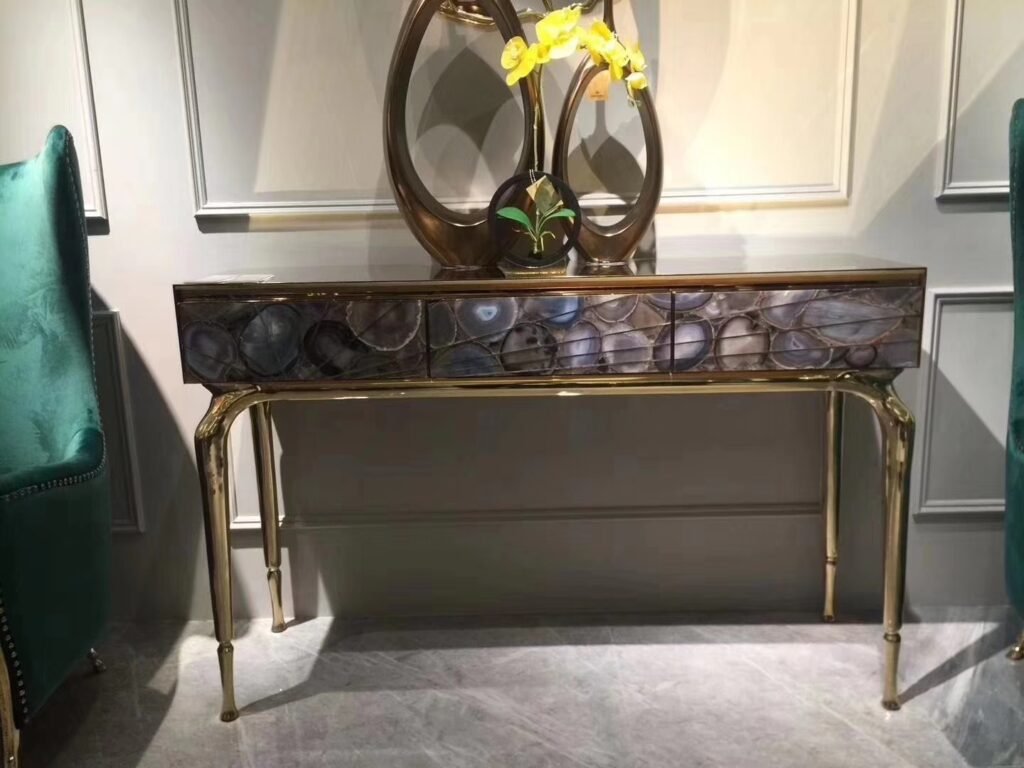
Mirrored Console Tables: Luxury and Light
Mirrored console tables occupy a distinct segment: they function simultaneously as furniture and as architectural interventions — expanding perceived space, amplifying light, and creating an unmistakable luxury signal in any environment.
Key commercial characteristics: Strong demand in luxury residential (apartments, urban penthouses, formal living rooms), five-star hotel entry lobbies and corridors, and high-end boutique retail environments. Mirrored pieces are among the highest average-price-per-unit items in a console table portfolio and generate significant inquiry from clients who have seen them in aspirational media contexts.
Margin profile: Premium — and justifiably so. Bevelled mirror panels, custom frame profiles, and integrated lighting options push this category into the highest price band of the console table range. Durability and maintenance conversations are essential at the specification stage for commercial applications.
Client profile: Luxury residential designers, five-star hospitality designers, high-end retail interior specialists.
Traditional Console Tables: Timeless Elegance
Traditional console tables draw on centuries of European and Asian furniture craft traditions: carved cabriole legs, inlaid veneers, hand-applied patinas, dovetailed drawer construction, and proportions that reference the golden ratio. They communicate permanence, refinement, and investment.
Key commercial characteristics: The primary demand market is high-end residential — country estates, heritage properties, formal townhouses — and traditional luxury hospitality: grand hotels, private members’ clubs, heritage hotel brands. These pieces rarely appear in trend reports but never go out of demand in their core markets.
Margin profile: Highest in the category, and the margin is earned. Solid hardwood construction, hand-finishing, and the craft time embedded in a properly made traditional console table justify pricing that clients with discernment understand and accept. The challenge is communicating that value to buyers who are comparing traditional pieces against mass-produced alternatives at lower price points.
Client profile: High-end residential designers, heritage hotel designers, institutional buyers (private clubs, embassies, formal corporate environments).

Modern console tables work hardest in environments where visual restraint is the design philosophy — high-density residential, lifestyle hotel lobbies, and contemporary corporate receptions.
3. The Console Table Style Quiz: How to Use It Strategically
Positioning the Quiz in Your Sales Process
The quiz is most effective when introduced early — before product recommendations are made — as a structured way to understand the client’s project context and aesthetic values. The framing matters: it is a professional consultation tool, not a retail novelty.
When to Introduce the Quiz to Prospects
The optimal moment is the first substantive project conversation — whether that happens in a showroom, on a discovery call, or at a project briefing meeting. Introducing it too late (after you have already made style recommendations) undermines its purpose. Introducing it before the conversation begins positions it as your professional process.
For distributors managing large designer accounts, consider sending the quiz as a pre-meeting tool: “Before our meeting, it would be helpful if you could take five minutes to complete our design preference brief — it helps me prepare the most relevant recommendations for your project.”
For showrooms, position it at the showroom entrance as part of the welcome experience: “Let me start by asking you a few questions about your project — it helps us focus on the pieces most relevant to what you’re trying to achieve.”
How to Frame It as a Professional Consultation Tool
The language you use when introducing the quiz determines how clients receive it. Avoid framing it as a “quiz” with right and wrong answers. Frame it as a design brief or preference profile. “We use this with all our designer clients to make sure our recommendations are based on your project’s specific values rather than our assumptions” is both accurate and positions you as a methodical professional.
Integrating It Into Your Showroom Experience and Digital Strategy
Embed the quiz on your website as a lead-generation tool with email capture. A prospect who completes the quiz and provides their email address in exchange for a personalized style report is a warm lead with documented preferences — far more valuable than an anonymous catalog inquiry.
In the showroom, create a physical version — a one-page design brief that a showroom consultant completes with the client during the welcome conversation. The completed form becomes a project file that follows the client through every subsequent interaction.
What the Quiz Questions Actually Reveal
Design Preference Indicators Beyond Surface-Level Aesthetics
A client who selects “raw materials and visible construction” is not just telling you they like industrial style — they are signaling a value system that prioritizes authenticity over ornamentation, function over decoration. That value system extends to their entire project brief and often to their budget philosophy.
A client who selects “intricate detailing and carved accents” is telling you they value craftsmanship narratives — and is likely the kind of buyer who will pay for genuine hand-finishing rather than machine-applied detail, if you explain the difference clearly.
Budget Clues Hidden in Style and Material Preferences
Style preferences correlate meaningfully with budget orientation. Clients drawn to mirrored and traditional styles are consistently positioned in higher project budget bands than those drawn to industrial or farmhouse — not universally, but as a reliable tendency. This allows you to calibrate your recommendations and pricing conversations before explicit budget discussions, reducing the awkwardness of early price misalignment.
Project Type Signals That Help You Recommend Inventory
A client selecting “light and space-enhancing” as their primary functional priority is signaling a spatial constraint — a small entry hall, a narrow corridor, a low-ceiling room. Their project is a residential or boutique hospitality specification, not a grand hotel lobby. Your recommendation should respond to that signal with pieces that actually solve the spatial problem, not with your most impressive statement piece.
The Console Table Style Quiz
Complete this brief to identify the style profile that best serves your project. For each question, select the response that most closely reflects your client’s priorities.
Question 1: What is the primary function of the console table in this project?
- A. Decorative statement and visual anchor for the entry or living space
- B. Functional storage with display capability
- C. Spatial enhancement — making the room feel larger or brighter
- D. Durable everyday surface for a high-traffic area
- E. Investment piece with long-term heritage appeal
Question 2: Which material combination would you most naturally reach for?
- A. Marble or stone top with brushed metal base
- B. Distressed solid timber with iron hardware
- C. Mirrored surfaces with gilded or chrome frame
- D. Reclaimed timber with welded steel frame
- E. Carved hardwood with hand-applied patina finish
Question 3: How would you describe the room’s overall design language?
- A. Clean, curated, and architecturally precise
- B. Warm, layered, and personally textured
- C. Glamorous, reflective, and high-impact
- D. Raw, honest, and design-forward
- E. Classic, proportioned, and refined
Question 4: What is the project context?
- A. Contemporary urban apartment or lifestyle hotel
- B. Residential home, boutique hotel, or coastal property
- C. Luxury residence, five-star hotel lobby, or high-end retail
- D. Commercial venue, urban hospitality, or design-forward residential
- E. Heritage property, grand residence, private club, or formal institutional
Question 5: How does your client describe their relationship with furniture?
- A. “I want it to feel intentional and current.”
- B. “I want it to feel lived-in and welcoming.”
- C. “I want it to make an impression.”
- D. “I want it to feel honest and well-made.”
- E. “I want it to feel like it belongs to the space permanently.”
Quiz Results:
| Mostly A | Mostly B | Mostly C | Mostly D | Mostly E |
|---|---|---|---|---|
| Modern | Farmhouse | Mirrored | Industrial | Traditional |
| Clean lines, material precision, visual restraint | Warmth, natural materials, emotional resonance | Luxury, light, spatial drama | Authenticity, raw materials, functional boldness | Craftsmanship, heritage, permanence |
Interpreting Quiz Results for Your Clients
How to Translate Results Into Specific Product Recommendations
A quiz result is a starting point, not a conclusion. When a client result lands clearly in one style category, use it to narrow your showroom presentation to the three to five pieces most relevant to their profile — not to present every piece in that category. Focused recommendations respect the client’s time and signal confidence in your judgment.
When a result is split across two categories (often Modern/Industrial or Farmhouse/Traditional), treat the combination as a design brief, not a contradiction. “Your responses suggest you value honest materials and clean forms — which is why I want to show you this piece that bridges modern restraint with industrial authenticity.”
Connecting Style Preferences to Your Actual Inventory
Map your quiz results to specific SKUs in your inventory before you introduce the quiz to clients. A quiz that generates a recommendation your showroom cannot fulfill is worse than no quiz at all. Jade Ant Furniture’s console table range covers all five style categories, with customization options available across materials, dimensions, and finishes — which means quiz results can always be translated into a specific, deliverable recommendation.
4. Modern Style: Positioning It to Design-Forward Clients
Why Your Interior Designer Clients Choose Modern
Modern console tables solve a specific problem that a large portion of your designer client base faces daily: they work in spaces where the architecture is the statement, and the furniture’s job is to complement without competing.
A 180sqm urban penthouse with floor-to-ceiling glazing and a polished concrete floor does not need a console table that tells its own story — it needs one that maintains the visual vocabulary the architect established. A marble-topped console in matte black steel, 120cm wide and 80cm tall, does exactly that while providing the entry experience the developer needs for sales photography.
That combination of spatial sensitivity and sales photography value is worth communicating explicitly to designers who are pitching to developers. The right modern console table is not just furniture — it is part of the project’s commercial narrative.
The Competitive Advantage of Recommending Modern Console Tables
Modern pieces are the most straightforward style category to specify for time-pressured designers because the design criteria are concrete and verifiable: dimensions, material specification, finish quality. A designer who can confirm on-site that a marble top is genuinely Calacatta and not a printed laminate, that the steel base is 3mm tube not 1.5mm, and that the welding is finished rather than raw — that designer can defend her specification with confidence.
Train your showroom staff to identify and demonstrate these technical details. The difference between a $1,200 modern console table and a $3,800 one is rarely visible in a photograph — but it is immediately apparent in person when you know what to show.
Margin Opportunities in Contemporary Design Projects
The upgrade path in modern console tables is among the most commercially powerful in the category. A standard modern console in engineered stone and powder-coated steel is a $1,400–$1,800 piece. The same design in genuine marble, with brushed brass base hardware and a custom lacquer colour matched to the architect’s specification, is a $3,800–$5,500 piece. The design change is incremental; the price change is substantial. Position these upgrades not as premium options, but as specification precision — “this version is the one that actually delivers the design intent your drawings call for.”
🎥 Watch: How to Style a Console Table for Maximum Impact — A Designer’s Step-by-Step Guide
This practical guide walks through styling principles for every console table category — useful context for showroom staff training and for sharing with designer clients preparing for project presentations.
Helping Showrooms Display Modern Pieces Effectively
A modern console table displayed in an underdressed showroom context loses 60–70% of its visual impact. Modern pieces require architectural context: clean wall behind, considered lighting, and complementary pieces that reinforce the design vocabulary.
Create a dedicated modern vignette with a statement mirror or oversized artwork, a single architectural table lamp, and one or two precisely placed objects — no clutter, no competing styles. The display should feel like a page from a high-end architecture magazine, not a furniture store.
Pricing Strategy for the Contemporary Market Segment
Resist the temptation to compete on price in the modern category. The buyers who matter most — design-forward residential designers and lifestyle hotel designers — are not buying the cheapest modern console table. They are buying the one that looks right, comes with reliable specification documentation, and arrives on schedule.
Build your pricing around total specification value: accurate technical drawings, material certification, finish samples, and on-time delivery. These service elements justify a 15–20% premium over the market average and attract exactly the clients you want.
Modern Console Tables That Perform in Commercial Spaces
Hospitality Applications Where Modern Exceeds Expectations
Lifestyle hotel brands — the W Hotels, Kimpton, and Andaz tier of hospitality — have built their brand identity on exactly the visual language that modern console tables execute best. A hotel lobby with 40 rooms may specify 4–6 console tables for corridor landings alone, before accounting for lobby, bar, and restaurant applications.
For these projects, durability specifications matter as much as aesthetics: commercial lacquer grades that withstand cleaning chemicals, metal finishes that don’t show fingerprints in guest-facing environments, and construction quality that survives daily guest contact. Know these specifications for the modern pieces in your range and lead with them in hospitality conversations.
5. Farmhouse Style: Connecting with Your Residential and Boutique Hospitality Market
Why Farmhouse Resonates with Your Target Clients
Farmhouse furniture occupies a unique commercial position: it is the style that sells on emotional response rather than specification comparison. A client who responds to a farmhouse console table in your showroom does not need to be convinced by material certificates or technical drawings — they need to be understood.
The emotional triggers are warmth, authenticity, and the suggestion of a life well-lived. For residential designers working in suburban and coastal lifestyle markets, these triggers are commercially reliable. For boutique hotel operators trying to create a sense of place and belonging that chain hotels cannot replicate, farmhouse pieces are an operational asset.
The Enduring Appeal for Residential Interior Designers
Unlike modern design, which can feel dated when a specific material or finish trend passes, well-executed farmhouse furniture is trend-resistant. A solid oak console table with turned legs and an iron drawer pull looks appropriate in 2015 and 2025 and will continue to do so. This longevity is a genuine selling point for residential clients who are furnishing homes they intend to live in for 20 years, not staging properties for resale.
Boutique Hotel and Bed-and-Breakfast Applications
Boutique hospitality operators who differentiate on character and charm — the 20-room country house hotel, the coastal bed-and-breakfast, the agritourism property — are building a design identity that farmhouse pieces serve better than any other category. The investment cost is moderate; the impact on the guest experience narrative is disproportionate.
For these clients, farmhouse console tables are not just individual pieces — they are components of a design story that the property tells across every guest touchpoint. Your ability to help them build that story, rather than just supply individual items, is the value that earns long-term supply relationships.
Sourcing and Inventory Considerations for Farmhouse Styles
Material Authenticity That Justifies Premium Pricing
The commercial risk in farmhouse furniture is the quality spectrum: pieces that look identical in photographs can range from solid hardwood with hand-applied distressing to MDF with printed wood grain and factory-applied artificial aging. The difference is invisible in an online catalog and immediately apparent in person.
For distributors and showrooms in the premium farmhouse segment, material authenticity is your primary competitive differentiator. Know the wood species, the construction method, and the finishing process for every farmhouse piece in your range — and be able to explain why these details matter to a designer who is justifying the specification to their client.
Distressing and Finishing Techniques That Matter to Designers
Hand-applied distressing — wire-brushing, hand-scraping, controlled chemical aging — produces results that are visually distinct from machine-applied alternatives. Hand-distressed pieces have an irregularity and depth that experienced designers can identify in person. Machine-distressed pieces have a repetitive pattern that, when viewed in quantity, reads as artificial.
For high-end residential and boutique hospitality specifications, the authentic finish is worth 20–35% more than the factory-distressed alternative. Build this distinction into your showroom displays — a direct comparison between hand-finished and machine-finished surfaces makes the value proposition immediately tangible.

Farmhouse console tables in boutique hospitality contexts do not just furnish a space — they signal that the property has a point of view. That signal is worth a premium, and worth communicating to operators who understand it.
6. Industrial Style: The Showstopper for Commercial and Trendy Residential Projects
Why Industrial Appeals to Your Commercial Design Clients
Industrial console tables perform a function in commercial design that few other styles can replicate: they communicate that a space takes design seriously, without trying too hard. The raw materiality — visible steel, heavy timber, honest construction — reads as confident and intentional in environments where that confidence is the brand signal.
An urban restaurant with a heavy steel and reclaimed timber console table at the entrance is communicating something about its character before a guest has seen the menu. A co-working space with industrial console tables in its communal areas is suggesting that the people who work there have good taste and don’t need things to be pretty.
High-Demand Applications in Hospitality and Retail Fit-Outs
Industrial pieces are consistently among the fastest-moving styles in the B2B commercial furniture segment. Key commercial application areas include: hotel bar and restaurant fit-outs (where the industrial aesthetic has been a dominant trend for nearly a decade and shows no sign of diminishing), retail flagships for fashion, lifestyle, and technology brands, co-working and flexible office environments, and design-forward residential for buyers who want their homes to feel more like curated spaces than conventional furniture arrangements.
Competitive Differentiation Through Industrial Authenticity
The challenge in the industrial segment is quality differentiation in a category that has been significantly commoditized at the lower price points. A mass-produced industrial console table in thin-wall steel tube and pine board looks similar in photographs to a hand-welded piece in 4mm black steel and 50mm solid timber. The difference is in the weight, the finish quality, and the longevity — and it is only apparent in person.
This is where your showroom experience creates a competitive advantage that online competitors cannot replicate. Bring a client to your industrial display, lift the edge of the piece, and let them feel the difference. Weight is credibility in industrial furniture.
Material Sourcing and Quality Standards
| Material Specification | Lower Quality | Premium Quality | Impact sur les prix |
|---|---|---|---|
| Steel tube wall thickness | 1.2–1.5mm | 3–4mm | +25–40% |
| Steel surface treatment | Powder coat over raw | Hand-blackened/patinated | +15–25% |
| Timber species | Pine, spruce | Solid oak, walnut, reclaimed | +30–50% |
| Timber thickness | 25–30mm | 45–60mm | +20–30% |
| Weld finishing | Machine-welded, unfinished | Hand-welded, ground flush | +15–20% |
| Hardware | Standard plated | Solid black iron, hand-forged | +10–15% |
Reclaimed vs. New Materials: Cost and Authenticity Considerations
Reclaimed timber carries a premium — typically 30–50% above comparable new timber — that is justified by two factors: the visual character of genuinely aged material (checking, grain character, nail holes, and patina that cannot be replicated) and the sustainability narrative that is increasingly important to commercial clients with ESG (Environmental, Social, and Governance) reporting requirements.
For clients where the sustainability story matters — hotel groups with green certification requirements, corporate fit-out clients with sustainability procurement policies — reclaimed material documentation (chain-of-custody certification, source documentation) is as important as the material itself.
Industrial Console Tables in Hotel and Commercial Spaces
Customization Opportunities That Increase Project Value
Industrial pieces are among the most customizable in the console table category — the fabrication process adapts readily to non-standard dimensions, integrated features (shelf configurations, cable management channels, integrated power), and surface treatment variations. For commercial projects with specific requirements, this customization capability is a significant commercial opportunity.
A hotel chain specifying 60 corridor console tables with integrated USB charging and specific dimension requirements for a non-standard corridor width is a project that a custom industrial fabrication capability wins. Jade Ant Furniture’s custom manufacturing service handles exactly this kind of commercial project brief.
7. Mirrored Style: The Luxury Upgrade That Expands Your Market
Why Mirrored Console Tables Command Premium Pricing
Mirrored console tables are the only furniture category that simultaneously performs as furniture, mirror, and architectural lighting enhancement. In spaces with limited natural light — hotel corridors, apartment entries, interior rooms without window access — a well-placed mirrored console table can increase perceived ambient light by 30–40%, a functional benefit with genuine spatial impact.
This dual functional and aesthetic value proposition is what supports premium pricing. A mirrored console table in a five-star hotel corridor is not competing with the adjacent timber console — it is solving a different problem at a different price point for a different buyer.
The Luxury Positioning That Attracts High-End Residential Clients
In luxury residential markets, mirrored furniture communicates a specific design confidence: the willingness to make a bold visual statement without apology. Clients drawn to mirrored pieces are not price-sensitive in the conventional sense — they are quality-sensitive, and they are buying a specific spatial and visual effect that they understand and want.
For distributors and showrooms serving the luxury residential segment, maintaining a strong mirrored console table offering — in multiple mirror treatments (clear, smoked, antique, bronze) and frame styles (gilded, chrome, black lacquer, carved) — is a direct revenue opportunity. The average transaction value for mirrored console table sales consistently exceeds that of every other style category.
Showing Mirrored Pieces in Your Showroom
Lighting Considerations That Make Mirrored Surfaces Shine
A mirrored console table displayed under harsh fluorescent lighting in a poorly designed showroom looks cheap regardless of its quality. The same piece under warm directional lighting, in front of a considered backdrop, with complementary pieces that reinforce the luxury context, looks exactly what it is: a premium product worth a premium price.
Invest in dedicated lighting for your mirrored displays — warm LED spotlights at 2,700–3,000K colour temperature, positioned to create depth and dimension in the mirror surface rather than creating glare. This is one of the highest-return investments you can make in your showroom presentation.
Addressing Durability and Maintenance Concerns Proactively
The primary objection to mirrored furniture in commercial and high-use residential applications is maintenance: visible fingerprints, the appearance of scratches in the mirror surface, and the perceived fragility of glass panels in high-traffic environments. Address these concerns before clients raise them.
Modern mirror panels used in quality commercial furniture are 6–8mm tempered or toughened glass, bevelled at the edges, and sealed with a protective backing that prevents silvering deterioration. The maintenance requirement — regular polishing with appropriate glass cleaner — is not materially greater than lacquered furniture. Demonstrating this in your showroom, with a polished display piece that shows no marks, is more persuasive than any verbal assurance.

In luxury hospitality corridors and formal residential entries, a well-positioned mirrored console table does architectural work that no other furniture category can replicate — amplifying light, extending perceived space, and creating a luxury signal that guests and clients register immediately.
8. Traditional Style: Serving Your Heritage and High-End Residential Segment
The Enduring Appeal of Traditional Console Tables
Traditional console tables are the category where the best-performing distributors and showrooms consistently find their most loyal, highest-value client relationships. The clients who specify traditional furniture are not trend-followers — they have a clear, stable aesthetic framework, a genuine appreciation for craftsmanship, and a budget that reflects both.
These clients return. A designer who has worked with you successfully on a traditional console table specification for a country house project will come back for the dining table, the bedroom furniture, and eventually the guesthouse refurbishment. The relationship value of getting this segment right is disproportionate to the initial transaction.
Heritage and Craftsmanship Storytelling That Sells
Traditional console tables are sold through narrative as much as through specification. A client evaluating a hand-carved mahogany console table with cabriole legs and inlaid veneer does not need to be told the dimensions — they need to understand the craft decisions that produced the piece.
How many hours does a skilled carver spend on the leg detail? What wood species was selected and why does it hold carved detail better than alternatives? How many coats of hand-rubbed finish were applied, and what is the difference between that and a sprayed lacquer?
These stories are not marketing embellishment — they are the substance of the value proposition. Build them into your showroom presentations, your product documentation, and your sales team training.
Craftsmanship Details That Matter to Your Clients
Joinery, Wood Selection, and Finishing Techniques
The technical details that distinguish quality traditional furniture from mass-produced reproduction are visible in person to educated buyers — and invisible to buyers who haven’t been shown what to look for. Your job, and your showroom staff’s job, is to create educated buyers.
| Craftsmanship Element | Standard Production | Quality Traditional | What It Means |
|---|---|---|---|
| Drawer construction | Stapled MDF sides | Dovetailed solid wood sides | Structural integrity over 20+ years of use |
| Leg-to-frame joinery | Dowelled with adhesive | Mortise and tenon, hand-cut | Stability under weight and movement |
| Wood selection | Homogenous engineered wood | Book-matched veneer or solid timber | Visual consistency and material authenticity |
| Finish application | Sprayed lacquer, 2 coats | Hand-rubbed oil or wax, 4–8 coats | Depth, repairability, and patina development |
| Hardware quality | Zinc alloy, plated | Solid brass, hand-finished | Longevity, weight, and tactile quality |
How to Communicate Quality to Designers and Showroom Staff
Create a physical demonstration station in your showroom: a half-section of a quality traditional drawer box that shows dovetail joinery, a cross-section of a multi-coat hand finish, and a side-by-side comparison of machine-routed and hand-carved decorative details. This demonstration converts abstract craftsmanship claims into tangible, visible evidence — and gives your sales team a consistent, confident way to justify premium pricing.
Traditional Console Tables in Institutional and Luxury Residential
Applications in Country Homes, Estates, and Heritage Properties
Heritage residential properties — Georgian townhouses, Victorian estates, converted barn complexes — are environments where traditional console tables are not a style choice but a specification necessity. A 40mm-top mahogany console table with brass inlay detail in a Georgian entrance hall is architecturally appropriate. The same space with a modern steel-and-glass piece would be a professional error.
For designers working in this segment, your ability to source traditional pieces with genuine period accuracy — correct proportions, appropriate wood species, authentic joinery methods — is a differentiator that commands premium pricing and earns repeat business.
Commercial Uses in Upscale Hotels and Private Clubs
Grand luxury hotels — the Raffles, Four Seasons, and Mandarin Oriental tier — specify traditional console tables for their lobbies, libraries, and formal corridor landings as part of a deliberate design language that communicates permanence and heritage. Private members’ clubs, embassy residences, and formal institutional interiors are similarly committed to traditional quality.
For these buyers, the primary selection criteria are not price — they are provenance (can you document the quality?), reliability (have you supplied this category successfully before?), and service (can you handle the logistics of a complex multi-piece institutional delivery?).
9. Using Quiz Results to Drive Your Sales Strategy
Converting Quiz Results Into Sales Conversations
How to Follow Up with Prospects Who Complete the Quiz
When a design professional completes your quiz — whether online or in your showroom — the follow-up communication should reference their specific result. Not a generic catalog. Not a standard reply. A message that says: “Based on your responses, your project profile suggests an affinity for [Modern/Traditional/etc.] pieces — particularly those that balance [their stated priority] with [their functional requirement]. I’ve pulled three pieces from our range that I think are directly relevant to what you’re describing.”
That specificity is the difference between a follow-up that generates a reply and one that is archived unread.
Personalizing Recommendations Based on Their Style Profile
Build a recommendation map that connects quiz outcomes to specific SKUs in your current inventory. Update it every time your inventory changes. A quiz system that recommends a piece you no longer stock is a credibility problem, not a sales opportunity.
Pour Meubles Jade Ant clients, the product range covers all five style categories with multiple options in each — allowing quiz-based recommendations to consistently map to available, deliverable product.
Creating Customization Opportunities from Quiz Insights
When to Offer Modifications to Match Exact Preferences
Quiz results that land between two style categories are a natural customization prompt. A client whose responses show equal resonance with Modern and Traditional — often expressing as “I want clean lines but in rich, natural materials” — is describing a transitional brief that a standard catalog piece may not satisfy perfectly.
This is precisely where a custom conversation becomes appropriate: “What you’re describing sounds like a transitional brief — modern proportions in traditional materials. That’s something we can develop from a custom specification. Let me show you how that conversation typically works.”
Customization deepens client relationships, increases average order values by 30–60%, and creates pieces that cannot be price-compared against competitors’ catalogs — all outcomes that directly benefit your business.
Pricing Custom Options to Protect Margins
Custom work should always be priced with a custom premium — typically 25–40% above the comparable standard piece — to reflect the additional production coordination, material sourcing, and project management involved. Position this premium honestly: “Custom work takes more time and more craft. The result is a piece that is exactly right for your project rather than approximately right. That precision has a cost, and it is worth it for the right project.”
Building a Database of Client Preferences
Tracking Which Styles Resonate With Which Client Segments
Within six months of systematic quiz deployment, you will have a dataset that tells you which style categories your client base genuinely gravitates toward — as opposed to which categories you assumed they preferred. That data directly informs your inventory strategy, your showroom display priorities, and your marketing focus.
A distributor who discovers through quiz data that 65% of their designer clients are selecting Modern or Industrial — despite having invested significantly in a Traditional display — has actionable intelligence to reallocate showroom space and inventory budget.
Using Data to Inform Future Inventory Decisions
| Style Category | Quiz Selection Rate | Conversion Rate | Average Order Value | Inventory Priority |
|---|---|---|---|---|
| Modern | 35% | 28% | $2,800 | Élevé |
| Farmhouse | 20% | 35% | $1,950 | Moyen |
| Industrial | 18% | 32% | $2,400 | Moyen |
| Mirrored | 12% | 22% | $4,200 | High (margin) |
| Traditional | 15% | 42% | $5,800 | High (value) |
These figures are indicative benchmarks. Your actual data will differ based on market and client mix — track your own figures quarterly.
10. Integrating the Quiz Into Your Business Operations
Digital Integration for Distributors and Showrooms
Embedding the Quiz on Your Website and in Digital Catalogs
A well-designed web-based version of the quiz — clean interface, mobile-optimized, requiring no registration to complete but offering enhanced results (personalized product recommendations, a downloadable style guide) in exchange for an email address — is one of the most cost-effective lead-generation tools available to furniture distributors and showrooms.
Build it as a standalone landing page, link to it from your main navigation and product pages, and promote it through your email marketing to existing clients as a project-planning tool. Typical completion rates for well-designed furniture style quizzes on professional B2B sites run 18–28% of visitors who begin the quiz — meaningfully higher than standard catalog inquiry forms.
Using Quiz Results to Automate Follow-Up Communications
Configure your CRM to trigger style-specific follow-up sequences based on quiz completion outcomes. A prospect who completes the quiz and selects Traditional should receive a follow-up email within 4 hours featuring your three strongest traditional console table options, a short craftsmanship story that reinforces the value of the category, and a direct invitation to schedule a showroom visit or video consultation.
This automated relevance — a follow-up that speaks directly to what they just told you they care about — generates significantly higher open and response rates than generic catalog follow-ups.
Training Your Sales Team to Leverage Quiz Insights
Equipping Showroom Staff With Interpretation Guidance
Your showroom team needs to understand not just what each quiz result means in terms of style category, but what it signals about the client’s project context, budget orientation, and decision-making style. A client who selected Traditional with strong responses to “investment piece with long-term heritage appeal” is a different conversation from one who selected Traditional from default preference without strong conviction.
Build a one-page interpretation guide for each of the five style results — key characteristics, typical project types, common client motivations, inventory recommendations, and common objections with suggested responses.
Creating Talking Points Based on Style Profiles
| Style Result | Key Client Motivation | Strongest Talking Point | Common Objection | Suggested Response |
|---|---|---|---|---|
| Modern | Visual precision, space management | Material specification and architectural compatibility | “It looks cold” | Show warm material combinations (travertine, warm metals, natural oak) |
| Farmhouse | Emotional warmth, authenticity | Material authenticity and finish quality | “Is it really solid wood?” | Demonstrate cross-section, show grain character |
| Industrial | Authenticity, visual confidence | Weight and material quality, customization capability | “Will it last in commercial use?” | Discuss steel specification, provide durability testing data |
| Mirrored | Spatial impact, luxury signal | Light amplification, spatial enhancement | “Won’t it show every mark?” | Demonstrate cleaning, show tempered glass specification |
| Traditional | Permanence, craftsmanship | Joinery quality, authentic finish techniques | “Why does it cost so much more?” | Show craftsmanship demonstration, explain time investment |
Measuring Success and Optimizing Over Time
Track five metrics monthly from the moment you deploy the quiz: completion rate (starts versus finishes), email capture rate (for digital deployments), quiz-to-inquiry conversion rate, inquiry-to-order conversion rate segmented by style result, and average order value per style category. Review these metrics quarterly and adjust quiz language, question order, and result definitions based on the patterns the data reveals.
Make the Quiz Your Competitive Advantage
Why Professional Guidance Tools Matter in B2B Furniture Sales
The furniture distributors and showrooms that consistently grow revenues in competitive markets are not those with the widest catalog or the most aggressive pricing. They are those who have built systems — like the style quiz — that make their client relationships more structured, more consultative, and more consistently productive.
A quiz that takes five minutes to complete and generates a clear, actionable recommendation delivers more commercial value than thirty minutes of undirected showroom browsing. It respects your client’s time, demonstrates your expertise, and creates a documented foundation for every subsequent conversation.
Next Steps: Getting Started with Your Style Quiz
Implementation does not require a significant technology investment or an extended development timeline. You can begin with a paper version this week — a one-page brief that your showroom consultants complete with clients during the welcome conversation, mapped to your current inventory. Within two to four weeks, you can build a basic web version using any of several free or low-cost quiz tools (Typeform, JotForm, or a WordPress quiz plugin). Within 90 days, you can have a fully integrated digital version with CRM connection and automated follow-up sequences.
The most important step is the first one: mapping your quiz results to your actual inventory before you deploy. A recommendation that doesn’t connect to something you can deliver is a promise you can’t keep. Ensure that every quiz outcome links to at least three specific, currently available pieces — and update that mapping every time your inventory changes.
Ready to Help Your Clients Find Their Perfect Console Table Style?
Start using the style quiz framework today — in your showroom, in your digital presence, and in your sales conversations. The result: more confident design consultations, more persuasive recommendations, and more consistent sales.
Explore the Jade Ant Furniture console table range — available in all five style categories, with custom dimension and finish options for project-specific requirements.
View Our Full Console Table Collection | Explore Living Room Furniture | Contact Our B2B Team
Additional industry resources: Fortune Business Insights: Console Table Market | Tribesigns Console Table Buying Guide | FSC Certified Wood Furniture
Frequently Asked Questions
Q1: How can I use this quiz to improve my design consultations with residential clients?
The quiz gives you a structured basis for your recommendations before you make them — which is the single most powerful change you can make to the quality and efficiency of your design consultations. Share the results with clients during the presentation: “Based on what you told me about your priorities, I focused this recommendation on [style result] — and here’s why these specific pieces reflect exactly what you described.” That framing transforms a sales conversation into a validation conversation, where the client is confirming a recommendation they already feel ownership over rather than evaluating an unsolicited pitch. Clients who feel heard recommend you to other clients. That referral value compounds.
Q2: What should I do if a client’s quiz results don’t match my initial design instinct?
Treat the discrepancy as intelligence, not a contradiction. If a client’s responses lean Modern but your instinct said Traditional based on their project brief, explore why. Ask follow-up questions: “Your responses suggest you’re drawn to clean lines and material precision — how does that sit with the period architecture of the property?” Often, the quiz surfaces an underlying aesthetic preference that the client hasn’t yet reconciled with their project constraints. That conversation — which the quiz makes possible — is where your expertise as a design professional creates the most value. Use the discrepancy to deepen the brief, not to override either the quiz or your instinct.
Q3: How do I handle clients who are torn between two console table styles?
Indecision between two styles is a design brief, not a problem. A client torn between Modern and Farmhouse is telling you they want clean structure with natural warmth — which is a precise and achievable specification. A client torn between Industrial and Traditional is telling you they want honest craft in premium materials — also precise and achievable. The value lies in helping them articulate what they actually want, then showing them that a piece can be specified to satisfy both impulses: a modern console in solid oak with hand-applied finish, or a traditional console in blackened steel with hand-carved timber top. Use the indecision as a platform for a customization conversation where your design knowledge creates direct commercial value.
Q4: Can I customize console tables based on quiz results?
Customization is one of the highest-value outcomes of the quiz framework. A client whose quiz result sits clearly in one style category but with a specific functional requirement — a width that doesn’t match any standard piece, a finish that needs to match existing cabinetry — is a natural custom brief. Present customization as design precision: “The standard pieces in this category are close to what you need, but given what your quiz profile tells me about your priorities, I think we should look at a custom specification that’s exactly right rather than approximately right.” Meubles Jade Ant supports custom dimension, material, and finish modifications for all style categories — with dedicated project coordination for commercial and project-scale orders.
Q5: How often should I update the quiz to reflect new inventory or trends?
Review your quiz mapping — the connection between quiz results and specific recommended pieces — quarterly. Review the quiz questions themselves annually or whenever you make a significant strategic shift in your console table offering. The questions should always reflect the actual decisions your clients face and the actual inventory you can deliver. A quiz recommending a piece you discontinued three months ago is worse than no quiz — it creates a follow-up conversation that begins with a correction rather than a confirmation.
Q6: Should I use different versions of the quiz for residential designers versus hospitality fit-out specialists?
Yes. The decision criteria are meaningfully different. Residential designers weight aesthetics and design storytelling most heavily. Hospitality fit-out specialists weight durability, lead time reliability, commercial grade specifications, and maintenance requirements alongside aesthetics. A hospitality version of the quiz should include questions about project traffic level, cleaning protocol requirements, brand identity alignment, and delivery timeline constraints. These questions surface the commercial specification requirements that turn a style preference into a deliverable product brief.
Q7: What metrics should I track to measure whether the quiz is actually helping my business?
Track five metrics month-over-month: quiz completion rate (percentage of starters who finish), email capture rate (for digital versions), quiz-to-inquiry conversion (completions that generate a product inquiry), inquiry-to-order conversion rate segmented by quiz style result, and average order value per completed quiz versus non-quiz-initiated sales conversations. Within three months of consistent deployment, you will have enough data to identify which style categories generate the highest conversion rates and which generate the highest average order values — intelligence that directly informs inventory investment decisions.
Q8: How can I use quiz data to improve my showroom displays?
Let the data drive the floor plan. If your quiz data over six months shows that 40% of your clients are selecting Modern and 25% are selecting Traditional, but 60% of your showroom floor space is allocated to Farmhouse and Industrial — your display investment is misaligned with your actual market. Use the style distribution data to rationalize your floor plan, prioritize your lighting investment, and determine which categories get prime display positions versus secondary locations. The quiz becomes your market research tool as much as your sales enablement tool.
Q9: Can I use the quiz as a lead-generation tool for my distribution business?
Absolutely. A digital quiz with email capture in exchange for a personalized style report and product recommendation is one of the most commercially valuable lead-generation tools available to furniture distributors. The exchange is genuinely valuable to the prospect — they receive a focused, relevant recommendation rather than a generic catalog — which makes the email capture feel like a fair trade rather than a data grab. Promote the quiz through LinkedIn and email campaigns to your designer and hospitality client networks. Follow up within 4 hours of every completion with a personalized message that references the specific result. The combination of immediate relevance and personal attention generates reply rates consistently above 30% in B2B furniture contexts.
Q10: What should I do if a client completes the quiz but doesn’t match any single style clearly?
An eclectic or undifferentiated result is itself valuable information. It tells you one of three things: the client has genuinely eclectic taste that is not served by any single style category; the client is still early in their design thinking and has not yet formed clear preferences; or the project has multiple stakeholders with different preferences whose individual styles average to an unclear result. In any of these cases, the next step is a deeper conversation rather than a product recommendation. “Your responses suggest a range of influences — which is interesting. Can we spend 20 minutes exploring the project context in more detail?” That conversation is where complex, high-value briefs develop — and where the most valuable supplier relationships are formed.
Q11: How do I explain price differences between styles to clients who don’t understand why traditional costs more than modern?
Connect the price difference to the craft process, not to abstract quality claims. “A traditional console table requires 40–60 hours of skilled joinery and finishing work. A comparable modern piece requires 12–15 hours. The price difference reflects the labour investment — which is also why the traditional piece will look better at 30 years than it does now, while the modern piece will look exactly the same. Neither is better — they’re different value propositions. Your quiz result suggests the investment in permanence is right for your project.” That framing is honest, educational, and positions the traditional premium as appropriate rather than arbitrary.
Q12: Can I use the quiz to identify which console table styles I should stock more of?
The quiz is one of the most reliable inventory planning tools available to you, precisely because it captures genuine client preference rather than what clients say they prefer when asked directly. Track style selection distribution quarterly, correlate it with order conversion data and average order values, and use the matrix to inform your buying decisions. If mirrored console tables generate 12% of quiz selections but 22% of total revenue from quiz-initiated sales — their margin profile justifies more floor space and inventory investment than their selection rate alone would suggest. This kind of nuanced inventory analysis is only possible with a structured data collection tool.
Q13: How do I handle a situation where a client’s budget doesn’t match their style preference?
Use the situation to demonstrate your expertise and your genuine interest in the client’s success — not just the transaction. “Your quiz result shows strong resonance with Traditional — and I understand why. The hand-crafted quality of those pieces is genuinely different. Given your project budget, let me show you two alternatives: a transitional piece that captures some of that warmth and material quality at a lower price point, and a traditional piece at a reduced specification that still carries the design language you’re drawn to. I’d rather help you find something that’s genuinely right for your project than push you toward something that doesn’t sit well with you.” That honesty builds the trust that generates long-term client relationships.
Q14: Should I share the quiz with competitors or keep it proprietary?
The quiz framework is not proprietary — the value lies entirely in how you implement it, what inventory you map to the results, and how your team uses the insights in client conversations. Share the general concept freely; your competitive advantage comes from execution depth, client relationships, and inventory quality — none of which competitors acquire by understanding your quiz structure. Your most powerful competitive position is being known as the distributor or showroom that takes design consultation seriously, not the one that guards its tools.
Q15: How can I adapt the quiz for commercial and hospitality projects where multiple stakeholders are involved?
Create a commercial version with an expanded question set that captures project-specific variables: traffic intensity (lobby versus corridor versus back-of-house), required durability standard (residential grade versus contract grade), brand identity alignment constraints, cleaning protocol compatibility, and decision-maker hierarchy (who is the aesthetic decision-maker, who is the technical approver, who controls the budget). For multi-stakeholder projects, consider having each stakeholder complete the quiz independently and then presenting the results as a group exercise: “I had both of you complete the brief — here’s where your preferences align and where they diverge. Let’s use those divergences as a starting point for the design conversation.” This approach turns stakeholder misalignment from a problem into a structured discussion — and positions you as a facilitator, not just a vendor.
For more resources on console table styles, B2B furniture sourcing, and commercial specification support, visit JadeAnt.com. Industry references: Fortune Business Insights Console Table Market | Tribesigns Console Table Trends 2025 | Tom Faulkner: Console Table & Mirror Pairing Guide