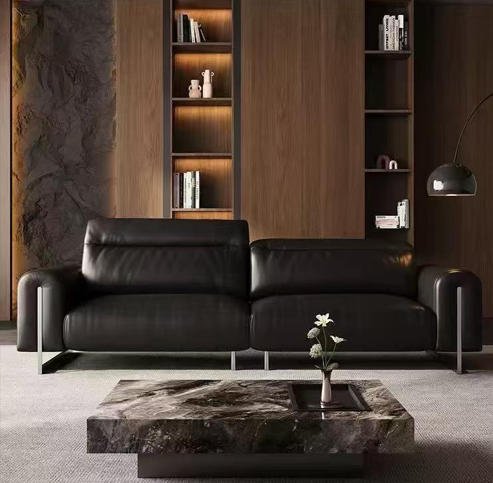
What Defines Luxury Furniture Today: Craft, Value and ROI for Professional Buyers

For high-end importers and distributors, villa owners, interior designers, private label brand owners, FF&E and hotel buyers, architecture and engineering firms, developers, and hotel operators.
The short answer: Luxury furniture today is judged by four things: materials that age well, craftsmanship you can inspect, comfort that improves daily life, and long-term value you can calculate. Price tags and brand names are no longer the proof.
I. The Paradigm Shift in High-End Interiors
The definition of luxury is moving from “conspicuous consumption” to “conscious curation.”
Conspicuous consumption means buying something mainly to show that you can afford it. For decades, a famous label on a sofa did that job. Today, the buyers who spend the most are asking different questions. Where was it made? What is inside it? Will it still look right in fifteen years?
Label-driven luxury often fails in modern architecture.
Picture a villa with floor-to-ceiling glass and a plain stone floor. Someone drops in a heavily branded armchair with a loud logo plate. The chair is expensive, but it competes with the building instead of supporting it. Or picture a hotel lobby where the “designer” lounge chairs show seam stress after 14 months of daily use. The label was luxury. The chair was not.
Beauty and performance now have to arrive together.
A piece that looks stunning but sags, fades or squeaks is a liability. A piece that performs well but looks generic does not lift a property. High-end buyers expect both, in the same object.
What this guide covers. We will redefine luxury as a balance of heritage, innovation and longevity. The core idea is simple:
In today’s high-end market, luxury furniture is a smart investment in artisanal craftsmanship, sustainable materials and ergonomic wellness. It gives professional buyers and homeowners lasting value and years of reliable use.
The global luxury furniture market is expected to grow from about $38.2 billion in 2026 to $60.79 billion by 2035, according to Business Research Insights. More money is chasing the word “luxury,” and that makes a clear way to judge it more valuable.
In a finished space, every sourcing decision is visible. Source: Jade Ant furniture project library.
II. Beyond the Price Tag: Deconstructing the New Luxury Standard
True luxury is measured by the scarcity of skill and the purity of origin, not the retail markup.
From “expensive” to “invaluable”: the role of exclusivity.
Expensive means it costs a lot. Invaluable means you cannot easily replace it. A table made by one workshop from a single walnut slab, with a signed provenance card, is hard to copy. A table with a famous logo made in the thousands is simply costly.
Exclusivity now comes from three sources: rare skill (such as hand-carving or hand-stitching), rare material (such as a bookmatched stone slab), and rare fit (a piece made for one particular room).
The psychological shift: from showing wealth to experiencing quality.
Ultra-high-net-worth clients (often shortened to UHNW; people with very large investable assets) have already seen it all. They are less impressed by a visible logo and more moved by how a drawer closes, how a chair holds the back, and how a surface feels under the hand.
This is why the phrase “quiet luxury” is everywhere in design briefs. The wealth is real. It simply does not shout.
How professional buyers tell “premium” from “luxury.”
Many suppliers use the two words as if they mean the same thing. They do not. Here is a quick way to separate them:
| Question | Premium | Luxury |
|---|---|---|
| Who made it? | A factory line, with good materials | Named craftspeople or a controlled workshop |
| What is the construction? | Strong, but standardized | Designed for repair and refinishing |
| Is it documented? | Basic specs | Full material, test and certificate records |
| What happens at year 10? | Often replaced | Cleaned, refinished or re-upholstered |
| Typical commercial lifespan | 5 to 8 years | 10 to 25 years |
The same pattern shows up in the sourcing tiers in our guide to modern luxury furniture brands. It is worth keeping open when you build a shortlist.
Midpoints of typical commercial lifespan ranges (2–4, 5–8, 10–15 and 15–25 years). Real results vary by usage and care.
Not sure how the tiers look in practice? This short video explains why furniture prices differ so much:

Watch: furniture tiers explained, from good to luxury.
III. The Architecture of Materiality: Sourcing for Permanence
The foundation of luxury is raw material that ages gracefully.
Grade-A hardwoods and sustainable exotic stones: stability and patina.
Grade-A hardwood means the best cut of the log: tight grain, few knots, and well dried. Wood that is dried to around 8 to 12 percent moisture before building is far less likely to crack or warp later.
Patina is the soft change in color and sheen that develops with age. On good oak, walnut or teak, patina adds warmth. On cheap veneer, aging looks like peeling. That is the difference between a piece that gets better and one that just gets older.
Tight, even grain is a quick visual sign of well-selected solid walnut.
Stone follows a similar rule. A bookmatched marble slab (two mirrored cuts laid side by side) has a pattern no one can repeat. Ask for the stone’s thickness, finish (honed or polished) and whether it has been sealed.
High-performance textiles: tactile luxury with commercial-grade durability.
Guests judge fabric by touch first. Operators judge it by how it looks after 18 months. You need both.
Two standard tests tell you how much abrasion a fabric can take:
- Martindale (common in Europe and Asia) counts “rub cycles” in a machine. Higher is tougher.
- Wyzenbeek (common in the US) counts “double rubs.” Again, higher is tougher.
The two numbers are not interchangeable, so always ask which test was used. As a working guide:
| Utilisation | Martindale (rub cycles) | Typical fabric choice |
|---|---|---|
| Luxury residential seating | 30,000 or more | Wool bouclé, linen blends, soft velvets |
| Hotel guest room seating | 40,000 or more | Treated velvet, performance bouclé |
| Hotel lobby and restaurant seating | 80,000 or more | Performance velvet, top-grain leather |
| Private suites, headboards, low-touch pieces | Lower is fine | Silk, fine wool, bespoke weaves |
Check these ranges against your hotel brand standards, since many brands set their own minimums.
The impact of material purity on property value.
When a villa is appraised or a hotel is sold, buyers walk through and touch things. Real stone, real wood and real leather read as “built to last.” Printed laminate and thin veneer read as “furnished to impress.” The first group keeps its value in photos, in reviews, and in the sale room.
For a deeper look at how materials come together across a whole home, see our villa furniture strategy guide.
IV. The Art of Craftsmanship: Where Engineering Meets Artistry
Precision engineering and hand-finished detail are the best protection against planned obsolescence.
Planned obsolescence means a product is built so it will wear out and need replacing. Good joinery does the opposite.
Traditional joinery vs. mass-production fasteners.
Joinery is how two wooden parts are locked together. Here is how the common methods compare:
| Method | How it works | Strength | Repairable? |
|---|---|---|---|
| Mortise-and-tenon | A tongue of wood fits a matching slot | Very high | Yes, can be re-glued or re-pinned |
| Dovetail | Interlocking wedge shapes, used on drawer corners | Very high (resists pulling apart) | Yes |
| Dowel joint | Round wooden pins link two parts | Bien | Sometimes |
| Staples, cam-lock, or glue only | Metal fasteners or glue | Low to moderate | Rarely |
A fast test: pull out a drawer. Look at the corners. Dovetails show crisp, interlocking teeth. Staples or butt joints show flat edges and glue lines.
The value of the “human touch”: hand-rubbed finishes and bespoke tailoring.
A hand-rubbed finish means a craftsperson applies oil, wax or shellac by hand, layer by layer. Methods like French polishing can take days per piece, and they give a depth of color a spray gun cannot match. Hand-finished surfaces can also be touched up on site. A sprayed lacquer usually needs a full re-spray.
On the textile side, bespoke tailoring means pattern-matched stripes, hand-stitched piping and cushions cut to the exact frame. These small details are what an experienced guest or client notices without knowing why.
Fine hardware, tight drawer gaps and consistent finishes are quality signals you can check in minutes.
Quality control (QC) as a luxury feature: zero-defect delivery for FF&E projects.
FF&E stands for furniture, fixtures and equipment, the movable items in a hotel or villa project. When you order 300 identical nightstands, the 300th one must match the first.
That takes a repeatable QC process:
- Sign off a physical golden sample (the approved reference piece) before production.
- Inspect at three points: before production, during production, and before shipping.
- Utilisation AQL (Acceptable Quality Level), a sampling rule that sets how many defects a batch may contain before it fails. For luxury work, critical defects should be zero.
- Hire an outside inspector, such as QIMA, who works for you and not the factory.
This video outlines the main types of furniture inspection that importers use:

Watch: key inspection types for furniture buyers and importers.
V. Ergonomics and Wellness: The Luxury of Comfort
A piece of furniture is only luxurious if it improves how the user feels.
The science of comfort: multi-density foam and anatomical support.
Comfort is not just softness. A seat that feels cloud-soft in the showroom can leave you aching after 20 minutes.
Good seating often uses multi-density foam, which means layers of different firmness. A firm base gives support. A softer top layer gives the feel. The details matter:
- High-resilience (HR) foam springs back after pressing, so it keeps its shape for years.
- ILD (Indentation Load Deflection) measures firmness. Contract seating often falls in the 35 to 45 range.
- A commonly used HR foam density for luxury seating is around 40 kg/m³.
- Dining chair seat heights are usually 43 to 46 cm, with a slight backward lean of about 8 to 12 degrees.
Deep seats, supportive backs and warm materials make guests stay longer in a lounge.
Integration of wellness: biophilic design and non-toxic, low-VOC materials.
Biophilic design brings natural materials, light and plants into a space because people tend to feel calmer around them. In furniture, this means real wood, stone, linen and wool in place of plastic-looking surfaces.
Then there is air quality. VOCs (volatile organic compounds) are gases released by some glues, foams and lacquers. They cause the “new furniture smell.” For hotels, spas and family villas, ask for low-VOC finishes and request test reports from the factory.
Solving the “Museum Effect”: spaces that are lived in, not just looked at.
The “museum effect” is when a room is so formal that people are afraid to sit down. Fix it in the specification:
- Choose performance fabrics that hide spills but still feel soft.
- Pick seat depths that allow people to curl up.
- Add sturdy side tables within arm’s reach of every seat.
- Round the corners of coffee tables near walkways.
A beautiful room that people use will always outperform one they only admire. The same principle applies to bedrooms; see our bedroom furniture care framework for keeping soft surfaces fresh over time.
VI. Strategic Investment: Recognizing Lasting Value and ROI
For developers and designers, luxury furniture is a capital asset.
ROI stands for return on investment. It asks: what do I get back for what I spent?
Depreciation vs. appreciation: why artisanal pieces hold value.
Be honest here. Most furniture loses value the day it is delivered. But solid, repairable pieces lose far less, and a few appreciate. Design-signed pieces, rare materials and limited editions can climb in value. A solid walnut sideboard can be refinished and resold. A particleboard unit with a printed finish cannot.
Documents help. A piece that comes with its material list, certificates and care records is much easier to value and resell. This is true for insurance claims as well.
The cost-per-use analysis: long-term savings of durability over frequent replacement.
Here is a simple example for one hotel lounge chair. These figures are for illustration; use your own quotes.
| Item | Mid-market chair | Luxury chair |
|---|---|---|
| Prix d'achat | $350 | $850 |
| Years in service | 3 | 12 |
| Cost per year | about $117 | about $71 |
| Purchases needed over 12 years | 4 | 1 |
| Cost for 100 chairs over 12 years | $140,000 | $85,000 |
The $140,000 figure does not include freight, installation or the room-nights lost during each replacement. Those hidden costs make the gap wider.
Illustrative example only. Replace with your project quotes and expected lifespans.
Increasing the “perceived value” of hotel suites and luxury villas.
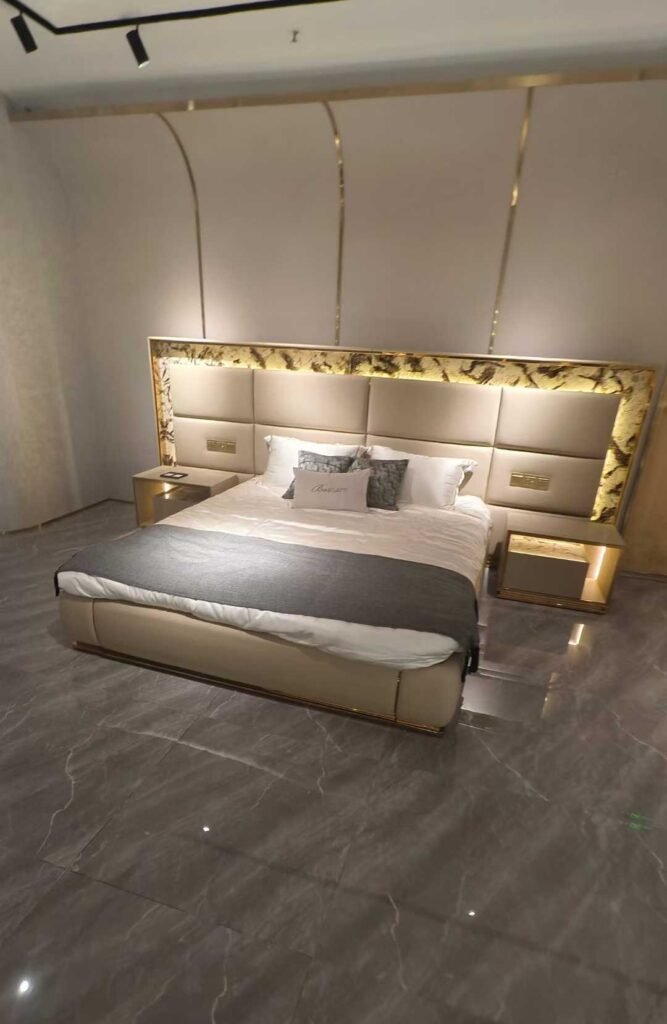
Perceived value is what a guest or buyer thinks a space is worth. Furniture shapes that opinion quickly. A suite with a carefully tailored headboard, solid wood nightstands and soft, layered lighting feels like a higher-rate room before the guest has unpacked.
Details like a custom headboard and integrated lighting support a higher nightly rate.
For a wider view of where hospitality specification is heading, read our overview of hotel furniture trends.
VII. Bespoke Capability: Solving the Problem of Spatial Constraints
The ultimate luxury is a perfect fit.
Customization as a solution for unique architectural footprints.
Standard sofas are built for standard rooms. Many luxury projects are not standard: curved walls, sloped ceilings, a bay window that needs a built-in bench, a stair landing that needs a console exactly 28 cm deep. Bespoke work turns those awkward spots into signature features.
The collaboration workflow: from CAD drawings to final installation.
CAD means computer-aided design, the digital drawings that show exact dimensions. A clear workflow keeps surprises low:
| Étape | What happens | Typical timing |
|---|---|---|
| 1. Brief | Mood board, room plans and budget shared | Week 1 |
| 2. CAD drawings | Dimensions, materials and finishes drawn up | Weeks 1 to 3 |
| 3. Sample or prototype | Physical sample of key finish or frame | Weeks 3 to 6 |
| 4. Approval | Signed-off drawings and golden sample | Week 6 or earlier |
| 5. Production | Build with photo updates | Weeks 6 to 16 |
| 6. QC and packing | Inspection before shipping | 1 week |
| 7. Shipping and installation | Delivery to site and placement | Varies by route |
Custom luxury pieces often take about 12 to 20 weeks from approved specification. Plan the schedule from the first design meeting, not from the day you place the order.
Eliminating the compromise: dimensions and finishes tailored to the mood board.
When a finish is “almost right,” it will bother you for years. With bespoke work, you can match a stain to a sample taken from the room’s own stone, or adjust a dining table’s height by 20 mm to suit a specific chair. For brands that want their own signature collections, our private label guide shows how to turn one-off designs into a repeatable line.
Single-slab marble, hand-stitched leather and custom storage all built to the room’s measurements.
VIII. Sustainability as the New Prestige
Ethical sourcing and environmental care are now baseline expectations.
The shift toward circularity: repairability and timeless design over trends.
A circular economy keeps products in use for as long as possible, then repairs, reuses or recycles them. In furniture this means three habits: build for repair (screwed and pinned joints instead of glue-only), choose timeless shapes that will not look dated in five years, and plan for refresh (removable covers, replaceable legs).
The most sustainable chair is the one you do not have to throw away.
Certifications that matter: FSC, LEED, and fair-trade labor practices.
Certificates only help if you can verify them. Always ask for the certificate number and check it with the issuer.
| Certification | What it tells you | Where it applies |
|---|---|---|
| FSC (Forest Stewardship Council) | Wood comes from responsibly managed forests, tracked from forest to finished product | Wood furniture |
| LEED | A rating system for the whole building. Furniture can help earn credits through certified materials and low emissions | Hotels, offices, large developments |
| GREENGUARD Gold | Low chemical emissions, good for air quality | Upholstery, casegoods, finishes |
| BIFMA standards | Safety and durability benchmarks for commercial furniture; see the BIFMA standards overview | Hotel and contract seating |
| Social audits (such as BSCI or SMETA) | Fair labor practices and safe workplaces at the factory | Supplier approval |
For wood sourcing, our guide on sourcing luxury furniture from China explains how to check documents before you pay a deposit.
How sustainable luxury appeals to the modern UHNW client.
Younger high-net-worth buyers often ask for provenance documents the way they would for a watch or a car. A villa owner who can say “this table is FSC-certified walnut, finished with a low-VOC oil” has a story to tell guests. That story is part of the value.
Durable materials and responsible sourcing extend to outdoor spaces. See our outdoor furniture sourcing guide for details.
Roughly 37 percent of consumers prefer bespoke furniture and 33 percent choose imported luxury brands, per figures cited by Business Research Insights. “Other” is the remainder.
IX. Operational Excellence for B2B Buyers (FF&E and Distributors)
For professional importers and operators, luxury extends to a reliable supply chain.
Mitigating risk: lead-time accuracy and protective logistics.
A flawless chair that arrives six weeks late can delay a hotel opening. Protect the schedule with these habits:
- Add a buffer of 10 to 15 percent to every quoted lead time.
- Lock fabric and special-material delivery before mass production starts. Late fabric is one of the most common causes of delay.
- Specify packaging in writing: foam corners, individual cartons, wooden crates for marble or glass.
- Insure cargo for at least 110 percent of its value.
For first-time buyers, our guide to importing and distributing high-end furniture walks through each shipping step.
The importance of after-sales support and maintenance protocols.
Luxury does not end when the container is unloaded. Ask every supplier these four questions before you order:
- What does the warranty cover, and for how many years?
- Will replacement parts (hardware, fabric, mechanisms) be available for at least 10 years?
- Who is my named after-sales contact?
- How are transit-damage claims handled?
Hand over a care card for each material, including a note on indoor humidity. Wood furniture is happiest with indoor humidity between 40 and 60 percent. If your project is in a hot, damp place, see our notes on luxury bedroom furniture for humid climates.
Scaling luxury: maintaining consistency across large developments.
The hardest part of a 60-villa project is not the first villa. It is the sixtieth. Three controls keep quality steady:
- Batch matching: pieces cut from the same material lot, so color and grain stay close.
- One master specification that everyone works from, with version numbers.
- A mock-up room that you approve before the full order goes into production.
Skipping these steps is among the most expensive procurement mistakes in the field.
A hotel restaurant of this scale depends on dozens of identical tables and chairs that match perfectly.
X. The Future of High-End Living
Luxury furniture today is a mix of art, science and ethics.
Here are the four pillars in one place:
- Material: solid, traceable and able to age well.
- Craft: joinery and finishes you can inspect, repair and refinish.
- Comfort: foam, shape and air quality that support real daily use.
- Value: a cost-per-year you can show on paper.
Add two supports: customization that fits the room, and a supply chain that delivers the same quality on the first piece and the last.
A final thought. Investing in quality is an act of stewardship. The best pieces outlast their first owner, and they leave the room better than they found it.
Your next step. Pick one live project. Before you approve the next specification, ask for three things from every supplier: the material list, the joinery details, and the certificate numbers. Compare what you receive against the four pillars. The gap between “looks luxurious” and “is luxurious” will show up quickly.
If you would like a partner who works this way, speak with Meuble Fourmi de Jade. You can read more about the Jade Ant team or browse the Jade Ant sourcing blog for related guides. Before shortlisting suppliers, it also helps to compare luxury furniture brands with a scoring checklist.
Glossary of Key Terms
Quick definitions for terms used in this guide.
| Term | Plain-English meaning | Example |
|---|---|---|
| Patina | The soft change in color and sheen that develops with age | A walnut table that deepens in tone after years of use |
| Martindale / Wyzenbeek | Lab tests that count how many rubs a fabric can take | 40,000 Martindale cycles for guest room seats |
| Mortise-and-tenon | A joint where a wooden tongue fits a matching slot | Bed rails that can be re-tightened for decades |
| HR foam | High-resilience foam that springs back after pressing | Sofa seat cores that stay firm after years of use |
| ILD | A firmness score for foam | 35 to 45 for contract seating |
| VOC | Gases released by some glues, foams and finishes | Low-VOC lacquer on a nursery dresser |
| FF&E | Furniture, fixtures and equipment | Beds, chairs, lamps in a hotel suite |
| AQL | A sampling rule that decides pass or fail on a batch | Zero critical defects allowed |
| Golden sample | The approved reference piece all later batches must match | A signed armchair stored at the factory |
| Bookmatched | Two mirrored slabs placed side by side | A marble tabletop with a symmetrical pattern |
| Circularity | Designing products to be repaired, reused and recycled | Removable chair covers instead of full replacement |
| UHNW | Ultra-high-net-worth individual | A client commissioning a private estate |
Frequently Asked Questions
1. How do I distinguish between “premium” mass-market furniture and true artisanal luxury?
Look at what you cannot see in a photograph. Ask for the frame material, the joinery type, the foam density and the finish process. Premium pieces are well made in a factory with standard methods. Artisanal luxury shows hand work: dovetailed drawers, hand-rubbed finishes, pattern-matched upholstery, and a documented material list. If a supplier cannot tell you the wood species and foam density, treat the “luxury” label as marketing.
2. What specific certifications should I look for to ensure material sustainability in high-end projects?
Start with FSC for wood and GREENGUARD Gold for low emissions. For fabrics, look for OEKO-TEX. For commercial use, ask for BIFMA test results. For factory ethics, request a recent social audit such as BSCI or SMETA. LEED is a building rating system, so ask whether the furniture’s documents can help earn credits. Always verify certificate numbers with the issuer instead of relying on a PDF alone.
3. How does investing in high-end furniture impact the overall appraisal value of a luxury villa or hotel?
Furniture is usually not part of a real-estate appraisal for a sold property, but it strongly affects perceived value, photographs, reviews and room rates. Hotels with high-quality, well-kept furniture tend to hold their rates better and need fewer mid-cycle replacements. Keep purchase records, material certificates and care logs. They support insurance claims, resale and brand audits.
4. What are the most durable luxury fabrics for high-traffic FF&E environments without sacrificing the “hand-feel”?
Performance velvet, tightly woven bouclé with a synthetic core, and top-grain leather are strong choices. Aim for around 80,000 Martindale cycles or more in lobbies and restaurants, and about 40,000 in guest rooms. Ask for a swatch and rub it with your hands before approving. Test any stain-protection treatment on a hidden area first, since some change the feel of silk or velvet.
5. How can I ensure that bespoke furniture maintains consistency across a multi-unit development?
Use one signed master specification with version numbers. Approve a physical golden sample and a full mock-up unit. Order materials from the same lot, such as one fabric dye lot or veneer batch. Require inspection reports with photos at three stages: before, during and after production. Name one project manager on the factory side.
6. What is the expected lifespan of luxury furniture compared to mid-market alternatives?
Typical commercial use shows roughly 2 to 4 years for mass-market catalog pieces, 5 to 8 for mid-tier contract furniture, 10 to 15 for genuine premium, and 15 to 25 for true bespoke. In private villas with light use, quality solid wood pieces can last decades. Actual life depends on usage, climate and care.
7. How do I evaluate the quality of joinery and internal framing when the piece is upholstered?
Ask for a cutaway sample or a photo of the frame before it is covered. Look for kiln-dried hardwood, corner blocks, and mortise-and-tenon or dowel joints instead of staples. Ask for the frame load-test result. You can also check weight: a solid frame sofa is noticeably heavier than one built from thin panels. During inspection, have the inspector press and rock the piece to feel for movement.
8. What are the current trends in “Quiet Luxury” for residential interior design?
Quiet luxury favors soft, natural color, tactile materials such as wool, linen and bouclé, honed stone, and clean shapes with no visible logos. The focus is on craft and fit instead of display. Think single-slab surfaces, hidden hardware, and carefully matched grain. It also fits the shift toward repairable, timeless pieces.
9. How do I handle the logistics and installation of oversized luxury pieces to avoid damage?
Measure doors, elevators and stair turns before ordering. Ask for crating with foam corners and a moisture barrier. Specify a white-glove team for assembly, since big sofas and stone tables are easy to chip. Confirm floors and walls are finished and protected before delivery. Photograph the packaging before opening and note any damage on the delivery paperwork before signing.
10. What maintenance schedules are required to preserve the warranty and value of exotic wood and stone furniture?
Follow the maker’s written care card, since each warranty has its own terms. As a general guide, dust wood weekly with a dry microfiber cloth, wipe monthly with a pH-neutral damp cloth, and re-oil or wax according to the finish type, often once a year. Keep indoor humidity between 40 and 60 percent and avoid direct sun. Seal stone as advised and wipe spills right away, especially acidic ones like wine or lemon. Keep dated records of every service.
11. How do I balance a client’s desire for “trendiness” with the need for timeless, lasting value?
Put the lasting investment in the big, hard-to-change items: sofas, dining tables, beds and casegoods in timeless shapes and neutral materials. Let trends live in the easy-to-swap layers such as cushions, throws, lamps, rugs and accent chairs. Design “refresh-ready” pieces with removable covers or replaceable legs, so a style update does not mean a full replacement.
12. What are the red flags to watch for when vetting a new high-end furniture manufacturer?
Watch for no factory video or audit access, no named wood species or foam spec, certificates that cannot be verified, samples that look far better than production photos, lead times that are much shorter than the market average, and verbal promises with nothing in writing. A good manufacturer will happily share project references, a written warranty and an inspection plan.
Ready to specify luxury furniture that holds up on site and on paper? Share your project brief with the team at the link above and ask for a material and joinery summary alongside your quote.