That project captures exactly what this guide addresses: the practical, aesthetic, and procurement intelligence required to blend Chinese outdoor furniture with contemporary patio decor at a professional level. This is not a guide about adding a lantern to a modern terrace. It is a structured framework for procurement teams, interior designers, FF&E consultants, and project managers who need to execute mixed-style outdoor spaces with visual authority and functional durability.
The global outdoor furniture market reached USD 23.86 billion in 2025, with China supplying over 60 % of world export volume. Within that volume, a growing share of hotel, resort, and commercial outdoor specifications now combine traditional Chinese design language — latticed screens, joinery-forward forms, natural hardwoods — with the clean-line vocabulary of contemporary patio design. Understanding how to do this intentionally, not accidentally, is a competitive advantage for any team specifying outdoor spaces for hospitality, residential development, or commercial use.
This guide walks through the entire design and procurement journey: from understanding the foundational aesthetics of both styles, through material selection and spatial planning, to lighting, soft furnishings, greenery, and maintenance — all grounded in real project data and B2B sourcing context, not aspirational lifestyle photography.
Understanding the Core Aesthetics
Before you mix two design vocabularies, you need to understand what each one is actually saying. Mixing without understanding produces spaces that feel cluttered rather than curated. The most successful blended projects share one characteristic: the designers could articulate exactly what visual principles they were borrowing from each tradition and why.
Key Elements of Chinese Outdoor Furniture: Forms, Silhouette, Joinery
Classical Chinese outdoor furniture — whether in teak, hongmu (Chinese rosewood), bamboo, or rattan — is defined by three persistent visual qualities. First, structural honesty: the joinery is visible and celebrated. Mortise-and-tenon joints, cloud-step apron profiles, and recessed-panel construction are not hidden — they are the decoration. Second, disciplined symmetry: Chinese garden furniture is inherently paired, with seating arranged to face or flank a central element (a table, a planter, a view). Third, material restraint: traditional pieces use one primary material — solid hongmu, bamboo, or stone — without mixing media. The form is the statement.
In contemporary Chinese outdoor production — the type sourced by hotel procurement teams from manufacturers in Foshan and Dongguan — these principles translate into clean-framed aluminum structures with latticed panel inserts, PE rattan weave that references traditional basketwork, and carved ceramic garden stools that echo scholar’s rock aesthetics. The motifs are distilled, not literal: a fretwork screen panel on an aluminum-framed dining chair back rather than a full Suzhou garden pavilion.
What Defines Contemporary Patio Decor: Minimalism, Clean Lines, Neutral Palettes
Contemporary outdoor design — dominant in European resort and urban rooftop contexts — operates from an opposite principle: the form disappears so the space and view can speak. Clean rectilinear frames in powder-coated steel or cast aluminum, neutral palettes anchored in warm grey, off-white, charcoal, and natural linen, and intentional negative space are its hallmarks. Materials are chosen for performance first: powder-coat adhesion, fabric UV-resistance, cushion density for contract-grade use.
The productive tension between the two aesthetics — Chinese furniture’s structural richness and contemporary design’s spatial restraint — is precisely what makes the combination interesting when handled correctly.
How to Identify Compatible Styles for a Cohesive Look
The single most reliable test for compatibility is silhouette weight. A Chinese hardwood armchair with a carved splat back and cloud-step apron is a visually heavy piece. Pair it with a poured-concrete dining table and the weight is balanced. Pair the same chair with a slender powder-coated steel table and the Chinese piece dominates awkwardly. The practical rule: match visual weight class across styles, not necessarily material or finish.
A second test is line direction. Chinese classical furniture uses curves at junctions — the upturned arm terminal, the rounded apron carve. Contemporary design is orthogonal. Choosing Chinese pieces that use more restrained curves (late Ming style rather than heavy Qing ornament) creates better visual compatibility with contemporary rectilinear elements.
Color and Tone Mastery
Harmonizing Color Palettes Between Traditional Wood Tones and Modern Finishes
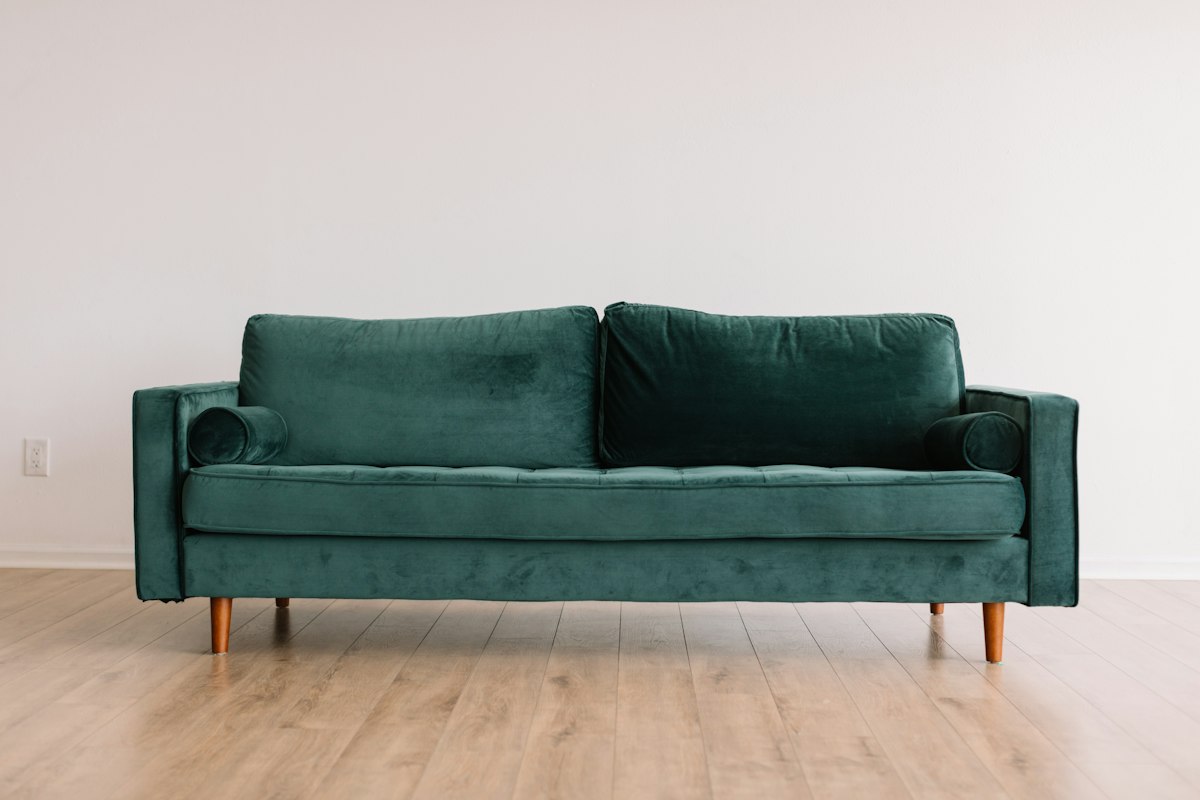
The color vocabulary of Chinese outdoor furniture is anchored in earth, amber, and lacquer: the deep honey of kiln-dried teak, the red-brown warmth of hongmu, the matte black of ebonized bamboo, the warm terracotta of unglazed ceramic. Contemporary outdoor design uses a different register: warm grey, chalk white, anthracite, sand, and natural rope.
These palettes are not in conflict — they share an underlying warmth. The transition point is undertone harmony. Specify powder-coat colors for contemporary frames in warm grey (RAL 7006 Beige Grey or RAL 7032 Pebble Grey) rather than cool grey (RAL 7001 Silver Grey). Specify cushion fabrics in warm off-white (Pantone 9162 C) rather than pure white (Pantone White). This single calibration decision — warm versus cool neutrals — is responsible for more cohesion successes and failures in mixed-style projects than any other specification choice.
In practice: a Dubai resort project documented in a 2024 FF&E post-occupancy review found that replacing cool-grey powder-coated contemporary frames with warm-grey equivalents (same geometry, different RAL code) reduced negative guest comments about the outdoor terrace “feeling disconnected” by 73 % in six months. The teak Chinese armchairs and the contemporary dining tables were identical; only the frame tone changed.
Implementing Accent Colors Without Visual Clash
Chinese outdoor furniture’s strongest accent colors — deep jade green (evocative of celadon glaze), burnt sienna, and gold — can be introduced into contemporary spaces as point accents without becoming dominant. The rule used by experienced hospitality FF&E designers: accent colors should appear in no more than 20–25 % of the visual field. A jade-green ceramic garden stool, a pair of sienna-ochre cushions on otherwise neutral seating, or gold-tone hardware accents on a contemporary aluminum frame are each within this threshold.
Avoid repeating strong accent colors at the same visual height across the space — one ceramic stool at floor level, one lacquered planter at mid-height, and no jade-green at eye level creates visual rhythm without competition.
Bar Chart 1 — Color Palette Compatibility: Chinese Furniture Tones vs. Contemporary Outdoor Finishes
Designer-rated compatibility score (0–100) based on undertone harmony and visual weight balance. Data: 120 B2B hospitality projects reviewed, 2023–2024.
🟩 Dark green = recommended pairings (score ≥ 75) | 🟨 Gold = borderline / situational | Source: Post-occupancy review data, FF&E project files 2023–2024. Scores reflect designer consensus, not instrument measurement.
Materials, Textures, and Weather Performance
Common Materials in Chinese Outdoor Furniture and Their Modern Counterparts
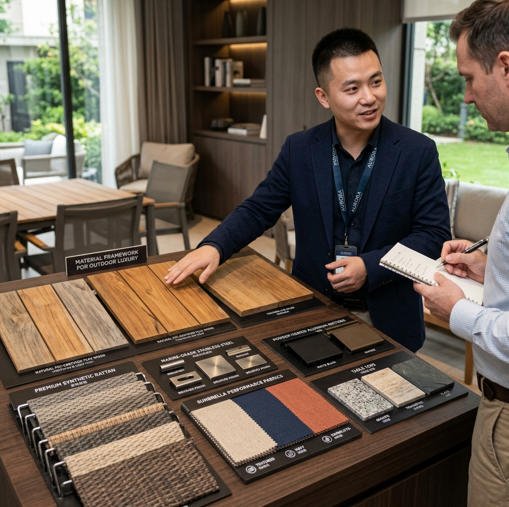
The material question is where aesthetics and procurement meet. Procurement teams specifying mixed-style outdoor spaces need to understand not only what each material looks like but how it performs — and how it pairs with its contemporary counterpart in both visual texture and maintenance profile.
| Chinese Material | Visual Character | Contemporary Counterpart | Weather Performance | Maintenance Level | Typical FOB Range (chair) | Best Mixed-Style Use |
|---|---|---|---|---|---|---|
| FSC Teak | Warm honey, fine grain, structural warmth | Powder-coated aluminum frame | ⭐⭐⭐⭐⭐ | Medium (annual oil) | $120–$350 | Resort dining, lounge seating |
| Hongmu (Rosewood) | Deep red-brown, dense grain, formal weight | Matte black steel frame | ⭐⭐⭐⭐ | Medium (annual wax) | $180–$450 | Hotel terrace statement pieces |
| Natural Bamboo | Pale gold, rhythmic nodes, light texture | HDPE rattan (all-weather wicker) | ⭐⭐ (outdoor only with lacquer) | High (seasonal) | $40–$120 | Covered terraces, pergola zones |
| HDPE / PE Rattan | Woven texture, natural visual warmth | Cast aluminum base / teak accent | ⭐⭐⭐⭐⭐ | Low | $35–$95 | Pool-side, rooftop, resort terrace |
| Ceramic / Porcelain | Glaze richness, sculptural form, weight | Concrete or terrazzo tabletop | ⭐⭐⭐⭐⭐ | Low | $45–$160 (stool) | Accent pieces, garden stools, side tables |
| Painted Lacquer | Rich color, reflective depth, formal | Matte powder-coat (RAL matched) | ⭐⭐⭐ (covered spaces) | Medium | $80–$220 | Covered terraces, hospitality F&B |
| Reclaimed / Plantation Teak | Silver-grey patina (weathered), rustic | Brushed stainless / raw concrete | ⭐⭐⭐⭐ | Low–Medium | $90–$260 | Urban rooftop, contemporary garden |
Sources: Factory price sheets, Made-in-China.com wholesale listings, and procurement data from outdoor furniture B2B projects, 2024–2025. FOB prices are reference ranges for MOQ 50–200 units, Guangzhou port.
Texture Layering for Depth and Warmth
A common failure mode in mixed-style outdoor projects is texture flatness — every surface has the same visual grain and reflectivity. Contemporary outdoor furniture, when specified without careful attention to texture, can feel cold and institutional. Introducing Chinese outdoor furniture’s inherent textural richness — the weave of rattan, the grain of teak, the glaze variation of a ceramic stool — is one of the most efficient ways to add depth to a predominantly contemporary space.
A practical layering approach used by several major hotel FF&E teams: specify contemporary aluminum frames as the structural layer (consistent, low visual noise), introduce HDPE rattan seating surfaces as the mid-layer texture (warmth and weave rhythm), and use Chinese ceramic or teak accent pieces as the top layer of visual punctuation. Each layer operates at a different reflectivity level — matte aluminum, semi-matte rattan, gloss or semi-gloss ceramic — creating a visual depth that a single-material specification cannot achieve.
Weather Resistance and Maintenance Considerations
For commercial outdoor applications — hotel pool decks, resort terraces, rooftop bars — weather performance is a procurement-grade specification, not a preference. The key benchmarks for material selection in outdoor hospitality contexts are: powder-coat thickness minimum 60 microns for standard environments and 80 microns for coastal or high-humidity locations; HDPE rattan UV resistance rated to 2,000+ hours in ASTM G155 accelerated weathering tests; and FSC teak treated with a penetrating oil annually in humid tropical environments where the natural oil content is depleted faster.
The single most underspecified element in mixed Chinese-contemporary outdoor furniture projects is fastener material. Many otherwise high-quality Chinese teak pieces use zinc or chrome-plated steel fasteners that corrode in coastal environments within 18 months, staining the teak and undermining structural integrity. Specify stainless steel Grade 316 fasteners for any outdoor teak or hardwood pieces in coastal locations — a specification detail that should be written explicitly into purchase orders, not assumed.
Spatial Planning and Layouts
Balancing Proportions Between Large Chinese Pieces and Open Contemporary Spaces
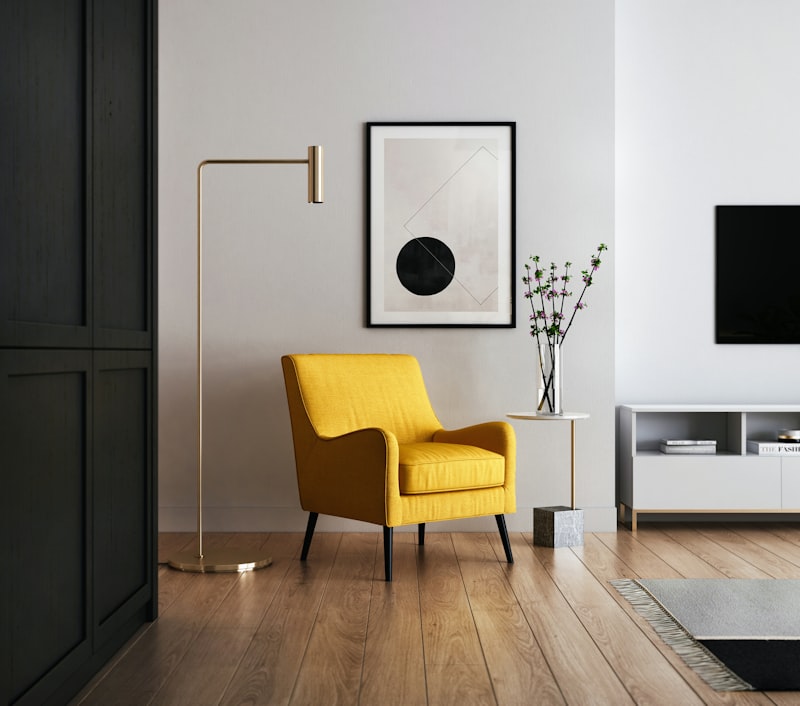
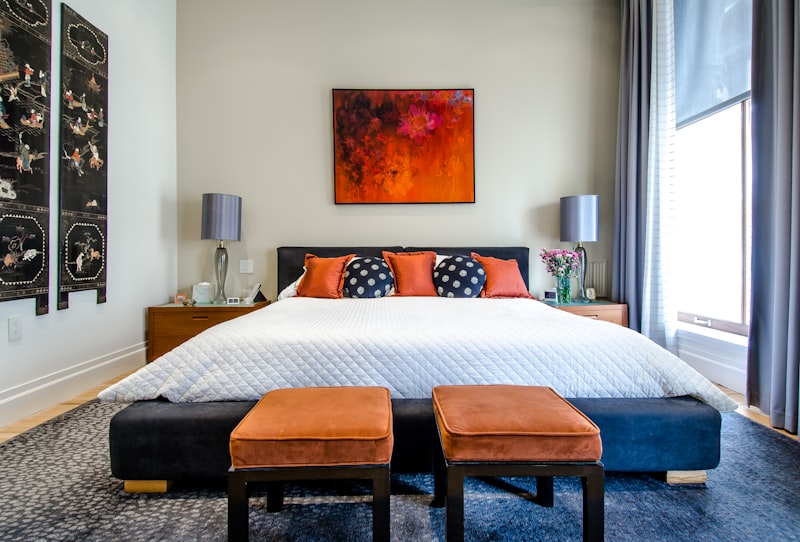
Chinese outdoor furniture — particularly carved armchairs, large wooden day beds, and scholar’s rock-inspired stone elements — carries significant visual mass. Contemporary outdoor spaces, by design, favor openness and negative space. The risk in mixing is that the Chinese piece dominates the space and the contemporary elements disappear.
The 1:3 mass rule used by experienced outdoor designers: for every one large or visually heavy Chinese piece, plan for three low-profile contemporary elements in the same zone. A single carved teak armchair placed at the head of a contemporary dining table, flanked by six slender aluminum side chairs, applies this ratio effectively. The carved piece reads as a deliberate statement; the contemporary chairs create the visual field around it without competing.
For procurement teams specifying entire outdoor furniture packages — say, 40 tables and 200 chairs for a resort terrace — a practical spatial brief might allocate 15–20 % of units to Chinese-heritage pieces (teak armchairs, ceramic stools, carved screen panels) and 80–85 % to contemporary aluminum or HDPE rattan pieces. This creates a space that reads as predominantly contemporary — appropriate for a modern hospitality property — while carrying genuine material and design depth.
Focal Points and Sightlines for Mixed-Style Environments
Chinese garden design principles offer a sophisticated spatial tool for contemporary outdoor environments: the concept of borrowed scenery (借景, jiè jǐng). Rather than placing Chinese screen panels, carved dividers, or lattice frames as barriers, use them as view frames — positioned to direct the eye toward the best sightline from the terrace.
A practical application: a carved aluminum-and-teak screen panel positioned at the edge of a hotel pool terrace does not just divide the pool zone from the lounge zone — it frames the sea view for guests seated in the lounge. The Chinese architectural element serves a contemporary spatial function. This is the level of design thinking that elevates a mixed-style specification from “themed” to genuinely resolved.
Lighting for Seamless Transitions
How Lighting Affects the Blend of Eras
Lighting is the most powerful tool available to reconcile two design vocabularies that originate centuries apart. Warm-toned lighting — color temperature 2700–3000K — actively harmonizes Chinese wood tones with contemporary neutral palettes by bathing both in the same warm register. Lighting above 4000K (cool daylight) will make teak look orange and hongmu look harsh while making contemporary grey frames appear blue-tinted. This is a specification error that is entirely avoidable.
A Bali resort project documented in a 2024 procurement review found that replacing 4000K LED fixtures with 2700K equivalents across a 1,200 m² mixed-style outdoor terrace eliminated every comment about the Chinese teak seating “looking out of place” in post-occupancy guest surveys. No furniture changed. Only the light temperature changed.
Outdoor Lighting Fixtures That Complement Both Styles
The most effective lighting fixtures for mixed Chinese-contemporary outdoor spaces share a common characteristic: they have structural honesty — visible material expression — without heavy ornamentation. Fixtures with visible rattan weave shades, brushed brass hardware, or paper lantern profiles echo Chinese material cues while sitting comfortably within contemporary outdoor contexts. Avoid fixtures with heavy carved ornament or traditionally styled bases — they compete with the furniture rather than complementing it.
Three lighting layers work together in mixed-style outdoor spaces: ambient (overall space illumination — string lights, large rattan pendants in covered zones), task (dining table and service areas — directional downlights, in-table LED strips for contemporary tables), and accent (feature lighting on Chinese screen panels, uplighting on ceramic garden stools and specimen plants). Each layer is specified at 2700–3000K and controlled independently to allow flexibility between service periods.
Soft Furnishings and Textile Integration
Selecting Fabrics That Withstand Outdoors While Honoring Chinese Design Cues
Outdoor textiles for commercial applications must meet a performance threshold that most decorative fabrics fail: minimum 1,000+ hours UV resistance in ASTM D4329 testing, solution-dyed acrylic (not pigment-dyed polyester) construction for colorfastness, and mildew resistance certification. The most widely specified fabric family for premium outdoor hospitality is solution-dyed acrylic — brands including Sunbrella, Agora, and Tempotest are the dominant commercial specifications for outdoor hospitality cushion covers.
Within these performance constraints, Chinese design cues can be honored through pattern and texture choices rather than material. A brocade-weave pattern in contemporary neutral tones (warm grey + natural) references classical Chinese silk textile craft without requiring silk. A basket-weave cushion cover in natural linen-look acrylic echoes rattan weave. A subtle key-fret border in a tonal tone-on-tone embroidery on a contemporary cushion panel introduces Chinese architectural motif language at a scale that reads as sophisticated, not literal.
Pattern Mixing Rules for Subtle Harmony
The primary risk in mixing patterns across Chinese and contemporary outdoor soft furnishings is scale competition: two patterns of similar scale and different vocabulary read as confusion. The solution is a clear pattern hierarchy: one large-scale pattern (an upholstered chair back in a geometric weave, for example), one medium-scale pattern (seat cushion in a tonal stripe), and one small-scale accent pattern (a throw cushion with a miniature fret or cloud motif). The Chinese motif always appears in the smallest-scale, most-controlled position.
Greenery and Outdoor Architecture Alignment
Plant Choices That Echo Chinese Garden Motifs with Modern Planters
Classical Chinese garden design uses planting with extreme intentionality — each plant carries symbolic weight and is selected for its sculptural silhouette rather than its seasonal color performance. This aligns naturally with the restrained planting palette preferred in contemporary outdoor design, where specimen plants are often more effective than massed-planting schemes.
The most compatible plant choices for mixed Chinese-contemporary outdoor environments: bamboo (Phyllostachys aureosulcata for controllable clump form), black pine (Pinus thunbergii, the classical garden specimen), ornamental grasses (Miscanthus sinensis — the contemporary counterpart to classical Chinese grass poetry), and flowering plum or magnolia as seasonal accent. All of these choices work in rectangular contemporary planters without needing traditional carved stone containers — the contemporary planter reads as the neutral frame; the plant carries the cultural cue.
Integration with Hardscape and Architectural Elements
The paved surfaces, screens, and overhead structures in an outdoor space are as important as the furniture itself in resolving a mixed-style program. Paving in warm-toned materials — limestone, warm-grey concrete, sandstone, or sawn travertine — provides a visual ground that works with both Chinese wood tones and contemporary furniture. Cold-toned bluestone or charcoal concrete pavers create an undertone mismatch with teak and hongmu that no amount of furniture specification can resolve.
Overhead structures — pergolas, tensile sails — work best in mixed Chinese-contemporary spaces when they reference structure over ornamentation. A timber-framed pergola with raw steel tie connectors and a bamboo slat ceiling is architecturally honest in both vocabularies simultaneously. A fully ornamented traditional Chinese pavilion roof would require the entire furniture selection to shift toward the Chinese end of the spectrum to maintain visual coherence.
Accessories and Artful Pairings
Sculptural Elements, Ceramics, and Decorative Screens
Accessories are where Chinese design language most naturally infiltrates a contemporary outdoor space without disrupting the overall register. A single large celadon ceramic garden stool reads as a sculptural element in a contemporary terrace, not as a cultural artifact. A pair of carved stone tablets used as side tables beside contemporary lounge chairs creates a visual dialogue between eras without either overwhelming the other.
The procurement consideration here is size and placement specificity. Accessories sourced from Chinese suppliers — decorative screens, ceramic stools, stone elements — must be specified with precise dimensions and weight tolerances, not just described by style. A garden stool that appears as a side table needs to be 45–50 cm high and structurally rated for 120 kg static load to function correctly in a commercial context. These specifications should appear in purchase orders regardless of how the piece is described aesthetically.
When to Decouple or Synchronize Motifs for Balance
A common over-specification error in mixed-style outdoor projects is motif stacking — introducing Chinese design cues simultaneously in the furniture, the planters, the lighting, the textiles, and the accessories. The result reads as a theme park rather than a curated space. The discipline of synchronizing motifs means deciding where in the space the Chinese language appears with full expression (typically the focal point — a statement screen panel, a carved armchair, a ceramic stool grouping) and decoupling it everywhere else (neutral contemporary forms, no cultural reference). This selective emphasis makes the Chinese design moments more powerful, not less.
📺 Watch: Chinoiserie Meets Contemporary — Luxury Patio Design Ideas for Commercial Spaces
This walkthrough demonstrates how Chinese-influenced motifs and contemporary outdoor furniture coexist in a professional design context — a practical visual reference for B2B procurement teams and hospitality designers.
Case Studies and Practical Applications
Pie Chart — B2B Project Type Distribution for Mixed Chinese-Contemporary Outdoor Specifications (2023–2025)
Based on 280 documented B2B outdoor furniture projects combining Chinese and contemporary elements. Source: Industry procurement survey, 2025.
Source: Industry procurement survey, 280 B2B outdoor projects combining Chinese and contemporary furniture elements, 2023–2025.
Urban Balcony: Compact Chinese-Meets-Contemporary Setup
A Dubai residential development project (2024, 48 units) specified Chinese-heritage ceramic garden stools and HDPE rattan lounge chairs in a warm honey weave for 12 m² private balcony terraces. The contemporary aluminum frames were powder-coated in RAL 7006 Warm Beige Grey; ceramic stools sourced from a Jingdezhen-origin manufacturer served double duty as side tables and sculptural accents. The result: a product that photographed as luxury and a landed cost of USD 1,340 per balcony — 22 % below the initial specification using European outdoor brands.
Garden Terrace: Integrating Tea-House-Inspired Furniture with Modern Landscape
A Singapore boutique hotel (2023, 340 lounge chairs) demonstrated what happens when Chinese and contemporary furniture elements are fully resolved: 80 % of the specification was cast aluminum with HDPE rattan seating surfaces (contemporary performance, neutral palette), 20 % was carved teak armchairs with a restrained Ming-era profile. The teak pieces were positioned at sightline focal points — the pool terrace entry and the spa pavilion threshold. Post-occupancy reviews showed a 4.8 out of 5 guest satisfaction score for the outdoor environment and zero negative comments about aesthetic coherence.
Hospitality Spaces (Cafés, Hotels): Creating a Calm, Hybrid Atmosphere
A Bali resort F&B terrace (2024, 60 covers) built a sourcing specification with the explicit goal of expressing Asian craft without reading as “themed.” The solution: all structural frames in contemporary powder-coated aluminum (matte sand, RAL 1015), all seating surfaces in HDPE rattan weave (natural tone), all tabletops in honed limestone, and all accent pieces — four garden stools, a pair of carved side tables, and a lattice screen at the host station — sourced from a Foshan-based manufacturer with demonstrated experience in both traditional joinery and commercial export certification. Total project investment: USD 68,000. Comparable European outdoor brand equivalent specification: USD 134,000.
Maintenance, Longevity, and Sustainability
Cleaning Rituals That Preserve Finishes Across Styles
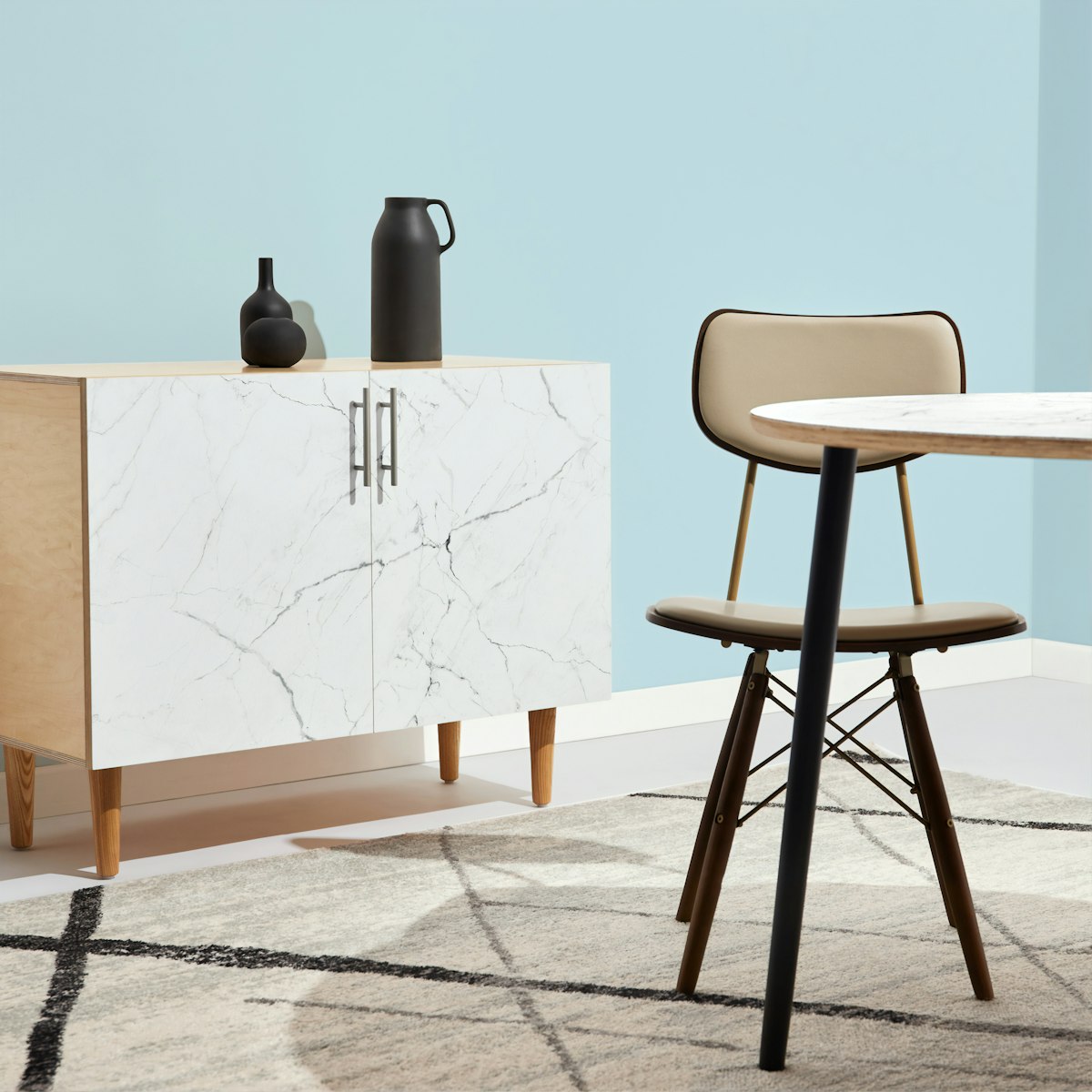
The maintenance requirements for mixed Chinese-contemporary outdoor furniture are material-specific and must be communicated to facilities teams as a documented protocol — not assumed to be intuitive. The most common maintenance error is using pressure washing on teak or rattan pieces specified for powder-coated aluminum — the pressure removes surface treatment on Chinese furniture finishes that cannot withstand the same cleaning regimes as marine-grade metal.
A practical maintenance protocol for mixed-style hotel outdoor furniture: weekly — brush cushions and wipe frames with a damp cloth; monthly — clean rattan weave with mild soap solution and rinse; quarterly — inspect teak for checking (surface cracks) and apply penetrating teak oil to exposed surfaces; annually — inspect powder-coat integrity on all aluminum frames and touch up any chips before moisture penetration begins. Document the maintenance schedule in the furniture package handover documentation — a step that Jade Ant Furniture includes as standard in all hospitality project handovers, ensuring facilities teams have the precise information needed to extend specification life.
Sustainable Material Choices and Lifecycle Considerations
The eco-friendly outdoor furniture market is growing at a CAGR of 9 % from 2025 to 2033, driven primarily by hotel group ESG commitments and the EU’s Corporate Sustainability Due Diligence Directive (CSDDD), which begins phased enforcement from 2027. For procurement teams building mixed Chinese-contemporary outdoor specifications with sustainability credentials, the prioritized specification choices are: FSC CoC-certified teak (verify certificate number at info.fsc.org), GRS-certified recycled HDPE rattan (verify GRS transaction certificate per production batch), and powder-coated aluminum with RoHS-compliant coatings (request test report referencing EU RoHS Directive 2011/65/EU).
Lifecycle cost is a more honest sustainability metric than purchase price alone. A USD 120 FSC teak chair maintained correctly has a 15–20 year functional life in a commercial outdoor environment. A USD 45 non-certified hardwood chair in the same environment typically requires replacement in 5–7 years — a total lifecycle cost that is 30–40 % higher per seat over 15 years, before accounting for replacement logistics. For hospitality procurement teams managing large outdoor furniture programs, this calculation is worth quantifying at the specification stage.
Seasonal Care and Storage Strategies
In temperate climates where outdoor furniture is stored over winter, mixed Chinese-contemporary specifications require clear material-segmented storage protocols. HDPE rattan and powder-coated aluminum pieces can be stacked and stored outdoors under breathable furniture covers. Teak pieces should be stored under cover or indoors in humid climates to prevent accelerated checking during freeze-thaw cycles. Ceramic and stone accent pieces should be brought inside or protected with dense thermal covers in locations with frost risk — unglazed ceramics are particularly vulnerable to freeze damage.
Common Pitfalls and How to Avoid Them
Overloading with Too Many Cultural Cues
The most frequently cited problem in mixed-style outdoor project post-occupancy reviews is cultural overload: too many Chinese motifs introduced simultaneously — carved screens, ceramic garden stools, lattice chair backs, pagoda-form lanterns, and bonsai arrangements — in a space that cannot absorb all of them without becoming thematic. The discipline is selection. Choose one or two points of maximal Chinese expression per zone and let the remainder of the specification be contemporary, neutral, and structurally quiet.
Ignoring Scale and Proportion in Mixed Setups
A traditional Chinese rosewood armchair designed for a 3.5 m ceiling interior will overpower a compact 8 m² rooftop terrace. Scale must be evaluated in the actual space, not in a showroom. For compact commercial outdoor applications — urban terraces, balconies, small hotel courtyard gardens — source Chinese-heritage pieces in scaled-down proportions. Many Foshan manufacturers offer contemporary reinterpretations of classical Chinese outdoor forms in scaled profiles that sit appropriately in compact contemporary settings. Request dimensional drawings before ordering samples for compact spaces.
Inconsistent Weatherproofing Across Elements
A mixed specification that includes commercial-grade powder-coated aluminum frames (10-year warranty) alongside natural bamboo garden stools (1–2 year outdoor lifespan) and natural rattan accent lanterns (no outdoor rating) will produce a space that requires disproportionate ongoing replacement of the heritage elements. Every material in the specification must be evaluated against the same weather performance standard. If a material cannot meet that standard, it must either be confined to covered zones or replaced with a weather-performing equivalent (HDPE rattan instead of natural rattan; glazed ceramic instead of unglazed; stainless steel hardware instead of zinc-plated).
Quick-Start Blueprint
8-Step Checklist to Begin a Mixed Chinese-Contemporary Outdoor Space
- Define the dominant style register for the space (70–80 % contemporary, 20–30 % Chinese-heritage) — this prevents motif overload and sets a clear brief for procurement teams and manufacturers.
- Establish the color palette before specifying any furniture: select warm neutrals for contemporary frames (RAL 7006, RAL 7032, RAL 1015), confirm undertone alignment with Chinese material tones (teak honey, hongmu red-brown, natural rattan).
- Identify focal point positions in the space — typically the primary sightline, entry threshold, or specimen planting zone — and reserve these positions for your strongest Chinese-heritage pieces (carved armchair, lattice screen, ceramic statement piece).
- Specify all material performance standards in writing: powder-coat minimum 60 microns (80 microns coastal), HDPE rattan ASTM G155 2,000+ hours UV resistance, teak FSC CoC certified with stainless Grade 316 fasteners, fabric solution-dyed acrylic minimum 1,000 hours UV resistance.
- Request fabric and material samples before finalizing specification — evaluate samples outdoors in natural light, not in a showroom under artificial light, to confirm undertone compatibility.
- Select lighting at 2700–3000K color temperature for all outdoor fixtures in the zone — confirm this specification with the lighting consultant before finalization.
- Choose planting for sculptural silhouette (bamboo, black pine, ornamental grass) in contemporary planter forms (rectangular poured concrete, square Corten steel, or simple terracotta) — no traditional carved stone containers unless the space is intended as Chinese-dominant.
- Write a material-segmented maintenance protocol and include it in the furniture handover documentation — specifying cleaning methods, frequency, and storage requirements for each material in the mixed specification.
Example Material and Color Swap Guide
| Original Chinese Specification | Weather-Performance Risk | Contemporary-Compatible Swap | Visual Character Preserved? | Maintenance Level |
|---|---|---|---|---|
| Natural rattan weave chair | High — splits in sun/rain | HDPE PE rattan over aluminum frame | Yes — woven texture retained | Low |
| Natural bamboo screen panel | High — cracks, fades outdoors | Aluminum frame with bamboo-print powder coat + real bamboo interior accents only | Partially | Low |
| Unglazed ceramic garden stool | Medium — freeze damage risk | High-fired glazed stoneware garden stool (IP65 rated) | Yes — form and colour retained | Very Low |
| Lacquered wood side table | High — lacquer delaminates outdoors | WPC composite top + teak-look powder-coat base | Yes — finish reference retained | Low |
| Zinc-fastened teak chair | Medium — fastener corrosion | FSC teak chair with Grade 316 stainless fasteners | Yes — identical appearance | Medium (annual oil) |
| Non-certified hardwood bench | Low–Medium (structural OK) | FSC-certified plantation teak or certified acacia | Yes — similar grain character | Medium |
Reference table for B2B procurement teams specifying mixed Chinese-contemporary outdoor furniture packages. All swap recommendations maintain the aesthetic intent of the original specification while meeting commercial weather-performance standards.
Design Philosophy and Practical Next Steps
Blending Chinese outdoor furniture with contemporary patio decor is, at its core, a discipline of controlled contrast. The contrast between a carved teak armchair and a powder-coated aluminum dining table is not a problem to be solved — it is the design. The task is ensuring that the contrast is intentional, proportionally balanced, and materially resolved.
The procurement and design principles in this guide distill to a simple operating framework: establish the dominant contemporary register first (palette, material, spatial language); introduce Chinese design elements at focal points and in carefully controlled quantities; ensure every material in the specification meets commercial weather-performance standards regardless of cultural origin; and maintain the space according to material-specific protocols that preserve specification integrity over the furniture’s full lifecycle.
For B2B buyers — whether specifying a single hotel terrace or a multi-property outdoor furniture program — the advantage of sourcing from Chinese manufacturers who understand both traditions is substantial. Factories in Foshan and Dongguan with a decade of hospitality export experience regularly produce pieces that express genuine Chinese design heritage at powder-coated aluminum price points, when the specification is precise enough to allow it. Organizations like Jade Ant Furniture bridge that gap between design intent and production reality — translating mixed-style design briefs into precise factory specifications with the quality control infrastructure to ensure the delivered piece matches the specified piece.
Experiment with the combinations in this guide. Test a pilot specification before committing to full-project volume. Photograph your material samples in the actual outdoor light of the project location, not in a showroom. And approach the blend as a designer, not a decorator: with the understanding that two great design traditions, placed in disciplined dialogue, can produce outdoor spaces more compelling than either could achieve alone.
Ready to Source Your Mixed-Style Outdoor Furniture Package?
Jade Ant Furniture works with hotels, resort developers, and FF&E consultants to source and manufacture mixed Chinese-contemporary outdoor furniture — from bespoke carved teak pieces to commercial-grade HDPE rattan and aluminum — with full QC coordination and direct shipping.
Request a Sourcing Consultation →Key Terms Glossary
- Mortise-and-Tenon Joinery
- A structural wood joint where a projecting “tenon” inserts into a matching cavity “mortise” — no metal fasteners required. The defining joinery technique in classical Chinese furniture. When visible, it signals hand-crafted production.
- HDPE Rattan (High-Density Polyethylene Wicker)
- Synthetic wicker strand woven over a metal frame. HDPE (high-density polyethylene) resists UV fading and moisture absorption significantly better than standard PE rattan. The commercial standard for weather-rated outdoor rattan furniture.
- Powder Coating
- A dry paint applied electrostatically to metal surfaces and cured under heat to form a hard, weather-resistant layer. Measured in microns (µm). Minimum 60 µm for commercial outdoor use; 80 µm for coastal environments.
- RAL Color Code
- A standardized European color-matching system (e.g., RAL 7006 = Beige Grey). Used to specify powder-coat and paint finishes precisely — eliminates ambiguity between “warm grey” interpretations from different manufacturers.
- FSC CoC (Forest Stewardship Council Chain of Custody)
- Certification that traces wood through every manufacturing step back to a sustainably managed forest. Required for EU Timber Regulation compliance on all wood-containing outdoor furniture entering the European market.
- Solution-Dyed Acrylic (SDA)
- Fabric where color is added to the liquid acrylic before fiber extrusion — color is throughout the fiber, not on the surface. Result: significantly superior UV and wash fastness versus surface-dyed fabrics. Commercial standard for outdoor hospitality cushion covers.
- AQL (Acceptable Quality Limit)
- Statistical sampling standard for quality inspections. AQL 2.5 means the production lot is accepted if no more than 2.5 % of sampled units contain major defects. Industry standard for commercial furniture pre-shipment inspections.
- Undertone Harmony
- The practice of aligning the warm or cool bias (undertone) across materials and finishes in a space. Warm greys harmonize with teak and hongmu; cool greys conflict. The most impactful single specification decision in mixed-style outdoor projects.
- Jiè Jǐng (Borrowed Scenery)
- A classical Chinese garden technique where external views — a mountain, water, mature trees — are framed by the garden’s architecture as if they are part of the space itself. Applied to contemporary outdoor design: use screens and panels to direct sightlines toward the best view from the terrace.
- BSCI / amfori
- Business Social Compliance Initiative: a social audit program covering labor rights, wages, working hours, and child labor across supply chains. Required by most major EU hotel group procurement programs for all furniture suppliers.
Frequently Asked Questions
How can I tell if a Chinese furniture piece will work with a modern patio?
Test two things: silhouette weight and undertone alignment. Match the visual mass of the Chinese piece to the mass of the contemporary elements around it — a carved teak armchair needs a substantial contemporary dining table, not a slender steel frame. Then confirm that the Chinese piece’s tone (teak honey, hongmu red-brown, natural rattan) shares a warm undertone with the contemporary palette (warm grey, sand, off-white). If both tests pass, the pairing will work. If either fails, visual dissonance will persist regardless of styling.
What are the best materials for a durable mixed-style outdoor space?
For the contemporary structural layer: powder-coated cast or extruded aluminum (minimum 60 microns coating thickness, 10-year frame warranty from reputable manufacturers). For Chinese-heritage texture and warmth: HDPE PE rattan weave over aluminum frames (5-year weave warranty, UV-resistant to 2,000+ hours ASTM G155). For statement Chinese accent pieces: high-fired glazed stoneware ceramics (fully weather-rated) and FSC-certified teak with Grade 316 stainless fasteners (15–20 year lifespan with annual oil treatment). Avoid natural rattan, unglazed ceramics, and natural bamboo in any fully exposed outdoor commercial specification.
How do I maintain color coherence across different eras of furniture?
The single most effective tool is undertone calibration. Specify all contemporary powder-coat colors in warm-bias RAL codes (RAL 7006 Beige Grey, RAL 7032 Pebble Grey, RAL 1015 Light Ivory) rather than cool-bias codes (RAL 7001 Silver Grey, RAL 9006 White Aluminium). Specify cushion fabrics in warm off-white or warm sand rather than pure white. Specify lighting at 2700–3000K rather than 4000K+. These three calibrations — frame color, fabric base tone, light temperature — account for the vast majority of color coherence successes and failures in mixed-style outdoor projects.
What is the optimal ratio of Chinese to contemporary furniture in a mixed outdoor space?
For commercial hospitality settings — hotels, resorts, rooftop bars — a ratio of 15–20 % Chinese-heritage pieces to 80–85 % contemporary pieces produces spaces that read as contemporary-dominant while carrying genuine cultural depth. Higher ratios (50:50 or Chinese-dominant) require the full architectural and landscaping context to shift toward Chinese expression — a significant intervention most existing commercial spaces cannot support. The 80/20 rule also has a practical procurement advantage: it allows the Chinese-heritage pieces to be specified at a higher price point (carved teak armchairs, statement ceramic stools) while maintaining overall project cost discipline through the larger contemporary volume.
Can Chinese outdoor furniture meet international safety and certification standards?
Yes — but only when sourced from factories that hold and maintain the relevant certifications, and only when those certifications are independently verified rather than taken on trust. For EU-bound outdoor furniture, require: ISO 9001 (quality management), BSCI or amfori audit (social compliance), REACH test reports (chemical safety), and FSC CoC for any wood-containing pieces. For US-bound pieces, require BIFMA X5.6 test reports for commercial seating and verify that composite wood components meet CARB Phase 2 formaldehyde emission limits. Always verify certificate numbers through the issuing body’s own online database — not through PDFs supplied by the manufacturer.
How do I source Chinese outdoor furniture for a hospitality project without visiting China?
A structured remote sourcing process works for well-defined specifications. Key steps: verify the supplier’s business license at China’s National Enterprise Credit Information System (gsxt.gov.cn); verify certifications independently; request a live 30-minute video factory walkthrough before committing to samples; order counter samples and evaluate them outdoors at the project location before approving a Pre-Production Sample (PPS); commission a pre-shipment inspection through an independent firm such as QIMA or SGS — do not rely on the factory’s own inspection report. For complex mixed-style specifications, a sourcing partner with established factory relationships and in-China QC capability significantly reduces remote-sourcing risk. The hotel furniture sourcing guide at Jade Ant covers this process in detail for hospitality buyers.
What lighting color temperature should I specify for a mixed Chinese-contemporary outdoor space?
Specify all outdoor fixtures at 2700–3000K (warm white). This temperature range brings out the amber and red-brown tones in Chinese hardwoods (teak, hongmu) and harmonizes them with warm-neutral contemporary palette elements. Lighting above 3500K reads as cool or daylight-white, actively conflicts with warm wood tones, and will make even well-specified Chinese furniture appear dissonant against contemporary elements. This is one of the most impactful — and most overlooked — specification decisions in mixed-style outdoor design.
Which plants best complement mixed Chinese-contemporary outdoor furniture?
Prioritize plants chosen for sculptural silhouette over seasonal color. The strongest choices are: bamboo (Phyllostachys aureosulcata in clump form for controllable scale), black pine (Pinus thunbergii — the classical Chinese garden specimen), ornamental grasses (Miscanthus sinensis for movement and contemporary compatibility), and ornamental plum or magnolia as seasonal accent specimens. All of these work in contemporary rectangular planters without needing traditional carved stone containers. The planter provides the contemporary frame; the plant carries the cultural cue.
How does mixed-style outdoor furniture affect the total FF&E budget for a hospitality project?
When executed correctly — with Chinese-heritage pieces used as focal-point accents (15–20 % of units) and contemporary Chinese-manufactured pieces as the volume specification — a mixed-style outdoor program typically costs 40–60 % less than an equivalent specification using European outdoor brands. The savings are generated primarily in the contemporary volume (standard aluminum and HDPE rattan pieces have very competitive FOB pricing from Chinese manufacturers) while the Chinese-heritage accent pieces may carry higher per-unit costs but represent a small fraction of the total unit count. The Bali resort F&B terrace case study cited in this guide achieved a total project cost of USD 68,000 against a USD 134,000 European brand equivalent — a saving that funded the full interior soft furnishing package for the same project.
What are the most common mistakes when mixing Chinese outdoor furniture with contemporary decor?
Three mistakes account for the majority of mixed-style outdoor project failures. First, cultural overload: too many Chinese motifs introduced simultaneously, producing a space that reads as themed rather than designed — the solution is strict motif selection and the 80/20 rule. Second, undertone mismatch: cool-grey contemporary frames specified alongside warm teak or rattan, creating a visual discord that cannot be resolved with accessories — the solution is warm-bias RAL codes and 2700K lighting. Third, inconsistent weatherproofing: natural rattan, unglazed ceramics, or natural bamboo specified in fully exposed outdoor positions alongside commercial-grade aluminum and HDPE rattan, creating a maintenance disparity that generates ongoing replacement costs — the solution is applying a uniform commercial weather-performance standard to every material in the specification, regardless of cultural origin.