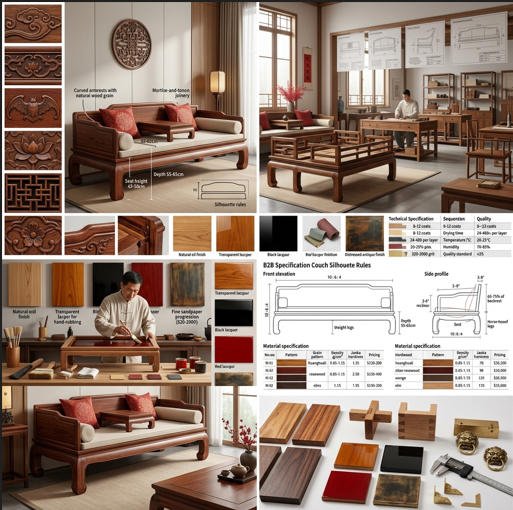

For procurement managers, interior design studios, and hospitality FF&E specifiers, understanding the vocabulary of Ming-era design is not an academic exercise — it is a sourcing advantage. The difference between a Chinese couch that reads as “merely decorative” and one that commands the centre of a lobby or suite lies in three disciplines: motif integrity, lacquer execution, and silhouette proportion. This guide decodes all three.
Chinese couch design carries one of the longest continuous lineages of any furniture tradition on earth. When the Ming dynasty consolidated its cultural output between 1368 and 1644, it produced a set of design principles so precisely resolved — in proportion, joinery, ornament, and finish — that they still function as a legible design language in commercial interiors today. Luxury hotels in Singapore, private members’ clubs in London, and high-end residential projects in the Middle East routinely specify Ming-influenced seating not for nostalgia, but because the visual grammar of the form works across contexts.
This guide maps those principles systematically, from the symbolic logic behind dragon and cloud motifs to the layering chemistry of red and black lacquer, to the seat-height arithmetic that makes a Ming-inspired couch comfortable for modern occupants. At each stage, practical specification guidance is included for B2B buyers working with Chinese manufacturers.
Ming Motifs
Dragons, clouds, ruyi, and geometric fretwork each carry documented symbolic meaning that informs where and how they are placed on a couch form.
Lacquer Finishes
Red and black lacquer applied in 30–120 micro-layers create depth and durability unavailable in any synthetic substitute.
Silhouette & Proportion
Ming proportional restraint — derived from Confucian and Daoist philosophy — produces forms that age without becoming dated.
Material & Joinery
Elm and huanghuali hardwoods, combined with mortise-and-tenon construction, deliver structural longevity measurable in centuries.
Ming Dynasty Influences on Couch Form
Core Principles of Ming Furniture Philosophy
Ming furniture philosophy did not emerge from decorative ambition. It emerged from intellectual constraint — specifically, the Confucian principle that the physical world should reflect moral order, and the Daoist conviction that natural materials carry an intrinsic beauty that human intervention should reveal rather than obscure. A Sotheby’s analysis of Ming-era furniture describes this as “advanced engineering in service of a minimalist aesthetic: simple lines and curves that favour grace over extravagance.”
In practical terms for B2B sourcing, this philosophy produces three rules that still distinguish a Ming-influenced couch from any other design tradition. First, the structural system must be visible — joints are exposed, wood grain is celebrated, and nothing structural is concealed beneath decorative veneer. Second, proportion governs every dimension: the relationship of seat depth to back height, the diameter of the arm rail relative to the leg diameter, the overhang of the apron below the seat frame — all are resolved in fixed ratios that produce an immediate sense of visual correctness. Third, restraint in ornament: decoration is concentrated at transition points (the spandrel between leg and apron, the carved panel of the back splat, the arm terminal) and absent from structural surfaces.
For interior procurement teams, these rules are commercially useful. A couch that follows Ming proportion reads as resolved in any setting — contemporary, transitional, or heritage — without requiring a period-specific context. A couch that merely applies Chinese motif graphics to an unrelated form does not carry this adaptability.
How Scale, Proportion, and Restraint Shape Couch Silhouettes
The proportional system underlying Ming seating furniture is not arbitrary. Researchers at MDPI’s design studies journal have identified a consistent ratio framework in Ming chair and couch construction: seat height to overall height typically falls between 1:2.2 and 1:2.4; seat depth to seat width between 1:1.8 and 1:2.1; and back-post diameter to arm-rail diameter between 1:0.75 and 1:0.85. These ratios produce forms that read as neither heavy nor fragile — a visual characteristic that is immediately perceptible but difficult to articulate without understanding the underlying arithmetic.
The practical consequence for B2B specification: a manufacturer who is genuinely producing Ming-influenced furniture will be able to provide these dimensional ratios for any piece in their catalogue. A manufacturer who is producing “Chinese-style” furniture without this proportional discipline will be unable to explain their dimensions in relational terms — they will simply quote centimetre measurements. The question to ask your supplier is not “what are the dimensions?” but “what is the relationship between seat height and total back height?” The answer reveals whether the design logic is authentic or cosmetic.
Seat height in authentic Ming couch forms typically runs at 46–50 cm — slightly higher than contemporary Western sofas, which typically sit at 40–44 cm. This is not a manufacturing error; it reflects the Ming-era convention of upright, formal posture. For contemporary commercial contexts — hotel lobbies, private clubs, executive waiting areas — this height is often preferred precisely because it facilitates easier ingress and egress for suited occupants and projects visual authority. For residential or lounge contexts where reclined comfort is required, experienced manufacturers like Móveis Jade Ant can adjust seat depth and back angle within the Ming proportional framework to achieve contemporary comfort without breaking the silhouette logic.

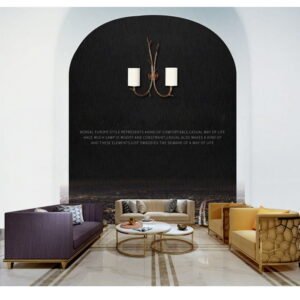
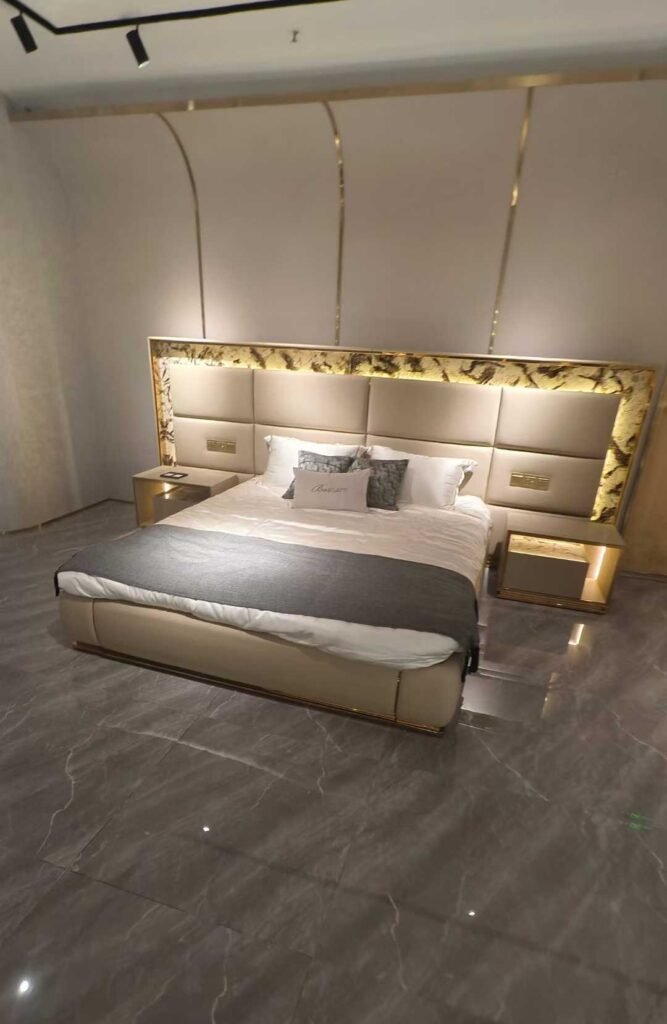
Ming-inspired silhouette in a luxury residential context — the proportional logic of the form operates independently of the surrounding décor scheme.
Key Ming Motifs: Dragons, Clouds, and Geometries
Common Motifs and Their Symbolic Meanings
Motifs in Ming furniture were not selected for visual interest alone. Each carried a documented symbolic function within the Confucian social hierarchy, and their placement on a furniture form was as regulated as their design. Understanding this system allows B2B buyers to specify motifs that are contextually appropriate — and to identify manufacturers who are applying them correctly versus randomly.
O dragon (lóng) is the most iconic Ming motif, but its correct specification is more nuanced than it appears. The five-clawed imperial dragon was reserved exclusively for dynastic use; furniture incorporating five-clawed dragons outside the imperial workshops was technically a capital offence. Contemporary production uses four-clawed dragons for all non-imperial contexts. The distinction matters commercially: a supplier producing hotel furniture with five-clawed dragon motifs for a non-heritage project is either uninformed about the tradition or indifferent to it — neither of which inspires confidence in their design authenticity.
Cloud scrolls (runyun) represent auspicious energy, the breath of heaven, and the vehicle of immortals in Chinese cosmology. On furniture, cloud scroll carvings at the spandrel (the decorative element filling the angle between leg and apron) signal the highest quality carving tier, as the fluid, multi-directional lines of the cloud form require greater skill than geometric patterns. The Shen Yun arts resource on traditional Chinese motifs notes that cloud imagery in classical art carries a consistent seven-hued symbolic palette that informed colour choices in lacquerwork as well.
O ruyi sceptre head motif — a stylised mushroom or cloud form with three lobes — appears as a repetitive border pattern on aprons, back rails, and arm returns. It represents fulfilled wishes and was among the most common motifs across all furniture tiers, making it the appropriate choice for large-volume contract production where individual carving cost per piece must be managed. Geometric fretwork (qingwen) — interlocking square, hexagonal, or stepped patterns — functions as a visual texture on back panels and stretchers, providing visual interest without the labour cost of figural carving.
| Motif | Symbolic Meaning | Typical Placement on Couch | Carving Complexity | Best-fit Application |
|---|---|---|---|---|
| Four-Clawed Dragon | Strength, authority, dynastic prestige | Back splat, arm terminals, apron centre panel | Alto | Luxury hotel, VIP suites, private club |
| Cloud Scroll (Runyun) | Auspicious energy, heavenly blessing | Spandrel, arm rail profile, back rail | Alto | Premium hospitality, branded interiors |
| Ruyi Sceptre | Fulfilled wishes, good fortune | Apron border, back panel frame, stretcher face | Médio | Contract volume, commercial lobbies |
| Geometric Fretwork (Qingwen) | Order, structural harmony | Back panels, arm screens, skirt panels | Baixa–Média | Any tier — high value-to-cost ratio |
| Bat (Fú) | Luck and prosperity (homophone of fú) | Carved back panel, arm top surface | Médio | Residential, resort, hospitality |
Integrating Motifs into Splines, Backs, and Armrests
The placement logic for Ming motifs on a couch form follows a hierarchy of visual prominence. The back splat — the central vertical panel in the backrest, the most prominent surface — receives the highest-complexity motif: typically a single dragon medallion, a central cloud scroll composition, or a figural landscape panel. The spandrels at each leg-to-apron junction receive the secondary motif — cloud scrolls or ruyi patterns in low relief. The arm return faces receive the tertiary motif — geometric fretwork or simple ruyi borders. Surfaces that are structural rather than display (seat rails, stretchers, back posts) receive either no decoration or a single carved bead profile line.
A manufacturer who reverses this hierarchy — placing heavy carving on structural surfaces and leaving display surfaces plain — is producing a misread of the tradition, regardless of how technically accomplished the individual carvings may be. Specifying motif placement by hierarchy rather than just motif type is the mark of a B2B buyer operating at design literacy rather than catalogue-selection level.
Lacquer Finishes: Techniques and Preservation
Traditional Layering, Polishing, and Patination Processes
Natural lacquer — qi in Chinese, urushi in Japanese — is the processed sap of the Toxicodendron vernicifluum tree. It is one of the oldest synthetic materials in human history, with lacquered artefacts from China dating back over 7,000 years. Its chemistry is remarkable: the sap cures not by evaporation but by enzymatic oxidation in a humid environment, producing a cross-linked polymer film harder than most modern coatings. A fully cured natural lacquer surface has a Mohs hardness of approximately 5–6, comparable to glass, and is resistant to water, alcohol, and most organic solvents.
The process of building a traditional lacquered furniture finish involves a minimum of 30 individual coats — and premium heritage pieces carry 80 to 120. Each coat is applied by brush or spatula to a thickness of approximately 0.1–0.15mm, then cured for 24–48 hours in a dedicated humidity chamber at 75–85% relative humidity. Between coats, the surface is hand-polished with progressively finer abrasive — charcoal powder, deer antler ash, and ultimately the craftsman’s palm. The resulting depth — the sense that the surface has interior luminosity rather than a coating sitting on top — is the characteristic no synthetic alternative can reproduce.
For B2B buyers specifying lacquered furniture from Chinese production, the key question is the number of coats in the production specification. Mass-market production uses 5–8 coats of catalysed polyurethane labelled as “lacquer finish”; mid-range production uses 12–20 coats of modified natural lacquer blends; authentic heritage-technique production uses 30+ coats of natural qi. The price differential between these tiers is substantial — but so is the performance differential, particularly in high-humidity climates where synthetic coatings delaminate within five to seven years while natural lacquer can survive centuries.
Differences Between Red and Black Lacquer Aesthetics
Red and black are the two dominant colours in the classical Chinese lacquer palette, and their aesthetic logic — both visual and symbolic — is distinct enough to constitute separate specification decisions for B2B buyers.
Vermilion red lacquer (zhu qi) derives its colour from cinnabar (mercuric sulfide), historically, or from heat-processed iron oxide in contemporary safe production. It carries strong associations with imperial authority, celebration, and auspicious energy in Chinese cultural tradition. Visually, it creates maximum contrast against dark wood tones and reads with high legibility in large-scale interior applications — hospitality lobbies, ceremonial dining, branded retail. Red lacquer on a couch’s carved back splat or arm panels draws immediate visual focus and signals deliberate cultural reference rather than ambient decoration.
Black lacquer (hei qi) — produced by adding iron salts to the raw sap — achieves a depth that is different in character from painted or spray-applied black. When polished, it has a wet, mirror-like reflectivity that reveals colour variation in its depths: dark olive, deep brown-black, and near-purple tones visible as the viewing angle changes. Black lacquer is the more versatile commercial specification: it integrates with neutral, contemporary, and contrast-heavy palettes alike and ages with a distinctive amber-undertone patina that enriches rather than degrades the surface.
O Metropolitan Museum of Art’s exhibition on red and black Chinese lacquer from the 13th–16th centuries provides the most comprehensive publicly available documentation of how these two finishes functioned together in Ming-era furnishing schemes — a useful reference for design teams building period-accurate or period-informed commercial interiors.

Red and black lacquer finishes function as distinct design instruments — not interchangeable colour options — in authentic Ming-influenced furniture.
Colors in Chinese Lacquer: Red, Black, and Natural Tones
Symbolism of Color in Ming-Era Pieces
The Ming colour palette was governed by a five-element colour cosmology (wuxing) in which each primary colour corresponded to a natural element, a cardinal direction, a season, and a set of human virtues. Red corresponded to fire, south, summer, and propriety. Black to water, north, winter, and knowledge. Yellow (reserved for imperial use exclusively) to earth and centrality. Green to wood, east, and benevolence. White to metal, west, and righteousness.
For furniture production, this hierarchy meant that colour choice was a statement of context and intent. Red lacquer on a formal seating piece positioned in a reception hall announced ceremony and authority. Black lacquer in a scholar’s study signalled intellectual refinement and restraint. Natural wood tones — the pale gold of huanghuali (fragrant rosewood), the silver-grey of aged elm — were used when the material itself was the design statement, requiring no additional surface colour to assert quality.
Contemporary B2B applications of this colour logic function most effectively when the symbolic register is maintained even if not explicitly communicated to the end user. A corporate reception lobby with red lacquer couch elements reads as powerful and deliberate without anyone needing to understand the five-element cosmology. A hotel library with black-lacquered seating reads as intellectually serious and composed. The design language carries its own communication without requiring explanation — which is precisely what makes it commercially valuable for international applications.
How Color Choices Influence Modern Couch Styling
In contemporary production, three colour approaches dominate the Ming-influenced couch market. Full red lacquer — applied to the entire exposed wood frame — creates the highest-impact, most overtly Chinese-reference aesthetic, appropriate for flagship hotel projects, branded hospitality, or luxury residential where Chinese cultural identity is explicit. Partial black lacquer — applied to structural elements with natural wood exposed on carved detail surfaces — creates a more versatile, contemporary result that integrates with non-Chinese interior design schemes. Natural-finish hardwood — no lacquer on the frame, with colour introduced only through upholstery textile — produces the most flexible and universally specified approach, allowing the silhouette and joinery of the Ming form to carry the design identity without committing to a strong lacquer colour.
📊 Colour Finish Preferences in Contemporary Ming-Influenced Couch Orders — B2B Contract Market (2024–2025)
Based on combined contract order data from Chinese export furniture manufacturers serving hospitality and commercial interior sectors
Silhouette and Proportions: Clean Lines and Sturdy Frames
Posture, Seat Height, and Leg Presentation in Ming-Inspired Design
The silhouette of a Ming-inspired couch is defined by a specific visual grammar that is immediately legible to trained eyes but also functions subliminally on untrained ones. The key elements are: fully exposed legs of consistent taper from seat rail to floor contact; an apron (the horizontal panel below the seat, above the leg) of precise height — typically 8–12% of total height — bearing the primary carved decoration; a back construction that is either open-frame with a central splat or panelled with a carved back board, never solid upholstered as in Western sofa construction; and arm rails that are continuous with the back posts in a single curved profile, terminating in a carved scroll or cloud-form.
Leg presentation — the visual weight, taper profile, and foot termination — is where the most significant quality variation appears between manufacturers. A correctly proportioned Ming couch leg tapers from approximately 45mm square at the seat rail to 30–35mm at the floor, with the taper beginning at approximately one-third of the leg height from the top. The foot terminates in one of three traditional profiles: a straight cut (the most austere, for literati-style pieces), a hoof foot (mati, a slight outward splay resembling a horse hoof), or a ball foot (baqiu, a rounded terminal used in more decorative contexts). Each foot type carries its own design register; a mati foot on a dragon-splat couch is a contradiction in the same way as Doric columns on a Baroque church.
Achieving Elegance Through Restrained Ornamentation
The restraint principle in Ming ornament is not minimalism in the contemporary sense. It is a hierarchical concentration of effort: maximum skill applied to the point of maximum visual focus, and disciplined absence elsewhere. A craftsman producing a Ming-inspired back splat will spend four to six times longer on that single element than on the entire remaining frame. The result is a couch that rewards close inspection — where the ornamental investment is revealed progressively as the viewer approaches — while reading as clean and architecturally resolved from a distance.
“Ming furniture achieves perfect harmony between substance and empty space — the voids between frame members are as deliberately proportioned as the members themselves.”
— Christie’s Hong Kong, MQJ Collection of Ming FurnitureFor B2B buyers, this principle has direct specification implications. A couch that adds ornament uniformly across all surfaces — fully carved apron, carved legs, decorated arm rails, patterned back panel — is not “more Ming,” it is less Ming. The tradition is one of concentrated expressiveness. Specifying a single carved back panel of museum quality against an otherwise plain frame is a more authoritative design decision than specifying decorative carving on every element at lower quality.
🥧 Ornament Concentration by Furniture Zone — Authentic Ming Tradition vs. Mass-Market “Ming-Style” Production
Inner ring: Authentic Ming ornament distribution. Outer ring: Typical mass-market “Chinese-style” distribution. Note the inversion of back-splat versus leg-face emphasis.
Wood Selection: Elm, Hardwood, and Sustainability
Suitability of Elm and Other Hardwoods for Lacquer Compatibility
The canonical wood of Ming furniture is huanghuali (fragrant rosewood, Dalbergia odorifera), celebrated for its honey-gold colour, its striking grain figure, and its natural oil content that renders the surface almost self-finishing. However, huanghuali is now classified under CITES Appendix II as an endangered species; its legal procurement for new furniture production is exceptionally difficult and expensive, restricting its use to bespoke and limited-edition applications.
The practical alternatives for contemporary B2B production are elm (yumu), walnut, e beech, with elm being the most historically resonant — it was the dominant furniture wood in northern China throughout the Ming and Qing periods and remains widely used in Shanxi and Hebei province furniture production today. Elm’s open grain structure accepts lacquer with excellent adhesion, its natural colour (a warm pale gold-grey) provides a flattering base for both red and black lacquer, and its hardness (Janka approximately 830 lbf) gives it adequate resistance to surface denting in commercial use.
From a lacquer-compatibility perspective, wood selection matters more than it does in paint-finished furniture. Natural lacquer forms a chemical bond with the wood substrate; open-grain hardwoods (elm, oak, ash) accept this bond more readily than close-grain species (maple, cherry), which require additional sealer coats. Walnut, increasingly used in Chinese export production for its dark natural tone and Western market appeal, provides excellent lacquer adhesion and is a legitimate specification for Ming-influenced couches targeting hospitality markets that favour a sophisticated, contemporary-dark colour palette.
Environmental Considerations in Sourcing and Finishing
The EUDR (EU Deforestation Regulation), enforced from 2026 onward, requires full timber chain-of-custody documentation for furniture entering the European market. For B2B buyers sourcing Ming-influenced lacquered furniture from China, this means requesting either FSC certification on the timber substrate or an equivalent PEFC-certified supply chain document. Elm sourced from managed Chinese plantation stock (the dominant supply chain for Shanxi furniture province production) typically carries these certifications when the factory has organised its procurement for European export.
The lacquer finish itself introduces a separate environmental question. Natural qi lacquer is entirely biodegradable and zero-VOC in its cured state; the solvent emissions occur during application and curing, not in end-product use. This makes natural lacquer furniture one of the most environmentally clean surface-finish options in furniture production — a counter-intuitive fact that is commercially useful for procurement teams in projects with LEED, BREEAM, or WELL certification requirements. Synthetic polyurethane “lacquer” substitutes, by contrast, off-gas VOCs in occupied spaces and are subject to GREENGUARD certification requirements in US commercial interiors.
Joinery and Construction: Mortise and Tenon in Furniture
How Traditional Joinery Enhances Durability and Aesthetic of Couches
The mortise-and-tenon joint — where a shaped projection (the tenon) on one timber member fits precisely into a corresponding cavity (the mortise) in another — is the foundational technology of all Chinese furniture construction. Unlike metal-fastener systems, which fail through corrosion, strip-out, or fatigue, properly executed mortise-and-tenon joints distribute stress across the wood grain and, critically, allow the frame to flex slightly under load rather than transmitting stress to a rigid fixed point. Chinese court furniture from the Ming dynasty, now over 400 years old and surviving in museum collections worldwide, demonstrates the longevity ceiling of this construction method.
In couch construction specifically, the mortise-and-tenon joint appears at every critical load point: where the back posts meet the seat rail, where the arm rail meets the back post, where the front legs meet the seat rail, and at the apron-to-leg junction. A quality manufacturer will be able to describe the joint type at each of these locations — there are over a dozen variants in the Chinese furniture joinery vocabulary, from the simple butt tenon to the complex mitre-and-shoulder joint used where three members meet at a corner. The guide to authentic Chinese lacquer furniture notes that mortise-and-tenon construction without glue or nails is the benchmark of heritage authenticity — a frame that holds together by geometry alone.
Visual Cues of Craftsmanship in Exposed Joints
Ming furniture celebrates its joinery. Unlike Western furniture traditions where joints are concealed beneath mouldings, veneers, or upholstery, Ming construction treats the joint as a visual element. On a quality piece, the junction between back post and seat rail will show a clean shoulder line — the flat perpendicular face where the tenon’s shoulder presses against the mortise face — with a gap tolerance of less than 0.5mm. A gap visible to the naked eye at a joint shoulder is a QC failure; a gap you can insert a piece of paper into is a structural concern at volume production.
The exposed joint on a couch leg at the seat rail is one of the most reliable on-site quality indicators available to a B2B buyer during a showroom or factory visit. Run your thumbnail across the joint line. If the joint is flush to within half a millimetre, the precision of the entire production process is almost certainly consistent. If the joint has a visible step, the same imprecision will appear in the motif carving, the lacquer layering, and the dimensional tolerances of the finished piece.

Exposed joinery on a Ming-inspired frame — the precision of the joint shoulder line is the single most reliable on-site quality indicator during factory or showroom inspection.
Watch: The Ancient Craft of Chinese Lacquer — From Tree to Furniture
The following documentary, produced by SLICE, captures the full process of traditional Chinese red lacquer craft as practiced by a father-son artisan family — from harvesting raw qi sap to the final polishing of a completed furniture surface. It provides essential visual context for the layering, curing, and polishing process described throughout this guide, and is a useful reference point for design and procurement teams evaluating the difference between authentic lacquer production and synthetic substitutes.
Surface Decoration: Inlays, Carving, and Painted Motifs
Subtlety vs. Expressiveness in Carved Details
Carved decoration in Ming furniture operates on two registers: low-relief (qiangjin, literally “cutting gold”) and high-relief deep carving. Low-relief carving — where the motif is incised into the surface to a depth of 1–3mm, leaving the surrounding field flat — is the more restrained and, in the Ming tradition, the more prestigious register. It requires exceptional control of the cutting tool to maintain clean, fluid outlines at shallow depth, and the result reads as embedded in the material rather than applied to it. High-relief carving, where motifs project from the surface by 5–15mm or more, is more visually dramatic and more immediately legible from a distance — appropriate for large-scale hotel pieces where the carving must communicate across a lobby, but inappropriate for intimate residential or club seating where close viewing is expected.
The distinction matters for specification: requesting “carved motifs” without specifying relief depth will result in whatever the factory finds most efficient, which is typically medium-depth semi-relief carving of inconsistent quality. Specifying low-relief carving of 2mm maximum depth is a constraint that forces higher-quality tool control and produces the visually sophisticated result the tradition requires.
Lacquered Painting Techniques That Complement Ming Motifs
Three painting techniques appear in the Ming furniture vocabulary. Gold-on-black (jin cai qi) — applying gold leaf or gold powder suspended in lacquer to a cured black ground — produces the most iconic Ming decorative surface: the dark, reflective field with luminous gold motifs. It is technically demanding because gold leaf must be applied to a specific wetness of the underlying coat, and any error in timing produces a matt or uneven gold application. Polychrome painting — applying multiple pigmented lacquer colours over a cured ground — was used primarily in Qing dynasty furniture and appears in contemporary Neo-Chinese design applied to Ming forms; it is a legitimate contemporary interpretation but should be specified as such rather than as “traditional Ming decoration.” Carved and filled (Tixi / Guri) — carving geometric patterns through multiple layers of different-coloured lacquer to reveal the layer transitions as a colour banding effect — is one of the most technically sophisticated lacquer techniques and represents the highest tier of decorative investment available in the category.
Contemporary Interpretations: Modern Homes with Ming Essence
When to Preserve Authenticity vs. Adapt for Interiors
The most commercially successful contemporary applications of Ming furniture design make a clear distinction between two approaches: authenticity (applying the historical design system in its original formal logic, appropriate for heritage hotel projects, museum-quality residential commissions, or Chinese cultural institution installations) and adaptation (deriving the silhouette and proportional logic from Ming precedents while adjusting materials, finishes, and upholstery for contemporary use). Both approaches produce compelling results; the failure mode occurs when neither is committed to — when a designer attempts both simultaneously and produces a piece that reads as neither authentically traditional nor convincingly contemporary.
For hospitality B2B projects, the Neo-Chinese interior design approach developed by Chinese furniture specialists provides the most practically useful framework: it preserves the structural vocabulary of Ming forms — the back post profile, the apron construction, the leg taper — while using contemporary upholstery materials (performance velvets, leather blends, technical fabrics) on the seat and back pad, allowing the couch to deliver both cultural reference and commercial-grade comfort. This approach is particularly effective in mixed-market hospitality environments where guests range from culturally fluent Chinese nationals to international visitors for whom the aesthetic reads simply as refined and distinctive.
Mixing Ming-Inspired Silhouettes with Contemporary Materials
The material pairings that work most reliably in contemporary Ming-influenced couch design are: black lacquer frame with natural linen upholstery (the contrast between the formal, processed frame and the raw textile creates a productive tension); natural elm with dark chocolate performance leather (the wood grain and leather share tonal warmth while differing in surface character); red lacquer frame with smoke-grey velvet (the chromatic contrast is dramatic without being cartoonishly “Chinese”). The pairings that typically fail are: black lacquer with black upholstery (the frame disappears into the pad, eliminating the visual grammar of the Ming form); natural wood with white or cream fabric (produces a Scandinavian reference that overwhelms the Chinese silhouette).
O guide to mixing Italian leather, marble, and timber provides detailed guidance on multi-material balance for luxury interior specifications — a directly applicable reference for design teams working with Ming-inspired couches in complex material environments.


Care, Maintenance, and Restoration of Chinese Lacquered Couch
Cleaning, Climate Control, and Handling Tips for Lacquer Finishes
Lacquer furniture care is a topic most Chinese manufacturers provide inadequate guidance on, which creates avoidable damage in client installations. For B2B buyers delivering lacquered couch furniture to hospitality or commercial clients, the following protocols should be provided in writing at handover, as they directly affect the service life of the finish and the frequency of touch-up requirements.
Cleaning should be limited to a dry or barely-damp lint-free microfibre cloth. No commercial spray cleaners, aerosol waxes, or silicone-based polishes should ever be applied to natural lacquer surfaces — these create a progressive build-up that dulls the finish permanently and cannot be reversed without professional stripping. Water is the most common cause of lacquer damage in commercial environments: any spill that sits for more than 60 seconds will leave a white bloom (lacquer blushing) that requires professional consolidation to remove.
Climate control is the single most important variable for long-term lacquer preservation. The ideal indoor environment for lacquered furniture is a relative humidity of 50–60% and a temperature range of 18–24°C. Below 30% humidity — common in centrally heated hotel rooms in northern hemisphere winter — the wood substrate contracts faster than the lacquer shell can accommodate, producing micro-cracking at stress points (typically along grain lines and near joint shoulders). Above 75% humidity — relevant for Southeast Asian coastal installations without consistent air conditioning — the wood expands, creating convex surface distortion and potential lacquer lifting at edges. Specialist lacquer conservators recommend a room humidifier adjacent to lacquered furniture in any climate where winter heating drops ambient humidity below 40%.
Physical handling requires that lacquer surfaces never make contact with other lacquer surfaces during transport or storage — the hardness-on-hardness contact will produce permanent scratch marks. All lacquered pieces should be individually wrapped in acid-free tissue paper and then blanket-padded before crating. This protocol is standard practice for art-quality lacquer but is often omitted in standard furniture logistics unless explicitly specified in the purchase order.
| Maintenance Task | Frequência | Método | Common Mistake to Avoid |
|---|---|---|---|
| Dust removal | Daily / as needed | Dry microfibre cloth, light touch | Spray dusters, abrasive cloths |
| Surface cleaning | Weekly | Barely-damp lint-free cloth, dry immediately | Commercial polish, silicone spray, aerosol wax |
| Humidity monitoring | Continuous (seasonal adjustment) | Maintain 50–60% RH with humidifier/dehumidifier | Placing near HVAC vents or direct heat sources |
| UV protection | Em andamento | Diffuse or indirect lighting; UV-filtering glass if near windows | Direct sunlight or unfiltered halogen spotlights |
| Surface touch-up | As needed (every 3–5 yrs in commercial use) | Specialist lacquer restorer only | DIY paint matching, polyurethane top-coat application |
When to Consult Specialists for Restoration and Touch-Ups
Three conditions require specialist consultation rather than in-house maintenance. First, any lacquer lifting or flaking — where the lacquer film has separated from the substrate — should not be touched until a conservator has assessed whether the lifting area can be consolidated from below or must be removed and relaid. Pressing lifted lacquer down with finger pressure or adhesive tape is the single most destructive action an uninformed person can take. Second, deep scratches that have penetrated through multiple lacquer layers and into the substrate require colour-matched lacquer application in multiple thin coats by a practitioner who understands the curing requirements — any single-coat fill will be visually obvious in the surface under oblique lighting. Third, any piece that has been subject to water immersion or extreme humidity damage requires professional de-humidification before any surface work is attempted — consolidating lifting lacquer over a still-wet substrate guarantees re-lifting within weeks.
For B2B buyers supplying lacquered furniture to hospitality or institutional clients, building a specialist restoration contact into the after-sales service package — and providing a named conservator alongside the product handover — is a meaningful competitive differentiator. Most Chinese furniture manufacturers do not provide this; those that do are communicating a level of product confidence that influences repeat procurement decisions.
Terminology Reference
- Qi (漆) / Urushi
- The natural sap of the Toxicodendron vernicifluum tree. Cures to a hard, waterproof polymer film through enzymatic oxidation in humid conditions. The raw material of authentic Chinese lacquer.
- Mortise and Tenon
- The foundational Chinese furniture joint: a shaped projection (tenon) fits precisely into a corresponding cavity (mortise) in an adjacent timber. No nails or glue required in finest-quality work.
- Back Splat
- The central vertical panel in the backrest of a Ming-style chair or couch. The primary carved surface; receives the highest-quality and most complex motif work.
- Spandrel
- The decorative element filling the angle between the vertical leg and the horizontal apron. Secondary ornament placement in Ming hierarchy.
- Huanghuali (黃花梨)
- Fragrant rosewood (Dalbergia odorifera). The prestige wood of Ming furniture. Now CITES Appendix II protected; legal for new production only in very limited circumstances.
- Ruyi (如意)
- A three-lobed sceptre head motif symbolising fulfilled wishes. One of the most common Ming ornamental patterns; used on aprons, back rails, and border decorations across all furniture tiers.
- Qingwen (清紋)
- Geometric fretwork pattern. Interlocking squares, hexagons, or stepped forms used as a carved texture on back panels and secondary surfaces. High visual value-to-cost ratio.
- Mati Foot (馬蹄)
- Horse-hoof foot profile — a slight outward splay at the base of the couch leg. The most common Ming leg termination, used across all contexts from literati to palatial settings.
- Cinnabar
- Mercuric sulfide: the mineral historically used to produce vermilion red lacquer. Contemporary safe-production equivalents use heat-processed iron oxide pigment to achieve the same colour.
Ming motifs, lacquer finishes, and silhouette proportion are not independent aesthetic choices — they are a coherent design system whose individual elements reinforce and depend upon each other. A dragon splat carved in low relief on a correctly proportioned back post, lacquered in black with gold-leaf detailing and mounted on a mati-foot leg of the right taper, produces a result that is immediately recognisable as authoritative Chinese craft. Any one of those elements specified incorrectly — the wrong relief depth, the wrong lacquer tier, the wrong foot profile, the wrong proportional ratio — degrades the whole.
For B2B buyers — whether specifying a twenty-piece hotel lobby package or a bespoke singular commission — the practical takeaway is that the design vocabulary of Ming furniture is precise enough to be specified in writing. Motif type, placement hierarchy, and carving relief depth. Lacquer type, layer count, and colour. Timber species, joint type, and dimensional ratios. A manufacturer who can receive, confirm, and produce to this level of specification is a manufacturer working within the tradition. A manufacturer who can only respond to photographic reference or catalogue selection is working outside it.
The furniture tradition that produced the pieces now displayed in the Metropolitan Museum and the Palace Museum Beijing was built on exactly this kind of specification discipline — craftsmen working to documented standards of material, proportion, and technique. Contemporary B2B applications of that tradition perform best when the same discipline is applied to the sourcing process. For procurement teams beginning that process, the Jade Ant Furniture living room collection e o Chinese contract furniture review guide are practical starting references for understanding what current production standards look like at the premium Chinese export tier.
Specifying Ming-Inspired Couches for a Commercial or Hospitality Project?
Jade Ant Furniture works exclusively with B2B clients — hospitality operators, interior design studios, and furniture importers — to produce custom-specified lacquered and carved furniture with full material documentation, pre-production sampling, and pre-shipment inspection support. Ming-influenced couch forms are available in natural hardwood, black lacquer, and red lacquer finishes with custom motif and upholstery specification.
Start a Custom Specification →