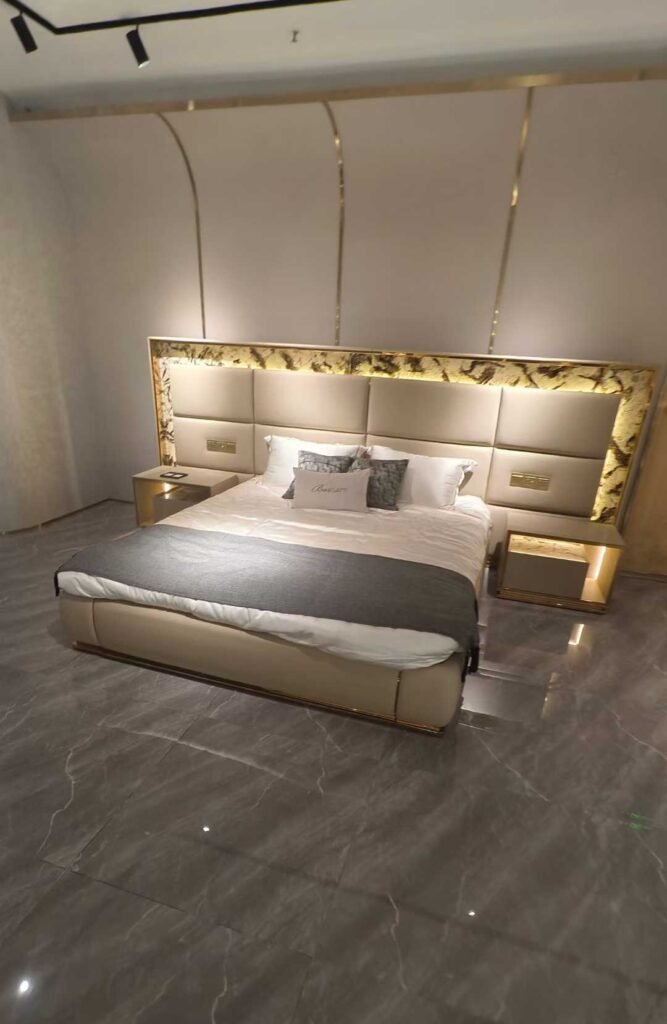

A room can look expensive and still be built cheaply. A room can also look quiet and simple and still be solid in year twelve. The difference is rarely the showroom. It is the supplier behind the showroom.
Most buyers see the same thing in a sales meeting: a nice sample, a glossy catalogue, and a price that feels too good for the finish. The information that decides the project sits somewhere else. It sits in the foam density, the veneer thickness, the moisture reading on the frame, and the date the factory can actually ship.
This guide gives you a ten-part framework for judging that information. You can score every supplier on the same ten points. Then you compare numbers instead of impressions. The framework is written for importers, designers, developers, hotel buyers, and private label owners who need a partner, not a one-off deal.

A calm, high-value dining room. The price of this look is set long before the styling, in the frame and the fabric.
The Strategic Paradox of Affordable Luxury in High-End Procurement
Affordable luxury sounds like a contradiction. In trade procurement it is a ratio, not a price point.
Affordable luxury means a piece that meets a written specification at a price that still leaves money for the rest of the project. The word affordable describes the total cost of ownership, not the invoice. A USD 900 chair that lasts four years is more expensive than a USD 1,600 chair that lasts twelve.
Here is the gap in real numbers. Take a 120-key hotel with a loose furniture budget of USD 4,200 per key. A well-known European brand quotes about USD 9,800 per key for a similar silhouette and a similar fabric. The difference is USD 672,000 across the project.
That money is real. It can pay for better mattresses, better lighting, more art, or a contingency line that saves the schedule when the site runs late. Owners and developers know this. It is why the affordable luxury tier exists and keeps growing.
The same gap is also where failures live. Three parts usually get cut first:
- Foam density in seat cushions
- Veneer thickness on case goods
- Frame joinery inside the upholstery
None of these show in a photograph. All of them show in year three, when the sofa sits low on one side and the table edge has chipped through to the core.
Two different things get called affordable luxury, and buyers mix them up. The first is a brand premium removed: the same frame, the same foam, the same factory, sold without the label. The second is a cheaper build dressed in a good photograph. The first is a legitimate sourcing strategy. The second is a claim that fails on site.
Le global furniture market outlook shows steady growth in the mid and upper segments. That growth is exactly why the second kind of supplier is getting better at sounding like the first.
So the job is not to avoid the affordable tier. The job is to separate suppliers who engineer to a spec from suppliers who style to a photo.
This framework does that in ten checks. Give each check a score from 1 to 5. A supplier that scores below 3 on materials or quality control fails, no matter how good the price looks.
Material Integrity and Craftsmanship Audit
True luxury is defined by how long a material holds up and where it came from, not by how the finish looks on delivery day.
Start with the frame. A contract-grade frame uses kiln-dried hardwood. The moisture content should sit between 8% and 12%, and it should match the climate of the destination. A frame dried to 8% and shipped to a humid coastal market will swell. A frame dried to 14% and shipped to a dry climate will shrink and split at the joints.
Ask for a moisture reading on the day of your visit. A good factory keeps a meter in the QC room and uses it without being asked.
Foam, fill, and the seat you actually sit on
Seat foam for contract use should sit around 35 to 40 kg/m³. Residential-light foam sits at 25 to 28 kg/m³. The difference is not visible. It shows up as a hollow seat after eighteen months of daily use in a lobby.
Ask three questions:
- What is the foam density in the seat core?
- Is there a wrapped layer or a memory topper?
- What is the expected compression set after 80,000 cycles?
A supplier who answers with a number is a supplier who buys to a spec. A supplier who answers with “high density” is guessing.
Leather and fabric
For leather, ask for top-grain or full-grain, and ask for the thickness in millimetres. Contract upholstery usually sits at 1.2 to 1.4 mm. Corrected-grain leather is sanded and stamped. It looks uniform and wears fast on arms and seat fronts.
For fabric, ask for the Martindale rub count. Residential fabric often sits at 20,000 cycles. Contract fabric starts around 30,000, and hotel lobby seating is safer at 40,000 and above.

Texture sells a room. Rub count keeps it selling for five years.
Hardware, edges, and the parts nobody photographs
Hinges, runners, and edge banding decide how a piece feels in daily use. Ask for the brand of the hinge and the load rating of the runner. Soft-close hardware from a known maker costs a few dollars more per unit and removes a whole category of service calls.
Edge banding gets the same treatment. A 2 mm ABS edge protects a table top from chair knocks. A 0.5 mm edge lifts within a year in a busy dining room. Nobody photographs the edge on a proposal. Everybody notices it in year two.

A stone top hides nothing. The edge profile and the joint line tell you how the base was built.
Joinery and finish
Look inside a drawer, under a seat, and behind a headboard. These are the three places where cost is either spent or saved.
| What to inspect | Strong answer | Warning answer |
|---|---|---|
| Frame joints | Dowel plus screw plus corner block, glued and clamped | Staples only, or screws into end grain |
| Drawer boxes | Dovetail or doweled, 12 mm sides, metal runners | Stapled boxes, 9 mm sides, no runners |
| Veneer | 0.6 mm sliced veneer, matched grain, solid edge banding | 0.2 mm paper-thin veneer, printed edge tape |
| Finish | Three coats, hand-rubbed between coats, edges sealed | One heavy coat, sharp edges, no sanding between |
| Underside | Sanded, sealed, dust-free | Rough, unsealed, staples exposed |
A pattern we see in quotes: moving from 0.2 mm to 0.6 mm veneer adds roughly 15% to 20% to the panel cost. Repairing a chipped 0.2 mm top after installation usually costs more than the whole panel. The cheap choice is only cheap on the day of purchase.
This is where a written spec earns its place. The contract spec sheet we build at Jade Ant furniture lists frame moisture and foam density before it lists the fabric code. Buyers who copy that order of priority tend to get fewer surprises.
If wood cores confuse you, this comparison of solid wood and engineered cores explains where each one belongs. For budget maths, this breakdown of cost and quality trade-offs shows which upgrades actually pay back.
Production Capacity and Scalability Analysis
A supplier that can double output without dropping quality has already solved the hardest part of manufacturing.
Capacity is not a number on a website. It is a set of constraints: spray booths, sewing lines, cutting machines, drying rooms, and skilled hands. Ask how many of each exist, and ask how many are running on your visit day.
MOQ is a cash-flow number, not a quality number
Quantité minimale de commande means minimum order quantity, the smallest run a factory will accept. Buyers often treat a low MOQ as a sign of flexibility. In practice, a low MOQ mostly means you are paying for changeover time.
| Order type | MOQ typique | What it does to your risk |
|---|---|---|
| Stock program, existing finish | 1 to 5 units per SKU | Low stock risk, least control over spec |
| Semi-custom, standard frame | 20 to 50 units | Balanced. Small spec changes allowed |
| Full bespoke, new frame | 50 to 100 units | High control, high tooling and sampling cost |
| Private label with own hardware and labels | 100 to 300 units | Best unit cost, longest commitment |
The real question is not “what is your MOQ”. It is “what happens to the price at 60 units versus 120 units, and where does the curve flatten”. Ask for the price at three quantities. A supplier who cannot produce a curve does not know their own cost structure.

The cutting room tells you more than the showroom. Look at the offcut pile and the blade condition.
Lead time, honestly counted
Most lead times are quoted from deposit, not from the day you send a purchase order. Add drawing approval, sample approval, and the Chinese New Year shutdown, which removes three to four weeks from the calendar between January and March.

Planning figures from live project schedules. Bespoke work adds weeks at the sample stage, not at the machine.
Ask one question that separates mature factories from the rest: “Which department is the bottleneck this month?” A factory that answers “finishing” or “upholstery” is watching its own line. A factory that answers “we have no bottleneck” is not.
Here is what a working plant looks like from the inside. Watch two things in this walkthrough: the material check in the first minutes, and the number of times a unit is handled between cutting and packing.
https://www.youtube.com/watch?v=nC-jHd5vipI
A high-volume furniture plant, filmed start to finish. Handling steps are the quiet cost that shows up in your lead time.
Phased projects
Hotels, villas, and multi-building developments rarely order everything at once. Ask for a hold-and-release plan. You commit to a volume, the factory holds raw material, and you call off shipments by phase. This protects the price and protects your cash flow at the same time.
Our guide to sourcing strategy for importers covers how to structure that commitment. If you are building your own brand, the private label programs page explains what changes when your name goes on the label.
Customization Capabilities and Design Flexibility
For architects and designers, the ability to change a specification late is not a luxury. It is a working requirement.
Good suppliers run a defined pipeline: shop drawing, sample, approval, production. Weak suppliers run a conversation. Ask to see the pipeline as a document with dates.
The bespoke pipeline
A shop drawing is the technical drawing a factory produces from your design. It shows dimensions, materials, joint details, and hardware. It is the document that decides what gets built.
Ask for these four timings:
- Shop drawing turnaround: 5 to 7 working days is normal
- Physical sample: 15 to 20 working days for upholstery
- Finish sample on your own substrate: 7 to 10 working days
- Revision round: 3 to 5 working days
Then agree how many revisions are free. Two rounds is a fair standard. After that, the factory is entitled to charge, and you should expect it.
COM and the yield problem
COM means customer’s own material, the fabric or leather you supply. The trap is yield. A plain fabric needs about 1.4 times the finished surface area. A large repeat pattern can need 2.2 times, because the factory must match the pattern across seams and cushions.
A supplier who quotes COM without asking about the repeat is a supplier who will send you a shortfall invoice later. Send the fabric specification, not just the name.
Site constraints
Custom work often fails at the door, not at the machine. Ask the factory to check the lift dimensions, the stair turn, and the ceiling height before production. A three-metre sofa that cannot enter the building is a total loss, and it happens more often than the industry admits.

Hospitality work punishes guesswork. Every fixed element here had to pass a lift, a corridor, and a fire test.
This is the stage where the custom manufacturing workflow matters more than the catalogue. Designers who write tight specifications will recognise their own checklist in this FF&E specification guide.
Quality Control (QC) Systems and Risk Mitigation
A quality control system is the only thing standing between a good sample and a bad container.
Quality control, or QC, is the set of checks a factory runs on materials, work in progress, and finished goods. A real system has three gates, and each gate has a form with a signature on it.
The three gates
- Incoming material check. Veneer, foam, fabric, and hardware are checked against the approved sample before they enter the line.
- In-process check. Frames, joints, and foam are checked after assembly and before upholstery covers them.
- Final check. Dimensions, finish, function, and packing are checked before cartons close.
Ask to see the blank forms. A factory that cannot show a form has no system, only good intentions.
On Jade Ant furniture project orders, each gate produces a dated photo set, filed by room and SKU. It takes about ten minutes a day, and it ends most damage claims inside a week.
AQL and what it really means
AQL stands for acceptable quality limit. It is the sampling standard used to accept or reject a batch. For furniture, a common starting point is AQL 2.5 for major defects, 4.0 for minor defects, and zero tolerance for critical defects.
Agree these numbers in the purchase order, not in an email after the goods are packed. Then the inspection is a decision point, not an argument.
An illustrative repair model from project claims. The same defect costs about twelve times more once it is installed.
Third-party inspection
A supplier who welcomes an independent inspection is confident. A supplier who resists one is telling you something. Ask two questions:
- Will you accept a third-party inspector at 100% production, before packing?
- Will you share the full report, including photographs, without edits?
Factories that pass this test are usually the ones that also pass on time.
Defect management
Agree the replacement clause before you pay. Who pays for the return freight? Who pays the duty on the replacement? What is the deadline for a claim after delivery? A five-line clause here saves months of arguing.
The practical checklist we use for pre-shipment inspection covers photos, carton marking, and packing tests. It also pairs well with this list of red flags in a factory visit.
Compliance, Certification, and Global Standards
Compliance is a risk file, not a paperwork exercise.
A hotel operator who fails a fire inspection loses revenue the next morning. A developer who cannot produce a formaldehyde declaration can lose a certificate of occupancy. These are not abstract concerns. They are schedule risks.
What to demand, by market
| Standard | What it covers | Who usually asks for it |
|---|---|---|
| CAL TB 117-2013 | Upholstery flammability for US contract seating | US hotels, universities, public buildings |
| BS 5852 | Flammability for UK and EU contract furniture | UK and EU hospitality projects |
| TSCA Title VI and CARB P2 | Formaldehyde limits for composite wood | US importers and specifiers |
| FSC chain of custody | Responsible forest sourcing, tracked through the supply chain | Developers with green building targets |
| Norme OEKO-TEX Standard 100 | Harmful substances in textiles | Brands with consumer safety policies |
| GREENGUARD Gold | Low chemical emissions for indoor air | Schools, healthcare, LEED projects |
Two practical habits reduce compliance risk. First, ask for certificates with your company name and the order reference on them, not generic PDFs from 2019. Second, ask which laboratory ran the test and when it expires.
Shipping documents
Customs does not care how good the sofa looks. It cares about codes and values.
Ask your supplier to confirm the HS code for each item, the country of origin, and the treatment certificate for any solid wood packing material. The harmonized system codes come from the World Customs Organization, and a wrong code can move your duty rate by double digits.
US importers should also check the customs entry requirements before the first shipment, not after the container arrives. A missing bond or a wrong value declaration stops the container at the port, and storage fees run daily.
For green building projects, ask for FSC chain of custody documentation that matches the actual order. For indoor air quality, GREENGUARD Gold certification is the certificate most specifiers accept without further questions.
Logistics Infrastructure and Supply Chain Reliability
The luxury experience ends at the curb if the crate fails.
White glove delivery means a trained two-person team carries the piece inside, places it, assembles it, and removes the packaging. It is standard for villas and branded residences. It is rare for a factory that only ships containers.
Packaging standards
Ask for the packing specification in writing. A contract-grade pack usually includes:
- A double-wall carton with a minimum burst strength of 200 lb
- Moulded corner protection on every edge
- A moisture absorber for long sea transit
- Carton marking with room number, SKU, and orientation arrows
- A container loading plan that keeps weight low and heavy items off upholstery
In our experience with project claims, most transit damage traces back to packing and container loading, not to the shipping line. A crushed corner is usually a stacking decision made in a warehouse, not an accident at sea.

Packing is where a good factory becomes a reliable one. Watch how corners are protected, not how fast the line moves.
The sub-tier supply chain
Ask who supplies the fabric, the foam, and the hardware. Then ask what happens if that supplier runs late. A factory with one fabric mill and no approved alternative will delay your order for reasons that have nothing to do with your project.
Bien freight and delivery planning starts at the packing table. The landed cost breakdown shows why a lower FOB price can still deliver a higher final cost.
Container fill is a design decision
A 40HQ container holds about 68 cubic metres. Sofas are mostly air, so a supplier who designs frames to stack and legs to detach can fit 30% more units in the same box. On a 200-unit order, that difference is a full container, and a full container is one of the largest single savings available to an importer.
Ask for the loading plan before production, not after. Ask how many units fit per container, and ask for the carton dimensions. If the supplier cannot answer, they are planning your order on the day it ships.
Financial Stability and Partnership Terms
A supplier with weak cash flow will eventually pass that weakness to you.
Factories fund material, labour, and freight before they get paid. When cash is tight, the first things to slip are material quality and staff retention. Both show up in your order.
Payment terms
| Structure | Typical use | What to watch |
|---|---|---|
| 30% deposit, 70% before shipment | Standard stock and semi-custom | Inspect before you release the balance |
| 30% deposit, 40% before shipment, 30% after arrival | Larger project orders | Confirm the inspection trigger in writing |
| Letter of credit at sight | First orders with new partners | Fees and document accuracy matter |
| Open account, 30 to 60 days | Repeat partners with history | Only after two clean shipments |
Never release the balance before the inspection report. The report is your only leverage, and leverage is cheaper than a lawyer.
Pricing transparency
Ask for a quote that separates product cost, packing, inland transport, and freight. Then ask which Incoterm applies. Incoterms are the standard trade terms that decide who pays for transport, insurance, and duty at each point.
Le Incoterms 2020 rules are worth reading once. Most pricing arguments are actually delivery-term arguments.
FOB is the most common term for furniture. DDP looks simpler because one number covers everything, but it hides the duty and the broker fee inside the unit price. If you compare FOB and DDP quotes side by side, convert both to landed cost first.
Price validity and currency
Ask how long the quote holds. Sixty days is normal. Thirty days is common in a rising material market. A quote with no expiry date is a quote that will be revised at deposit.
Ask which currency the price is set in, and who carries the exchange risk. If the quote is in US dollars and the factory pays its workers in local currency, a 5% currency move can wipe out the factory’s margin, and the factory will recover it somewhere in your order.
Warranty and after-sales
Ask for the warranty in writing, by component. A fair structure for contract furniture looks like this:
- Frame and structure: 5 years
- Foam and suspension: 3 years
- Upholstery and finish: 2 years
- Hardware and mechanisms: 2 years
Then ask how a claim is handled in practice. Who inspects? Who decides? How long does a replacement take? A warranty with no process is a marketing line.
Le high-value order checklist turns these terms into questions you can send by email. The import roadmap shows where each decision sits in the timeline.
The Strategic Evaluation Checklist: A Practical Implementation Tool
Standardising the evaluation keeps the process objective when three vendors are all charming.
Score each pillar from 1 to 5. Multiply by the weight. Add the total. Compare suppliers on the same sheet, on the same day.
| Pillar | Weight | What a 5 looks like | Score |
|---|---|---|---|
| Material integrity | 20% | Written spec, tested samples, moisture records | |
| Craftsmanship and finish | 10% | Clean joints, even coating, sealed edges | |
| Production capacity | 10% | Clear bottleneck, realistic schedule, phased plan | |
| Customization | 10% | Fast drawings, defined revision policy, COM yield advice | |
| Quality control | 15% | Three gates, AQL agreed, third party welcome | |
| Compliance | 10% | Current certificates, correct HS codes, full documents | |
| Logistics and packing | 10% | Packing spec, loading plan, white glove option | |
| Financial terms | 5% | Transparent quote, fair warranty, clear claim process | |
| Communication | 5% | Named contact, replies in 24 hours, written answers | |
| Trial order result | 5% | On spec, on time, no unplanned rework |
Two rules make the matrix work. First, any score below 3 on material integrity or quality control is an automatic fail, whatever the total says. Second, do not average across people. One buyer scores, one reviewer checks.
The red flag list
Some answers should end the conversation. These are the ones we see most often:
| Red flag | Why it matters |
|---|---|
| “Our quality is the best in China” with no spec sheet | Claims without numbers cannot be verified |
| No moisture meter in the factory | Frame defects appear after delivery |
| Refuses third-party inspection | The factory knows what an inspector will find |
| Quotes a lead time without asking for drawings | The date is a guess |
| Cannot name the foam density | The foam is bought on price, not spec |
| Sends a different sample from the production unit | The sample was made by the best team, once |
| No written warranty by component | Claims will be negotiated case by case |
| Price drops 30% with no spec change | Something in the build changed |
A cheap quote is not a red flag by itself. A cheap quote with no explanation is.
The trial order
Before a full rollout, place a trial order. One to three SKUs is enough. Keep it small, keep it documented, and treat it as a test of process rather than product.
A good trial order tests five things: drawing accuracy, sample match, packing quality, document accuracy, and response time when something goes wrong. Deliberately include one custom item. That is where the process shows itself.
Score twice, then decide
Score every supplier once from documents and once after a visit or a live video walkthrough. The gap between the two scores is the most useful number on the sheet. A supplier who scores 4.2 on paper and 2.8 in person is selling a brochure. A supplier who scores 3.8 both times is telling you the truth, and truth is worth more than a perfect pitch.
Set a decision date before you start. Three suppliers, two weeks, one matrix. Procurement that drifts across three months loses the price it negotiated in week one.
Jade Ant furniture runs this same sequence on first orders, because a small failure is cheaper to find than a large one. If you need a single partner for a mixed project, this single-source supply model for hotels explains how one production plan can cover case goods, seating, and outdoor pieces. Design teams who want to see how their requirements translate into production can read what designers expect from a supplier.
Transitioning from Vendor to Strategic Partner
The ten pillars come down to one idea. You are not buying furniture. You are buying the probability that the project opens on time, looks right, and still looks right in year five.
A supplier who passes this framework gives you three things that a cheap supplier cannot. Predictable quality across phases. A schedule you can promise to an owner. A paper trail that satisfies compliance, insurers, and your own client.
The cost difference is usually smaller than buyers expect. Across the quotes we see, a well-run factory with a written spec lands within 10% to 15% of the cheapest credible offer. The cheapest offer, in turn, carries a repair and replacement exposure that is often larger than that gap.
That is the trade. Pay a little more for process, or pay later for problems.
If you are evaluating suppliers for an upcoming project, send us your project brief and the Jade Ant furniture team will return a spec sheet, a lead time, and a cost breakdown in the same format. You can also view current collections to see how the finishes and frames are built.
Glossary
| Terme | Plain meaning |
|---|---|
| Affordable luxury | A product that meets a written spec at a price that keeps the project viable |
| Quantité minimale de commande | Minimum order quantity. The smallest run a factory will accept |
| COM | Customer’s own material. Fabric or leather supplied by the buyer |
| AQL | Acceptable quality limit. The sampling rule used to accept or reject a batch |
| FF&E | Furniture, fixtures, and equipment. The loose and fixed items in a project |
| Shop drawing | The factory’s technical drawing made from your design |
| Kiln-dried | Wood dried in a controlled oven to a target moisture level |
| Top-grain leather | The upper layer of the hide, lightly sanded but not stamped |
| Veneer | A thin slice of real wood glued to a panel surface |
| White glove delivery | Inside delivery with placement, assembly, and packaging removal |
FAQ
How do I verify that a supplier’s luxury claim matches the real material grade?
Ask for three documents and one physical test. The documents are the material spec sheet, the foam density certificate, and a moisture reading from the frame. The test is a cut sample: ask for a 10 cm offcut of the veneer and a foam cube from the same batch. Then compare them with the approved sample. A supplier who sells real spec will send these within a day.
What is a realistic lead time for custom luxury furniture today?
From approved drawing to FOB, plan on 10 weeks for semi-custom and 16 to 19 weeks for full bespoke. Add three to four weeks if your order overlaps Chinese New Year. Add two weeks for sea freight to Europe or the US East Coast. Any quote far below these numbers usually means the factory is counting from a later start date.
How can I negotiate MOQ without damaging craftsmanship?
Negotiate the frame, not the finish. Offer to accept one standard frame with a limited finish range, and ask for a lower MOQ on that basis. Factories lose money on changeovers, not on units. If you can reduce changeovers, you can usually reduce the minimum. Ask for pricing at three quantities so you can see where the cost curve flattens.
Which certifications should I require for hotel and hospitality projects?
At minimum: CAL TB 117-2013 or BS 5852 for upholstery flammability, TSCA Title VI or CARB P2 for composite wood, and OEKO-TEX Standard 100 for textiles. Add FSC chain of custody if the project has green building targets, and GREENGUARD Gold if indoor air quality is specified. Ask for certificates that name your order, not generic files.
What do I do when the sample is perfect but bulk production is not?
Stop the shipment before it leaves. Compare the bulk unit against the signed approval sample, photograph the differences, and issue a written corrective action request with a deadline. Then require a re-inspection of the corrected batch. If the gap is structural, ask for a rework plan with dates. Do not accept a verbal promise, and do not release the balance.
What are the most common hidden costs when importing affordable luxury furniture?
Five appear again and again: duty calculated on the wrong HS code, freight surcharges added after booking, port storage when documents are late, inland delivery that excludes lift access, and replacement freight for damaged units. Ask for a landed cost sheet that lists every line, and compare suppliers on that sheet rather than on the FOB price.
How can I be sure a supplier can handle a sudden volume increase?
Ask for the production schedule with your order slotted into it, and ask which line would absorb a 40% increase. Then ask for the name of the last project where that happened. A factory that has done it once can describe the constraint. A factory that has not will describe the ambition.
How do I audit a factory remotely?
Run it as a live call, not a video. Ask for a route in advance: entrance, material store, cutting, assembly, upholstery, QC station, packing. Ask the camera operator to open a carton at random and read the label. Ask to see the QC form for the order in progress. Record the call. A recorded walkthrough with no cuts is worth more than a polished factory film.
How do I balance a low price with the durability a hotel needs?
Set a target life first. For a hotel, assume seven years of daily use. Then price the unit per year of use, not per unit. A chair at USD 420 that lasts four years costs USD 105 per year. A chair at USD 610 that lasts seven years costs USD 87 per year. The cheaper chair is the expensive one.
What warranty and after-sales terms are normal for contract furniture?
A fair structure is five years on frames, three years on foam and suspension, two years on upholstery and finish, and two years on hardware. Ask how a claim is processed: who inspects, who decides, and how fast a replacement ships. Get it in writing before the deposit, because after the deposit your leverage is smaller.