Luxury Furniture Sourcing: A Strategic Guide for High-End Importers and Distributors

A well-sourced room looks effortless. Behind it sits a supplier file, a signed sample, and a packing plan.
Written for high-end furniture importers and distributors, villa owners, interior designers, private label owners, FF&E and hotel buyers, architecture and engineering firms, developers, and hotel operators.
Quick Answer: What Is Luxury Furniture Sourcing?
Luxury furniture sourcing is the process of finding, testing, and managing the suppliers that make and deliver high-end furniture for your projects or your brand. It covers supplier checks, material rules, quality control, packaging, shipping, payment terms, and after-sales support.
Done well, it protects your margin and your client’s trust. Done badly, it shows up as late containers, mismatched finishes, and damaged pieces in a finished lobby.
I. The Strategic Imperative of High-End Sourcing
In 2024, a European contract furniture distributor placed a USD 280,000 order with a Guangdong factory. They had vetted it through a B2B platform profile and one video call.
Eleven weeks later the container reached Rotterdam. About 30% of the units had lacquer defects. The composite panels tested above California’s formaldehyde limits. The “factory” was a trading company with no manufacturing scope at all.
This case is documented in the factory due diligence checklist published by Jade Ant furniture. The factory was not simply bad. The buyer never built a process to find that out before paying.
That is the core argument of this guide:
To mitigate risk and ensure scalable growth in the luxury furniture market, high-end importers and distributors must transition from simple procurement to a strategic partnership model based on rigorous supplier vetting, stringent quality benchmarks, and integrated logistics management.
The stakes keep rising. One industry estimate puts the global luxury furniture market at $38.2 billion in 2026, growing toward $60.79 billion by 2035. More money means more competitors and tighter client expectations.
A. The Complexity of the Modern Luxury Furniture Supply Chain
One sofa can pass through six or more hands before it reaches a client. The frame maker, the foam supplier, the fabric mill, the finisher, the packer, the freight forwarder, and the last-mile installer each add risk.
A problem at any step becomes your problem at the end. Your client does not care which subcontractor missed a stitch.
B. The “Quality–Lead Time–Cost” Triad for B2B Buyers
Every buyer wants the best quality, the fastest delivery, and the lowest price. You can usually secure two. The third one moves against you.
| If you push hard on… | What usually moves | What it means in practice |
|---|---|---|
| Lowest cost | Quality or lead time slips | Cheaper substitute materials, rushed finishing, or a slot behind bigger customers |
| Fastest lead time | Cost or quality slips | Air freight, overtime, or skipped inspection steps |
| Highest quality | Cost and lead time rise | More samples, slower approval, hand finishing |
Aperçu du secteur : The best buyers do not pick one corner. They decide which corner matters most for each product. A hero sofa in a hotel lobby gets quality first. A bedside lamp gets cost first.
C. What This Guide Does
This guide moves you from transactional buying (one order, one price, one hope) to strategic sourcing (a repeatable system). Each section ends with actions you can use on your next order.
If you want the wider market picture first, read our guide to importing and distributing high-end furniture.
II. Evaluating Supplier Capabilities and Manufacturing Scale
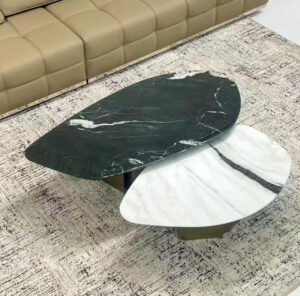
A table like this has three material risks: the wood species, the stone thickness, and the finish. Each one needs a written spec.
A supplier’s technical infrastructure determines their ability to scale with your brand’s growth. A factory that is perfect for a 20-piece villa order may fail a 300-room hotel.
1. Assess Production Capacity vs. Actual Output
Capacity is what a factory could make. Output is what it really makes with the staff and machines it has today. Bottlenecks hide in the gap.
Use this simple check:
$$\text{Practical output} = \text{lines} \times \text{units per line per day} \times \text{working days}$$
Here is an example. A factory with one chair line making 40 chairs a day delivers about 1,040 chairs in 26 working days. If it promises 2,000 chairs in 30 days, it must be subcontracting, running heavy overtime, or both.
Ask these questions on every first call:
- How many lines will make my product, and how many workers are on each?
- What share of capacity is already booked in my delivery month?
- Which steps are done in-house, and which are outsourced? (Metal plating, marble cutting, and upholstery are common ones.)
Aperçu du secteur : The real bottleneck is rarely cutting. It is usually finishing (spraying and drying) or upholstery. Ask to see those two areas first.
You can learn how to tell a real factory from a trading company in the video below. Then use our guide to vetting a Chinese furniture supplier to turn those flags into a checklist.

Video: five red flags to check before trusting any supplier.
2. Evaluate Material Sourcing Transparency
“Genuine Italian leather” and “solid oak” are claims. A specification is a written rule you can test. Ask for the second one.
For wood, ask for the species by common name and Latin name, plus the moisture content at assembly. A typical target for indoor furniture is 8–12%. Jade Ant furniture’s published analysis of 320 Foshan factories found that 41% would swap rubberwood for specified ash or oak on orders under 100 units when no penalty clause existed.
For certifications, ask for the certificate number and check it with the issuer. FSC chain of custody certification means certified wood is tracked from forest to finished product. A PDF in your inbox is not proof.
For leather, ask for the tannery name, the hide grade (full-grain, top-grain, or corrected-grain), and the thickness. For textiles, ask for the Martindale rating and an OEKO-TEX certificate number, which I explain later.
Plain-English definition: Chain of custody. A paper trail that shows where a material came from at every step, so you can prove a claim to a hotel brand or a client.
3. Analyze the Balance Between Artisanal Craftsmanship and Industrial Efficiency
“Handmade” and “machine-made” are not good or bad. The real question is which steps use which method.
| Étape | Best done by… | Why |
|---|---|---|
| Cutting, boring, CNC profiles | Machines | Repeatable to a fraction of a millimeter |
| Fitting joints to final tolerance | Skilled hands | A joiner feels the fit and adjusts in tiny steps |
| Carving and decorative detail | Skilled hands | Grain direction changes continuously |
| Spray finishing on large runs | Machines (with skilled setup) | Film thickness stays even across 200 pieces |
| Final touch-up and pattern matching | Skilled hands | Machines miss small visual details |
For 200 identical hotel chairs, a factory with CNC-cut joints and controlled spraying gives you consistency. For one walnut dining table in a villa, hand-fitted joints and hand-applied finish give you character. Match the method to the job.
Your action list for Section II
- Ask for a live video tour of the line that will make your product.
- Do the capacity math above before you sign.
- Write species, grade, and certificate numbers into the contract.
III. Navigating Minimum Order Quantities (MOQs) and Order Flexibility
Balancing inventory risk with pricing power requires a nuanced approach to MOQs. A minimum order quantity (MOQ) is the smallest order a factory will accept for one item. It exists because setup, materials, and finishing cost the same whether you order 5 or 50.
1. Strategies for Negotiating MOQs: “Hero” Pieces vs. Accessory Items
A hero piece is a signature item that defines a room or a collection, such as a sculptural sofa or a marble dining table. Accessories are smaller supporting items such as side tables, stools, and mirrors.
Treat them differently:
| Item type | MOQ approach | Why it works |
|---|---|---|
| Hero pieces | Accept a smaller run at a higher unit price | You protect cash and keep the piece exclusive |
| Accessories | Bundle into one larger order | Shared materials and finishes lower the unit cost |
| Shared components (legs, hardware, fabric) | Order across several models | You hit the factory’s volume without over-buying one SKU |
Jade Ant furniture’s sourcing guidance notes that suppliers often state MOQs 30–50% above what they will accept. In the same guidance, buyers who bring a 12-month rolling forecast and a quarterly ordering plan report MOQ reductions of 40–60% from the opening position. Treat those as typical ranges, not promises. Our full walk-through of bulk ordering steps shows how to structure the ask.
2. Transitioning from Stock-and-Ship to Made-to-Order (MTO) Models
Stock-and-ship means you buy in bulk, store the goods, and sell from inventory. Made-to-order (MTO) means the factory builds after you or your client confirms the order.
| Stock-and-ship | Made-to-order | |
|---|---|---|
| Lead time to client | Days to weeks | 10–28 weeks, depending on complexity |
| Cash tied up | Élevé | Low (deposit only) |
| Finish and size choice | Limité | Wide |
| Risk of dead stock | Élevé | Faible |
| Best for | Proven, fast-selling items | Hero pieces, project work, custom finishes |
A smart hybrid is common. Stock your top five sellers in neutral finishes. Make everything else to order.
3. Evaluating the Impact of MOQ on Cash Flow and Warehouse Utilization
Cash tied up in stock is easy to calculate:
$$\text{Cash tied up} = \text{units in stock} \times \text{landed cost per unit}$$
For example, 120 sofas with a landed cost of 1,300 each means 156,000 in cash sitting in a warehouse. Add storage fees, insurance, and the risk of a finish going out of style. A smaller MOQ with a slightly higher unit price often wins once you count those costs.
If you also run a house brand, the private label guide explains how to price from landed cost, not factory price.
Your action list for Section III
- Split your range into hero pieces, accessories, and shared components before talking MOQ.
- Offer a 12-month forecast instead of a one-off order.
- Compare MOQ options by total cash tied up, not by unit price alone.
IV. Rigorous Quality Control (QC) Frameworks for Luxury Standards
Stitch lines, seam tension, and leather grain are easy to check on a golden sample and hard to fix after packing.
In the high-end segment, a single defect can jeopardize a multi-million dollar project. One mismatched headboard in a 200-room hotel can hold up a whole floor.
The gap between buyers with and without a QC plan is large. In Jade Ant furniture’s published data from 1,840 pre-shipment inspections across 186 Guangdong factories, orders with no buyer-led QC averaged a 12.7% major defect rate. Orders with a structured three-checkpoint program averaged 2.3%.
Source: Jade Ant furniture’s published analysis of 1,840 pre-shipment inspections, 2024–2025.
1. Implementing a Three-Tier Inspection Process
| Tier | When | What the inspector checks |
|---|---|---|
| 1. Raw material | Before production starts | Wood species and moisture, foam density, fabric roll lot against the approved swatch, hardware brand and model |
| 2. Mid-production | At about 20–50% completion | Joinery method, dimensions against drawing, finish match on the first units, hardware movement |
| 3. Pre-shipment | At 80–100% completion | Random sample by AQL, function tests, packaging, labels, quantity |
Why the mid-production check pays off: finding a systematic error at 40% means reworking about 40 units, not 200.
Jade Ant furniture’s data shows a typical inspection costs $500–$1,400 per order. Rework on a defective container often runs $15,000–$50,000. That is the cheapest insurance in your supply chain.
2. Establishing a “Golden Sample” Baseline for All Future Production Runs
A Golden Sample is the one approved piece that every later piece must match. Both sides sign it, photograph it from every angle, and keep a copy.
A good Golden Sample file includes:
- Photos from all sides, with measurements marked on them
- The material list with codes (fabric code, finish code, hardware model)
- Color readings against a reference
- The signed approval date and names
Ask for 2–3 production samples, not one. One sample shows what a factory can do. Several samples show whether it can do it every time. Our guide to selecting a reliable supplier covers sample checks in detail.
3. Defining Acceptable Tolerance Levels for Dimensions, Stitching, and Finishing
“Looks fine” is not a standard. Put numbers in the contract. The table below uses ranges from Jade Ant furniture’s supplier guidance. Treat them as starting points and confirm with your factory and your client’s design team.
| Area | Typical tolerance (starting point) | How to measure |
|---|---|---|
| Case goods dimensions | ±2 mm | Tape or caliper against drawing |
| Upholstered dimensions | ±3 mm | Tape against drawing |
| Joint gaps | Over 1 mm counts as a major defect | Feeler gauge |
| Stitch line | Straight within 2 mm | Straight edge |
| Lacquer film thickness | 80–120 microns | Dry-film thickness gauge |
| Color match | ΔE of 1.5 or less against the approved sample | Spectrophotometer |
Plain-English definition: ΔE (Delta E). A number that says how different two colors look. A color difference (Delta E) of about 1 is hard to see. Around 2 and above, many people can see the gap between two nightstands.
Now set your sampling rule. AQL (Acceptable Quality Limit) is a sampling method, described under Acceptable quality limit, that sets how many defects you will accept in a random sample before the lot fails. For luxury work, a common starting point is:
| Defect class | AQL level | Example |
|---|---|---|
| Critical | 0 (zero tolerance) | Structural joint failure, sharp exposed hardware, banned chemical limits exceeded |
| Major | 1.5 | Visible finish mismatch, dimension error over 5 mm, fabric color mismatch |
| Minor | 2.5 | Small mark on a hidden surface, small packaging flaw |
For a lot of 500 units under General Inspection Level II, the sample is 50 units. At AQL 2.5, the lot fails if more than 3 show major defects. This video explains the inspection levels step by step.

Video: how General and Special inspection levels work.
Also read how to assess furniture quality from Chinese manufacturers before you write your tolerance sheet.
Here is where defects usually show up at the final inspection:
Source: Jade Ant furniture’s published analysis of 1,840 pre-shipment inspections, 2024–2025.
Aperçu du secteur : Finish and packaging together account for nearly half of defects (28% plus 18%). Both are visible, so both are preventable with a clear spec and a good sample.
Your action list for Section IV
- Book all three inspection tiers when you place the order, not after problems start.
- Sign and photograph a Golden Sample before mass production.
- Put tolerances and AQL levels in the contract as numbers.
V. Customization and Bespoke Engineering Capabilities
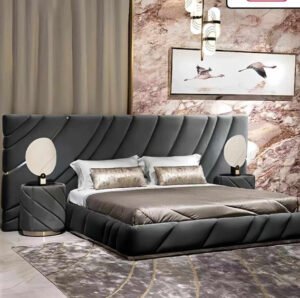
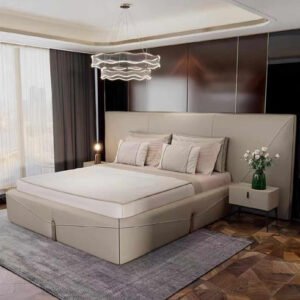
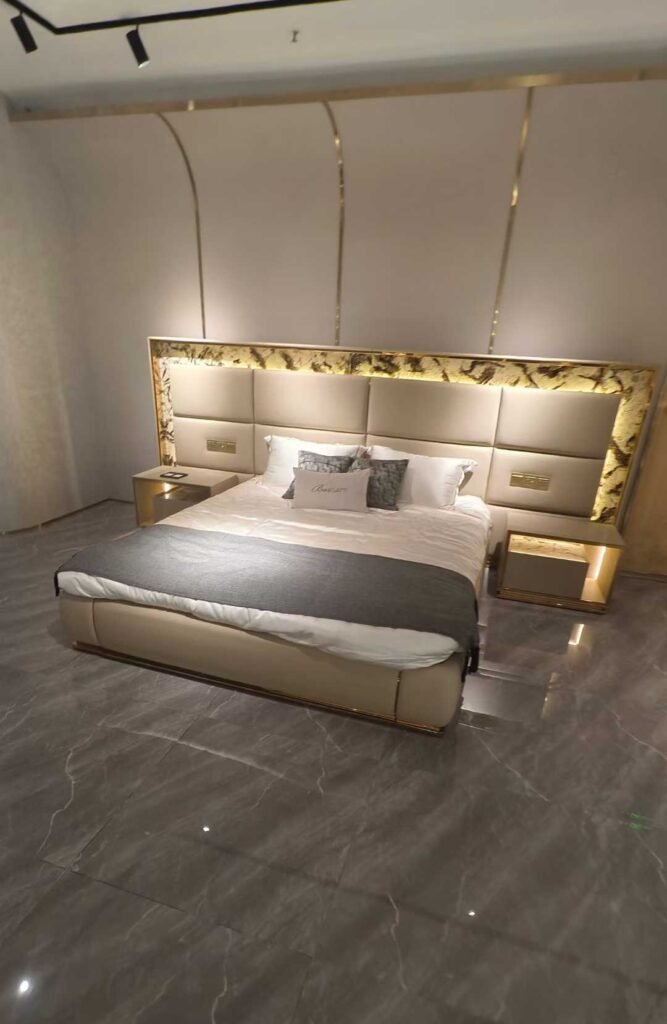
A custom headboard only works if the width, the fabric repeat, and the wall details were agreed before cutting.
The ability to offer “white-glove” customization is the primary differentiator for interior designers and FF&E buyers. FF&E stands for Furniture, Fixtures and Equipment, which is the movable items in a hotel or villa project.
1. Evaluating the Supplier’s CAD/CAM Capabilities for Custom Dimensions
CAD (Computer-Aided Design) is the software used to draw a piece. CAM (Computer-Aided Manufacturing) turns those drawings into machine instructions, such as CNC cutting paths.
A capable supplier can:
- Read your DWG or PDF drawings without redrawing them from scratch
- Produce shop drawings, which are factory-ready drawings that show every dimension, joint, and material, for your approval before cutting
- Flag problems early, such as a leg too thin for a marble top
Jade Ant furniture works this way for custom work: drawings first, approval second, cutting third. Our guide to sourcing custom furniture that fits explains what to measure, including the delivery route into the building.
2. Assessing the Breadth of the CMF (Color, Material, Finish) Library
CMF stands for Color, Material, Finish. A strong CMF library gives your designer real choices without starting from zero each time.
Ask to see:
- A physical finish board with codes (RAL, Pantone, or the factory’s own codes)
- Fabric options with Martindale ratings. The Martindale rub count is a test where a machine rubs the fabric. A higher cycle count means longer wear.
- Whether you can supply COM (Customer’s Own Material), which means you send your own fabric or leather for the factory to use
Plain-English definition: COM yardage. The amount of fabric the factory needs per piece. Ask for it in writing early. Late COM fabric is a top cause of delay.
3. Managing the Communication Loop Between the Designer’s Vision and the Factory’s Execution
Most custom-project delays happen before production starts. Late drawing approval, missing finish samples, and unclear hardware choices cost more time than the factory process.
Use one loop for every custom piece:
- Designer sends the brief, drawings, and finish references.
- Factory returns shop drawings and a materials list.
- Designer signs off in writing.
- Factory builds a sample or prototype.
- Both sides approve the sample, which becomes the Golden Sample.
- Any later change goes into a signed change order with cost and time impact.
Typical timelines help you plan. These ranges come from Jade Ant furniture’s supplier guidance:
| Order type | Typical production time | Planning buffer to add |
|---|---|---|
| Catalogue item, minor changes | 3–6 weeks | +1 week |
| Custom from standard range (new color or COM) | 6–10 weeks | +2 weeks |
| Fully bespoke (new design, drawings) | 12 à 18 semaines | +3 weeks |
| Hotel project, multi-category, 50+ rooms | 18–28 weeks | +4 weeks minimum |
For a view of the cost trade-offs, read our custom furniture cost vs quality analysis.
Your action list for Section V
- Do not release money until you have signed shop drawings.
- Confirm COM yardage and delivery date before the factory books your slot.
- Keep every change in a written change order.
VI. Logistics Optimization and Global Distribution
A marble top and a lacquered base can both be perfect at the factory. Only a good logistics plan keeps them that way.
The luxury experience is negated if the product arrives damaged or delayed. A flawless sofa that arrives late for a hotel opening is still a failed delivery.
1. Analyzing Shipping Methods: LCL vs. FCL and the Impact on Lead Times
FCL (Full Container Load) means you rent a whole container. LCL (Less than Container Load) means your goods share a container with other shippers.
| FCL | LCL | |
|---|---|---|
| Best for | Large orders and fragile or high-value goods | Small orders and samples |
| Handling | Loaded once, opened at destination | Handled more times at consolidation points |
| Damage risk | Inférieur | Higher |
| Lead time | More predictable | Often longer, as the container must fill |
| Cost per unit | Lower at volume | Higher per cubic meter |
Transit times matter for planning. Using figures from Jade Ant furniture’s importing guide, a shipment from Foshan to the US West Coast takes about 14–18 days by ocean. Add 5–10 days for customs clearance, and the total is roughly 19–28 days to the port-city site. East Coast routes run longer. Always add a few days of port buffer.
Who pays for what depends on the trade term. Learn FOB, CIF and EXW terms in plain language, and then check the exact wording in the official Incoterms 2020 rules.
2. Vetting Freight Forwarders Specializing in Oversized, High-Value Furniture
A freight forwarder books and manages your shipment from factory to destination. Not all forwarders handle luxury goods well.
Ask each candidate:
- Which furniture importers have you moved in the last 24 months? Can I call two?
- Can you supervise container loading at the factory?
- Who handles customs clearance, and what is the plan if goods are held?
- Do you have a white-glove partner in my delivery city?
3. Managing “Last Mile” Delivery Challenges for Villa Owners and Hotel Operators
Le last mile is the final leg from the port or warehouse to the room. It is where many luxury projects slip.
White-glove delivery is a service that includes bringing the piece in, unpacking it, placing it, assembling it, and removing all packaging. For villas, check stair turns, elevator size, and door widths before you order. For hotels, label every carton by room, for example “Tower B / Floor 7 / Room 712 / Nightstand left.”
Aperçu du secteur : Furniture stored in a damp construction site can absorb moisture or pick up dust before installation. Confirm the site is ready before the container ships.
For more on turning logistics into a business advantage, read about furniture logistics as a competitive edge, and map your schedule with the FF&E project timeline.
Your action list for Section VI
- Choose FCL for fragile or high-value orders whenever the volume allows.
- Interview two forwarders and ask for furniture-specific references.
- Label cartons by room and confirm site access before shipping.
VII. High-Performance Packaging for Fragile Luxury Goods
Packaging is not an afterthought; it is a critical component of risk management. The extra cost of good packing is small next to the cost of a damaged piece.
For a complex item, export crating can add roughly $200–$800 per piece, based on Jade Ant furniture’s importing guide. A finish claim on a $6,000 credenza can wipe out the margin plus the client relationship. The math favors crating.
1. Reviewing Reinforced Crating and Moisture-Barrier Technology for International Transit
Think of packaging in three layers:
| Layer | Job | Typical materials |
|---|---|---|
| Inner | Protect the surface | Acid-free tissue on finishes, wrapped hardware, foam corner blocks |
| Middle | Protect the structure | Custom-cut foam in a plywood crate or reinforced carton |
| Outer | Protect from the environment | Moisture barrier, desiccant, humidity indicator card, steel or strong strapping |
A humidity indicator card is a small card that changes color if the crate gets too damp. It gives you proof of what happened in transit.
2. Implementing “Drop Test” Standards to Minimize Damage-on-Arrival (DOA) Rates
Damage-on-Arrival (DOA) is the share of pieces that arrive damaged. Track it per supplier and per route.
A drop test means dropping a packed piece from set heights onto faces, edges, and corners to see if the pack survives. Standard test plans come from ISTA, the International Safe Transit Association. Browse the ISTA test procedures to see what exists. Two points are useful for furniture buyers:
- ISTA 2C is a screening test written for packaged furniture case goods.
- ISTA 3A targets parcel shipments up to 150 lb (70 kg). A container shipment from Asia needs a different plan, such as ISTA Project 3M, which covers direct imports from Asia-Pacific to a US distribution center.
Match the test to your route. Then read this carton drop test explained guide to see how inspectors document failures.
Add container loading supervision too. An inspector watches the loading to make sure heavy pieces sit low and cartons are not crushed.
3. Sustainable Luxury Packaging: Balancing Eco-Friendly Materials with Maximum Protection
Eco-friendly packaging is a real expectation for hotel brands and design firms. But protection comes first. A recycled carton that fails costs more waste than a crate that works.
Practical ways to balance both:
- Test the eco-friendly option with a drop test before you switch.
- Use recycled-content or FSC-certified paper and board where strength allows.
- Choose single-material foam or paper-based cushioning that is easy to recycle at the destination.
- Make crates reusable for sample runs and repairs.
Your action list for Section VII
- Write the packaging spec into your purchase order. Do not leave it to the factory’s default.
- Run a drop test on the first production pack, not only on the prototype.
- Track DOA per supplier and per route every quarter.
VIII. After-Sales Support and Warranty Management
Long-term profitability in luxury furniture depends on the efficiency of the claims process. Clients forgive one problem. They do not forgive a slow fix.
1. Establishing Clear SLAs for Replacement Parts
A service level agreement (SLA) is a written promise about response and fix times. Here is a sample you can adapt:
| Event | Supplier response target (example) |
|---|---|
| Claim received with photos | Acknowledge within 24 hours |
| Defect classified (factory, transit, or install) | Within 72 hours |
| Small part (hardware, leg, cover) | Ship by express within an agreed number of days |
| Full piece replacement | Production slot confirmed in writing |
These are starting points to negotiate, not industry rules. Agree on real numbers before the first order, and keep spare hardware, fabric, and finish samples on file.
2. Managing Warranty Claims: Determining Liability Between the Manufacturer and Distributor
Decide who pays before a claim happens. A simple split:
| Problem type | Usually the responsibility of… | Evidence needed |
|---|---|---|
| Material or build defect | Fabricant | Photos, measurements, Golden Sample comparison |
| Transit damage | Whoever held risk under the trade term, often covered by cargo insurance | Photos before opening, notes on the delivery receipt |
| Installation damage | Installer or distributor | Install records |
| Misuse or normal wear | Client | Care guide, use records |
Warranties should list what is covered, what is excluded, how long it lasts, and what proof you must send. Natural materials also change over time. Leather softens and walnut darkens. That is not a defect, so set the expectation at the point of sale.
3. Providing Digital Assembly Guides and Maintenance Manuals for End-Users
Send every client a short digital pack:
- Assembly guide with photos or a short video
- Care instructions for each material (a French-polished surface is not cleaned like oil-finished oak)
- Finish and fabric codes for future repairs
- A QR code on the packaging that links to the pack
Our 10-step care framework is a good model for building those manuals.
Your action list for Section VIII
- Agree on response times and liability split in writing before the first shipment.
- Keep a spare-parts and finish-code file for every project.
- Send a care and assembly pack with every delivery.
IX. Financial Risk Mitigation and Contractual Safeguards
A dining set looks simple. The contract behind it should be just as clear: materials, tolerances, payment milestones, and delivery dates.
Protecting margins requires structured payment terms and legal protections. Always have a lawyer review your final contract. The information below is general guidance, not legal advice.
1. Analyzing Payment Structures (Deposit vs. Net-30/60) to Maintain Liquidity
A deposit is money paid up front. Net-30 or Net-60 means you pay 30 or 60 days after delivery or invoice. Most Chinese factories ask for a deposit on new relationships. Net terms usually come after a track record.
| Structure | When it fits | Buyer protection |
|---|---|---|
| 30% deposit / 70% against bill of lading | First orders of all sizes | Modéré |
| 30/70 plus a 5–10% holdback for 60–90 days after delivery | Upholstery and finish-heavy orders | Bien |
| Letter of credit (L/C) | New suppliers and orders above about $30,000 | Strong (the bank pays only against matching documents) |
| Three-tranche milestone payments | Large hotel or project orders | Strong |
| 100% prepayment | Not recommended for a first order | Aucun |
These structures come from Jade Ant furniture’s supplier guidance. Use them as a starting point and adapt them to your deal.
2. Implementing Performance-Based Payment Milestones Tied to QC Approvals
Tie each payment to something you can verify:
- Deposit when the contract and the Golden Sample are signed.
- Second payment when mid-production inspection passes.
- Final payment when pre-shipment inspection passes, before release of documents.
- Holdback released after a defined period with no latent defects.
This makes the factory care about quality in the middle of production. It also gives you leverage if something goes wrong.
For budget planning on larger projects, see our hotel FF&E budget guide.
3. Drafting Clear “Quality Agreements” to Avoid Disputes Over Subjective Aesthetics
A quality agreement is a signed document that turns taste into measurable rules. “Looks luxurious” cannot be enforced. “ΔE of 1.5 or less against the Golden Sample” can.
Include:
- The Golden Sample reference and photos
- Tolerances for size, color, stitching, and gloss
- The viewing conditions for visual checks (for example, a set light level and distance)
- Defect classes and AQL limits
- What happens when a lot fails: rework, replacement, price reduction, or rejection
- How changes are approved (written change order only)
If you need a model for choosing partners who will sign this kind of document, read how to choose a hospitality furniture manufacturer.
Your action list for Section IX
- Tie payments to inspection approvals, not just to dates.
- Add a holdback on upholstery and finish-heavy orders.
- Write a quality agreement that uses numbers, not adjectives.
X. Building a Sustainable Luxury Ecosystem
A. Summary of the Holistic Approach to Supplier Selection
Strong sourcing is a chain with no weak links. You check the supplier’s real capacity. You set MOQs that protect cash. You inspect at three points. You design the customization loop. You test packaging. You plan after-sales. You structure payment around proof.
B. The Shift Toward “Value-Added” Partnerships Over “Lowest-Cost” Sourcing
The lowest quote often hides the highest cost. A cheaper chair that needs rework, arrives late, or fails in a lobby costs more than a fairly priced chair that is right the first time. Partners who share forecasts, sign samples, and fix problems fast are worth a few percentage points of unit price.
A supplier scorecard keeps this honest. Copy the table below into Excel or Google Sheets and adjust the weights.
| Critères | Weight | Supplier A score (0–10) | Supplier A weighted | Supplier B score (0–10) | Supplier B weighted |
|---|---|---|---|---|---|
| Capacity and scale | 20% | 8 | 1.60 | 9 | 1.80 |
| Material transparency | 15% | 7 | 1.05 | 6 | 0.90 |
| Quality system and QC | 20% | 9 | 1.80 | 6 | 1.20 |
| Customization and engineering | 10% | 6 | 0.60 | 8 | 0.80 |
| Logistics and packaging | 15% | 8 | 1.20 | 7 | 1.05 |
| Commercial terms (MOQ, payment) | 10% | 7 | 0.70 | 9 | 0.90 |
| After-sales support | 10% | 8 | 0.80 | 5 | 0.50 |
| Total | 100% | 7.75 | 7.15 |
Example scores. Supplier B has the lower quote and the weaker QC system, which is why it scores lower overall.
C. Final Checklist for the Professional Importer/Distributor
- Verify the business license, manufacturing scope, and address. Match them to the factory you actually visit or see live.
- Calculate practical output against your order size and delivery date.
- Put species, grades, and certificate numbers in the contract.
- Split your range into hero pieces, accessories, and shared components, and negotiate MOQ on each.
- Sign a Golden Sample and keep photo records.
- Book raw material, mid-production, and pre-shipment inspections.
- Write tolerances and AQL limits as numbers.
- Approve shop drawings and COM yardage before cutting.
- Choose FCL for fragile goods, vet your forwarder, and label cartons by room.
- Specify packaging and run a drop test on the first production pack.
- Agree on SLAs and warranty liability before the first shipment.
- Tie payments to inspection approvals and add a holdback where it fits.
Ready to Build Your Sourcing System?
At Jade Ant furniture, we have 15+ years of experience making custom and luxury furniture for hotels, villas, and commercial projects. We work with importers, distributors, designers, and developers who want drawings, samples, and inspections agreed before the first cut.
You can contact the Jade Ant team with your drawings, quantities, and target dates. You can also learn more about Jade Ant, or read our guide on negotiation and provenance when sourcing luxury furniture in China.
Glossaire des termes clés
| Terme | Plain-English meaning | Example |
|---|---|---|
| AQL | A sampling rule that sets how many defects you accept before a lot fails | AQL 2.5 for minor defects |
| CAD / CAM | CAD draws the piece. CAM turns the drawing into machine instructions | A DWG file cut on a CNC machine |
| CMF | Color, Material, Finish | A finish board with codes |
| COM | Customer’s Own Material, meaning fabric or leather you supply | Your designer’s fabric sent to the factory |
| DOA | Damage-on-Arrival rate | 3 damaged pieces out of 100 shipped |
| FCL / LCL | Full container load / shared container | FCL for fragile marble pieces |
| FF&E | Furniture, Fixtures and Equipment | Beds, chairs, lamps in a hotel |
| Golden Sample | The approved piece all production must match | A signed sofa kept at the factory and by you |
| Hero piece | A signature item that defines a collection | A sculptural lobby sofa |
| Quantité minimale de commande | Minimum order quantity | 20 units per design |
| MTO | Made-to-order | Built after you confirm the order |
| QC / PSI | Quality control / pre-shipment inspection | A third-party check at 80–100% completion |
| Shop drawing | A factory-ready drawing with all dimensions and materials | A drawing you sign before cutting |
| SLA | Service level agreement, a written promise about response times | Acknowledge a claim in 24 hours |
| ΔE (Delta E) | A number for color difference | ΔE of 1.5 or less |
Related FAQs for High-End Buyers
1. How do I verify if a supplier actually owns the factory or is just a trading company?
Start with the business license. Check that the registered scope includes manufacturing and that the address matches the factory. Verify it on China’s official enterprise registry. Then ask for a live video of your own product on the line, with the camera showing equipment, workers, and the factory gate. Ask who owns the machines and which steps are outsourced. Registered capital can be a hint: Jade Ant furniture’s guidance treats under 500,000 CNY for a claimed “factory” as a warning sign. A real manufacturer answers all of this within a day.
2. What is the industry standard for “acceptable” defect rates in high-end upholstery?
There is no single legal number. Many luxury buyers use AQL 0 for critical defects, 1.5 for major defects, and 2.5 for minor defects, then define each class with examples in the contract. Hand-finished upholstery has small natural variation, so describe the allowed range with a Golden Sample and tolerances such as seam straightness within 2 mm. Jade Ant furniture’s data shows structured inspection programs average about 2.3% major defects, but you should set your own limit based on the project.
3. How can I reduce lead times for custom FF&E projects without sacrificing quality?
Fix the cause of delay before production starts. Lock the full specification before you ask for quotes. Approve samples within about five business days rather than three to six weeks. Order or confirm COM fabric early. Split large projects into delivery phases by floor. Ask the factory to pre-build shared parts like frames. Use air freight only for samples or urgent replacements. Skipping inspections saves days and costs weeks.
4. What are the red flags to look for during a virtual factory audit?
Watch for these: the factory cannot do a live video within 48 hours, the camera avoids certain areas, the address does not match the license, your product is never shown on the line, workers give scripted answers, and there is no defect log or corrective-action record. For a full list, see these 12 factory audit red flags. Also remember that a virtual audit supports, but does not replace, an on-site check for a first qualification.
5. How do I handle a situation where a production batch does not match the approved Golden Sample?
Stop the shipment and release no further payment. Document the gap with photos, measurements, and color readings next to the Golden Sample. Send it in writing and cite your quality agreement. Agree on a remedy: rework, replacement, a price reduction, or rejection of the lot. Re-inspect after the fix, not just after the factory says it is done. Keep the signed change orders handy to confirm nobody approved the difference.
6. What is the most effective way to manage SKU proliferation when offering high customization?
Build around a small set of core frames and let the finish, fabric, and leg options vary. Keep a limited CMF library with fixed codes. Use a clear SKU naming system that includes model, size, and finish code. Cap the number of standard finishes you stock. Make everything outside that library made-to-order, with a minimum quantity or a surcharge. This keeps your catalogue manageable and your factory efficient.
7. How should I structure a contract to ensure the supplier uses specific high-grade materials?
Attach a specification exhibit. List the wood species by common and Latin name, the moisture range, foam density, fabric Martindale rating, leather grade, and hardware brand and model. Require material certificates with certificate numbers. Add inspection rights at raw material stage. State a penalty for substitution, such as replacement at the supplier’s cost. This matters: Jade Ant furniture’s analysis found 41% of surveyed Foshan factories would substitute species on small orders when no clause existed. Have a lawyer review the final wording.
8. What are the current shipping trends for oversized furniture to reduce transit damage?
Rates and schedules change often, so check them with your forwarder before every order. Practical habits are stable, though. Buyers use FCL for fragile or oversized pieces, engineer custom crates, test packaging with drop and vibration plans, supervise container loading, and ship direct to the project site with white-glove delivery. Moisture control (desiccants and humidity indicator cards) is also standard on long ocean routes.
9. How do I balance the need for low MOQs with the desire for competitive wholesale pricing?
Share a 12-month rolling forecast and an annual framework agreement even if each order is small. Use shared components and standard fabrics across models. Ask for step pricing, with a better price at each volume tier. Accept production in the factory’s low season. Jade Ant furniture’s sourcing guidance notes that buyers who bring a forecast often reach MOQ reductions of 40–60% from the opening position, though results vary by factory and product.
10. What certifications (ISO, FSC, OEKO-TEX) are non-negotiable for luxury hotel projects?
It depends on the hotel brand and the market, so ask the owner’s specification first. Common requirements include ISO 9001 for the factory’s quality system (it shows a process exists, not that quality is high), FSC chain of custody for wood claims, and OEKO-TEX STANDARD 100 for textiles tested for harmful substances. Add the right fire standard for the destination, such as California TB 117-2013 in the US or EN 1021 and BS 5852 in Europe and the UK. For commercial seating, review the BIFMA standards overview. Always verify certificate numbers with the issuer.
11. How can I implement a “Just-in-Time” (JIT) delivery model for large-scale villa developments?
Just-in-time (JIT) means delivering what is needed, when it is needed. For villas, build a delivery schedule backward from the installation dates. Produce in batches by villa or floor. Use a consolidation warehouse near the port or project to hold finished goods. Label every carton by room and call off deliveries as sites become ready. Add a buffer of about 10–15% to each stage, because one delay can cascade through the whole schedule.
12. What is the best way to manage after-sales repairs for custom-made furniture in different geographic regions?
Plan before delivery. Keep a file for each project with finish codes, fabric references, drawings, and photos. Ship a small spare kit (hardware, touch-up finish, extra fabric if possible). Name a regional repair partner for common fixes. Agree on SLAs for parts and replacement pieces. Send clients a digital care guide and a QR code on the packaging so the right instructions are always one scan away.