One-Stop Furniture Solution: How Integrated Sourcing Protects Luxury Hotel and Villa Projects

Written for developers, hotel operators and owners, FF&E and hotel buyers, interior designers, architecture and engineering firms, high-end importers and distributors, private label brand owners, and villa owners.
The short answer: On high-stakes luxury projects, one accountable furniture partner usually costs less in total than several specialist vendors, even when its unit prices are slightly higher. The savings come from less rework, fewer delays, simpler logistics and one clear owner when something goes wrong. The sections below show how to test that claim on your own project.
I. The High Stakes of Luxury FF&E Procurement
Picture a 140-room coastal resort three weeks from opening. The beds come from one factory. The casegoods come from a second, the lounge chairs from a third, and the lighting from a fourth.
Each piece passes its own inspection. But on site, the walnut headboards look a shade warmer than the walnut nightstands. A wardrobe is 18 mm too deep for its alcove. Three containers arrive on three different days, and nobody has a single list of what is missing.
Nobody made a big mistake. The system made it for them.
The complexity of luxury projects
Luxury projects ask for two opposite things at once. They need bespoke artistry: pieces that look like nothing else on the market. They also need industrial scale: 140 near-identical guest rooms that must match each other down to the stitching.
FF&E means Furniture, Fixtures and Equipment, the movable items that furnish a hotel or villa. According to the HVS hotel development cost survey, cited in industry guides, FF&E often makes up around 10 to 20 percent of a hotel’s development cost. That is a large budget line to manage through a patchwork of suppliers.
The “Fragmentation Trap”
Quick definition: The Fragmentation Trap. The hidden cost that builds up when a project splits furniture across many vendors. Each vendor looks cheaper alone, but the buyer pays for coordination, rework and delays that never appear on any single quote.
The trap is easy to fall into because it looks smart. Splitting the package creates competition, and competition seems to lower prices. The costs you cannot see on the quote, such as staff hours, mismatches, late arrivals and arguments over fault, are the ones that hurt.
What this guide covers
This guide evaluates the shift from many vendors to an integrated service provider. The goal is to protect design intent (what the designer meant the space to look and feel like) and the delivery schedule.
If you manage a luxury hotel, resort, branded residence or private villa, you will find:
- A cost model you can rebuild with your own numbers.
- A simple way to price the cost of opening late.
- A checklist to tell real manufacturers from middlemen.
- A plan for moving from multi-vendor to integrated sourcing without losing creative control.
II. The Hidden Costs of Multi-Vendor Coordination
Fragmented procurement adds risks that no single quote shows. Those risks hit both your budget and your timeline.
| Hidden cost | Where it shows up | Everyday example |
|---|---|---|
| Communication gap | Between designer, maker and installer | A 5 mm reveal detail on a drawing never reaches the crew |
| Accountability vacuum | When pieces do not fit the building | The wardrobe is too deep, and three parties blame each other |
| Logistics overload | Shipping, storage and receiving | Nine vendors, nine delivery dates, nine customs files |
The “Communication Gap”
Every handoff loses a little information. A designer sends drawings to an agent. The agent passes them to a factory. The factory builds, and a third party installs.
Details drop out at each step: a finish code, a hidden bracket, the direction of the wood grain, the exact height of a headboard above the mattress.
With many vendors, the gaps multiply. Vendor A never sees what Vendor B received. Nobody checks that the headboard and nightstand match, because nobody owns both.
The Accountability Vacuum
Now imagine the wardrobe is 18 mm too deep. The designer says the maker built it wrong. The maker says the drawing was approved. The contractor says the wall was within tolerance.
Each statement may be true. Meanwhile the resort cannot open the rooms, and nobody is paid to fix it quickly.
Industry insight: When a problem touches two vendors, the first week is usually spent deciding who pays, not how to fix it. A single provider cannot afford that argument, because they own both sides of the fit.
Logistics Overload
Every vendor brings its own packing list, shipping date, port and paperwork. Your team must receive, check and store all of it.
| What you must track | 9 separate vendors | 1 integrated provider |
|---|---|---|
| Purchase orders | 9 | 1 |
| Packing lists | 9 | 1 |
| Inspection reports | 9 | 1 |
| Delivery dates to coordinate | 9 or more | 1 consolidated plan |
| Warranty contacts | 9 | 1 |
This is simple arithmetic, but it shows why coordination time grows faster than the number of vendors. A guide to turnkey versus multi-vendor fit-outs describes the same pattern from the contractor’s side.
III. The One-Stop Solution: Defining the Integrated Model
An integrated provider is one point of accountability for design matching, custom fabrication and installation. You still choose the design. You simply stop managing nine people to deliver it.
Quick definition: One-stop furniture solution. A single partner that handles design matching, production, quality control, logistics and installation support for a complete furniture package. It does not mean “one factory makes everything.” It means one party answers for the result.
Jade Ant furniture, for example, supplies furniture together with high-end mattresses, lamps and home accessories for villas, apartments and hotels, so one team can cover an entire room rather than a single item.
Vertical Integration
Vertical integration means one company controls several stages of the process that would otherwise belong to different businesses. In furniture, that includes raw wood selection, frame making, upholstery, finishing, packing and shipping.
The benefit is control. If the grain of a walnut batch looks too pale, the same team that bought the wood can see it, fix it and adjust the stain before anything is assembled.
Design Matching
Design matching means keeping the same grain, stain and textile look across every zone, from guest room to lobby to spa. This is hard when five vendors each buy their own wood and mix their own colors.
An integrated provider can:
- Buy wood and fabric for the whole project in matched batches.
- Mix stain from one master recipe.
- Use shared color standards such as RAL codes, a numbered system, instead of words like “warm oak.”
- Measure drift with a color difference score, where a lower number means a closer match.
Unified Project Management
A single project manager gives FF&E buyers and developers one phone number and one live schedule. That person tracks drawings, samples, production, inspections, shipping and installation in one place.
| Question | Fragmented answer | Integrated answer |
|---|---|---|
| Who knows the full status? | Nobody; you assemble it | One project manager |
| Who approves a change? | Each vendor separately | One change log |
| Who fixes a mismatch? | Whoever gets blamed first | The provider |
| Who plans the shipments? | You | The provider, with you |
If you want to see the full path from brief to handover, our furniture sourcing workflow walks through each stage.
IV. Quality Control: Precision vs. Approximation
Luxury lives in the details, and details need a single owner. With many vendors, quality means “each vendor checked its own work.” With one provider, quality means “the whole room matches.”
Standardized QC Protocols
QC (quality control) is the set of checks that catch defects before goods leave the factory. A single benchmark across all custom wood interiors means every piece is judged by the same rules.
| Checkpoint | What gets checked | Why it matters |
|---|---|---|
| Incoming materials | Wood moisture, foam density, fabric lot | Bad materials cannot be fixed later |
| Frame stage | Dimensions, joinery, stability | Structural errors are hidden once upholstered |
| Finishing stage | Stain, sheen, grain direction | Color drift is easiest to fix before assembly |
| Upholstery stage | Seams, pattern matching, tension | Stitching must match across 100+ units |
| Final inspection | Comparison to the approved sample | Last gate before packing |
| Packing | Crating, corner guards, labeling | Protects the finish in transit |
Jade Ant furniture builds photo checkpoints into frame assembly, upholstery and final finishing, so a defect is caught at the cheapest moment to fix it. For an independent check, firms like QIMA inspect goods at the factory on your behalf.
This short video explains the main inspection types buyers use:

Watch: the main furniture quality control inspections for importers and buyers.
Prototyping and Mock-ups
A prototype is a physical sample built to the final specification. A mock-up room is one fully furnished guest room built early to test the whole design before it is repeated.
When the prototype and the factory sit under one roof, changes take hours instead of weeks. The designer says the headboard looks heavy. The same team lowers it and shows a new sample, with no courier delay between three companies.
Industry insight: The mock-up room is the cheapest place to find errors. Fixing a nightstand in one room may take a day. Fixing the same error in 140 rooms can take weeks.
Site-Specific Calibration
Drawings show the building as designed. Real sites differ. As-built conditions are the actual dimensions of a finished building, and they often vary from the plans by several millimeters.
Good integrated partners measure the site before final production and adjust the furniture. A wardrobe built to the drawing may not fit a wall that is 12 mm out of square. A wardrobe built to the as-built measurement will.
- Request or take site measurements after walls and floors are complete.
- Compare them to the drawings.
- Adjust custom dimensions where needed.
- Record the change in the same change log as every other revision.
V. Timeline Optimization: Accelerating the Path to Opening
An integrated provider shortens the timeline by removing waiting. In a fragmented model, tasks wait for each other. In an integrated model, many of them run side by side.
Concurrent Workflow
Sequential means one step must finish before the next begins. Concurrent means steps overlap. The chart below shows an illustrative example of the difference for a mid-sized project.
This is a planning model, not audited data. Real timelines depend on project size, finishes and shipping routes.
Where the weeks go:
- Design and selection: One partner can start materials while drawings are being finalized.
- Sampling: Samples for several product types are reviewed together instead of one vendor at a time.
- Production: Materials are bought for the whole project at once, and production slots are booked early.
- Shipping: One consolidated plan replaces several partial shipments.
Reduced Lead-Time Friction
Lead-time friction is the lag between “approved” and “started.” In a multi-vendor project, each vendor needs its own approval, deposit and slot confirmation. A delay with one vendor does not stop the others, but it does stop the room that needs all of them.
An integrated provider approves once, books production once and tells you the single date the whole room will be complete.
According to the FF&E project timeline guide, production delays account for about 38 percent of schedule slippage in the aggregated project data it cites. Freight and customs account for about 23 percent. Together they make up the majority of slippage, and both are areas where one provider can plan ahead.
Synchronized Installation
Delivery and fitting work best as a single phase. A crew that receives all pieces for a floor together, with room labels, can install straight into place.
Our notes on logistics as a competitive advantage explain how consolidated shipments and clear labeling cut handling time.
What a late opening really costs
A late opening is a revenue problem, not only a schedule problem. Two hotel metrics help here. ADR (average daily rate) is the average price paid per occupied room. RevPAR (revenue per available room) is room revenue divided by all rooms available. The STR glossary defines both.
Take a 120-room hotel with an ADR of $ 300 and 70% occupancy:
One week of delay is about $ 176,400 in missed room revenue. Opening-month occupancy is often lower than mature occupancy, so use your own numbers. The point stands: a few weeks of delay can cost more than the entire price difference between two suppliers.
VI. Financial Implications: CAPEX vs. OPEX and Long-Term ROI
A fragmented package can look cheaper per item and still cost more in total. The real question is the full cost of delivering a working room.
Quick definitions. CAPEX is money spent to buy or build assets, such as furniture. OPEX is money spent to operate and maintain them. Total cost of ownership adds both over the life of the asset.
Model: cost per USD 1 million of furniture
The model below uses illustrative numbers. It assumes the integrated provider charges 6% more in unit price. It then adds the costs that fragmented buyers often forget.
| Cost item | Fragmented (USD thousands) | Integrated (USD thousands) |
|---|---|---|
| Furniture price | 1,000 | 1,060 |
| Coordination labor | 60 | 20 |
| Rework and site fixes | 70 | 20 |
| Freight and storage | 90 | 65 |
| Delay cost | 80 | 20 |
| Total | 1,300 | 1,185 |
Replace each line with your own project’s numbers. If the integrated option does not come out ahead on your inputs, that is useful information too.
Eliminating “Hidden” Management Costs
Your team’s time has a price, even when it is not on an invoice. Chasing nine vendors means a project manager spends hours each week on emails, calls and shipping updates. Guidance on coordination fees, idle site labor and punch-list disputes shows the same costs appearing on multi-vendor hotel projects.
Reducing Rework Costs
Rework is expensive because it happens late. A mismatched finish found at the factory costs a few hours. Found on site, it costs a crew, a delay and sometimes a replacement shipped by air.
Integrated QC and as-built measurement move most corrections upstream, where they are cheap.
Asset Longevity
Better QC also lowers operating costs. A table with a stable core and an even finish needs fewer repairs. A chair built to commercial strength does not need replacing in two years.
Our custom furniture cost versus quality analysis shows how maintenance and replacement can outweigh the initial price difference over a property’s life.
VII. Case Study Analysis: Hospitality vs. High-End Residential
The model behaves differently by project type, but it reduces risk in both. The scenarios below are illustrative composites, built to show how the same principles apply at different scales. They are not reports about a named client.
Scenario A: Hotel and Resort Scale
The situation: A 140-room resort with a brand “signature” look. The challenge is repeating that look in every guest room without drift.
Fragmented approach: Beds, casegoods and seating come from separate vendors. Each vendor interprets the stain slightly differently. Mismatches appear on site, and installers adapt pieces on the spot.
Integrated approach: One partner builds a mock-up room, signs off a single finish standard and produces rooms in repeatable batches. Delivery is staged floor by floor.
Scenario B: Ultra-Luxury Villas
The situation: A private villa with one-off pieces: a 3.2 m dining table, a curved bed, built-in wardrobes for odd corners. Volume is low, but the customization is extreme.
Fragmented approach: Each unique piece goes to a different specialist. Everyone is skilled, but nobody checks that a bedside table matches the bed’s curve or the wardrobe’s trim.
Integrated approach: One team controls the finish library, takes the site measurements and reviews all pieces together before shipping. The owner has one person to call.
For more on villa strategy, see our guide to villa furniture strategies.
Comparison of Outcomes
The table shows modelled planning targets, not audited results. Use it as a template and replace the figures with your own data.
| Système métrique | Hotel, multi-vendor | Hotel, integrated | Villa, multi-vendor | Villa, integrated |
|---|---|---|---|---|
| Rooms or zones installed on schedule | 55% | 90% | 60% | 90% |
| Punch-list items at handover | Élevé | Faible | Moyen | Faible |
| Owner or operator satisfaction (1 to 10) | 6.5 | 8.5 | 7.0 | 9.0 |
| Number of parties to call with a problem | 8 to 10 | 1 | 4 to 6 | 1 |
For documented patterns from real manufacturing partnerships, read Jade Ant’s hospitality case studies.
VIII. Strategic Selection: How to Vet an Integrated Partner
Not every “one-stop shop” is the same. Some are real manufacturers with in-house departments. Others are trading companies that subcontract everything and add a margin. For a luxury project, the difference matters.
Assessing Manufacturing Depth
| Question to ask | Strong answer | Weak answer |
|---|---|---|
| Which processes are done in-house? | Wood, upholstery, metal and finishing, with a factory tour | “We have partner factories” |
| Can I see work in progress? | Yes, live video of the floor | Only catalog photos |
| Who owns the QC team? | The provider’s own staff | Outsourced or undefined |
| How do you control material batches? | Written system and lot tracking | “We always use good materials” |
| What certifications can you show? | Verifiable ISO 9001 quality management and material documents | PDFs that cannot be verified |
A strong partner will gladly share the above. A trading company can still be useful, but you should know what you are buying.
Portfolio Validation
A portfolio of beautiful photos is not proof. Ask for:
- Completed projects of similar size and finish level in the last 24 months.
- A direct reference you can call.
- Photos of the delivered work, not only renders.
- A description of what went wrong and how it was fixed. Every real project has one.
For a deeper framework, use this hospitality contract furniture manufacturer checklist, and read our guide to sourcing luxury furniture from China if your project involves Chinese factories.
Installation Expertise
A good installer does more than assemble. They read site conditions, protect floors, work around other trades and finish with a clean snag list.
Ask who installs: your partner’s own crew or a local subcontractor? How are they trained on luxury pieces? How do they protect finished floors and walls? How do they report damage? Our luxury furniture investment checklist lists more questions to ask before you commit.
Red flags that should pause a conversation
- The provider cannot show where production happens.
- Lead times are quoted without any mention of current factory capacity.
- Quality control is described as “our team checks everything” with no written steps.
- There is no named project manager for your account.
- A price far below the market comes with no clear explanation.
IX. Overcoming the Transition: Moving from Traditional to Integrated
Changing how you buy is a mindset change as much as a contract change. Designers and developers who have managed vendor by vendor for years may feel they are giving up control. In practice, control moves from micromanaging to setting clear standards.
Trusting the Specialist
Instead of checking every vendor’s work, define the standard and verify the results. You set the finish library, tolerances and approval gates. The partner delivers against them and reports regularly.
Control does not disappear. It becomes more focused, with fewer decisions and better data behind each one.
Integrating Early
Bring the furniture partner in during design development, not after drawings are final. An early conversation can catch a joint that will not hold, a fabric that will not match across batches, or a piece too large for the elevator.
Our overview of the hotel FF&E procurement process shows how early specification and mock-up stages shape the later phases.
Many teams organize this work in an FF&E schedule, a master list of every item with its specification. This short video shows how designers build one:
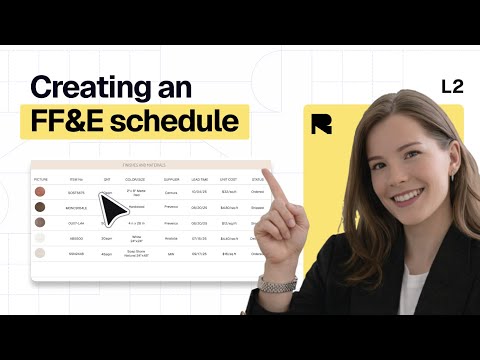
Watch: how to build an FF&E schedule that your furniture partner can work from.
Aligning KPIs
A KPI (key performance indicator) is a number you track to judge success. Agree on shared KPIs at the start, so you and your partner pull in the same direction. These targets are starting suggestions, so adjust them to your project:
| KPI | Suggested target | How to measure |
|---|---|---|
| On-time milestone rate | 95% or higher | Milestones met divided by milestones planned |
| First-pass inspection rate | 95% or higher | Batches passing the first inspection |
| Defects found at receiving | Below an agreed limit | Photo-documented count per delivery |
| Response time to technical questions | Within 1 business day | Logged requests |
| Punch-list closure time | Within an agreed number of days | Dated snag list |
Jade Ant furniture’s team works from the project brief onward, so these measures can be set at the start of an engagement instead of after the first delay.
X. The Future of Luxury Project Delivery
Integrated sourcing wins when the project cannot afford surprises. It protects design intent, brings the opening date forward and gives you one party to hold accountable.
Summary of the strategic advantage
- Cost: The unit price may be higher, but total cost can be lower once coordination, rework, freight and delay are counted.
- Consistency: One partner buying materials and finishing in matched batches keeps every zone looking like the same project.
- Speed: Concurrent workflows and one delivery plan remove waiting time.
- Accountability: One owner for fit and finish ends the blame game.
Final verdict
For projects where “zero error” is the real requirement, such as a branded hotel opening on a fixed date or a villa handover for a demanding owner, the one-stop model is the most practical path. For small, simple jobs with generous timelines, a multi-vendor approach may still work. Run your own numbers before deciding.
Your next step
- Pick one live project and rebuild the cost table in Section VI with your real figures.
- Calculate the daily cost of delay using the RevPAR formula in Section V.
- Score your current vendors against the checklist in Section VIII.
- Ask one shortlisted partner for a mock-up plan and a milestone calendar.
Protecting a luxury brand means protecting every detail guests touch. If you want a partner who works this way, talk to the Jade Ant team and share your brief through the contact page. You can also read more about Jade Ant or browse the Jade Ant blog for related guides.
Frequently Asked Questions
1. How does an integrated provider handle the “design ego” or the specific vision of a lead architect?
A good provider treats the architect’s vision as the standard to protect. They ask for drawings, materials and finish references, then return shop drawings and samples for approval at each stage. Nothing changes without a written sign-off from the design team. The advantage is speed: the architect talks to one team that can explain what is possible, instead of relaying questions through several vendors.
2. Is it more expensive to use a one-stop solution than to source individually from various factories?
Often the unit price is a little higher, but the total project cost can be lower. In the illustrative model in Section VI, a 6 percent premium on unit price still produced a total saving of about 9 percent, because coordination, rework, freight and delay costs fell. Your result will depend on your project, so build the comparison with your own figures.
3. What happens if one specific element of the integrated package doesn’t meet my standards?
Define the process before you sign. A strong agreement states how defects are documented (photos and measurements against the approved sample), how fast the provider responds, and whether the fix is rework, replacement or credit. Because one party owns the package, the fix starts without a dispute over who is responsible.
4. How do integrated providers ensure material consistency across different furniture categories (e.g., wardrobes vs. vanity units)?
They buy wood, veneer and fabric in matched batches, finish everything from one stain recipe and check each category against the same master sample. Standards like RAL codes and color difference measurements make the match objective. Ask the provider for a finish board signed by both sides, and compare each production batch against it.
5. Can an integrated provider work with my existing private label specifications?
Yes, if they have private label experience. Share your drawings, finish codes and branding requirements, and sign an NDA before design files change hands. Confirm who owns the tooling and the designs. Our private label specifications guide covers pricing, protection and quality for brand owners.
6. How is the risk of “single-point failure” mitigated when using one provider instead of ten?
A single point of failure is a real concern, and the answer is to plan for it rather than to avoid integration. Check the provider’s capacity and financial stability, split payments across milestones, keep ownership of designs and tooling, and agree on a backup plan for critical items. Many buyers keep a second supplier for one or two high-risk categories.
7. What is the typical impact on the project timeline when switching to an integrated model?
It varies. In the illustrative model, the integrated path was about 11 weeks shorter on a 40-week schedule, mainly from overlapping tasks and consolidated shipping. Treat that as a planning example, not a promise. Ask each partner for a written schedule with milestones, current factory capacity and buffer time.
8. How do integrated providers handle site measurements and “as-built” discrepancies?
They measure the finished site before final production, compare it with the drawings and adjust custom dimensions where needed. Every change goes into the change log with the date and the approver. This matters most for built-in wardrobes, banquettes and any piece that fits into an alcove.
9. Do one-stop solutions offer the same level of bespoke customization as a boutique artisan?
For most luxury pieces, yes: custom sizes, materials, finishes and details. For a purely sculptural one-off piece made by a named artisan, a specialist may still be the better choice. Many projects use a hybrid approach, with the integrated partner producing the bulk of the package and an artisan making one or two signature items. The partner can still handle delivery and installation of the artisan’s pieces.
10. How is the installation phase managed differently in an integrated model compared to traditional FF&E?
One crew and one plan replace several. Cartons are labeled by building, floor and room, deliveries are staged to match site readiness, and an installation supervisor with authority resolves issues on the spot. The final walkthrough produces one snag list that the same team closes.
11. What documentation and certifications should I demand from an integrated luxury furniture partner?
Ask for material specification sheets, QC reports, packing lists and warranty terms. Request certificates that match your project and market, and verify them with the issuing body, not just a PDF. Common ones include FSC chain-of-custody for wood, Californie TB 117-2013 for upholstery fire safety, BIFMA standards for commercial strength, GREENGUARD for low emissions and OEKO-TEX Standard 100 for textiles. Your project’s fire engineer should confirm which ones apply.
12. How does this model affect the warranty and after-sales service for hotel operators?
It simplifies it. One partner holds the production records, finish codes and spare-parts information, so an exact-match replacement is easier to produce years later. Put the warranty length, covered items, claim process and response time in writing before the order. Ask for a care guide organized by material, so your housekeeping and engineering teams use the right methods.
Glossary of Key Terms
| Term | Plain-English meaning | Example |
|---|---|---|
| FF&E | Furniture, Fixtures and Equipment: movable items in a project | Beds, chairs, lamps |
| Fragmentation Trap | Hidden cost of splitting a package across many vendors | Nine vendors, nine delivery dates |
| One-stop solution | One partner accountable for the whole furniture package | Design matching to installation |
| Vertical integration | One company controlling several production stages | Wood selection to finishing |
| Design matching | Keeping grain, stain and fabric consistent across zones | Same walnut tone in rooms and lobby |
| QC | Quality control: checks that catch defects early | Frame, finish and final inspections |
| Mock-up room | A full guest room built first to test the design | A prototype suite |
| As-built | The real dimensions of the finished building | A wall 12 mm out of square |
| ADR | Average daily rate: average price per occupied room | $ 300 per night |
| RevPAR | Room revenue per available room | ADR times occupancy |
| CAPEX / OPEX | Spending on assets / spending to run them | Buying chairs / repairing them |
| TCO | Total cost of ownership over an asset’s life | Price plus upkeep plus replacement |
| KPI | A number used to track performance | On-time milestone rate |
| Snag list | A list of items to fix at final walkthrough | Hardware needing adjustment |